
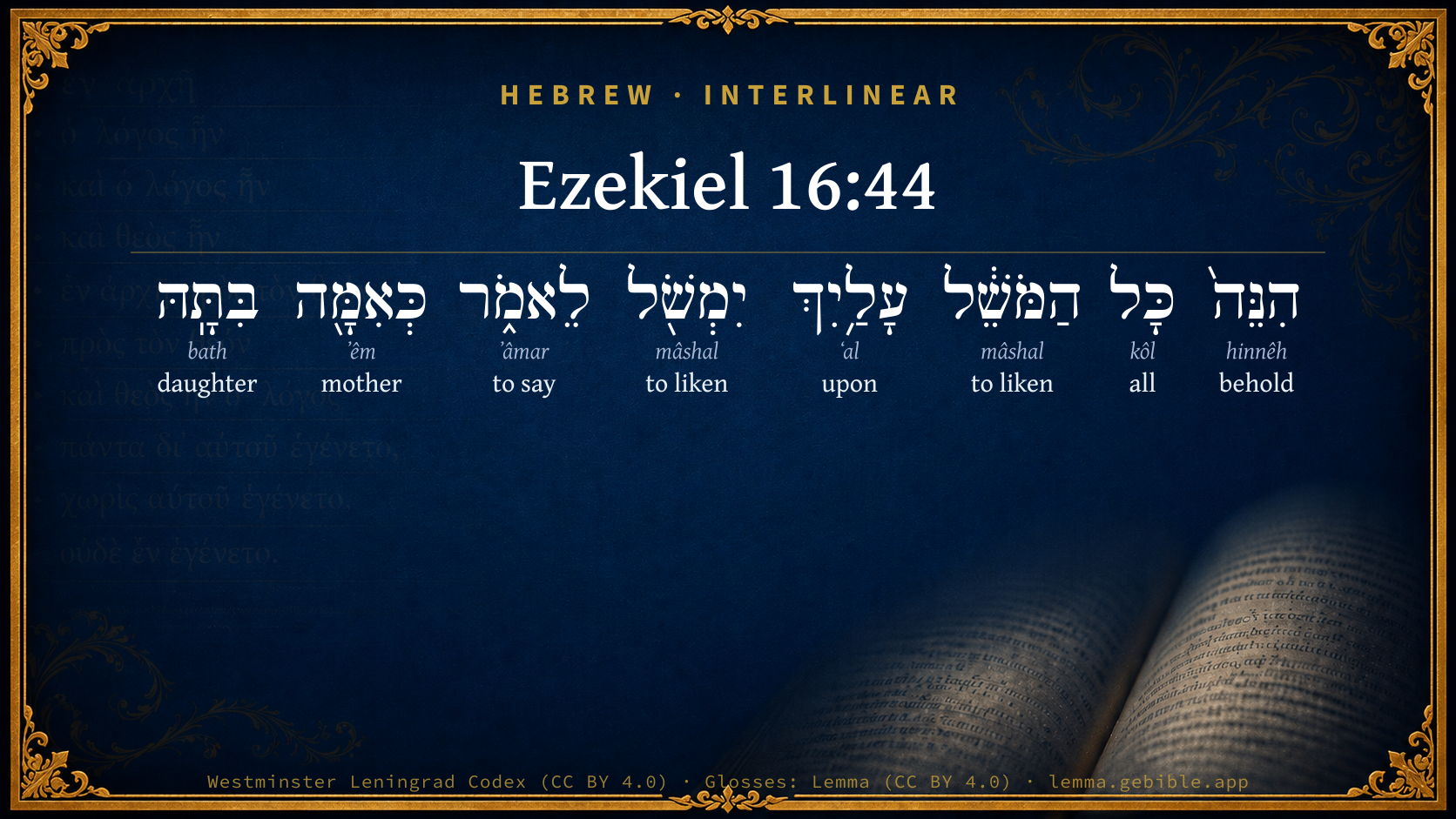
Ezekiel 16:44

Hebrew (Westminster Leningrad Codex) Ezekiel 16:44 appears in the Hebrew Old Testament. The text above is from the Westminster Leningrad Codex. Each word links to its Strong’s number, a concise gloss, and parsing drawn from the Open Scriptures Hebrew Bible morphology. Click any word for its full Brown-Driver-Briggs (BDB) entry.
Download image
Cite this verse

Ezekiel 16:44 (World English Bible). Public Domain. Lemma interlinear Bible study tool, https://lemma.gebible.app/v/ezekiel/16/44.

Show BibTeX & RIS
BibTeX
RIS
English Translation
Behold, everyone who uses proverbs shall use [this] proverb against you, saying, As is the mother, so is her daughter.
World English Bible · Public Domain
Download a study sheet

One document with this verse’s original text, its word-by-word gloss line, the meaning frame, cross-references with their text, attributed commentary, and full source and license credits — printable, and it pastes into notes with its structure intact.

This verse Autodidact and up

Study sheet (.html) Plain text (.txt)

A passage Seminary Student

Up to 50 verses in one chapter. A passage sheet keeps up to 6 commentary sources and 12 cross-references per verse, in the order this page ranks them, and says so on the sheet whenever that leaves anything out. Ask for a single verse and you get the Autodidact verse sheet above.

Everything on this page stays free to read, with no account — the sheet is a download of what is already on screen, not access to it.

Want to remove ads? Support Godless Engineer
Compare translations 3

The same verse in 3 English versions, stacked beneath the original-language interlinear above. Click any original word for its lexicon entry.

Each is an independent rendering of the whole verse — the interlinear is not word-aligned to these translations.

Highlighted words mark where these versions differ — a whole-verse word diff, not a word-by-word alignment.

  • World English Bible Public Domain
    Behold, everyone who uses proverbs shall use [this] proverb against you, saying, As is the mother, so is her daughter.
  • King James Version Public Domain
    Behold, every one that useth proverbs shall use this proverb against thee, saying, As is the mother, so is her daughter.
  • unfoldingWord Literal Text CC BY-SA 4.0
    Behold! Everyone who speaks proverbs concerning you will say, “As the mother is, so also is her daughter.”

unfoldingWord Literal Text — © unfoldingWord, licensed CC BY-SA 4.0. Word-aligned USFM3 via Door43 (git.door43.org/unfoldingWord/en_ult).

Versions to compare (up to 4)

3 of 4 selected

Show all 18 translations

Every available English version of this verse, each an independent rendering of the whole verse.

  • World English Bible Public Domain
    Behold, everyone who uses proverbs shall use [this] proverb against you, saying, As is the mother, so is her daughter.
  • Berean Standard Bible Public Domain
    Behold, all who speak in proverbs will quote this proverb about you: ‘Like mother, like daughter.’
  • Majority Standard Bible Public Domain
    Behold, all who speak in proverbs will quote this proverb about you: ‘Like mother, like daughter.’
  • King James Version Public Domain
    Behold, every one that useth proverbs shall use this proverb against thee, saying, As is the mother, so is her daughter.
  • American Standard Version (1901) Public Domain
    Behold, every one that useth proverbs shall use `this' proverb against thee, saying, As is the mother, so is her daughter.
  • Revised Version (1885) Public Domain
    Behold, every one that useth proverbs shall use this proverb against thee, saying, As is the mother, so is her daughter.
  • Geneva Bible (1599) Public Domain
    Beholde, all that vse prouerbes, shall vse this prouerbe against thee, saying, As is the mother, so is her daughter.
  • Douay-Rheims (1899) Public Domain
    Behold every one that useth a common proverb, shall use this against thee, saying: As the mother was, so also is her daughter.
  • Young's Literal Translation Public Domain
    Lo, every one using a simile, Doth use a simile concerning thee, saying: As the mother -- her daughter!
  • Literal Standard Version CC BY-SA 4.0
    Behold, everyone using the allegory against you, || Uses [this] allegory concerning [you], saying, || As the mother—her daughter!
  • Unlocked Literal Bible CC BY-SA 4.0
    Behold! Everyone who speaks proverbs concerning you will say, “As the mother is, so also is her daughter.”
  • unfoldingWord Literal Text CC BY-SA 4.0
    Behold! Everyone who speaks proverbs concerning you will say, “As the mother is, so also is her daughter.”
  • Darby Bible Public Domain
    Behold, every one that useth proverbs shall speak in a proverb against thee, saying, As the mother, [so is] her daughter!
  • World Messianic Bible Public Domain
    “‘“Behold, everyone who uses proverbs will use this proverb against you, saying, ‘As is the mother, so is her daughter.’
  • Webster's Bible Public Domain
    Behold, every one that useth proverbs shall use this proverb against thee, saying, As is the mother, so is her daughter.
  • Free Bible Version CC BY-SA 4.0
    Everyone who likes to use proverbs will quote this one about you: ‘Like mother, like daughter.’
  • Bible in Basic English Public Domain
    See, in every common saying about you it will be said, As the mother is, so is her daughter.
  • JPS Tanakh (1917) Public Domain
    Behold, every one that useth proverbs shall use this proverb against thee, saying: As the mother, so her daughter.

Literal Standard Version (2020), Covenant Press — licensed CC BY-SA 4.0. Text via the HelloAO Bible API (eBible.org). Unlocked Literal Bible (unfoldingWord) — licensed CC BY-SA 4.0. Text via the HelloAO Bible API (eBible.org). unfoldingWord Literal Text — © unfoldingWord, licensed CC BY-SA 4.0. Word-aligned USFM3 via Door43 (git.door43.org/unfoldingWord/en_ult). Free Bible Version, Dr. Jonathan Gallagher — licensed CC BY-SA 4.0. Text via the HelloAO Bible API (eBible.org).

Word by word

More ways to search: Search by grammar → Find every occurrence → Compare this word →

Practice this passage: Drill this verse → Learn its vocabulary →

הַמֹּשֵׁ֔ל
mâshal
H4911
“the · likening”
Particle, Definite Article + Verb, Qal, Participle Active, Masculine, Singular, Absolute
Part of Speech
Particle + Verb
Stem
Qal
Form
Participle Active
Gender
Masculine
Number
Singular
State
Absolute
Full BDB Definition

Origin: denominative from H4912

TWOT: 1258 , 1258b

to represent, liken, be like - (Niphal) to liken, be like, be similar - (Hiphil) to compare - (Hithpael) to become like - to speak in a proverb, use a proverb, speak in parables, speak in sentences of poetry - (Qal) to use a proverb, speak a parable or proverb - (Piel) to make a parable - maker of parables (participle)
  1. הִנֵּה֙ hinnêh H2009 “behold” Particle, Demonstrative
  2. כָּל kôl H3605 “all of” Noun, Common, Masculine, Singular, Construct
  3. עָלַ֥יִךְ ʻal H5921 “upon · you” Preposition + Suffix, Personal, 2nd Person, Feminine, Singular
  4. יִמְשֹׁ֖ל mâshal H4911 “to liken” Verb, Qal, Imperfect, 3rd Person, Masculine, Singular
  5. לֵאמֹ֑ר ʼâmar H559 “to say” Preposition + Verb, Qal, Infinitive Construct
  6. כְּאִמָּ֖ה ʼêm H517 “like/as · mother · her” Preposition + Noun, Common, Feminine, Singular, Construct + Suffix, Personal, 3rd Person, Feminine, Singular
  7. בִּתָּֽהּ bath H1323 “daughter · her” Noun, Common, Feminine, Singular, Construct + Suffix, Personal, 3rd Person, Feminine, Singular

About this verse

These counts appear in no published source. They are computed here, from the morphology-tagged text and Lemma’s own curated glosses. What Lemma adds →

8
words
7
distinct lemmas
Prophets
section

Notable vocabulary

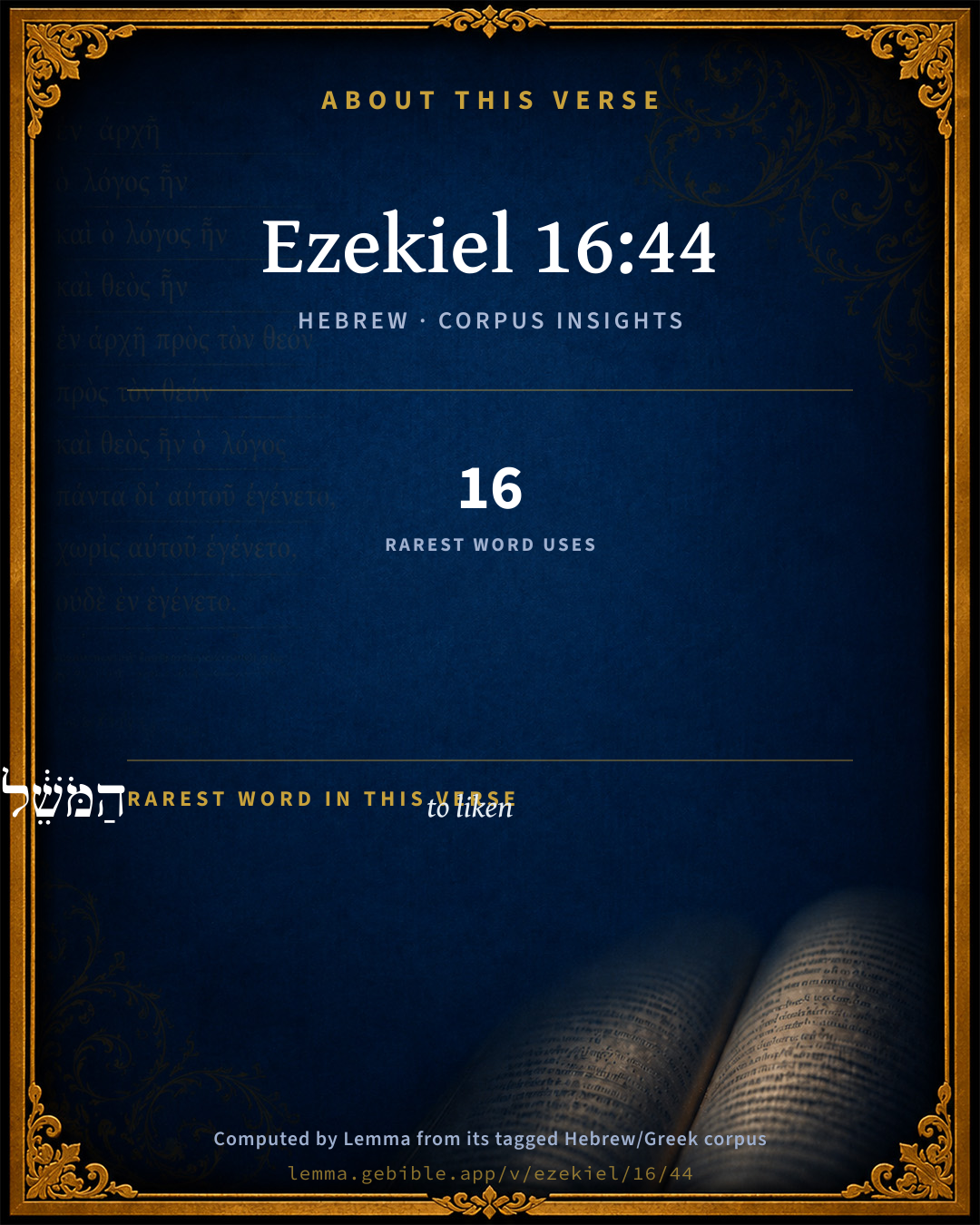
The rarest word here is הַמֹּשֵׁ֔ל to liken H4911 — appearing just 16 times in the whole Hebrew Bible.

Shared distinctive vocabulary

הַמֹּשֵׁ֔ל to liken H4911 occurs in 15 verses of the Hebrew Bible. Also found in:

Grammatical profile

  • 3 verbs
  • 3 nouns
  • 1 preposition
  • 1 particle

Verb forms

  • הַמֹּשֵׁ֔ל Qal · Participle Active
  • יִמְשֹׁ֖ל Qal · Imperfect
  • לֵאמֹ֑ר Qal · Infinitive Construct

Repetition

A word recurs within this verse — often emphatic in Hebrew:

  • הַמֹּשֵׁ֔ל to liken H4911 ×2

Hebrew & Septuagint length

In English translation the verse runs 20 words from the Hebrew and 14 from the Septuagint (LXX English) — the Septuagint runs noticeably shorter here. See the side-by-side →

A rough comparison of the two English renderings, which tokenize alike — not a word-level alignment.

Word counts can differ between the Hebrew and the Greek without any difference in meaning — e.g. the Hebrew direct-object marker אֵת has no separate Greek word, and Greek often adds the article ὁ.

Cross-references

10

Topical passages linked to Ezekiel 16:44 in the Treasury of Scripture Knowledge — connected by theme and wording, ordered by reader-vote popularity; previews shown in the World English Bible.

  • Ezekiel 18:2–3 What do you mean, that you use this proverb concerning the land of Israel, saying, The fathers have eaten sour grapes, and the children's teeth are set on edge?
  • 1 Samuel 24:13 As says the proverb of the ancients, Out of the wicked comes forth wickedness; but my hand shall not be on you.
  • Psalms 106:35–38 But mixed themselves with the nations, And learned their works.
  • Ezekiel 16:3 and say, Thus says the Lord Yahweh to Jerusalem: Your birth and your birth is of the land of the Canaanite; the Amorite was your father, and your mother was a Hittite.
  • Ezra 9:1 Now when these things were done, the princes drew near to me, saying, The people of Israel, and the priests and the Levites, have not separated themselves from the peoples of the lands, [doing] according to their abominations, even of the Canaanites, the Hittites, the Perizzites, the Jebusites, the Ammonites, the Moabites, the Egyptians, and the Amorites.
  • 1 Kings 21:16 It happened, when Ahab heard that Naboth was dead, that Ahab rose up to go down to the vineyard of Naboth the Jezreelite, to take possession of it.
  • 2 Kings 17:11 and there they burnt incense in all the high places, as did the nations whom Yahweh carried away before them; and they worked wicked things to provoke Yahweh to anger;
  • 2 Kings 17:15 They rejected his statutes, and his covenant that he made with their fathers, and his testimonies which he testified to them; and they followed vanity, and became vain, and [went] after the nations that were round about them, concerning whom Yahweh had charged those who they should not do like them.
  • 2 Kings 21:9 But they didn't listen: and Manasseh seduced them to do that which is evil more than did the nations whom Yahweh destroyed before the children of Israel.
  • Ezekiel 16:45 You are the daughter of your mother, who loathes her husband and her children; and you are the sister of your sisters, who loathed their husbands and their children: your mother was a Hittite, and your father an Amorite.

Cross-references courtesy of OpenBible.info (CC BY 4.0).

Hebrew and Greek witnesses Masoretic Hebrew ↔ Greek Septuagint

The same verse in the two great witnesses to the Old Testament, shown verse-for-verse.

Here the Septuagint runs noticeably shorter than the Hebrew — LXX2012 (modern English Septuagint) 14 words vs World English Bible 20. A rough length comparison of the two English translations, not a word-level alignment — read both below.

These are two independent witnesses, not word-aligned to each other, and the Septuagint is shown in lemma (dictionary) form.

Hebrew Ezekiel 16:44 Masoretic · Westminster Leningrad Codex

הִנֵּה֙ כָּל הַמֹּשֵׁ֔ל עָלַ֥יִךְ יִמְשֹׁ֖ל לֵאמֹ֑ר כְּאִמָּ֖ה בִּתָּֽהּ

Behold, everyone who uses proverbs shall use [this] proverb against you, saying, As is the mother, so is her daughter.

World English Bible · Public Domain

Greek LXX Ezekiel 16:44 Septuagint · lemma form

οὗτος εἰμί πᾶς ὅσος εἶπον κατά σύ ἐν παραβολή λέγω καθώς ὁ μήτηρ καί ὁ θυγάτηρ

These are all the things they have spoken against you in a proverb, saying,

LXX2012 (modern English Septuagint) · Public Domain

Hebrew: Westminster Leningrad Codex (CC BY 4.0). Greek: Septuagint (public domain); English from LXX2012 (modern English Septuagint) (Public Domain). How the Septuagint differs from the Hebrew →

Targum (Aramaic paraphrase)

1

The Targum is the ancient Jewish Aramaic paraphrase of the Hebrew Scriptures — an interpretive translation, not the Hebrew text itself. Onkelos (literal) and Pseudo-Jonathan (expansive) render the Torah, and Jonathan the Prophets. Coverage is partial: where no permissively-licensed English translation exists for a verse, only the Aramaic is shown. This is verse-level text, not a word-by-word alignment to the Hebrew.

  1. Targum Jonathan Prophets (Joshua–Malachi)
    הָא כָּל דְמָתֵיל עֲלָךְ יִמְתוֹל לְמֵימָר כְּעוֹבָדֵי אִמָא כֵּן בְּרַתָּא:

    (no public-domain English translation for this verse)

    Targum Jonathan — Aramaic: “Mikraot Gedolot” (public domain). English: “Sefaria Community Translation” (CC0 1.0 (public-domain dedication)); “London "Chaldee Paraphrase," 1871” (public domain). Text via Sefaria.

Commentary

Notes on Ezekiel 16:44 from classic Christian and Jewish commentators (each source and its license shown beneath its notes). The classic Christian expositions comment on the surrounding passage and are grouped to its opening verse, so a note may address several verses; the Jewish commentaries on the Tanakh (Rashi and others) are per-verse, so they appear only where the commentator wrote on this verse.

Lemma curates 59 commentaries, every one of them public domain or Creative Commons licensed, each selected and text-cleaned for this edition rather than reprinted as found. About our sources →

Matthew Henry's Commentary

The prophet here further shows Jerusalem her abominations, by comparing her with those places that had gone before her, and showing that she was worse than any of them, and therefore should, like them, be utterly and irreparably ruined. We are all apt to judge of ourselves by comparison, and to imagine that we are sufficiently good if we are but as good as such and such, who are thought passable; or that we are not dangerously bad if we are no worse than such and such, who, though bad, are not of the worst. Now God by the prophet shows Jerusalem,

I. That she was as bad as her mother, that is, as the accursed devoted Canaanites that were the possessors of this land before her. Those that use proverbs, as most people do, shall apply that proverb to Jerusalem, As is the mother, so is her daughter, Eze 16:44. She is her mother's own child. The Jews are as like the Canaanites in temper and inclination as if they had been their own children. The character of the mother was that she loathed her husband and her children, she had all the marks of an adulteress; and that is the character of the daughter: she forsakes the guide of her youth, and is barbarous to the children of her own bowels. When God brought Israel into Canaan he particularly warned them not to do according to the abominations of the men of that land, who went before them (for which it had spued them out, Lev 18:27, Lev 18:28), the monuments of whose idolatry, with the remains of the idolaters themselves, would be a continual temptation to them; but they learned their way, and trod in their steps, and were as well affected to the idols of Canaan as ever they were (Psa 106:38), and thus, in respect of imitation, it might truly be said that their mother was a Hittite and their father an Amorite (Eze 16:45), for they resembled them more than Abraham and Sarah.

II. That she was worse than her sisters Sodom and Samaria, that were adulteresses too, that loathed their husbands and their children, that were weary of the gods of their fathers, and were for introducing new gods, a-la-mode - quite in style, that came newly up, and new fashions in religion, and were given to change. On this comparison between Jerusalem and her sisters the prophet here enlarges, that he might either shame them into repentance or justify God in their ruin. Observe,

1. Who Jerusalem's sisters were, Eze 16:45. Samaria and Sodom. Samaria is called the elder sister, or rather the greater, because it was a much larger city and kingdom, richer and more considerable, and more nearly allied to Israel. If Jerusalem look northward, this is partly on her left hand. This city of Samaria, and the towns and villages, that were as daughters to that mother-city, these had been lately destroyed for their spiritual whoredom. Sodom, and the adjacent towns and villages that were her daughters, dwelt at Jerusalem's right hand, and was her less sister, less than Jerusalem, less than Samaria, and these were of old destroyed for their corporeal whoredom, Jde 1:7.

2. Wherein Jerusalem's sins resembled her sisters', particularly Sodom's (v. 49): This was the iniquity of Sodom (it is implied, and this is thy iniquity too), pride, fulness of bread, and abundance of idleness. Their going after strange flesh, which was Sodom's most flagrant wickedness, is not mentioned, because notoriously known, but those sins which did not look so black, but opened the door and led the way to these more enormous crimes, and began to fill that measure of her sins, which was filled up at length by their unnatural filthiness. Now these initiating sins were, (1.) Pride, in which the heart lifts up itself above and against both God and man. Pride was the first sin that turned angels into devils, and the garden of the Lord into a hell upon earth. It was the pride of the Sodomites that they despised righteous Lot, and would not bear to be reproved by him; and this ripened them for ruin. (2.) Gluttony, here called fulness of bread. It was God's great mercy that they had plenty, but their great sin that they abused it, glutted themselves with it, ate to excess and drank to excess, and made that the gratification of their lusts which was given them to be the support of their lives. (3.) Idleness, abundance of idleness, a dread of labour and a love of ease. Their country was fruitful, and the abundance they had they came easily by, which was a temptation to them to indulge themselves in sloth, which disposed them to all that abominable filthiness which kindled their flames. Note, Idleness is an inlet to much sin. The men of Sodom, who were idle, were wicked, and sinners before the Lord exceedingly, Gen 13:13. The standing waters gather filth and the sitting bird is the fowler's mark. When David arose from off his bed at evening he saw Bathsheba. Quaeritur, Aegisthus quare sit factus adulter? In promptu causa est; desidiosus erat - What made Aegisthus an adulterer? Indolence. (4.) Oppression: Neither did she strengthen the hands of the poor and needy; probably it is implied that she weakened their hands and broke their arms; however, it was bad enough that, when she had so much wealth, and consequently power and interest and leisure, she did nothing for the relief of the poor, in providing for whose wants those that themselves are full of bread may employ their time well; they need not be so abundantly idle as too often they are. These were the sins of the Sodomites, and these were Jerusalem's sins. Their pride, the cause of their sins, is mentioned again (Eze 16:50): They were haughty, with the horrid effects of their sins, their abominations which they committed before God. Men arrive gradually at the height of impiety and wickedness. Nemo repente fit turpissimus - No man reaches the height of vice at once. But, where pride has got the ascendant in a man, he is in the high road to all abominations.

3. How much the sins of Jerusalem exceeded those of Sodom and Samaria; they were more heinous in the sight of God, either in themselves or by reason of several aggravations: "Thou hast not only walked after their ways, and trod in their steps, but hast quite outdone them in wickedness, Eze 16:47. Thou thoughtest it a very little thing to do as they did; didst laugh at them as sneaking sinners and silly ones; thou wouldst be more cunning, more daring, in wickedness, wouldst triumph more boldly over thy convictions, and bid more open defiance to God and religion: 'if a man will break, let him break for something.' Thus thou wast corrupted more than they in all thy ways." Jerusalem was more polite, and therefore sinned with more wit, more art and ingenuity, than Sodom and Samaria could. Jerusalem had more wealth and power, and its government was more absolute and arbitrary, and therefore had the more opportunity of oppressing the poor, and shedding malignant influences around her, than Sodom and Samaria had. Jerusalem had the temple, and the ark, and the priesthood, and kings of the house of David; and therefore the wickedness of that holy city, that was so dignified, so near, so dear to God, was more provoking to him than the wickedness of Sodom and Samaria, that had not Jerusalem's privileges and means of grace. Sodom has not done as thou hast done, Eze 16:48. This agrees with what Christ says. Mat 11:24, It shall be more tolerable for the land of Sodom in the day of judgment than for thee. The kingdom of the ten tribes had been very wicked; and yet Samaria has not committed half thy sins (Eze 16:51), has not worshipped half so many idols, nor slain half so many prophets. It was bad enough that those of Jerusalem were guilty of Sodom's sins, Sodomy itself not excepted, Kg1 14:24; Kg2 23:7. And though the Dead Sea, the standing monument of Sodom's sin and ruin, bordered upon their country (Num 34:12), and that sulphureous lake was always under their nose (God having taken away Sodom and her daughters in such way and manner as he saw good, as he says here, Eze 16:50, so as that one thing should effectually make their overthrow an example to those that afterwards should live ungodly, Pe2 2:6), yet they did not take warning, but multiplied their abominations more than they; and, (1.) By this they justified Sodom and Samaria, Eze 16:51. They pretended, in their haughtiness and superciliousness, to judge them, and in the days of old, when they retained their integrity, they did judge them, Eze 16:52. But now they justify them comparatively: Sodom and Samaria are more righteous than thou, that is, less wicked. It will look like some extenuation of their sins that, bad as they were, Jerusalem was worse, though it was God's own city. Not that it will serve for a plea to justify Sodom, but it condemns Jerusalem, against which Sodom and Samaria will rise up in judgment. (2.) For this they ought themselves to be greatly ashamed: "Thou who hast judged thy sisters, and cried out shame on them, now bear thy own shame, for thy sins which thou hast committed, which, though of the same kind with theirs, yet, being committed by thee, are more abominable than theirs," Eze 16:52. This may be taken either as foretelling their ruin (Thou shalt bear thy shame) or as inviting them to repentance: "Be thou confounded and bear thy shame; take the shame to thyself that is due to thee." It may be hoped that sinners will forsake their sins when they begin to be heartily ashamed of them. And therefore they shall go into captivity, and there they shall lie, that they may be confounded in all that they have done, because they had been a comfort and encouragement to Sodom and Samaria, Eze 16:54. Note, There is nothing in sin which we have more reason to be ashamed of than this, that by our sin we have encouraged others in sin, and comforted them in that for which they must be grieved or they are undone. Another reason why they must now be ashamed is because in the day of their prosperity they had looked with so much disdain upon their neighbours: Thy sister Sodom was not mentioned by thee in the day of they pride, Eze 16:56. They thought Sodom not worthy to be named the same day with Jerusalem, little dreaming that Jerusalem would at length lie under a worse and more scandalous character than Sodom herself. Those that are high may perhaps come to stand upon a level with those they contemn. Or "Sodom was not mentioned, that is, the warning designed to be given to thee by Sodom's ruin was not regarded." If the Jews had but talked more frequently and seriously to one another, and to their children, concerning the wrath of God revealed from heaven against Sodom's ungodliness and unrighteousness, it might have kept them in awe, and prevented their treading in their steps; but they kept the thought of it at a distance, would not bear the mention of it, and (as the ancients say) put Isaiah to death for putting them in mind of it, when he called them rulers of Sodom and people of Gomorrah, Isa 1:10. Note, Those are but preparing judgments for themselves that will not take notice of God's judgments upon others.

4. What desolations God had brought and was bringing upon Jerusalem for these wickednesses, wherein they had exceeded Sodom and Samaria. (1.) She has already long ago been disgraced, and has fallen into contempt, among her neighbours (Eze 16:57): Before her wickedness was discovered, before she came to be so grossly and openly flagitious, she bore the just punishment of her secret and more concealed lewdness, when she fell under the reproach of the daughters of Syria, of the Philistines, who were said to despise her and be ashamed of her (Eze 16:27), and under the reproach of all that were round about her, which seems to refer to the descent made upon Judah by the Syrians in the days of Ahaz, and soon after another by the Philistines, Ch2 28:5, Ch2 28:18. Note, Those that disgrace themselves by yielding to their lusts will justly be brought into disgrace by being made to yield to their enemies; and it is observable that before God brought potent enemies upon them, for their destruction, he brought enemies upon them that were less formidable, for their reproach. If less judgments would do the work, God would not send greater. In this thou hast borne thy lewdness, Eze 16:58. Those that will not cast off their sins by repentance and reformation shall be made to bear their sins to their confusion. (2.) She is now in captivity, or hastening into captivity, and therein is reckoned with, not only for her lewdness (Eze 16:58), but for her perfidiousness and covenant-breaking (Eze 16:59): "I will deal with thee as thou hast done; I will forsake thee as thou hast forsaken me, and cast thee off as thou hast cast me off, for thou hast despised the oath, in breaking the covenant." This seems to be meant of the covenant God made with their fathers at Mount Sinai, whereby he took them and theirs to be a peculiar people to himself. They flattered themselves with a conceit that because God had hitherto continued his favour to them, notwithstanding their provocations, he would do so still. "No," says God, "you have broken covenant with me, have despised both the promises of the covenant and the obligations of it, and therefore I will deal with thee as thou hast done." Note, Those that will not adhere to God as their God have no reason to expect that he should continue to own them as his people. (3.) The captivity of the wicked Jews, and their ruin, shall be as irrevocable as that of Sodom and Samaria. In this sense, as a threatening, most interpreters take Eze 16:53, Eze 16:55. "When I shall bring again the captivity of Sodom and Samaria, and when they shall return to their former estate, then I will bring again the captivity of thy captives in the midst of them, and as it were for their sakes, and under their shadow and protection, because they are more righteous than thou, and then thou shalt return to thy former estate," But Sodom and Samaria were never brought back, nor ever returned to their former estate, and therefore let not Jerusalem expect it, that is, those who now remained there, whom God would deliver to be removed into all the kingdoms of the earth for their hurt, Jer 24:9, Jer 24:10. Sooner shall the Sodomites arise out of the salt sea, and the Samaritans return out of the land of Assyria, than they enjoy their peace and prosperity again; for, to their shame be it spoken, it is a comfort to those of the ten tribes, who are dispersed and in captivity, to see those of the two tribes who had been as bad as they, or worse, in like manner dispersed and in captivity; and therefore they shall live and die, shall stand and fall, together. The bad ones of both shall perish together; the good ones of both shall return together. Note, Those who do as the worst of sinners do must expect to fare as they fare. Let my enemy be as the wicked.

Matthew Henry's Commentary on the Whole Bible (1708–1710) — public domain (CC PDM 1.0). Text via the HelloAO Bible API.

Trapp's Complete Commentary

John Trapp

Eze 16:44 Behold, every one that useth proverbs shall use [this] proverb against thee, saying, As [is] the mother, [so is] her daughter.

Ver. 44. Behold, every one that useth proverbs.] Omnis paraemiator paraemiabit. That is skilful at, and exercised in gibing and jeering; as was Socrates - called therefore ο Sκωπτων, the Scoffer - Democritus, Lucian, Sir Thomas Moore, Erasmus, &c.

Shall use this proverb.] This taunting proverb.

As is the mother, so is her daughter.] The birth followeth the belly. Kακου κορακος κακον ωον. Ill birds lay ill eggs. Qualis hera, talis ancilla, &c.

John Trapp, A Commentary or Exposition upon All the Books of the Old and New Testament (1647–1656) — public domain. Text from a community e-Sword module.

Joseph Benson's Commentary

Eze 16:44-45. Every one that useth proverbs — They who love to apply proverbial sayings, shall apply that common saying to thee, As is the mother, so is her daughter — The inhabitants of Jerusalem are just such a people as the Amorites and Hittites were, whose land they inhabit. Thou art thy mother’s daughter — The Canaanites and other nations, who dwelt in the land before the Israelites, are here called their mother; and in terming the Jews their mother’s daughter, the prophet signifies that they walked in the steps of the Canaanites, or imitated their manners. That loatheth her husband and her children — Both these qualities belong to harlots, and were verified in the Jews, who hated God, their husband, and offered their children to idols, having cast off all natural affection to them. And thou art the sister of thy sisters — Thou art in disposition like to those to whom thou art allied by blood. The sisters here spoken of are Sodom, the Ammonites, the Moabites, and Samaria, the principal city of the ten tribes. Moloch, who was worshipped in general by the ten tribes, and very often by those of Judah, was the ancient god of the Ammonites and Moabites: and the Samaritans also received among them the ancient gods of Chaldea. The inhabitants of Samaria were the kindred of the Jews by Jacob, and the Ammonites and Moabites were also related to them in the female line.

Joseph Benson's Commentary on the Old and New Testaments (1811–1818) — public domain. Text from a community e-Sword module.

Whedon's Commentary on the Bible

Daniel D. Whedon

THE LOATHSOMENESS OF JERUSALEM, THE SPIRITUAL SISTER OF SODOM AND SAMARIA, DESCRIBED, Eze_16:44-59.

How brave the prophet who could speak thus! What awful satire, what dreadful execration! No wonder the prophet grew angry and bitter when he saw what burden of denunciation had been laid upon him. To say that his own beloved people are no better than the Hittites and Amorites, whom they abhorred; to say that Sodom and Samaria are their nearest spiritual relatives; to go further, and declare that Jerusalem is incomparably worse than these cities — such words could only have been born of great courage and a controlling sense of duty. No wonder that the prophet again and again declares that the hand of the Lord was heavy upon him. (Compare Eze_3:14.)

44, 45. See notes Eze_5:3. The use of proverbs is one of Ezekiel’s favorite literary devices.

That loatheth her husband — If the allegory is continued here, Ezekiel, like St. Paul, must be teaching that Jehovah is God of the whole earth and that idolatry originated through unfaithfulness to the true God. (See Rom_1:20-24.) It may be, however, that this is a side reference to the actual adultery and child murder which the Jews so abhorred in the Canaanites.

Daniel D. Whedon (gen. ed.), Commentary on the Old and New Testaments (1874–1909) — public domain. Text from a community e-Sword module.

Tyndale Open Study Notes

Tyndale Open Resources

16:44-45 Jerusalem’s “parents” were a Hittite and an Amorite. Hittites and Amorites were previous occupants of Canaan who were cut off from the land because of their sins (cp. Gen 15:16). The pagan city of Jerusalem was captured and incorporated into Israel in David’s time (2 Sam 5:6-10). Jerusalem’s subsequent behavior was in keeping with her heredity.

Tyndale Open Study Notes — © Tyndale Open Resources, licensed CC BY-SA 4.0. Text via the HelloAO Bible API.

Geneva Bible (1599)

Geneva Bible translators

As were the Canaanites, and the Hittites and others your predecessors, so are you their successors.

Geneva Bible (1599) marginal notes — public domain. Text via Bolls.life.

Jamieson, Fausset & Brown

Robert Jamieson, A. R. Fausset & David Brown

As . . . mother . . . her daughter--"Is," and "so is," are not in the original; the ellipsis gives the proverb (but two words in the Hebrew) epigrammatic brevity. Jerusalem proved herself a true daughter of the Hittite mother in sin (Eze 16:3).

Jamieson, Fausset & Brown — Commentary Critical and Explanatory on the Whole Bible (1871) — public domain (CC PDM 1.0). Text via the HelloAO Bible API.

Adam Clarke's Commentary

Verse 44. As is the mother, so is her daughter.] כאמה בתה keimmah bittah, "As the mother, her daughter." As is the cause, so is the effect. As is the breeding, so is the practice. A silken purse cannot be made out of a swine's ear. What is bred in the bone seldom comes out of the flesh. All such proverbs show the necessity of early holy precepts, supported by suitable example.

Adam Clarke's Commentary on the Bible (1810–1826) — public domain. Text from a community e-Sword/MySword module.

John Calvin's Commentaries

Here the Prophet uses another form of speech; for he says that the Jews deserved to be subject to the taunting proverbs of those who delight in wickedness. The sense is, that they were worthy of extreme infamy, so that their disgrace was bandied about in vulgar sayings. This is one point: he now adds, that proverbs of this kind were the Jews’ desert — the daughter is like her mother and sisters Then he says, their mother was a Hittite, and their sisters Samaria and Sodom. We must briefly treat these clauses in order. When the Prophet speaks of proverbs, he doubtless means what I have touched on, namely, that the crimes of the nation deserved that their infamy should fly abroad on the tongues of all; for there are many sins which are hidden, through either their being spared, or their not seeming to be much noticed. If any one surpass all others in cruelty, avarice, lust, and other vices, his disgrace will be notorious, and he will be pointed at by vulgar proverbs. Hence Ezekiel dwells on the people’s wickedness, since they supply material for all men to laugh at their expense; for he alludes to buffoons and wits, and such as are ingenious in fabricating vulgar sayings.

The maker of proverbs shall utter this proverb against thee: like mother like daughter. There is no doubt that they used this saying at that period, and it often happens that daughters’ faults are like their mothers’. Daughters indeed often degenerate from the best mothers, and matrons will be found who excel in the virtues of modesty, chastity, sobriety, and watchfulness, while their daughters are rash and proud, luxurious, lustful, and intemperate; but it usually happens that a mother has wicked daughters like herself: this happens less by nature than by education; for a woman of a perverse inclination will think that a stigma attaches to herself if her daughter is better than she is, and so she will wish to form her after her own morals; hence it happens that few daughters are found modest whose mothers are immodest: few sober who have been brought up by drunkards. Since therefore experience always taught the similarity between mothers and daughters, hence this proverb was in the mouth of every one. Proverbs, however, are not always true, but only on the whole; but God sometimes extends his pity so far that the daughter of a wicked woman is honorable and well conducted. But this is very rare: hence this proverbial saying cannot be rejected, — like mother like daughter. It now follows: thou art the daughter of thy mother; that is, altogether like her: and this phrase is equally common among us, “Thou art thy father’s son,” namely, you are like him in thy sins. Thus the Prophet means that the nation was like their mother, since it differed in nothing from the Canaanites and the Hittites. He adds also, sister and their daughters, as if he would collect the whole family. He says that Samaria is their elder sister, and Sodom their younger. I know not whether those who think that Samaria is called older than Jerusalem, through its revolting first from the worship of God, have sufficient grounds for their interpretation: for as we go on we shall see that Samaria is compared with Sodom, and since Sodom is the worst, it is very naturally compared with it. For Jerusalem will afterwards be placed in the highest rank, because it had surpassed them all in enormity. Samaria therefore is one of the sisters, and so is Sodom these towns are called daughters, for we know that Sodom was not the only one destroyed by fire from heaven, since there were five cities. (Genesis 10:19, and Genesis 19:25.) We see, then, why those smaller cities near at hand were called daughters of Sodom, and as far as Samaria is concerned, it was the head of the kingdom of Israel: hence all the cities of the ten tribes were called its daughters.

With relation to the father, the Prophet says here more than he had ventured before. He says, their father was an, Amorite, as if the Jews had sprung from profane nations, and did not draw their origin from a holy parent; and the Prophet very often makes this objection, not that they were spurious or descended according to the flesh from the uncircumcised Gentiles, but because they were unworthy of their father Abraham, through being degenerate. In fine, God here signifies that the parents of the Jews were not only profane nations but utterly reprobate, and those whom God for very just reasons had ordered to be destroyed, since they had contaminated the earth with their crimes far too long. He says that the Jews were like a daughter sprung from most abandoned parents. As to his saying, that the mother as well as sisters had despised their husbands, this may seem absurd. But we know that in proverbs, parables, examples, and comparisons, all things ought not to be exacted with the utmost nicety. When Christ’s coming is said to be stealthy, (Matthew 24:43, 44,) if any one here desires to be cunning and inquires how Christ is like a thief, that will be absurd. And also in this place when it is said, thy mother has abandoned her husband and her sons, and thy sisters have done the same. God simply means that both the mother and sisters of Jerusalem were impure and perfidious women; and cruel also, since they not only had violated the marriage pledge and had thus broken through all chastity, but were like ferocious beasts against their own sons. (Luke 12:39, 40; 1 Thessalonians 5:2.) He reproves the crime which we yesterday exposed, that of the Jews burning their own sons. In fine, he means to compare the Jews with the Canaanites, the Samaritans, and the Sodomites, in both perfidy and cruelty. Hence they are first condemned for throwing away all modesty and conjugal fidelity, and next for forgetting all humanity. It now follows —

John Calvin's Commentaries (1540-1563) — public domain. Text from the Calvin Translation Society English edition (1840s-50s) via the Christian Classics Ethereal Library (ccel.org). Calvin's coverage is partial (roughly two-thirds of the Bible); uncommented books and verses are honest gaps, never fabricated. The 19th-century editor's footnotes and remarks are omitted so the notes are faithfully Calvin's own voice.

Ellicott's Commentary for English Readers

(44) As is the mother.—The sin of the people had become so notorious as to attract general attention, and lead to the application of this proverb. The nativity of Israel described in Eze_16:3 is here in mind, and the proverb becomes equivalent to saying, these sins belong to every people living in Canaan; once practised by the Amorites and Hittites, they are now continued by the Israelites.

A Bible Commentary for English Readers, edited by Charles John Ellicott (1878–1897) — public domain. Text from a community e-Sword module.

The Cambridge Bible for Schools and Colleges

gen. ed. J. J. S. Perowne

44. A taunting proverb in regard to Jerusalem, the adulteress and child-murderer: she is the true daughter of her mother the Canaanite. The proverb or saying is probably to be restricted to the words: “As is her mother, so is her daughter.” In Eze_16:45 seq. the prophet speaks and addresses Jerusalem.

The Cambridge Bible for Schools and Colleges (gen. ed. J. J. S. Perowne; Cambridge University Press, 1878–1918) — public domain. Text from a community e-Sword module.

John Gill's Exposition

Thou art thy mother's daughter,.... Exactly like her; they that have known the one must know the other. The Targum is,

"wherefore art thou become the daughter of the land of Canaan, to do according to the works of the people?''

that loatheth her husband and her children; a true character of an adulteress; and which agrees both with the mother the Canaanites, and with the daughter the Jews; who both despised, rejected, and forsook God their husband, Creator, and lawgiver, and sacrificed their children to idols; see Eze 16:20;

and thou art the sister of thy sisters; the true genuine sister of them, Samaria and Sodom after mentioned; being not only allied to them in blood, more nearly to the one more remotely to the other, but exceedingly alike in manners, religion, and worship:

which loatheth their husbands and their children; as before:

your mother was an Hittite, and your father an Amorite; these the Israelites succeeded in their land, and followed their customs; See Gill on Eze 16:3. The Targum is,

"was not your mother Sarah among the Hittites? and she did not do according to their works; and your father Abraham was among the Amorites, and he walked not in their counsels.''

John Gill's Exposition of the Whole Bible (1746–1763) — public domain (CC PDM 1.0). Text via the HelloAO Bible API.

Albert Barnes' Notes on the Bible

The Jews prided themselves on being under the special protection of Yahweh. In the downfall of their neighbors, they found only additional grounds for confidence in their own security. Ezekiel now in severe rebuke places them on an equality with Sodom and Samaria. Alike have been their sins, except that Judah has had the preeminence in guilt. Alike shall be their punishment.

Albert Barnes' Notes on the Bible (1834–1885) — public domain. Text from a community e-Sword/MySword module.

Haydock's Catholic Bible Commentary

Daughter. They too commonly (Calmet) follow bad parents. (Juvenal vi. 239., and xiv. 25.) --- Jerusalem is more wicked than the Cethite, (Haydock) her mother, ver. 3. (Calmet) --- Even this nation had once received the principles of the true religion for the patriarchs, but cast them off to embrace idolatry, and to destroy her children. (Haydock) --- Jerusalem was formerly and is till wicked. (Worthington)

George Leo Haydock (1774–1849), Haydock's Catholic Family Bible and Commentary, 1859 edition — public domain. Excludes Psalms (Douay-Rheims chapter numbering differs from Protestant) and Deuterocanonical books (Catholic canon only).

Matthew Poole's English Annotations

That useth proverbs; that delights to make parables, and useth to taunt at the vices of notorious sinners.

Shall use this proverb against thee: this might be read with the former phrase, and render us this sense, Every one that would speak against thee, O Jerusalem, and tartly upbraid thee, shall use this proverb.

The mother; old Jerusalem, when the seat of the Jebusites; or the land of Canaan, when full of the idolatrous, bloody, barbarous nations.

Her daughter; Jerusalem, or synagogue of the Jews, which is more like in the wickednesses of those accursed nations, than near them in places of abode. See more Eze 16:3.

Matthew Poole's English Annotations on the Holy Bible (1683–1685) — public domain. Text from a community e-Sword/MySword module.

The Pulpit Commentary

Every one that speaketh proverbs, etc. As in Eze_18:2, we have an example of the tendency of the Eastern mind to condense the experience of life into the form of proverbial sayings. Here the proverb expresses what we call the doctrine of heredite. We say, in such cases, "Like father, like son;" but the feeling of the East recognized, especially in the case of daughters, that the mother"s influence was predominant.

Vers. 44-59. Sin seen in the light of comparison.

If men are so encased in worldliness that they cannot see their sin in the light of God"s perfect righteousness, they may yet discover some features of their sin in the light of others" conduct, in the light of others" doom. God has employed manifold methods for convincing men of sin.

I SIN MAY BE SEEN IN THE LIGHT OF ANOTHER"S FALL. In the case of Israel it might have been seen in a parent"s disaster and doom. For their idolatries, and the vices bred of idolatry, the Amorites and Hittites were swept out of the land; yea, swept out by the sword of Israel. They had seen the judgments which God had brought upon idolatry. It was a fact indissolubly linked with their own history. For them to fall into the same sin is inexplicable; it is the climax of depravity.

II SIN MAY BE SEEN IN THE LIGHT OF PRIVILEGE. The Hebrews had seen the result of idolatry in the sister kingdom of Samaria. The calves erected at Dan and Bethel had not availed to save Israel from defeat and ruin. They in Judaea had greater privilege. The visible presence of Jehovah was in their holy of holies. They had the priesthood and the daily sacrifice and the smoking altar of incense in their midst. If some kind of excuse could be framed on behalf of Israel"s lapse, no such excuse could be framed for Judah. They knew the better course, yet they chose the worse.

III SIN MAY BE SEEN IN THE LIGHT OF REPEATED WARNING. The disaster which fell upon Samaria and upon Sodom was in the nature of warning to them. It was the clearest warning, written in largest characters. Beside these matter of fact warnings, they were rebuked by a succession of messengers from God. The sin which was great prior to Samaria"s fall was greater still after that fall. To continue in sin after repeated warning is to contract fresh sin. Contumely and insubordination are now added. Warning despised is itself a sin.

IV THE MEASURE OF SIN IS SEEN IN THE LIGHT OF ITS INJURIOUS INFLUENCE ON OTHERS. The inhabitants of Jerusalem had encouraged others to commit idolatry. Other peoples were cloaking themselves under Israel"s name. All sin (like some diseases) is terribly contagious. The Jews were inducing others to say, "Well, if these sticklers for an invisible God betake themselves to idols, there must be a reason. Their Jehovah must have failed them. After all, idolatry must be at least permissible." "Thou hast justified thy sisters in all thine abomination.

V THE DOOM OF SIN MAY BE SEEN IN THE LIGHT OF GOD"S CONSISTENT JUSTICE. "When thy sisters, Sodom and her daughters, shall return to their former estate then thou and thy daughters shall return to your former estate." God has not one tribunal for the Jews and another for the Canaanites. Out of one statute book all shall be alike judged. Human conduct in every land and in every age shall be measured by one standard rule. As God has dealt with transgressors in former ages, so assuredly will he deal with transgressors in times to come. Other things may change, but God and law and righteousness never. D.

Vers. 44-52. A picture of comparative iniquity.

every one that useth proverbs shall use this proverb against thee, saying. As is the mother, so is her daughter," etc. The following observations are suggested by this paragraph.

I THE HEINOUSNESS OF SIN IS PROPORTIONATE TO THE POSITION AND PRIVILEGES OF THE SINNERS. "The more mercies people enjoy, the greater are their sins if they answer not those mercies." It is by the application of this principle that the people of Judah are pronounced greater sinners than they of Sodom or Samaria. Judah was immeasurably richer in moral and religious advantages than Sodom. "They had Moses and the prophets;" they had a clearer and fuller revelation of the Divine will; they had more frequent warnings and exhortations from holy prophets of the Lord; they had regular religious ordinances, and other aids to a true and righteous life, which Sodom possessed not. The people of Judah had greater privileges than Samaria also, in having the temple of God in their midst, and in having kings of the line of David to reign over them, some of whom were eminent for their piety. Because of their grievous sins, notwithstanding their superior privileges, they are accounted more guilty than the people of Sodom and Samaria (vers. 46-48). The sins of Sodom are specified by the prophet. "Behold, this was the iniquity of thy sister Sodom, pride, fulness of bread," etc. (vers. 49, 50). Her grossest, foulest sin is not mentioned here. Before it was destroyed, Sodom had become a moral plague spot upon the face of God"s fair earth. And the sins of Samaria, or of the ten tribes, were many and dark. Yet the highly favoured people of Judah were accounted guiltier than either Sodom or Samaria, because they had committed their sins despite the greatest advantages and privileges. Their wickedness had became proverbial. It was common to say of them, "As is the mother, so is her daughter," etc. (vers. 44, 45; and cf. ver. 3). The principle with which we are dealing was clearly and explicitly stated by our Lord. (Mat_11:20-24; Luk_12:47, Luk_12:48) Viewed in this light, how heinous are the sins of Great Britain! This land has been must richly blessed by God with civil and religious freedom, with a splendid literature, a noble ancestry, an open Bible, a weekly day of rest and religious service, abundant provision for public worship, and countless Christian ministries. And if these great advantages be not truly prized and improved, a darker, deeper guilt will be ours than that of less favoured peoples.

II THE MORE HEINOUS SINS OF A MORE FAVOURED PEOPLE JUSTIFY THE SINS OF PERSONS OF INFERIOR PRIVILEGES. "Thou hast justified thy sisters in all thine abominations which thou hast done" (ver. 51). "The justification is a comparative one: in relation to thee, Sodom and Samaria must appear as righteous." Great sins appear small when compared with greater ones. Thus professedly religious people, when they give way to sin, cause those who make no profession of religion to think less gravely, or even lightly, of sin. When religious people have a low standard of practical life and conduct, they thereby lower the standard of those who are about them. Sin in those who occupy the place of the people of God seems to excuse sin in those who occupy a lower position, and in this way affords encouragement to wickedness. Let those "who profess and call themselves Christians" take heed that they so live as not in any way or degree to justify or countenance sin in others.

III THE GREATEST SINNERS ARE SOMETIMES MOST READY TO JUDGE OTHER SINNERS. "Thou also hast judged thy sisters" (ver. 52). "Judah had concurred from the heart in the Divine judgment on Sodom and Samaria, and exalted herself above them on this account, as the Pharisee in the Gospel." They had spoken harshly of their fellow countrymen who were in exile, and with self-righteous assertion of their own privileges. (Eze_11:15) Yet in some respects, as we have seen, they were the greatest sinners. And still it is not the holy, but the wicked, who are most ready to condemn sin in others, and to judge others with rigorous severity. But mark the teaching of our Lord on this matter. (Mat_7:1-5; Joh_8:2-11)

IV THE GREATEST SINNERS WILL MEET WITH THE SEVEREST PUNISHMENT. "Thou also, which hast judged thy sisters, bear thine own shame for thy sins that thou hast committed more abominable than they," etc. (ver. 52). Punishment is proportionate with guilt. Terrible were the judgments of God upon Jerusalem. (cf. Eze_5:9-12; Lam_4:4-11) Jeremiah cries, "The punishment of the iniquity of the daughter of my people is greater thou the punishment of the sin of Sodom, that was overthrown as in a moment, and no hands stayed on her." "Sodom"s punishment was sharp but short; Jerusalem"s was sharp and long." "We are sure that the judgment of God is according to truth." "The righteous judgment of God, who will render to every man according to his deeds.

CONCLUSION. Even the greatest sinners may obtain free and full forgiveness through the infinite mercy of God. "Let the wicked forsake his way, and the unrighteous man his thoughts," etc.. W.J. (Isa_55:6, Isa_55:7)

The Pulpit Commentary (1880–1919), ed. H.D.M. Spence-Jones & Joseph S. Exell — public domain. Text from a community e-Sword module.

John Wesley's Explanatory Notes

The mother - Old Jerusalem, when the seat of the Jebusites, or the land of Canaan, when full of the idolatrous, bloody, barbarous nations. Her daughter - Jerusalem, or the Jews who are more like those accursed nations in sin, than near them in place of abode.

John Wesley, Explanatory Notes Upon the Whole Bible (1754–1765) — public domain. Text via the GEBible commentary corpus.

unfoldingWord translationNotes

Door43 World Missions Community

General Information:

Yahweh continues to speak about Jerusalem as if the city were his unfaithful wife. The city represents the people who live there. (See: Metaphor and Metonymy)

Behold!

The word "behold" here alerts us to pay attention to the surprising information that follows.

who detested her husband

"who hated her husband"

Your mother was a Hittite, and your father was an Amorite

The Amorites and Hittites were both pagan people groups who lived in the land before the people of Israel conquered it. Yahweh speaks of Jerusalem's father and mother belonging to these people groups to express that she was born into idolatry. See how you translated these phrases in Ezekiel 16:3. (See: Metaphor)

translationWords

proverb

Hittite

Amorite

unfoldingWord translationNotes — © Distant Shores Media and the Door43 World Missions Community, licensed CC BY-SA 4.0. Source: git.door43.org/Door43/en_tn.

Rashi

Rabbi Shlomo Yitzchaki (Rashi)

whoever uses proverbs Heb. הַמֹשֵּׁל. This is an expression of a proverb and a riddle

“Like mother, like daughter” Heb. כְּאִמָה בִּתָּה. The ‘hey’ of כְּאִמָה is not a ‘mappiq [aspirate] hey,’ [to read her mother; i.e. it is not the third person possessive] because it does not serve for any noun but it means, as the mother, so is her daughter.

Rashi on the Tanakh — English translations: “The Judaica Press complete Tanach with Rashi, translated by A. J. Rosenberg” (CC BY 4.0); “Pentateuch with Rashi's commentary by M. Rosenbaum and A.M. Silbermann, 1929-1934” (public domain); “The Metsudah Tanach series, Lakewood, N.J” (CC BY 4.0); and “The Book of Joshua, Metsudah Publications, 1997” (CC BY 4.0). Text via Sefaria.

Lesson kit

Teaching starters — assembled from the data on this page, not authored interpretation. Every prompt links to the verse data it draws on. Edit before teaching.

Ezekiel, in the Prophets, opens this verse with 8 words (7 distinct Hebrew lemmas). Its most distinctive word is mâshal (“to liken”). The Greek Septuagint runs shorter here. A historical commentator’s framing appears above. Read the whole chapter for the surrounding context.

Discussion questions

  1. The word mâshal carries the sense “to liken.” How does it shape the verse?
  2. Numbers 21:27 shares the word «to liken» with this verse. How do the two illuminate each other?
  3. “to liken” occurs 2× in this one verse. What is the effect of the repetition?
  4. Compared with the Hebrew, the Septuagint runs shorter here. What questions does that raise?
  5. The translations on this page render this verse differently — a whole-verse word diff, not a word-by-word alignment. What might account for the different wordings?
  6. The verb «הַמֹּשֵׁ֔ל» is Qal Participle Active. How does its form color the action?
  7. Reading how Matthew Henry's Commentary and Trapp's Complete Commentary read this verse, where do the two commentators agree and where do they part?

Things to notice

Reading settings

Reading text

Shown beneath each verse's original-language words.

Old Testament
Old Testament edition

Read the OT as the Masoretic Hebrew (MT) or the Greek Septuagint (LXX).

English shown for the Greek Septuagint (in the Hebrew ↔ Greek comparison).

Comparing translations? Open the Compare panel on any verse page to stack up to four side by side.