
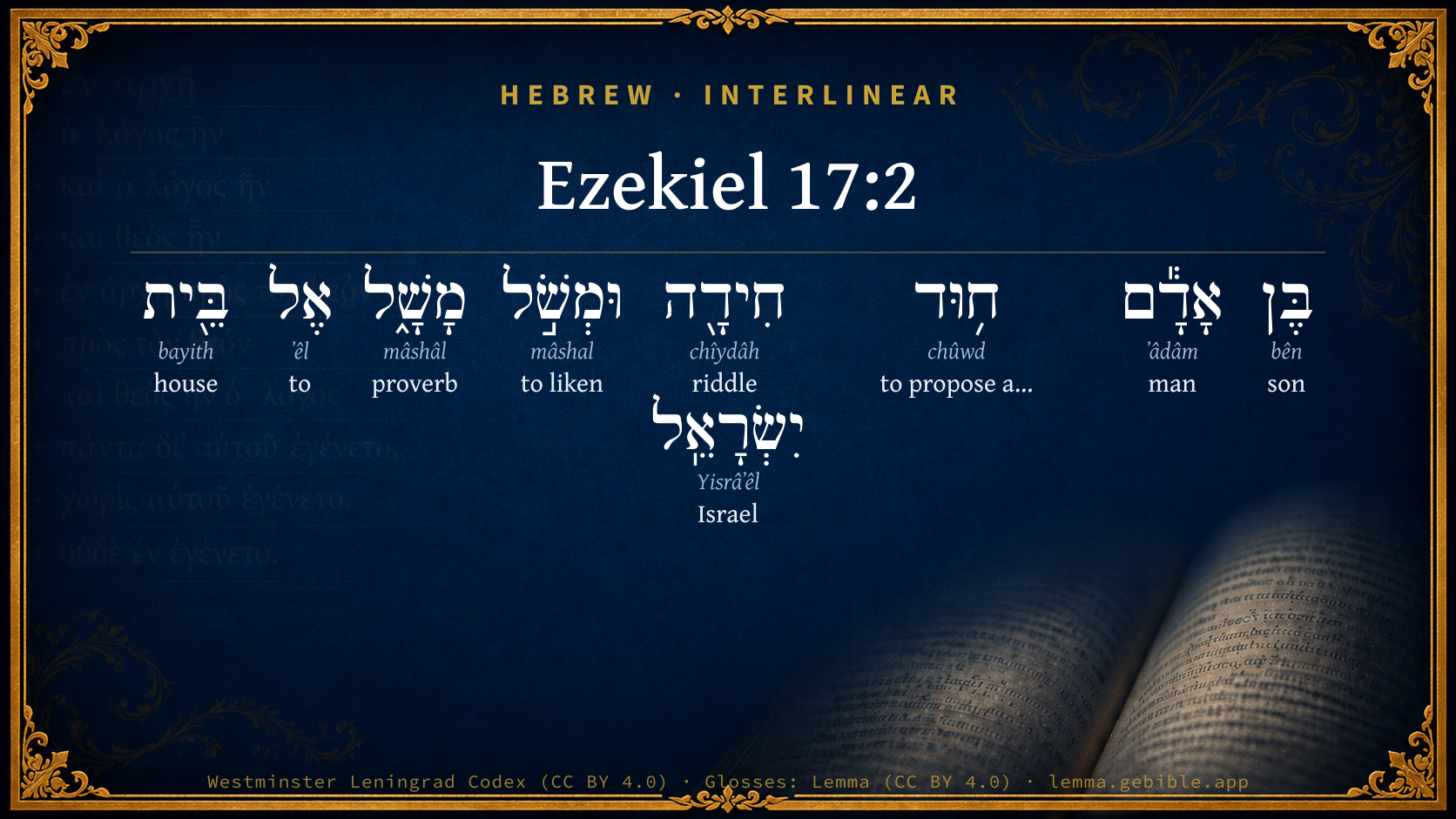
Ezekiel 17:2

Hebrew (Westminster Leningrad Codex) Ezekiel 17:2 appears in the Hebrew Old Testament. The text above is from the Westminster Leningrad Codex. Each word links to its Strong’s number, a concise gloss, and parsing drawn from the Open Scriptures Hebrew Bible morphology. Click any word for its full Brown-Driver-Briggs (BDB) entry.
Download image
Cite this verse

Ezekiel 17:2 (World English Bible). Public Domain. Lemma interlinear Bible study tool, https://lemma.gebible.app/v/ezekiel/17/2.

Show BibTeX & RIS
BibTeX
RIS
English Translation
Son of man, put forth a riddle, and speak a parable to the house of Israel;
World English Bible · Public Domain
Download a study sheet

One document with this verse’s original text, its word-by-word gloss line, the meaning frame, cross-references with their text, attributed commentary, and full source and license credits — printable, and it pastes into notes with its structure intact.

This verse Autodidact and up

Study sheet (.html) Plain text (.txt)

A passage Seminary Student

Up to 50 verses in one chapter. A passage sheet keeps up to 6 commentary sources and 12 cross-references per verse, in the order this page ranks them, and says so on the sheet whenever that leaves anything out. Ask for a single verse and you get the Autodidact verse sheet above.

Everything on this page stays free to read, with no account — the sheet is a download of what is already on screen, not access to it.

Want to remove ads? Support Godless Engineer
Compare translations 3

The same verse in 3 English versions, stacked beneath the original-language interlinear above. Click any original word for its lexicon entry.

Each is an independent rendering of the whole verse — the interlinear is not word-aligned to these translations.

Highlighted words mark where these versions differ — a whole-verse word diff, not a word-by-word alignment.

  • World English Bible Public Domain
    Son of man, put forth a riddle, and speak a parable to the house of Israel;
  • King James Version Public Domain
    Son of man, put forth a riddle, and speak a parable unto the house of Israel;
  • unfoldingWord Literal Text CC BY-SA 4.0
    “Son of man, present a riddle and speak a parable to the house of Israel.

unfoldingWord Literal Text — © unfoldingWord, licensed CC BY-SA 4.0. Word-aligned USFM3 via Door43 (git.door43.org/unfoldingWord/en_ult).

Versions to compare (up to 4)

3 of 4 selected

Show all 18 translations

Every available English version of this verse, each an independent rendering of the whole verse.

  • World English Bible Public Domain
    Son of man, put forth a riddle, and speak a parable to the house of Israel;
  • Berean Standard Bible Public Domain
    “Son of man, pose a riddle; speak a parable to the house of Israel
  • Majority Standard Bible Public Domain
    “Son of man, pose a riddle; speak a parable to the house of Israel
  • King James Version Public Domain
    Son of man, put forth a riddle, and speak a parable unto the house of Israel;
  • American Standard Version (1901) Public Domain
    Son of man, put forth a riddle, and speak a parable unto the house of Israel;
  • Revised Version (1885) Public Domain
    Son of man, put forth a riddle, and speak a parable unto the house of Israel;
  • Geneva Bible (1599) Public Domain
    Sonne of man, put foorth a parable and speake a prouerbe vnto the house of Israel,
  • Douay-Rheims (1899) Public Domain
    Son of man, put forth a riddle, and speak a parable to the house of Israel,
  • Young's Literal Translation Public Domain
    `Son of man, put forth a riddle, and use a simile unto the house of Israel,
  • Literal Standard Version CC BY-SA 4.0
    “Son of man, put forth a riddle, and use an allegory to the house of Israel,
  • Unlocked Literal Bible CC BY-SA 4.0
    “Son of man, present a riddle and speak a parable to the house of Israel.
  • unfoldingWord Literal Text CC BY-SA 4.0
    “Son of man, present a riddle and speak a parable to the house of Israel.
  • Darby Bible Public Domain
    Son of man, put forth a riddle, and speak a parable unto the house of Israel,
  • World Messianic Bible Public Domain
    “Son of man, tell a riddle, and speak a parable to the house of Israel;
  • Webster's Bible Public Domain
    Son of man, put forth a riddle, and speak a parable to the house of Israel;
  • Free Bible Version CC BY-SA 4.0
    “Son of man, present this riddle—share it as a parable with the people of Israel.
  • Bible in Basic English Public Domain
    Son of man, give out a dark saying, and make a comparison for the children of Israel,
  • JPS Tanakh (1917) Public Domain
    'Son of man, put forth a riddle, and speak a parable unto the house of Israel,

Literal Standard Version (2020), Covenant Press — licensed CC BY-SA 4.0. Text via the HelloAO Bible API (eBible.org). Unlocked Literal Bible (unfoldingWord) — licensed CC BY-SA 4.0. Text via the HelloAO Bible API (eBible.org). unfoldingWord Literal Text — © unfoldingWord, licensed CC BY-SA 4.0. Word-aligned USFM3 via Door43 (git.door43.org/unfoldingWord/en_ult). Free Bible Version, Dr. Jonathan Gallagher — licensed CC BY-SA 4.0. Text via the HelloAO Bible API (eBible.org).

Word by word

More ways to search: Search by grammar → Find every occurrence → Compare this word →

Practice this passage: Drill this verse → Learn its vocabulary →

About this verse

These counts appear in no published source. They are computed here, from the morphology-tagged text and Lemma’s own curated glosses. What Lemma adds →

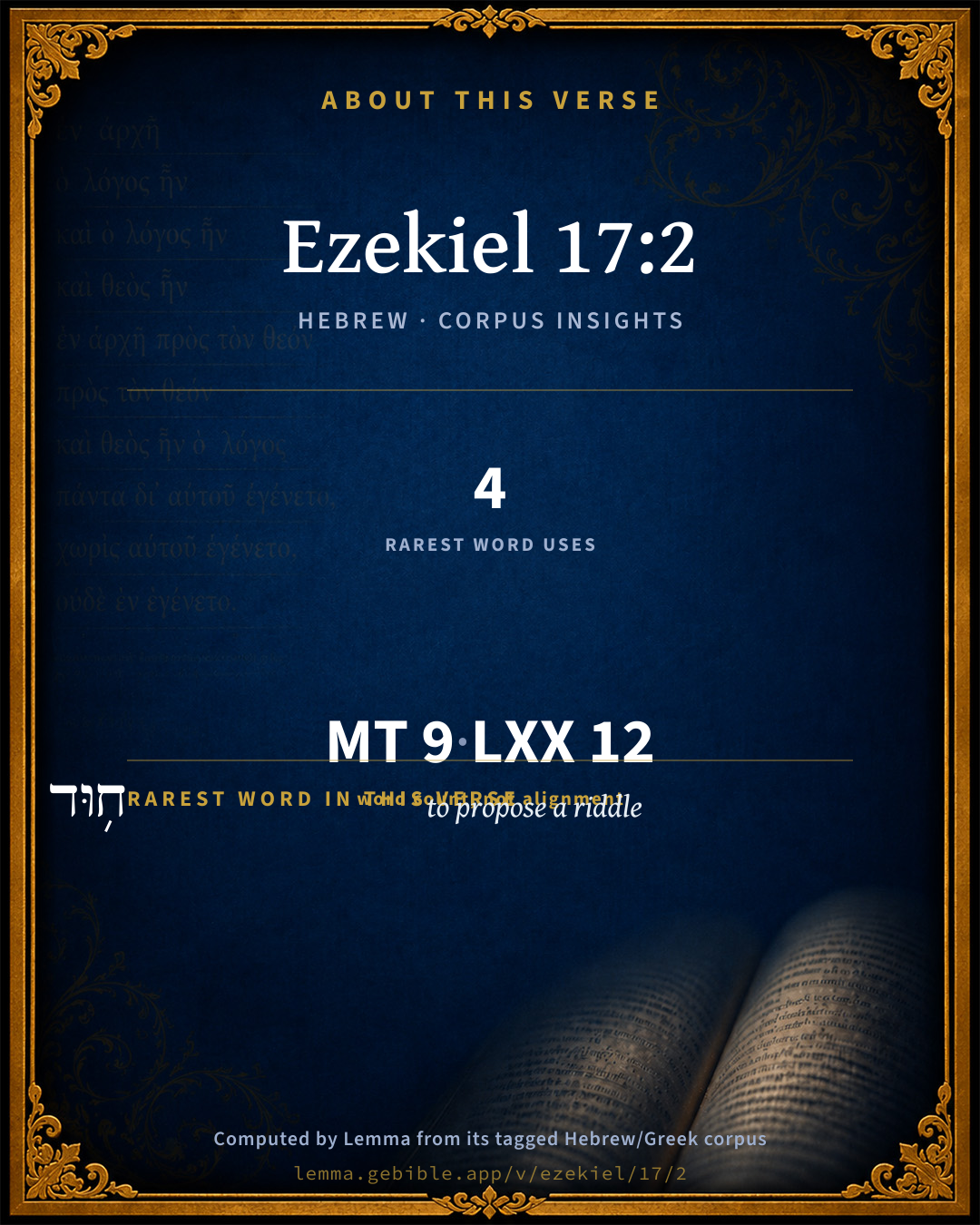
9
words
9
distinct lemmas
Prophets
section

Notable vocabulary

The rarest word here is ח֥וּד to propose a riddle H2330 — appearing just 4 times in the whole Hebrew Bible.

Shared distinctive vocabulary

ח֥וּד to propose a riddle H2330 occurs in 4 verses of the Hebrew Bible. Also found in:

Grammatical profile

  • 2 verbs
  • 6 nouns
  • 1 preposition

Verb forms

  • ח֥וּד Qal · Imperative
  • וּמְשֹׁ֣ל Qal · Imperative

Hebrew & Septuagint length

In English translation the verse runs 16 words from the Hebrew and 15 from the Septuagint (LXX English) — closely comparable.

A rough comparison of the two English renderings, which tokenize alike — not a word-level alignment.

Word counts can differ between the Hebrew and the Greek without any difference in meaning — e.g. the Hebrew direct-object marker אֵת has no separate Greek word, and Greek often adds the article ὁ.

In the original languages it is 9 Hebrew tokens and 12 Greek tokens — but the two are counted differently (Hebrew bundles its prefixes and suffixes into one token; the Greek is in lemma form), so that isn’t a like-for-like length.

Cross-references

10

Topical passages linked to Ezekiel 17:2 in the Treasury of Scripture Knowledge — connected by theme and wording, ordered by reader-vote popularity; previews shown in the World English Bible.

  • Ezekiel 20:49 Then said I, Ah Lord Yahweh! they say of me, Isn't he a speaker of parables?
  • Matthew 13:35 that it might be fulfilled which was spoken through the prophet, saying, "I will open my mouth in parables; I will utter things hidden from the foundation of the world."
  • Judges 9:8–15 The trees went forth on a time to anoint a king over them; and they said to the olive tree, Reign you over us.
  • Judges 14:12–19 Samson said to them, Let me now put forth a riddle to you: if you can declare it to me within the seven days of the feast, and find it out, then I will give you thirty linen garments and thirty changes of clothing;
  • 2 Samuel 12:1–4 Yahweh sent Nathan to David. He came to him, and said to him, "There were two men in one city; the one rich, and the other poor.
  • Ezekiel 24:3 Utter a parable to the rebellious house, and tell them, Thus says the Lord Yahweh, Set on the caldron, set it on, and also pour water into it:
  • Hosea 12:10 I have also spoken to the prophets, And I have multiplied visions; And by the ministry of the prophets I have used parables.
  • Matthew 13:13–14 Therefore I speak to them in parables, because seeing they don't see, and hearing, they don't hear, neither do they understand.
  • Mark 4:33–34 With many such parables he spoke the word to them, as they were able to hear it.
  • 1 Corinthians 13:12 For now we see in a mirror, dimly, but then face to face. Now I know in part, but then I will know fully, even as I was also fully known.

Cross-references courtesy of OpenBible.info (CC BY 4.0).

Hebrew and Greek witnesses Masoretic Hebrew ↔ Greek Septuagint

The same verse in the two great witnesses to the Old Testament, shown verse-for-verse.

These are two independent witnesses, not word-aligned to each other, and the Septuagint is shown in lemma (dictionary) form.

Hebrew Ezekiel 17:2 Masoretic · Westminster Leningrad Codex

בֶּן אָדָ֕ם ח֥וּד חִידָ֖ה וּמְשֹׁ֣ל מָשָׁ֑ל אֶל בֵּ֖ית יִשְׂרָאֵֽל

Son of man, put forth a riddle, and speak a parable to the house of Israel;

World English Bible · Public Domain

Greek LXX Ezekiel 17:2 Septuagint · lemma form

υἱός ἄνθρωπος διαἡγέομαι διήγημα καί εἶπον παραβολή πρός ὁ οἶκος ὁ ἰσραήλ

Son of man, relate a tale, and speak a parable to the house of Israel:

LXX2012 (modern English Septuagint) · Public Domain

Hebrew: Westminster Leningrad Codex (CC BY 4.0). Greek: Septuagint (public domain); English from LXX2012 (modern English Septuagint) (Public Domain). How the Septuagint differs from the Hebrew →

Targum (Aramaic paraphrase)

1

The Targum is the ancient Jewish Aramaic paraphrase of the Hebrew Scriptures — an interpretive translation, not the Hebrew text itself. Onkelos (literal) and Pseudo-Jonathan (expansive) render the Torah, and Jonathan the Prophets. Coverage is partial: where no permissively-licensed English translation exists for a verse, only the Aramaic is shown. This is verse-level text, not a word-by-word alignment to the Hebrew.

  1. Targum Jonathan Prophets (Joshua–Malachi)
    בַּר אָדָם חוּד חִידְתָּא וּמְתַל מַתְלָא עַל בֵּית יִשְׂרָאֵל:

    (no public-domain English translation for this verse)

    Targum Jonathan — Aramaic: “Mikraot Gedolot” (public domain). English: “Sefaria Community Translation” (CC0 1.0 (public-domain dedication)); “London "Chaldee Paraphrase," 1871” (public domain). Text via Sefaria.

Commentary

Notes on Ezekiel 17:2 from classic Christian and Jewish commentators (each source and its license shown beneath its notes). The classic Christian expositions comment on the surrounding passage and are grouped to its opening verse, so a note may address several verses; the Jewish commentaries on the Tanakh (Rashi and others) are per-verse, so they appear only where the commentator wrote on this verse.

Lemma curates 59 commentaries, every one of them public domain or Creative Commons licensed, each selected and text-cleaned for this edition rather than reprinted as found. About our sources →

Trapp's Complete Commentary

John Trapp

Eze 17:2 Son of man, put forth a riddle, and speak a parable unto the house of Israel;

Ver. 2. Son of man, put forth a riddle.] Acue acumen, sharpen a sharpening, or whet a whetting. The prophet might have expressed God’s mind in fewer words; but then it would not have taken so deep an impression. Parents must whet God’s word upon their children, {Deu 6:7} ministers upon their people, and Christians upon one another for the increase of love and good works. {Heb 10:24} Riddles exercise the wit, and parables help the memory, and excite both attention and affection.

John Trapp, A Commentary or Exposition upon All the Books of the Old and New Testament (1647–1656) — public domain. Text from a community e-Sword module.

Joseph Benson's Commentary

Eze 17:2. Son of man, put forth a riddle — A continued metaphor or figurative speech: an allegory. The prophets frequently delivered their instructions in this way, as being well calculated both to engage the attention of their hearers or readers, and to make a deep and lasting impression on their minds. It was a mode of teaching peculiarly adapted to the eastern people, and therefore often adopted by their instructers, whether inspired or uninspired. It is well known that our Lord frequently used it in preaching his gospel.

Joseph Benson's Commentary on the Old and New Testaments (1811–1818) — public domain. Text from a community e-Sword module.

Adam Clarke's Commentary

Verse 2. Son of man, put forth a riddle] Riddle, [Anglo-Saxon] or [A.S.], Anglo-Saxon, from [A.S.] to divine; a thing that must be curiously investigated and sifted, to find out the meaning; and hence, riddle, a sort of coarse sieve to clean corn, to separate coarse chaff and straws from the pure grain. An instrument formerly used for divination. This is not far removed from the Hebrew חידה chidah, from חד chad, to penetrate; not that which penetrates the mind, but which we must penetrate to find out the sense.

Adam Clarke's Commentary on the Bible (1810–1826) — public domain. Text from a community e-Sword/MySword module.

John Calvin's Commentaries

But I come to the words Son of man, set forth in enigma: the noun and the verb mutually answer to each other, hence any one may if he please render the Prophet’s words, by saying enigmatize an enigma: for the Prophet here speaks of allegorical language, חידה, chideh, signifies the same as “allegory,” where the words are different from the sense, that is, where the sense is wrapped up in obscure involutions: but we know that God sometimes spoke enigmatically when unwilling to be understood by the impious and disbelieving. But here the obscurity of the sentence has another meaning, namely, that the Jews should be waked up, and this prophecy should penetrate their minds: we know their extreme hardness, and hence if the Prophet had spoken simply and in his accustomed language, they had not been so attentive. This therefore is the reason why, God orders him to speak enigmatically. He now adds, משל ומשל, vemeshel meshel. We know that meshel is a remarkable sentence, and is the word used by Solomon as the title of his proverbs: משל, meshel, then, means the same as apothegm: but it is sometimes taken for likeness: and in this place God so denounces destruction upon the Israelites in an allegory, as to illustrate his language by a comparison, since otherwise it would have been obscure. Be this as it may, God so prefaced his address, that the Jews might acknowledge the message to be no common one, but that it ought to affect them seriously. The usual reason for speaking enigmatically does not hold good here, namely, that the Jews were unworthy of the doctrine of salvation, since the Prophet will very shortly explain what he had hitherto uttered in figure and allegory. It is indeed true, that Christ spoke in parables to the people, because the disciples alone were capable of familiar and pure teaching. Of unbelievers, also, Isaiah says, Prophecy shall be to you a sealed book. Hence I will speak with this people in a strange and barbarous tongue, and they shall not proceed beyond the rudiments. (Matthew 13; Mark 4; Luke 8; Isaiah 29:11, 12.) But, as I have said, the obscurity of this teaching was only a preparation, that the people should strictly attend to the subject here set before them.

John Calvin's Commentaries (1540-1563) — public domain. Text from the Calvin Translation Society English edition (1840s-50s) via the Christian Classics Ethereal Library (ccel.org). Calvin's coverage is partial (roughly two-thirds of the Bible); uncommented books and verses are honest gaps, never fabricated. The 19th-century editor's footnotes and remarks are omitted so the notes are faithfully Calvin's own voice.

Ellicott's Commentary for English Readers

(2) A riddle . . . a parable.—What the prophet has to say is called a riddle as well as a parable, because there is something in it recondite and obscure—something which, until it is explained, should excite the minds of the people to guess its meaning.

A Bible Commentary for English Readers, edited by Charles John Ellicott (1878–1897) — public domain. Text from a community e-Sword module.

The Cambridge Bible for Schools and Colleges

gen. ed. J. J. S. Perowne

2. a riddle] As requiring interpretation; the passage is also called a “parable,” as containing a similitude or comparison. The eagle is Nebuchadnezzar, king of Babylon. Conquerors are often compared to the eagle, Deu_28:49; Isa_46:11; Jer_4:13; Jer_48:40; Hos_8:1; Lam_4:19.

The Cambridge Bible for Schools and Colleges (gen. ed. J. J. S. Perowne; Cambridge University Press, 1878–1918) — public domain. Text from a community e-Sword module.

John Gill's Exposition

And say, thus saith the Lord God,.... The riddle is not the prophet's, nor the parable his, but the Lord God's; and exceeding beautiful and apt it is, to signify the things designed by it; the wisdom of God is greatly displayed in it:

a great eagle; which is Nebuchadnezzar king of Babylon, as it is explained, Eze 17:12; who is compared to an eagle for his power and authority, that being the king of birds, and for his swiftness and voracity in conquering and subduing kingdoms; see Jer 48:40;

with great wings; so the Babylonish monarchy is signified by a lion with eagle's wings, Dan 7:4; and the two parts of the Roman empire, into which it was divided at the death of Theodosius, are called two wings of a great eagle, Rev 12:14; and so here it may denote the large kingdoms and provinces which belonged to the Babylonian monarchy; see Est 1:1;

longwinged; or having a "long member" (m); meaning the body of the wing, which was long; and so, as the wings spread, may signify the breadth of his dominion, this the length of them, and both their extensiveness:

full of feathers; of cities, towns, people, armies, wealth, and riches:

which had divers colours; or an "embroidery" (n); like that of the weaver, only needle work, consisting of various colours; and so it alludes to such eagles as are called the golden eagle, and "asterias", from their golden colour, and their being spotted like stars, and which are said to be of the largest size, as Bochart, from Aelianus (o), observes; and may signify people of divers languages, customs, manners, and circumstances, subject to the government of the king of Babylon:

came unto Lebanon; the northern border of the land of Judea, and invaded it; where were the mountain and forest of Lebanon, famous for the cedars that grew there, from whence the whole land may here take its name, as being more apt for the allegory used: or the city of Jerusalem, where were the temple built of the cedars of Lebanon, as many of its palaces and houses also were; whither the king of Babylon came, and took it, and who came northward, as Babylon was:

and took the highest branch of the cedar; by the "cedar" is meant, either the nation in general, or the royal family in particular; and by the "highest branch" the then reigning king, Jeconiah with the princes and nobles of the land, who were taken and carried captive by Nebuchadnezzar; see Kg2 24:14.

(m) "longa corpore", Castalio; "longa membris", Munster, Grotius; "longo membororum ductu", Pradus. (n) , Heb; "opus phrygionicum", Piscator. (o) Aelian. Hist. Animal. l. 2. c. 39.

John Gill's Exposition of the Whole Bible (1746–1763) — public domain (CC PDM 1.0). Text via the HelloAO Bible API.

Haydock's Catholic Bible Commentary

Riddle. Thus the prophets and Christ often delivered their doctrine. (Calmet)

George Leo Haydock (1774–1849), Haydock's Catholic Family Bible and Commentary, 1859 edition — public domain. Excludes Psalms (Douay-Rheims chapter numbering differs from Protestant) and Deuterocanonical books (Catholic canon only).

Matthew Poole's English Annotations

These two verses are preface to what follows in the chapter.

A riddle; a dark saying, which calls for thorough consideration to understand and apply it, because the meaning is different to the sound of the words.

A parable; the same thing redoubled in different words. And it is likely the prophet is commanded to use a parable, because those Eastern people were much used to and taken with this kind of discourse.

The house of Israel, i.e. the remainders of the house of Israel, whether of the ten tribes, or of the two tribes.

Matthew Poole's English Annotations on the Holy Bible (1683–1685) — public domain. Text from a community e-Sword/MySword module.

The Pulpit Commentary

Put forth a riddle, etc. Again there is an interval of silence, till another theme is suggested to the prophet"s mind and worked out elaborately. This he describes as a "riddle". (same word as the "dark speeches" of Num_12:8, the "hard questions" of 1Ki_10:1) It will task the ingenuity of his hearers or readers to interpret it, and so he subjoins (vers. 12-24) the interpretation. That interpretation enables us to fix the occasion and the date of the prophecy. It was the time when Zedekiah was seeking to strengthen himself against Nebuchadnezzar by an Egyptian alliance.

Ver. 2. A riddle and a parable.

In the present instance the riddle and the parable are one, the riddle being expressed in the form of a parable. Both of these oblique forms of expression are characteristic of Oriental literature, and appear frequently in the pages of the Bible. Let us consider their advantages.

I THE RIDDLE. This is not a mere puzzle to amuse; nor is it propounded to vex and perplex the listener. Unlike our idle conundrum, it has a grave purpose.

1. To arrest attention. Ezekiel was required to prophesy to people with blind eyes and deaf ears. (Eze_12:2) The methods of direct instruction had failed to impress his somnolent hearers. Called upon to try more rousing means, the prophet now launches into parables and riddles. Novelty of method may be desirable in the expression of old familiar truths. It is useless to preach if we have not the ears of the audience. Yet it is dangerous to shock reverence by frivolous eccentricity. There was nothing frivolous in Ezekiel"s riddle, it was grave, and even sublime; neither was there anything eccentric about it, it followed a recognized method.

2. To provoke thought. While a direct statement may not be strongly grasped just because it is intelligible in a moment, an oblique phrase, which demands thought for the understanding of it, may sink the deeper into the mind. It is not only requisite that we should see the truth; we need also to take bold of it. An easy comprehension of it does not satisfy all its demands, and we should not only think about it, but think our way into it, using our own minds. Truth that is thus held is most truly our own possession.

3. To endure. The riddle will be easily remembered and readily transmitted. Truth is not the private property of its discoverer nor of his first hearer. It is the heritage of all; it claims eternal remembrance. We want to make the teaching of it tell and stay.

II THE PARABLE. Ezekiel"s riddle was thrown into the form of a parable. Usually the riddle appears to have been of the character of a parable, though perhaps, as a rule, more brief and less easily interpreted than an ordinary parable; e.g. compare Samson"s riddle with Jotham"s parable. (Jud_1:14:12 and Jud 9:7-15) The one is curt and enigmatical; the other fuller and more easily understood. The parabolic form of speech has its own peculiar advantages. Sharing the three advantages of the riddle already discussedi.e. arresting attention, provoking thought, and enduring though in a milder form when the parable is simpler and less concise than the riddle, it is compensated for any apparent inferiority to the riddle in these respects by the possession of certain good points of its own. Let us consider its special mission.

1. To take possession of the imagination. The parable appeals to the pictorial faculty. It handles truth on its poetic rather than on its philosophical side. It is therefore realistic, for nothing is so realistic as poetry, nothing so paints upon our inward eye the things it is describing in words. Now, it is not enough that we should understand the truth in word and naked idea. We want to see it, to handle it, to feel the glow and power of its presence.

2. To connect truth with present facts. The parable brings heaven down to earth. When dealing with earthly things it draws them into relation with nearer objects. Thus it shows that the subjects it treats of are closely connected with us. Theology is too much discussed as though it belonged to the star Sirius. Parables remind us that it belongs to our earth. Following analogies with nature and life, they indicate links of connection between the material and the spiritual, between nature and God, and also between nature and man.

The Pulpit Commentary (1880–1919), ed. H.D.M. Spence-Jones & Joseph S. Exell — public domain. Text from a community e-Sword module.

John Wesley's Explanatory Notes

A riddle - A dark saying. The house of Israel - The remainders of the house of Israel, whether of the ten, or of the two tribes.

John Wesley, Explanatory Notes Upon the Whole Bible (1754–1765) — public domain. Text via the GEBible commentary corpus.

Rashi

Rabbi Shlomo Yitzchaki (Rashi)

propound a riddle The prophecy in this chapter is expressed as a riddle, [in] which he compares Nebuchadnezzar to an eagle and the kings of Judah to the lofty top of cedars.

Rashi on the Tanakh — English translations: “The Judaica Press complete Tanach with Rashi, translated by A. J. Rosenberg” (CC BY 4.0); “Pentateuch with Rashi's commentary by M. Rosenbaum and A.M. Silbermann, 1929-1934” (public domain); “The Metsudah Tanach series, Lakewood, N.J” (CC BY 4.0); and “The Book of Joshua, Metsudah Publications, 1997” (CC BY 4.0). Text via Sefaria.

Lesson kit

Teaching starters — assembled from the data on this page, not authored interpretation. Every prompt links to the verse data it draws on. Edit before teaching.

Ezekiel, in the Prophets, opens this verse with 9 words (9 distinct Hebrew lemmas). Its most distinctive word is chûwd (“to propose a riddle”). A historical commentator’s framing appears above. Read the whole chapter for the surrounding context.

Discussion questions

  1. The word chûwd carries the sense “to propose a riddle.” How does it shape the verse?
  2. How does Judges 14:12, which shares the word «to propose a riddle», read alongside this verse?
  3. These translations render this verse differently. What is at stake in choosing one wording over another?
  4. «ח֥וּד» is a Qal Imperative verb. How does that grammatical form shape the action described?
  5. Compare how Trapp's Complete Commentary and Joseph Benson's Commentary read this verse. Where do they agree or differ?

Things to notice

Reading settings

Reading text

Shown beneath each verse's original-language words.

Old Testament
Old Testament edition

Read the OT as the Masoretic Hebrew (MT) or the Greek Septuagint (LXX).

English shown for the Greek Septuagint (in the Hebrew ↔ Greek comparison).

Comparing translations? Open the Compare panel on any verse page to stack up to four side by side.