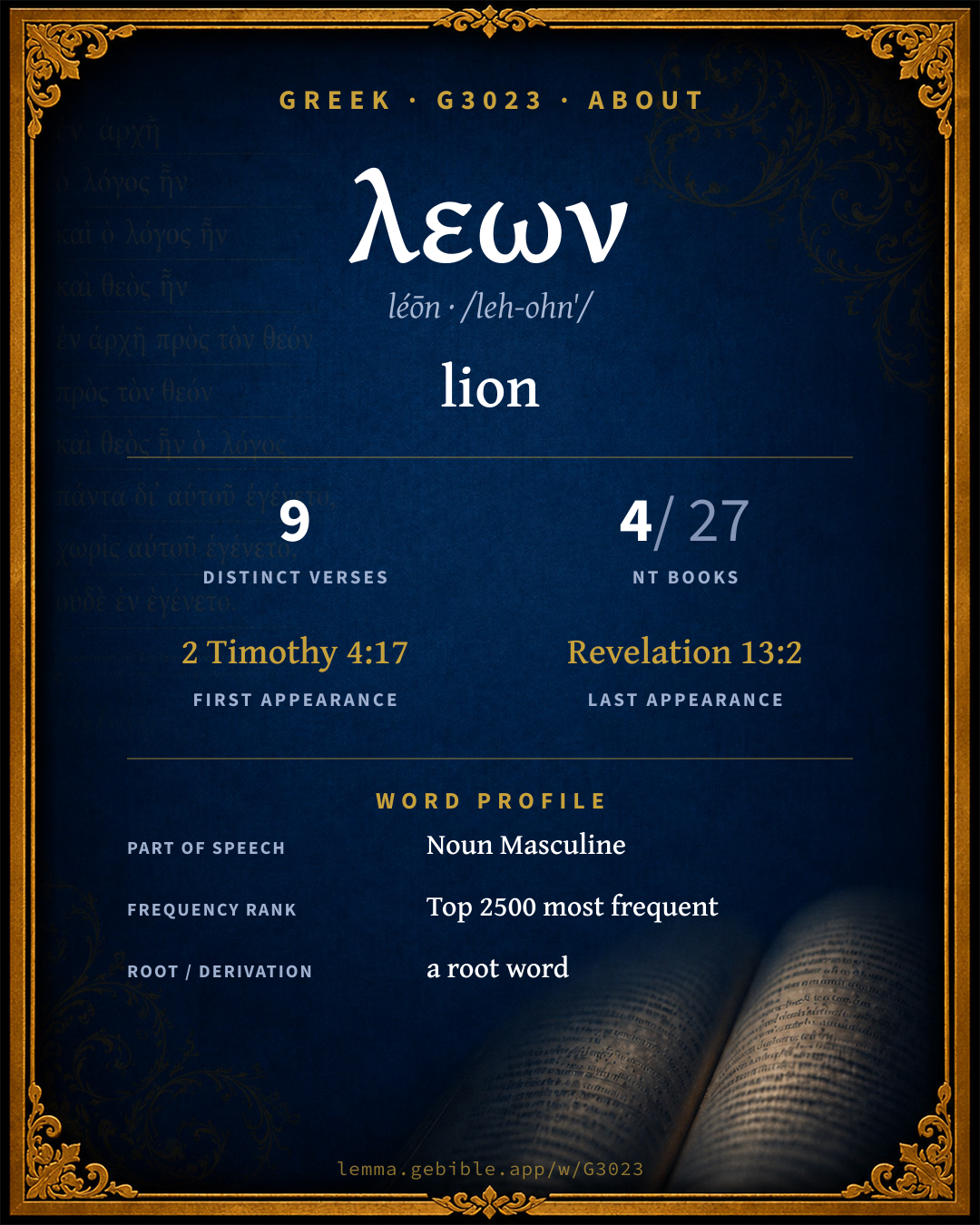
λεών
lion
‘lion’ is one of 2 main senses fuller range ↓
Full lexicon entry — Thayer's Greek Lexicon
From Thayer's Greek Lexicon
Where this word appears
See every Genitive-case word in the Greek New Testament →
Grammar key — what these labels mean
Part of speech
- Noun
- A naming word — a person, place, thing, or idea.
Case
- Genitive
- The case of source, possession, or “of” — answers “whose / from what.”
- Nominative
- The case of the subject (and the predicate nominative).
- Dative
- The case of the indirect object, means, or location — “to / for / with / in.”
Gender
- Masculine
- Grammatically masculine.
Number
- Plural
- More than one.
- Singular
- One.
5 distinct verses where G3023 appears in the Genitive case, across 3 books. Filtered view — show all forms. Click any verse to open its interlinear word-by-word view. Verse text shown in the World English Bible for context — . Each verse’s Greek form is shown with its reference; the English is not keyword-highlighted, since the data carries no word-level English alignment. Use “Compare translations” on any verse to read it across multiple English versions. This concordance covers the Greek New Testament; Septuagint (Greek Old Testament) occurrences of this word are not indexed here.
2 Timothy 1 verse
Hebrews 1 verse
Revelation 3 verses
- Revelation 9:8 λεόντων n gen pl masc They had hair like women's hair, and their teeth were like those of lions.
- Revelation 9:17 λεόντων n gen pl masc Thus I saw the horses in the vision, and those who sat on them, having breastplates of fiery red, hyacinth blue, and sulfur yellow; and the heads of lions. Out of their mouths proceed fire, smoke, and sulfur.
- Revelation 13:2 λεόντων n gen pl masc The beast which I saw was like a leopard, and his feet were like those of a bear, and his mouth like the mouth of a lion. The dragon gave him his power, his throne, and great authority.
About this entry
At a glance — auto-summarized from this page’s data, not written by a person. Every figure links to its source below. This summary describes the numbers; it doesn’t interpret them.
At its core, λεων (léōn) means “lion.” Its uses cluster heavily in Revelation (67% of all occurrences). With 9 verses in 4 books, it is an uncommon word in the Greek New Testament. First canonically at 2 Timothy 4:17, it enters the text early. Catalogued under 2 senses, its meaning is not single-sense. Dig into 9-verse concordance and the renderings breakdown below.
Gloss history
Strong's 1890 vs modern scholarship
About this word
Strong's G3023 catalogs a Greek word from the Greek New Testament.
These counts are not copied from any lexicon or concordance. They are computed here, from the morphology-tagged Greek New Testament. What Lemma adds →
- 9
- distinct verses
- The word appears in 9 distinct verses.
- 4 / 27
- NT books
- The word appears in 4 of 27 New Testament books.
- #1,140
- by frequency
- Top 2500 most frequent Greek words (rank 1,140 of 5,347 Greek words by occurrence).
View all 9 occurrences in the concordance →
Most concentrated in
- Revelation 6 verses 67%
- 2 Timothy 1 verse 11%
- Hebrews 1 verse 11%
By section of the New Testament
By traditional corpus
Conventional, traditional groupings — biblical authorship is debated, so this is a traditional corpus grouping, not an authorship claim. Some books belong to more than one corpus (Luke is in both the Gospels and the Lukan corpus, and so on), so these shares overlap and need not total 100%. Each figure is a share of the word’s 9 distinct verses.
- Johannine 6 verses · 67%
- Revelation 6 verses · 67%
- Pauline corpus 1 verse · 11%
- Hebrews 1 verse · 11%
- General (Catholic) Epistles 1 verse · 11%
How translations render this word
Counts come from each version’s own published word-to-Strong’s tagging or interlinear alignment — an approximate guide to how each version renders this word, not a word-level alignment the data otherwise carries. Because each total is that version’s own tagged count, the per-version totals vary from one another and need not match the appearance or distinct-verse counts above. These counts may also differ from a printed concordance because Lemma counts each distinctly tagged rendering and does not collapse phrase taggings into a single head-word total. This is a fixed set of word-tagged versions (KJV, ASV, BSB, ULT) and does not change with the reading translation you choose elsewhere. Each version’s license is shown beside its name below (and on Sources).
- King James Version: Lion 6×, Lions 2×
- American Standard Version: Lion 6×, Lions 2×
- Berean Standard Bible: Lion 6×, Lions 3×
- unfoldingWord Literal Text: Lion 6×, Lions 3×
King James Version Public Domain
Renders G3023 across 9 tagged occurrences — most commonly:
Plus 1 rendering that appears only once — usually multi-word phrases or single function words the recovered tagging swept in, not distinct renderings.
American Standard Version Public Domain
Renders G3023 across 9 tagged occurrences — most commonly:
Plus 1 rendering that appears only once — usually multi-word phrases or single function words the recovered tagging swept in, not distinct renderings.
Berean Standard Bible Public Domain
Renders G3023 across 9 tagged occurrences — most commonly:
unfoldingWord Literal Text CC BY-SA 4.0
Renders G3023 across 10 tagged occurrences — most commonly:
Plus 1 rendering that appears only once — usually multi-word phrases or single function words the recovered tagging swept in, not distinct renderings.
Senses in Thayer's
The 2 senses Thayer's distinguishes for this word, in lexicon order (not ranked by frequency or importance). The full entry — with sub-senses — is in the Lexicon Entry tab.
- a lion
- a brave and mighty hero Both Christ and Satan are referred to as a lion, indicatinggreat strength,
Word origin
Origin: a root word
A primary word; a lion : - lion.
— Strong’s Exhaustive Concordance (1890), public domain.
Forms in the corpus
The 4 distinct written forms G3023 takes in the Greek New Testament, most frequent first — each parse links to that case’s occurrences in the concordance.
| Form | Parsing | Example | Uses |
|---|---|---|---|
| λεόντων leóntōn | Noun, Genitive, Plural, Masculine | Hebrews 11:33 | 4 |
| λέων léōn | Noun, Nominative, Singular, Masculine | 1 Peter 5:8 | 3 |
| λέοντι léonti | Noun, Dative, Singular, Masculine | Revelation 4:7 | 1 |
| λέοντος léontos | Noun, Genitive, Singular, Masculine | 2 Timothy 4:17 | 1 |
Septuagint usage
The same Greek word λεων appears 122 times in the Greek Old Testament (Septuagint), across 106 verses in 27 books.
- 122
- LXX occurrences
- Tagged occurrences of this Greek word in the Septuagint.
- 106
- verses
- Distinct Septuagint verses containing this word.
- 27 / 39
- OT books
- The word appears in 27 of the 39 Old Testament books.
Sample Septuagint occurrences
- Genesis 49:9 λέων
- Numbers 23:24 λέων
- Deuteronomy 33:20 λέων
- Judges 14:5 λέων
- 1 Samuel 17:14 λέων
- 2 Samuel 1:23 λέων
- 1 Kings 7:16 λέων
- 2 Kings 17:25 λέων
- 1 Chronicles 11:22 λέων
- 2 Chronicles 9:18 λέων
- Job 4:10 λέων
- Psalms 7:3 λέων
Septuagint occurrences (same lexeme)
Every verse where the same Strong’s number (G3023) appears in the Greek Septuagint — showing the first 50 of 106. Verse text shown in the World English Bible for context; the Greek form is the matched word — the English is not keyword-highlighted.
- Genesis 49:9 λέων Judah is a lion's cub. From the prey, my son, you have gone up. He stooped down, he crouched as a lion, As a lioness. Who will rouse him up?
- Numbers 23:24 λέων Behold, the people rises up as a lioness, As a lion does he lift himself up: He shall not lie down until he eat of the prey, Drink the blood of the slain.
- Numbers 24:9 λέων He couched, he lay down as a lion, As a lioness; who shall rouse him up? Blessed be everyone who blesses you, Cursed be everyone who curses you.
- Deuteronomy 33:20 λέων Of Gad he said, Blessed be he who enlarges Gad: He dwells as a lioness, Tears the arm, yes, the crown of the head.
- Deuteronomy 33:22 λέων Of Dan he said, Dan is a lion's cub, That leaps forth from Bashan.
- Judges 14:5 λέων Then went Samson down, and his father and his mother, to Timnah, and came to the vineyards of Timnah: and, behold, a young lion roared against him.
- Judges 14:8 λέων After a while he returned to take her; and he turned aside to see the carcass of the lion: and, behold, there was a swarm of bees in the body of the lion, and honey.
- Judges 14:9 λέων He took it into his hands, and went on, eating as he went; and he came to his father and mother, and gave to them, and they ate: but he didn't tell them that he had taken the honey out of the body of the lion.
- Judges 14:18 λέων The men of the city said to him on the seventh day before the sun went down, What is sweeter than honey? and what is stronger than a lion? He said to them, If you hadn't plowed with my heifer, You wouldn't have found out my riddle.
- 1 Samuel 17:14 λέων David was the youngest; and the three eldest followed Saul.
- 1 Samuel 17:16 λέων The Philistine drew near morning and evening, and presented himself forty days.
- 1 Samuel 17:17 λέων Jesse said to David his son, Take now for your brothers an ephah of this parched grain, and these ten loaves, and carry [them] quickly to the camp to your brothers;
- 2 Samuel 1:23 λέων Saul and Jonathan were lovely and pleasant in their lives, In their death they were not divided: They were swifter than eagles, They were stronger than lions.
- 2 Samuel 17:10 λέων Even he who is valiant, whose heart is as the heart of a lion, will utterly melt; for all Israel knows that your father is a mighty man, and those who are with him are valiant men.
- 2 Samuel 23:20 λέων Benaiah the son of Jehoiada, the son of a valiant man of Kabzeel, who had done mighty deeds, he killed the two [sons of] Ariel of Moab: he went down also and killed a lion in the midst of a pit in time of snow.
- 1 Kings 7:16 λέων He made two capitals of molten brass, to set on the tops of the pillars: the height of the one capital was five cubits, and the height of the other capital was five cubits.
- 1 Kings 7:22 λέων On the top of the pillars was lily-work: so was the work of the pillars finished.
- 1 Kings 10:19 λέων There were six steps to the throne, and the top of the throne was round behind; and there were stays on either side by the place of the seat, and two lions standing beside the stays.
- 1 Kings 10:20 λέων Twelve lions stood there on the one side and on the other on the six steps: there was nothing like it made in any kingdom.
- 1 Kings 13:24 λέων When he was gone, a lion met him by the way, and killed him: and his body was cast in the way, and the donkey stood by it; the lion also stood by the body.
- 1 Kings 13:25 λέων Behold, men passed by, and saw the body cast in the way, and the lion standing by the body; and they came and told it in the city where the old prophet lived.
- 1 Kings 13:28 λέων He went and found his body cast in the way, and the donkey and the lion standing by the body: the lion had not eaten the body, nor torn the donkey.
- 1 Kings 21:36 λέων
- 2 Kings 17:25 λέων So it was, at the beginning of their dwelling there, that they didn't fear Yahweh: therefore Yahweh sent lions among them, which killed some of them.
- 2 Kings 17:26 λέων Therefore they spoke to the king of Assyria, saying, The nations which you have carried away, and placed in the cities of Samaria, don't know the law of the god of the land: therefore he has sent lions among them, and, behold, they kill them, because they don't know the law of the god of the land.
- 1 Chronicles 11:22 λέων Benaiah the son of Jehoiada, the son of a valiant man of Kabzeel, who had done mighty deeds, he killed the two [sons of] Ariel of Moab: he went down also and killed a lion in the midst of a pit in time of snow.
- 1 Chronicles 12:9 λέων Ezer the chief, Obadiah the second, Eliab the third,
- 2 Chronicles 9:18 λέων nd there were six steps to the throne, with a footstool of gold, which were fastened to the throne, and stays on either side by the place of the seat, and two lions standing beside the stays.
- 2 Chronicles 9:19 λέων Twelve lions stood there on the one side and on the other on the six steps: there was nothing like it made in any kingdom.
- Job 4:10 λέων The roaring of the lion, and the voice of the fierce lion, The teeth of the young lions, are broken.
- Job 4:11 λέων The old lion perishes for lack of prey, The cubs of the lioness are scattered abroad.
- Job 6:7 λέων My soul refuses to touch them; They are as loathsome food to me.
- Job 10:16 λέων If my head is held high, you hunt me like a lion. Again you show yourself powerful to me.
- Job 28:8 λέων The proud animals have not trodden it, Nor has the fierce lion passed by there.
- Job 38:39 λέων "Can you hunt the prey for the lioness, Or satisfy the appetite of the young lions,
- Psalms 7:3 λέων Yahweh, my God, if I have done this, If there is iniquity in my hands,
- Psalms 9:30 λέων
- Psalms 16:12 λέων
- Psalms 21:14 λέων
- Psalms 21:22 λέων
- Psalms 34:17 λέων The righteous cry, and Yahweh hears, And delivers them out of all their troubles.
- Psalms 57:7 λέων My heart is steadfast, God, my heart is steadfast. I will sing, yes, I will sing praises.
- Psalms 90:13 λέων Relent, Yahweh! How long? Have compassion on your servants!
- Proverbs 19:12 λέων The king's wrath is like the roaring of a lion, But his favor is like dew on the grass.
- Proverbs 20:2 λέων The terror of a king is like the roaring of a lion: He who provokes him to anger forfeits his own life.
- Proverbs 22:13 λέων The sluggard says, "There is a lion outside! I will be killed in the streets!"
- Proverbs 26:13 λέων The sluggard says, "There is a lion in the road! A fierce lion roams the streets!"
- Proverbs 28:1 λέων The wicked flee when no one pursues; But the righteous are as bold as a lion.
- Proverbs 28:15 λέων As a roaring lion or a charging bear, So is a wicked ruler over helpless people.
- Proverbs 30:30 λέων The lion, which is mightiest among animals, And doesn't turn away for any;
These are occurrences of the same Greek lexeme (G3023) in the Septuagint — not a translation of any one Hebrew word. The store carries no word-level Hebrew↔Greek alignment, so no Hebrew original is asserted here. Counts come from the recovered LXX Strong's tagging — high-frequency vocabulary is well covered, while rare or late forms may be untagged — so they reflect tagged occurrences and may slightly undercount.