
Deuteronomy 33:22

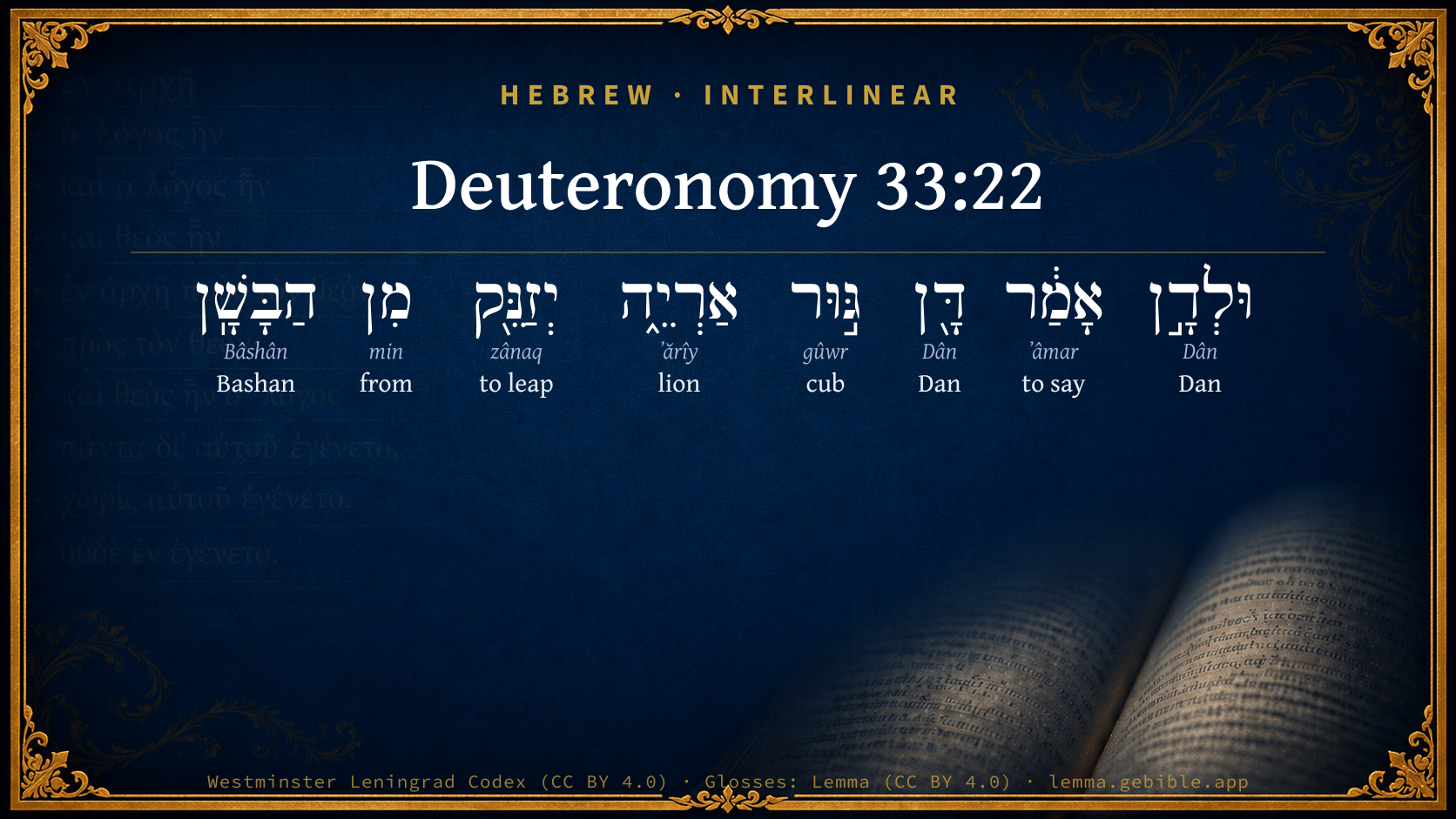
Hebrew (Westminster Leningrad Codex) Deuteronomy 33:22 appears in the Hebrew Old Testament. The text above is from the Westminster Leningrad Codex. Each word links to its Strong’s number, a concise gloss, and parsing drawn from the Open Scriptures Hebrew Bible morphology. Click any word for its full Brown-Driver-Briggs (BDB) entry.
Download image
Cite this verse

Deuteronomy 33:22 (World English Bible). Public Domain. Lemma interlinear Bible study tool, https://lemma.gebible.app/v/deuteronomy/33/22.

Show BibTeX & RIS
BibTeX
RIS
English Translation
Of Dan he said, Dan is a lion's cub, That leaps forth from Bashan.
World English Bible · Public Domain
Highlights
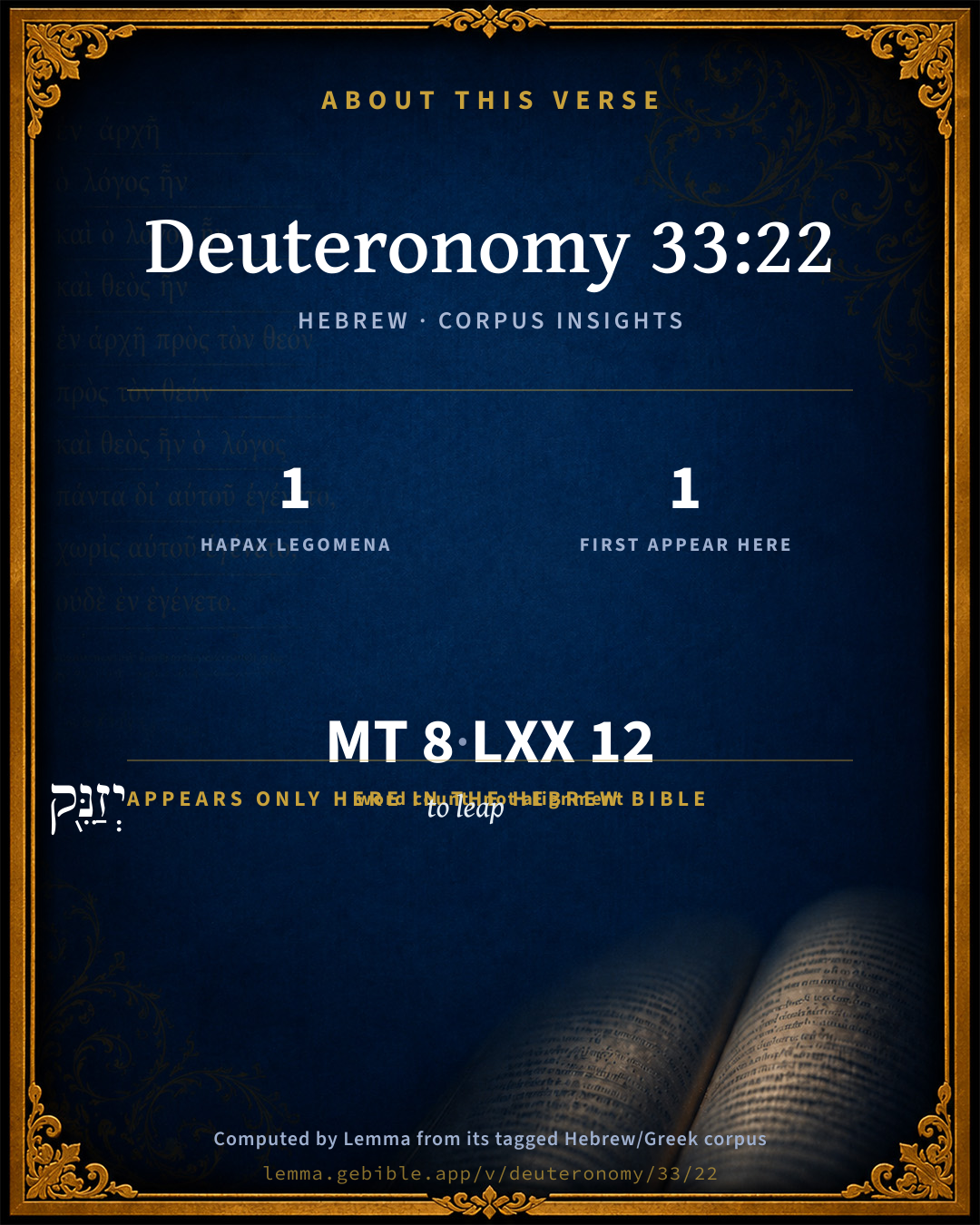
  • 1 hapax legomenon — only here in the Hebrew Bible
  • 1 first appearance in the Hebrew Bible
Full analysis ↓
Download a study sheet

One document with this verse’s original text, its word-by-word gloss line, the meaning frame, cross-references with their text, attributed commentary, and full source and license credits — printable, and it pastes into notes with its structure intact.

This verse Autodidact and up

Study sheet (.html) Plain text (.txt)

A passage Seminary Student

Up to 50 verses in one chapter. A passage sheet keeps up to 6 commentary sources and 12 cross-references per verse, in the order this page ranks them, and says so on the sheet whenever that leaves anything out. Ask for a single verse and you get the Autodidact verse sheet above.

Everything on this page stays free to read, with no account — the sheet is a download of what is already on screen, not access to it.

Want to remove ads? Support Godless Engineer
Compare translations 3

The same verse in 3 English versions, stacked beneath the original-language interlinear above. Click any original word for its lexicon entry.

Each is an independent rendering of the whole verse — the interlinear is not word-aligned to these translations.

Highlighted words mark where these versions differ — a whole-verse word diff, not a word-by-word alignment.

  • World English Bible Public Domain
    Of Dan he said, Dan is a lion's cub, That leaps forth from Bashan.
  • King James Version Public Domain
    And of Dan he said, Dan is a lion's whelp: he shall leap from Bashan.
  • unfoldingWord Literal Text CC BY-SA 4.0
    And to Dan, he said, “Dan a lion cub leaping out from Bashan.”

unfoldingWord Literal Text — © unfoldingWord, licensed CC BY-SA 4.0. Word-aligned USFM3 via Door43 (git.door43.org/unfoldingWord/en_ult).

Versions to compare (up to 4)

3 of 4 selected

Show all 18 translations

Every available English version of this verse, each an independent rendering of the whole verse.

  • World English Bible Public Domain
    Of Dan he said, Dan is a lion's cub, That leaps forth from Bashan.
  • Berean Standard Bible Public Domain
    Concerning Dan he said: “Dan is a lion’s cub, leaping out of Bashan.”
  • Majority Standard Bible Public Domain
    Concerning Dan he said: “Dan is a lion’s cub, leaping out of Bashan.”
  • King James Version Public Domain
    And of Dan he said, Dan is a lion's whelp: he shall leap from Bashan.
  • American Standard Version (1901) Public Domain
    And of Dan he said, Dan is a lion's whelp, That leapeth forth from Bashan.
  • Revised Version (1885) Public Domain
    And of Dan he said, Dan is a lion’s whelp, That leapeth forth from Bashan.
  • Geneva Bible (1599) Public Domain
    And of Dan he said, Dan is a lions whelp: he shall leape from Bashan.
  • Douay-Rheims (1899) Public Domain
    To Dan also he said: Dan is a young lion, he shall flow plentifully from Basan.
  • Young's Literal Translation Public Domain
    And of Dan he said: -- Dan `is' a lion's whelp; he doth leap from Bashan.
  • Literal Standard Version CC BY-SA 4.0
    And of Dan he said: Dan [is] a lion’s whelp; He leaps from Bashan.
  • Unlocked Literal Bible CC BY-SA 4.0
    About Dan, Moses said: Dan is a lion cub that leaps out from Bashan.
  • unfoldingWord Literal Text CC BY-SA 4.0
    And to Dan, he said, “Dan a lion cub leaping out from Bashan.”
  • Darby Bible Public Domain
    And of Dan he said, Dan is a young lion; He shall spring forth from Bashan.
  • World Messianic Bible Public Domain
    About Dan he said, “Dan is a lion’s cub that leaps out of Bashan.”
  • Webster's Bible Public Domain
    And of Dan he said, Dan is a lion's whelp: he shall leap from Bashan.
  • Free Bible Version CC BY-SA 4.0
    To Dan he said: “Dan is a young lion that leaps out of Bashan.”
  • Bible in Basic English Public Domain
    And of Dan he said, Dan is a young lion, springing out from Bashan.
  • JPS Tanakh (1917) Public Domain
    And of Dan he said: Dan is a lion's whelp, that leapeth forth from Bashan.

Literal Standard Version (2020), Covenant Press — licensed CC BY-SA 4.0. Text via the HelloAO Bible API (eBible.org). Unlocked Literal Bible (unfoldingWord) — licensed CC BY-SA 4.0. Text via the HelloAO Bible API (eBible.org). unfoldingWord Literal Text — © unfoldingWord, licensed CC BY-SA 4.0. Word-aligned USFM3 via Door43 (git.door43.org/unfoldingWord/en_ult). Free Bible Version, Dr. Jonathan Gallagher — licensed CC BY-SA 4.0. Text via the HelloAO Bible API (eBible.org).

Word by word

More ways to search: Search by grammar → Find every occurrence → Compare this word →

Practice this passage: Drill this verse → Learn its vocabulary →

About this verse

These counts appear in no published source. They are computed here, from the morphology-tagged text and Lemma’s own curated glosses. What Lemma adds →

8
words
7
distinct lemmas
Pentateuch
section

Notable vocabulary

1 hapax legomenon — a word that appears only here in the entire Hebrew Bible:

  • יְזַנֵּ֖ק to leap H2187

First appearance in Scripture

This word makes its first canonical appearance in the Hebrew Bible here:

  • יְזַנֵּ֖ק to leap H2187

Shared distinctive vocabulary

גּ֣וּר cub H1482 occurs in 7 verses of the Hebrew Bible. Also found in:

Grammatical profile

  • 2 verbs
  • 5 nouns
  • 1 preposition

Verb forms

  • אָמַ֔ר Qal · Perfect
  • יְזַנֵּ֖ק Piel · Imperfect

Repetition

A word recurs within this verse — often emphatic in Hebrew:

  • וּלְדָ֣ן Dan H1835 ×2

Hebrew & Septuagint length

In English translation the verse runs 14 words from the Hebrew and 16 from the Septuagint (LXX English) — closely comparable.

A rough comparison of the two English renderings, which tokenize alike — not a word-level alignment.

Word counts can differ between the Hebrew and the Greek without any difference in meaning — e.g. the Hebrew direct-object marker אֵת has no separate Greek word, and Greek often adds the article ὁ.

In the original languages it is 8 Hebrew tokens and 12 Greek tokens — but the two are counted differently (Hebrew bundles its prefixes and suffixes into one token; the Greek is in lemma form), so that isn’t a like-for-like length.

Cross-references

11

Topical passages linked to Deuteronomy 33:22 in the Treasury of Scripture Knowledge — connected by theme and wording, ordered by reader-vote popularity; previews shown in the World English Bible.

  • Joshua 19:47 The border of the children of Dan went out beyond them; for the children of Dan went up and fought against Leshem, and took it, and struck it with the edge of the sword, and possessed it, and lived therein, and called Leshem, Dan, after the name of Dan their father.
  • Judges 18:27 They took that which Micah had made, and the priest whom he had, and came to Laish, to a people quiet and secure, and struck them with the edge of the sword; and they burnt the city with fire.
  • Genesis 49:16–17 "Dan will judge his people, As one of the tribes of Israel.
  • Judges 13:2 There was a certain man of Zorah, of the family of the Danites, whose name was Manoah; and his wife was barren, and didn't bear.
  • Judges 13:24–25 The woman bore a son, and named him Samson: and the child grew, and Yahweh blessed him.
  • Judges 14:6 The Spirit of Yahweh came mightily on him, and he tore him as he would have torn a kid; and he had nothing in his hand: but he didn't tell his father or his mother what he had done.
  • Judges 14:19 The Spirit of Yahweh came mightily on him, and he went down to Ashkelon, and struck thirty men of them, and took their spoil, and gave the changes [of clothing] to those who declared the riddle. His anger was kindled, and he went up to his father's house.
  • Judges 15:8 He struck them hip and thigh with a great slaughter: and he went down and lived in the cleft of the rock of Etam.
  • Judges 15:15 He found a fresh jawbone of a donkey, and put forth his hand, and took it, and struck a thousand men therewith.
  • Judges 16:30 Samson said, Let me die with the Philistines. He bowed himself with all his might; and the house fell on the lords, and on all the people who were therein. So the dead that he killed at his death were more than those who he killed in his life.
  • 1 Chronicles 12:35 Of the Danites who could set the battle in array, twenty-eight thousand six hundred.

Cross-references courtesy of OpenBible.info (CC BY 4.0).

Hebrew and Greek witnesses Masoretic Hebrew ↔ Greek Septuagint

The same verse in the two great witnesses to the Old Testament, shown verse-for-verse.

These are two independent witnesses, not word-aligned to each other, and the Septuagint is shown in lemma (dictionary) form.

Hebrew Deuteronomy 33:22 Masoretic · Westminster Leningrad Codex

וּלְדָ֣ן אָמַ֔ר דָּ֖ן גּ֣וּר אַרְיֵ֑ה יְזַנֵּ֖ק מִן הַבָּשָֽׁן

Of Dan he said, Dan is a lion's cub, That leaps forth from Bashan.

World English Bible · Public Domain

Greek LXX Deuteronomy 33:22 Septuagint · lemma form

καί ὁ δαν εἶπον δαν σκύμνος λέων καί ἐκπηδάω ἐκ ὁ βασαν

And to Dan he said, Dan is a lion's whelp, and shall leap out of Basan.

LXX2012 (modern English Septuagint) · Public Domain

On this verse, Haydock's Catholic Bible Commentary discusses the Septuagint’s reading. Read the note in Commentary ↓

Hebrew: Westminster Leningrad Codex (CC BY 4.0). Greek: Septuagint (public domain); English from LXX2012 (modern English Septuagint) (Public Domain). How the Septuagint differs from the Hebrew →

Targum (Aramaic paraphrase)

2

The Targum is the ancient Jewish Aramaic paraphrase of the Hebrew Scriptures — an interpretive translation, not the Hebrew text itself. Onkelos (literal) and Pseudo-Jonathan (expansive) render the Torah, and Jonathan the Prophets. Coverage is partial: where no permissively-licensed English translation exists for a verse, only the Aramaic is shown. This is verse-level text, not a word-by-word alignment to the Hebrew.

  1. Targum Onkelos Torah (Genesis–Deuteronomy)
    וּלְדָן אֲמַר דָן תַּקִיף כְּגוּר אַרְיְוָן אַרְעֵהּ שָׁתְיָא מִן נַחֲלַיָא דְנָגְדָן מִן מַתְנָן

    (no public-domain English translation for this verse)

    Targum Onkelos — Aramaic: “Onkelos Genesis” (public domain); “Onkelos Exodus” (public domain); “Onkelos Leviticus” (public domain); “Onkelos Numbers” (public domain); “Onkelos Deuteronomy” (public domain). English: “Sefaria Community Translation” (CC0 1.0 (public-domain dedication)); “J.W. Etheridge. The Targums of Onkelos and Jonathan Ben Uzziel on the Pentateuch. London: Longmans, Green, 1862” (public domain). Text via Sefaria.

  2. Targum Pseudo-Jonathan Torah (Genesis–Deuteronomy)
    וּלְשִׁבְטָא דְדָן בְּרִיךְ משֶׁה נְבִיָא דַיְיָ וַאֲמַר שִׁבְטָא דְדָן מְדַמֵי לְגוּר בַּר אַרְיְוָון אַרְעֵיהּ שַׁתְיָא מִנַחֲלַיָא דְנַגְדִין מִן מַתְנָן וּתְחוּמֵיהּ יְהֵי מָטֵי עַד בּוּתְנַיֵי

    And Mosheh the prophet of the Lord blessed the tribe of Dan, and said: The tribe of Dan is like a lion’s whelp, his land is watered by the streams that flow from Mathnan, and his border cometh unto Batania.

    Targum Pseudo-Jonathan — Aramaic: “Targum Jonathan on Genesis” (public domain); “Targum Jonathan on Exodus” (public domain); “Targum Jonathan on Leviticus” (public domain); “Targum Jonathan on Numbers” (public domain); “Targum Jonathan on Deuteronomy” (public domain). English: “The Targum of Jonathan ben Uzziel, trans. J. W. Etheridge, London, 1862” (public domain). Text via Sefaria.

Commentary

Notes on Deuteronomy 33:22 from classic Christian and Jewish commentators (each source and its license shown beneath its notes). The classic Christian expositions comment on the surrounding passage and are grouped to its opening verse, so a note may address several verses; the Jewish commentaries on the Tanakh (Rashi and others) are per-verse, so they appear only where the commentator wrote on this verse.

Lemma curates 59 commentaries, every one of them public domain or Creative Commons licensed, each selected and text-cleaned for this edition rather than reprinted as found. About our sources →

Matthew Henry's Commentary

Here is, I. The blessing of Dan, Deu 33:22. Jacob in his blessing had compared him to a serpent for subtlety; Moses compares him to a lion for courage and resolution: and what could stand before those that had the head of a serpent and the heart of a lion? He is compared to the lions that leaped from Bashan, a mountain noted for fierce lions, whence they came down to leap upon their prey in the plains. This may refer either, 1. To the particular victories obtained by Samson (who was of this tribe) over the Philistines. The Spirit of the Lord began to move him in the camp of Dan when he was very young, as a lion's whelp, so that in his attacks upon the Philistines he surprised them, and overpowered them by main strength, as a lion does his prey; and one of his first exploits was the rending of a lion. Or, 2. To a more general achievement of that tribe, when a party of them, upon information brought them of the security of Laish, which lay in the furthest part of the land of Canaan from them, surprised it, and soon made themselves masters of it. See Jdg 18:27. And, the mountains of Bashan lying not far from that city, probably thence they made their descent upon it; and therefore are here said to leap from Bashan.

II. The blessing of Naphtali, Deu 33:23. He looks upon this tribe with wonder, and applauds it: "O Naphtali, thou art happy, thou shalt be so, mayest thou be ever so!" Three things make up the happiness of this tribe: - 1. Be thou satisfied with favour. Some understand it of the favour of men, their good-will and good word. Jacob had described this tribe to be, generally, courteous obliging people, giving goodly words, as the loving hind, Gen 49:21. Now what should they get by being so? Moses here tells them they should have an interest in the affections of their neighbours, and be satisfied with favour. Those that are loving shall be beloved. But others understand it of the favour of God, and with good reason; for that only is the favour that is satisfying to the soul and puts true gladness into the heart. Those are happy indeed that have the favour of God; and those shall have it that place their satisfaction in it, and reckon that, in having that, they have enough and desire no more. 2. Be thou full with the blessing of the Lord, that is, not only with those good things that are the fruits of the blessing (corn, and wine, and oil), but with the blessing itself; that is, the grace of God, according to his promise and covenant. Those who have that blessing may well reckon themselves full: they need nothing else to make them happy. "The portion of the tribe of Naphtali" (the Jews say) "was so fruitful, and the productions so forward, though it lay north, that those of that tribe were generally the first that brought their first-fruits to the temple; and so they had first the blessing from the priest, which was the blessing of the Lord." Capernaum, in which Christ chiefly resided, lay in this tribe. 3. Be thou in possession of the sea and the south; so it may be read, that is, of that sea which shall lie south of thy lot, that was the sea of Galilee, which we so often read of in the gospels, directly north of which the lot of this tribe lay, and which was of great advantage to this tribe, witness the wealth of Capernaum and Bethsaida, which lay within this tribe, and upon the shore of that sea. See how Moses was guided by a spirit of prophesy in these blessings; for before the lot was cast into the lap he foresaw and foretold how the disposal of it would be.

III. The blessing of Asher, Deu 33:24, Deu 33:25. Four things he prays for and prophecies concerning this tribe, which carries blessedness in its name; for Leah called the father of it Asher, saying Happy am I, Gen 30:13. 1. The increase of their numbers. They were now a numerous tribe, Num 26:47. "Let it be more so: Let Asher be blessed with children." Note, Children, especially children of the covenant, are blessings, not burdens. 2. Their interest in their neighbours: Let him be acceptable to his brethren. Note, It is a very desirable thing to have the love and good-will of those we live among: it is what we should pray to God for, who has all hearts in his hand; and what we should endeavour to gain by meekness and humility, and a readiness, as we have ability and opportunity, to do good to all men. 3. The richness of their land. (1.) Above ground: Let him dip his foot in oil, that is, "Let him have such plenty of it in his lot that he may not only anoint his head with it, but, if he please, wash his feet in it," which was not commonly done; yet we find our blessed Saviour so acceptable to his brethren that his feet were anointed with the most precious ointment, Luk 7:46. (2.) Under ground: Thy shoes shall be iron and brass, that is, "Thou shalt have great plenty of these metals (mines of them) in thy own ground, which by an uncommon blessing shall have both its surface and its bowels rich:" or, if they had them not as the productions of their own country, they should have them imported from abroad; for the lot of this tribe lay on the sea-coast. The Chaldee paraphrasts understand this figuratively: "Thou shalt be strong and bright, as iron and brass." 4. The continuance of their strength and vigour: As thy days, so shall thy strength be. Many paraphrase it thus, "The strength of thy old age shall be like that of thy youth; thou shalt not feel a decay, nor be the worse for the wearing, but shalt renew thy youth; as if not thy shoes only, but thy bones, were iron and brass." The day is often in scripture put for the events of the day; and, taking it so here, it is a promise that God would graciously support them under their trials and troubles, whatever they were. And so it is a promise sure to all the spiritual seed of Abraham, that God will wisely proportion their graces and comforts to the services and sufferings he calls them out to. Have they work appointed them? They shall have strength to do it. Have they burdens appointed them? They shall have strength to bear them; and never be tempted above that they are able. Faithful is he that has thus promised, and hath caused us to hope in this promise.

Matthew Henry's Commentary on the Whole Bible (1708–1710) — public domain (CC PDM 1.0). Text via the HelloAO Bible API.

Trapp's Complete Commentary

John Trapp

Deu 33:22 And of Dan he said, Dan [is] a lion’s whelp: he shall leap from Bashan.

Ver. 22. He shall leap from Bashan,] i.e., He shall suddenly set upon his enemies; as Ahithophel counselled Absalom, {2Sa 17:1-2} and this is called "good counsel"; {2Sa 17:14} and as Caesar served Pompey,

“ … Caesar in omnia praeceps,

Nil actum credens, dum quid superesset agendum,

Fertur atro … ” - Lucan.

John Trapp, A Commentary or Exposition upon All the Books of the Old and New Testament (1647–1656) — public domain. Text from a community e-Sword module.

The Biblical Illustrator

Joseph S. Exell

Deu_33:22

Dan is a lions whelp.

Dan; or activity in conflict

1. The section in Moses blessing devoted to Dan offers three significant points of contrast with all the other sections of the poem.

(1) It is the shortest of all. This sudden economy of his utterances is all the more noticeable because of the lavish scattering of his choicest flowers of eloquence upon the three preceding blessings.

(2) There is no indication in the case of Dan as to the local inheritance which he should occupy in Canaan. In the case of the other tribes, from Benjamin onwards, Moses paints for us a kind of birds-eye view of the portions which God was about to assign to them in the promised land; but although the lot of Dan invited this pictorial treatment as well as did any other, we have no description of any of its well-known features, its fertile corn lands, its sandy seaboard, or its gently swelling hills towards the east, where Sorek and Zorah gave their names to the choicest vintages of southern Palestine.

(3) There is no mention of, or allusion to, the Divine name in what Moses says concerning Dan. No word is used that could suggest any special relation as subsisting between this tribe and Israels covenant God. In this respect Dan stands absolutely alone amongst all his brethren.

2. Nor does the history of the tribe do ought but confirm the unhappy suggestion which flows from all these features of brevity and of omission in Moses words. That history is exceedingly meagre, and records very little to the credit of the Danites. The character of their ancestor, which seems also to have been transmitted to the tribe, was crafty, deceitful, and cruel. In the Book of Judges this tribe has no small space appropriated to its doings, but the narrative is one of shame and of inexcusable sin against both universal laws of justice, humanity, and truth, and the special obligations of the Hebrew nation. Moreover, two incidental notices which we find in the later historical books suggest that the Danites disregarded the law of Moses, which forbade intermarriages with heathens, and that they fell very early into the idolatrous practices of their Phoenician and Philistine neighbours (2Ch_2:14; 1Ki_12:28-31; Jdg_18:1-31; Jdg_14:1-5).

3. When we have noted the uniform tenor of these glimpses into the character and conduct of the tribe of Dan, we can hardly be surprised to find that no members of that tribe cared to return with Judah into the land of promise when the captivity in Babylon ended. No Danite name occurs in the lists which Ezra and Nehemiah compiled in reference to the returned exiles of Israel; and the only conclusion which can be drawn from that omission is, that all the tribe of Dan despised or neglected the opportunity of temporal redemption which God had given to His people as the earnest of a better spiritual blessing when Messiah should appear. How sad in its inferences is this single fact! But the sadness of the omen is increased when we read the list of the sealed in the Book of Revelation and find no mention in it of the tribe of Dan. The only interpretation which can be put upon it is, that Dan had somehow forfeited his right to the blessings of Israels covenant, and that, for his special unfaithfulness and sin, his very name had been blotted out of the Lambs book of life (Exo_32:33). (T. G. Rooke, B. A.)

The Biblical Illustrator, edited by Joseph S. Exell (c. 1880s–1900s) — public domain. Text from a community e-Sword module.

Joseph Benson's Commentary

Deu 33:22. A lion’s whelp — Courageous, and generous, and strong, and successful against his enemies. Which leapeth from Bashan — Because there were many and fierce lions in those parts, whence they used to come forth and leap upon the prey. Or this may refer either to the particular victories obtained by Samson, who was of the tribe of Dan, or to a more general achievement of that tribe, when a party of them surprised Laish, which lay in the furthest part of the land of Canaan from them. And the mountain of Bashan lying not far from that city, from whence they probably made their descent upon it, thus leaping from Bashan.

Joseph Benson's Commentary on the Old and New Testaments (1811–1818) — public domain. Text from a community e-Sword module.

Tyndale Open Study Notes

Tyndale Open Resources

33:22 Dan was the elder of two sons of Jacob by Rachel’s servant Bilhah (Gen 30:5-6). The name means “he judged.” The tribe of Dan was originally given territory between Judah and the Mediterranean. However, because of fierce hostility in that region, they were unable to settle there (Josh 19:40-48). The tribe then moved to the far north, destroyed the people who lived there, and settled in their place near Mount Hermon, north of the Sea of Galilee and adjacent to Bashan. The historical record doesn’t mention Dan’s staging area from which an attack was made against Laish, but the phrase leaping out from Bashan might suggest that Dan would attack from Bashan (Judg 18:27-28; see Gen 49:16-17).

Tyndale Open Study Notes — © Tyndale Open Resources, licensed CC BY-SA 4.0. Text via the HelloAO Bible API.

Jamieson, Fausset & Brown

Robert Jamieson, A. R. Fausset & David Brown

Dan is a lion's whelp--His proper settlement in the south of Canaan being too small, he by a sudden and successful irruption, established a colony in the northern extremity of the land. This might well be described as the leap of a young lion from the hills of Bashan.

Jamieson, Fausset & Brown — Commentary Critical and Explanatory on the Whole Bible (1871) — public domain (CC PDM 1.0). Text via the HelloAO Bible API.

Adam Clarke's Commentary

Verse 22. Dan is a lion's whelp: he shall leap from Bashan.] The Jewish interpreters observe that Bashan was a place much frequented by lions, who issued thence into all parts to look for prey. By this probably Moses intended to point out the strength and prowess of this tribe, that it should extend its territories, and live a sort of predatory life. It appears from Jos 19:47, that the portion originally assigned to this tribe was not sufficient for them; hence we find them going out to war against Leshem and taking it, adding it to their territories, and calling it by the name of the tribe. Jacob, in his prophetic blessing of this tribe, represents it under the notion of a serpent in the path, Ge 49:17. The character there, and that given here, constitute the complete warrior-stratagem and courage. See Clarke on Ge 49:17.

Adam Clarke's Commentary on the Bible (1810–1826) — public domain. Text from a community e-Sword/MySword module.

Ellicott's Commentary for English Readers

(22) Dan is a lion’s whelp.—Jacob compared him to a serpent and an adder. The lion of the tribe of Dan is not like the lion of the tribe of Judah.

He shall leap from Bashan.—The taking of Laish is probably referred to. It was a sudden, treacherous surprise, like the spring of a lion on his prey (Jdg_18:27-28). The “hill of Bashan” is opposed to God’s hill in Psa_68:15. The “king of Bashan” are reproved (Amo_4:1). The “bulls of Bashan” represent the enemies of Christ in Psa_22:12.

O Naphtali . . . possess thou the west (literally, the sea) and the south.—This is not easy to interpret literally. The only sea in Naphtali’s inheritance was the Sea of Galilee. If we look on to the days when that sea becomes famous in Holy Scripture, we find our Saviour dwelling in “the land of Zeoulun and the land of Naphtali,” and through his Galilean followers possessing the west and the south, taking the “nations for his inheritance, and the utmost parts of the earth for His possession.”

A Bible Commentary for English Readers, edited by Charles John Ellicott (1878–1897) — public domain. Text from a community e-Sword module.

The Cambridge Bible for Schools and Colleges

gen. ed. J. J. S. Perowne

22 And of Dan he said:

Dan, a whelp of a lion,

He leaps from Bashán.

22. The situation assigned is that northern one, to which the tribe migrated from their earlier seat in the South (Jdg_18:7). They settled at Laish (a poetical term for lion) or Leshem, thereafter called Dan, which is usually identified with Tell-el-Ḳadi (Ḳadi = Dan) in the valley of Jordan below Ḥermon. But because of the military weakness of this site and the impossibility of holding the valley—the main northern avenue into Palestine—except from the heights above the neighbouring Banias, on which stand the ruins of the Crusaders’ Castle, eṣ-Ṣubeibeh, the present writer has argued (HGHL, 473, 479 ff.) that the site of Laish or Dan must have been on these heights. This is confirmed by the present v. he leaps from Bashán, a name which never covers the Jordan valley where Tell-el-Ḳadi lies, but is applicable to the heights to the E. of it.—The oracle in Gen_49:16 f. reflects this post of vantage over the entrance of invaders from the N.

The Cambridge Bible for Schools and Colleges (gen. ed. J. J. S. Perowne; Cambridge University Press, 1878–1918) — public domain. Text from a community e-Sword module.

John Gill's Exposition

And of Naphtali he said,.... The tribe of Naphtali, as the Targums of Jonathan and Jerusalem:

O Naphtali, satisfied with favour; with the favour of men, which to have is a great blessing; and as he gave goodly words to others, he had the good word of others, Gen 49:21; and with the favour of God, as the next clause shows; which is the greatest blessing of all, and is special and peculiar, free and sovereign, and the source of all blessings, temporal and spiritual; and to be full of this, and satisfied of an interest in it, is the highest of enjoyments; and nothing is of a more satisfying nature, it is a feast of itself; see Psa 63:3,

and full with the blessing of the Lord; as such must needs be who are full of and satisfied with the your, good will, and love of God; for they are filled with all spiritual blessings, with all the blessings of grace, which spring from his free favour, as pardon of sin, a justifying righteousness, adoption, sanctifying grace, a right and title to eternal life. This may have respect to the temporal happiness of this tribe, which had a remarkable share in the favour and good will of God, and in the blessings of his goodness. Strabo (a), an Heathen writer, speaking of this part of the land of Judea, says it was a happy and fruitful country, bearing all manner of fruit; in this tribe was the fruitful country of Gennesaret, full of delightful gardens and fields, which lay along by a lake of that name, frequently mentioned in the New Testament; which country, Josephus says (b), one may call the ambition of nature; and the Targum of Jonathan has it,"ye shall be full of the fruits of the valley of Gennesaret;''and particularly this country was favoured with the presence of our Lord Jesus Christ; see Mat 4:13,

possess thou the west and the south; not the west and south of the land of Israel; for, according to Josephus (c), this tribe lay to the east and north of it, just the reverse; and it is plain from Jos 19:34; that it had Asher on the west, and Zebulun on the south; wherefore some understand this of the commodities this tribe was supplied with, as through the tribe of Asher on the west, on which those trading cities Tyre and Sidon bordered; and through Zebulun on the south, which was near the sea, and was given to navigation and trade: though it should be observed that the word for "west" signifies the "sea" (d); and intends not the Mediterranean sea, which this tribe did not reach; but the sea of Tiberias and Gennesaret, as all the Targums explain it; and Bochart (e) observes, that the portion of Naphtali reached from the south of the city of Dan to the sea of Tiberias; so that the south is observed with respect to Dan last mentioned, and the west or sea to the sea of Tiberias.

(a) Geograph. l. 16. p. 519. (b) De Bello Jud. l. 3. c. 9. sect. 8. (c) Antiqu. l. 5. c. 1. sect. 22. (d) "mare", Montanus, V. L. Cocceius. (e) Heirozoic. par. 1. l. 3. c. 18. col. 898.

John Gill's Exposition of the Whole Bible (1746–1763) — public domain (CC PDM 1.0). Text via the HelloAO Bible API.

Albert Barnes' Notes on the Bible

Dan shall be like a lion which leaps forth from his covert in Bashan. Compare Son 4:8.

Albert Barnes' Notes on the Bible (1834–1885) — public domain. Text from a community e-Sword/MySword module.

Haydock's Catholic Bible Commentary

Basan. As the Jordan rushes with impetuosity (Haydock) from Lais, which was seized by some of this tribe; (Judges xviii.) and as a lion falls on its prey from the mountains of Basan, so shall this tribe give birth to Samson, who was stronger than a lion, (Calmet) and terribly harassed the Philistines, Judges xiv. 5, 14, &c. When the Danites found themselves straitened for room, they sent a colony, (Haydock) which took possession of Lais, and called it after their own name: one of the fountains of the Jordan was in this place, the other was called Jor, (Menochius) though the river may have a more distant and obscure source in the lake of Phiala, whence Josephus says (Haydock) it runs, by a subterraneous passage, to a fountain of Dan. As it then takes its course through the promised land, of which it is the principal river, Dan may thus be said to supply waters abundantly for the whole country. (Menochius) --- But the Hebrew and Septuagint have, "he shall leap from Basan," which must be understood of the lion, since the territory of Dan was very remote from that mountain. (Haydock)

George Leo Haydock (1774–1849), Haydock's Catholic Family Bible and Commentary, 1859 edition — public domain. Excludes Psalms (Douay-Rheims chapter numbering differs from Protestant) and Deuterocanonical books (Catholic canon only).

Matthew Poole's English Annotations

Lion’s whelp, i.e. courageous, and generous, and strong, and successful against his enemies.

He shall leap from Bashan, or, which leapeth from Bashan; for this clause seems not to belong to the tribe of Dan, which was at a great distance from Bashan, even at the other end of the land, and therefore this seems too great a leap for him; and if he did leap so far, he should rather be said to take his leap from his own lot in the south of Canaan, and thence to leap not from Bashan, but to Bashan, to fall upon his enemies there: but it rather is a continuation of the metaphor, and belongs to the lion, which is said to leap from Bashan, because there were many and fierce lions in those parts; see Jdg 14:5; whence they used to come forth to prey, and their manner was to leap upon the prey.

Matthew Poole's English Annotations on the Holy Bible (1683–1685) — public domain. Text from a community e-Sword/MySword module.

Whedon's Commentary on the Bible

Daniel D. Whedon

22. Dan is a lion’s whelp: he shall leap from Bashan — In Jacob’s prophecy of the tribes Dan was to be serpent-like. Moses sees the tribe in its future history springing like the lion on its prey.

Daniel D. Whedon (gen. ed.), Commentary on the Old and New Testaments (1874–1909) — public domain. Text from a community e-Sword module.

The Pulpit Commentary

Jacob compared Dan to a serpent that suddenly springs forth by the way, and bites the heels of a horse so that the rider falls backward. Moses here compares the tribe to a young lion that suddenly leaps from its lair in Bashan on the object of its attack. Both similitudes relate to the vigor and force which the tribe should display in conflict.

Vers. 22, 23

The blessing of Dan and Naphtali; the satisfaction which accrues from the enjoyment of the Divine favor.

The word rendered "favor" in this verse, is the same as the one translated "good will" in the blessing of Joseph. (For several instances in which that word is used, see the Homily on that passage.) We are not going beyond the significance attached to the word in the time of Moses, in thinking of it as conveying to us the meaning of that favor, grace, and mercy of God, which is the portion of those who are accepted in his sight. And the Mosaic expression, "satisfied with favor," suggests to us this theme for meditationAcceptance with God a matter for devout satisfaction.

I THE BLESSING HERE PRONOUNCED ON DAN AND NAPHTALI SPEAKS OF TEMPORAL MERCIES OF SO MEAN VALUE. To Dan is promised the strength and leaping freedom of young life. Samson was a mighty hero in this tribe. The historical details are not sufficient to enable us to compare the history of the tribe with the blessing upon it. Nevertheless, in general, it is sufficiently obvious that an amplitude of power is a great boon, if, indeed it be attended with the greater one, of wisdom to use it aright. Naphtali, too, was to enjoy "the sunny south" (see Hebrew). To be permitted to know this earthly life on its sunny side is indeed a mercy; how it sweetens our existence when, enjoying the warm sunbeams, we are permitted to feel that life is a privilege. Let such as have the earthly gifts bestowed on Dan and Naphtali strength and sunshine not be slow to perceive or to acknowledge their indebtedness andresponsibility to God.

II YET GREAT AS THESE TEMPORAL MERCIES ARE, BY THEMSELVES THEY WILL NOT YIELD SATISFACTION TO THE HIGHER NATURE OF MAN, HOWEVER ABUNDANT THE DEGREE IN WHICH THEY MAY BE POSSESSED. It is true that this is not so much expressed in the text as implied in the form of it. The satisfaction of which Moses speaks arises from something else which neither might nor brightness can secure.

III THERE IS A GREATER BOON, even favor acceptance with God. This the Hebrews enjoyed who had made a covenant with God through sacrifice. (For the blessedness of this in its ripest Christian form,. (Rom_5:1-11) Earthly blessings are the gifts of God"s hand. Spiritual blessings are the outflowings of his grace. (Eph_1:1-3 Eph_2:1-6)

IV THIS GREATER BOON IT IS WHICH YIELDS ENTIRE SATISFACTION. With God"s "favor," all who possess it are abundantly satisfied. It must be so. For in this blessed state of acceptance, we enjoy what the Apostle Paul speaks of as a resurrection life. We are in "a new creation," "all things are become new.

1. The intellect is satisfied. For so much comes into view to delight the. (1Co_2:9, 1Co_2:10)

2. The conscience is pacified. For the enjoyment of God"s favor comes out of Christ"s own reconciling work, and is attended with pardon and adoption.

3. The affections are satisfied. For Divine love is "shed abroad in the heart." Fellowship with God is ever maintained.

4. A double joy is put into the use of earthly gifts. They are received as a Father"s tokens of love. They mean so much more than they can to others.

5. The expectations are satisfied. In God"s love they have an enduring treasury of wealth.

... when all earthly pleasures fail, (And fail they always will to every soul of man), He sends his hopes on high; reaches his sickle forth, And reaps the clusters from the vines of God.

Verily such a one is "satisfied with favor, and filled with the blessing of the Lord.

The blessing of strength.

From the tribe of Dan sprang Samson, whom we may regard as a typical child of Dan. In all probability the whole tribe was noted for strong men, and their pride was to cultivate and increase muscular strength. We have here promised

I YOUTHFUL STRENGTH. This is confessedly not the highest form of blessing; yet, in some conditions of civic society, it is essential to the preservation of independence, property, and life. The picture is that of a young lion.

II DESTRUCTIVE STRENGTH. This has its place in God"s kingdom. The destructive strength of Samson was an inestimable boon, when the Philistines threatened to overwhelm the land. We cannot otherwise regard the prodigious strength of Samson but as God"s scourge for the chastisement of gross idolaters. Yet, what prodigies of good might such strength accomplish if directed into beneficent channels!

III STRENGTH UNDER THE DIRECTION AND CONTROL OF SAGACITY. "He shall leap from Bashan." Strength is ofttimes wasted from want of prudence. The strength of Dan was reserved for suitable occasions. It displayed itself in forms surprising and unexpected. The close vicinity of the Philistines to one part of Dan"s allotment necessitated this training of muscular strength. It is instructive to note what latent energies there reside in man, which come into view only when great occasions require. D.

The Pulpit Commentary (1880–1919), ed. H.D.M. Spence-Jones & Joseph S. Exell — public domain. Text from a community e-Sword module.

John Wesley's Explanatory Notes

A lion's whelp - Courageous, and generous, and strong, and successful against his enemies. Which leapeth - From Bashan, because there were many and fierce lions in those parts, whence they used to come forth and leap upon the prey. Or this may refer either to the particular victories obtained by Samson, who was of the tribe of Daniel, or to a more general achievement of that tribe, when a party of them surprised Laish, which lay in the farthest part of the land of Canaan from them. And the mountain of Bashan lying not far from that city, from whence they probably made their descent upon it, thus leaping from Basham.

John Wesley, Explanatory Notes Upon the Whole Bible (1754–1765) — public domain. Text via the GEBible commentary corpus.

Keil & Delitzsch

C. F. Keil & F. Delitzsch

Dan is "a young lion which springs out of Bashan." Whilst Jacob compared him to a serpent by the way, which suddenly bites a horse's feet, so that its rider falls backward, Moses gives greater prominence to the strength which Dan would display in conflict with foes, by calling him a young lion which suddenly springs out of its ambush. The reference to Bashan has nothing to do with the expedition of the Danites against Laish, in the valley of Rehoboth (Jdg 18:28), as this valley did not belong to Bashan. It is to be explained from the simple fact, that in the regions of eastern Bashan, which abound with caves, and more especially in the woody western slopes of Jebel Hauran, many lions harboured, which rushed forth from the thicket, and were very dangerous enemies to the herds of Bashan. Even if no other express testimonies to this fact are to be found it may be inferred from the description given of the eastern spurs of Antilibanus in the Song of Sol. (Sol 4:8), as the abodes of lions and leopards. The meaning leap forth, spring out, is confirmed by both the context and dialects, though the word only occurs here.

Keil & Delitzsch — Biblical Commentary on the Old Testament (1861–1891) — public domain (CC PDM 1.0). Text via the HelloAO Bible API. (Old Testament only.)

unfoldingWord translationNotes

Door43 World Missions Community

General Information:

Moses continues to bless the tribes of Israel; the blessings are short poems. (See: Parallelism)

Dan is a lion cub that leaps out from Bashan

The people of Dan are strong like a lion cub, and they attack their enemies who live in Bashan. You can make clear the understood information. (See: Metaphor and Ellipsis)

translationWords

Dan

Bashan

unfoldingWord translationNotes — © Distant Shores Media and the Door43 World Missions Community, licensed CC BY-SA 4.0. Source: git.door43.org/Door43/en_tn.

Rashi

Rabbi Shlomo Yitzchaki (Rashi)

דן גור אריה DAN IS A LION’S CUB — He, too, lived close to the border, and therefore it compares him to a lion (Sifrei Devarim 355:12).

יזנק מן הבשן HE SHALL LEAP FROM BASHAN — Understand this as the Targum has it: (“His land drinks of the rivers that flow from Bashan”) — for the Jordan issued from his territory (ירדן = ‎ירד דן, “It comes down from Dan”) — from the cave of Pameas that is identical with Leshem which is in the territory of Dan (cf. Bekhorot 55a), as it is said, (Joshua 19:47) “And they called Leshem, Dan”, but its spurting (זנוק) and gushing forth (the source of the river) was from Bashan. — Another explanation is: Just as a gush of water issues from one place and divides itself afterwards into two directions, similarly the tribe of Dan took a portion in two places: first they took in the northwest, Ekron and its adjoining parts, and this did not suffice them, so they came and fought against Leshem, which is Pameas. and is in the north-east, — because the Jordan issued from the cave of Pameas which is in the east of the land of Israel and goes from north to south and ends at the extremity of the Salt Sea which is in the east of Judah who took his territory in the southern part of the Land of Israel, as is set forth in the Book of Joshua, and that is the meaning of what is said, (Joshua 19:47) “And the border of the children of Dan went forth from them; for the children of Dan went up and fought against Leshem … [and possessed it and dwelt therein]”, i.e., their border went forth from all that direction in which they first took their inheritance (Sifrei Devarim 355:13).

Rashi on the Tanakh — English translations: “The Judaica Press complete Tanach with Rashi, translated by A. J. Rosenberg” (CC BY 4.0); “Pentateuch with Rashi's commentary by M. Rosenbaum and A.M. Silbermann, 1929-1934” (public domain); “The Metsudah Tanach series, Lakewood, N.J” (CC BY 4.0); and “The Book of Joshua, Metsudah Publications, 1997” (CC BY 4.0). Text via Sefaria.

Lesson kit

Teaching starters — assembled from the data on this page, not authored interpretation. Every prompt links to the verse data it draws on. Edit before teaching.

Deuteronomy, in the Pentateuch, opens this verse with 8 words (7 distinct Hebrew lemmas). Its most distinctive word is zânaq (“to leap”). A historical commentator’s framing appears above. Read the whole chapter for the surrounding context.

Discussion questions

  1. What does “to leap” (zânaq) contribute to the verse as a whole?
  2. 1 word here appears nowhere else in the Hebrew Bible. Why might the author reach for such rare wording?
  3. This is the first place “to leap” appears in Scripture (first appears here). What does its debut here establish?
  4. How does Genesis 49:9, which shares the word «cub», read alongside this verse?
  5. What does the repetition of “Dan” (2× in this one verse) do in this verse?
  6. These translations render this verse differently; the difference is in the English rendering, not the original. What questions does that raise?
  7. «אָמַ֔ר» is a Qal Perfect verb. How does that grammatical form shape the action described?
  8. Compare how Matthew Henry's Commentary and Trapp's Complete Commentary read this verse. Where do they agree or differ?

Things to notice

  • 1 word in this verse appears nowhere else in the Hebrew Bible.
  • 1 word makes its first canonical appearance in Scripture here.
  • This verse counts 8 Hebrew ↔ 12 Greek words.
  • These translations choose different wording for 10 words in this verse.
  • “Dan” occurs 2× in this single verse.

Reading settings

Reading text

Shown beneath each verse's original-language words.

Old Testament
Old Testament edition

Read the OT as the Masoretic Hebrew (MT) or the Greek Septuagint (LXX).

English shown for the Greek Septuagint (in the Hebrew ↔ Greek comparison).

Comparing translations? Open the Compare panel on any verse page to stack up to four side by side.