
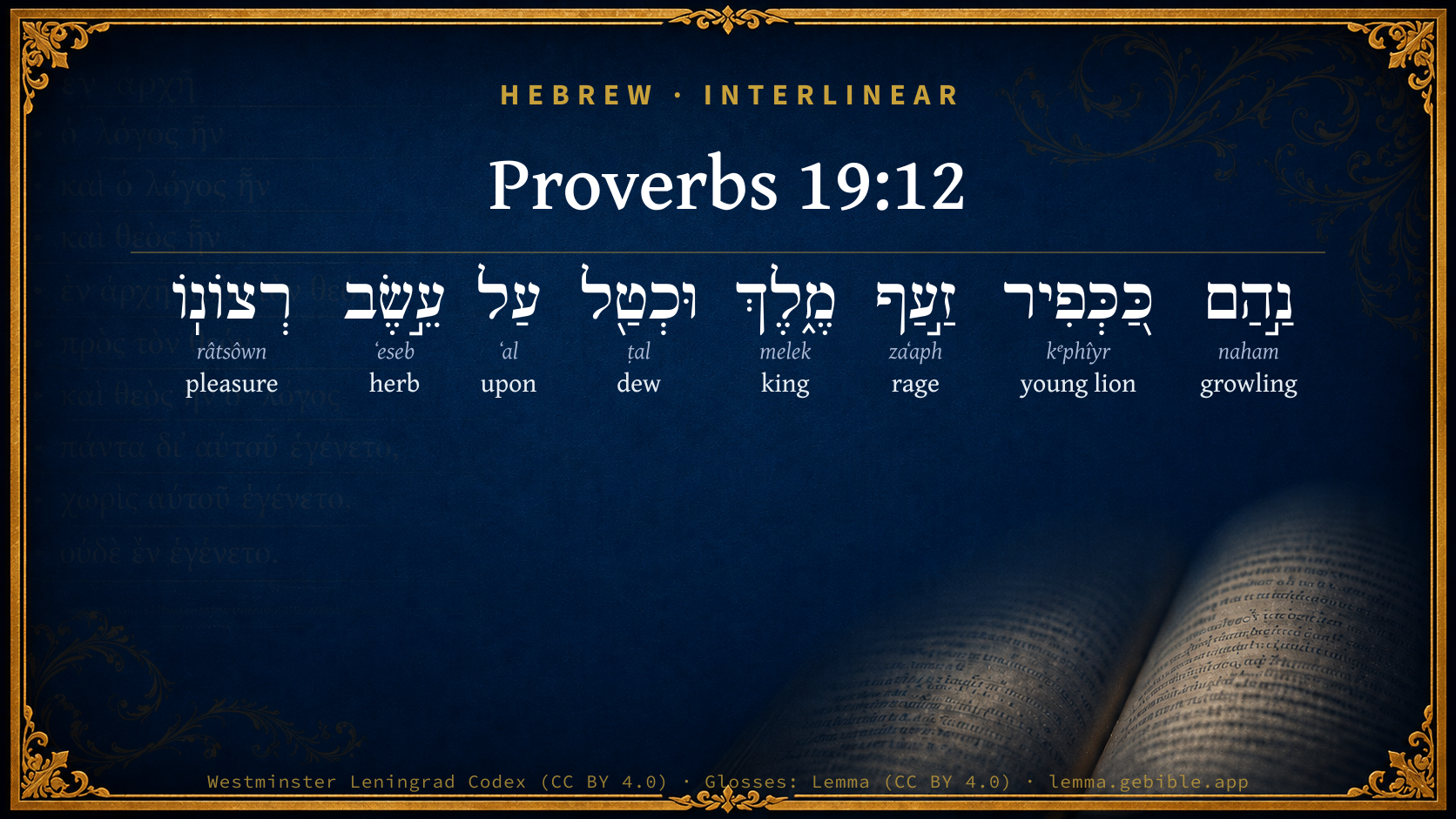
Proverbs 19:12

Hebrew (Westminster Leningrad Codex) Proverbs 19:12 appears in the Hebrew Old Testament. The text above is from the Westminster Leningrad Codex. Each word links to its Strong’s number, a concise gloss, and parsing drawn from the Open Scriptures Hebrew Bible morphology. Click any word for its full Brown-Driver-Briggs (BDB) entry.
Download image
Cite this verse

Proverbs 19:12 (World English Bible). Public Domain. Lemma interlinear Bible study tool, https://lemma.gebible.app/v/proverbs/19/12.

Show BibTeX & RIS
BibTeX
RIS
English Translation
The king's wrath is like the roaring of a lion, But his favor is like dew on the grass.
World English Bible · Public Domain
Highlights
  • 1 first appearance in the Hebrew Bible
Full analysis ↓
Download a study sheet

One document with this verse’s original text, its word-by-word gloss line, the meaning frame, cross-references with their text, attributed commentary, and full source and license credits — printable, and it pastes into notes with its structure intact.

This verse Autodidact and up

Study sheet (.html) Plain text (.txt)

A passage Seminary Student

Up to 50 verses in one chapter. A passage sheet keeps up to 6 commentary sources and 12 cross-references per verse, in the order this page ranks them, and says so on the sheet whenever that leaves anything out. Ask for a single verse and you get the Autodidact verse sheet above.

Everything on this page stays free to read, with no account — the sheet is a download of what is already on screen, not access to it.

Want to remove ads? Support Godless Engineer
Compare translations 3

The same verse in 3 English versions, stacked beneath the original-language interlinear above. Click any original word for its lexicon entry.

Each is an independent rendering of the whole verse — the interlinear is not word-aligned to these translations.

Highlighted words mark where these versions differ — a whole-verse word diff, not a word-by-word alignment.

  • World English Bible Public Domain
    The king's wrath is like the roaring of a lion, But his favor is like dew on the grass.
  • King James Version Public Domain
    The king's wrath is as the roaring of a lion; but his favour is as dew upon the grass.
  • unfoldingWord Literal Text CC BY-SA 4.0
    The rage of a king a growling like the young lion, but his favor like dew on vegetation.

unfoldingWord Literal Text — © unfoldingWord, licensed CC BY-SA 4.0. Word-aligned USFM3 via Door43 (git.door43.org/unfoldingWord/en_ult).

Versions to compare (up to 4)

3 of 4 selected

Show all 18 translations

Every available English version of this verse, each an independent rendering of the whole verse.

  • World English Bible Public Domain
    The king's wrath is like the roaring of a lion, But his favor is like dew on the grass.
  • Berean Standard Bible Public Domain
    A king’s rage is like the roar of a lion, but his favor is like dew on the grass.
  • Majority Standard Bible Public Domain
    A king’s rage is like the roar of a lion, but his favor is like dew on the grass.
  • King James Version Public Domain
    The king's wrath is as the roaring of a lion; but his favour is as dew upon the grass.
  • American Standard Version (1901) Public Domain
    The king's wrath is as the roaring of a lion; But his favor is as dew upon the grass.
  • Revised Version (1885) Public Domain
    The king’s wrath is as the roaring of a lion; but his favour is as dew upon the grass.
  • Geneva Bible (1599) Public Domain
    The Kings wrath is like the roaring of a lyon: but his fauour is like the dewe vpon ye grasse.
  • Douay-Rheims (1899) Public Domain
    As the roaring of a lion, so also is the anger of a king: and his cheerfulness as the dew upon the grass.
  • Young's Literal Translation Public Domain
    The wrath of a king `is' a growl as of a young lion, And as dew on the herb his good-will.
  • Literal Standard Version CC BY-SA 4.0
    The wrath of a king [is] a growl as of a young lion, || And his goodwill as dew on the herb.
  • Unlocked Literal Bible CC BY-SA 4.0
    The wrath of the king is like the roaring of a young lion, but his favor is like dew on the grass.
  • unfoldingWord Literal Text CC BY-SA 4.0
    The rage of a king a growling like the young lion, but his favor like dew on vegetation.
  • Darby Bible Public Domain
    The king's displeasure is as the roaring of a lion; but his favour is as dew upon the grass.
  • World Messianic Bible Public Domain
    The king’s wrath is like the roaring of a lion, but his favor is like dew on the grass.
  • Webster's Bible Public Domain
    The king's wrath is as the roaring of a lion; but his favor is as dew upon the grass.
  • Free Bible Version CC BY-SA 4.0
    When a king gets angry, he sounds like a roaring lion; but his kindness is as soft as dew on the grass.
  • Bible in Basic English Public Domain
    The king's wrath is like the loud cry of a lion, but his approval is like dew on the grass.
  • JPS Tanakh (1917) Public Domain
    The king's wrath is as the roaring of a lion; but his favour is as dew upon the grass.

Literal Standard Version (2020), Covenant Press — licensed CC BY-SA 4.0. Text via the HelloAO Bible API (eBible.org). Unlocked Literal Bible (unfoldingWord) — licensed CC BY-SA 4.0. Text via the HelloAO Bible API (eBible.org). unfoldingWord Literal Text — © unfoldingWord, licensed CC BY-SA 4.0. Word-aligned USFM3 via Door43 (git.door43.org/unfoldingWord/en_ult). Free Bible Version, Dr. Jonathan Gallagher — licensed CC BY-SA 4.0. Text via the HelloAO Bible API (eBible.org).

Word by word

More ways to search: Search by grammar → Find every occurrence → Compare this word →

Practice this passage: Drill this verse → Learn its vocabulary →

About this verse

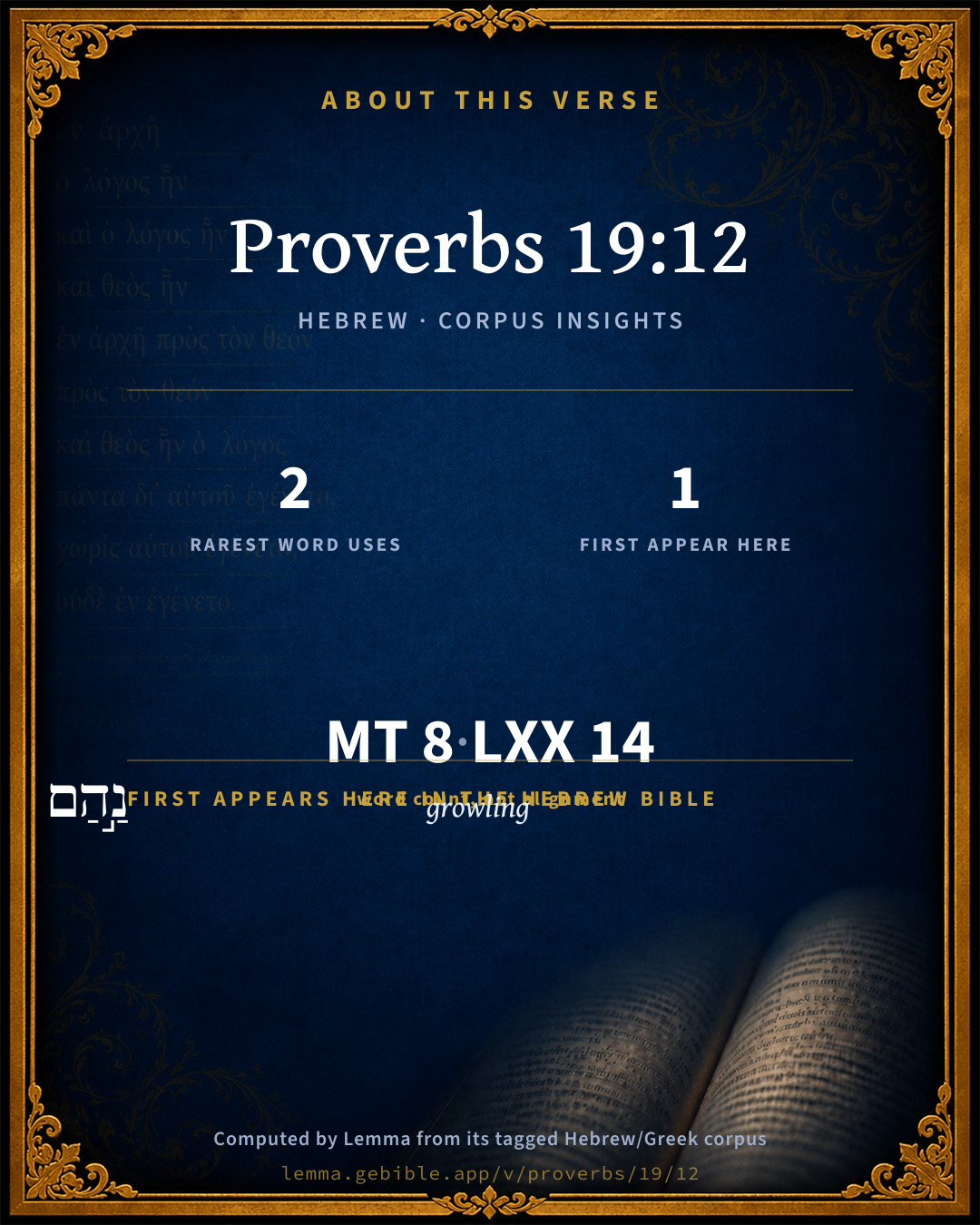
These counts appear in no published source. They are computed here, from the morphology-tagged text and Lemma’s own curated glosses. What Lemma adds →

8
words
8
distinct lemmas
Wisdom
section

Notable vocabulary

The rarest word here is נַ֣הַם growling H5099 — appearing just 2 times in the whole Hebrew Bible.

First appearance in Scripture

This word makes its first canonical appearance in the Hebrew Bible here:

  • נַ֣הַם growling H5099

Shared distinctive vocabulary

נַ֣הַם growling H5099 occurs in 2 verses of the Hebrew Bible. Also found in:

Grammatical profile

  • 7 nouns
  • 1 preposition

Hebrew & Septuagint length

In English translation the verse runs 19 words from the Hebrew and 22 from the Septuagint (LXX English) — closely comparable.

A rough comparison of the two English renderings, which tokenize alike — not a word-level alignment.

Word counts can differ between the Hebrew and the Greek without any difference in meaning — e.g. the Hebrew direct-object marker אֵת has no separate Greek word, and Greek often adds the article ὁ.

In the original languages it is 8 Hebrew tokens and 14 Greek tokens — but the two are counted differently (Hebrew bundles its prefixes and suffixes into one token; the Greek is in lemma form), so that isn’t a like-for-like length.

Cross-references

15

Topical passages linked to Proverbs 19:12 in the Treasury of Scripture Knowledge — connected by theme and wording, ordered by reader-vote popularity; previews shown in the World English Bible.

  • Hosea 14:5 I will be like the dew to Israel. He will blossom like the lily, And send down his roots like Lebanon.
  • Proverbs 16:14–15 The king's wrath is a messenger of death, But a wise man will pacify it.
  • Proverbs 20:2 The terror of a king is like the roaring of a lion: He who provokes him to anger forfeits his own life.
  • Luke 12:4–5 "I tell you, my friends, don't be afraid of those who kill the body, and after that have no more that they can do.
  • Proverbs 28:15 As a roaring lion or a charging bear, So is a wicked ruler over helpless people.
  • Esther 7:8 Then the king returned out of the palace garden into the place of the banquet of wine; and Haman was fallen on the couch whereon Esther was. Then said the king, Will he even force the queen before me in the house? As the word went out of the king's mouth, they covered Haman's face.
  • Psalms 133:3 Like the dew of Hermon, That comes down on the hills of Zion: For there Yahweh gives the blessing, Even life forevermore.
  • Ecclesiastes 8:4 for the king's word is supreme. Who can say to him, "What are you doing?"
  • Daniel 2:12–13 For this cause the king was angry and very furious, and commanded to destroy all the wise men of Babylon.
  • Daniel 3:19–23 Then was Nebuchadnezzar full of fury, and the form of his visage was changed against Shadrach, Meshach, and Abednego: [therefore] he spoke, and commanded that they should heat the furnace seven times more than it was wont to be heated.
  • 2 Samuel 23:4 [He shall be] as the light of the morning, when the sun rises, A morning without clouds, [When] the tender grass [springs] out of the earth, Through clear shining after rain.
  • Psalms 72:6 He will come down like rain on the mown grass, As showers that water the earth.
  • Daniel 6:24 The king commanded, and they brought those men who had accused Daniel, and they cast them into the den of lions, them, their children, and their wives; and the lions had the mastery of them, and broke all their bones in pieces, before they came to the bottom of the den.
  • Micah 5:7 The remnant of Jacob will be in the midst of many peoples, Like dew from Yahweh, Like showers on the grass, That don't wait for man, Nor wait for the sons of men.
  • Daniel 5:19 and because of the greatness that he gave him, all the peoples, nations, and languages trembled and feared before him: whom he would he killed, and whom he would he kept alive; and whom he would he raised up, and whom he would he put down.

Cross-references courtesy of OpenBible.info (CC BY 4.0).

Hebrew and Greek witnesses Masoretic Hebrew ↔ Greek Septuagint

The same verse in the two great witnesses to the Old Testament, shown verse-for-verse.

These are two independent witnesses, not word-aligned to each other, and the Septuagint is shown in lemma (dictionary) form.

Hebrew Proverbs 19:12 Masoretic · Westminster Leningrad Codex

נַ֣הַם כַּ֭כְּפִיר זַ֣עַף מֶ֑לֶךְ וּכְטַ֖ל עַל עֵ֣שֶׂב רְצוֹנֽוֹ

The king's wrath is like the roaring of a lion, But his favor is like dew on the grass.

World English Bible · Public Domain

Greek LXX Proverbs 19:12 Septuagint · lemma form

βασιλεύς ἀπειλή ὅμοιος βρυγμός λέων ὥσπερ δέ δρόσος ἐπί χόρτος οὕτως ὁ ἱλαρός αὐτός

The threatening of a king is like the roaring of a lion; but as dew on the grass, so is his favor.

LXX2012 (modern English Septuagint) · Public Domain

On this verse, The Pulpit Commentary discusses the Septuagint’s reading. Read the note in Commentary ↓

Hebrew: Westminster Leningrad Codex (CC BY 4.0). Greek: Septuagint (public domain); English from LXX2012 (modern English Septuagint) (Public Domain). How the Septuagint differs from the Hebrew →

Commentary

Notes on Proverbs 19:12 from classic Christian and Jewish commentators (each source and its license shown beneath its notes). The classic Christian expositions comment on the surrounding passage and are grouped to its opening verse, so a note may address several verses; the Jewish commentaries on the Tanakh (Rashi and others) are per-verse, so they appear only where the commentator wrote on this verse.

Lemma curates 59 commentaries, every one of them public domain or Creative Commons licensed, each selected and text-cleaned for this edition rather than reprinted as found. About our sources →

Trapp's Complete Commentary

John Trapp

Pro 19:12 The king’s wrath [is] as the roaring of a lion; but his favour [is] as dew upon the grass.

Ver. 12. The king’s wrath is as the roaring of a lion.] Heb., Of a young lion, which, being in his prime, roars more terribly; sets up his roar with such a force that he amazeth the other creatures whom he hunteth, so that, though far swifter of foot than the lion, they have no power to fly from him. {a} Kings have long hands, strong clutches. Good therefore is the wise man’s counsel in Ecc 8:2-4. {See Trapp on "Pro 16:14"} {See Trapp on "Pro 16:15"}

{a} Ambros., Hexs., lib. vi. cap. 5.

John Trapp, A Commentary or Exposition upon All the Books of the Old and New Testament (1647–1656) — public domain. Text from a community e-Sword module.

Joseph Benson's Commentary

Pro 19:12. The king’s wrath is as the roaring of a lion — The words of a king in anger are as much to be feared as the roaring of a lion; but his favour is as dew upon the grass — Any token of his favour and kindness is as comfortable as the dew which refreshes the grass and herbs, parched by the hot beams of the sun.

Joseph Benson's Commentary on the Old and New Testaments (1811–1818) — public domain. Text from a community e-Sword module.

Tyndale Open Study Notes

Tyndale Open Resources

19:12 A lion’s roar is a frightening prelude to life-threatening violence (cp. 20:2). Dew on the grass is soothing and contributes to growth (see 16:14-15).

Tyndale Open Study Notes — © Tyndale Open Resources, licensed CC BY-SA 4.0. Text via the HelloAO Bible API.

Matthew Henry's Commentary

This is to the same purport with what we had Pro 16:14, Pro 16:15, and the design of it is, 1. To make kings wise and considerate in dispensing their frowns and smiles. They are not like those of common persons; their frowns are very terrible and their smiles very comfortable, and therefore it concerns them to be very careful that they never frighten a good man from doing well with their frowns, nor ever give countenance to a wicked man in doing ill with their smiles, for then they abuse their influence, Rom 13:3. 2. To make subjects faithful and dutiful to their princes. Let them be restrained from all disloyalty by the consideration of the dreadful consequence of having the government against them; and let them be encouraged in all good services to the public by the hopes of the favour of their prince. Christ is a King whose wrath against his enemies will be as the roaring of a lion (Rev 10:3) and his favour to his own people as the refreshing dew, Psa 72:6.

Matthew Henry's Commentary on the Whole Bible (1708–1710) — public domain (CC PDM 1.0). Text via the HelloAO Bible API.

Jamieson, Fausset & Brown

Robert Jamieson, A. R. Fausset & David Brown

(Compare Pro 16:14-15; Pro 20:2). A motive to submission to lawful authority.

Jamieson, Fausset & Brown — Commentary Critical and Explanatory on the Whole Bible (1871) — public domain (CC PDM 1.0). Text via the HelloAO Bible API.

Adam Clarke's Commentary

Verse 12. The king's wrath is as the roaring of a lion] There is nothing more dreadful than the roaring of this tyrant of the forest. At the sound of it all other animals tremble, flee away, and hide themselves. The king who is above law, and rules without law, and whose will is his own law, is like the lion. This is strongly descriptive of the character of Asiatic sovereigns.

Adam Clarke's Commentary on the Bible (1810–1826) — public domain. Text from a community e-Sword/MySword module.

The Cambridge Bible for Schools and Colleges

gen. ed. J. J. S. Perowne

12. as dew upon the grass] Comp. Pro_16:15; Psa_72:6.

The Cambridge Bible for Schools and Colleges (gen. ed. J. J. S. Perowne; Cambridge University Press, 1878–1918) — public domain. Text from a community e-Sword module.

John Gill's Exposition

The king's wrath is as the roaring of a lion,.... Which is very terrible when hungry, and is after its prey, and has got it. Kings, especially tyrannical ones, are compared to lions; as Nebuchadnezzar by Jeremiah, Jer 4:17; and Nero by the Apostle Paul, Ti2 4:7; and the rage of such is very dreadful, as Ahasuerus's was to Haman. Jarchi interprets the king, of the holy blessed God. It may be applied to Jesus Christ, the Lion of the tribe of Judah; who is said to cry with a loud voice, as when a lion roareth; and whose wrath is terrible to wicked men, and even to the kings of the earth, Rev 5:5;

but his favour is as dew upon the grass; which refreshes and revives it, and causes it to grow and flourish: and so the favour and good will of a king to his subjects delights them, and causes joy and cheerfulness in them; and such an effect has the love of God and Christ on the children of men, Hos 14:6.

John Gill's Exposition of the Whole Bible (1746–1763) — public domain (CC PDM 1.0). Text via the HelloAO Bible API.

Haydock's Catholic Bible Commentary

Anger. Is not their dominion enough? Having none to admonish them, they do not perceive their excesses.

George Leo Haydock (1774–1849), Haydock's Catholic Family Bible and Commentary, 1859 edition — public domain. Excludes Psalms (Douay-Rheims chapter numbering differs from Protestant) and Deuterocanonical books (Catholic canon only).

Whedon's Commentary on the Bible

Daniel D. Whedon

12. King’s wrath — The verse presents a striking picture of an Oriental despot, on whose smile or frown life or death depends. The word rendered lion means a young lion, said to be the strongest and fiercest. Comp. Pro_16:14; Pro_20:2; Pro_28:15. For the figure of dew, comp. Pro_16:15; Psa_72:6.

Daniel D. Whedon (gen. ed.), Commentary on the Old and New Testaments (1874–1909) — public domain. Text from a community e-Sword module.

The Pulpit Commentary

The king"s wrath is as the roaring of a lion, which inspires terror, as precluding danger and death. The same idea occurs in Pro_20:2. (comp. Amo_3:4, Amo_3:8) The Assyrian monuments have made us familiar with the lion as a type of royalty; and the famous throne of Solomon was ornamented with figures of lions on each of its six steps. (1Ki_10:19, etc.) Thus St. Paul. alluding to the Roman emperor, says, (2Ti_4:17) "I was delivered out of the mouth of the lion." "The lion is dead," announced Marsyas to Agrippa, on the decease of Tiberius (Josephus, "Ant.," 18:6, 10). The mondist here gives a monition to kings to repress their wrath and not to let it rage uncontrolled, and a warning to subjects not to offend their ruler, lest he tear them to pieces like a savage beast, which an Eastern despot had full power to do. But his favour is as dew upon the grass. In Pro_16:15 the king"s favour was compared to a cloud of the latter rain; here it is likened to the dew. (comp. Psa_72:6) We hardly understand in England the real bearing of this comparison. "The secret of the luxuriant fertility of many parts of Palestine," says Dr. Geikie ("Holy Land and Bible," 1:72, etc.), "lies in the rich supply of moisture afforded by the sea winds which blow inland each night, and water the face of the whole land. There is no dew, properly so called in Palestine, for there is no moisture in the hot summer air to be chilled into dewdrops by the coolness of the night, as in a climate like ours. From May till October rain is unknown, the sun shining with unclouded brightness day after day. The heat becomes intense, the ground hard; and vegetation would perish but for the moist west winds that come each night from the sea. The bright skies cause the heat of the day to radiate very quickly into space, so that the nights are as cold as the day is the reverse....To this coldness of the night air the indispensable watering of all plant life is due. The winds, loaded with moisture, are robbed of it as they pass over the land, the cold air condensing it into drops of water, which fall in a gracious rain of mist on every thirsty blade. In the morning the fog thus created rests like a sea over the plains, and far up the sides of the hills, which raise their heads above it like so many islands The amount of moisture thus poured on the thirsty vegetation during the night is very great. Dew seemed to the Israelites a mysterious gift of Heaven, as indeed it is. That the skies should be stayed from yielding it was a special sign of Divine wrath, and there could be no more gracious conception of a loving farewell address to his people than where Moses tells them that his speech should distil as the dew. The favour of an Oriental monarch could not be more boneficially conceived than by saying that, while his wrath is like the roaring of a lion, his favour is as the dew upon the grass." wOxr (ration), "favour," is translated by the Septuagint, to ilaron , and by the Vulgate, hilaritas, "cheerfulness", (as in Pro_18:22) which gives the notion of a smiling, serene, benevolent countenance as contrasted with the angry, lowering look of displeased monarch.

The Pulpit Commentary (1880–1919), ed. H.D.M. Spence-Jones & Joseph S. Exell — public domain. Text from a community e-Sword module.

Keil & Delitzsch

C. F. Keil & F. Delitzsch

12 A murmuring as of a lion is the wrath of the king,

And as dew on plants is his favour.

Line 1 is a variation of Pro 20:2; line 2a of Pro 16:15. זעף is not the being irritated against another, but generally ill-humour, fretfulness, bad humour; the murmuring or growling in which this state of mind expresses itself is compared to that of a lion which, growling, prepares and sets itself to fall upon its prey (vid., Isa 5:29, cf. Amo 3:4). Opposed to the זעף stands the beneficial effect of the רצון, i.e., of the pleasure, the delight, the satisfaction, the disposition which shows kindness (lxx τὸ ἱλαρὸν αὐτοῦ). In the former case all are afraid; in the latter, everything lives, as when the refreshing dew falls upon the herbs of the field. The proverb presents a fact, but that the king may mirror himself in it.

Keil & Delitzsch — Biblical Commentary on the Old Testament (1861–1891) — public domain (CC PDM 1.0). Text via the HelloAO Bible API. (Old Testament only.)

Bridges on Proverbs

Charles Bridges

The monarch of the forest is a just comparison to the monarch of the land.†1 "The lion hath roared; who will not fear?"†2 The rocks and hills echo the terrific cry. The whole race of the animals of the forest are driven to flight, or petrified to the spot. Such is the king’s wrath in a land of despotism;†3 reigning without law, above law, his will his only law; an awful picture of cruelty,†4 tyranny,†5 and caprice!†6 Unlimited power is too much for proud human nature to bear, except with special grace from above. Just so is the king’s favour a reviving blessing, as dew upon the grass — the nourishment of vegetative life in the East, where the more powerful influence is only partially or periodically known.†7

But if the wrath of a king be so terrible — Oh, my soul, what must be the wrath of God! (Luk 12:4-5 .) If it be so terrible in this world, where every drop is mixed with mercy; what will it be in eternity, where it is "poured out without mixture" and wthout cessation (Rev 14:10-11 ); where his power is so fearfully manifested, not only in tormenting, but in preserving and "establishing for correction"? (Hab 1:12 .) Oh! let this wrath be the grand object of my reverential fear. Let me flee from it by the only way of escape, while escape is open to me; and seek his favour, as the enriching "dew" unto Israel, invigorating and fertilizing my barren soil. (Hos 14:5-7 . Psa 72:6 .)

Footnotes:

†1 Compare Jer 4:7 ; Jer 50:17 . 2Ti 4:17 .

†2 Amo 3:8. Rev 10:1-3 . See Homer’s fine picture, Iliad, Y. 164-171.

†3 Pro 16:14; Pro 20:2 ; Pro 28:15 .

†4 Mat 2:16-18.

†5 Exo 5:4-9. Dan 3:1-19

†6 Dan 2:5-12.

†7 Pro 16:15. 2Sa 23:3-4 .

Charles Bridges, An Exposition of the Book of Proverbs (1846) — public domain. Text from a community e-Sword module.

Kretzmann's Popular Commentary

Paul E. Kretzmann

v. 12. The king’s wrath is as the roaring of a lion, striking terror to the hearts of men as he prepares to fall upon his prey; but his favor is as dew upon the grass, pleasant and refreshing.

Paul E. Kretzmann, Popular Commentary of the Bible (1921–1924) — public domain. Text from a community e-Sword module.

Rashi

Rabbi Shlomo Yitzchaki (Rashi)

The King’s fury is like a lion’s roar [The fury of] the Holy One, blessed be He.

Rashi on the Tanakh — English translations: “The Judaica Press complete Tanach with Rashi, translated by A. J. Rosenberg” (CC BY 4.0); “Pentateuch with Rashi's commentary by M. Rosenbaum and A.M. Silbermann, 1929-1934” (public domain); “The Metsudah Tanach series, Lakewood, N.J” (CC BY 4.0); and “The Book of Joshua, Metsudah Publications, 1997” (CC BY 4.0). Text via Sefaria.

Lesson kit

Teaching starters — assembled from the data on this page, not authored interpretation. Every prompt links to the verse data it draws on. Edit before teaching.

Proverbs, in the Wisdom, opens this verse with 8 words (8 distinct Hebrew lemmas). Its most distinctive word is naham (“growling”). A historical commentator’s framing appears above. Read the whole chapter for the surrounding context.

Discussion questions

  1. What does “growling” (naham) contribute to the verse as a whole?
  2. The word “growling” first appears here in Scripture. What is being introduced at this debut?
  3. Proverbs 20:2 shares the word «growling» with this verse. How do the two illuminate each other?
  4. These translations render this verse differently; the difference is in the English rendering, not the original. What questions does that raise?
  5. Reading how Trapp's Complete Commentary and Joseph Benson's Commentary read this verse, where do the two commentators agree and where do they part?

Things to notice

Reading settings

Reading text

Shown beneath each verse's original-language words.

Old Testament
Old Testament edition

Read the OT as the Masoretic Hebrew (MT) or the Greek Septuagint (LXX).

English shown for the Greek Septuagint (in the Hebrew ↔ Greek comparison).

Comparing translations? Open the Compare panel on any verse page to stack up to four side by side.