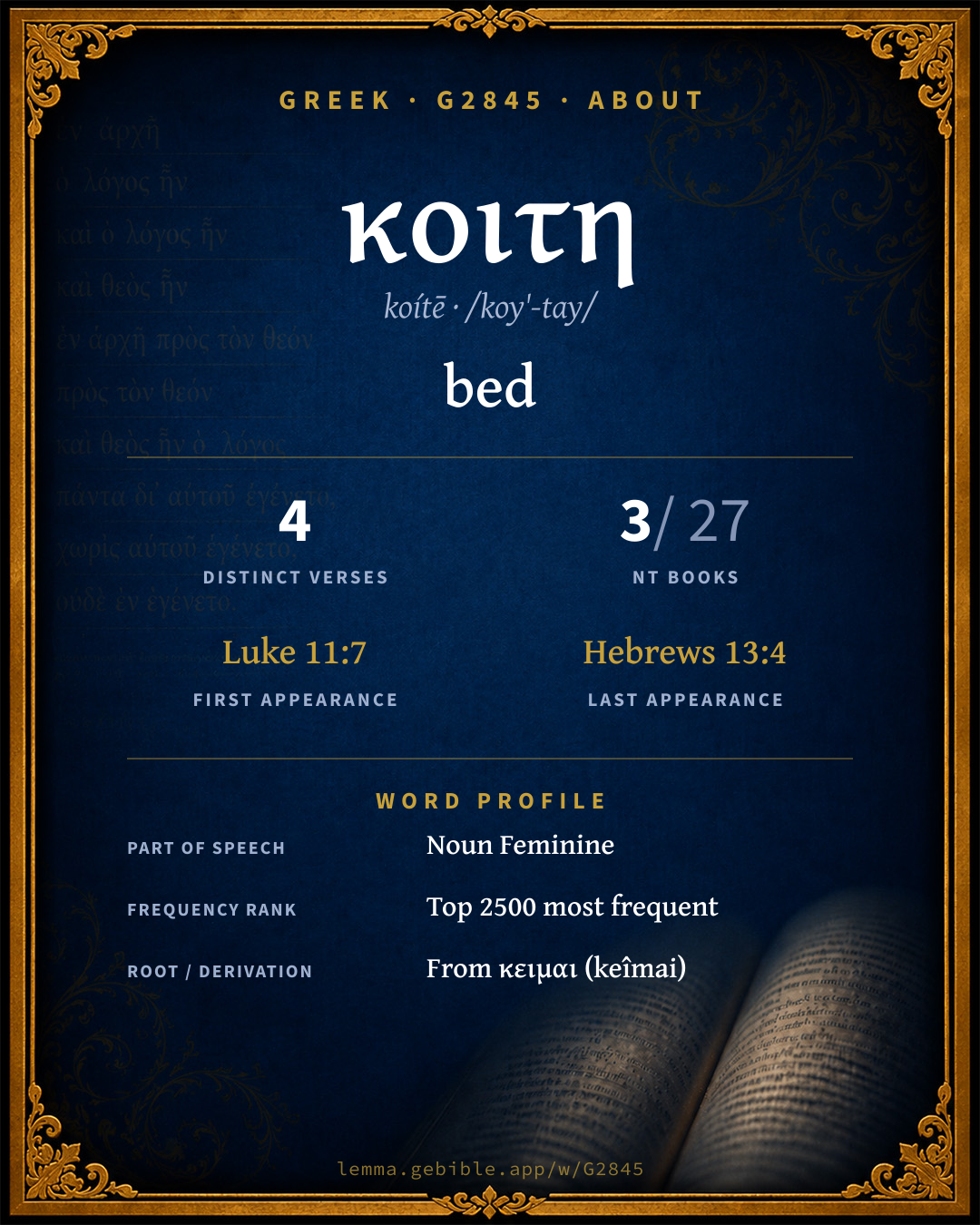
κοίτη
bed
‘bed’ is one of 3 main senses fuller range ↓
Full lexicon entry — Thayer's Greek Lexicon
From Thayer's Greek Lexicon
Where this word appears
See every Accusative-case word in the Greek New Testament →
Grammar key — what these labels mean
Part of speech
- Noun
- A naming word — a person, place, thing, or idea.
Case
- Accusative
- The case of the direct object and of extent.
- Dative
- The case of the indirect object, means, or location — “to / for / with / in.”
- Nominative
- The case of the subject (and the predicate nominative).
Gender
- Feminine
- Grammatically feminine.
Number
- Singular
- One.
- Plural
- More than one.
1 distinct verse where G2845 appears in the Nominative case, across 1 book. Filtered view — show all forms. Click any verse to open its interlinear word-by-word view. Verse text shown in the World English Bible for context — . Each verse’s Greek form is shown with its reference; the English is not keyword-highlighted, since the data carries no word-level English alignment. Use “Compare translations” on any verse to read it across multiple English versions. This concordance covers the Greek New Testament; Septuagint (Greek Old Testament) occurrences of this word are not indexed here.
Hebrews 1 verse
About this entry
At a glance — auto-summarized from this page’s data, not written by a person. Every figure links to its source below. This summary describes the numbers; it doesn’t interpret them.
At its core, κοιτη (koítē) means “bed.” It occurs a mere 4 verses across Scripture. The word gravitates to Romans (50%), then Luke and Hebrews. It first appears in Luke 11:7. Ranging over 3 senses, it is not a single-sense word. Dig into 4-verse concordance and the renderings breakdown below.
Gloss history
Strong's 1890 vs modern scholarship
About this word
Strong's G2845 catalogs a Greek word from the Greek New Testament.
These counts are not copied from any lexicon or concordance. They are computed here, from the morphology-tagged Greek New Testament. What Lemma adds →
- 4
- distinct verses
- The word appears in 4 distinct verses.
- 3 / 27
- NT books
- The word appears in 3 of 27 New Testament books.
- #1,877
- by frequency
- Top 2500 most frequent Greek words (rank 1,877 of 5,347 Greek words by occurrence).
View all 4 occurrences in the concordance →
By section of the New Testament
By traditional corpus
Conventional, traditional groupings — biblical authorship is debated, so this is a traditional corpus grouping, not an authorship claim. Some books belong to more than one corpus (Luke is in both the Gospels and the Lukan corpus, and so on), so these shares overlap and need not total 100%. Each figure is a share of the word’s 4 distinct verses.
- Pauline corpus 2 verses · 50%
- Gospels 1 verse · 25%
- Lukan (Luke–Acts) 1 verse · 25%
- Hebrews 1 verse · 25%
How translations render this word
Counts come from each version’s own published word-to-Strong’s tagging or interlinear alignment — an approximate guide to how each version renders this word, not a word-level alignment the data otherwise carries. Because each total is that version’s own tagged count, the per-version totals vary from one another and need not match the appearance or distinct-verse counts above. These counts may also differ from a printed concordance because Lemma counts each distinctly tagged rendering and does not collapse phrase taggings into a single head-word total. This is a fixed set of word-tagged versions (KJV, ASV, BSB, ULT) and does not change with the reading translation you choose elsewhere. Each version’s license is shown beside its name below (and on Sources).
- King James Version: Bed 2×
- American Standard Version: Bed 1×, Chambering 1×, Conceived 1×
- Berean Standard Bible: Bed 1×, Conceived 1×, Marriage bed 1×
- unfoldingWord Literal Text: Bed 1×, Having conceived 1×, Marriage bed 1×
King James Version Public Domain
Renders G2845 across 4 tagged occurrences — most commonly:
Plus 2 renderings that appear only once — usually multi-word phrases or single function words the recovered tagging swept in, not distinct renderings.
American Standard Version Public Domain
Renders G2845 across 4 tagged occurrences — most commonly:
Berean Standard Bible Public Domain
Renders G2845 across 4 tagged occurrences — most commonly:
unfoldingWord Literal Text CC BY-SA 4.0
Renders G2845 across 4 tagged occurrences — most commonly:
Senses in Thayer's
The 3 senses Thayer's distinguishes for this word, in lexicon order (not ranked by frequency or importance). The full entry — with sub-senses — is in the Lexicon Entry tab.
- a place for laying down, resting, sleeping in
- of adultery
- cohabitation, whether lawful or unlawful
Word origin
Derived from κειμαι (keîmai) (G2749) — to lie.
From G2749 ; a couch ; by extension cohabitation ; by implication the male sperm : - bed chambering X conceive.
— Strong’s Exhaustive Concordance (1890), public domain.
Forms in the corpus
The 3 distinct written forms G2845 takes in the Greek New Testament, most frequent first — each parse links to that case’s occurrences in the concordance.
| Form | Parsing | Example | Uses |
|---|---|---|---|
| κοίτην koítēn | Noun, Accusative, Singular, Feminine | Luke 11:7 | 2 |
| κοίταις koítais | Noun, Dative, Plural, Feminine | Romans 13:13 | 1 |
| κοίτη koítē | Noun, Nominative, Singular, Feminine | Hebrews 13:4 | 1 |
Same root — word family
Other Thayer's entries built from the same root as G2845, grouped by Strong’s listed origin. These share a root / origin per the lexicon — not necessarily a shared meaning. Each links to that word’s own entry.
Derives from
Shares the same root
Derived from this word
Compare all same-root words → Showing 4 of 6 — not the complete family. They share a root, not necessarily a meaning.
Septuagint usage
The same Greek word κοιτη appears 63 times in the Greek Old Testament (Septuagint), across 61 verses in 18 books.
- 63
- LXX occurrences
- Tagged occurrences of this Greek word in the Septuagint.
- 61
- verses
- Distinct Septuagint verses containing this word.
- 18 / 39
- OT books
- The word appears in 18 of the 39 Old Testament books.
Sample Septuagint occurrences
- Genesis 49:4 κοίτη
- Exodus 10:23 κοίτη
- Leviticus 15:4 κοίτη
- Numbers 5:13 κοίτη
- Judges 21:11 κοίτη
- 2 Samuel 4:5 κοίτη
- 1 Kings 1:47 κοίτη
- 1 Chronicles 5:1 κοίτη
- Job 7:13 κοίτη
- Psalms 4:5 κοίτη
- Proverbs 7:17 κοίτη
- Song of Solomon 3:1 κοίτη
Septuagint occurrences (same lexeme)
Every verse where the same Strong’s number (G2845) appears in the Greek Septuagint — showing the first 50 of 61. Verse text shown in the World English Bible for context; the Greek form is the matched word — the English is not keyword-highlighted.
- Genesis 49:4 κοίτη Boiling over as water, you shall not have the pre-eminence; Because you went up to your father's bed; Then defiled it. He went up to my couch.
- Exodus 10:23 κοίτη They didn't see one another, neither did anyone rise from his place for three days; but all the children of Israel had light in their dwellings.
- Exodus 21:18 κοίτη "If men quarrel and one strikes the other with a stone, or with his fist, and he doesn't die, but is confined to bed;
- Leviticus 15:4 κοίτη "'Every bed whereon he who has the discharge lies shall be unclean; and everything he sits on shall be unclean.
- Leviticus 15:5 κοίτη Whoever touches his bed shall wash his clothes, and bathe himself in water, and be unclean until the evening.
- Leviticus 15:16 κοίτη "'If any man has an emission of semen, then he shall bathe all his flesh in water, and be unclean until the evening.
- Leviticus 15:17 κοίτη Every garment, and every skin, whereon the semen is, shall be washed with water, and be unclean until the evening.
- Leviticus 15:18 κοίτη If a man lies with a woman and there is an emission of semen, they shall both bathe themselves in water, and be unclean until the evening.
- Leviticus 15:21 κοίτη Whoever touches her bed shall wash his clothes, and bathe himself in water, and be unclean until the evening.
- Leviticus 15:23 κοίτη If it is on the bed, or on anything whereon she sits, when he touches it, he shall be unclean until the evening.
- Leviticus 15:24 κοίτη "'If any man lies with her, and her monthly flow is on him, he shall be unclean seven days; and every bed whereon he lies shall be unclean.
- Leviticus 15:26 κοίτη Every bed whereon she lies all the days of her discharge shall be to her as the bed of her period: and everything whereon she sits shall be unclean, as the uncleanness of her period.
- Leviticus 15:32 κοίτη This is the law of him who has a discharge, and of him who has an emission of semen, so that he is unclean thereby;
- Leviticus 18:20 κοίτη "'You shall not lie carnally with your neighbor's wife, and defile yourself with her.
- Leviticus 18:22 κοίτη "'You shall not lie with a man, as with a woman. That is detestible.
- Leviticus 18:23 κοίτη "'You shall not lie with any animal to defile yourself with it; neither shall any woman give herself to an animal, to lie down with it: it is a perversion.
- Leviticus 19:20 κοίτη "'If a man lies carnally with a woman who is a slave girl, pledged to be married to another man, and not ransomed, or given her freedom; they shall be punished. They shall not be put to death, because she was not free.
- Leviticus 20:13 κοίτη If a man lies with a male, as with a woman, both of them have committed an abomination: they shall surely be put to death; their blood shall be upon them.
- Leviticus 22:4 κοίτη "'Whoever of the seed of Aaron is a leper or has an issue; he shall not eat of the holy things, until he is clean. Whoever touches anything that is unclean by the dead, or a man whose seed goes from him;
- Numbers 5:13 κοίτη and a man lies with her carnally, and it is hidden from the eyes of her husband, and is kept close, and she is defiled, and there is no witness against her, and she isn't taken in the act;
- Numbers 5:20 κοίτη But if you have gone astray, being under your husband, and if you are defiled, and some man has lain with you besides your husband:'
- Numbers 31:17 κοίτη Now therefore kill every male among the little ones, and kill every woman who has known man by lying with him.
- Numbers 31:18 κοίτη But all the girls, who have not known man by lying with him, keep alive for yourselves.
- Numbers 31:35 κοίτη and thirty-two thousand persons in all, of the women who had not known man by lying with him.
- Judges 21:11 κοίτη This is the thing that you shall do: you shall utterly destroy every male, and every woman who has lain by man.
- Judges 21:12 κοίτη They found among the inhabitants of Jabesh Gilead four hundred young virgins, who had not known man by lying with him; and they brought them to the camp to Shiloh, which is in the land of Canaan.
- 2 Samuel 4:5 κοίτη The sons of Rimmon the Beerothite, Rechab and Baanah, went, and came about the heat of the day to the house of Ish-bosheth, as he took his rest at noon.
- 2 Samuel 4:11 κοίτη How much more, when wicked men have slain a righteous person in his own house on his bed, shall I not now require his blood of your hand, and take you away from the earth?
- 2 Samuel 11:2 κοίτη It happened at evening, that David arose from off his bed, and walked on the roof of the king's house: and from the roof he saw a woman bathing; and the woman was very beautiful to look on.
- 2 Samuel 11:13 κοίτη When David had called him, he ate and drink before him; and he made him drunk: and at even he went out to lie on his bed with the servants of his lord, but didn't go down to his house.
- 2 Samuel 13:5 κοίτη Jonadab said to him, Lay you down on your bed, and feign yourself sick: and when your father comes to see you, tell him, Please let my sister Tamar come and give me bread to eat, and dress the food in my sight, that I may see it, and eat it from her hand.
- 2 Samuel 17:28 κοίτη brought beds, and basins, and earthen vessels, and wheat, and barley, and meal, and parched [grain], and beans, and lentils, and parched [pulse],
- 1 Kings 1:47 κοίτη Moreover the king's servants came to bless our lord king David, saying, Your God make the name of Solomon better than your name, and make his throne greater than your throne: and the king bowed himself on the bed.
- 1 Chronicles 5:1 κοίτη The sons of Reuben the firstborn of Israel (for he was the firstborn; but, because he defiled his father's couch, his birthright was given to the sons of Joseph the son of Israel; and the genealogy is not to be reckoned after the birthright.
- Job 7:13 κοίτη When I say, 'My bed shall comfort me, My couch shall ease my complaint;'
- Job 33:15 κοίτη In a dream, in a vision of the night, When deep sleep falls on men, In slumbering on the bed;
- Job 33:19 κοίτη He is chastened also with pain on his bed, With continual strife in his bones;
- Job 36:28 κοίτη Which the skies pour down And drop on man abundantly.
- Job 37:8 κοίτη Then the animals take cover, And remain in their dens.
- Job 38:40 κοίτη When they crouch in their dens, And lie in wait in the thicket?
- Psalms 4:5 κοίτη Offer the sacrifices of righteousness. Put your trust in Yahweh.
- Psalms 35:5 κοίτη Let them be as chaff before the wind, Yahweh's angel driving them on.
- Psalms 40:4 κοίτη Blessed is the man who makes Yahweh his trust, And doesn't respect the proud, nor such as turn aside to lies.
- Psalms 149:5 κοίτη Let the saints rejoice in honor. Let them sing for joy on their beds.
- Proverbs 7:17 κοίτη I have perfumed my bed with myrrh, aloes, and cinnamon.
- Song of Solomon 3:1 κοίτη By night on my bed, I sought him whom my soul loves. I sought him, but I didn't find him.
- Isaiah 11:8 κοίτη The sucking child shall play on the hole of the asp, and the weaned child shall put his hand on the adder's den.
- Isaiah 17:2 κοίτη The cities of Aroer are forsaken; they shall be for flocks, which shall lie down, and none shall make them afraid.
- Isaiah 56:10 κοίτη His watchmen are blind, they are all without knowledge; they are all mute dogs, they can't bark; dreaming, lying down, loving to slumber.
- Isaiah 57:7 κοίτη On a high and lofty mountain have you set your bed; there also you went up to offer sacrifice.
These are occurrences of the same Greek lexeme (G2845) in the Septuagint — not a translation of any one Hebrew word. The store carries no word-level Hebrew↔Greek alignment, so no Hebrew original is asserted here. Counts come from the recovered LXX Strong's tagging — high-frequency vocabulary is well covered, while rare or late forms may be untagged — so they reflect tagged occurrences and may slightly undercount.