
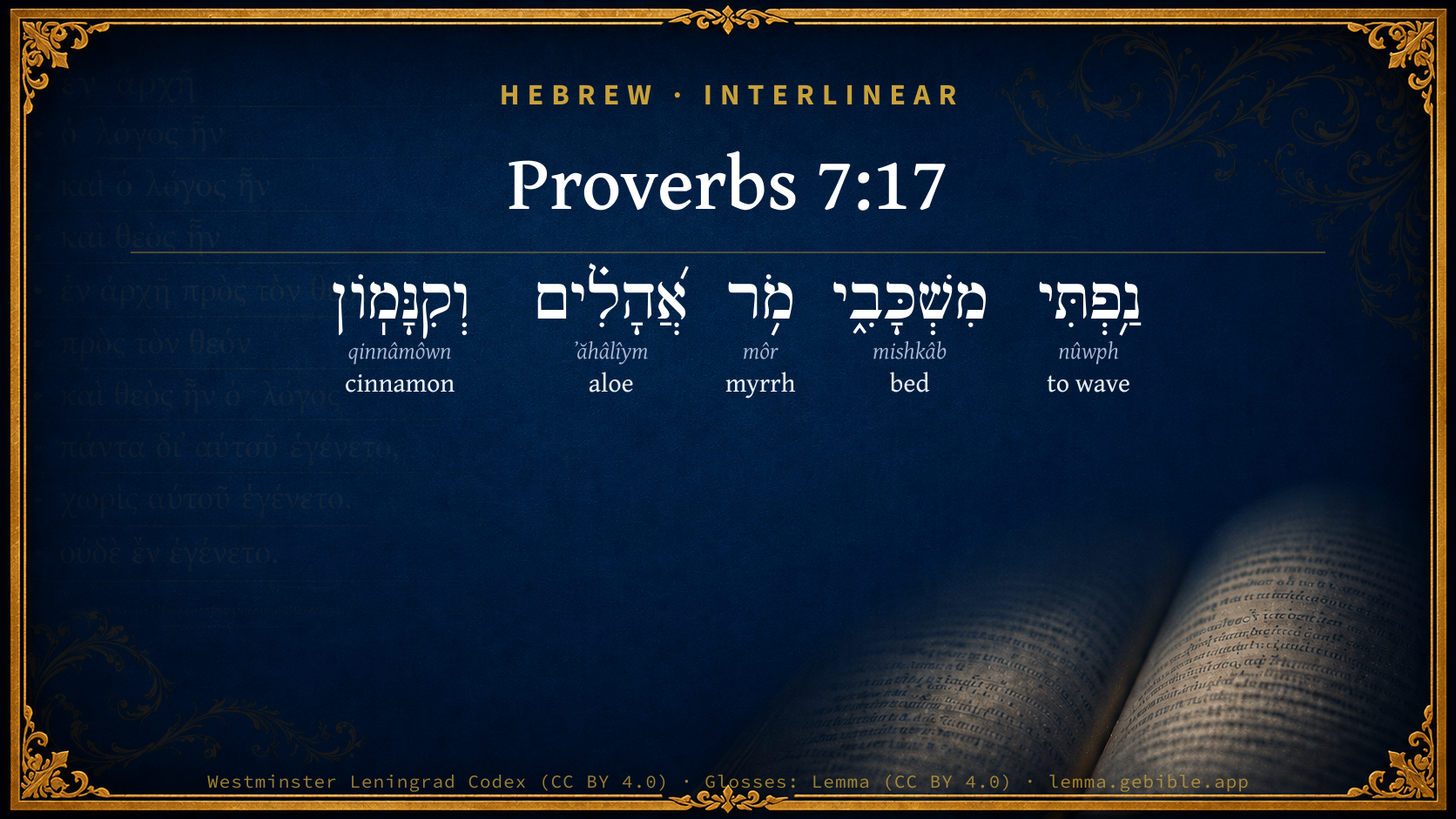
Proverbs 7:17

Hebrew (Westminster Leningrad Codex) Proverbs 7:17 appears in the Hebrew Old Testament. The text above is from the Westminster Leningrad Codex. Each word links to its Strong’s number, a concise gloss, and parsing drawn from the Open Scriptures Hebrew Bible morphology. Click any word for its full Brown-Driver-Briggs (BDB) entry.
Download image
Cite this verse

Proverbs 7:17 (World English Bible). Public Domain. Lemma interlinear Bible study tool, https://lemma.gebible.app/v/proverbs/7/17.

Show BibTeX & RIS
BibTeX
RIS
English Translation
I have perfumed my bed with myrrh, aloes, and cinnamon.
World English Bible · Public Domain
Download a study sheet

One document with this verse’s original text, its word-by-word gloss line, the meaning frame, cross-references with their text, attributed commentary, and full source and license credits — printable, and it pastes into notes with its structure intact.

This verse Autodidact and up

Study sheet (.html) Plain text (.txt)

A passage Seminary Student

Up to 50 verses in one chapter. A passage sheet keeps up to 6 commentary sources and 12 cross-references per verse, in the order this page ranks them, and says so on the sheet whenever that leaves anything out. Ask for a single verse and you get the Autodidact verse sheet above.

Everything on this page stays free to read, with no account — the sheet is a download of what is already on screen, not access to it.

Want to remove ads? Support Godless Engineer
Compare translations 3

The same verse in 3 English versions, stacked beneath the original-language interlinear above. Click any original word for its lexicon entry.

Each is an independent rendering of the whole verse — the interlinear is not word-aligned to these translations.

Highlighted words mark where these versions differ — a whole-verse word diff, not a word-by-word alignment.

  • World English Bible Public Domain
    I have perfumed my bed with myrrh, aloes, and cinnamon.
  • King James Version Public Domain
    I have perfumed my bed with myrrh, aloes, and cinnamon.
  • unfoldingWord Literal Text CC BY-SA 4.0
    I have sprinkled my bed myrrh, aloes, and cinnamon.

unfoldingWord Literal Text — © unfoldingWord, licensed CC BY-SA 4.0. Word-aligned USFM3 via Door43 (git.door43.org/unfoldingWord/en_ult).

Versions to compare (up to 4)

3 of 4 selected

Show all 18 translations

Every available English version of this verse, each an independent rendering of the whole verse.

  • World English Bible Public Domain
    I have perfumed my bed with myrrh, aloes, and cinnamon.
  • Berean Standard Bible Public Domain
    I have perfumed my bed with myrrh, with aloes, and with cinnamon.
  • Majority Standard Bible Public Domain
    I have perfumed my bed with myrrh, with aloes, and with cinnamon.
  • King James Version Public Domain
    I have perfumed my bed with myrrh, aloes, and cinnamon.
  • American Standard Version (1901) Public Domain
    I have perfumed my bed With myrrh, aloes, and cinnamon.
  • Revised Version (1885) Public Domain
    I have perfumed my bed with myrrh, aloes, and cinnamon.
  • Geneva Bible (1599) Public Domain
    I haue perfumed my bedde with myrrhe, aloes, and cynamom.
  • Douay-Rheims (1899) Public Domain
    I have perfumed my bed with myrrh, aloes, and cinnamon.
  • Young's Literal Translation Public Domain
    I sprinkled my bed -- myrrh, aloes, and cinnamon.
  • Literal Standard Version CC BY-SA 4.0
    I sprinkled my bed [with] myrrh, aloes, and cinnamon.
  • Unlocked Literal Bible CC BY-SA 4.0
    I have sprinkled my bed with myrrh, aloes, and cinnamon.
  • unfoldingWord Literal Text CC BY-SA 4.0
    I have sprinkled my bed myrrh, aloes, and cinnamon.
  • Darby Bible Public Domain
    I have perfumed my couch with myrrh, aloes, and cinnamon.
  • World Messianic Bible Public Domain
    I have perfumed my bed with myrrh, aloes, and cinnamon.
  • Webster's Bible Public Domain
    I have perfumed my bed with myrrh, aloes, and cinnamon.
  • Free Bible Version CC BY-SA 4.0
    I've sprinkled perfume on my bed—myrrh, aloes, and cinnamon.
  • Bible in Basic English Public Domain
    I have made my bed sweet with perfumes and spices.
  • JPS Tanakh (1917) Public Domain
    I have perfumed my bed with myrrh, aloes, and cinnamon.

Literal Standard Version (2020), Covenant Press — licensed CC BY-SA 4.0. Text via the HelloAO Bible API (eBible.org). Unlocked Literal Bible (unfoldingWord) — licensed CC BY-SA 4.0. Text via the HelloAO Bible API (eBible.org). unfoldingWord Literal Text — © unfoldingWord, licensed CC BY-SA 4.0. Word-aligned USFM3 via Door43 (git.door43.org/unfoldingWord/en_ult). Free Bible Version, Dr. Jonathan Gallagher — licensed CC BY-SA 4.0. Text via the HelloAO Bible API (eBible.org).

Word by word

More ways to search: Search by grammar → Find every occurrence → Compare this word →

Practice this passage: Drill this verse → Learn its vocabulary →

About this verse

These counts appear in no published source. They are computed here, from the morphology-tagged text and Lemma’s own curated glosses. What Lemma adds →

5
words
5
distinct lemmas
Wisdom
section

Notable vocabulary

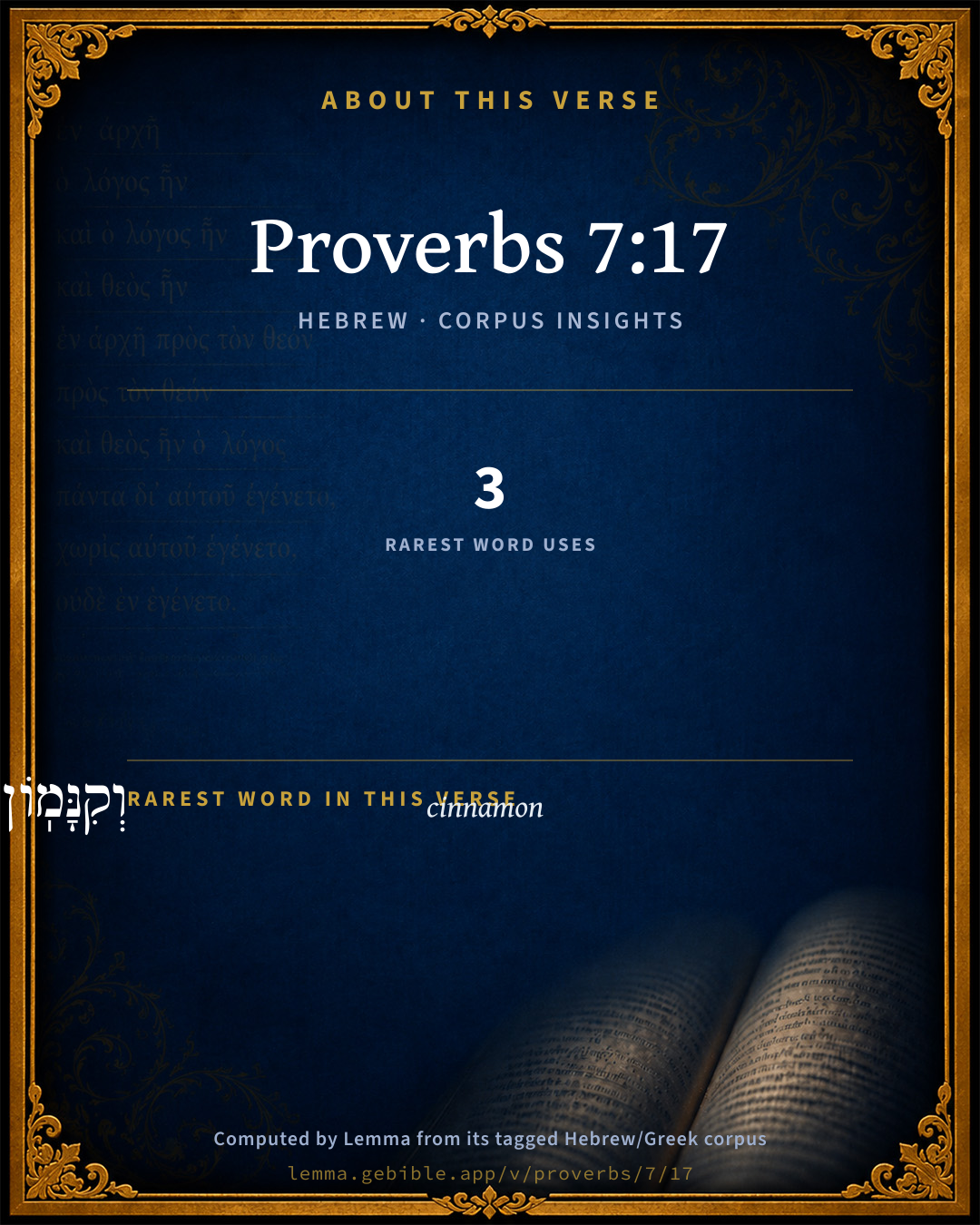
The rarest word here is וְקִנָּמֽוֹן cinnamon H7076 — appearing just 3 times in the whole Hebrew Bible.

Shared distinctive vocabulary

וְקִנָּמֽוֹן cinnamon H7076 occurs in 3 verses of the Hebrew Bible. Also found in:

Grammatical profile

  • 1 verb
  • 4 nouns

Verb forms

  • נַ֥פְתִּי Qal · Perfect

Hebrew & Septuagint length

In English translation the verse runs 10 words from the Hebrew and 12 from the Septuagint (LXX English) — closely comparable.

A rough comparison of the two English renderings, which tokenize alike — not a word-level alignment.

Word counts can differ between the Hebrew and the Greek without any difference in meaning — e.g. the Hebrew direct-object marker אֵת has no separate Greek word, and Greek often adds the article ὁ.

Cross-references

5

Topical passages linked to Proverbs 7:17 in the Treasury of Scripture Knowledge — connected by theme and wording, ordered by reader-vote popularity; previews shown in the World English Bible.

  • Psalms 45:8 All your garments smell like myrrh, aloes, and cassia. Out of ivory palaces stringed instruments have made you glad.
  • Isaiah 57:7–9 On a high and lofty mountain have you set your bed; there also you went up to offer sacrifice.
  • Exodus 30:23 "Also take fine spices: of liquid myrrh, five hundred shekels; and of fragrant cinnamon half as much, even two hundred and fifty; and of fragrant cane, two hundred and fifty;
  • Song of Solomon 3:6 Who is this who comes up from the wilderness like pillars of smoke, Perfumed with myrrh and frankincense, With all spices of the merchant?
  • Song of Solomon 4:13–14 Your shoots are an orchard of pomegranates, with precious fruits: Henna with spikenard plants,

Cross-references courtesy of OpenBible.info (CC BY 4.0).

Hebrew and Greek witnesses Masoretic Hebrew ↔ Greek Septuagint

The same verse in the two great witnesses to the Old Testament, shown verse-for-verse.

These are two independent witnesses, not word-aligned to each other, and the Septuagint is shown in lemma (dictionary) form.

Hebrew Proverbs 7:17 Masoretic · Westminster Leningrad Codex

נַ֥פְתִּי מִשְׁכָּבִ֑י מֹ֥ר אֲ֝הָלִ֗ים וְקִנָּמֽוֹן

I have perfumed my bed with myrrh, aloes, and cinnamon.

World English Bible · Public Domain

Greek LXX Proverbs 7:17 Septuagint · lemma form

διαῥαίνω ὁ κοίτη ἐγώ κρόκος ὁ δέ οἶκος ἐγώ κιννάμωμον

I have sprinkled my couch with saffron, and my house with cinnamon.

LXX2012 (modern English Septuagint) · Public Domain

On this verse, The Cambridge Bible for Schools and Colleges discusses the Septuagint’s reading. Read the note in Commentary ↓

Hebrew: Westminster Leningrad Codex (CC BY 4.0). Greek: Septuagint (public domain); English from LXX2012 (modern English Septuagint) (Public Domain). How the Septuagint differs from the Hebrew →

Commentary

Notes on Proverbs 7:17 from classic Christian and Jewish commentators (each source and its license shown beneath its notes). The classic Christian expositions comment on the surrounding passage and are grouped to its opening verse, so a note may address several verses; the Jewish commentaries on the Tanakh (Rashi and others) are per-verse, so they appear only where the commentator wrote on this verse.

Lemma curates 59 commentaries, every one of them public domain or Creative Commons licensed, each selected and text-cleaned for this edition rather than reprinted as found. About our sources →

Trapp's Complete Commentary

John Trapp

Pro 7:17 I have perfumed my bed with myrrh, aloes, and cinnamon.

Ver. 17. With myrrh, aloes, &c.] This might have minded the young man that he was going to his grave; for the bodies of the dead were so perfumed. Such a meditation would have much rebated his edge, cooled his courage. Jerusalem’s filthiness was "in her skirts"; and why? "She remembered not her latter end" {Lam 1:9} As the strokings of a dead hand, they say, cureth a tympany; and as the ashes of a viper applied to the part that is stung draws the venom out of it, so the serious thought of death will prove death to fleshly lusts. I meet with a story {a} of one that gave a loose young man a ring with a death’s head, with this condition, that he should one hour daily, for seven days together, look and think upon it, which bred a strange alteration in his life.

{a} Mr Ward’s Sermons.

John Trapp, A Commentary or Exposition upon All the Books of the Old and New Testament (1647–1656) — public domain. Text from a community e-Sword module.

Jamieson, Fausset & Brown

Robert Jamieson, A. R. Fausset & David Brown

bed--a place for sleeping.

Jamieson, Fausset & Brown — Commentary Critical and Explanatory on the Whole Bible (1871) — public domain (CC PDM 1.0). Text via the HelloAO Bible API.

Adam Clarke's Commentary

Verse 17. I have perfumed any bed with Myrrh] מר mor, "aloes," אהלים ahalim, and "cinnamon," קנמון kinnamon. We have taken our names from the original words; but probably the ahalim may not mean aloes, which is no perfume; but sandal wood, which is very much used in the East. She had used every means to excite the passions she wished to bring into action.

Adam Clarke's Commentary on the Bible (1810–1826) — public domain. Text from a community e-Sword/MySword module.

The Cambridge Bible for Schools and Colleges

gen. ed. J. J. S. Perowne

17. perfumed] or sprinkled, R.V. marg.; διέῤῥαγκα, LXX.; aspersi, Vulg. No sensual gratification shall be wanting. For a similar perfuming of garments see Psa_45:8; Son_3:6; Son_4:14.

The Cambridge Bible for Schools and Colleges (gen. ed. J. J. S. Perowne; Cambridge University Press, 1878–1918) — public domain. Text from a community e-Sword module.

John Gill's Exposition

Come, let us take our fill of love until the morning,.... Taking him by the hand, and pulling him along, she says, "come"; let us not stand here in the streets, but let us go within, and after supper to bed; and there enjoy ourselves, till "inebriated" with love, as the word (w) signifies: so the poet (x) speaks of "ebrios ocellos", "eyes drunk", that is, with love; and so continue till the morning light, the night being the fittest season for those works of darkness: this expresses the insatiableness of her lust;

let us solace ourselves with loves; mutual love, not lawful, but criminal; more properly lusts; denoting the abundance of it, and the pleasure promised in it, which is very short lived, and bitterness in the end.

(w) "inebriemur", Pagninus, Montanus, Mercerus, Piscator, Gejerus, Michaelis, Schultens. (x) Catullus de Acme, Ep. 43. c. 11.

John Gill's Exposition of the Whole Bible (1746–1763) — public domain (CC PDM 1.0). Text via the HelloAO Bible API.

Albert Barnes' Notes on the Bible

The love of perfumes is here, as in Isa 3:24, a sign of luxurious vice.

Cinnamon - The Hebrew word is identical with the English. The spice imported by the Phoenician traders from the further East, probably from Ceylon, has kept its name through all changes of language.

Albert Barnes' Notes on the Bible (1834–1885) — public domain. Text from a community e-Sword/MySword module.

Haydock's Catholic Bible Commentary

Aloes. Of Syria, (John xix. 39.) different from ours, Numbers xxxiv. 6. (Calmet)

George Leo Haydock (1774–1849), Haydock's Catholic Family Bible and Commentary, 1859 edition — public domain. Excludes Psalms (Douay-Rheims chapter numbering differs from Protestant) and Deuterocanonical books (Catholic canon only).

Whedon's Commentary on the Bible

Daniel D. Whedon

17. My bed — משׁכבי, (mishkabhi;) meaning the place to sleep on, as the couch or sofa, of Pro_7:16, is the place to recline upon.

Myrrh, aloes, and cinnamon — Our words are nearly the same as the Hebrew; וקנמון מר אהלים, (mor, ahalim, kinnamon.) The fluid extracts are generally supposed to be intended; but Zockler thinks the dry spices, in small bits, were strewed upon the bed. Comp. Psa_45:8; Son_3:6; Son_4:4. The love of perfumes is very great in the Orientals, but is here, as in Isa_3:24, associated with luxurious vice.

Aloes — Lign Aloes, said to be very resinous and fragrant.

Daniel D. Whedon (gen. ed.), Commentary on the Old and New Testaments (1874–1909) — public domain. Text from a community e-Sword module.

The Pulpit Commentary

I have perfumed my bed with myrrh, aloes, and cinnamon. The substances mentioned were dissolved in or mixed with water, and then sprinkled on the couch. The love of such things is reckoned as a sign of luxury and vice. (Isa_3:20, etc.) The three perfumes are mentioned together in Son_4:14; "myrrh, aloes, and cassia," in Psa_45:8. Septuagint, "I have sprinkled my couch with saffron, and my house with cinnamon." Myrrh is nowadays imported chiefly from Bombay, but it seems to be found in Arabia and on the coasts of the Red Sea and Persian Gulf. It is a gummy substance exuding from the bark of the balsamodendron when wounded, and possessing an aromatic odour not particularly agreeable to modern tastes. It was one of the ingredients of the holy oil, (Exo_30:28) and was used in the purification of women, (Est_2:12) as well as in perfuming persons and things, and, mixed with aloes, in embalming dead bodies. (Joh_19:39) Aloes is the inspissated juice of the leaves of the aloe, a leguminous plant growing in India, Cochin China, Abyssinia, and Socotra. The ancients used the dried root for aromatic purposes. It is mentioned by Balaam. (Num_24:6) Cinnamon, which is the same word in Hebrew and Greek, is the fragrant bark of a tree growing in Ceylon and India and the east coast of Africa.

The Pulpit Commentary (1880–1919), ed. H.D.M. Spence-Jones & Joseph S. Exell — public domain. Text from a community e-Sword module.

Rashi

Rabbi Shlomo Yitzchaki (Rashi)

I fanned Heb. נפתי. I fanned the scent as one fans with a scarf in a perfumery to bring the scent from above down below. Dunash (Teshuvoth Dunash p. 22) defines it as an expression of smoking, which he states has no comparison.

Rashi on the Tanakh — English translations: “The Judaica Press complete Tanach with Rashi, translated by A. J. Rosenberg” (CC BY 4.0); “Pentateuch with Rashi's commentary by M. Rosenbaum and A.M. Silbermann, 1929-1934” (public domain); “The Metsudah Tanach series, Lakewood, N.J” (CC BY 4.0); and “The Book of Joshua, Metsudah Publications, 1997” (CC BY 4.0). Text via Sefaria.

Lesson kit

Teaching starters — assembled from the data on this page, not authored interpretation. Every prompt links to the verse data it draws on. Edit before teaching.

Proverbs, in the Wisdom, opens this verse with 5 words (5 distinct Hebrew lemmas). Its most distinctive word is qinnâmôwn (“cinnamon”). A historical commentator’s framing appears above. Read the whole chapter for the surrounding context.

Discussion questions

  1. How does “cinnamon” (qinnâmôwn) shape what this verse is saying?
  2. Exodus 30:23 shares the word «cinnamon» with this verse. How do the two illuminate each other?
  3. These translations render this verse differently; the difference is in the English rendering, not the original. What questions does that raise?
  4. The verb «נַ֥פְתִּי» is Qal Perfect. How does its form color the action?
  5. Reading how Trapp's Complete Commentary and Jamieson, Fausset & Brown read this verse, where do the two commentators agree and where do they part?

Things to notice

Reading settings

Reading text

Shown beneath each verse's original-language words.

Old Testament
Old Testament edition

Read the OT as the Masoretic Hebrew (MT) or the Greek Septuagint (LXX).

English shown for the Greek Septuagint (in the Hebrew ↔ Greek comparison).

Comparing translations? Open the Compare panel on any verse page to stack up to four side by side.