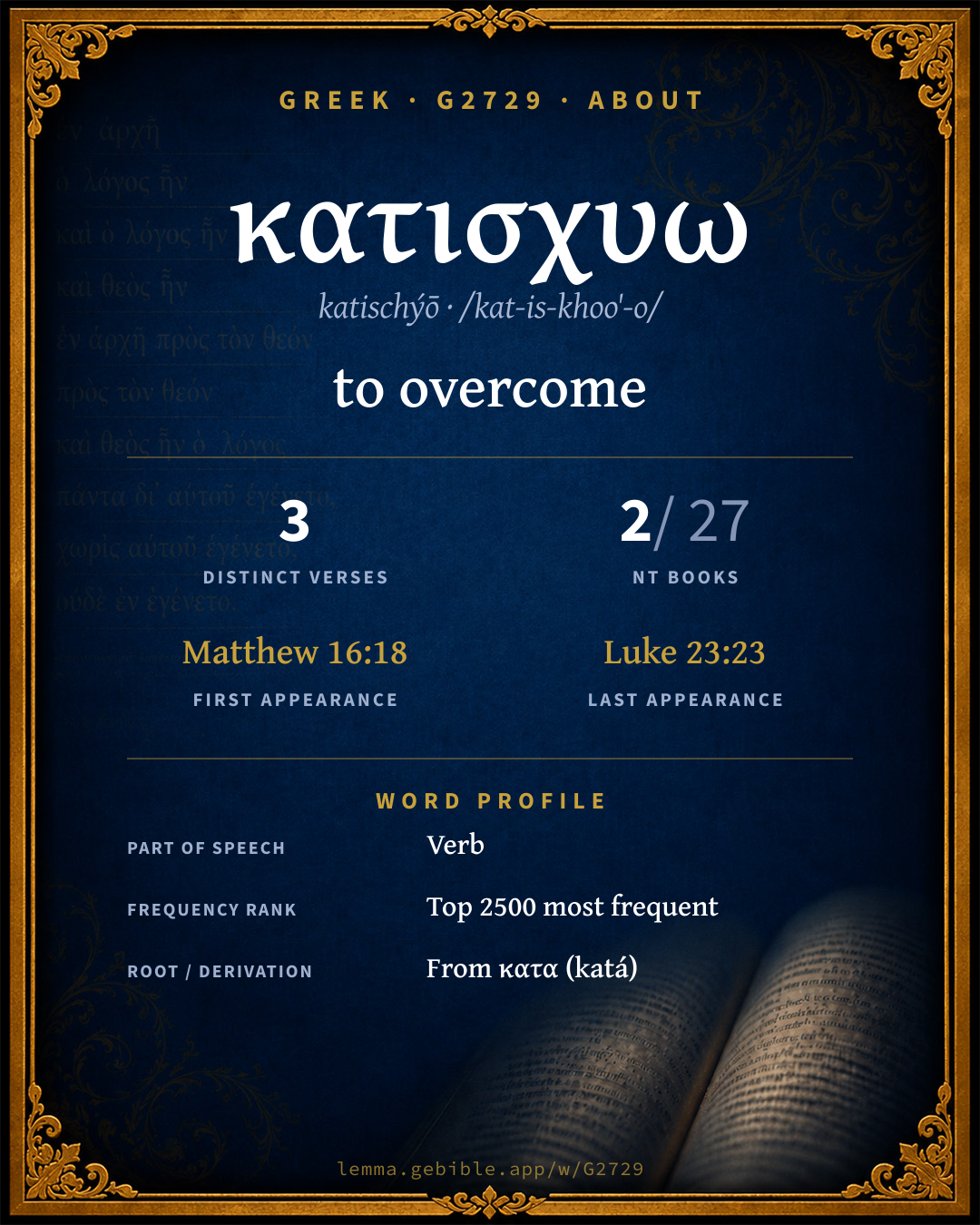
κατισχύω
to overcome
‘to overcome’ is one of 4 main senses fuller range ↓
Full lexicon entry — Thayer's Greek Lexicon
From Thayer's Greek Lexicon
Where this word appears
See every Future-tense verb in the Greek New Testament →
Grammar key — what these labels mean
Part of speech
- Verb
- An action or state-of-being word.
Tense
- Future
- Action expected in future time.
- Imperfect
- Continuous or repeated action in past time (“was writing”).
- Present
- Ongoing or general action in present time (imperfective aspect).
Voice
- Active
- The subject performs the action.
Mood
- Indicative
- States a fact or asks a factual question (the mood of reality).
- Subjunctive
- Expresses probability, purpose, or possibility (the mood of contingency).
Person
- 3rd person
- The one spoken about (“he / she / it / they”).
- 2nd person
- The one addressed (“you”).
Number
- Plural
- More than one.
Grammatical forms
- Verb, Future, Active, Indicative, 3rd person, Plural 1 time (33%)
- Verb, Imperfect, Active, Indicative, 3rd person, Plural 1 time (33%)
- Verb, Present, Active, Subjunctive, 2nd person, Plural 1 time (33%)
Parsed forms decoded from the imported morphology (Robinson–Tischendorf, public domain), counted across 3 parsed occurrences — not distinct verses.
Every verse where G2729 appears — 3 distinct verses across 2 books. Click any verse to open its interlinear word-by-word view. Verse text shown in the World English Bible for context — . Each verse’s Greek form is shown with its reference; the English is not keyword-highlighted, since the data carries no word-level English alignment. Use “Compare translations” on any verse to read it across multiple English versions. This concordance covers the Greek New Testament; Septuagint (Greek Old Testament) occurrences of this word are not indexed here.
Matthew 1 verse
Luke 2 verses
- Luke 21:36 κατισχύσητε pres act subj 2pl Therefore be watchful all the time, asking that you may be counted worthy to escape all these things that will happen, and to stand before the Son of Man."
- Luke 23:23 κατίσχυον impf act ind 3pl But they were urgent with loud voices, asking that he might be crucified. Their voices and the voices of the chief priests prevailed.
About this entry
At a glance — auto-summarized from this page’s data, not written by a person. Every figure links to its source below. This summary describes the numbers; it doesn’t interpret them.
“to overcome” is the headline sense of the Greek verb κατισχυω (katischýō). A scarce word — 3 verses in all of the Greek New Testament. More than two-thirds of its appearances fall in Luke. First canonically at Matthew 16:18, it enters the text early. Catalogued under 4 senses, its meaning is not single-sense. The sections below give every sense, occurrence, and version rendering.
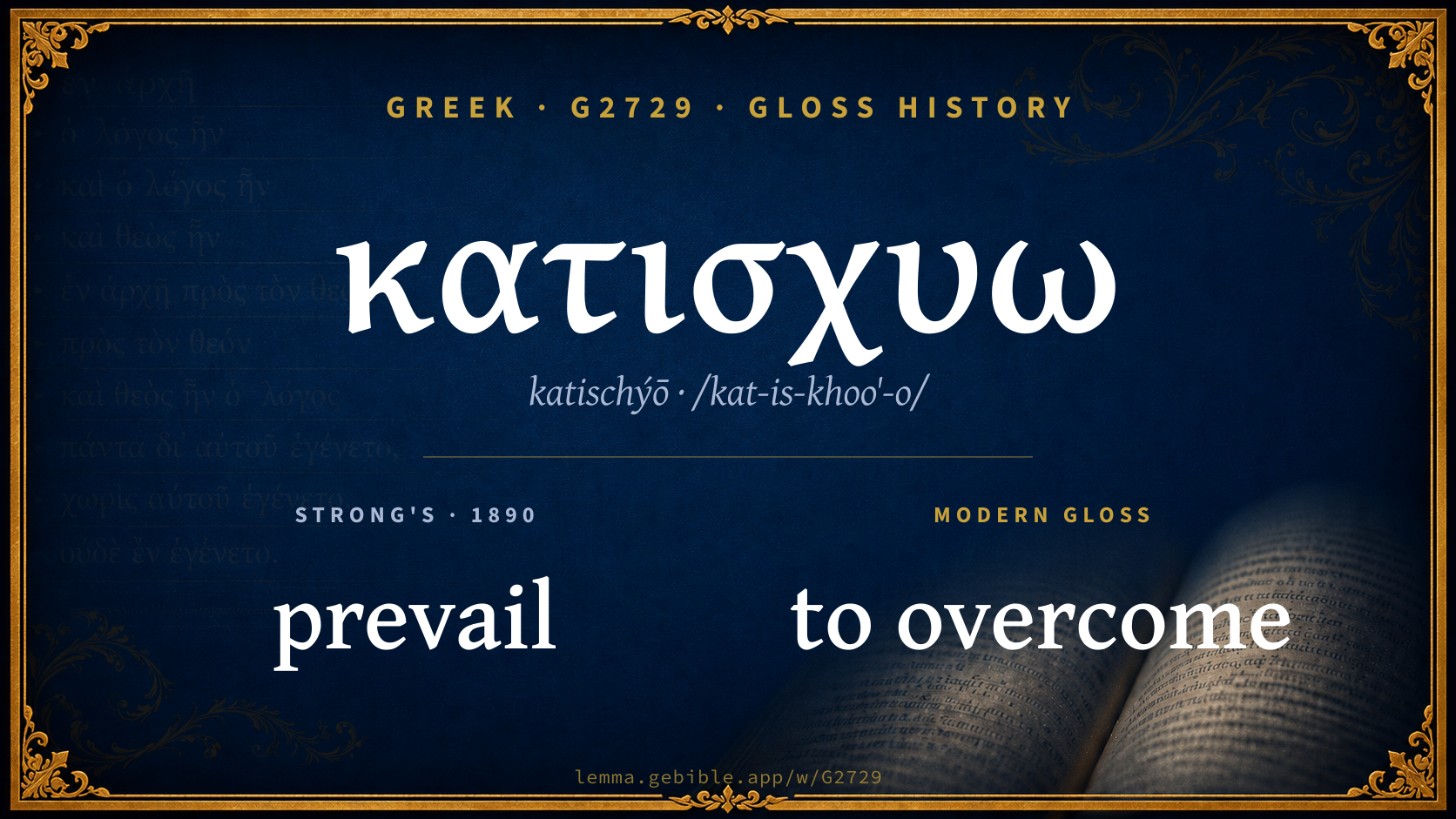
Gloss history
Strong's 1890 vs modern scholarship
About this word
Strong's G2729 catalogs a Greek word from the Greek New Testament.
These counts are not copied from any lexicon or concordance. They are computed here, from the morphology-tagged Greek New Testament. What Lemma adds →
- 3
- distinct verses
- The word appears in 3 distinct verses.
- 2 / 27
- NT books
- The word appears in 2 of 27 New Testament books.
- #2,203
- by frequency
- Top 2500 most frequent Greek words (rank 2,203 of 5,347 Greek words by occurrence).
View all 3 occurrences in the concordance →
By traditional corpus
Conventional, traditional groupings — biblical authorship is debated, so this is a traditional corpus grouping, not an authorship claim. Some books belong to more than one corpus (Luke is in both the Gospels and the Lukan corpus, and so on), so these shares overlap and need not total 100%. Each figure is a share of the word’s 3 distinct verses.
- Gospels 3 verses · 100%
- Lukan (Luke–Acts) 2 verses · 67%
How translations render this word
Counts come from each version’s own published word-to-Strong’s tagging or interlinear alignment — an approximate guide to how each version renders this word, not a word-level alignment the data otherwise carries. Because each total is that version’s own tagged count, the per-version totals vary from one another and need not match the appearance or distinct-verse counts above. These counts may also differ from a printed concordance because Lemma counts each distinctly tagged rendering and does not collapse phrase taggings into a single head-word total. This is a fixed set of word-tagged versions (KJV, ASV, BSB, ULT) and does not change with the reading translation you choose elsewhere. Each version’s license is shown beside its name below (and on Sources).
- King James Version: Prevail against 1×, Prevailed 1×, Shall 1×
- American Standard Version: Prevail against 1×, Prevailed 1×, Shall 1×
- Berean Standard Bible: Prevailed 1×, Will not prevail against 1×, You may have the strength 1×
- unfoldingWord Literal Text: Prevail against 1×, Prevailed 1×, Will 1×
King James Version Public Domain
Renders G2729 across 3 tagged occurrences — most commonly:
American Standard Version Public Domain
Renders G2729 across 3 tagged occurrences — most commonly:
Berean Standard Bible Public Domain
Renders G2729 across 3 tagged occurrences — most commonly:
unfoldingWord Literal Text CC BY-SA 4.0
Renders G2729 across 4 tagged occurrences — most commonly:
Senses in Thayer's
The 4 senses Thayer's distinguishes for this word, in lexicon order (not ranked by frequency or importance). The full entry — with sub-senses — is in the Lexicon Entry tab.
- to be strong to another's detriment, to prevail against
- to be superior in strength
- to overcome
- to prevail
Word origin
Derived from κατα (katá) (G2596) — down.
Forms in the corpus
The 3 distinct written forms G2729 takes in the Greek New Testament, most frequent first — each parse links to that tense’s occurrences in the concordance.
| Form | Parsing | Example | Uses |
|---|---|---|---|
| κατίσχυον katíschyon | Verb, Imperfect, Active, Indicative, 3rd person, Plural | Luke 23:23 | 1 |
| κατισχύσητε katischýsēte | Verb, Present, Active, Subjunctive, 2nd person, Plural | Luke 21:36 | 1 |
| κατισχύσουσιν katischýsousin | Verb, Future, Active, Indicative, 3rd person, Plural | Matthew 16:18 | 1 |
Same root — word family
Other Thayer's entries built from the same root as G2729, grouped by Strong’s listed origin. These share a root / origin per the lexicon — not necessarily a shared meaning. Each links to that word’s own entry.
Derives from
Shares the same root
- καθα kathá G2505 according as
- καθαιρεω kathairéō G2507 to tear down
- καθαπτω katháptō G2510 to fasten down
- καθεδρα kathédra G2515 seat
- καθεζομαι kathézomai G2516 to sit down
- καθεξης kathexēs G2517 in order
- καθευδω katheúdō G2518 to fall asleep
- καθηγητης kathēgētḗs G2519 guide
- καθηκω kathḗkō G2520 to come down
- καθημαι káthēmai G2521 to sit down
- καθημερινος kathēmerinós G2522 daily
- καθιημι kathíēmi G2524 to send down
- καθιστημι kathístēmi G2525 to place
- καθο kathó G2526 according to what
- καθολου kathólou G2527 wholly
- καθοπλιζω kathoplízō G2528 to arm
- καθοραω kathoráō G2529 to see clearly
- καθοτι kathóti G2530 according to what
- καθως kathṓs G2531 according as
- καμμυω kammýō G2576 to close eyes
- καταβαινω katabaínō G2597 to descend
- καταβαλλω katabállō G2598 to cast down
- καταβαρεω katabaréō G2599 to weigh down
- καταβιβαζω katabibázō G2601 to bring down
+103 more words share this root (not shown).
Compare all same-root words → Showing 4 of 129 — not the complete family. They share a root, not necessarily a meaning.
Septuagint usage
The same Greek word κατισχυω appears 90 times in the Greek Old Testament (Septuagint), across 83 verses in 18 books.
- 90
- LXX occurrences
- Tagged occurrences of this Greek word in the Septuagint.
- 83
- verses
- Distinct Septuagint verses containing this word.
- 18 / 39
- OT books
- The word appears in 18 of the 39 Old Testament books.
Sample Septuagint occurrences
- Genesis 49:24 καταἰσχύω
- Exodus 1:7 καταἰσχύω
- Deuteronomy 1:38 καταἰσχύω
- Joshua 11:20 καταἰσχύω
- Judges 7:8 καταἰσχύω
- 1 Samuel 19:8 καταἰσχύω
- 2 Kings 14:5 καταἰσχύω
- 1 Chronicles 5:20 καταἰσχύω
- 2 Chronicles 8:3 καταἰσχύω
- Job 18:9 καταἰσχύω
- Psalms 88:22 καταἰσχύω
- Isaiah 22:4 καταἰσχύω
Septuagint occurrences (same lexeme)
Every verse where the same Strong’s number (G2729) appears in the Greek Septuagint — showing the first 50 of 83. Verse text shown in the World English Bible for context; the Greek form is the matched word — the English is not keyword-highlighted.
- Genesis 49:24 καταἰσχύω But his bow abode in strength, The arms of his hands were made strong, By the hands of the Mighty One of Jacob, (From there is the shepherd, the stone of Israel),
- Exodus 1:7 καταἰσχύω The children of Israel were fruitful, and increased abundantly, and multiplied, and grew exceedingly mighty; and the land was filled with them.
- Exodus 7:13 καταἰσχύω Pharaoh's heart was hardened, and he didn't listen to them; as Yahweh had spoken.
- Exodus 17:11 καταἰσχύω It happened, when Moses held up his hand, that Israel prevailed; and when he let down his hand, Amalek prevailed.
- Exodus 18:23 καταισχύω If you will do this thing, and God commands you so, then you will be able to endure, and all of these people also will go to their place in peace."
- Deuteronomy 1:38 καταἰσχύω Joshua the son of Nun, who stands before you, he shall go in there: encourage you him; for he shall cause Israel to inherit it.
- Deuteronomy 2:30 καταἰσχύω But Sihon king of Heshbon would not let us pass by him; for Yahweh your God hardened his spirit, and made his heart obstinate, that he might deliver him into your hand, as at this day.
- Deuteronomy 3:28 καταἰσχύω But charge Joshua, and encourage him, and strengthen him; for he shall go over before this people, and he shall cause them to inherit the land which you shall see.
- Joshua 11:20 καταἰσχύω For it was of Yahweh to harden their hearts, to come against Israel in battle, that he might utterly destroy them, that they might have no favor, but that he might destroy them, as Yahweh commanded Moses.
- Joshua 17:13 καταἰσχύω It happened, when the children of Israel had grown strong, that they put the Canaanites to forced labor, and didn't utterly drive them out.
- Joshua 23:6 καταἰσχύω Therefore be you very courageous to keep and to do all that is written in the book of the law of Moses, that you not turn aside from it to the right hand or to the left;
- Judges 7:8 καταἰσχύω So the people took food in their hand, and their trumpets; and he sent all the men of Israel every man to his tent, but retained the three hundred men: and the camp of Midian was beneath him in the valley.
- 1 Samuel 19:8 καταἰσχύω There was war again: and David went out, and fought with the Philistines, and killed them with a great slaughter; and they fled before him.
- 2 Kings 14:5 καταἰσχύω It happened, as soon as the kingdom was established in his hand, that he killed his servants who had slain the king his father:
- 2 Kings 22:5 καταἰσχύω and let them deliver it into the hand of the workmen who have the oversight of the house of Yahweh; and let them give it to the workmen who are in the house of Yahweh, to repair the breaches of the house,
- 2 Kings 24:2 καταἰσχύω Yahweh sent against him bands of the Chaldeans, and bands of the Syrians, and bands of the Moabites, and bands of the children of Ammon, and sent them against Judah to destroy it, according to the word of Yahweh, which he spoke by his servants the prophets.
- 1 Chronicles 5:20 καταἰσχύω They were helped against them, and the Hagrites were delivered into their hand, and all who were with them; for they cried to God in the battle, and he was entreated of them, because they put their trust in him.
- 1 Chronicles 11:10 καταἰσχύω Now these are the chief of the mighty men whom David had, who shown themselves strong with him in his kingdom, together with all Israel, to make him king, according to the word of Yahweh concerning Israel.
- 1 Chronicles 15:26 καταἰσχύω It happened, when God helped the Levites who bore the ark of the covenant of Yahweh, that they sacrificed seven bulls and seven rams.
- 1 Chronicles 21:6 καταἰσχύω But he didn't count Levi and Benjamin among them; for the king's word was abominable to Joab.
- 1 Chronicles 22:12 καταἰσχύω May Yahweh give you discretion and understanding, and put you in charge of Israel; that so you may keep the law of Yahweh your God.
- 1 Chronicles 29:12 καταἰσχύω Both riches and honor come of you, and you rule over all; and in your hand is power and might; and it is in your hand to make great, and to give strength to all.
- 2 Chronicles 8:3 καταἰσχύω Solomon went to Hamath-zobah, and prevailed against it.
- 2 Chronicles 11:12 καταἰσχύω In every city [he put] shields and spears, and made them exceeding strong. Judah and Benjamin belonged to him.
- 2 Chronicles 11:17 καταἰσχύω So they strengthened the kingdom of Judah, and made Rehoboam the son of Solomon strong, three years; for they walked three years in the way of David and Solomon.
- 2 Chronicles 12:13 καταἰσχύω So king Rehoboam strengthened himself in Jerusalem, and reigned: for Rehoboam was forty-one years old when he began to reign, and he reigned seventeen years in Jerusalem, the city which Yahweh had chosen out of all the tribes of Israel, to put his name there: and his mother's name was Naamah the Ammonitess.
- 2 Chronicles 13:18 καταἰσχύω Thus the children of Israel were brought under at that time, and the children of Judah prevailed, because they relied on Yahweh, the God of their fathers.
- 2 Chronicles 13:21 καταἰσχύω But Abijah grew mighty, and took to himself fourteen wives, and became the father of twenty-two sons, and sixteen daughters.
- 2 Chronicles 14:10 καταἰσχύω Then Asa went out to meet him, and they set the battle in array in the valley of Zephathah at Mareshah.
- 2 Chronicles 15:8 καταἰσχύω When Asa heard these words, and the prophecy of Oded the prophet, he took courage, and put away the abominations out of all the land of Judah and Benjamin, and out of the cities which he had taken from the hill-country of Ephraim; and he renewed the altar of Yahweh, that was before the porch of Yahweh.
- 2 Chronicles 16:9 καταἰσχύω For the eyes of Yahweh run back and forth throughout the whole earth, to show himself strong in the behalf of them whose heart is perfect toward him. Herein you have done foolishly; for from henceforth you shall have wars.
- 2 Chronicles 17:1 καταἰσχύω Jehoshaphat his son reigned in his place, and strengthened himself against Israel.
- 2 Chronicles 22:9 καταἰσχύω He sought Ahaziah, and they caught him (now he was hiding in Samaria), and they brought him to Jehu, and killed him; and they buried him, for they said, He is the son of Jehoshaphat, who sought Yahweh with all his heart. The house of Ahaziah had no power to hold the kingdom.
- 2 Chronicles 24:5 καταἰσχύω He gathered together the priests and the Levites, and said to them, Go out to the cities of Judah, and gather of all Israel money to repair the house of your God from year to year; and see that you hasten the matter. However the Levites didn't hurry.
- 2 Chronicles 25:8 καταἰσχύω But if you will go, do [valiantly], be strong for the battle: God will cast you down before the enemy; for God has power to help, and to cast down.
- 2 Chronicles 25:11 καταἰσχύω Amaziah took courage, and led forth his people, and went to the Valley of Salt, and struck of the children of Seir ten thousand.
- 2 Chronicles 26:7 καταἰσχύω God helped him against the Philistines, and against the Arabians who lived in Gur Baal, and the Meunim.
- 2 Chronicles 26:8 καταἰσχύω The Ammonites gave tribute to Uzziah: and his name spread abroad even to the entrance of Egypt; for he grew exceeding strong.
- 2 Chronicles 26:9 καταἰσχύω Moreover Uzziah built towers in Jerusalem at the corner gate, and at the valley gate, and at the turning [of the wall], and fortified them.
- 2 Chronicles 26:15 καταἰσχύω He made in Jerusalem engines, invented by skillful men, to be on the towers and on the battlements, with which to shoot arrows and great stones. His name spread far abroad; for he was marvelously helped, until he was strong.
- 2 Chronicles 26:16 καταἰσχύω But when he was strong, his heart was lifted up, so that he did corruptly, and he trespassed against Yahweh his God; for he went into the temple of Yahweh to burn incense on the altar of incense.
- 2 Chronicles 27:5 καταἰσχύω He fought also with the king of the children of Ammon, and prevailed against them. The children of Ammon gave him the same year one hundred talents of silver, and ten thousand measures of wheat, and ten thousand of barley. So much did the children of Ammon render to him, in the second year also, and in the third.
- 2 Chronicles 27:6 καταἰσχύω So Jotham became mighty, because he ordered his ways before Yahweh his God.
- 2 Chronicles 28:23 καταἱσχύω For he sacrificed to the gods of Damascus, which struck him; and he said, Because the gods of the kings of Syria helped them, [therefore] will I sacrifice to them, that they may help me. But they were the ruin of him, and of all Israel.
- 2 Chronicles 31:4 καταἰσχύω Moreover he commanded the people who lived in Jerusalem to give the portion of the priests and the Levites, that they might give themselves to the law of Yahweh.
- 2 Chronicles 32:4 καταἰσχύω So there was gathered much people together, and they stopped all the springs, and the brook that flowed through the midst of the land, saying, Why should the kings of Assyria come, and find much water?
- 2 Chronicles 32:5 καταἰσχύω He took courage, and built up all the wall that was broken down, and raised [it] up to the towers, and the other wall outside, and strengthened Millo [in] the city of David, and made weapons and shields in abundance.
- 2 Chronicles 34:10 καταἰσχύω They delivered it into the hand of the workmen who had the oversight of the house of Yahweh; and the workmen who labored in the house of Yahweh gave it to mend and repair the house;
- 2 Chronicles 35:2 καταἰσχύω He set the priests in their offices, and encouraged them to the service of the house of Yahweh.
- 2 Chronicles 36:13 καταἰσχύω He also rebelled against king Nebuchadnezzar, who had made him swear by God: but he stiffened his neck, and hardened his heart against turning to Yahweh, the God of Israel.
These are occurrences of the same Greek lexeme (G2729) in the Septuagint — not a translation of any one Hebrew word. The store carries no word-level Hebrew↔Greek alignment, so no Hebrew original is asserted here. Counts come from the recovered LXX Strong's tagging — high-frequency vocabulary is well covered, while rare or late forms may be untagged — so they reflect tagged occurrences and may slightly undercount.