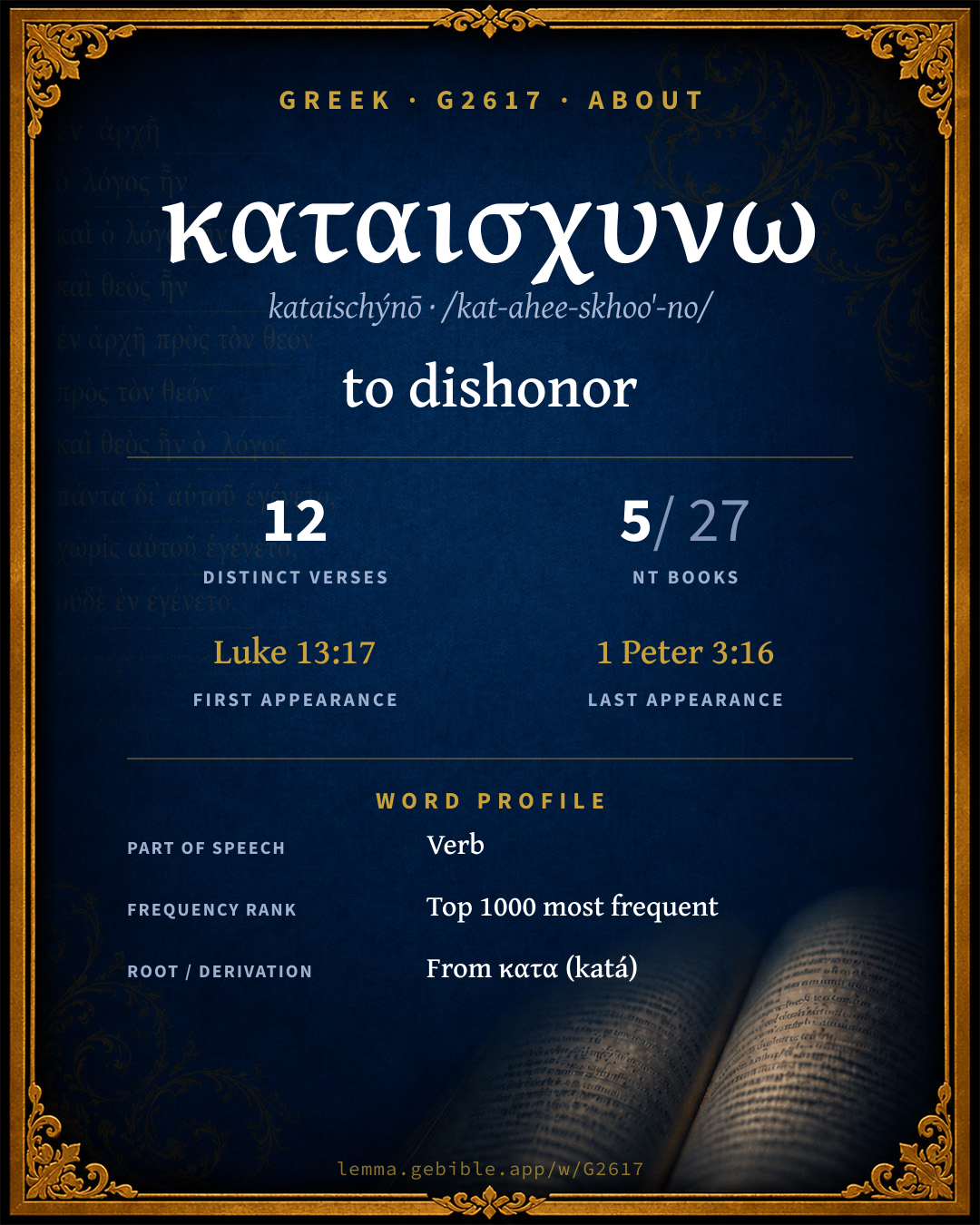
καταισχύνω
to dishonor
‘to dishonor’ is one of 2 main senses fuller range ↓
Full lexicon entry — Thayer's Greek Lexicon
From Thayer's Greek Lexicon
Where this word appears
Grammar key — what these labels mean
Part of speech
- Verb
- An action or state-of-being word.
Tense
- Present
- Ongoing or general action in present time (imperfective aspect).
- Future
- Action expected in future time.
- Aorist
- Action viewed as a simple whole, without regard to duration — often past (perfective aspect).
- Imperfect
- Continuous or repeated action in past time (“was writing”).
Voice
- Active
- The subject performs the action.
- Passive
- The subject receives the action.
Mood
- Indicative
- States a fact or asks a factual question (the mood of reality).
- Subjunctive
- Expresses probability, purpose, or possibility (the mood of contingency).
Person
- 3rd person
- The one spoken about (“he / she / it / they”).
- 1st person
- The speaker (“I / we”).
- 2nd person
- The one addressed (“you”).
Number
- Singular
- One.
- Plural
- More than one.
Every verse where G2617 appears in the Book of 1 Peter — 2 distinct verses. Click any verse to open its interlinear word-by-word view. Verse text shown in the World English Bible for context — . Each verse’s Greek form is shown with its reference; the English is not keyword-highlighted, since the data carries no word-level English alignment. Use “Compare translations” on any verse to read it across multiple English versions. This concordance covers the Greek New Testament; Septuagint (Greek Old Testament) occurrences of this word are not indexed here.
1 Peter
- 1 Peter 2:6 καταισχυνθῇ aor pass subj 3sg Because it is contained in Scripture, "Behold, I lay in Zion a chief cornerstone, chosen, and precious: He who believes in him will not be disappointed."
- 1 Peter 3:16 καταισχυνθῶσιν aor pass subj 3pl having a good conscience; that, while you are spoken against as evildoers, they may be disappointed who curse your good manner of life in Christ.
About this entry
At a glance — auto-summarized from this page’s data, not written by a person. Every figure links to its source below. This summary describes the numbers; it doesn’t interpret them.
At its core, καταισχυνω (kataischýnō) means “to dishonor.” Scripture first uses it in Luke 13:17. With 12 verses in 5 books, it is an uncommon word in the Greek New Testament. Its uses concentrate in 1 Corinthians (33% of all occurrences). Ranging over 2 senses, it is not a single-sense word. Each statement above links to its evidence; the full detail follows below.
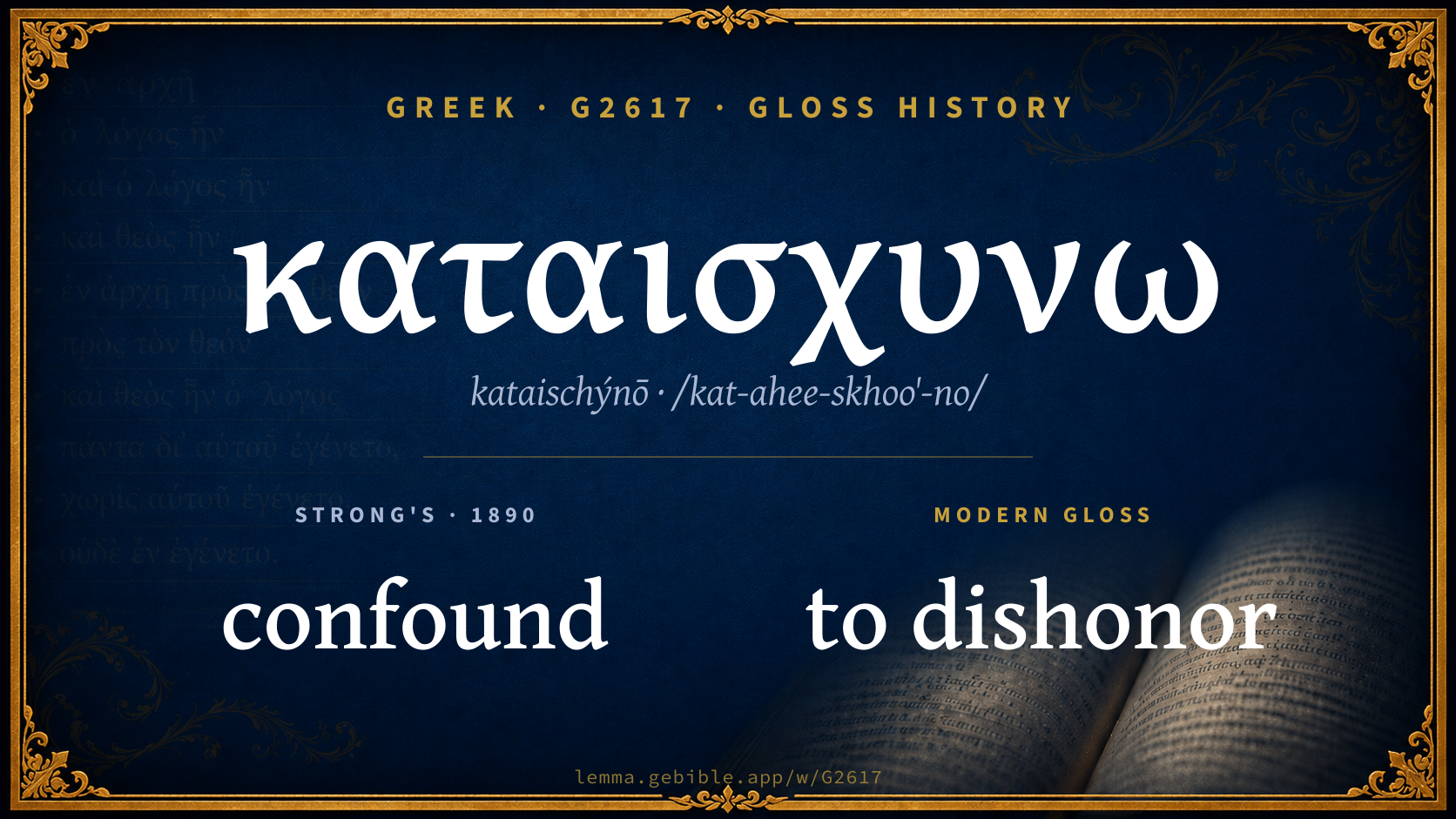
Gloss history
Strong's 1890 vs modern scholarship
About this word
Strong's G2617 catalogs a Greek word from the Greek New Testament.
These counts are not copied from any lexicon or concordance. They are computed here, from the morphology-tagged Greek New Testament. What Lemma adds →
- 12
- distinct verses
- The word appears in 12 distinct verses.
- 5 / 27
- NT books
- The word appears in 5 of 27 New Testament books.
- #863
- by frequency
- Top 1000 most frequent Greek words (rank 863 of 5,347 Greek words by occurrence).
View all 12 occurrences in the concordance →
Most concentrated in
- 1 Corinthians 4 verses 33%
- Romans 3 verses 25%
- 2 Corinthians 2 verses 17%
By section of the New Testament
By traditional corpus
Conventional, traditional groupings — biblical authorship is debated, so this is a traditional corpus grouping, not an authorship claim. Some books belong to more than one corpus (Luke is in both the Gospels and the Lukan corpus, and so on), so these shares overlap and need not total 100%. Each figure is a share of the word’s 12 distinct verses.
- Pauline corpus 9 verses · 75%
- General (Catholic) Epistles 2 verses · 17%
- Gospels 1 verse · 8%
- Lukan (Luke–Acts) 1 verse · 8%
How translations render this word
Counts come from each version’s own published word-to-Strong’s tagging or interlinear alignment — an approximate guide to how each version renders this word, not a word-level alignment the data otherwise carries. Because each total is that version’s own tagged count, the per-version totals vary from one another and need not match the appearance or distinct-verse counts above. These counts may also differ from a printed concordance because Lemma counts each distinctly tagged rendering and does not collapse phrase taggings into a single head-word total. This is a fixed set of word-tagged versions (KJV, ASV, BSB, ULT) and does not change with the reading translation you choose elsewhere. Each version’s license is shown beside its name below (and on Sources).
- King James Version: Shall 3×, Ashamed 2×, Be ashamed 2×
- American Standard Version: Shame 4×, Be put to shame 3×, Shall 3×
- Berean Standard Bible: Dishonors 2×, Shame 2×, Will never be put to shame 2×
- unfoldingWord Literal Text: Be ashamed 2×, Dishonors 2×, He might shame 2×
King James Version Public Domain
Renders G2617 across 18 tagged occurrences — most commonly:
Plus 7 renderings that appear only once — usually multi-word phrases or single function words the recovered tagging swept in, not distinct renderings.
American Standard Version Public Domain
Renders G2617 across 18 tagged occurrences — most commonly:
Plus 6 renderings that appear only once — usually multi-word phrases or single function words the recovered tagging swept in, not distinct renderings.
Berean Standard Bible Public Domain
Renders G2617 across 13 tagged occurrences — most commonly:
Plus 7 renderings that appear only once — usually multi-word phrases or single function words the recovered tagging swept in, not distinct renderings.
unfoldingWord Literal Text CC BY-SA 4.0
Renders G2617 across 18 tagged occurrences — most commonly:
Plus 10 renderings that appear only once — usually multi-word phrases or single function words the recovered tagging swept in, not distinct renderings.
Senses in Thayer's
The 2 senses Thayer's distinguishes for this word, in lexicon order (not ranked by frequency or importance). The full entry — with sub-senses — is in the Lexicon Entry tab.
- to dishonour, disgrace
- to put to shame, make ashamed
Word origin
Derived from κατα (katá) (G2596) — down.
Forms in the corpus
The 9 distinct written forms G2617 takes in the Greek New Testament, most frequent first — each parse links to that tense’s occurrences in the concordance.
| Form | Parsing | Example | Uses |
|---|---|---|---|
| καταισχύνει kataischýnei | Verb, Present, Active, Indicative, 3rd person, Singular | Romans 5:5 | 3 |
| καταισχυνθήσεται kataischynthḗsetai | Verb, Future, Passive, Indicative, 3rd person, Singular | Romans 9:33 | 2 |
| καταισχύνῃ kataischýnē | Verb, Present, Active, Subjunctive, 3rd person, Singular | 1 Corinthians 1:27 | 2 |
| καταισχυνθῇ kataischynthē̂ | Verb, Aorist, Passive, Subjunctive, 3rd person, Singular | 1 Peter 2:6 | 1 |
| καταισχυνθῶμεν kataischynthō̂men | Verb, Aorist, Passive, Subjunctive, 1st person, Plural | 2 Corinthians 9:4 | 1 |
| καταισχυνθῶσιν kataischynthō̂sin | Verb, Aorist, Passive, Subjunctive, 3rd person, Plural | 1 Peter 3:16 | 1 |
| καταισχύνετε kataischýnete | Verb, Present, Active, Indicative, 2nd person, Plural | 1 Corinthians 11:22 | 1 |
| κατῃσχύνθην katēschýnthēn | Verb, Aorist, Passive, Indicative, 1st person, Singular | 2 Corinthians 7:14 | 1 |
| κατῃσχύνοντο katēschýnonto | Verb, Imperfect, Passive, Indicative, 3rd person, Plural | Luke 13:17 | 1 |
Same root — word family
Other Thayer's entries built from the same root as G2617, grouped by Strong’s listed origin. These share a root / origin per the lexicon — not necessarily a shared meaning. Each links to that word’s own entry.
Derives from
Shares the same root
- καθα kathá G2505 according as
- καθαιρεω kathairéō G2507 to tear down
- καθαπτω katháptō G2510 to fasten down
- καθεδρα kathédra G2515 seat
- καθεζομαι kathézomai G2516 to sit down
- καθεξης kathexēs G2517 in order
- καθευδω katheúdō G2518 to fall asleep
- καθηγητης kathēgētḗs G2519 guide
- καθηκω kathḗkō G2520 to come down
- καθημαι káthēmai G2521 to sit down
- καθημερινος kathēmerinós G2522 daily
- καθιημι kathíēmi G2524 to send down
- καθιστημι kathístēmi G2525 to place
- καθο kathó G2526 according to what
- καθολου kathólou G2527 wholly
- καθοπλιζω kathoplízō G2528 to arm
- καθοραω kathoráō G2529 to see clearly
- καθοτι kathóti G2530 according to what
- καθως kathṓs G2531 according as
- καμμυω kammýō G2576 to close eyes
- καταβαινω katabaínō G2597 to descend
- καταβαλλω katabállō G2598 to cast down
- καταβαρεω katabaréō G2599 to weigh down
- καταβιβαζω katabibázō G2601 to bring down
+103 more words share this root (not shown).
Compare all same-root words → Showing 4 of 129 — not the complete family. They share a root, not necessarily a meaning.
Septuagint usage
The same Greek word καταισχυνω appears 64 times in the Greek Old Testament (Septuagint), across 59 verses in 15 books.
- 64
- LXX occurrences
- Tagged occurrences of this Greek word in the Septuagint.
- 59
- verses
- Distinct Septuagint verses containing this word.
- 15 / 39
- OT books
- The word appears in 15 of the 39 Old Testament books.
Sample Septuagint occurrences
- Judges 18:7 κατααἰσχύνω
- Ruth 2:15 κατααἰσχύνω
- 2 Samuel 10:6 κατααἰσχύνω
- 2 Kings 19:26 κατααἰσχύνω
- Psalms 6:11 κατααἰσχύνω
- Proverbs 19:26 κατααἰσχύνω
- Isaiah 3:15 κατααἰσχύνω
- Jeremiah 2:36 κατααἰσχύνω
- Ezekiel 24:12 κατααἰσχύνω
- Daniel 3:41 κατααἰσχύνω
- Hosea 2:7 κατααἰσχύνω
- Joel 2:26 κατααἰσχύνω
Septuagint occurrences (same lexeme)
Every verse where the same Strong’s number (G2617) appears in the Greek Septuagint — showing the first 50 of 59. Verse text shown in the World English Bible for context; the Greek form is the matched word — the English is not keyword-highlighted.
- Judges 18:7 κατααἰσχύνω Then the five men departed, and came to Laish, and saw the people who were therein, how they lived in security, after the manner of the Sidonians, quiet and secure; for there was none in the land, possessing authority, that might put [them] to shame in anything, and they were far from the Sidonians, and had no dealings with any man.
- Ruth 2:15 κατααἰσχύνω When she was risen up to glean, Boaz commanded his young men, saying, Let her glean even among the sheaves, and don't reproach her.
- 2 Samuel 10:6 κατααἰσχύνω When the children of Ammon saw that they were become odious to David, the children of Ammon sent and hired the Syrians of Beth Rehob, and the Syrians of Zobah, twenty thousand footmen, and the king of Maacah with one thousand men, and the men of Tob twelve thousand men.
- 2 Samuel 16:21 κατααἰσχύνω Ahithophel said to Absalom, Go in to your father's concubines, that he has left to keep the house; and all Israel will hear that you are abhorred of your father: then will the hands of all who are with you be strong.
- 2 Samuel 19:6 κατααἰσχύνω in that you love those who hate you, and hate those who love you. For you have declared this day, that princes and servants are nothing to you: for this day I perceive that if Absalom had lived, and all we had died this day, then it had pleased you well.
- 2 Kings 19:26 κατααἰσχύνω Therefore their inhabitants were of small power, they were dismayed and confounded; they were as the grass of the field, and as the green herb, as the grass on the housetops, and as grain blasted before it is grown up.
- Psalms 6:11 κατααἰσχύνω
- Psalms 13:6 κατααἰσχύνω I will sing to Yahweh, Because he has been good to me.
- Psalms 21:6 κατααἰσχύνω For you make him most blessed forever. You make him glad with joy in your presence.
- Psalms 24:2 κατααἰσχύνω For he has founded it on the seas, And established it on the floods.
- Psalms 24:3 κατααἰσχύνω Who may ascend to Yahweh's hill? Who may stand in his holy place?
- Psalms 24:20 κατααἰσχύνω
- Psalms 30:2 κατααἰσχύνω Yahweh my God, I cried to you, And you have healed me.
- Psalms 30:18 κατααἰσχύνω
- Psalms 33:6 κατααἰσχύνω By Yahweh's word the heavens were made; All their host by the breath of his mouth.
- Psalms 34:4 κατααἰσχύνω I sought Yahweh, and he answered me, And delivered me from all my fears.
- Psalms 36:19 κατααἰσχύνω
- Psalms 39:15 κατααἰσχύνω
- Psalms 43:8 κατααἰσχύνω
- Psalms 43:10 κατααἰσχύνω
- Psalms 52:6 κατααἰσχύνω The righteous also will see it, and fear, And laugh at him, saying,
- Psalms 69:3 κατααἰσχύνω I am weary with my crying. My throat is dry. My eyes fail, looking for my God.
- Psalms 70:1 κατααἰσχύνω Hurry, God, to deliver me. Come quickly to help me, Yahweh.
- Psalms 73:21 κατααἰσχύνω For my soul was grieved. I was embittered in my heart.
- Psalms 118:31 κατααἰσχύνω
- Psalms 118:116 κατααἰσχύνω
- Psalms 126:5 κατααἰσχύνω Those who sow in tears will reap in joy.
- Proverbs 19:26 κατααἰσχύνω He who robs his father and drives away his mother, Is a son who causes shame and brings reproach.
- Isaiah 3:15 κατααἰσχύνω What do you mean that you crush my people, And grind the face of the poor?" says the Lord, Yahweh of Hosts.
- Isaiah 28:16 κατααἰσχύνω therefore thus says the Lord Yahweh, Behold, I lay in Zion for a foundation a stone, a tried stone, a precious corner -[stone] of sure foundation: he who believes shall not be in haste.
- Isaiah 54:4 κατααἰσχύνω Don't be afraid; for you shall not be ashamed: neither be confounded; for you shall not be disappointed: for you shall forget the shame of your youth; and the reproach of your widowhood shall you remember no more.
- Jeremiah 2:36 κατααἰσχύνω Why go you about so much to change your way? you shall be ashamed of Egypt also, as you were ashamed of Assyria.
- Jeremiah 6:15 κατααἰσχύνω Were they ashamed when they had committed abomination? nay, they were not at all ashamed, neither could they blush: therefore they shall fall among those who fall; at the time that I visit them they shall be cast down, says Yahweh.
- Jeremiah 7:19 κατααἰσχύνω Do they provoke me to anger? says Yahweh; [do they] not [provoke] themselves, to the confusion of their own faces?
- Jeremiah 9:18 κατααἰσχύνω and let them make haste, and take up a wailing for us, that our eyes may run down with tears, and our eyelids gush out with waters.
- Jeremiah 10:14 κατααἰσχύνω Every man is become brutish [and is] without knowledge; every goldsmith is disappointed by his engraved image; for his molten image is falsehood, and there is no breath in them.
- Jeremiah 15:9 κατααἰσχύνω She who has borne seven languishes; she has given up the spirit; her sun is gone down while it was yet day; she has been disappointed and confounded: and the residue of them will I deliver to the sword before their enemies, says Yahweh.
- Jeremiah 17:13 κατααἰσχύνω Yahweh, the hope of Israel, all who forsake you shall be disappointed. Those who depart from me shall be written in the earth, because they have forsaken Yahweh, the spring of living waters.
- Jeremiah 17:18 κατααἰσχύνω Let them be disappointed who persecute me, but let not me be disappointed; let them be dismayed, but don't let me be dismayed; bring on them the day of evil, and destroy them with double destruction.
- Jeremiah 26:24 κατααἰσχύνω But the hand of Ahikam the son of Shaphan was with Jeremiah, that they should not give him into the hand of the people to put him to death.
- Jeremiah 27:2 κατααἰσχύνω Thus says Yahweh to me: Make you bonds and bars, and put them on your neck;
- Jeremiah 27:38 κατααἰσχύνω
- Jeremiah 28:17 κατααἰσχύνω So Hananiah the prophet died the same year in the seventh month.
- Jeremiah 30:29 κατααἰσχύνω
- Jeremiah 31:13 κατααἰσχύνω Then shall the virgin rejoice in the dance, and the young men and the old together; for I will turn their mourning into joy, and will comfort them, and make them rejoice from their sorrow.
- Jeremiah 31:20 κατααἰσχύνω Is Ephraim my dear son? is he a darling child? for as often as I speak against him, I do earnestly remember him still: therefore my heart yearns for him; I will surely have mercy on him, says Yahweh.
- Ezekiel 24:12 κατααἰσχύνω She has wearied [herself] with toil; yet her great rust doesn't go forth out of her; her rust doesn't [go forth] by fire.
- Daniel 3:41 κατααἰσχύνω
- Daniel 3:44 κατααἰσχύνω
- Hosea 2:7 κατααἰσχύνω She will follow after her lovers, But she won't overtake them; And she will seek them, But won't find them. Then she will say, 'I will go and return to my first husband; For then was it better with me than now.'
These are occurrences of the same Greek lexeme (G2617) in the Septuagint — not a translation of any one Hebrew word. The store carries no word-level Hebrew↔Greek alignment, so no Hebrew original is asserted here. Counts come from the recovered LXX Strong's tagging — high-frequency vocabulary is well covered, while rare or late forms may be untagged — so they reflect tagged occurrences and may slightly undercount.