
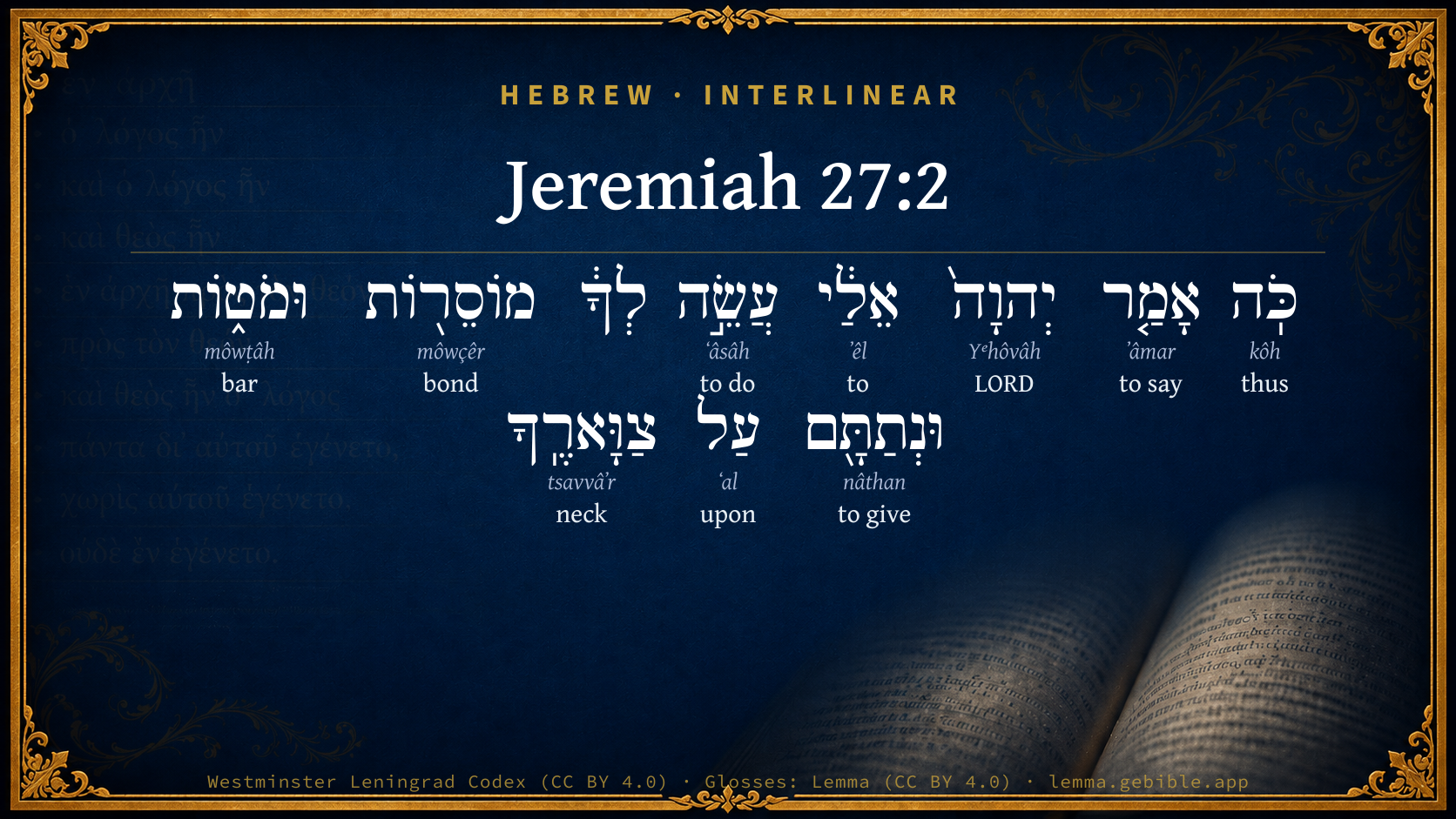
Jeremiah 27:2

Hebrew (Westminster Leningrad Codex) Jeremiah 27:2 appears in the Hebrew Old Testament. The text above is from the Westminster Leningrad Codex. Each word links to its Strong’s number, a concise gloss, and parsing drawn from the Open Scriptures Hebrew Bible morphology. Click any word for its full Brown-Driver-Briggs (BDB) entry.
Download image
Cite this verse

Jeremiah 27:2 (World English Bible). Public Domain. Lemma interlinear Bible study tool, https://lemma.gebible.app/v/jeremiah/27/2.

Show BibTeX & RIS
BibTeX
RIS
English Translation
Thus says Yahweh to me: Make you bonds and bars, and put them on your neck;
World English Bible · Public Domain
Download a study sheet

One document with this verse’s original text, its word-by-word gloss line, the meaning frame, cross-references with their text, attributed commentary, and full source and license credits — printable, and it pastes into notes with its structure intact.

This verse Autodidact and up

Study sheet (.html) Plain text (.txt)

A passage Seminary Student

Up to 50 verses in one chapter. A passage sheet keeps up to 6 commentary sources and 12 cross-references per verse, in the order this page ranks them, and says so on the sheet whenever that leaves anything out. Ask for a single verse and you get the Autodidact verse sheet above.

Everything on this page stays free to read, with no account — the sheet is a download of what is already on screen, not access to it.

Want to remove ads? Support Godless Engineer
Compare translations 3

The same verse in 3 English versions, stacked beneath the original-language interlinear above. Click any original word for its lexicon entry.

Each is an independent rendering of the whole verse — the interlinear is not word-aligned to these translations.

Highlighted words mark where these versions differ — a whole-verse word diff, not a word-by-word alignment.

  • World English Bible Public Domain
    Thus says Yahweh to me: Make you bonds and bars, and put them on your neck;
  • King James Version Public Domain
    Thus saith the LORD to me; Make thee bonds and yokes, and put them upon thy neck,
  • unfoldingWord Literal Text CC BY-SA 4.0
    “Thus says Yahweh to me, ‘Make for yourself bonds and yoke bars, and put them on your neck.

unfoldingWord Literal Text — © unfoldingWord, licensed CC BY-SA 4.0. Word-aligned USFM3 via Door43 (git.door43.org/unfoldingWord/en_ult).

Versions to compare (up to 4)

3 of 4 selected

Show all 18 translations

Every available English version of this verse, each an independent rendering of the whole verse.

  • World English Bible Public Domain
    Thus says Yahweh to me: Make you bonds and bars, and put them on your neck;
  • Berean Standard Bible Public Domain
    This is what the LORD said to me: “Make for yourself a yoke out of leather straps and put it on your neck.
  • Majority Standard Bible Public Domain
    This is what the LORD said to me: “Make for yourself a yoke out of leather straps and put it on your neck.
  • King James Version Public Domain
    Thus saith the LORD to me; Make thee bonds and yokes, and put them upon thy neck,
  • American Standard Version (1901) Public Domain
    Thus saith Jehovah to me: Make thee bonds and bars, and put them upon thy neck;
  • Revised Version (1885) Public Domain
    Thus saith the LORD to me: Make thee bands and bars, and put them upon thy neck;
  • Geneva Bible (1599) Public Domain
    Thus saith the Lord to me, Make thee bonds, and yokes, and put them vpon thy necke,
  • Douay-Rheims (1899) Public Domain
    Thus saith the Lord to me: Make thee bands, and chains: and thou shalt put them on thy neck.
  • Young's Literal Translation Public Domain
    `Thus said Jehovah unto me, Make to thee bands and yokes,
  • Literal Standard Version CC BY-SA 4.0
    “Thus said YHWH to me: Make bands and yokes for yourself,
  • Unlocked Literal Bible CC BY-SA 4.0
    This is what Yahweh said to me, “Make fetters and a yoke for yourself. Place them on your neck.
  • unfoldingWord Literal Text CC BY-SA 4.0
    “Thus says Yahweh to me, ‘Make for yourself bonds and yoke bars, and put them on your neck.
  • Darby Bible Public Domain
    Thus hath Jehovah said unto me: Make thee bonds and yokes, and put them upon thy neck;
  • World Messianic Bible Public Domain
    the LORD says to me: “Make bonds and bars, and put them on your neck.
  • Webster's Bible Public Domain
    Thus saith the LORD to me; Make for thee bonds and yokes, and put them upon thy neck,
  • Free Bible Version CC BY-SA 4.0
    This is what the Lord told me: Make for yourself a harness and a yoke and strap it on your neck
  • Bible in Basic English Public Domain
    This is what the Lord has said to me: Make for yourself bands and yokes and put them on your neck;
  • JPS Tanakh (1917) Public Domain
    'Thus saith the LORD to me: Make thee bands and bars, and put them upon thy neck;

Literal Standard Version (2020), Covenant Press — licensed CC BY-SA 4.0. Text via the HelloAO Bible API (eBible.org). Unlocked Literal Bible (unfoldingWord) — licensed CC BY-SA 4.0. Text via the HelloAO Bible API (eBible.org). unfoldingWord Literal Text — © unfoldingWord, licensed CC BY-SA 4.0. Word-aligned USFM3 via Door43 (git.door43.org/unfoldingWord/en_ult). Free Bible Version, Dr. Jonathan Gallagher — licensed CC BY-SA 4.0. Text via the HelloAO Bible API (eBible.org).

Word by word

More ways to search: Search by grammar → Find every occurrence → Compare this word →

Practice this passage: Drill this verse → Learn its vocabulary →

מוֹסֵר֖וֹת
môwçêr
H4147
“bonds”
Noun, Common, Both, Plural, Absolute
Part of Speech
Noun
Type
Common
Gender
Both
Number
Plural
State
Absolute
Full BDB Definition

Origin: from H3256

TWOT: 141f

band, bond
  1. כֹּֽה kôh H3541 “thus” Adverb
  2. אָמַ֤ר ʼâmar H559 “to say” Verb, Qal, Perfect, 3rd Person, Masculine, Singular
  3. יְהוָה֙ Yᵉhôvâh H3068 “LORD” Noun, Proper
  4. אֵלַ֔י ʼêl H413 “to · me” Preposition + Suffix, Personal, 1st Person, Common, Singular
  5. עֲשֵׂ֣ה ʻâsâh H6213 “do” Verb, Qal, Imperative, 2nd Person, Masculine, Singular
  6. וּמֹט֑וֹת môwṭâh H4133 “and · bars of” Conjunction + Noun, Common, Feminine, Plural, Construct
  7. וּנְתַתָּ֖ם nâthan H5414 “and · to give · them” Conjunction + Verb, Qal, Sequential Perfect, 2nd Person, Masculine, Singular + Suffix, Personal, 3rd Person, Masculine, Plural
  8. עַל ʻal H5921 “upon” Preposition
  9. צַוָּארֶֽךָ tsavvâʼr H6677 “neck · your” Noun, Common, Masculine, Singular, Construct + Suffix, Personal, 2nd Person, Masculine, Singular

About this verse

These counts appear in no published source. They are computed here, from the morphology-tagged text and Lemma’s own curated glosses. What Lemma adds →

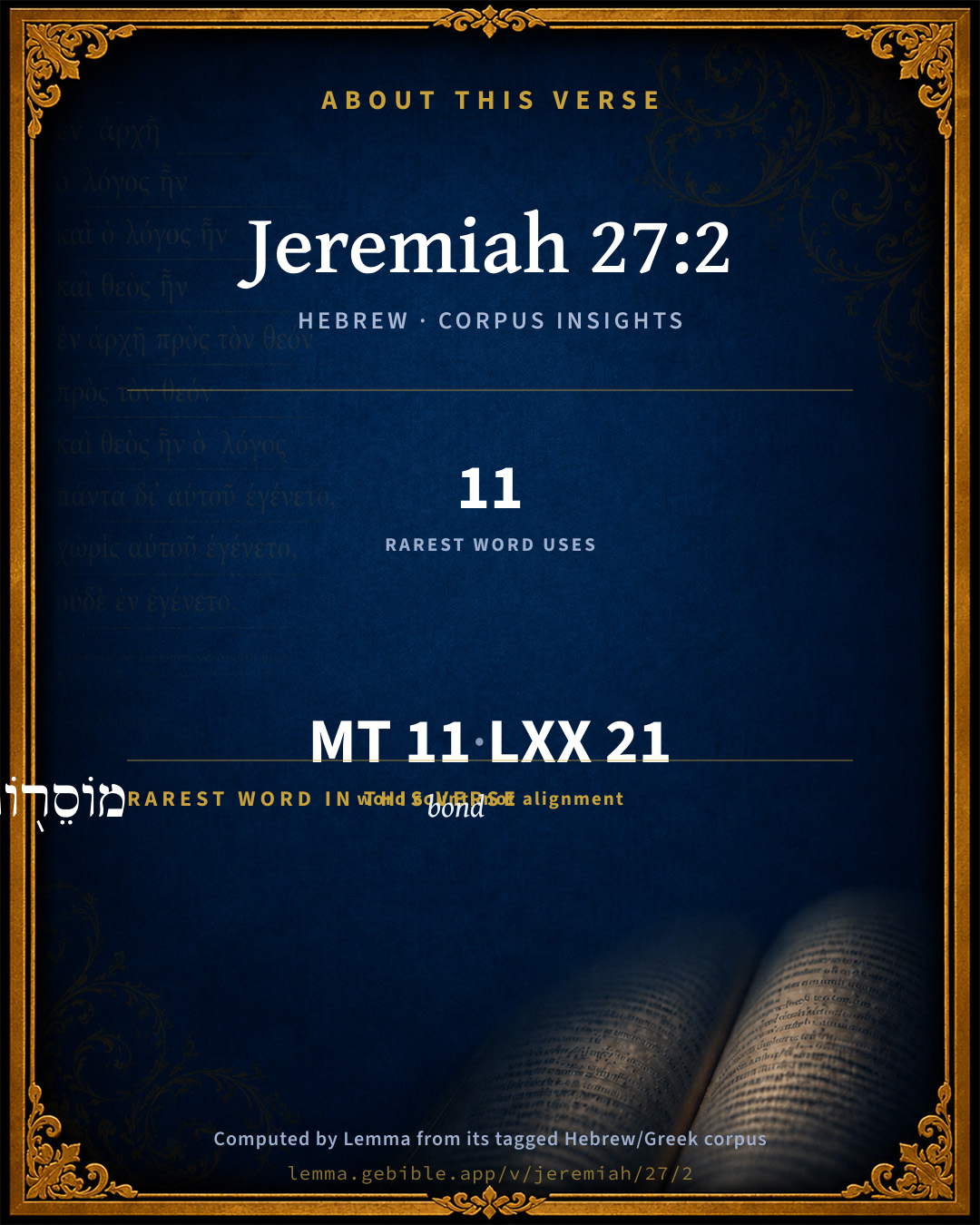
11
words
10
distinct lemmas
Prophets
section

Notable vocabulary

The rarest word here is מוֹסֵר֖וֹת bond H4147 — appearing just 11 times in the whole Hebrew Bible.

Shared distinctive vocabulary

מוֹסֵר֖וֹת bond H4147 occurs in 11 verses of the Hebrew Bible. Also found in:

Grammatical profile

  • 3 verbs
  • 4 nouns
  • 3 prepositions
  • 1 adverb

Verb forms

  • אָמַ֤ר Qal · Perfect
  • עֲשֵׂ֣ה Qal · Imperative
  • וּנְתַתָּ֖ם Qal · Sequential Perfect

Hebrew & Septuagint length

In the original languages it is 11 Hebrew tokens and 21 Greek tokens — but the two are counted differently (Hebrew bundles its prefixes and suffixes into one token; the Greek is in lemma form), so that isn’t a like-for-like length.

Cross-references

12

Topical passages linked to Jeremiah 27:2 in the Treasury of Scripture Knowledge — connected by theme and wording, ordered by reader-vote popularity; previews shown in the World English Bible.

  • Amos 7:1 Thus the Lord Yahweh showed me: and, behold, he formed locusts in the beginning of the shooting up of the latter growth; and, behold, it was the latter growth after the king's harvest.
  • 1 Kings 11:30–31 Ahijah laid hold of the new garment that was on him, and tore it in twelve pieces.
  • Isaiah 20:2–4 at that time Yahweh spoke by Isaiah the son of Amoz, saying, Go, and loose the sackcloth from off your loins, and put your shoe from off your foot. He did so, walking naked and barefoot.
  • Jeremiah 13:1–11 Thus says Yahweh to me, Go, and buy you a linen belt, and put it on your loins, and don't put it in water.
  • Jeremiah 18:2–10 Arise, and go down to the potter's house, and there I will cause you to hear my words.
  • Jeremiah 19:1–11 Thus said Yahweh, Go, and buy a potter's earthen bottle, and [take] of the elders of the people, and of the elders of the priests;
  • Jeremiah 27:12 I spoke to Zedekiah king of Judah according to all these words, saying, Bring your necks under the yoke of the king of Babylon, and serve him and his people, and live.
  • Jeremiah 28:10–14 Then Hananiah the prophet took the bar from off the prophet Jeremiah's neck, and broke it.
  • Ezekiel 4:1–5 You also, son of man, take a tile, and lay it before you, and portray on it a city, even Jerusalem:
  • Ezekiel 12:1–28 The word of Yahweh also came to me, saying,
  • Ezekiel 24:3–12 Utter a parable to the rebellious house, and tell them, Thus says the Lord Yahweh, Set on the caldron, set it on, and also pour water into it:
  • Amos 7:4 Thus the Lord Yahweh showed me and, behold, the Lord Yahweh called for judgment by fire; and it dried up the great deep, and would have devoured the land.

Cross-references courtesy of OpenBible.info (CC BY 4.0).

Hebrew and Greek witnesses Masoretic Hebrew ↔ Greek Septuagint

The same verse in the two great witnesses to the Old Testament, shown verse-for-verse.

These are two independent witnesses, not word-aligned to each other, and the Septuagint is shown in lemma (dictionary) form.

Hebrew Jeremiah 27:2 Masoretic · Westminster Leningrad Codex

כֹּֽה אָמַ֤ר יְהוָה֙ אֵלַ֔י עֲשֵׂ֣ה לְךָ֔ מוֹסֵר֖וֹת וּמֹט֑וֹת וּנְתַתָּ֖ם עַל צַוָּארֶֽךָ

Thus says Yahweh to me: Make you bonds and bars, and put them on your neck;

World English Bible · Public Domain

Greek LXX Structure differs

In the Septuagint, Jeremiah is about an eighth shorter than the Hebrew and arranges its material differently — the Oracles Against the Nations (Hebrew chapters 46–51) appear in the middle of the Greek book, after 25:13. Because the chapter and verse boundaries do not line up, a verse-for-verse comparison with the Hebrew is not shown.

A verse-for-verse comparison isn’t shown here because the chapters and verses don’t line up. Switch to the LXX edition with the MT / LXX toggle above to read the Greek directly.

On this verse, Keil & Delitzsch discusses the Septuagint’s reading. Read the note in Commentary ↓

Hebrew: Westminster Leningrad Codex (CC BY 4.0). Greek: Septuagint (public domain); English from a public-domain English Septuagint. How the Septuagint differs from the Hebrew →

Targum (Aramaic paraphrase)

1

The Targum is the ancient Jewish Aramaic paraphrase of the Hebrew Scriptures — an interpretive translation, not the Hebrew text itself. Onkelos (literal) and Pseudo-Jonathan (expansive) render the Torah, and Jonathan the Prophets. Coverage is partial: where no permissively-licensed English translation exists for a verse, only the Aramaic is shown. This is verse-level text, not a word-by-word alignment to the Hebrew.

  1. Targum Jonathan Prophets (Joshua–Malachi)
    כִּדְנַן אֲמַר יְיָ לִי עָבֵיד לָךְ חַנְקִין וְנִירִין וְתִתְּנִינוּן עַל צַוְרָךְ:

    (no public-domain English translation for this verse)

    Targum Jonathan — Aramaic: “Mikraot Gedolot” (public domain). English: “Sefaria Community Translation” (CC0 1.0 (public-domain dedication)); “London "Chaldee Paraphrase," 1871” (public domain). Text via Sefaria.

Commentary

Notes on Jeremiah 27:2 from classic Christian and Jewish commentators (each source and its license shown beneath its notes). The classic Christian expositions comment on the surrounding passage and are grouped to its opening verse, so a note may address several verses; the Jewish commentaries on the Tanakh (Rashi and others) are per-verse, so they appear only where the commentator wrote on this verse.

Lemma curates 59 commentaries, every one of them public domain or Creative Commons licensed, each selected and text-cleaned for this edition rather than reprinted as found. About our sources →

Trapp's Complete Commentary

John Trapp

Jer 27:2 Thus saith the LORD to me; Make thee bonds and yokes, and put them upon thy neck,

Ver. 2. Make thee bonds and yokes,] i.e., Yokes with bonds, such as they are wont to be fastened with.

And put them upon thy neck.] This was to the prophet, saith the Jesuit, molesta et probrosa poenitentia, {a} a troublesome and disgraceful penance. But this was no will worship, say we; and much handsomer than the penances they put the people to in Italy, where you may see them go along the streets, saith mine author, {b} with a great rope about their necks, as if they were dropped down from the gallows. And sometimes they wear a sausage or a swine’s pudding in place of a silver or gold chain, for a sign of their mortification, and that they may merit.

{a} A Lapide.

{b} Bee Hive of Rome.

John Trapp, A Commentary or Exposition upon All the Books of the Old and New Testament (1647–1656) — public domain. Text from a community e-Sword module.

Joseph Benson's Commentary

Jer 27:2-3. Make thee bonds and yokes, &c. — The prophets were frequently ordered to foreshow future events by actions as well as by words. Thus Isaiah was commanded to go naked and barefoot, Isa 20:3. Ezekiel, in like manner, was ordered to prophesy by signs, Eze 4:1; Eze 12:3; and Eze 24:17-19. In making these yokes, putting them upon his neck, and fastening them on with bands, Jeremiah was intended to be a type both to his own people, and also to the people afterward mentioned, that they should be brought under subjection to the king of Babylon. And send them to the king of Edom, &c. — These nations were near to the Jews, and their princes had their ambassadors resident at Jerusalem. They were also some of those countries which God had declared that he had given into the hand of the king of Babylon: see Jer 25:21; Jer 25:24. By the hand of the messengers, &c. — The business of these messengers seems to have been, to engage Zedekiah to join in a league with the nations from which they came, against the king of Babylon.

Joseph Benson's Commentary on the Old and New Testaments (1811–1818) — public domain. Text from a community e-Sword module.

Keil & Delitzsch

C. F. Keil & F. Delitzsch

The yoke of the king of Babylon upon the kings of Edom, Moab, Ammon, Tyre, and Sidon. - Jer 27:2. "Thus said Jahveh to me: Make thee bonds and yokes, and put them upon thy neck, Jer 27:3. And send them to the king of Edom, the king of Moab, the king of the sons of Ammon, the king of Tyre, and the king of Sidon, by the hand of the messengers that are come to Jerusalem to Zedekiah king of Judah. Jer 27:4. And command them to say unto their masters, Thus hath Jahveh of hosts, the God of Israel, said: Thus shall ye say unto your masters: Jer 27:5. I have made the earth, the man and the beast that are upon the ground, by my great power and by my outstretched hand, and give it to whom it seemeth meet unto me. Jer 27:6. And how have I given all these lands into the hand of Nebuchadnezzar king of Babylon, my servant; and the beasts of the field also have I given him to serve him. Jer 27:7. And all nations shall serve him, and his son, and his son's son, until the time of his land come, and many nations and great kings serve themselves of him. Jer 27:8. And the people and the kingdom that will not serve him, Nebuchadnezzar king of Babylon, and that will not put its neck into the yoke of the king of Babylon, with sword, with famine, and with pestilence I will visit that people, until I have made an end of them by his hand. Jer 27:9. And ye, hearken not to your prophets, and your soothsayers, and to your dreams, to your enchanters and your sorcerers, which speak unto you, saying: Ye shall not serve the king of Babylon. Jer 27:10. For they prophesy a lie unto you, that I should remove you far from your land, and that I should drive you out and ye should perish. Jer 27:11. But the people that will bring its neck under the yoke of the king of Babylon and will serve him, that will I let remain in its land, saith Jahveh, to till it and to dwell therein."

The yoke Jeremiah is to make and lay on his neck is a plain emblem of the Babylonian yoke the nations are to bear. The words "bonds and yokes" denote together one yoke. מטות are the two wooden beams or poles of the yoke, which were fastened together by means of the מוסרות, bonds, ropes, so that the yoke might be laid on the beast's neck; cf. Lev 26:13. That Jeremiah really put such a yoke on his neck and wore it, we see from Jer 28:10, Jer 28:12, where a false prophet breaks it for him. He is to send the yoke to the kings of Edom, Moab, etc., by means of envoys of those kings, who were come to Jerusalem to Zedekiah. And since Jeremiah laid a yoke on his own neck, and so carried out the commanded symbolical action in objective reality, there is no reason to doubt that he made yokes for the five kings named and gave them to their respective envoys. Chr. B. Mich., Hitz., Graf, hold this to be improbable, and suppose that Jeremiah only made a yoke for himself and put it on his neck; but by appearing abroad with it, he set before the eyes of the ambassadors, the yoke that was to be laid on their kings, and, in a certain sense, emblematically gave it to them. But even though this might have sufficed to accomplish the aim of the prophecy, it is difficulty to reconcile it with the wording of the text; hence Hitz. seeks arbitrarily to change שׁלּחתּם into שׁלּחתּה. And it is a worthless argument that Jeremiah cannot possibly have believed that the envoys would carry the yokes with them and deliver them to their masters. Why should not he have believed they would do so? And if they did not, it was their concern. The plur. "bands and yokes" may indeed mean a single yoke, but it may also mean many; and the verbs נתתּם and שׁלּחתּם, both with plural suffixes, indicate clearly that he was to make not merely one yoke for himself, but yokes for himself and the kings. In Jer 28:10 and Jer 28:12, where one yoke is spoken of, the singular המּוטה is used; while, Jer 28:13, "yokes of wood hast thou broken," does not prove that this plural has the same force as the singular.

We are not told for what purpose ambassadors from the kings named had come to Jerusalem; but we can discover what it was from the message Jeremiah gives them for their lords. From this it appears, without a doubt, that they were come to take counsel as to a coalition with the view of throwing off the Chaldean supremacy. By God's command Jeremiah opposes this design with the announcement, that the God of Israel, the Creator of the world and of all creatures, has given all these lands (those of the kings named in Jer 27:3) into the hand of Nebuchadnezzar; that men, and even beasts, should serve him, i.e., that he might exercise unbounded dominion over these lands and all that belonged to them, cf. Jer 28:14. "My servant," as in Jer 25:9. All nations are to serve him, his son and his grandson. These words simply express the long duration of the king of Babylon's power over them, without warranting us in concluding that he was succeeded on the throne by his son and his grandson, cf. Deu 6:2; Deu 4:25. For, as we know, Nebuchadnezzar was succeeded by his son Evil-Merodach; then came his brother-in-law Neriglissar, who murdered Evil-Merodach, who was followed by his son Laborosoarchod, a child, murdered after a nine months' reign by conspirators. Of these latter, Neboned ascended the throne of Babylon; and it was under his reign that the time for his land came that it should be made subject by many nations and great kings, cf. Jer 25:14. גּם הוּא serves to strengthen the suffix on ארצו; and the suffix, like בּו, refers to Nebuchadnezzar.

(Note: Jer 27:7 is wanting in the lxx, and therefore Mov. and Hitz. pronounce it spurious. But, as Graf remarked, they have no sufficient reason for this, since, reference being had to Jer 27:16 and to Jer 28:3, Jer 28:11, this verse is very much in place here. It is not a vaticinium ex eventu, as Hitz. asserts, but was rather omitted by the lxx, simply because its contents, taken literally, were not in keeping with the historical facts. The lxx omit also the clause from "that will not serve" to "king of Babylon and," which is accordingly, and for other subjective reasons of taste, pronounced spurious by Hitz.; but Graf justly opposes this.)

What is said in Jer 27:6 and Jer 27:7 is made sterner by the threatening of Jer 27:8, that the Lord will punish with sword, famine, and pestilence the people and kingdom that will not serve Nebuchadnezzar. ואת introduces a second relative clause, the את being here quite in place, since "the people and the kingdom" are accusatives made to precede absolutely, and resumed again by the 'על הגּוי ה, which belongs directly to the verb "visit." With עד־תּמּי, cf. Jer 24:10 and אתם עד־כּלּותי, corresponding in meaning, in Jer 9:15.

Keil & Delitzsch — Biblical Commentary on the Old Testament (1861–1891) — public domain (CC PDM 1.0). Text via the HelloAO Bible API. (Old Testament only.)

Geneva Bible (1599)

Geneva Bible translators

By such signs the Prophets used sometimes to confirm their prophecies which notwithstanding they could not do of themselves, but in as much as they had a revelation for the same, Isa. 20:2, and therefore the false Prophets to get more credit, did use also such visible signs, but they had no revelation, 1 Kings 22:12.

Geneva Bible (1599) marginal notes — public domain. Text via Bolls.life.

Jamieson, Fausset & Brown

Robert Jamieson, A. R. Fausset & David Brown

bonds--by which the yoke is made fast to the neck (Jer 5:5).

yokes--literally, the carved piece of wood attached at both ends to the two yokes on the necks of a pair of oxen, so as to connect them. Here the yoke itself. The plural is used, as he was to wear one himself, and give the others to the ambassadors; (Jer 27:3; Jer 28:10, Jer 28:12) proves that the symbolical act was in this instance (though not in others, Jer 25:15) actually done (compare Isa 20:2, &c.; Eze 12:3, Eze 12:11, Eze 12:18).

Jamieson, Fausset & Brown — Commentary Critical and Explanatory on the Whole Bible (1871) — public domain (CC PDM 1.0). Text via the HelloAO Bible API.

Adam Clarke's Commentary

Verse 2. Make thee bonds and yokes] Probably yokes with straps, by which they were attached to the neck. This was a symbolical action, to show that the several kings mentioned below should be brought under the dominion of the Chaldeans.

Adam Clarke's Commentary on the Bible (1810–1826) — public domain. Text from a community e-Sword/MySword module.

Ellicott's Commentary for English Readers

(2) Make thee bonds and yokes.—This method of vivid symbolic prediction had a precedent in the conduct of Isaiah when he walked “naked and barefoot” (Isa_20:2). We have to realise the infinitely more vivid impression which the appearance of the prophet in this strange guise, as though he were at once a captive slave and a beast of burden, would make on the minds of men, as compared with simply warning them of a coming subjugation. The principle on which the prophet acted was that of Horace (Ep. ad Pis. 180):—

“Segnius irritant animos demissa per aures,

Quam quæ sunt oculis subjecta fidelibus, et quæ

Ipse sibi tradit spectator.”

“Things that we hear less stir the inmost soul,

Than what the eye sees dramatised in act.”

So Agabus bound himself with Paul’s girdle (Act_21:11). So Ezekiel dug through the wall of his house and carried out his stuff (Eze_12:5-7). We find from Jer_28:10 that the prophet obeyed the command quite literally.

A Bible Commentary for English Readers, edited by Charles John Ellicott (1878–1897) — public domain. Text from a community e-Sword module.

The Cambridge Bible for Schools and Colleges

gen. ed. J. J. S. Perowne

2. bands and bars] The former were to fasten the bars together, thus forming a yoke. For the symbolic action cp. 1Ki_22:11.

2–11. Certain kings having sent to invite Zedekiah to join them in an attempt to overthrow the power of Babylon, Jeremiah warns them to desist as the attempt would be futile. Du. points out that Zedekiah’s visit to Babylon (Jer_51:59) about this time, whether voluntary or at the requisition of Nebuchadnezzar, may have had for one purpose the clearing himself from suspicion of being implicated in the proposed revolt, an unrest that may well have received a stimulus from the change of ruler in Egypt, Psammetichus II. succeeding his father Pharaoh-necoh in b.c. 594.

The Cambridge Bible for Schools and Colleges (gen. ed. J. J. S. Perowne; Cambridge University Press, 1878–1918) — public domain. Text from a community e-Sword module.

John Gill's Exposition

Thus saith the Lord to me, make thee bonds and yokes,.... The yokes were made of wood, as appears from Jer 28:13; and the bonds were strings or thongs, which bound the yoke together, that it might not slip off the neck, on which it was put:

and put them upon thy neck; not all of them together, but one after another, at different times; and this was very significant; for the prophet being seen abroad with a yoke upon his neck, it would be natural to inquire the meaning of it; when they would be told it was to signify the subjection of Judah, and so of other nations, to the king of Babylon; and that he did wear at times such a yoke, even fifteen years after, in the fourth of Zedekiah's reign, appears from Jer 28:1.

John Gill's Exposition of the Whole Bible (1746–1763) — public domain (CC PDM 1.0). Text via the HelloAO Bible API.

Albert Barnes' Notes on the Bible

Yokes - Two curved pieces of wood, the one put over the neck of the ox, the other under, and then fastened together by bonds or cords (compare Psa 2:3). Compare the marginal references.

Albert Barnes' Notes on the Bible (1834–1885) — public domain. Text from a community e-Sword/MySword module.

Haydock's Catholic Bible Commentary

Chains. Hebrew, "a yoke and pole," (Calmet) or piece of wood for the necks of slaves. (St. Jerome) --- Thus would the servitude of these nations be clearly represented. (Haydock) --- Bands and chains were proper signs, as they were used to bind captives. (Worthington)

George Leo Haydock (1774–1849), Haydock's Catholic Family Bible and Commentary, 1859 edition — public domain. Excludes Psalms (Douay-Rheims chapter numbering differs from Protestant) and Deuterocanonical books (Catholic canon only).

Matthew Poole's English Annotations

God commandeth the prophet to procure, either by his own labour, or with his money, some yokes, with bonds to make them more fast; and to put some one of them upon his own neck, that therein he might be a type both to his own people, and also the people afterward mentioned, that they should be in bondage to the king of Babylon, and their yoke should be so fastened with bonds, that they should not be able to slip them, or get them from off their necks.

Matthew Poole's English Annotations on the Holy Bible (1683–1685) — public domain. Text from a community e-Sword/MySword module.

Whedon's Commentary on the Bible

Daniel D. Whedon

2. Bonds and yokes — The yoke was made of two curved pieces of wood, placed the one over and the other under the neck of the animal, and fastened together with cords. See Psa_2:3.

Put them upon thy neck — In the manner in which they were worn by animals when used to draw a load. The “yoke,” as here employed, was the appropriate symbol of bondage. This command was literally obeyed. See Jer_28:10. Some hold that Jeremiah obeyed these literally as to himself, but not for the different kings mentioned. But this does great violence to the text, which is as explicit for one as the other.

Daniel D. Whedon (gen. ed.), Commentary on the Old and New Testaments (1874–1909) — public domain. Text from a community e-Sword module.

The Pulpit Commentary

Make thee bends and yokes; rather, bands and poles; i.e. the bands which secured the two pieces of wood placed respectively above and beneath the neck of the ox, so forming a yoke. Hence, in Lev_26:13, we find the phrase, "the poles Authorized Version wrongly, "the bands of your yoke." It is clear from Jer_28:10 that this account is to be taken literally.

The Pulpit Commentary (1880–1919), ed. H.D.M. Spence-Jones & Joseph S. Exell — public domain. Text from a community e-Sword module.

John Wesley's Explanatory Notes

Thus saith - God commands the prophet to procure some yokes with bonds to make them more fast; and to put one of them upon his own neck, that therein he might be a type both to his own people, and also the people afterward mentioned, that they should be in bondage to the king of Babylon.

John Wesley, Explanatory Notes Upon the Whole Bible (1754–1765) — public domain. Text via the GEBible commentary corpus.

Rashi

Rabbi Shlomo Yitzchaki (Rashi)

thongs They are the thongs of the yoke that are called kongoijli (cojongles).

Rashi on the Tanakh — English translations: “The Judaica Press complete Tanach with Rashi, translated by A. J. Rosenberg” (CC BY 4.0); “Pentateuch with Rashi's commentary by M. Rosenbaum and A.M. Silbermann, 1929-1934” (public domain); “The Metsudah Tanach series, Lakewood, N.J” (CC BY 4.0); and “The Book of Joshua, Metsudah Publications, 1997” (CC BY 4.0). Text via Sefaria.

Lesson kit

Teaching starters — assembled from the data on this page, not authored interpretation. Every prompt links to the verse data it draws on. Edit before teaching.

Jeremiah, in the Prophets, opens this verse with 11 words (10 distinct Hebrew lemmas). Its most distinctive word is môwçêr (“bond”). A historical commentator’s framing appears above. Read the whole chapter for the surrounding context.

Discussion questions

  1. What does “bond” (môwçêr) contribute to the verse as a whole?
  2. Job 39:5 shares the word «bond» with this verse. How do the two illuminate each other?
  3. These translations render this verse differently; the difference is in the English rendering, not the original. What questions does that raise?
  4. The verb «אָמַ֤ר» is Qal Perfect. How does its form color the action?
  5. Reading how Trapp's Complete Commentary and Joseph Benson's Commentary read this verse, where do the two commentators agree and where do they part?

Things to notice

Reading settings

Reading text

Shown beneath each verse's original-language words.

Old Testament
Old Testament edition

Read the OT as the Masoretic Hebrew (MT) or the Greek Septuagint (LXX).

English shown for the Greek Septuagint (in the Hebrew ↔ Greek comparison).

Comparing translations? Open the Compare panel on any verse page to stack up to four side by side.