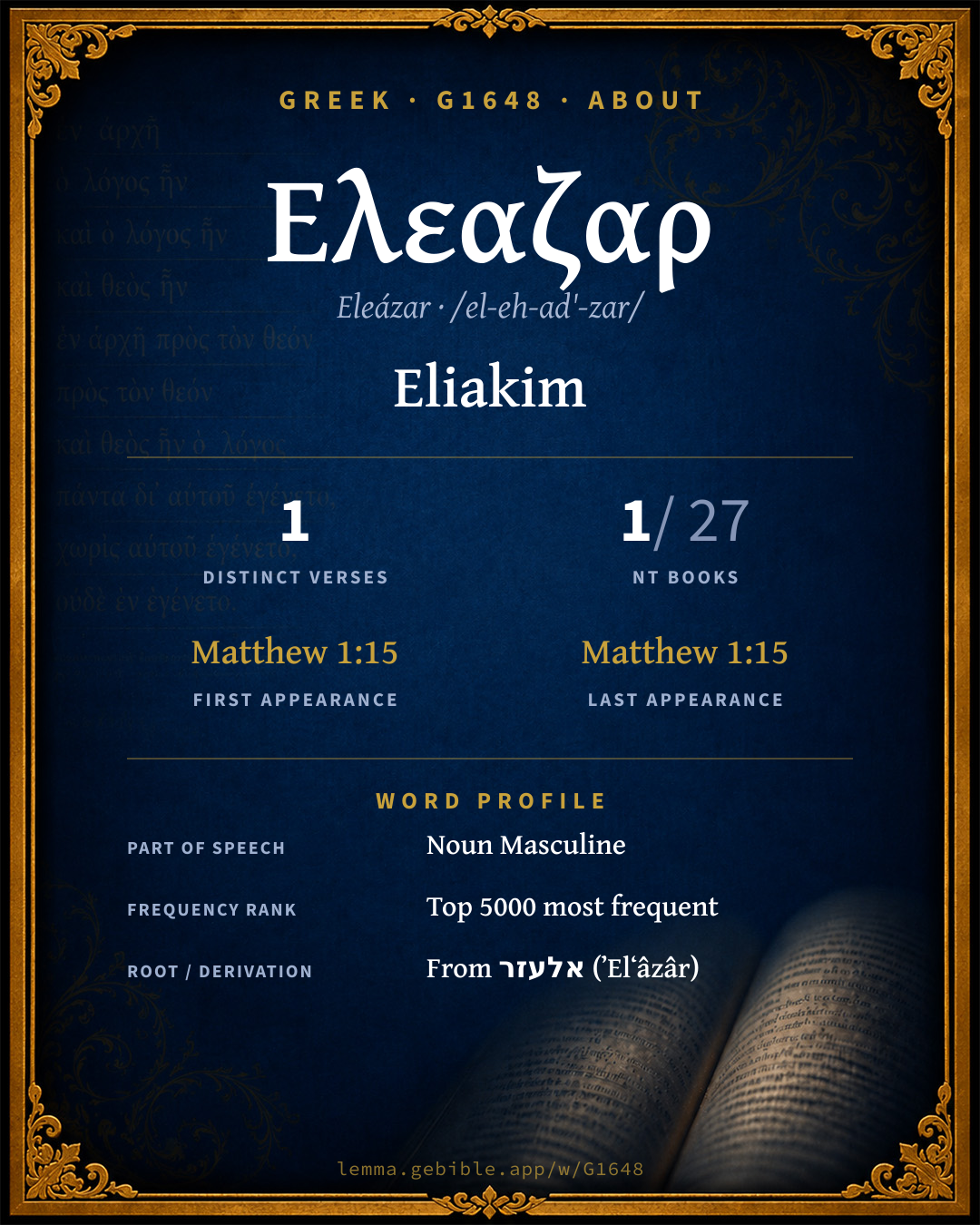
Ἐλεάζαρ
Eliakim
Thayer's lists 2 entries for ‘Eliakim’ fuller range ↓
Full lexicon entry — Thayer's Greek Lexicon
From Thayer's Greek Lexicon
Where this word appears
Every verse where G1648 appears — 1 distinct verse across 1 book. Click any verse to open its interlinear word-by-word view. Verse text shown in the World English Bible for context — . Each verse’s Greek form is shown with its reference; the English is not keyword-highlighted, since the data carries no word-level English alignment. Use “Compare translations” on any verse to read it across multiple English versions. This concordance covers the Greek New Testament; Septuagint (Greek Old Testament) occurrences of this word are not indexed here.
Matthew 1 verse
About this entry
At a glance — auto-summarized from this page’s data, not written by a person. Every figure links to its source below. This summary describes the numbers; it doesn’t interpret them.
Ελεαζαρ (Eleázar) is a Greek name most often rendered “Eliakim.” It is rare — just 1 verse in the entire Greek New Testament. Matthew dominates its distribution — 1 of 1 verses. Its lone occurrence is Matthew 1:15. The sections below give every occurrence and version rendering.
Gloss history
Strong's 1890 vs modern scholarship

About this word
Strong's G1648 catalogs a Greek word from the Greek New Testament.
These counts are not copied from any lexicon or concordance. They are computed here, from the morphology-tagged Greek New Testament. What Lemma adds →
- 1
- distinct verses
- The word appears in 1 distinct verse.
- 1 / 27
- NT books
- The word appears in 1 of 27 New Testament books.
- #2,678
- by frequency
- Top 5000 most frequent Greek words (rank 2,678 of 5,347 Greek words by occurrence).
View all 1 occurrence in the concordance →
Most concentrated in
- Matthew 1 verse 100%
By section of the New Testament
By traditional corpus
Conventional, traditional groupings — biblical authorship is debated, so this is a traditional corpus grouping, not an authorship claim. Some books belong to more than one corpus (Luke is in both the Gospels and the Lukan corpus, and so on), so these shares overlap and need not total 100%. Each figure is a share of the word’s 1 distinct verse.
- Gospels 1 verse · 100%
How translations render this word
Counts come from each version’s own published word-to-Strong’s tagging or interlinear alignment — an approximate guide to how each version renders this word, not a word-level alignment the data otherwise carries. Because each total is that version’s own tagged count, the per-version totals vary from one another and need not match the appearance or distinct-verse counts above. These counts may also differ from a printed concordance because Lemma counts each distinctly tagged rendering and does not collapse phrase taggings into a single head-word total. This is a fixed set of word-tagged versions (KJV, ASV, BSB, ULT) and does not change with the reading translation you choose elsewhere. Each version’s license is shown beside its name below (and on Sources).
- King James Version: Eleazar 2×
- American Standard Version: Eleazar 2×
- Berean Standard Bible: Eleazar 2×
- unfoldingWord Literal Text: Eleazar 2×
King James Version Public Domain
Renders G1648 across 2 tagged occurrences — most commonly:
American Standard Version Public Domain
Renders G1648 across 2 tagged occurrences — most commonly:
Berean Standard Bible Public Domain
Renders G1648 across 2 tagged occurrences — most commonly:
unfoldingWord Literal Text CC BY-SA 4.0
Renders G1648 across 2 tagged occurrences — most commonly:
Senses in Thayer's
The 2 senses Thayer's distinguishes for this word, in lexicon order (not ranked by frequency or importance). The full entry — with sub-senses — is in the Lexicon Entry tab.
- Eleazar = "help of God"
- one of the ancestors of Christ
Word origin
Derived from אלעזר (ʼElʻâzâr) (H499) — Eleazar.
Of hebrew origin [ H499 ]; Eleazar an Israelite : - Eleazar.
— Strong’s Exhaustive Concordance (1890), public domain.
Same root — word family
Other Thayer's entries built from the same root as G1648, grouped by Strong’s listed origin. These share a root / origin per the lexicon — not necessarily a shared meaning. Each links to that word’s own entry.
Derives from
Proper names from this root
People and places named from this root — a name, not an additional meaning of the word.
Compare all same-root words → 2 of the same-root words are proper names (people or places). They share a root, not necessarily a meaning.
Bible dictionary
Public-domain dictionary articles matched to this entry by name (Eliakim). A biblical name can be shared by more than one person or place, so an article may treat several.
Easton's Bible Dictionary · M. G. Easton, 1897
Whom God will raise up. (1.) The son of Melea (Luke 3:30), and probably grandson of Nathan.
(2.) The son of Abiud, of the posterity of Zerubbabel (Matt. 1:13).
(3.) The son of Hilkiah, who was sent to receive the message of the invading Assyrians and report it to Isaiah (2 Kings 18:18; 19:2; Isa. 36:3; 37:2). In his office as governor of the palace of Hezekiah he succeeded Shebna (Isa. 22:15-25). He was a good man (Isa. 22:20; 2 Kings 18:37), and had a splendid and honourable career.
(4.) The original name of Jehoiakim, king of Judah (2 Kings 23:34). He was the son of Josiah.
Smith's Bible Dictionary · William Smith, 1863
(raised up by God.).
+ Son of Hilkiah, master of Hezekiah's household ("over the house," as) (Isaiah 36:3) (2 Kings 18:18,26,37) (B.C. 713.) Eliakim was a good man, as appears by the title emphatically applied to him by God, "my servant Eliakim," (Isaiah 22:20) and also in the discharge of the duties of his high station, in which he acted as a "father to the inhabitants of Jerusalem, and to the house of Judah." (Isaiah 22:21) + The original name of Jehoiakim king of Judah. (2 Kings 23:34; 2 Chronicles 36:4) + A priest in the days of Nehemiah, who assisted at the dedication of the new wall of Jerusalem. (Nehemiah 12:41) (B.C. 446.) + Eldest son of Abiud or Judah; brother of Joseph, and father of Azor. (Matthew 1:13) + son of Melea, and father of Jonan. (Luke 3:30,31)
Hitchcock's Bible Names Dictionary · Roswell D. Hitchcock, 1869
resurrection of God
Classic public-domain reference works; full attribution on Sources.
Septuagint usage
The same Greek word Ελεαζαρ appears 74 times in the Greek Old Testament (Septuagint), across 70 verses in 10 books.
- 74
- LXX occurrences
- Tagged occurrences of this Greek word in the Septuagint.
- 70
- verses
- Distinct Septuagint verses containing this word.
- 10 / 39
- OT books
- The word appears in 10 of the 39 Old Testament books.
Sample Septuagint occurrences
- Exodus 6:23 ελεαζαρ
- Leviticus 10:6 ελεαζαρ
- Numbers 3:2 ελεαζαρ
- Deuteronomy 10:6 ελεαζαρ
- Joshua 14:1 ελεαζαρ
- Judges 20:28 ελεαζαρ
- 1 Samuel 7:1 ελεαζαρ
- 2 Samuel 23:9 ελεαζαρ
- 1 Chronicles 5:29 ελεαζαρ
- Ezra 7:5 ελεαζαρ
Septuagint occurrences (same lexeme)
Every verse where the same Strong’s number (G1648) appears in the Greek Septuagint — showing the first 50 of 70. Verse text shown in the World English Bible for context; the Greek form is the matched word — the English is not keyword-highlighted.
- Exodus 6:23 ελεαζαρ Aaron took Elisheba, the daughter of Amminadab, the sister of Nahshon, as his wife; and she bore him Nadab and Abihu, Eleazar and Ithamar.
- Exodus 6:25 ελεαζαρ Eleazar Aaron's son took one of the daughters of Putiel as his wife; and she bore him Phinehas. These are the heads of the fathers' houses of the Levites according to their families.
- Exodus 28:1 ελεαζαρ "Bring Aaron your brother, and his sons with him, near to you from among the children of Israel, that he may minister to me in the priest's office, even Aaron, Nadab and Abihu, Eleazar and Ithamar, Aaron's sons.
- Leviticus 10:6 ελεαζαρ Moses said to Aaron, and to Eleazar and to Ithamar, his sons, "Don't let the hair of your heads go loose, neither tear your clothes; that you don't die, and that he not be angry with all the congregation: but let your brothers, the whole house of Israel, bewail the burning which Yahweh has kindled.
- Leviticus 10:12 ελεαζαρ Moses spoke to Aaron, and to Eleazar and to Ithamar, his sons who were left, "Take the meal offering that remains of the offerings of Yahweh made by fire, and eat it without yeast beside the altar; for it is most holy;
- Leviticus 10:16 ελεαζαρ Moses diligently inquired about the goat of the sin offering, and, behold, it was burned: and he was angry with Eleazar and with Ithamar, the sons of Aaron who were left, saying,
- Numbers 3:2 ελεαζαρ These are the names of the sons of Aaron: Nadab the firstborn, and Abihu, Eleazar, and Ithamar.
- Numbers 3:4 ελεαζαρ Nadab and Abihu died before Yahweh, when they offered strange fire before Yahweh, in the wilderness of Sinai, and they had no children. Eleazar and Ithamar ministered in the priest's office in the presence of Aaron their father.
- Numbers 3:32 ελεαζαρ Eleazar the son of Aaron the priest shall be prince of the princes of the Levites, with the oversight of those who keep the charge of the sanctuary.
- Numbers 4:16 ελεαζαρ "The charge of Eleazar the son of Aaron the priest shall be the oil for the light, the sweet incense, the continual meal offering, and the anointing oil, the charge of all the tabernacle, and of all that is in it, the sanctuary, and its furnishings."
- Numbers 17:2 ελεαζαρ Speak to the children of Israel, and take of them rods, one for each fathers' house, of all their princes according to their fathers' houses, twelve rods: write you every man's name on his rod.
- Numbers 17:4 ελεαζαρ You shall lay them up in the tent of meeting before the testimony, where I meet with you.
- Numbers 19:3 ελεαζαρ You shall give her to Eleazar the priest, and he shall bring her forth outside of the camp, and one shall kill her before his face:
- Numbers 19:4 ελεαζαρ and Eleazar the priest shall take of her blood with his finger, and sprinkle her blood toward the front of the tent of meeting seven times.
- Numbers 20:25 ελεαζαρ Take Aaron and Eleazar his son, and bring them up to Mount Hor;
- Numbers 20:26 ελεαζαρ and strip Aaron of his garments, and put them on Eleazar his son: and Aaron shall be gathered [to his people], and shall die there.
- Numbers 20:28 ελεαζαρ Moses stripped Aaron of his garments, and put them on Eleazar his son; and Aaron died there on the top of the mountain: and Moses and Eleazar came down from the mountain.
- Numbers 25:7 ελεαζαρ When Phinehas, the son of Eleazar, the son of Aaron the priest, saw it, he rose up from the midst of the congregation, and took a spear in his hand;
- Numbers 25:11 ελεαζαρ Phinehas, the son of Eleazar, the son of Aaron the priest, has turned my wrath away from the children of Israel, in that he was jealous with my jealousy among them, so that I didn't consume the children of Israel in my jealousy.
- Numbers 26:1 ελεαζαρ It happened after the plague, that Yahweh spoke to Moses and to Eleazar the son of Aaron the priest, saying,
- Numbers 26:3 ελεαζαρ Moses and Eleazar the priest spoke with them in the plains of Moab by the Jordan at Jericho, saying,
- Numbers 26:60 ελεαζαρ To Aaron were born Nadab and Abihu, Eleazar and Ithamar.
- Numbers 26:63 ελεαζαρ These are those who were numbered by Moses and Eleazar the priest, who numbered the children of Israel in the plains of Moab by the Jordan at Jericho.
- Numbers 27:2 ελεαζαρ They stood before Moses, and before Eleazar the priest, and before the princes and all the congregation, at the door of the tent of meeting, saying,
- Numbers 27:19 ελεαζαρ and set him before Eleazar the priest, and before all the congregation; and give him a charge in their sight.
- Numbers 27:21 ελεαζαρ He shall stand before Eleazar the priest, who shall inquire for him by the judgment of the Urim before Yahweh: at his word shall they go out, and at his word they shall come in, both he, and all the children of Israel with him, even all the congregation.
- Numbers 27:22 ελεαζαρ Moses did as Yahweh commanded him; and he took Joshua, and set him before Eleazar the priest, and before all the congregation:
- Numbers 31:6 ελεαζαρ Moses sent them, one thousand of every tribe, to the war, them and Phinehas the son of Eleazar the priest, to the war, with the vessels of the sanctuary and the trumpets for the alarm in his hand.
- Numbers 31:12 ελεαζαρ They brought the captives, and the prey, and the spoil, to Moses, and to Eleazar the priest, and to the congregation of the children of Israel, to the camp at the plains of Moab, which are by the Jordan at Jericho.
- Numbers 31:13 ελεαζαρ Moses, and Eleazar the priest, and all the princes of the congregation, went forth to meet them outside of the camp.
- Numbers 31:21 ελεαζαρ Eleazar the priest said to the men of war who went to the battle, This is the statute of the law which Yahweh has commanded Moses:
- Numbers 31:26 ελεαζαρ Take the sum of the prey that was taken, both of man and of animal, you, and Eleazar the priest, and the heads of the fathers' [houses] of the congregation;
- Numbers 31:29 ελεαζαρ take it of their half, and give it to Eleazar the priest, for Yahweh's heave-offering.
- Numbers 31:31 ελεαζαρ Moses and Eleazar the priest did as Yahweh commanded Moses.
- Numbers 31:41 ελεαζαρ Moses gave the tribute, which was Yahweh's heave-offering, to Eleazar the priest, as Yahweh commanded Moses.
- Numbers 31:51 ελεαζαρ Moses and Eleazar the priest took the gold of them, even all worked jewels.
- Numbers 31:54 ελεαζαρ Moses and Eleazar the priest took the gold of the captains of thousands and of hundreds, and brought it into the tent of meeting, for a memorial for the children of Israel before Yahweh.
- Numbers 32:2 ελεαζαρ the children of Gad and the children of Reuben came and spoke to Moses, and to Eleazar the priest, and to the princes of the congregation, saying,
- Numbers 32:28 ελεαζαρ So Moses gave charge concerning them to Eleazar the priest, and to Joshua the son of Nun, and to the heads of the fathers' [houses] of the tribes of the children of Israel.
- Numbers 34:17 ελεαζαρ These are the names of the men who shall divide the land to you for inheritance: Eleazar the priest, and Joshua the son of Nun.
- Numbers 36:1 ελεαζαρ The heads of the fathers' [houses] of the family of the children of Gilead, the son of Machir, the son of Manasseh, of the families of the sons of Joseph, came near, and spoke before Moses, and before the princes, the heads of the fathers' [houses] of the children of Israel:
- Deuteronomy 10:6 ελεαζαρ (The children of Israel traveled from Beeroth Bene Jaakan to Moserah. There Aaron died, and there he was buried; and Eleazar his son ministered in the priest's office in his place.
- Joshua 14:1 ελεαζαρ These are the inheritances which the children of Israel took in the land of Canaan, which Eleazar the priest, and Joshua the son of Nun, and the heads of the fathers' [houses] of the tribes of the children of Israel, distributed to them,
- Joshua 17:4 ελεαζαρ They came near before Eleazar the priest, and before Joshua the son of Nun, and before the princes, saying, Yahweh commanded Moses to give us an inheritance among our brothers: therefore according to the commandment of Yahweh he gave them an inheritance among the brothers of their father.
- Joshua 19:51 ελεαζαρ These are the inheritances, which Eleazar the priest, and Joshua the son of Nun, and the heads of the fathers' [houses] of the tribes of the children of Israel, distributed for inheritance by lot in Shiloh before Yahweh, at the door of the tent of meeting. So they made an end of dividing the land.
- Joshua 21:1 ελεαζαρ Then came near the heads of fathers' [houses] of the Levites to Eleazar the priest, and to Joshua the son of Nun, and to the heads of fathers' [houses] of the tribes of the children of Israel;
- Joshua 22:13 ελεαζαρ The children of Israel sent to the children of Reuben, and to the children of Gad, and to the half-tribe of Manasseh, into the land of Gilead, Phinehas the son of Eleazar the priest,
- Joshua 24:33 ελεαζαρ Eleazar the son of Aaron died; and they buried him in the hill of Phinehas his son, which was given him in the hill-country of Ephraim.
- Judges 20:28 ελεαζαρ and Phinehas, the son of Eleazar, the son of Aaron, stood before it in those days), saying, Shall I yet again go out to battle against the children of Benjamin my brother, or shall I cease? Yahweh said, Go up; for tomorrow I will deliver him into your hand.
- 1 Samuel 7:1 ελεαζαρ The men of Kiriath Jearim came, and fetched up the ark of Yahweh, and brought it into the house of Abinadab in the hill, and sanctified Eleazar his son to keep the ark of Yahweh.
These are occurrences of the same Greek lexeme (G1648) in the Septuagint — not a translation of any one Hebrew word. The store carries no word-level Hebrew↔Greek alignment, so no Hebrew original is asserted here. Counts come from the recovered LXX Strong's tagging — high-frequency vocabulary is well covered, while rare or late forms may be untagged — so they reflect tagged occurrences and may slightly undercount.