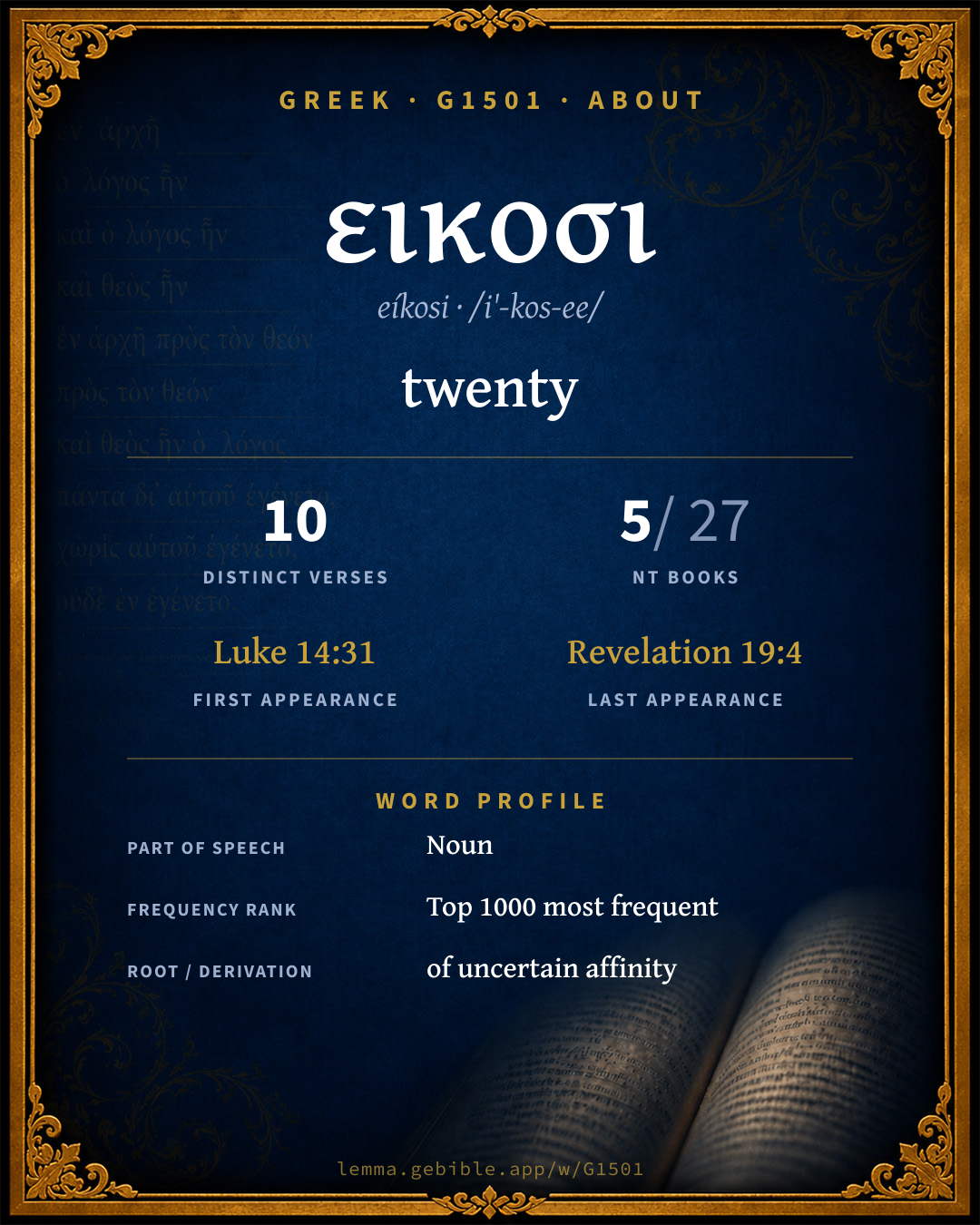
εἴκοσι
twenty
Full lexicon entry — Thayer's Greek Lexicon
From Thayer's Greek Lexicon
Where this word appears
Grammar key — what these labels mean
Part of speech
- Adjective
- A word that describes or qualifies a noun.
Case
- Nominative
- The case of the subject (and the predicate nominative).
Gender
- Feminine
- Grammatically feminine.
Number
- Plural
- More than one.
Grammatical forms
- Adjective, Numeral (indeclinable) 10 times (91%)
- Adjective, Nominative, Plural, Feminine 1 time (9%)
Parsed forms decoded from the imported morphology (Robinson–Tischendorf, public domain), counted across 11 parsed occurrences — not distinct verses.
Every verse where G1501 appears — 10 distinct verses across 5 books. Click any verse to open its interlinear word-by-word view. Verse text shown in the World English Bible for context — . Each verse’s Greek form is shown with its reference; the English is not keyword-highlighted, since the data carries no word-level English alignment. Use “Compare translations” on any verse to read it across multiple English versions. This concordance covers the Greek New Testament; Septuagint (Greek Old Testament) occurrences of this word are not indexed here.
Luke 1 verse
John 1 verse
Acts 2 verses
- Acts 1:15 εἴκοσι adj num indecl In these days, Peter stood up in the midst of the disciples (and the number of names was about one hundred twenty), and said,
- Acts 27:28 εἴκοσι adj num indecl They took soundings, and found twenty fathoms. After a little while, they took soundings again, and found fifteen fathoms..
1 Corinthians 1 verse
Revelation 5 verses
- Revelation 4:4 εἴκοσι εἴκοσι adj num indecl adj num indecl Around the throne were twenty-four thrones. On the thrones were twenty-four elders sitting, dressed in white garments, with crowns of gold on their heads.
- Revelation 4:10 εἴκοσι adj num indecl the twenty-four elders fall down before him who sits on the throne, and worship him who lives forever and ever, and throw their crowns before the throne, saying,
- Revelation 5:8 εἴκοσι adj num indecl Now when he had taken the book, the four living creatures and the twenty-four elders fell down before the Lamb, each one having a harp, and golden bowls full of incense, which are the prayers of the saints.
- Revelation 11:16 εἴκοσι adj num indecl The twenty-four elders, who sit on their thrones before God's throne, fell on their faces and worshiped God,
- Revelation 19:4 εἴκοσι adj num indecl The twenty-four elders and the four living creatures fell down and worshiped God who sits on the throne, saying, "Amen! Hallelujah!"
About this entry
At a glance — auto-summarized from this page’s data, not written by a person. Every figure links to its source below. This summary describes the numbers; it doesn’t interpret them.
At its core, εικοσι (eíkosi) means “twenty.” The word gravitates to Revelation (50%), then Acts and Luke. It turns up in 10 verses across 5 books, an uncommon footprint. Scripture first uses it in Luke 14:31. Older and newer Bibles part ways — “twenty” in the King James Version, “twenty-four” (Berean Standard Bible) in modern versions. See the renderings breakdown. Each statement above links to its evidence; the full detail follows below.
Gloss history
Strong's 1890 vs modern scholarship
About this word
Strong's G1501 catalogs a Greek word from the Greek New Testament.
These counts are not copied from any lexicon or concordance. They are computed here, from the morphology-tagged Greek New Testament. What Lemma adds →
- 10
- distinct verses
- The word appears in 10 distinct verses.
- 5 / 27
- NT books
- The word appears in 5 of 27 New Testament books.
- #978
- by frequency
- Top 1000 most frequent Greek words (rank 978 of 5,347 Greek words by occurrence).
View all 10 occurrences in the concordance →
Most concentrated in
- Revelation 5 verses 50%
- Acts 2 verses 20%
- Luke 1 verse 10%
By section of the New Testament
By traditional corpus
Conventional, traditional groupings — biblical authorship is debated, so this is a traditional corpus grouping, not an authorship claim. Some books belong to more than one corpus (Luke is in both the Gospels and the Lukan corpus, and so on), so these shares overlap and need not total 100%. Each figure is a share of the word’s 10 distinct verses.
- Johannine 6 verses · 60%
- Revelation 5 verses · 50%
- Lukan (Luke–Acts) 3 verses · 30%
- Gospels 2 verses · 20%
- Pauline corpus 1 verse · 10%
How translations render this word
Counts come from each version’s own published word-to-Strong’s tagging or interlinear alignment — an approximate guide to how each version renders this word, not a word-level alignment the data otherwise carries. Because each total is that version’s own tagged count, the per-version totals vary from one another and need not match the appearance or distinct-verse counts above. These counts may also differ from a printed concordance because Lemma counts each distinctly tagged rendering and does not collapse phrase taggings into a single head-word total. This is a fixed set of word-tagged versions (KJV, ASV, BSB, ULT) and does not change with the reading translation you choose elsewhere. Each version’s license is shown beside its name below (and on Sources).
- King James Version: Twenty 12×
- American Standard Version: Twenty 11×
- Berean Standard Bible: Twenty-four 6×, Twenty 3×
- unfoldingWord Literal Text: not separately translated
King James Version Public Domain
Renders G1501 across 12 tagged occurrences — most commonly:
American Standard Version Public Domain
Renders G1501 across 11 tagged occurrences — most commonly:
Berean Standard Bible Public Domain
Renders G1501 across 11 tagged occurrences — most commonly:
Plus 2 renderings that appear only once — usually multi-word phrases or single function words the recovered tagging swept in, not distinct renderings.
unfoldingWord Literal Text CC BY-SA 4.0
Does not render G1501 with a distinct English word (not separately translated in its 11 tagged occurrences).
Senses in Thayer's
The 1 sense Thayer's distinguishes for this word, in lexicon order (not ranked by frequency or importance). The full entry — with sub-senses — is in the Lexicon Entry tab.
- twenty
Word origin
Origin: of uncertain affinity
Of uncertain affinity; a score : - twenty.
— Strong’s Exhaustive Concordance (1890), public domain.
Forms in the corpus
The 2 distinct written forms G1501 takes in the Greek New Testament, most frequent first — each parse links to that case’s occurrences in the concordance.
| Form | Parsing | Example | Uses |
|---|---|---|---|
| εἴκοσι eíkosi | Adjective, Numeral (indeclinable) | Luke 14:31 | 10 |
| εἴκοσιτρεῖς eíkositreîs | Adjective, Nominative, Plural, Feminine | 1 Corinthians 10:8 | 1 |
Septuagint usage
The same Greek word εικοσι appears 244 times in the Greek Old Testament (Septuagint), across 212 verses in 20 books.
- 244
- LXX occurrences
- Tagged occurrences of this Greek word in the Septuagint.
- 212
- verses
- Distinct Septuagint verses containing this word.
- 20 / 39
- OT books
- The word appears in 20 of the 39 Old Testament books.
Sample Septuagint occurrences
- Genesis 6:3 εἴκοσι
- Exodus 26:2 εἴκοσι
- Leviticus 27:5 εἴκοσι
- Numbers 3:39 εἴκοσι
- Deuteronomy 31:2 εἴκοσι
- Joshua 12:24 εἴκοσι
- Judges 4:3 εἴκοσι
- 1 Samuel 4:18 εἴκοσι
- 2 Samuel 3:20 εἴκοσι
- 1 Kings 2:46 εἴκοσι
- 2 Kings 4:42 εἴκοσι
- 1 Chronicles 2:22 εἴκοσι
Septuagint occurrences (same lexeme)
Every verse where the same Strong’s number (G1501) appears in the Greek Septuagint — showing the first 50 of 212. Verse text shown in the World English Bible for context; the Greek form is the matched word — the English is not keyword-highlighted.
- Genesis 6:3 εἴκοσι Yahweh said, "My Spirit will not strive with man forever, because he also is flesh; yet will his days be one hundred twenty years."
- Genesis 11:25 εἴκοσι Nahor lived after he became the father of Terah one hundred nineteen years, and became the father of sons and daughters.
- Genesis 18:31 εἴκοσι He said, "See now, I have taken it on myself to speak to the Lord. What if there are twenty found there?" He said, "I will not destroy it for the twenty's sake."
- Genesis 23:1 εἴκοσι Sarah lived one hundred twenty-seven years. These were the years of Sarah's life.
- Genesis 31:38 εἴκοσι These twenty years have I been with you. Your ewes and your female goats have not cast their young, and I haven't eaten the rams of your flocks.
- Genesis 31:41 εἴκοσι These twenty years have I been in your house. I served you fourteen years for your two daughters, and six years for your flock, and you have changed my wages ten times.
- Genesis 32:15 εἴκοσι thirty milk camels and their colts, forty cows, ten bulls, twenty she-donkeys and ten foals.
- Genesis 32:16 εἴκοσι He delivered them into the hands of his servants, every herd by itself, and said to his servants, "Pass over before me, and put a space between herd and herd."
- Genesis 37:28 εἴκοσι Midianites who were merchants passed by, and they drew and lifted up Joseph out of the pit, and sold Joseph to the Ishmaelites for twenty pieces of silver. They brought Joseph into Egypt.
- Exodus 26:2 εἴκοσι The length of each curtain shall be twenty-eight cubits, and the breadth of each curtain four cubits: all the curtains shall have one measure.
- Exodus 26:18 εἴκοσι You shall make the boards for the tent, twenty boards for the south side southward.
- Exodus 26:19 εἴκοσι You shall make forty sockets of silver under the twenty boards; two sockets under one board for its two tenons, and two sockets under another board for its two tenons.
- Exodus 26:20 εἴκοσι For the second side of the tent, on the north side, twenty boards,
- Exodus 27:10 εἴκοσι and the pillars of it shall be twenty, and their sockets twenty, of brass; the hooks of the pillars and their fillets shall be of silver.
- Exodus 27:11 εἴκοσι Likewise for the north side in length there shall be hangings one hundred cubits long, and the pillars of it twenty, and their sockets twenty, of brass; the hooks of the pillars, and their fillets, of silver.
- Exodus 27:16 εἴκοσι For the gate of the court shall be a screen of twenty cubits, of blue, and purple, and scarlet, and fine twined linen, the work of the embroiderer; their pillars four, and their sockets four.
- Exodus 30:13 εἴκοσι They shall give this, everyone who passes over to those who are numbered, half a shekel after the shekel of the sanctuary; (the shekel is twenty gerahs;) half a shekel for an offering to Yahweh.
- Exodus 37:2 εἴκοσι He overlaid it with pure gold inside and outside, and made a molding of gold for it round about.
- Exodus 37:8 εἴκοσι one cherub at the one end, and one cherub at the other end. He made the cherubim of one piece with the mercy seat at its two ends.
- Exodus 37:9 εἴκοσι The cherubim spread out their wings on high, covering the mercy seat with their wings, with their faces toward one another. The faces of the cherubim were toward the mercy seat.
- Exodus 37:16 εἴκοσι He made the vessels which were on the table, its dishes, its spoons, its bowls, and its pitchers with which to pour out, of pure gold.
- Exodus 39:1 εἴκοσι Of the blue, purple, and scarlet, they made finely worked garments, for ministering in the holy place, and made the holy garments for Aaron; as Yahweh commanded Moses.
- Leviticus 27:5 εἴκοσι If the person is from five years old even to twenty years old, then your valuation shall be for a male twenty shekels, and for a female ten shekels.
- Leviticus 27:25 εἴκοσι All your valuations shall be according to the shekel of the sanctuary: twenty gerahs to the shekel.
- Numbers 3:39 εἴκοσι All who were numbered of the Levites, whom Moses and Aaron numbered at the commandment of Yahweh, by their families, all the males from a month old and upward, were twenty-two thousand.
- Numbers 3:43 εἴκοσι All the firstborn males according to the number of names, from a month old and upward, of those who were numbered of them, were twenty-two thousand two hundred seventy-three.
- Numbers 3:47 εἴκοσι you shall take five shekels apiece for each one; after the shekel of the sanctuary you shall take them (the shekel is twenty gerahs):
- Numbers 4:3 εἴκοσι from thirty years old and upward even until fifty years old, all who enter into the service, to do the work in the Tent of Meeting.
- Numbers 7:86 εἴκοσι the twelve golden ladles, full of incense, weighing ten shekels apiece, after the shekel of the sanctuary; all the gold of the ladles weighed one hundred twenty shekels;
- Numbers 7:88 εἴκοσι and all the oxen for the sacrifice of peace offerings twenty-four bulls, the rams sixty, the male goats sixty, the male lambs a year old sixty. This was the dedication of the altar, after it was anointed.
- Numbers 11:19 εἴκοσι You shall not eat one day, nor two days, nor five days, neither ten days, nor twenty days,
- Numbers 18:16 εἴκοσι Those who are to be redeemed of them from a month old shall you redeem, according to your estimation, for the money of five shekels, after the shekel of the sanctuary (the same is twenty gerahs).
- Numbers 25:9 εἴκοσι Those who died by the plague were twenty-four thousand.
- Numbers 26:14 εἴκοσι These are the families of the Simeonites, twenty-two thousand two hundred.
- Numbers 26:62 εἴκοσι Those who were numbered of them were twenty-three thousand, every male from a month old and upward: for they were not numbered among the children of Israel, because there was no inheritance given them among the children of Israel.
- Numbers 33:39 εἴκοσι Aaron was one hundred twenty-three years old when he died in Mount Hor.
- Deuteronomy 31:2 εἴκοσι He said to them, I am one hundred twenty years old this day; I can no more go out and come in: and Yahweh has said to me, You shall not go over this Jordan.
- Deuteronomy 34:7 εἴκοσι Moses was one hundred twenty years old when he died: his eye was not dim, nor his natural force abated.
- Joshua 12:24 εἴκοσι the king of Tirzah, one: all the kings thirty-one.
- Judges 4:3 εἴκοσι The children of Israel cried to Yahweh: for he had nine hundred chariots of iron; and twenty years he mightily oppressed the children of Israel.
- Judges 7:3 εἴκοσι Now therefore proclaim in the ears of the people, saying, Whoever is fearful and trembling, let him return and depart from Mount Gilead. There returned of the people twenty-two thousand; and there remained ten thousand.
- Judges 8:10 εἴκοσι Now Zebah and Zalmunna were in Karkor, and their hosts with them, about fifteen thousand men, all who were left of all the host of the children of the east; for there fell one hundred twenty thousand men who drew sword.
- Judges 10:2 εἴκοσι He judged Israel twenty-three years, and died, and was buried in Shamir.
- Judges 10:3 εἴκοσι After him arose Jair, the Gileadite; and he judged Israel twenty-two years.
- Judges 11:33 εἴκοσι He struck them from Aroer until you come to Minnith, even twenty cities, and to Abelcheramim, with a very great slaughter. So the children of Ammon were subdued before the children of Israel.
- Judges 15:20 εἴκοσι He judged Israel in the days of the Philistines twenty years.
- Judges 16:31 εἴκοσι Then his brothers and all the house of his father came down, and took him, and brought him up, and buried him between Zorah and Eshtaol in the burying-place of Manoah his father. He judged Israel twenty years.
- Judges 20:15 εἴκοσι The children of Benjamin were numbered on that day out of the cities twenty-six thousand men who drew the sword, besides the inhabitants of Gibeah, who were numbered seven hundred chosen men.
- Judges 20:21 εἴκοσι The children of Benjamin came forth out of Gibeah, and destroyed down to the ground of the Israelites on that day Twenty-two thousand men.
- Judges 20:35 εἴκοσι Yahweh struck Benjamin before Israel; and the children of Israel destroyed of Benjamin that day twenty-five thousand one hundred men: all these drew the sword.
These are occurrences of the same Greek lexeme (G1501) in the Septuagint — not a translation of any one Hebrew word. The store carries no word-level Hebrew↔Greek alignment, so no Hebrew original is asserted here. Counts come from the recovered LXX Strong's tagging — high-frequency vocabulary is well covered, while rare or late forms may be untagged — so they reflect tagged occurrences and may slightly undercount.