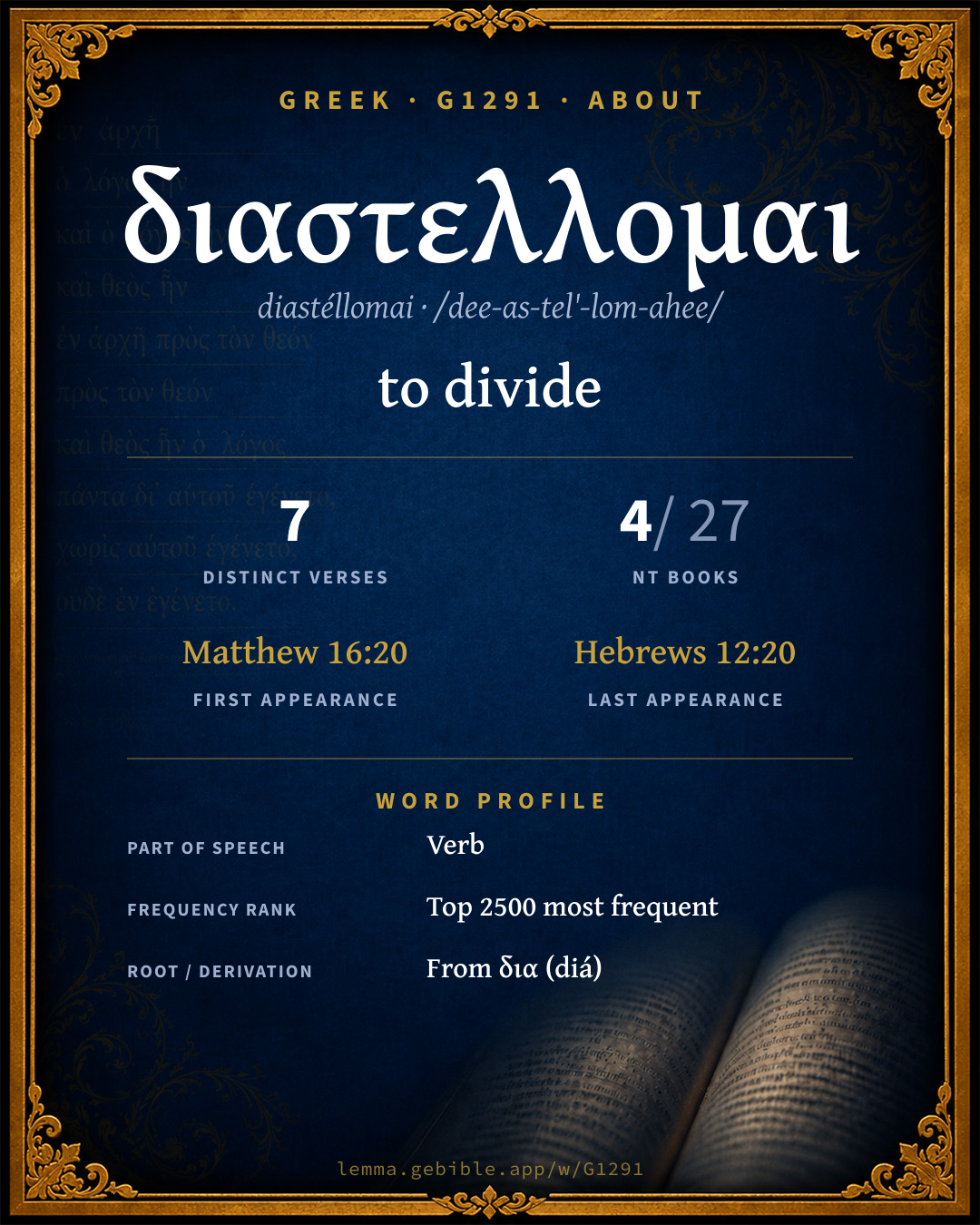
διαστέλλομαι
to divide
‘to divide’ is one of 3 main senses fuller range ↓
Full lexicon entry — Thayer's Greek Lexicon
From Thayer's Greek Lexicon
Where this word appears
See every Aorist-tense verb in the Greek New Testament →
Grammar key — what these labels mean
Part of speech
- Verb
- An action or state-of-being word.
Tense
- Aorist
- Action viewed as a simple whole, without regard to duration — often past (perfective aspect).
- Imperfect
- Continuous or repeated action in past time (“was writing”).
- Present
- Ongoing or general action in present time (imperfective aspect).
Voice
- Middle
- The subject acts on or for itself, or with special interest in the action.
- Passive
- The subject receives the action.
Mood
- Indicative
- States a fact or asks a factual question (the mood of reality).
- Participle
- A verbal adjective (“writing,” “having written”).
Case
- Accusative
- The case of the direct object and of extent.
Person
- 3rd person
- The one spoken about (“he / she / it / they”).
- 1st person
- The speaker (“I / we”).
Gender
- Neuter
- Grammatically neuter.
Number
- Singular
- One.
- Plural
- More than one.
2 verses where G1291 appears in the Imperfect tense in the Book of Mark. Filtered view — show all forms. Click any verse to open its interlinear word-by-word view. Verse text shown in the World English Bible for context — . Each verse’s Greek form is shown with its reference; the English is not keyword-highlighted, since the data carries no word-level English alignment. Use “Compare translations” on any verse to read it across multiple English versions. This concordance covers the Greek New Testament; Septuagint (Greek Old Testament) occurrences of this word are not indexed here.
Mark
- Mark 7:36 διεστείλατο διεστέλλετο aor mid ind 3sg impf mid ind 3sg He commanded them that they should tell no one, but the more he commanded them, so much the more widely they proclaimed it.
- Mark 8:15 διεστέλλετο impf mid ind 3sg He charged them, saying, "Take heed: beware of the yeast of the Pharisees and the yeast of Herod."
About this entry
At a glance — auto-summarized from this page’s data, not written by a person. Every figure links to its source below. This summary describes the numbers; it doesn’t interpret them.
“to divide” is the headline sense of the Greek verb διαστελλομαι (diastéllomai). More than half of its appearances fall in Mark. It appears 7 verses across 4 books of the Greek New Testament, among its uncommon vocabulary. Scripture first uses it in Matthew 16:20. Catalogued under 3 senses, its meaning is not single-sense. The sections below give every sense, occurrence, and version rendering.
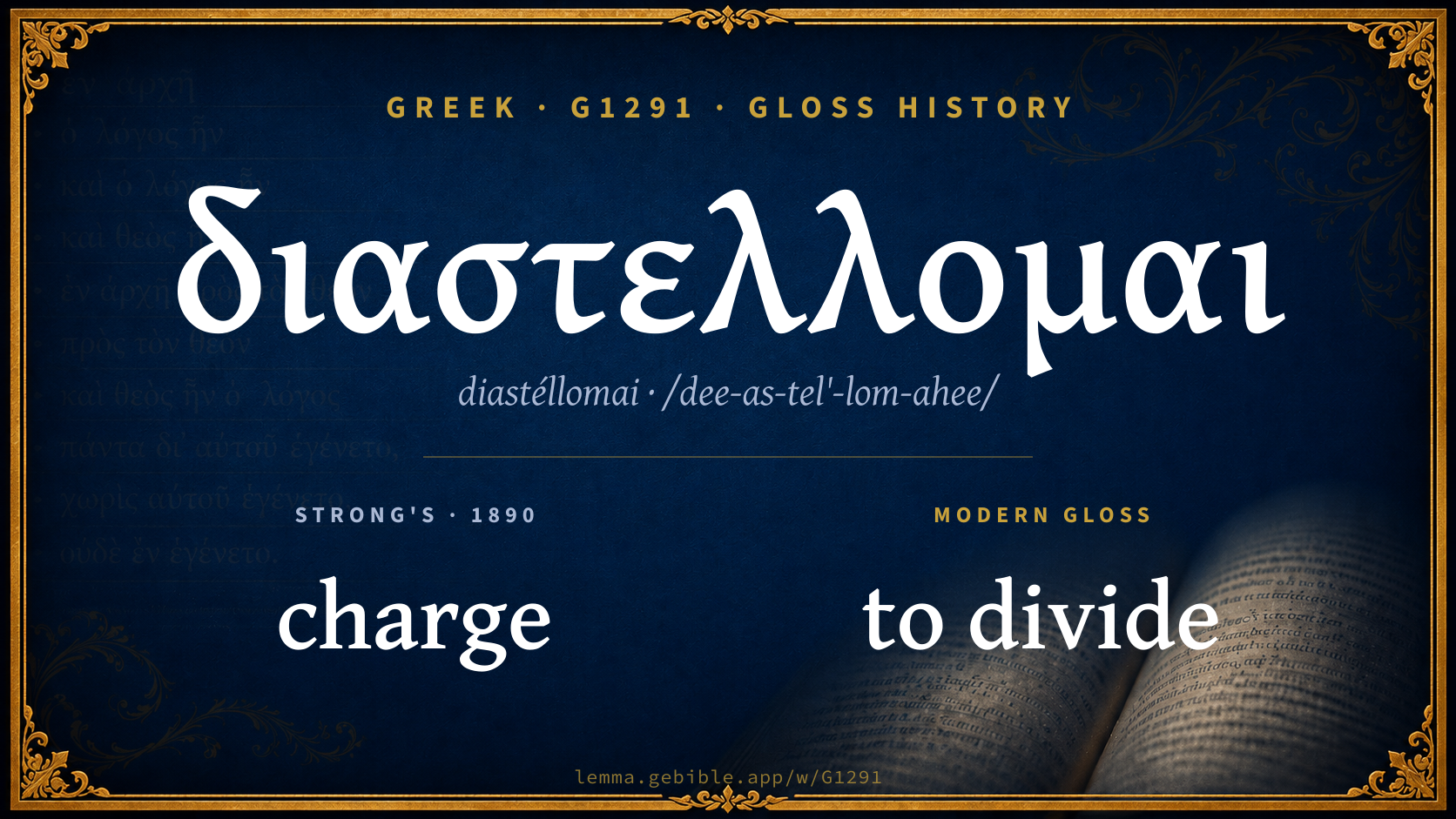
Gloss history
Strong's 1890 vs modern scholarship
About this word
Strong's G1291 catalogs a Greek word from the Greek New Testament.
These counts are not copied from any lexicon or concordance. They are computed here, from the morphology-tagged Greek New Testament. What Lemma adds →
- 7
- distinct verses
- The word appears in 7 distinct verses.
- 4 / 27
- NT books
- The word appears in 4 of 27 New Testament books.
- #1,240
- by frequency
- Top 2500 most frequent Greek words (rank 1,240 of 5,347 Greek words by occurrence).
View all 7 occurrences in the concordance →
By section of the New Testament
By traditional corpus
Conventional, traditional groupings — biblical authorship is debated, so this is a traditional corpus grouping, not an authorship claim. Some books belong to more than one corpus (Luke is in both the Gospels and the Lukan corpus, and so on), so these shares overlap and need not total 100%. Each figure is a share of the word’s 7 distinct verses.
- Gospels 5 verses · 71%
- Lukan (Luke–Acts) 1 verse · 14%
- Hebrews 1 verse · 14%
How translations render this word
Counts come from each version’s own published word-to-Strong’s tagging or interlinear alignment — an approximate guide to how each version renders this word, not a word-level alignment the data otherwise carries. Because each total is that version’s own tagged count, the per-version totals vary from one another and need not match the appearance or distinct-verse counts above. These counts may also differ from a printed concordance because Lemma counts each distinctly tagged rendering and does not collapse phrase taggings into a single head-word total. This is a fixed set of word-tagged versions (KJV, ASV, BSB, ULT) and does not change with the reading translation you choose elsewhere. Each version’s license is shown beside its name below (and on Sources).
- King James Version: He charged 4×
- American Standard Version: He charged 4×
- Berean Standard Bible: Ordered 2×
- unfoldingWord Literal Text: He commanded 4×
King James Version Public Domain
Renders G1291 across 9 tagged occurrences — most commonly:
Plus 5 renderings that appear only once — usually multi-word phrases or single function words the recovered tagging swept in, not distinct renderings.
American Standard Version Public Domain
Renders G1291 across 9 tagged occurrences — most commonly:
Plus 5 renderings that appear only once — usually multi-word phrases or single function words the recovered tagging swept in, not distinct renderings.
Berean Standard Bible Public Domain
Renders G1291 across 8 tagged occurrences — most commonly:
Plus 6 renderings that appear only once — usually multi-word phrases or single function words the recovered tagging swept in, not distinct renderings.
unfoldingWord Literal Text CC BY-SA 4.0
Renders G1291 across 9 tagged occurrences — most commonly:
Plus 5 renderings that appear only once — usually multi-word phrases or single function words the recovered tagging swept in, not distinct renderings.
Senses in Thayer's
The 3 senses Thayer's distinguishes for this word, in lexicon order (not ranked by frequency or importance). The full entry — with sub-senses — is in the Lexicon Entry tab.
- to draw asunder, divide, distinguish, dispose, order
- to open one's self i.e. one's mind, to set forth distinctly
- to admonish, order, charge
Word origin
Derived from δια (diá) (G1223) — through.
Forms in the corpus
The 4 distinct written forms G1291 takes in the Greek New Testament, most frequent first — each parse links to that tense’s occurrences in the concordance.
| Form | Parsing | Example | Uses |
|---|---|---|---|
| διεστείλατο diesteílato | Verb, Aorist, Middle, Indicative, 3rd person, Singular | Matthew 16:20 | 4 |
| διεστέλλετο diestélleto | Verb, Imperfect, Middle, Indicative, 3rd person, Singular | Mark 7:36 | 2 |
| διαστελλόμενον diastellómenon | Verb, Present, Passive, Participle, Accusative, Singular, Neuter | Hebrews 12:20 | 1 |
| διεστειλάμεθα diesteilámetha | Verb, Aorist, Middle, Indicative, 1st person, Plural | Acts 15:24 | 1 |
Same root — word family
Other Thayer's entries built from the same root as G1291, grouped by Strong’s listed origin. These share a root / origin per the lexicon — not necessarily a shared meaning. Each links to that word’s own entry.
Derives from
Shares the same root
- διαβαινω diabaínō G1224 to pass through
- διαβαλλω diabállō G1225 to slander
- διαβεβαιοομαι diabebaióomai G1226 to affirm strongly
- διαβλεπω diablépō G1227 to look through
- διαγγελλω diangéllō G1229 to proclaim
- διαγινομαι diagínomai G1230 to continue
- διαγινωσκω diaginṓskō G1231 to ascertain
- διαγογγυζω diagongýzō G1234 to murmur
- διαγρηγορεω diagrēgoréō G1235 to watch through
- διαγω diágō G1236 to lead through
- διαδεχομαι diadéchomai G1237 to receive in succession
- διαδημα diádēma G1238 diadem
- διαδιδωμι diadídōmi G1239 to distribute
- διαζωννυμι diazṓnnymi G1241 to gird around
- διαιρεω diairéō G1244 to divide
- διακαθαριζω diakatharízō G1245 to cleanse thoroughly
- διακατελεγχομαι diakatelénchomai G1246 to confute
- διακουομαι diakoúomai G1251 to hear fully
- διακρινω diakrínō G1252 to distinguish
- διακωλυω diakōlýō G1254 to hinder
- διαλαλεω dialaléō G1255 to converse
- διαλεγομαι dialégomai G1256 to discuss
- διαλειπω dialeípō G1257 to intermit
- διαλλασσω diallássō G1259 to reconcile
+62 more words share this root (not shown).
Derived from this word
Compare all same-root words → Showing 4 of 89 — not the complete family. They share a root, not necessarily a meaning.
Septuagint usage
The same Greek word διαστελλομαι appears 51 times in the Greek Old Testament (Septuagint), across 47 verses in 20 books.
- 51
- LXX occurrences
- Tagged occurrences of this Greek word in the Septuagint.
- 47
- verses
- Distinct Septuagint verses containing this word.
- 20 / 39
- OT books
- The word appears in 20 of the 39 Old Testament books.
Sample Septuagint occurrences
- Genesis 25:23 διαστέλλω
- Leviticus 5:4 διαστέλλω
- Numbers 8:14 διαστέλλω
- Deuteronomy 10:8 διαστέλλω
- Joshua 1:6 διαστέλλω
- Judges 1:19 διαστέλλω
- Ruth 1:17 διαστέλλω
- 1 Samuel 3:1 διαστέλλω
- 1 Kings 8:53 διαστέλλω
- 2 Kings 2:11 διαστέλλω
- 1 Chronicles 23:13 διαστέλλω
- 2 Chronicles 19:10 διαστέλλω
Septuagint occurrences (same lexeme)
Every verse where the same Strong’s number (G1291) appears in the Greek Septuagint. Verse text shown in the World English Bible for context; the Greek form is the matched word — the English is not keyword-highlighted.
- Genesis 25:23 διαστέλλω Yahweh said to her, Two nations are in your womb, Two peoples will be separated from your body. The one people will be stronger than the other people. The elder will serve the younger.
- Genesis 30:28 διαστέλλω He said, "Appoint me your wages, and I will give it."
- Genesis 30:35 διαστέλλω That day, he removed the male goats that were streaked and spotted, and all the female goats that were speckled and spotted, every one that had white in it, and all the black ones among the sheep, and gave them into the hand of his sons.
- Genesis 30:40 διαστέλλω Jacob separated the lambs, and set the faces of the flocks toward the streaked and all the black in the flock of Laban: and he put his own droves apart, and didn't put them into Laban's flock.
- Leviticus 5:4 διαστέλλω "'Or if anyone swears rashly with his lips to do evil, or to do good, whatever it is that a man might utter rashly with an oath, and it is hidden from him; when he knows of it, then he shall be guilty of one of these.
- Leviticus 10:10 διαστέλλω and that you are to make a distinction between the holy and the common, and between the unclean and the clean;
- Leviticus 11:47 διαστέλλω to make a distinction between the unclean and the clean, and between the living thing that may be eaten and the living thing that may not be eaten.'"
- Leviticus 16:26 διαστέλλω "He who lets the goat go for the scapegoat shall wash his clothes, and bathe his flesh in water, and afterward he shall come into the camp.
- Leviticus 22:21 διαστέλλω Whoever offers a sacrifice of peace offerings to Yahweh to accomplish a vow, or for a freewill offering, of the herd or of the flock, it shall be perfect to be accepted; there shall be no blemish therein.
- Numbers 8:14 διαστέλλω Thus you shall separate the Levites from among the children of Israel, and the Levites shall be mine.
- Numbers 16:9 διαστέλλω [seems it but] a small thing to you, that the God of Israel has separated you from the congregation of Israel, to bring you near to himself, to do the service of the tent of Yahweh, and to stand before the congregation to minister to them;
- Numbers 35:11 διαστέλλω then you shall appoint you cities to be cities of refuge for you, that the manslayer who kills any person unwittingly may flee there.
- Deuteronomy 10:8 διαστέλλω At that time Yahweh set apart the tribe of Levi, to bear the ark of the covenant of Yahweh, to stand before Yahweh to minister to him, and to bless in his name, to this day.
- Deuteronomy 19:2 διαστέλλω you shall set apart three cities for you in the midst of your land, which Yahweh your God gives you to possess it.
- Deuteronomy 19:7 διαστέλλω Therefore I command you, saying, You shall set apart three cities for you.
- Deuteronomy 29:20 διαστέλλω Yahweh will not pardon him, but then the anger of Yahweh and his jealousy will smoke against that man, and all the curse that is written in this book shall lie on him, and Yahweh will blot out his name from under the sky.
- Joshua 1:6 διαστέλλω Be strong and of good courage; for you shall cause this people to inherit the land which I swore to their fathers to give them.
- Joshua 20:4 διαστέλλω He shall flee to one of those cities, and shall stand at the entrance of the gate of the city, and declare his cause in the ears of the elders of that city; and they shall take him into the city to them, and give him a place, that he may dwell among them.
- Judges 1:19 διαστέλλω Yahweh was with Judah; and drove out [the inhabitants of] the hill-country; for he could not drive out the inhabitants of the valley, because they had chariots of iron.
- Ruth 1:17 διαστέλλω where you die, will I die, and there will I be buried: Yahweh do so to me, and more also, if anything but death part you and me."
- 1 Samuel 3:1 διαστέλλω The child Samuel ministered to Yahweh before Eli. The word of Yahweh was precious in those days; there was no frequent vision.
- 1 Kings 8:53 διαστέλλω For you did separate them from among all the peoples of the earth, to be your inheritance, as you spoke by Moses your servant, when you brought our fathers out of Egypt, Lord Yahweh.
- 2 Kings 2:11 διαστέλλω It happened, as they still went on, and talked, that behold, [there appeared] a chariot of fire, and horses of fire, which parted them both apart; and Elijah went up by a whirlwind into heaven.
- 1 Chronicles 23:13 διαστέλλω The sons of Amram: Aaron and Moses; and Aaron was separated, that he should sanctify the most holy things, he and his sons, forever, to burn incense before Yahweh, to minister to him, and to bless in his name, forever.
- 2 Chronicles 19:10 διαστέλλω Whenever any controversy shall come to you from your brothers who dwell in their cities, between blood and blood, between law and commandment, statutes and ordinances, you shall warn them, that they not be guilty towards Yahweh, and so wrath come on you and on your brothers: this do, and you shall not be guilty.
- 2 Chronicles 23:18 διαστέλλω Jehoiada appointed the officers of the house of Yahweh under the hand of the priests the Levites, whom David had distributed in the house of Yahweh, to offer the burnt offerings of Yahweh, as it is written in the law of Moses, with rejoicing and with singing, according to the order of David.
- Ezra 8:24 διαστέλλω Then I set apart twelve of the chiefs of the priests, even Sherebiah, Hashabiah, and ten of their brothers with them,
- Ezra 10:8 διαστέλλω and that whoever didn't come within three days, according to the counsel of the princes and the elders, all his substance should be forfeited, and himself separated from the assembly of the captivity.
- Ezra 10:11 διαστέλλω Now therefore make confession to Yahweh, the God of your fathers, and do his pleasure; and separate yourselves from the peoples of the land, and from the foreign women.
- Ezra 10:16 διαστέλλω The children of the captivity did so. Ezra the priest, [with] certain heads of fathers' [houses], after their fathers' houses, and all of them by their names, were set apart; and they sat down in the first day of the tenth month to examine the matter.
- Ezra 18:8 διαστέλλω
- Psalms 65:14 διαστέλλω
- Psalms 67:15 διαστέλλω
- Psalms 105:33 διαστέλλω He struck their vines and also their fig trees, And shattered the trees of their country.
- Jeremiah 22:14 διαστέλλω who says, I will build me a wide house and spacious chambers, and cuts him out windows; and it is ceiling with cedar, and painted with vermilion.
- Ezekiel 3:18 διαστέλλω When I tell the wicked, You shall surely die; and you give him no warning, nor speak to warn the wicked from his wicked way, to save his life; the same wicked man shall die in his iniquity; but his blood will I require at your hand.
- Ezekiel 3:19 διαστέλλω Yet if you warn the wicked, and he doesn't turn from his wickedness, nor from his wicked way, he shall die in his iniquity; but you have delivered your soul.
- Ezekiel 3:20 διαστέλλω Again, when a righteous man does turn from his righteousness, and commit iniquity, and I lay a stumbling block before him, he shall die: because you have not given him warning, he shall die in his sin, and his righteous deeds which he has done shall not be remembered; but his blood will I require at your hand.
- Ezekiel 3:21 διαστέλλω Nevertheless if you warn the righteous man, that the righteous not sin, and he does not sin, he shall surely live, because he took warning; and you have delivered your soul.
- Ezekiel 22:26 διαστέλλω Her priests have done violence to my law, and have profaned my holy things: they have made no distinction between the holy and the common, neither have they caused men to discern between the unclean and the clean, and have hid their eyes from my Sabbaths, and I am profaned among them.
- Ezekiel 24:14 διαστέλλω I, Yahweh, have spoken it: it shall happen, and I will do it: I will not go back, neither will I spare, neither will I repent; according to your ways, and according to your doings, shall they judge you, says the Lord Yahweh.
- Ezekiel 39:14 διαστέλλω They shall set apart men of continual employment, who shall pass through the land, and, with those who pass through, those who bury those who remain on the surface of the land, to cleanse it: after the end of seven months shall they search.
- Ezekiel 42:20 διαστέλλω He measured it on the four sides: it had a wall round about, the length five hundred, and the breadth five hundred, to make a separation between that which was holy and that which was common.
- Hosea 13:15 διαστέλλω Though he is fruitful among his brothers, an east wind will come, The breath of Yahweh coming up from the wilderness; And his spring will become dry, And his fountain will be dried up. He will plunder the storehouse of treasure.
- Micah 5:7 διαστέλλω The remnant of Jacob will be in the midst of many peoples, Like dew from Yahweh, Like showers on the grass, That don't wait for man, Nor wait for the sons of men.
- Nahum 1:12 διαστέλλω Thus says Yahweh: "Though they be in full strength, and likewise many, even so they will be cut down, and he shall pass away. Though I have afflicted you, I will afflict you no more.
- Malachi 3:11 διαστέλλω I will rebuke the devourer for your sakes, and he shall not destroy the fruits of your ground; neither shall your vine cast its fruit before its time in the field," says Yahweh of Hosts.
These are occurrences of the same Greek lexeme (G1291) in the Septuagint — not a translation of any one Hebrew word. The store carries no word-level Hebrew↔Greek alignment, so no Hebrew original is asserted here. Counts come from the recovered LXX Strong's tagging — high-frequency vocabulary is well covered, while rare or late forms may be untagged — so they reflect tagged occurrences and may slightly undercount.