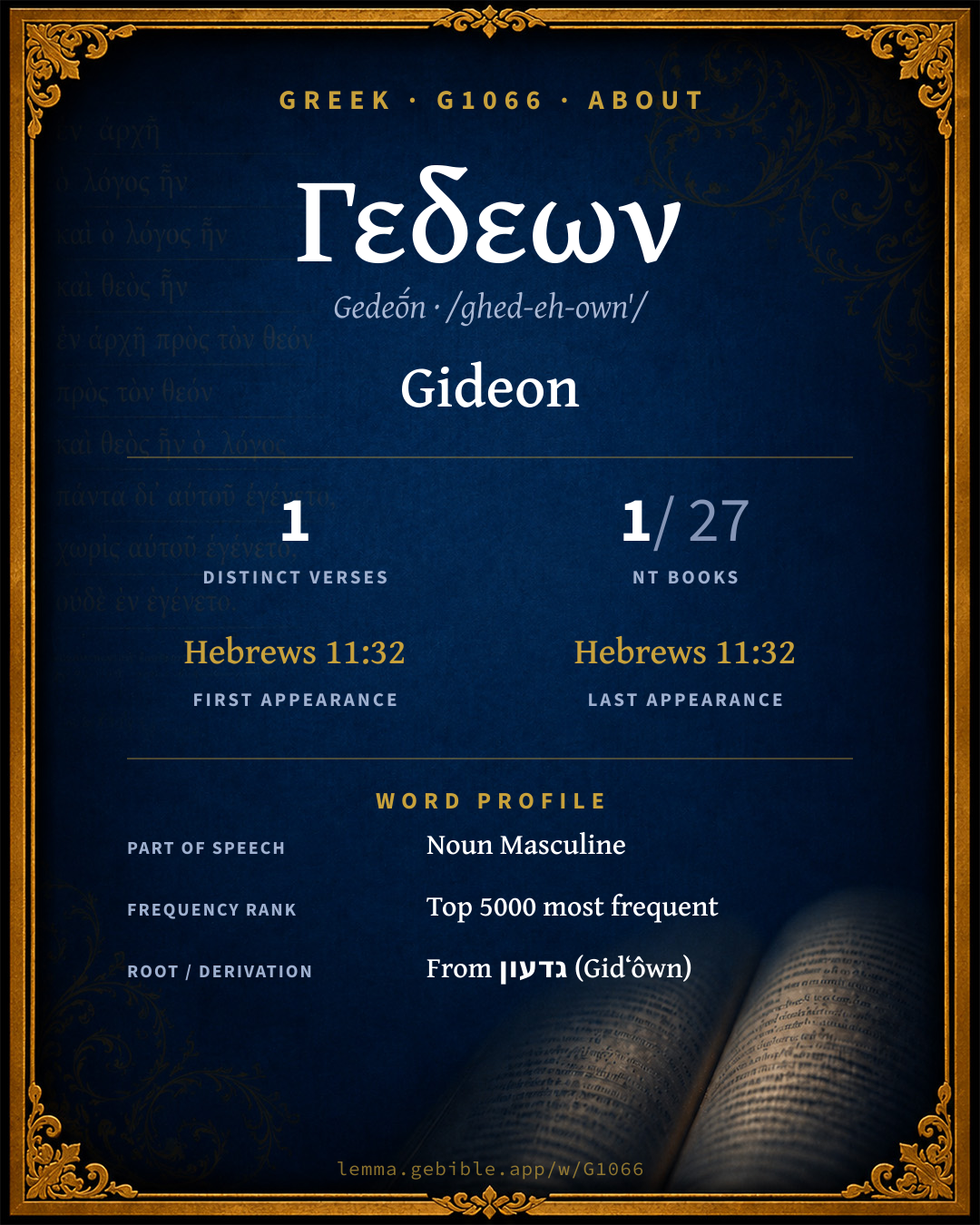
Γεδεών
Gideon
Thayer's lists 2 entries for ‘Gideon’ fuller range ↓
Full lexicon entry — Thayer's Greek Lexicon
From Thayer's Greek Lexicon
Where this word appears
Every verse where G1066 appears — 1 distinct verse across 1 book. Click any verse to open its interlinear word-by-word view. Verse text shown in the World English Bible for context — . Each verse’s Greek form is shown with its reference; the English is not keyword-highlighted, since the data carries no word-level English alignment. Use “Compare translations” on any verse to read it across multiple English versions. This concordance covers the Greek New Testament; Septuagint (Greek Old Testament) occurrences of this word are not indexed here.
Hebrews 1 verse
About this entry
At a glance — auto-summarized from this page’s data, not written by a person. Every figure links to its source below. This summary describes the numbers; it doesn’t interpret them.
Γεδεων — transliterated Gedeṓn — is a Greek name carrying the sense “Gideon.” With only 1 verse it sits in the long tail of Greek New Testament vocabulary. Its uses cluster heavily in Hebrews (100% of all occurrences). Scripture uses it exactly once, at Hebrews 11:32. Each statement above links to its evidence; the full detail follows below.
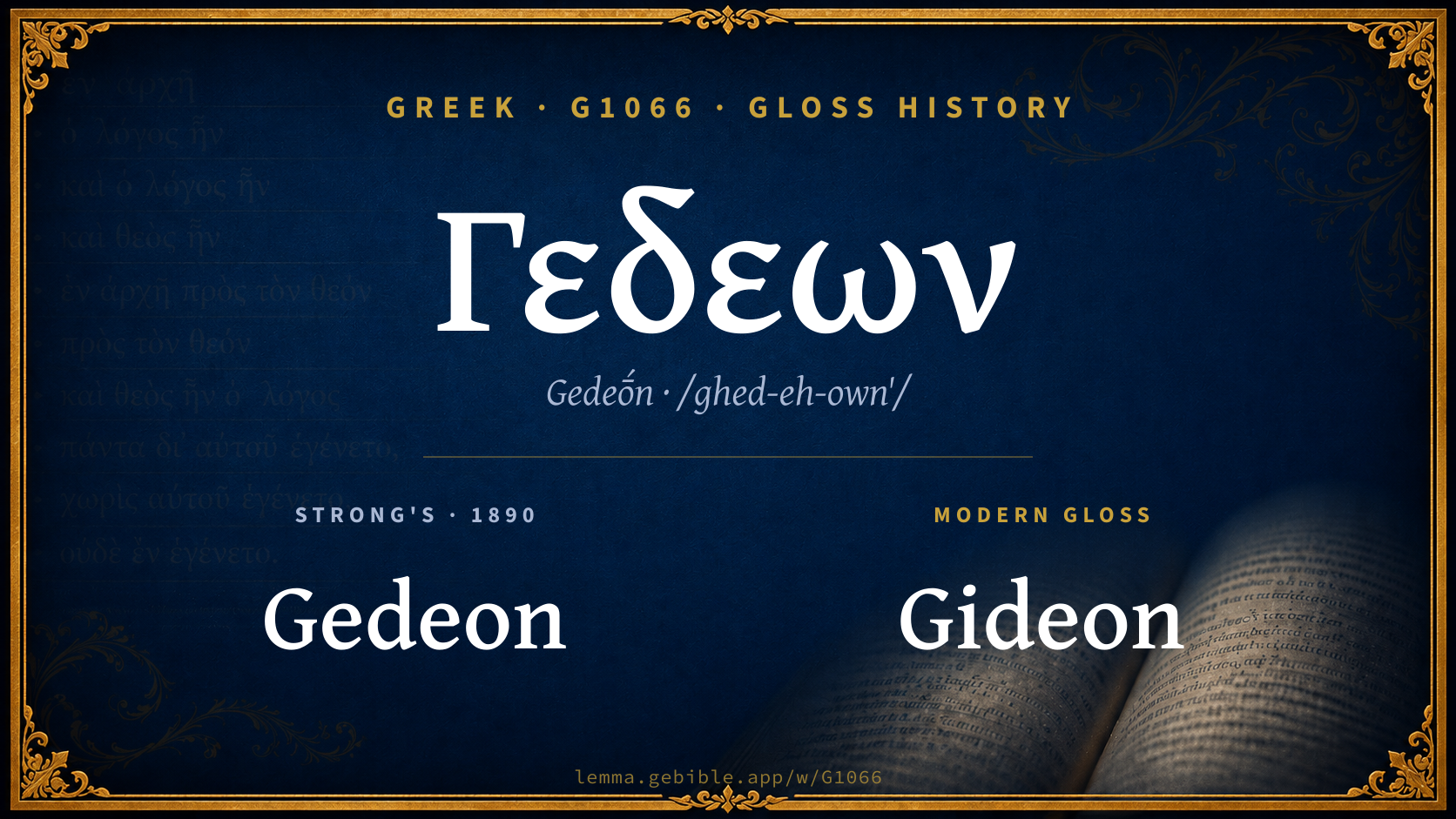
Gloss history
Strong's 1890 vs modern scholarship
About this word
Strong's G1066 catalogs a Greek word from the Greek New Testament.
These counts are not copied from any lexicon or concordance. They are computed here, from the morphology-tagged Greek New Testament. What Lemma adds →
- 1
- distinct verses
- The word appears in 1 distinct verse.
- 1 / 27
- NT books
- The word appears in 1 of 27 New Testament books.
- #3,503
- by frequency
- Top 5000 most frequent Greek words (rank 3,503 of 5,347 Greek words by occurrence).
View all 1 occurrence in the concordance →
Most concentrated in
- Hebrews 1 verse 100%
By section of the New Testament
By traditional corpus
Conventional, traditional groupings — biblical authorship is debated, so this is a traditional corpus grouping, not an authorship claim. Some books belong to more than one corpus (Luke is in both the Gospels and the Lukan corpus, and so on), so these shares overlap and need not total 100%. Each figure is a share of the word’s 1 distinct verse.
- Hebrews 1 verse · 100%
How translations render this word
Counts come from each version’s own published word-to-Strong’s tagging or interlinear alignment — an approximate guide to how each version renders this word, not a word-level alignment the data otherwise carries. Because each total is that version’s own tagged count, the per-version totals vary from one another and need not match the appearance or distinct-verse counts above. These counts may also differ from a printed concordance because Lemma counts each distinctly tagged rendering and does not collapse phrase taggings into a single head-word total. This is a fixed set of word-tagged versions (KJV, ASV, BSB, ULT) and does not change with the reading translation you choose elsewhere. Each version’s license is shown beside its name below (and on Sources).
- King James Version: Gedeon 1×
- American Standard Version: Gideon 1×
- Berean Standard Bible: Gideon 1×
- unfoldingWord Literal Text: Gideon 1×
King James Version Public Domain
Renders G1066 across 1 tagged occurrence — most commonly:
American Standard Version Public Domain
Renders G1066 across 1 tagged occurrence — most commonly:
Berean Standard Bible Public Domain
Renders G1066 across 1 tagged occurrence — most commonly:
unfoldingWord Literal Text CC BY-SA 4.0
Renders G1066 across 1 tagged occurrence — most commonly:
Senses in Thayer's
The 2 senses Thayer's distinguishes for this word, in lexicon order (not ranked by frequency or importance). The full entry — with sub-senses — is in the Lexicon Entry tab.
- Gideon = "the cutter down"
- a of the judge of Israel who delivered them from the Midianites
Word origin
Derived from גדעון (Gidʻôwn) (H1439) — Gideon.
Of hebrew origin [ H1439 ]; Gedeon (that is Gideon ) an Israelite : - Gedeon.
— Strong’s Exhaustive Concordance (1890), public domain.
Bible dictionary
Public-domain dictionary articles matched to this entry by name (Gideon). A biblical name can be shared by more than one person or place, so an article may treat several.
Easton's Bible Dictionary · M. G. Easton, 1897
Called also Jerubbaal (Judg. 6:29, 32), was the first of the judges whose history is circumstantially narrated (Judg. 6-8). His calling is the commencement of the second period in the history of the judges. After the victory gained by Deborah and Barak over Jabin, Israel once more sank into idolatry, and the Midianites (q.v.) and Amalekites, with other "children of the east," crossed the Jordan each year for seven successive years for the purpose of plundering and desolating the land. Gideon received a direct call from God to undertake the task of delivering the land from these warlike invaders. He was of the family of Abiezer (Josh. 17:2; 1 Chr. 7:18), and of the little township of Ophrah (Judg. 6:11). First, with ten of his servants, he overthrew the altars of Baal and cut down the asherah which was upon it, and then blew the trumpet of alarm, and the people flocked to his standard on the crest of Mount Gilboa to the number of twenty-two thousand men. These were, however, reduced to only three hundred. These, strangely armed with torches and pitchers and trumpets, rushed in from three different points on the camp of Midian at midnight, in the valley to the north of Moreh, with the terrible war-cry, "For the Lord and for Gideon" (Judg. 7:18, R.V.). Terror-stricken, the Midianites were put into dire confusion, and in the darkness slew one another, so that only fifteen thousand out of the great army of one hundred and twenty thousand escaped alive. The memory of this great deliverance impressed itself deeply on the mind of the nation (1 Sam. 12:11; Ps. 83:11; Isa. 9:4; 10:26; Heb. 11:32). The land had now rest for forty years. Gideon died in a good old age, and was buried in the sepulchre of his fathers. Soon after his death a change came over the people. They again forgot Jehovah, and turned to the worship of Baalim, "neither shewed they kindness to the house of Jerubbaal" (Judg. 8:35). Gideon left behind him seventy sons, a feeble, sadly degenerated race, with one exception, that of Abimelech, who seems to have had much of the courage and energy of his father, yet of restless and unscrupulous ambition. He gathered around him a band who slaughtered all Gideon's sons, except Jotham, upon one stone. (See OPHRAH.)
Smith's Bible Dictionary · William Smith, 1863
(he that cuts down), youngest son of Joash of the Abiezrites, an undistinguished family who lived at Ophrah, a town probably on the west of Jordan, (Judges 6:15) in the territory of Manasseh, near Shechem. He was the fifth recorded judge of Israel, and for many reasons the greatest of them all. When we first hear of him he was grown up and had sons, (Judges 6:11; 8:20) and from the apostrophe of the angel, ch. (Judges 6:12) we may conclude that he had already distinguished himself in war against the roving bands of nomadic robbers who had oppressed Israel for seven years. When the angel appeared, Gideon was threshing wheat with a flail in the wine-press, to conceal it from the predatory tyrants. His call to be a deliverer, and his destruction of Baal's altar, are related in Judges 6. After this begins the second act of Gideon's life. Clothed by the Spirit of God, (Judges 6:34) comp. 1Chr 12:18; Luke 24:49 He blew a trumpet, and was joined by Zebulun, Naphtali and even the reluctant Asher. Strengthened by a double sign from God, he reduced his army of 32,000 by the usual proclamation. (20:8) comp. 1 Macc. 3:56. By a second test at "the spring of trembling the further reduced the number of his followers to 300. (Judges 7:5) seq. The midnight attack upon the Midianites, their panic, and the rout and slaughter that followed are told in (Judges 7:1) ... The memory of this splendid deliverance took deep root in the national traditions. (1 Samuel 12:11; Psalms 83:11; Isaiah 9:4; 10:26; Hebrews 11:32) After this there was a peace of forty years, and we see Gideon in peaceful possession of his well-earned honors, and surrounded by the dignity of a numerous household. (Judges 8:29-31) It is not improbable that, like Saul, he owed a part of his popularity to his princely appearance. (Judges 8:18) In this third stage of his life occur alike his most noble and his most questionable acts viz., the refusal of the monarchy on theocratic grounds, and the irregular consecration of a jewelled ephod formed out of the rich spoils of Midian, which proved to the Israelites a temptation to idolatry although it was doubtless intended for use in the worship of Jehovah.
Hitchcock's Bible Names Dictionary · Roswell D. Hitchcock, 1869
he that bruises or breaks; a destroyer
Classic public-domain reference works; full attribution on Sources.
Septuagint usage
The same Greek word Γεδεων appears 45 times in the Greek Old Testament (Septuagint), across 43 verses in 1 book.
- 45
- LXX occurrences
- Tagged occurrences of this Greek word in the Septuagint.
- 43
- verses
- Distinct Septuagint verses containing this word.
- 1 / 39
- OT books
- The word appears in 1 of the 39 Old Testament books.
Sample Septuagint occurrences
- Judges 6:11 γεδεων
Septuagint occurrences (same lexeme)
Every verse where the same Strong’s number (G1066) appears in the Greek Septuagint. Verse text shown in the World English Bible for context; the Greek form is the matched word — the English is not keyword-highlighted.
- Judges 6:11 γεδεων The angel of Yahweh came, and sat under the oak which was in Ophrah, that pertained to Joash the Abiezrite: and his son Gideon was beating out wheat in the winepress, to hide it from the Midianites.
- Judges 6:13 γεδεων Gideon said to him, Oh, my lord, if Yahweh is with us, why then has all this happened to us? and where are all his wondrous works which our fathers told us of, saying, Did not Yahweh bring us up from Egypt? but now Yahweh has cast us off, and delivered us into the hand of Midian.
- Judges 6:15 γεδεων He said to him, Oh, Lord, with which shall I save Israel? behold, my family is the poorest in Manasseh, and I am the least in my father's house.
- Judges 6:17 γεδεων He said to him, If now I have found favor in your sight, then show me a sign that it is you who talk with me.
- Judges 6:19 γεδεων Gideon went in, and made ready a kid, and unleavened cakes of an ephah of meal: the flesh he put in a basket, and he put the broth in a pot, and brought it out to him under the oak, and presented it.
- Judges 6:22 γεδεων Gideon saw that he was the angel of Yahweh; and Gideon said, Alas, Lord Yahweh! because I have seen the angel of Yahweh face to face.
- Judges 6:24 γεδεων Then Gideon built an altar there to Yahweh, and called it Yahweh-shalom: to this day it is yet in Ophrah of the Abiezrites.
- Judges 6:27 γεδεων Then Gideon took ten men of his servants, and did as Yahweh had spoken to him: and it happened, because he feared his father's household and the men of the city, so that he could not do it by day, that he did it by night.
- Judges 6:29 γεδεων They said one to another, Who has done this thing? When they inquired and asked, they said, Gideon the son of Joash has done this thing.
- Judges 6:34 γεδεων But the Spirit of Yahweh came on Gideon; and he blew a trumpet; and Abiezer was gathered together after him.
- Judges 6:36 γεδεων Gideon said to God, If you will save Israel by my hand, as you have spoken,
- Judges 6:39 γεδεων Gideon said to God, Don't let your anger be kindled against me, and I will speak but this once: Please let me make a trial just this once with the fleece; let it now be dry only on the fleece, and on all the ground let there be dew.
- Judges 7:1 γεδεων Then Jerubbaal, who is Gideon, and all the people who were with him, rose up early, and encamped beside the spring of Harod: and the camp of Midian was on the north side of them, by the hill of Moreh, in the valley.
- Judges 7:2 γεδεων Yahweh said to Gideon, The people who are with you are too many for me to give the Midianites into their hand, lest Israel vaunt themselves against me, saying, My own hand has saved me.
- Judges 7:4 γεδεων Yahweh said to Gideon, The people are yet too many; bring them down to the water, and I will try them for you there: and it shall be, that of whom I tell you, This shall go with you, the same shall go with you; and of whoever I tell you, This shall not go with you, the same shall not go.
- Judges 7:5 γεδεων So he brought down the people to the water: and Yahweh said to Gideon, Everyone who laps of the water with his tongue, as a dog laps, him shall you set by himself; likewise everyone who bows down on his knees to drink.
- Judges 7:7 γεδεων Yahweh said to Gideon, By the three hundred men who lapped will I save you, and deliver the Midianites into your hand; and let all the people go every man to his place.
- Judges 7:13 γεδεων When Gideon had come, behold, there was a man telling a dream to his fellow; and he said, Behold, I dreamed a dream; and, behold, a cake of barley bread tumbled into the camp of Midian, and came to the tent, and struck it so that it fell, and turned it upside down, so that the tent lay flat.
- Judges 7:14 γεδεων His fellow answered, This is nothing else save the sword of Gideon the son of Joash, a man of Israel: into his hand God has delivered Midian, and all the host.
- Judges 7:15 γεδεων It was so, when Gideon heard the telling of the dream, and the interpretation of it, that he worshiped; and he returned into the camp of Israel, and said, Arise; for Yahweh has delivered into your hand the host of Midian.
- Judges 7:18 γεδεων When I blow the trumpet, I and all who are with me, then blow you the trumpets also on every side of all the camp, and say, For Yahweh and for Gideon.
- Judges 7:19 γεδεων So Gideon, and the hundred men who were with him, came to the outermost part of the camp in the beginning of the middle watch, when they had but newly set the watch: and they blew the trumpets, and broke in pieces the pitchers that were in their hands.
- Judges 7:20 γεδεων The three companies blew the trumpets, and broke the pitchers, and held the torches in their left hands, and the trumpets in their right hands with which to blow; and they cried, The sword of Yahweh and of Gideon.
- Judges 7:24 γεδεων Gideon sent messengers throughout all the hill-country of Ephraim, saying, Come down against Midian, and take before them the waters, as far as Beth Barah, even the Jordan. So all the men of Ephraim were gathered together, and took the waters as far as Beth Barah, even the Jordan.
- Judges 7:25 γεδεων They took the two princes of Midian, Oreb and Zeeb; and they killed Oreb at the rock of Oreb, and Zeeb they killed at the winepress of Zeeb, and pursued Midian: and they brought the heads of Oreb and Zeeb to Gideon beyond the Jordan.
- Judges 8:1 γεδεων The men of Ephraim said to him, Why have you served us thus, that you didn't call us, when you went to fight with Midian? They did chide with him sharply.
- Judges 8:4 γεδεων Gideon came to the Jordan, [and] passed over, he, and the three hundred men who were with him, faint, yet pursuing.
- Judges 8:7 γεδεων Gideon said, Therefore when Yahweh has delivered Zebah and Zalmunna into my hand, then I will tear your flesh with the thorns of the wilderness and with briers.
- Judges 8:9 γεδεων He spoke also to the men of Penuel, saying, When I come again in peace, I will break down this tower.
- Judges 8:11 γεδεων Gideon went up by the way of those who lived in tents on the east of Nobah and Jogbehah, and struck the host; for the host was secure.
- Judges 8:13 γεδεων Gideon the son of Joash returned from the battle from the ascent of Heres.
- Judges 8:15 γεδεων He came to the men of Succoth, and said, See Zebah and Zalmunna, concerning whom you did taunt me, saying, Are the hands of Zebah and Zalmunna now in your hand, that we should give bread to your men who are weary?
- Judges 8:19 γεδεων He said, They were my brothers, the sons of my mother: as Yahweh lives, if you had saved them alive, I would not kill you.
- Judges 8:21 γεδεων Then Zebah and Zalmunna said, Rise you, and fall on us; for as the man is, so is his strength. Gideon arose, and killed Zebah and Zalmunna, and took the crescents that were on their camels' necks.
- Judges 8:22 γεδεων Then the men of Israel said to Gideon, Rule you over us, both you, and your son, and your son's son also; for you have saved us out of the hand of Midian.
- Judges 8:23 γεδεων Gideon said to them, I will not rule over you, neither shall my son rule over you: Yahweh shall rule over you.
- Judges 8:24 γεδεων Gideon said to them, I would make a request of you, that you would give me every man the ear-rings of his spoil. (For they had golden ear-rings, because they were Ishmaelites.)
- Judges 8:27 γεδεων Gideon made an ephod of it, and put it in his city, even in Ophrah: and all Israel played the prostitute after it there; and it became a snare to Gideon, and to his house.
- Judges 8:28 γεδεων So Midian was subdued before the children of Israel, and they lifted up their heads no more. The land had rest forty years in the days of Gideon.
- Judges 8:30 γεδεων Gideon had seventy sons conceived from his body; for he had many wives.
- Judges 8:32 γεδεων Gideon the son of Joash died in a good old age, and was buried in the tomb of Joash his father, in Ophrah of the Abiezrites.
- Judges 8:33 γεδεων It happened, as soon as Gideon was dead, that the children of Israel turned again, and played the prostitute after the Baals, and made Baal Berith their god.
- Judges 8:35 γεδεων neither shown they kindness to the house of Jerubbaal, [who is] Gideon, according to all the goodness which he had shown to Israel.
These are occurrences of the same Greek lexeme (G1066) in the Septuagint — not a translation of any one Hebrew word. The store carries no word-level Hebrew↔Greek alignment, so no Hebrew original is asserted here. Counts come from the recovered LXX Strong's tagging — high-frequency vocabulary is well covered, while rare or late forms may be untagged — so they reflect tagged occurrences and may slightly undercount.