

1 Timothy 6:5
Greek (Tischendorf 8th ed.) 1 Timothy 6:5 appears in the Greek New Testament. The text above is from the Tischendorf 8th edition. Each word links to its Strong’s number and a concise gloss. Click any word for its full Thayer’s Greek Lexicon entry.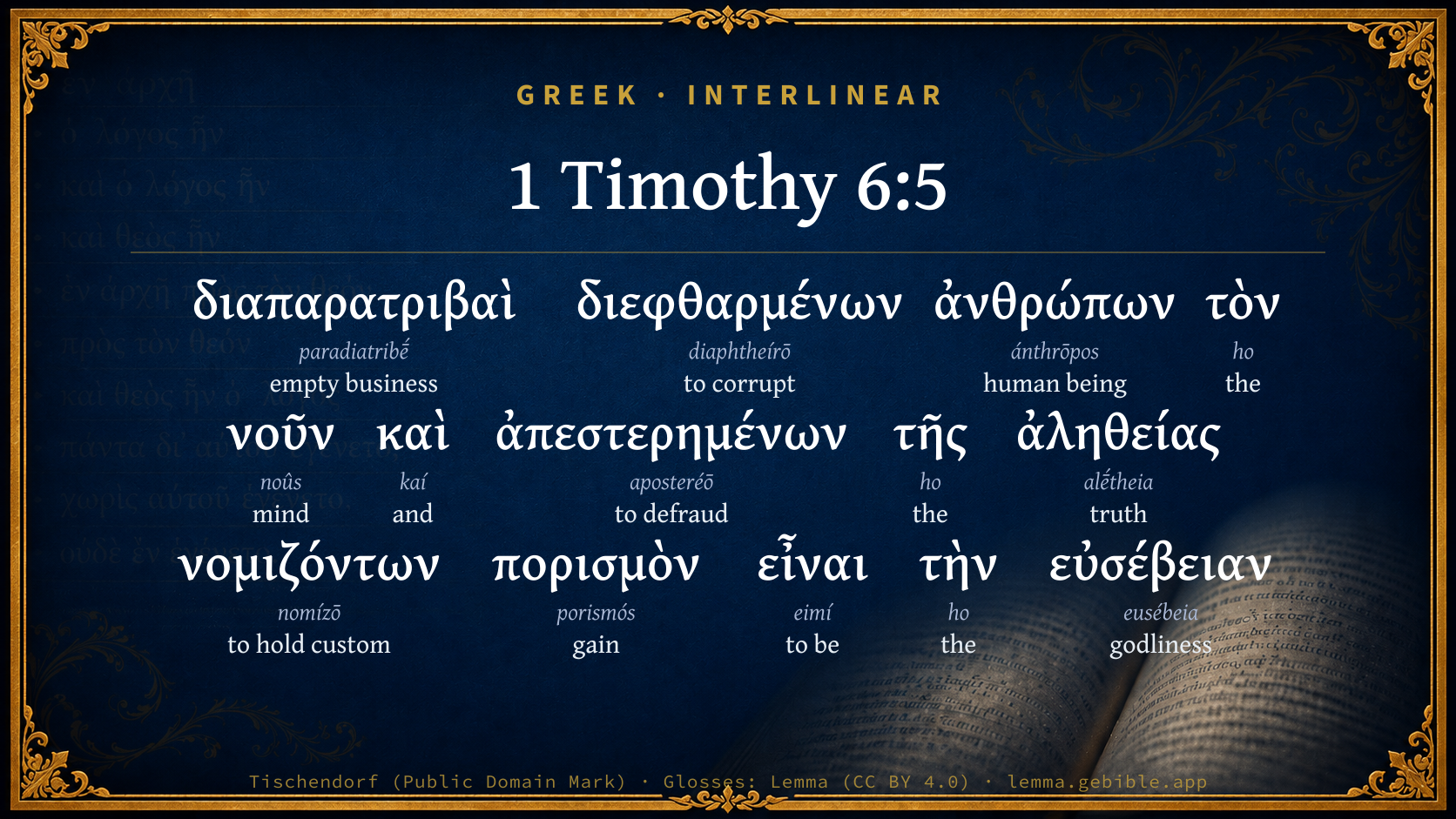
constant friction of people of corrupt minds and destitute of the truth, who suppose that godliness is a means of gain. Withdraw yourself from such.
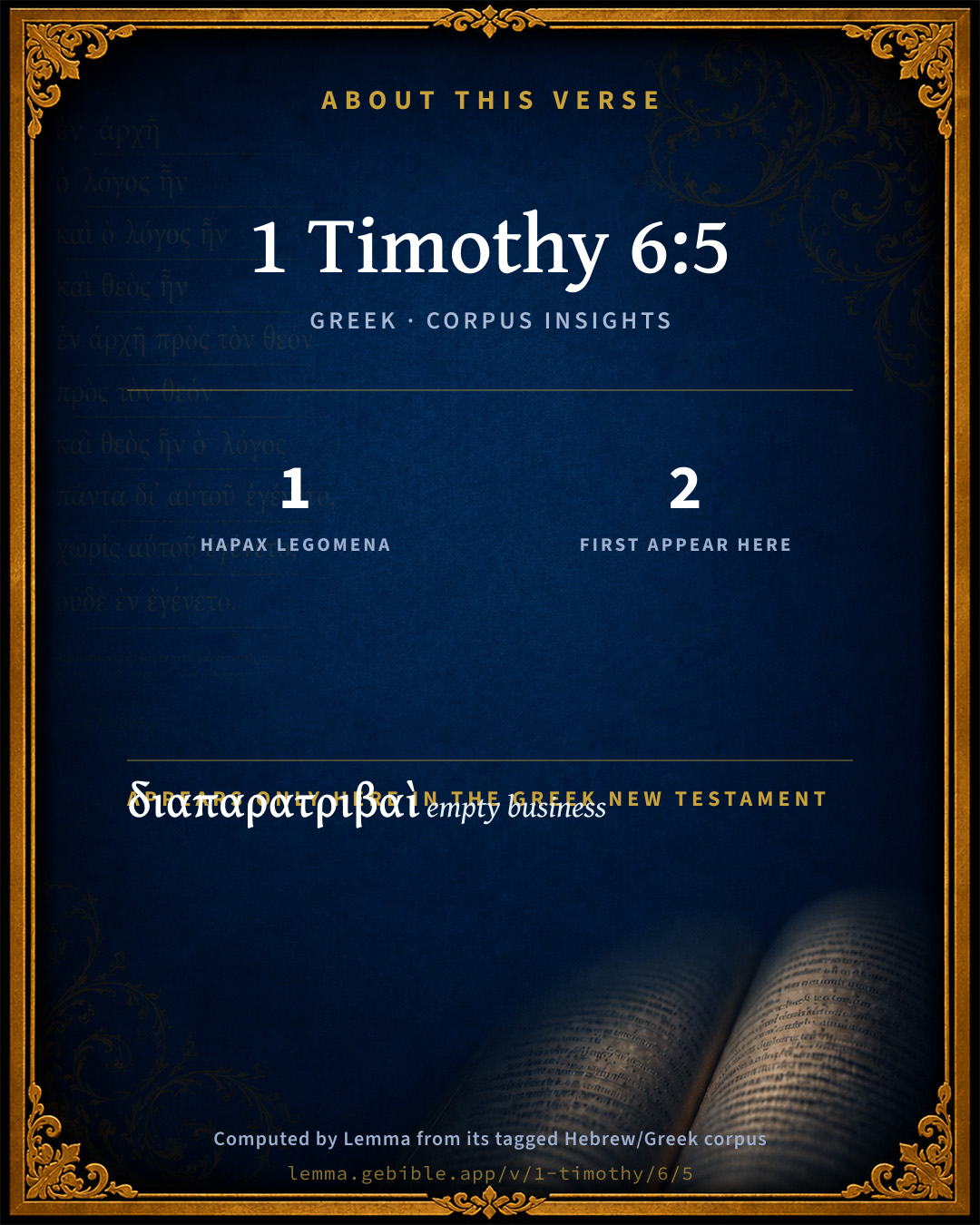
- 1 hapax legomenon — only here in the Greek New Testament
- 2 first appearances in the Greek New Testament
Download a study sheet
One document with this verse’s original text, its word-by-word gloss line, the meaning frame, cross-references with their text, attributed commentary, and full source and license credits — printable, and it pastes into notes with its structure intact.
This verse Autodidact and up
A passage Seminary Student
Up to 50 verses in one chapter. A passage sheet keeps up to 6 commentary sources and 12 cross-references per verse, in the order this page ranks them, and says so on the sheet whenever that leaves anything out. Ask for a single verse and you get the Autodidact verse sheet above.
Everything on this page stays free to read, with no account — the sheet is a download of what is already on screen, not access to it.
Compare translations 3
The same verse in 3 English versions, stacked beneath the original-language interlinear above. Click any original word for its lexicon entry.
Each is an independent rendering of the whole verse — the interlinear is not word-aligned to these translations.
Highlighted words mark where these versions differ — a whole-verse word diff, not a word-by-word alignment.
-
World English Bible Public Domain
constant friction of people of corrupt minds and destitute of the truth, who suppose that godliness is a means of gain. Withdraw yourself from such.
-
King James Version Public Domain
Perverse disputings of men of corrupt minds, and destitute of the truth, supposing that gain is godliness: from such withdraw thyself.
-
unfoldingWord Literal Text CC BY-SA 4.0
constant friction of men having been corrupted the mind and having been deprived of the truth, considering godliness to be a means of gain.
unfoldingWord Literal Text — © unfoldingWord, licensed CC BY-SA 4.0. Word-aligned USFM3 via Door43 (git.door43.org/unfoldingWord/en_ult).
Show all 19 translations
Every available English version of this verse, each an independent rendering of the whole verse.
-
World English Bible Public Domain
constant friction of people of corrupt minds and destitute of the truth, who suppose that godliness is a means of gain. Withdraw yourself from such.
-
Berean Standard Bible Public Domain
and constant friction between men of depraved mind who are devoid of the truth. These men regard godliness as a means of gain.
-
Majority Standard Bible Public Domain
and constant friction between men of depraved mind who are devoid of the truth. These men regard godliness as a means of gain. Withdraw yourself from such.
-
King James Version Public Domain
Perverse disputings of men of corrupt minds, and destitute of the truth, supposing that gain is godliness: from such withdraw thyself.
-
American Standard Version (1901) Public Domain
wranglings of men corrupted in mind and bereft of the truth, supposing that godliness is a way of gain.
-
Revised Version (1885) Public Domain
wranglings of men corrupted in mind and bereft of the truth, supposing that godliness is a way of gain.
-
Geneva Bible (1599) Public Domain
Frowarde disputations of men of corrupt mindes and destitute of ye trueth, which thinke that gaine is godlines: from such separate thy selfe.
-
Douay-Rheims (1899) Public Domain
Conflicts of men corrupted in mind, and who are destitute of the truth, supposing gain to be godliness.
-
Young's Literal Translation Public Domain
wranglings of men wholly corrupted in mind, and destitute of the truth, supposing the piety to be gain; depart from such;
-
Literal Standard Version CC BY-SA 4.0
wranglings of men wholly corrupted in mind, and destitute of the truth, supposing the piety to be gain; depart from such;
-
Unlocked Literal Bible CC BY-SA 4.0
and constant conflict between people with depraved minds. They have lost the truth and they think that godliness is a way to get more money.
-
unfoldingWord Literal Text CC BY-SA 4.0
constant friction of men having been corrupted the mind and having been deprived of the truth, considering godliness to be a means of gain.
-
Darby Bible Public Domain
constant quarrellings of men corrupted in mind and destitute of the truth, holding gain to be [the end of] piety.
-
World Messianic Bible Public Domain
constant friction of people of corrupt minds and destitute of the truth, who suppose that godliness is a means of gain. Withdraw yourself from such.
-
Webster's Bible Public Domain
Perverse disputings of men of corrupt minds, and destitute of the truth, supposing gain to be godliness: from such withdraw thyself.
-
Free Bible Version CC BY-SA 4.0
the constant arguing of people whose minds are totally corrupt and who have lost the truth, thinking that they can profit financially from religion…
-
Bible in Basic English Public Domain
Bitter talk of men who, being evil in mind and dead to what is true, take the faith to be a way of making profit.
-
Text-Critical English NT CC BY 4.0
and constant disagreement among people who are depraved in mind and deprived of the truth, supposing that godliness is a means of gain. Keep away from such people.
-
Tyndale New Testament (1534) Public Domain
and vayne disputacions of men with corrupte myndes and destitute of the trueth which thynke that lucre is godlines. From soche seperate thy silfe.
Literal Standard Version (2020), Covenant Press — licensed CC BY-SA 4.0. Text via the HelloAO Bible API (eBible.org). Unlocked Literal Bible (unfoldingWord) — licensed CC BY-SA 4.0. Text via the HelloAO Bible API (eBible.org). unfoldingWord Literal Text — © unfoldingWord, licensed CC BY-SA 4.0. Word-aligned USFM3 via Door43 (git.door43.org/unfoldingWord/en_ult). Free Bible Version, Dr. Jonathan Gallagher — licensed CC BY-SA 4.0. Text via the HelloAO Bible API (eBible.org).
Word by word
More ways to search: Search by grammar → Find every occurrence → Compare this word →
Practice this passage: Drill this verse → Learn its vocabulary →
- Appears 1× in the Greek New Testament
- First appears here
- Part of Speech
- Noun
- Case
- Nominative
- Number
- Plural
- Gender
- Feminine
Full Thayer's Definition
- διαπαρατριβαὶ paradiatribḗ G3859 “empty business” Noun, Nominative, Plural, Feminine
- διεφθαρμένων diaphtheírō G1311 “to corrupt” Verb, Perfect, Passive, Participle, Genitive, Plural, Masculine
- ἀνθρώπων ánthrōpos G444 “human being” Noun, Genitive, Plural, Masculine
- τὸν ho G3588 “the” Article, Accusative, Singular, Masculine
- νοῦν noûs G3563 “mind” Noun, Accusative, Singular, Masculine
- καὶ kaí G2532 “and” Conjunction
- ἀπεστερημένων aposteréō G650 “to defraud” Verb, Perfect, Passive, Participle, Genitive, Plural, Masculine
- τῆς ho G3588 “the” Article, Genitive, Singular, Feminine
- ἀληθείας alḗtheia G225 “truth” Noun, Genitive, Singular, Feminine
- νομιζόντων nomízō G3543 “to hold custom” Verb, Present, Active, Participle, Genitive, Plural, Masculine
- πορισμὸν porismós G4200 “gain” Noun, Accusative, Singular, Masculine
- εἶναι eimí G1510 “to be” Verb, Present, Active, Infinitive
- τὴν ho G3588 “the” Article, Accusative, Singular, Feminine
- εὐσέβειαν eusébeia G2150 “godliness” Noun, Accusative, Singular, Feminine
About this verse
These counts appear in no published source. They are computed here, from the morphology-tagged text and Lemma’s own curated glosses. What Lemma adds →
- 14
- words
- 12
- distinct lemmas
- Pauline Epistles
- section
Notable vocabulary
1 hapax legomenon — a word that appears only here in the entire Greek New Testament:
- διαπαρατριβαὶ empty business G3859
First appearance in Scripture
These words make their first canonical appearance in the Greek New Testament here:
Shared distinctive vocabulary
πορισμὸν gain G4200 occurs in 2 verses of the Greek New Testament. Also found in:
Repetition
A word recurs within this verse:
- τὸν the G3588 ×3
Cross-references
30Topical passages linked to 1 Timothy 6:5 in the Treasury of Scripture Knowledge — connected by theme and wording, ordered by reader-vote popularity; previews shown in the World English Bible.
- 2 Timothy 3:5 holding a form of godliness, but having denied the power thereof. Turn away from these, also.
- 2 Peter 2:3 In covetousness they will exploit you with deceptive words: whose sentence now from of old doesn't linger, and their destruction will not slumber.
- Titus 1:11 whose mouths must be stopped; men who overthrow whole houses, teaching things which they ought not, for dishonest gain's sake.
- 2 Timothy 3:8 Even as Jannes and Jambres opposed Moses, so do these also oppose the truth; men corrupted in mind, reprobate concerning the faith.
- Titus 1:15–16 To the pure, all things are pure; but to those who are defiled and unbelieving, nothing is pure; but both their mind and their conscience are defiled.
- Romans 16:17–18 Now I beg you, brothers, look out for those who are causing the divisions and occasions of stumbling, contrary to the doctrine which you learned, and turn away from them.
- 1 Timothy 6:6 But godliness with contentment is great gain.
- Matthew 12:33 "Either make the tree good, and its fruit good, or make the tree corrupt, and its fruit corrupt; for the tree is known by its fruit.
- Matthew 23:13 "Woe to you, scribes and Pharisees, hypocrites! For you devour widows' houses, and as a pretense you make long prayers. Therefore you will receive greater condemnation.
- 1 Timothy 3:3 not a drinker, not violent, not greedy for money, but gentle, not quarrelsome, not covetous;
- Matthew 7:17–20 Even so, every good tree produces good fruit; but the corrupt tree produces evil fruit.
- 1 Timothy 1:6 from which things some, having missed the mark, have turned aside to vain talking;
- Hebrews 3:12–13 Beware, brothers, lest perhaps there be in any one of you an evil heart of unbelief, in falling away from the living God;
- 2 John 1:8–10 Watch yourselves, that we don't lose the things which we have accomplished, but that we receive a full reward.
- 2 Thessalonians 3:6 Now we command you, brothers, in the name of our Lord Jesus Christ, that you withdraw yourselves from every brother who walks in rebellion, and not after the tradition which they received from us.
- 1 Timothy 3:8 Deacons, in the same way, must be reverent, not double-tongued, not addicted to much wine, not greedy for money;
- 2 Peter 2:15 forsaking the right way, they went astray, having followed the way of Balaam the son of Beor, who loved the wages of wrong-doing;
- Jude 1:11 Woe to them! For they went in the way of Cain, and ran riotously in the error of Balaam for hire, and perished in Korah's rebellion.
- Revelation 18:3 For all the nations have drunk of the wine of the wrath of her sexual immorality, the kings of the earth committed sexual immorality with her, and the merchants of the earth grew rich from the abundance of her luxury."
- Matthew 21:13 He said to them, "It is written, 'My house shall be called a house of prayer,' but you have made it a den of robbers!"
- Ephesians 4:17–19 This I say therefore, and testify in the Lord, that you no longer walk as the rest of the Gentiles also walk, in the futility of their mind,
- 2 Thessalonians 2:8–11 Then the lawless one will be revealed, whom the Lord will kill with the breath of his mouth, and bring to nothing by the brightness of his coming;
- 2 Kings 5:20–27 But Gehazi the servant of Elisha the man of God, said, Behold, my master has spared this Naaman the Syrian, in not receiving at his hands that which he brought: as Yahweh lives, I will run after him, and take somewhat of him.
- Isaiah 56:11 Yes, the dogs are greedy, they can never have enough; and these are shepherds who can't understand: they have all turned to their own way, each one to his gain, from every quarter.
- Jeremiah 6:13 For from the least of them even to the greatest of them everyone is given to covetousness; and from the prophet even to the priest everyone deals falsely.
- Jeremiah 8:10 Therefore will I give their wives to others, and their fields to those who shall possess them: for everyone from the least even to the greatest is given to covetousness; from the prophet even to the priest every one deals falsely.
- Ezekiel 33:31 They come to you as the people comes, and they sit before you as my people, and they hear your words, but don't do them; for with their mouth they show much love, but their heart goes after their gain.
- John 3:19–21 This is the judgment, that the light has come into the world, and men loved the darkness rather than the light; for their works were evil.
- Acts 8:18–20 Now when Simon saw that the Holy Spirit was given through the laying on of the apostles' hands, he offered them money,
- Acts 19:24–28 For a certain man named Demetrius, a silversmith, who made silver shrines of Artemis, brought no little business to the craftsmen,
Cross-references courtesy of OpenBible.info (CC BY 4.0).
Where the printed editions differ
1 variantPlaces in this verse where the major printed Greek editions disagree on the wording in a way that affects the translation — a comparison of editions, not a manuscript-by-manuscript collation. The editions are the modern critical texts (Nestlé-Aland 28/27, SBL, Westcott-Hort, Tregelles, Tyndale House) and the traditional texts behind the KJV (the Textus Receptus and the Byzantine/Majority text). It is not a claim about which reading is original.
-
Extra text
Ἀφίστασο ἀπὸ τῶν τοιούτων.
“do depart from <the>[one of] such.”
In TRByz Not in NA28NA27TynSBLWHTregἈφίστασο ἀπὸ τῶν τοιούτων.¶ (Aphistaso apo tōn toioutōn) 'do depart from [one of] such.' is only in traditional manuscripts (TR+Byz)
Textual data: Translators Amalgamated Greek New Testament (STEPBible TAGNT) · CC BY 4.0.
Lesson kit
Teaching starters — assembled from the data on this page, not authored interpretation. Every prompt links to the verse data it draws on. Edit before teaching.
1 Timothy, in the Pauline Epistles, opens this verse with 14 words (12 distinct Greek lemmas). Its most distinctive word is paradiatribḗ (“empty business”). A historical commentator’s framing appears above. Read the whole chapter for the surrounding context.
Discussion questions
- How does “empty business” (paradiatribḗ) shape what this verse is saying?
- This verse holds 1 word here found nowhere else in the Greek New Testament. What might the rare word draw attention to?
- 2 words here appear for the first time in Scripture. What is being introduced at this debut?
- 1 Timothy 6:6 shares the word «gain» with this verse. How do the two illuminate each other?
- “the” occurs 3× in this one verse. What is the effect of the repetition?
- These translations render this verse differently. What is at stake in choosing one wording over another?
- Reading how The Biblical Illustrator and The Expositor's Bible read this verse, where do the two commentators agree and where do they part?
Things to notice
- 1 word in this verse appears nowhere else in the Greek New Testament.
- 2 words make their first canonical appearance in Scripture here.
- These translations choose different wording for 23 words in this verse.
- “the” occurs 3× in this single verse.
- 12 distinct Greek lemmas span 14 words in this verse.
Commentary
Notes on 1 Timothy 6:5 from classic Christian and Jewish commentators (each source and its license shown beneath its notes). The classic Christian expositions comment on the surrounding passage and are grouped to its opening verse, so a note may address several verses; the Jewish commentaries on the Tanakh (Rashi and others) are per-verse, so they appear only where the commentator wrote on this verse.
Lemma curates 59 commentaries, every one of them public domain or Creative Commons licensed, each selected and text-cleaned for this edition rather than reprinted as found. About our sources →
The Biblical Illustrator
Joseph S. Exell
The Biblical Illustrator, edited by Joseph S. Exell (c. 1880s–1900s) — public domain. Text from a community e-Sword module.
The Expositor's Bible
William Robertson Nicoll, ed., The Expositor's Bible (London: Hodder & Stoughton, 1887–1910) — public domain. 65 of 66 books (1 Corinthians is not separately keyed, as that volume carries no machine-parseable verse references); section-level commentary keyed to the opening verse. Introductory and overview sections not keyed to a specific passage are excluded.
Tyndale Open Study Notes
Tyndale Open Resources
Tyndale Open Study Notes — © Tyndale Open Resources, licensed CC BY-SA 4.0. Text via the HelloAO Bible API.
Bengel's Gnomon
Johann Albrecht Bengel
Bengel's Gnomon of the New Testament — English translation (T&T Clark, Edinburgh, 1860) — public domain. Text from a community e-Sword module.
Expositor's Greek Testament
ed. W. Robertson Nicoll
The Expositor's Greek Testament, edited by W. Robertson Nicoll (1897–1910) — public domain. Text from a community e-Sword module.
Geneva Bible (1599)
Geneva Bible translators
Geneva Bible (1599) marginal notes — public domain. Text via Bolls.life.
Jamieson, Fausset & Brown
Robert Jamieson, A. R. Fausset & David Brown
Jamieson, Fausset & Brown — Commentary Critical and Explanatory on the Whole Bible (1871) — public domain (CC PDM 1.0). Text via the HelloAO Bible API.
Adam Clarke's Commentary
Adam Clarke's Commentary on the Bible (1810–1826) — public domain. Text from a community e-Sword/MySword module.
John Calvin's Commentaries
John Calvin's Commentaries (1540-1563) — public domain. Text from the Calvin Translation Society English edition (1840s-50s) via the Christian Classics Ethereal Library (ccel.org). Calvin's coverage is partial (roughly two-thirds of the Bible); uncommented books and verses are honest gaps, never fabricated. The 19th-century editor's footnotes and remarks are omitted so the notes are faithfully Calvin's own voice.
Ellicott's Commentary for English Readers
A Bible Commentary for English Readers, edited by Charles John Ellicott (1878–1897) — public domain. Text from a community e-Sword module.
The Cambridge Bible for Schools and Colleges
gen. ed. J. J. S. Perowne
The Cambridge Bible for Schools and Colleges (gen. ed. J. J. S. Perowne; Cambridge University Press, 1878–1918) — public domain. Text from a community e-Sword module.
John Gill's Exposition
John Gill's Exposition of the Whole Bible (1746–1763) — public domain (CC PDM 1.0). Text via the HelloAO Bible API.
Trapp's Complete Commentary
John Trapp
John Trapp, A Commentary or Exposition upon All the Books of the Old and New Testament (1647–1656) — public domain. Text from a community e-Sword module.
Albert Barnes' Notes on the Bible
Albert Barnes' Notes on the Bible (1834–1885) — public domain. Text from a community e-Sword/MySword module.
Haydock's Catholic Bible Commentary
George Leo Haydock (1774–1849), Haydock's Catholic Family Bible and Commentary, 1859 edition — public domain. Excludes Psalms (Douay-Rheims chapter numbering differs from Protestant) and Deuterocanonical books (Catholic canon only).
Matthew Poole's English Annotations
Matthew Poole's English Annotations on the Holy Bible (1683–1685) — public domain. Text from a community e-Sword/MySword module.
Whedon's Commentary on the Bible
Daniel D. Whedon
Daniel D. Whedon (gen. ed.), Commentary on the Old and New Testaments (1874–1909) — public domain. Text from a community e-Sword module.
The Pulpit Commentary
The Pulpit Commentary (1880–1919), ed. H.D.M. Spence-Jones & Joseph S. Exell — public domain. Text from a community e-Sword module.
John Wesley's Explanatory Notes
John Wesley, Explanatory Notes Upon the Whole Bible (1754–1765) — public domain. Text via the GEBible commentary corpus.
The People's New Testament
B. W. Johnson
B. W. Johnson's The People's New Testament with Notes (1889–1891) — public domain. Electronic text from the Christian Classics Ethereal Library (CCEL) ThML edition.
Cambridge Greek Testament for Schools and Colleges
Cambridge Greek Testament for Schools and Colleges (Cambridge University Press, 1896; 21 vols, various authors incl. Carr, Maclear, Plummer, Farrar, Lumby, Moule, M. R. James, Simcox) — public domain. Text from a community e-Sword module.
International Critical Commentary
International Critical Commentary — older volumes (1896–1929), various authors — public domain. Text from a community e-Sword module.
Vincent's Word Studies in the New Testament
Marvin R. Vincent
Marvin R. Vincent, Word Studies in the New Testament (1887–1900) — public domain. Text from a community e-Sword/MySword module.