2 Timothy 2:16

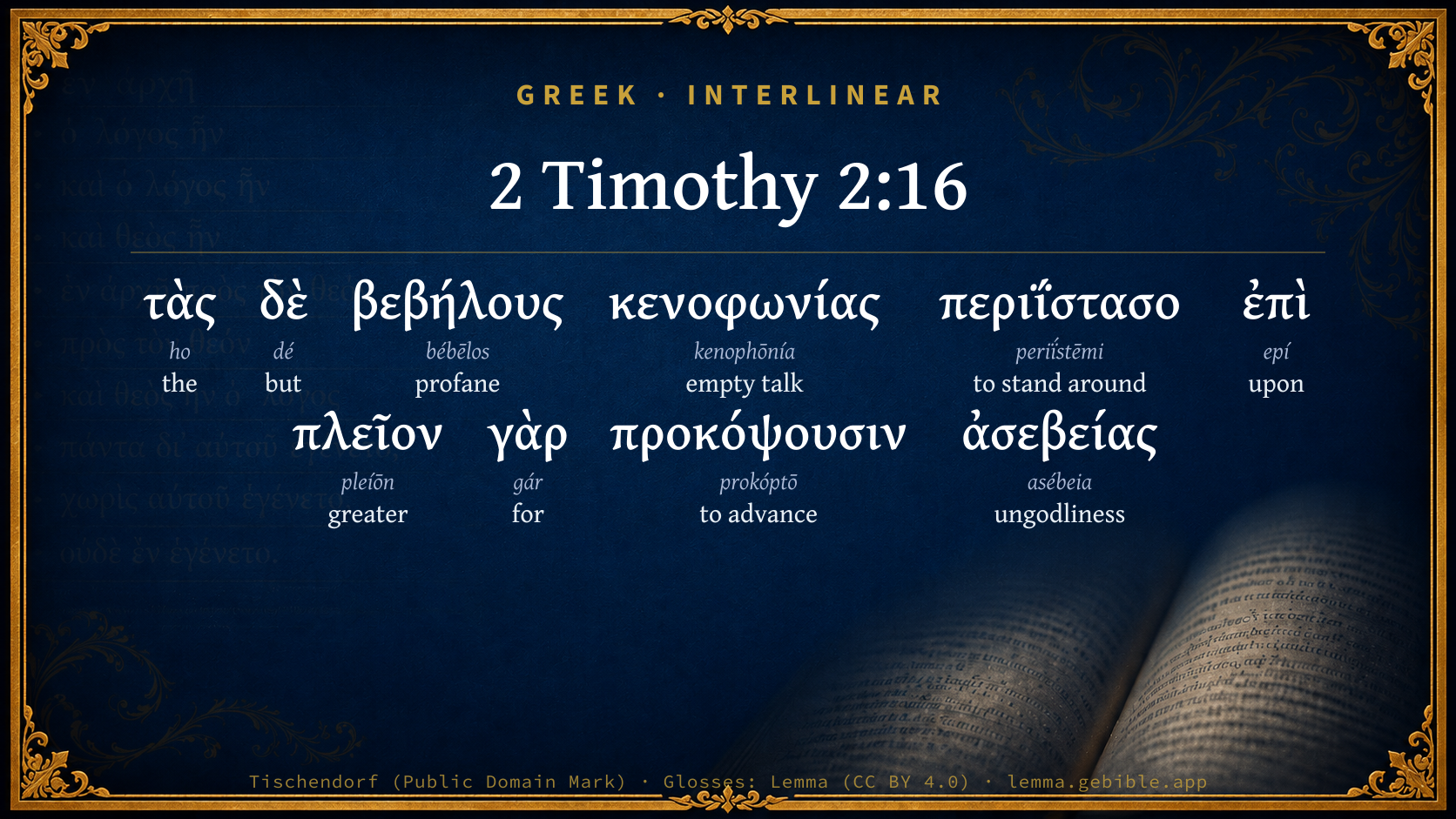
Greek (Tischendorf 8th ed.) 2 Timothy 2:16 appears in the Greek New Testament. The text above is from the Tischendorf 8th edition. Each word links to its Strong’s number and a concise gloss. Click any word for its full Thayer’s Greek Lexicon entry.
Download image
Cite this verse

2 Timothy 2:16 (World English Bible). Public Domain. Lemma interlinear Bible study tool, https://lemma.gebible.app/v/2-timothy/2/16.

Show BibTeX & RIS
BibTeX
RIS
English Translation
But shun empty chatter, for they will proceed further in ungodliness,
World English Bible · Public Domain
Download a study sheet

One document with this verse’s original text, its word-by-word gloss line, the meaning frame, cross-references with their text, attributed commentary, and full source and license credits — printable, and it pastes into notes with its structure intact.

This verse Autodidact and up

Study sheet (.html) Plain text (.txt)

A passage Seminary Student

Up to 50 verses in one chapter. A passage sheet keeps up to 6 commentary sources and 12 cross-references per verse, in the order this page ranks them, and says so on the sheet whenever that leaves anything out. Ask for a single verse and you get the Autodidact verse sheet above.

Everything on this page stays free to read, with no account — the sheet is a download of what is already on screen, not access to it.

Want to remove ads? Support Godless Engineer
Compare translations 3

The same verse in 3 English versions, stacked beneath the original-language interlinear above. Click any original word for its lexicon entry.

Each is an independent rendering of the whole verse — the interlinear is not word-aligned to these translations.

Highlighted words mark where these versions differ — a whole-verse word diff, not a word-by-word alignment.

  • World English Bible Public Domain
    But shun empty chatter, for they will proceed further in ungodliness,
  • King James Version Public Domain
    But shun profane and vain babblings: for they will increase unto more ungodliness.
  • unfoldingWord Literal Text CC BY-SA 4.0
    But avoid profane, empty sayings, for they will advance further in ungodliness,

unfoldingWord Literal Text — © unfoldingWord, licensed CC BY-SA 4.0. Word-aligned USFM3 via Door43 (git.door43.org/unfoldingWord/en_ult).

Versions to compare (up to 4)

3 of 4 selected

Show all 19 translations

Every available English version of this verse, each an independent rendering of the whole verse.

  • World English Bible Public Domain
    But shun empty chatter, for they will proceed further in ungodliness,
  • Berean Standard Bible Public Domain
    But avoid irreverent, empty chatter, which will only lead to more ungodliness,
  • Majority Standard Bible Public Domain
    But avoid irreverent, empty chatter, which will only lead to more ungodliness,
  • King James Version Public Domain
    But shun profane and vain babblings: for they will increase unto more ungodliness.
  • American Standard Version (1901) Public Domain
    But shun profane babblings: for they will proceed further in ungodliness,
  • Revised Version (1885) Public Domain
    But shun profane babblings: for they will proceed further in ungodliness,
  • Geneva Bible (1599) Public Domain
    Stay prophane, and vaine babblings: for they shall encrease vnto more vngodlinesse.
  • Douay-Rheims (1899) Public Domain
    But shun profane and vain babblings: for they grow much towards ungodliness.
  • Young's Literal Translation Public Domain
    and the profane vain talkings stand aloof from, for to more impiety they will advance,
  • Literal Standard Version CC BY-SA 4.0
    and stand aloof from the profane vain talkings, for they will advance to more impiety,
  • Unlocked Literal Bible CC BY-SA 4.0
    Avoid profane talk, which leads to more and more godlessness.
  • unfoldingWord Literal Text CC BY-SA 4.0
    But avoid profane, empty sayings, for they will advance further in ungodliness,
  • Darby Bible Public Domain
    But profane, vain babblings shun, for they will advance to greater impiety,
  • World Messianic Bible Public Domain
    But shun empty chatter, for it will go further in ungodliness,
  • Webster's Bible Public Domain
    But shun profane and vain babblings: for they will increase to more ungodliness.
  • Free Bible Version CC BY-SA 4.0
    Avoid pointless chatter because people who do this are heading away from God.
  • Bible in Basic English Public Domain
    But take no part in wrong and foolish talk, for those who do so will go farther into evil,
  • Text-Critical English NT CC BY 4.0
    Avoid profane chatter, for those who engage in such talk will stray further and further into ungodliness,
  • Tyndale New Testament (1534) Public Domain
    Vngostly and vayne voyces passe over. For they shall encreace vnto greater vngodlynes

Literal Standard Version (2020), Covenant Press — licensed CC BY-SA 4.0. Text via the HelloAO Bible API (eBible.org). Unlocked Literal Bible (unfoldingWord) — licensed CC BY-SA 4.0. Text via the HelloAO Bible API (eBible.org). unfoldingWord Literal Text — © unfoldingWord, licensed CC BY-SA 4.0. Word-aligned USFM3 via Door43 (git.door43.org/unfoldingWord/en_ult). Free Bible Version, Dr. Jonathan Gallagher — licensed CC BY-SA 4.0. Text via the HelloAO Bible API (eBible.org).

Word by word

More ways to search: Search by grammar → Find every occurrence → Compare this word →

Practice this passage: Drill this verse → Learn its vocabulary →

About this verse

These counts appear in no published source. They are computed here, from the morphology-tagged text and Lemma’s own curated glosses. What Lemma adds →

10
words
10
distinct lemmas
Pauline Epistles
section

Notable vocabulary

The rarest word here is κενοφωνίας empty talk G2757 — appearing just 2 times in the whole Greek New Testament.

Shared distinctive vocabulary

κενοφωνίας empty talk G2757 occurs in 2 verses of the Greek New Testament. Also found in:

Cross-references

17

Topical passages linked to 2 Timothy 2:16 in the Treasury of Scripture Knowledge — connected by theme and wording, ordered by reader-vote popularity; previews shown in the World English Bible.

  • Titus 3:9 but shun foolish questionings, genealogies, strife, and disputes about the law; for they are unprofitable and vain.
  • 1 Timothy 6:20 Timothy, guard that which is committed to you, turning away from the empty chatter and oppositions of the knowledge which is falsely so called;
  • 2 Thessalonians 2:7–8 For the mystery of lawlessness already works. Only there is one who restrains now, until he is taken out of the way.
  • 2 Timothy 2:14 Remind them of these things, charging them in the sight of the Lord, that they don't argue about words, to no profit, to the subverting of those who hear.
  • Titus 1:14 not paying attention to Jewish fables and commandments of men who turn away from the truth.
  • Hosea 12:1 Ephraim feeds on wind, And chases the east wind. He continually multiplies lies and desolation. They make a covenant with Assyria, And oil is carried into Egypt.
  • Ezra 10:10 Ezra the priest stood up, and said to them, You have trespassed, and have married foreign women, to increase the guilt of Israel.
  • 1 Timothy 4:7 But refuse profane and old wives' fables. Exercise yourself toward godliness.
  • Revelation 13:3 One of his heads looked like it had been wounded fatally. His fatal wound was healed, and the whole earth marveled at the beast.
  • 1 Corinthians 5:6 Your boasting is not good. Don't you know that a little yeast leavens the whole lump?
  • 1 Corinthians 15:33 Don't be deceived! "Evil companionships corrupt good morals."
  • 2 Timothy 3:13 But evil men and impostors will grow worse and worse, deceiving and being deceived.
  • Titus 1:11 whose mouths must be stopped; men who overthrow whole houses, teaching things which they ought not, for dishonest gain's sake.
  • Hebrews 12:15 looking carefully lest there be any man who falls short of the grace of God; lest any root of bitterness springing up trouble you, and thereby the many be defiled;
  • 2 Peter 2:2 Many will follow their immoral ways, and as a result, the way of the truth will be maligned.
  • 2 Peter 2:18 For, uttering great swelling words of emptiness, they entice in the lusts of the flesh, by licentiousness, those who are indeed escaping from those who live in error;
  • Revelation 13:14 He deceives my own people who dwell on the earth because of the signs he was granted to do in front of the beast; saying to those who dwell on the earth, that they should make an image to the beast who had the sword wound and lived.

Cross-references courtesy of OpenBible.info (CC BY 4.0).

Commentary

Notes on 2 Timothy 2:16 from classic Christian and Jewish commentators (each source and its license shown beneath its notes). The classic Christian expositions comment on the surrounding passage and are grouped to its opening verse, so a note may address several verses; the Jewish commentaries on the Tanakh (Rashi and others) are per-verse, so they appear only where the commentator wrote on this verse.

Lemma curates 59 commentaries, every one of them public domain or Creative Commons licensed, each selected and text-cleaned for this edition rather than reprinted as found. About our sources →

The Biblical Illustrator

Joseph S. Exell

2Ti_2:16

Shun profane and vain babblings.

Shun

The word rendered shun is a strong one, and signifies, literally, to make a circuit so as to avoid; or as Alford paraphrases it, the meaning seems to come from a number of persons falling back from an object of fear or loathing, and standing at a distance round it. The word is used in Tit_3:9. (H. D. M. Spence, M. A.)

They will increase unto more ungodliness.

Will increase

προκόψουσιν. The metaphor is from pioneers clearing the way before an army, by cutting down all obstacles: hence to make progress, to advance. (James Bryce, LL. D.)

A lax life connected with erroneous doctrine

The close connection between grave fundamental errors in doctrine and a lax and purely selfish life is constantly alluded to by St. Paul. (H. D. M. Spence, M. A.)

Error is of an encroaching nature

Let the serpent but wind in his head, and he will quickly bring in his whole body. He that saith Yea to the devil in a little, shall not say Nay when he pleases. (J. Trapp.)

The odium theologicum, the worst of social devils

On approaching my subject I shall premise four things:

1. I have no disposition to underrate the importance of right beliefs in religion.

2. I hold it to be the right of every man to endeavour to propagate his beliefs.

3. I recognise the value of a rightly-conducted theological controversy.

4. The controversy of which I have to speak is that of a conventional theology. By a conventional theology I mean a theology which a man has received from others, rather than reached by his own research; a theology which has been put into his memory as a class of propositions, rather than wrought out of his soul as spiritual convictions; a theology which is rather the manufacture of other men than the growth of individual reflection and experience; a theology which is more concerned about grammar than grace--symbol than sense--sign than substance. Now, such controversies, in the nature of the case, must always be marked by two features.

(1) Technicality.

(2) Personality.

I. Such controversies develop the most impious arrogancy. All the arrogancy of mere worldly men pales into dimness in the glare of the arrogancy which that man displays who dares pronounce a brother heretic because he subscribes not to his own views.

II. Such controversies develop the most lamentable dishonesty. The polemic of a mere scribe theology has ever been a cheat.

1. He cheats by the representation he makes of himself. He would have his readers or hearers believe that he has reached the conclusions in debate by a thorough study for himself of the holy Book. It is false. It is a law that self-reached convictions expel dogmatism. But the polemic of a mere scribe-theology cheats also by representing himself as being inspired only in the controversy by love for truth. It is not lore for truth; it is love for his own opinions.

2. He is dishonest in his representation of his opponents, he imputes motives not felt--ideas and conclusions not held.

III. Such controversies develop a most disastrous perversity. The conventional controversialist perverts the Bible, the powers of the intellect and the zeal of the heart.

IV. Such controversies develop the most heartless inhumanity. They blind the polemic to the excellences of others. The technical theologue who looks at a brother through the medium of his own orthodoxy, will fraternise with a modern scoundrel if he is orthodox; but, like Caiaphas of old, will rend his robes with pious horror at incarnate virtue if it conform not to his own views. What inhumanities have not been perpetrated in the name of orthodoxy! What built the inquisition? What kindled the flames of martyrdom? What animated Bonner? What prompted Calvin to murder Servetus? What roused the Jewish rabbis to put the Son of God to death? The remarks made will suffice to justify the proposition that the controversies of a mere conventional theology are the most effective means of developing depravity. (D. Thomas, D. D.)

Profane babbling to be avoided

I. Profane vain babblings are to be avoided. How often does our apostle condemn them? Why are they to be avoided?

1. Because the branches which bear them are evil; as weakness of judgment, frowardness of will, and disorder in tile affections.

2. And do they not blemish our reputation? obscure the gloss of grace? hinder the acts of it? kindle corruption? and turn from the faith?

II. The causes which increase sin are to be removed. (J. Barlow, D. D.)

The Biblical Illustrator, edited by Joseph S. Exell (c. 1880s–1900s) — public domain. Text from a community e-Sword module.

Joseph Benson's Commentary

2Ti 2:16-18. But shun profane and vain babblings — See on 1Ti 1:4; for they will increase, &c. — Though the evil of some of them may not immediately appear, and they may seem trifling rather than mischievous, they will advance unto more impiety; for the persons who so babble, having been prevailed on by Satan to quit the right way of experimental and practical godliness, will proceed not only to neglect, but even to deny, the most essential articles of the Christian faith. And their word — Their doctrine; will eat as doth a canker — Will destroy the souls of men, as a gangrene destroys the body, spreading itself further and further till the whole is infected. Of whom — Of which sort of ungodly talkers; are Hymeneus and Philetus — The apostle mentions these two by name as empty babblers, whom the faithful were to resist, because their errors were of the most dangerous nature, as is evident from the account which the apostle gives of them in the next verse. Of Hymeneus, see on 1Ti 1:20; Philetus is mentioned nowhere else in Scripture. Probably these teachers denied that Jesus Christ came in the flesh, (see 1Jn 4:2,) consequently they denied the reality both of his death and resurrection. Who concerning the truth have erred — Ηστοχησαν, have gone wide of the mark; have fallen into a most dangerous and destructive error, by their allegorical interpretations, explaining away one of the most fundamental doctrines of Christianity, and maintaining that the resurrection is past already — That is, that there is no other but a spiritual resurrection, from a death in sin to a life in righteousness, which consequently is already past with regard to all true Christians; and overthrow the faith of some — In a capital point, namely, concerning the resurrection of the body, and a future life of glory designed for it, as well as for the soul. By explaining the doctrine of the resurrection in a figurative sense, these false teachers probably endeavoured to recommend the gospel to the Greek philosophers, who considered the resurrection of the body not only as impossible in itself, but as a thing highly disadvantageous had it been possible.

Joseph Benson's Commentary on the Old and New Testaments (1811–1818) — public domain. Text from a community e-Sword module.

Bengel's Gnomon

Johann Albrecht Bengel

2Ti 2:16. Τὰς δὲ) So 2Ti 2:21-22, by Anaphora [The frequent repetition of words at beginnings. Append.]. Therefore profane vain babblings, which maintain great errors, differ from questions (1Ti 6:4) about things not worth a straw; the former are pernicious, the latter useless (unprofitable), Tit 3:9.—περιΐστασο) The same word, ibid.: in which περὶ elegantly means the same thing, as in περιγίνομαι; but περιγίνομαι [I am over and above, I overcome, I get the better of another] denotes the act of separating and overcoming; περιΐσταμαι, the state. Timothy had never entangled himself; therefore Paul exhorts him to continued stedfastness: remain thou separate.—ἐπὶ πλεῖον ἀσεβείας) to a greater degree of ungodliness. So ἐπὶ πλεῖον κακιας προβαίνειν, to advance more in vice.—Diodorus Siculus quoted by Pricæus.—προκόψουσι, they shall go forward) namely, those who give utterance to such vain babblings. To this subject (‘those’) we also are to refer the word their, 2Ti 2:17. There is in it a Mimesis,[8] as afterwards in the phrase ΝΟΜῊΝ ἝΞΕΙ, will have pasture, will eat. These men think they are going forward in sacred things. The future is used in its strict sense; for it is a prediction, as in will have pasture (will eat) in the next verse; comp. 2Ti 3:1.

[8] An allusion to the language which those seducers used. They no doubt flattered themselves they were going forward (προκόπτειν), and had spiritual pasturage or eating (νομὴν ἕξει). To this Paul replies by allusion, using the words in a bad sense.—ED.

Bengel's Gnomon of the New Testament — English translation (T&T Clark, Edinburgh, 1860) — public domain. Text from a community e-Sword module.

Meyer's Critical & Exegetical Commentary

Heinrich August Wilhelm Meyer

2Ti_2:16. Τὰς δὲ βεβήλους κενοφωνίας (comp. 1Ti_6:20) περιΐστασο] avoid (comp. Tit_3:9, synonymous with ἐκτρέπεσθαι, 1Ti_6:20); properly: go out of the way. Beza is wrong: cohibe, i. e. observa et velut obside, nempe ne in ecclesiam irrepant.

The reason for the exhortation follows in the next words: ἐπὶ πλεῖον γὰρ προκόψουσιν ἀσεβείας] προκόπτειν here is intransitive (comp. 1Ti_3:9; 1Ti_3:13), and ἀσεβείας is the genitive depending on ἐπὶ πλεῖον,[36] not the accusative, as if προκ. had here the transitive meaning to further. The subject is formed by the heretics whom the apostle has in mind, not the κενοφωνίαι, as ὁ λόγος αὐτῶν shows. Hence Luthers translation is incorrect: it (evil talking) helps much to ungodly character; besides, it puts the present for the future. Bengel: Futurum, proprie; est enim praedictio, ut ἕξει, 2Ti_2:17; comp. 1Ti_3:3 ff., 1Ti_3:6. Hofmann wishes a distinction to be made between those who deal in βεβ. κενοφωνίαι and those to whose number Hymenaeus and Philetus belong; and according to him, the subject should be taken from the ὧν ἐστι κ.τ.λ., so as to mean the followers of these two heretics. We cannot, however, understand why Paul should not have included among the βεβ. κενοφωνίαις the heresy that the resurrection had already taken place, unless this expression be greatly weakened, as Hofmann indeed does, to favour his view of the heresy at Ephesus (see Introduction, § 4). In any case, it is a mistake to take the subject for προκόψουσιν only from what follows, since such subject does not present itself naturally; and there is least ground of all for supposing that it must be οἱ περὶ Ὑμέναιον καὶ Φιλητόν.

The γάρ, which refers only to the sentence immediately preceding, makes the increasing godlessness of the heretics the reason why Timothy should not meddle further with the κενοφωνίαι, but simply oppose to them the word of truth.

[36] In Diod. Sicul. there occurs: ἐπὶ πλεῖον κακίας προβαίνειν; see Bengel on the passage.

Meyer — Critical and Exegetical Commentary on the New Testament — English translation by Peter Christie, edited by Frederick Crombie (T&T Clark, 1880) — public domain. Text from a community e-Sword module.

Expositor's Greek Testament

ed. W. Robertson Nicoll

2Ti 2:16 . κενοφωνίας : See on 1Ti 6:20 . Here, as Bengel suggests, κενο - is contrasted with ἀληθείας , φωνίας with λόγον .

περιίστασο : shun, devita , “ Give them a wide berth ” (Plummer), also in Tit 3:9 . In these places περιίστασθαι has the same meaning as ἐκτρέπεσθαι , 1Ti 6:20 . In fact Ell. cites from Lucian, Hermot . § 86, ἐκτραπήσομαι καὶ περιστήσομαι , where the two verbs are evidently used as indifferent alternatives. Where περιίστημι elsewhere occurs (N.T.), viz. , Joh 11:42 , Act 25:7 , it means “to stand around”.

ἐπὶ πλεῖον , κ . τ . λ .: Those who utter “babblings” (subject of προκόψουσιν ) are not, as is sometimes supposed, merely negatively useless; they are positively and increasingly mischievous. In 2Ti 3:9 , οὐ προκόψουσιν ἐπὶ πλεῖον , the situation is different. When a man’s ἄνοια has become manifest to all, he has lost his power to do mischief to others; on the other hand there is no limit to the deterioration of “evil men and impostors” in themselves, προκόψουσιν ἐπὶ τὸ χεῖρον (2Ti 3:13 ).

ἀσεβείας : genitive after ἐπὶ πλεῖον . The commentators compare Joseph. Bell. Jud . vi. 2, 3. προὔκοψαν εἰς τοσοῦτον παρανομίας . Charles thinks προκόψουσιν ἐπὶ κακῷ ἐν πλεονεξίᾳ , Test. of Twelve Patriarchs , Judah, 21:8, the source of this phrase; but it is merely a parallel.

The Expositor's Greek Testament, edited by W. Robertson Nicoll (1897–1910) — public domain. Text from a community e-Sword module.

Geneva Bible (1599)

Geneva Bible translators

Mark and watch, and see they creep not on further.

He discovereth the subtlety of Satan, who beginning with these principles draweth us by little and little to ungodliness through the means of that wicked and profane babbling, still creeping on: which he proveth by the horrible example of them that taught that, the resurrection was already past.

Geneva Bible (1599) marginal notes — public domain. Text via Bolls.life.

Jamieson, Fausset & Brown

Robert Jamieson, A. R. Fausset & David Brown

shun--literally, "stand above," separate from, and superior to.

vain--opposed to "the truth" (Ti2 2:15).

babblings--with loud voice: opposed to the temperate "word" (Tit 3:9).

increase--Greek, advance"; literally, "strike forward": an image from pioneers cutting away all obstacles before an advancing army. They pretend progress; the only kind of progress they make is to a greater pitch of impiety.

more ungodliness--Greek, "a greater degree of impiety."

Jamieson, Fausset & Brown — Commentary Critical and Explanatory on the Whole Bible (1871) — public domain (CC PDM 1.0). Text via the HelloAO Bible API.

Adam Clarke's Commentary

Verse 16. Shun profane and vain babblings] This is the character he gives of the preaching of the false teachers. Whatever was not agreeable to the doctrine of truth was, in the sight of God, empty and profane babbling; engendering nothing but ungodliness, and daily increasing in that.

Adam Clarke's Commentary on the Bible (1810–1826) — public domain. Text from a community e-Sword/MySword module.

John Calvin's Commentaries

16 But avoid profane and unmeaning noises My opinion as to the import of these words has been stated in my commentary on the last chapter of the First Epistle to Timothy; and my readers will find it there.

For they will grow to greater ungodliness. That he may more effectually deter Timothy from that profane and noisy talkativeness, he states that it is a sort of labyrinth, or rather a deep whirlpool, from which they cannot go out, but into which men plunge themselves more and more.

John Calvin's Commentaries (1540-1563) — public domain. Text from the Calvin Translation Society English edition (1840s-50s) via the Christian Classics Ethereal Library (ccel.org). Calvin's coverage is partial (roughly two-thirds of the Bible); uncommented books and verses are honest gaps, never fabricated. The 19th-century editor's footnotes and remarks are omitted so the notes are faithfully Calvin's own voice.

Ellicott's Commentary for English Readers

(16) But shun profane and vain babblings.—But, in strong contrast to the conduct just urged, on the workman of God, do thou avoid (or, withdraw thyself from) vain babblings. The word rendered “shun” is a strong one, and signifies literally, to make a circuit so as to avoid; or, as Alford paraphrases it, “the meaning seems to come from a number of persons falling back from an object of fear or loathing, and standing at a distance round it.” The word is used in Tit_3:9. On the words “profane,” “vain-babblings,” see 1Ti_6:20.

For they will increase unto more ungodliness.—Better translated, for they will advance unto . . . The tendency of these useless discussions and idle disputes is to lead men into vain and profitless speculations, which end too often—as in the case, cited below, of Hymenæus and Philetus—in the most fatal doctrinal error. The close connection between grave fundamental errors in doctrine and a lax and purely selfish life is constantly alluded to by St. Paul.

A Bible Commentary for English Readers, edited by Charles John Ellicott (1878–1897) — public domain. Text from a community e-Sword module.

The Cambridge Bible for Schools and Colleges

gen. ed. J. J. S. Perowne

16. shun] The word is the same as in Tit_3:9 where reasons are given for rendering it avoid. The present tense here and in 2Ti_2:14 are all the more forcible for the aorists which come in between. ‘Be ever putting in remembrance’ ‘ever avoiding.’ The article before ‘profane babblings’ points to a well-known theme, ‘these false teachers and their talk.’ ‘Let your teachers and yourself handle truth aright; but the false teachers and their profane babblings avoid.’ Hence there is no real ambiguity about the subject to the next clause; though R.V. leaves us in doubt. ‘For these false teachers will only proceed further in ungodliness.’ The pronoun in the next verse refers back to them.

profane and vain babblings] Profane babblings; ‘babblings’ is sufficient rendering of the word without the addition of ‘vain’: the word only occurs here and 1Ti_6:20; see note there.

they will increase unto more ungodliness] Lit. they will proceed further on. The verb corresponds to the word for ‘progress’ in 1Ti_4:15 where its usage is noted. As Bp Ellicott points out, the future shews that the error of the false teachers had not yet ‘appeared in its most developed state.’

The Cambridge Bible for Schools and Colleges (gen. ed. J. J. S. Perowne; Cambridge University Press, 1878–1918) — public domain. Text from a community e-Sword module.

John Gill's Exposition

But shun profane and vain babblings,.... The ministry of false teachers is mere babbling; a voice, and nothing else, as the man said of his nightingale; a sound of words, but no solid matter in them; great swelling words of vanity, like large bubbles of water, look big, and make a great noise, but have nothing in them; contain nothing but vain, empty, idle, and trifling stuff; what is unprofitable and unedifying, yea, what is profane, contrary to the nature and perfections of God, and not agreeable to the doctrine which is according to godliness; and being palmed upon the Holy Scriptures, is a profanation of them. And all such wicked and empty prate, and babbling, is to be shunned, avoided, and discouraged, refused, and rejected; and, as much as can be, a stop should be put to it, both by ministers and hearers of the word.

For they will increase unto more ungodliness meaning either that such babblings, if used and encouraged, will grow more and more profane and wicked; or the persons that use them, the unruly and vain talkers, will grow more daring, bold; and impudent, will wax worse and worse, and from one error will proceed to another, for such seldom stop; and having abused one passage of Scripture, will go on to attack another, and will not cease, till they have wrested the whole Scripture to their own destruction, and that of others.

John Gill's Exposition of the Whole Bible (1746–1763) — public domain (CC PDM 1.0). Text via the HelloAO Bible API.

Trapp's Complete Commentary

John Trapp

16 But shun profane and vain babblings: for they will increase unto more ungodliness.

Ver. 16. But shun] Gr. περμστασο, go round about them, viz. to suppress them on every side. St Peter calls them bubbles of words, full of wind, 2Pe 2:18.

For they will increase] The Greek word προκοψουσι signifies, to "cut a thing before," to make a passage for other things: as in some countries they cut a passage for their sheep because of the ice. Sure it is that error is of an encroaching nature. Let the serpent but wind in his head, and he will quickly bring in his whole body. He that saith yea to the devil in a little, shall not say nay when he pleases; he that tumbleth down the hill of error, will never leave tumbling till he comes to the bottom. The popish superstition at first grew secretly, the tares were hid under the grain; but now they overtop and choke it. How many (today) first turn Separatists, then Antinomians, then Anabaptists, then Arminians, then Socinians, Anti-scripturists, Anti-trinitarians, Stark-atheists. The London ministers in their late vindication complain of this wretched defection of many of their formerly forward hearers, and not without cause. It were far easier to write a book of apostates in this age than a book of martyrs.

John Trapp, A Commentary or Exposition upon All the Books of the Old and New Testament (1647–1656) — public domain. Text from a community e-Sword module.

Albert Barnes' Notes on the Bible

But shun profane and vain babblings, - see the notes at 1Ti 6:20.

For they will increase unto more ungodliness - Their tendency is to alienate the soul from God, and to lead to impiety. Such kinds of disputation are not merely a waste of time, they are productive of positive mischief. A man fond of contention in religious things is seldom one who has much love for the practical duties of piety, or any very deep sense of the distinction between right and wrong. You will not usually look for him in the place of prayer, nor can you expect his aid in the conversion of sinners, nor will you find that he has any very strict views of religious obligation.

Albert Barnes' Notes on the Bible (1834–1885) — public domain. Text from a community e-Sword/MySword module.

Haydock's Catholic Bible Commentary

Vain speeches, or vain babbling.[7] He seems to hint at disciples of the magician [Simon Magus], and their fables. (Witham)

===============================

[BIBLIOGRAPHY]

Vaniloquia, Greek: kenophonias.

George Leo Haydock (1774–1849), Haydock's Catholic Family Bible and Commentary, 1859 edition — public domain. Excludes Psalms (Douay-Rheims chapter numbering differs from Protestant) and Deuterocanonical books (Catholic canon only).

Matthew Poole's English Annotations

But shun profane and vain babblings; by these dishonourable terms the apostle defameth all impertinent discourses in discharge of the ministerial office, such as he had called fables and endless genealogies, which minister questions, 1Ti 1:4; profane and old wives’ fables, 1Ti 4:7; here he calls them κενοφωνιας, empty, vain, and unprofitable discourses, which though possibly not profane in themselves, yet were profane as used in the discharge of the ministerial office, where nothing ought to be discoursed but the solid, useful truths of the gospel.

For they will increase unto more ungodliness; these, he saith, will issue at last in errors and ungodliness of life.

Matthew Poole's English Annotations on the Holy Bible (1683–1685) — public domain. Text from a community e-Sword/MySword module.

Whedon's Commentary on the Bible

Daniel D. Whedon

16. Babblings—Greek, empty-vocalities; like logomachy, words to which there was no correspondent thing. Both designate those truthless systems set by Timothy’s opposers over against St. Paul’s type of saving doctrine (see note, 2Ti_1:13) given in 8-13, especially as appears by 2Ti_2:18 against the doctrine of the resurrection.

Unto more ungodliness— From their unmeanings they will advance to bad meanings, and from bad meanings to bad purposes and actions. This is indicated by St. Paul’s prophetic description of their future in 2Ti_3:1-9. It is the impiety resulting from errorism that awakens St. Paul’s deep concern and calls forth his warnings to Timothy.

Daniel D. Whedon (gen. ed.), Commentary on the Old and New Testaments (1874–1909) — public domain. Text from a community e-Sword module.

The Pulpit Commentary

Profane for profane and vain, A.V; proceed further in ungodliness for increase unto more ungodliness, A.V Shun (perii"staso, as in; (Tit_3:9) literally, step out of the way of, or stand away from an unusual use of the word, found also in Josephus, "Ant. Jud:," 4:6:12. Profane babblings. (see 1Ti_4:7 1Ti_6:20) They will proceed (prokoyousin); see note on prokoph in 1Ti_4:15. Further in ungodliness (ejpiav) surely better rendered in the A.V to more ungodliness. It may be questioned whether "they" refers to the babblings or to the false teachers. It makes very good sense to say, "Avoid these profane babblings, for they won"t stop there they will grow into open impiety and blasphemy." But ver. 17, as Alford observes, is in favour of the "teachers" being the subject of "will proceed;" but it is not conclusive. If a full stop be put after "ungodliness," as in the A.V, ver. 17 comes in quite naturally with the further statement that "their word will eat as doth a gangrene.

Vers. 16-18.

A warning against vain babblings, with there tendency to heresy and impiety.

"But shun profane babblings.

I THE DUTY OF THE MINISTER TOWARD SUCH BABBLINGS. He is to shun them, because they are profitless a mere sound of words, without solid meaning; great swelling words of vanity, not only unprofitable, but contrary to the doctrine that is according to godliness. The minister must shun, discourage, and repudiate them in the interests of truth and piety.

II THE TENDENCY OF SUCH BABBLINGS. "They will proceed further in ungodliness." The allusion is not to the babblings, but to the false teachers.

1. There is a close connection between lax doctrine and a loose life. The error of the false teachers had not yet appeared in its fully developed form, but its true moral tendency was clearly foreseen from the first.

2. There is a tendency in false teachers to carry their principles to their last logical results. They have thrown off the checks of authority and conscience; they have been emboldened, perhaps, by a temporary success; and so they insist on wresting the whole Scripture to their own destruction as well as that of others.

III THE EFFECTS OF SUCH FALSE TEACHING. "And their word will eat as doth a gangrene.

1. It will spread further and further.

1. Through the subtlety of seducers;

2. through the unwary simplicity of Christian professors;

3. and as a judicial infliction upon such as, possessing no love of the truth, receive delusion to believe a lie.

4. It will have corrupting and destroying effects. The strong figure of the apostle sets the matter in an impressive light.

IV THE RING LEADERS OF HERESY. "Of whom is Hymenaeus and Philetus; men who concerning the truth have erred, saying that the resurrection is past already, and overthrow the faith of some.

1. The leading apostles of error.

(1) It is a solemn thought that the Spirit of inspiration has given an immortality of infamy to these two names. If they were ambitious of notoriety, they have gained it far beyond the extent of their expectations.

(2) Hymenaeus is evidently the person referred to already, (1Ti 1:24) whom the apostle had "delivered unto Satan;" but he seems to have profited in no way in the interval by the severe discipline applied to him. Of Philetus nothing is known. It is a Greek name, but it occurs in Roman inscriptions.

2. The nature of their error. Their principal error, which is mentioned, was a denial of the resurrection in its true sense.

(1) They probably perverted the words of the apostle himself when he spoke of a spiritual resurrection (Rom_6:4, etc.; Col_2:12) of which they could say truly enough that "it was past already;" but they denied a resurrection of the body, which was just as expressly taught by the same apostle.

(2) The error had its origin in the Greek philosophy, which regarded matter as essentially evil, and as therefore unworthy to share in the ultimate glorification of the redeemed.

3. The injurious effects of their error. "And overthrow the faith of some.

(1) The doctrine of the resurrection is founded on the resurrection of Christ, which is the foundation doctrine of Christianity. Those errorists seem to have touched with unholy hands this cornerstone of Christian hope.

(2) The influence of the errorists, evil as it was, was only partial. It only affected "some;" but even this thought was a sad one to the apostle. T.C.

The Pulpit Commentary (1880–1919), ed. H.D.M. Spence-Jones & Joseph S. Exell — public domain. Text from a community e-Sword module.

John Wesley's Explanatory Notes

They - Who babble thus will grow worse and worse.

John Wesley, Explanatory Notes Upon the Whole Bible (1754–1765) — public domain. Text via the GEBible commentary corpus.

Fairbairn on Ezekiel, Jonah & the Pastoral Epistles

Patrick Fairbairn

Ver. 16. Here, again, the apostle returns to the things to be avoided—the corrupt practices of false teachers: But profane babblings shun— περιΐστασο, stand aloof from, as one naturally does in respect to any object of dislike or terror. It was used at Tit 3:9, much in the same way, with reference to unprofitable questions about the law, genealogies, and such like contentions. See also at 1Ti 6:20, where profane babblings are mentioned as things which Timothy should turn away from. Here it is added, by way of strengthening the exhortation, for they will advance to more of ungodliness; which the succeeding context shows must be understood of the persons who teach the profane babblings, not of the babblings themselves. The sense also requires this; for it is only the teachers of such things, of whom a forward movement in the wrong direction could justly be predicated. But readily enough of them: for exhibiting, as they did, a relish for modes of thought and discourse which could be characterized as at once empty and profane, their downward progress might be reckoned on as certain; the rather so, as now the great moral earnestness which appeared in the true teachers of the gospel would reflect unfavourably upon them, and almost inevitably drive them into extravagances of a more startling and pernicious kind.

Patrick Fairbairn — An Exposition of Ezekiel (1851), Jonah (1849), and The Pastoral Epistles (1874) — public domain. Text from a community e-Sword module.

Burkitt's Expository Notes on the New Testament

William Burkitt

St. Paul having now finished the exhortatory part of this chapter, and acquainted Timothy what he would have him practise and do, now comes to a dehortation, advising him what he would have him avoid and shun; and here, first, he bids him shun profane and vain babblings; the vain babblings of the Heathen philosopers, and the profane notions of heretical and seducing teachers, particularly the Gnostics, the followers of Simon Magus and Menander, who were guilty of an apostasy from Christianity, by turning the resurrection into an allegory; affirming that the resurrection of the soul to piety and virtue, was the only resurrection to be expected, disowning the resurrection of the body, and asserting, that the flesh was unfit to rise.

Observe, secondly, The nature of erroneous doctrine declared; it is of a devouring, spreading and destroying nature, their words will eat asdoth a gangrene.

Quest. How doth a gangrene eat?

Ans. It eats speedily, it eats incurably, it eats mortally, as it is well known the gangrene doth.

Quest. But what is it that heresies eat?

Ans. Faith, peace and godliness; so here, they overthrow the faith of some, and increase unto more ungodliness.

Quest. How comes it to pass that they so eat?

Ans. The spreading and prevailing of heresies, may be ascribed partly to the subtility and activity of seducers, partly to the curiousity and simplicity of the seduced, and partly to the justice of God, for the manifestation of those that are sincere, and the punishment of those that receive not the truth in the love of it.

William Burkitt's Expository Notes on the New Testament (1700–1703) — public domain. Text from a community e-Sword module.

Godbey's Commentary on the New Testament

William B. Godbey

ARGUMENT 4

RIGHTLY DIVIDING THE WORD OF TRUTH

Here we have emphatic warning against logomachy; i.e., word war, tit-for- tat disputation; not an organized debate, which does good. So never argue; but, like Jesus and Paul, teach your opponents in a loving, uncontroversial manner, at the same time rightly dividing the word of truth. Lord, save us

from the ignorant quackery which will give the medicine to the wrong patient, killing instead of curing, casting the pearls of holiness to the swine of carnality. Unsanctified preachers are utterly incompetent to rightly divide the word of truth. They mix it all up into a heterogeneous mass, giving toothless babies bacon and beans, and Herculean stalwarts gruel. Good reason to “tarry at Jerusalem till endued with power from on high.”

16. But “common empty talks avoid.” Everything without the Holy Ghost is “empty.” This is really a hackneyed phrase of the apostle. Hence the inestimable importance of keeping your soul stayed on God, your heart in constant prayer, so your words, whether in conversation, sermon, exhortation, prayer, testimony, or song, will be freighted with the Holy Ghost. For they shall proceed to more of ungodliness; i.e., freeze out more and more and get farther from God, till you fall into hell. Once you get rid of the Holy Ghost, and you are adrift, floating away on the dubious sea of carnality, whose ultimatum is the bottomless pit.

17. “Their word shall eat as a gangrene;” i.e., a cancer. “Empty utterances” are the ruin of the age. They will soon eat up the spiritual life of a Church. We see them all around us, eaten up by these spiritual cancers. What is the remedy? Fall down on the altar, and all cry to God till he pours on you the Holy Ghost, the only possible antidote for spiritual death.

18. Hymeneus and Philetus are examples of fallen preachers, who have lost the Holy Ghost, the only Conservator of orthodoxy, and gone off into the Swedenborgian heresy, which denies the physical resurrection and spiritualizes it. Many heresies emanate from spiritualizing the literal, and literalizing the spiritual. We must not tinker with God’s Bible; we must let it stay where he has put it, or we will have an awful account. (Revelation 22.) What about the thousands of preachers in the Protestant Churches who spiritualize the pre millennial resurrection? (Revelation 20.) They are certainly semi-Swedenborgian, and close on the track of Hymeneus and Philetus. If the first resurrection is spiritual, so is the second, because the Holy Ghost uses the same language to reveal both. All this is to evade the plainly revealed truth of the Lord’s millennium, and his pre millennial coming.

20,21. These long verses describe two classes of people in the same great house; i.e., the visible Church. Some vessels of gold and silver; i.e., fireproof, and others wooden and earthen; i.e., evanescent. Then, if any one will purify himself from these—i.e., “wooden and earthen”—he shall be a vessel unto honor, having been “sanctified and acceptable unto the Lord.” This is too plain for comment. The sanctified are vessels unto honor, represented by gold and silver. The unsanctified are vessels unto dishonor, represented by wood and earth.

22. Corroborates the preceding in behalf of all who “call on the Lord out of a clean heart.”

William B. Godbey, Commentary on the New Testament (1896–1900) — public domain. Text from a community e-Sword module.

The People's New Testament

B. W. Johnson

16. But shun. Preach the truth. Shun foolish speculations. Profane. Unholy.

B. W. Johnson's The People's New Testament with Notes (1889–1891) — public domain. Electronic text from the Christian Classics Ethereal Library (CCEL) ThML edition.

unfoldingWord translationNotes

Door43 World Missions Community

which leads to more and more godlessness

Paul speaks of this kind of talk as if it were something that could physically move to another location, and he speaks of godlessness as if it were that new location. AT: "which causes people to become more and more ungodly" (See: Metaphor)

Their talk will spread like cancer

Cancer quickly spreads in a person's body and destroys it. This is a metaphor that means what those people were saying would spread from person to person and harm the faith of those who heard it. AT: "What they say will spread like an infectious disease" or "Their talk will spread quickly and cause destruction like cancer" (See: Simile)

Hymenaeus and Philetus

These are names of men. (See: How to Translate Names)

who have gone astray from the truth

Here "gone astray from the truth" is a metaphor for no longer believing or teaching what is true. AT: "who have started saying things that are not true" (See: Metaphor)

the resurrection has already happened

"God has already raised dead believers to eternal life"

they destroy the faith of some

"they cause some people to stop believing"

translationWords

profane

godly

true

resurrection

faith

unfoldingWord translationNotes — © Distant Shores Media and the Door43 World Missions Community, licensed CC BY-SA 4.0. Source: git.door43.org/Door43/en_tn.

Cambridge Greek Testament for Schools and Colleges

16. τὰς δὲ βεβήλους κενοφωνίας περιίστασο, but shun profane babblings, such being the direct opposite of the word of truth, which it is Timothy’s business rightly to divide. Cp. the parallel passage 1Ti 6:20 and the note thereon. περιιστάναι is only used by St Paul here and at Tit 3:9 (which see).

ἐπὶ πλεῖον γὰρ προκόψουσιν ἀσεβείας, for they, sc. the false teachers, will proceed further in ungodliness. ἀσεβεία is, of course, the opposite of εὐσεβεία; see on 1Ti 2:2. For ἐπὶ πλεῖον cp. 2Ti 3:8 and Act 4:17.

Cambridge Greek Testament for Schools and Colleges (Cambridge University Press, 1896; 21 vols, various authors incl. Carr, Maclear, Plummer, Farrar, Lumby, Moule, M. R. James, Simcox) — public domain. Text from a community e-Sword module.

Alford’s Greek Testament

Henry Alford

16.] But (contrast not to the ὀρθοτομεῖν merely, but to the whole course of conduct recommended in the last verse) profane babblings (see ref. 1 Tim.) avoid (= ἐκτρέπεσθαι, 1Ti 6:20: so Origen has περιΐστασθαι κινδύνους (in Hammond): Joseph. B. J. ii. 8. 6, of the Essenes, τὸ ὀμνύειν αὐτοῖς περιΐσταται: Lucian, Hermotim. c. 86, οὕτως ἐκτραπήσομαι καὶ περιστήσομαι, ὥσπερ τοὺς λυττῶντας τῶν κυνῶν: Marc. Antonin. iii. 4, χρὴ μὲν οὖν καὶ τὸ εἰκῆ καὶ μάτην ἐν τῷ εἰρμῷ τῶν φαντασιῶν περιΐστασθαι: see other examples in Wetst. The meaning seems to come from a number of persons falling back from an object of fear or loathing, and standing at a distance round it. Beza’s sense, ‘cohibe, i.e. observa et velut obside, nempe ne in ecclesiam irrepant,’ has no countenance from usage): for they (the false teachers: not the κενοφωνίαι: cf. ὁ λόγος αὐτῶν below) will advance (intransitive, see reff.,—not transitive, governing ἀσεβείας in the accus.: see below) to a worse pitch of impiety (cf. ref. Jos., and Diodor. Sic. xiv. 98, ὁ δὲ βασιλεὺς οὐ βουλόμενος τὸν Εὐαγόραν προκόπτειν ἐπὶ πλεῖον …), and their word will eat (νομή (pasture, ref. John. Aristot. Hist. An. 10), from νέμεσθαι (τὸ φῦμα ἐκραγὲν ἐνέμετο πρόσω, Herod. iii. 133), is the medical term for the consuming progress of mortifying disease: cf. νομαὶ σαρκὸς θηριώδεις, Plut. Mor. p. 165 e: τὸ ἕλκος θᾶττον ποιεῖται νομήν, Polyb. i. 81. 6, and Hippocrates and Galen in Wetst. It is also used of the devastating progress of fire, as in Polyb. i. 48. 5, τὴν μὲν νομὴν τοῦ πυρὸς ἔνεργον συνέβαινε γίγνεσθαι, and xi. 5. 5, τὸ πῦρ λαμβάνει νομήν) as a gangrene (γάγγραινα, from γράω, γραίνω, to eat into, is defined by Hippocrates (in Wetst.) to be the state of a tumour between inflammation and entire mortification—ἕπεται ταῖς μεγάλαις φλεγμοναῖς ἡ καλουμένη γάγγραινα, νέκρωσίς τε οὖσα τοῦ πάσχοντος μορίου, καὶ ἢν μὴ διὰ ταχέων τις αὐτὴν ἰάσηται, νεκροῦται ῥᾳδίως τὸ πάσχον τοῦτο μόριον, ἐπιλαμβάνει τε τὰ συνεχῆ, καὶ ἀποκτείνει τὸν ἄνθρωπον. Sometimes it is identical with καρκῖνος, a cancer): of whom is (ref.) Hymenæus (see note, 1Ti 1:20) and Philetus (of him nothing further is known), men who concerning the truth went astray (cf. 1Ti 6:21), saying that the resurrection has already taken place (cf. Tert. de resurr. carnis, c. 19, vol. ii. p. 820,—“resurrectionem quoque mortuorum manifeste adnuntiatam in imaginariam significationem distorquent, adseverantes ipsam etiam mortem spiritaliter intelligendam. Non enim hanc esse in vero quæ sit in medio dissidium carnis atque animæ, sed ignorantiam Dei, per quam homo mortuus Deo non minus in errore jacuerit quam in sepulcro. Itaque et resurrectionem eam vindicandam, qua quis adita veritate sed animatus et revivificatus Deo, ignorantiæ morte discussa, velut de sepulcro veteris hominis eruperit: … exinde ergo resurrectionem fide consecutos cum domino esse, cum eum in baptismate induerint.”

So also Irenæus, ii. 31. 2, p. 164, “esse autem resurrectionem a mortuis, agnitionem ejus quæ ab eis dicitur veritatis.” (See Ellicott’s note.) This error, which belonged to the Gnostics subsequently, may well have been already sown and springing up in the apostolic age. If the form of it was that described by Tertullian, it would be one of those instances of wresting the words of St. Paul himself (cf. Col 2:12: Rom 6:4, al.) of which St. Peter speaks 2Pe 3:16. See on this Aug. Ep. iv. (cxix.) 4, vol. iii. p. 206. Thdrt. (so also Pel.) gives a curious and certainly mistaken meaning,—τὰς ἐκ παιδοποιΐας διαδοχὰς ἀνάστασιν οἱ δυσώνυμοι προσηγόρευον: (so Aug. Hær. 59, de Seleucianis, vol. viii. p. 42,—“Resurrectionem non putant futuram, sed quotidie fieri in generatione filiorum:”) Schöttg. another, but merely as a conjecture,—that the resurrection of some of the bodies of the saints with Christ (Mat 27:52) may have been by them called ‘the Resurrection of the dead’), and are overturning (ref.) the faith of some.

Henry Alford, The Greek Testament (1849–1861) — public domain. Text from a community e-Sword module.

International Critical Commentary

16. κενοφωνίας] cf. I 6:20. περιΐστασο Tit 3:9.

προκόψουσιν] i.e. οἱ κενοφωνοῦντες. The word is ironical (cf. I 4:15 note). They will make progress—on a downward grade, cf. 14. Perhaps there is a conscious antithesis to ὀρθοτομοῦντα, προκόπτειν, being also used of road-making.

International Critical Commentary — older volumes (1896–1929), various authors — public domain. Text from a community e-Sword module.

Vincent's Word Studies in the New Testament

Marvin R. Vincent

Shun [περιιστασο] . P o. In Pastorals, here and Tit 3:9. Originally, to place round; to stand round. In the middle voice, to turn one's self about, as for the purpose of avoiding something : hence, avoid, shun. Often in Class., but in this sense only in later Greek.

Profane and vain babblings [βεβηλους κενοφωνιας] . For profane, see on 1Ti 1:9. Vain is superfluous, being implied in babblings. For babblings, see on 1Ti 6:20. Babble is a word of early origin, an imitative word, formed on the efforts of a young child to speak, and having its counterparts in many languages. It appears very early in English, as in Piers Plowman :

"And so I bablede on my bedes." Vis. 2487.

Bacon : "Who will open himself to a blab or a babbler ?" Ess. vi

Shakespeare : "Leave thy vain bibble babble." Twelfth 10 4 2.

They will increase [προκοψουσιν] . See on Rom 13:12, and Gal 1:14.

Ungodiness [ασεβειας] . The opposite of eujsebeia godliness, for which see on 1Ti 2:2. In Pastorals, Tit 2:12. In Paul, Rom 1:18; Rom 11:26, cit.

Marvin R. Vincent, Word Studies in the New Testament (1887–1900) — public domain. Text from a community e-Sword/MySword module.

Lesson kit

Teaching starters — assembled from the data on this page, not authored interpretation. Every prompt links to the verse data it draws on. Edit before teaching.

2 Timothy, in the Pauline Epistles, opens this verse with 10 words (10 distinct Greek lemmas). Its most distinctive word is kenophōnía (“empty talk”). A historical commentator’s framing appears above. Read the whole chapter for the surrounding context.

Discussion questions

  1. The word kenophōnía carries the sense “empty talk.” How does it shape the verse?
  2. How does 1 Timothy 6:20, which shares the word «empty talk», read alongside this verse?
  3. These translations render this verse differently; the difference is in the English rendering, not the original. What questions does that raise?
  4. Compare how The Biblical Illustrator and Joseph Benson's Commentary read this verse. Where do they agree or differ?

Things to notice

Reading settings

Reading text

Shown beneath each verse's original-language words.

Old Testament
Old Testament edition

Read the OT as the Masoretic Hebrew (MT) or the Greek Septuagint (LXX).

English shown for the Greek Septuagint (in the Hebrew ↔ Greek comparison).

Comparing translations? Open the Compare panel on any verse page to stack up to four side by side.