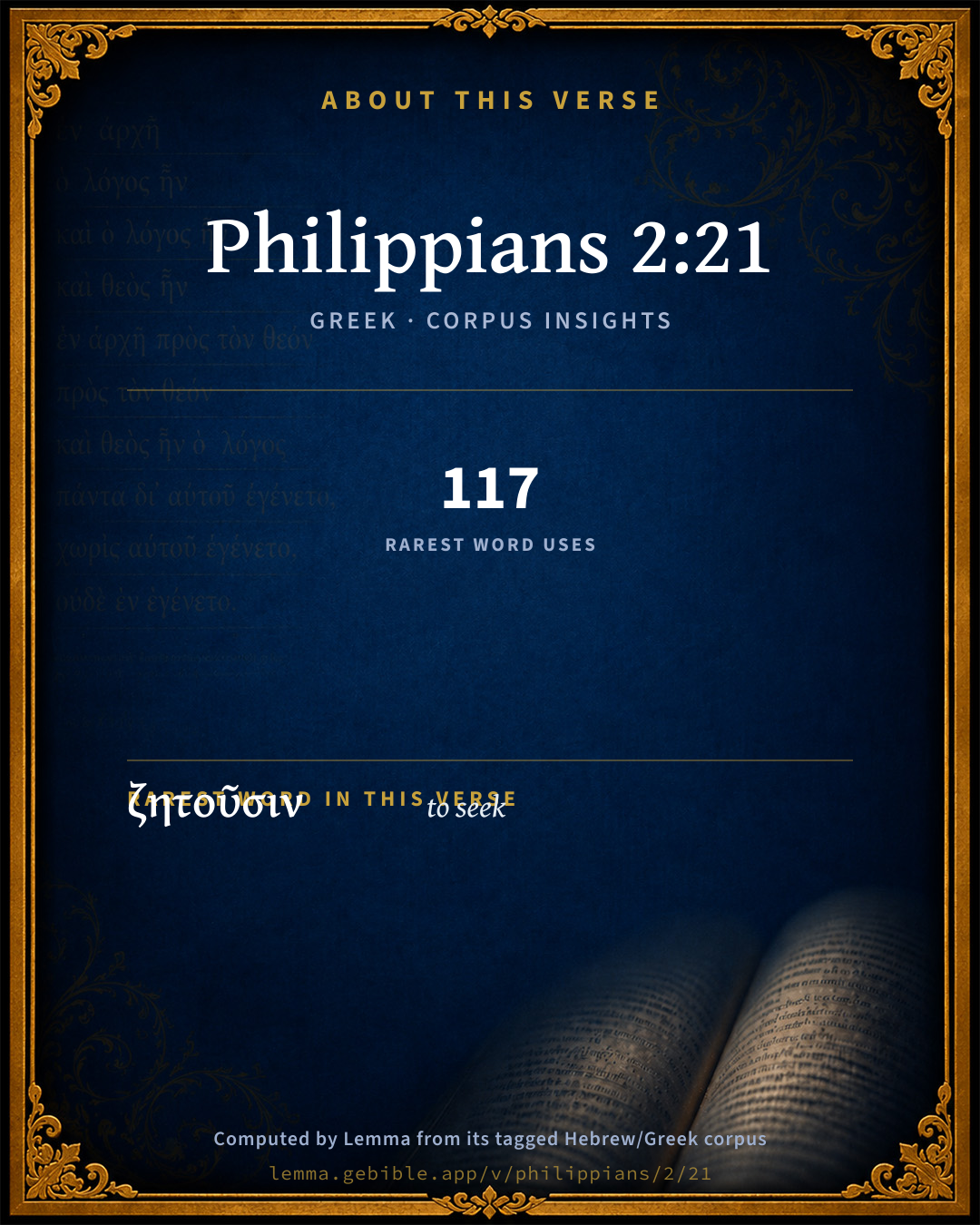
Philippians 2:21

Greek (Tischendorf 8th ed.) Philippians 2:21 appears in the Greek New Testament. The text above is from the Tischendorf 8th edition. Each word links to its Strong’s number and a concise gloss. Click any word for its full Thayer’s Greek Lexicon entry.
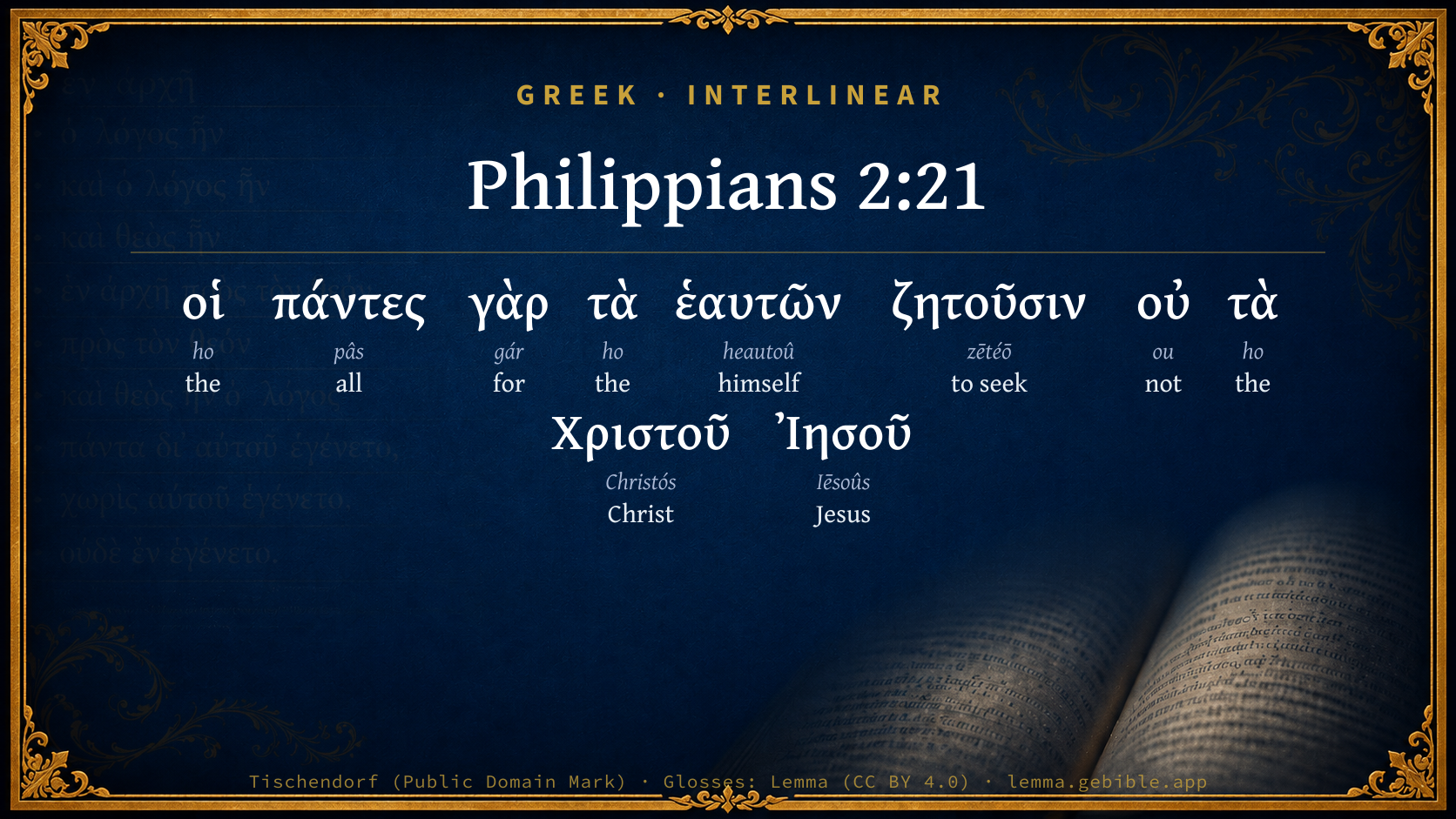
Download image
Cite this verse

Philippians 2:21 (World English Bible). Public Domain. Lemma interlinear Bible study tool, https://lemma.gebible.app/v/philippians/2/21.

Show BibTeX & RIS
BibTeX
RIS
English Translation
For they all seek their own, not the things of Jesus Christ.
World English Bible · Public Domain
Download a study sheet

One document with this verse’s original text, its word-by-word gloss line, the meaning frame, cross-references with their text, attributed commentary, and full source and license credits — printable, and it pastes into notes with its structure intact.

This verse Autodidact and up

Study sheet (.html) Plain text (.txt)

A passage Seminary Student

Up to 50 verses in one chapter. A passage sheet keeps up to 6 commentary sources and 12 cross-references per verse, in the order this page ranks them, and says so on the sheet whenever that leaves anything out. Ask for a single verse and you get the Autodidact verse sheet above.

Everything on this page stays free to read, with no account — the sheet is a download of what is already on screen, not access to it.

Want to remove ads? Support Godless Engineer
Compare translations 3

The same verse in 3 English versions, stacked beneath the original-language interlinear above. Click any original word for its lexicon entry.

Each is an independent rendering of the whole verse — the interlinear is not word-aligned to these translations.

Highlighted words mark where these versions differ — a whole-verse word diff, not a word-by-word alignment.

  • World English Bible Public Domain
    For they all seek their own, not the things of Jesus Christ.
  • King James Version Public Domain
    For all seek their own, not the things which are Jesus Christ's.
  • unfoldingWord Literal Text CC BY-SA 4.0
    for they all seek their own things, not the things of Jesus Christ.

unfoldingWord Literal Text — © unfoldingWord, licensed CC BY-SA 4.0. Word-aligned USFM3 via Door43 (git.door43.org/unfoldingWord/en_ult).

Versions to compare (up to 4)

3 of 4 selected

Show all 19 translations

Every available English version of this verse, each an independent rendering of the whole verse.

  • World English Bible Public Domain
    For they all seek their own, not the things of Jesus Christ.
  • Berean Standard Bible Public Domain
    For all the others look after their own interests, not those of Jesus Christ.
  • Majority Standard Bible Public Domain
    For all the others look after their own interests, not those of Christ Jesus.
  • King James Version Public Domain
    For all seek their own, not the things which are Jesus Christ's.
  • American Standard Version (1901) Public Domain
    For they all seek their own, not the things of Jesus Christ.
  • Revised Version (1885) Public Domain
    For they all seek their own, not the things of Jesus Christ.
  • Geneva Bible (1599) Public Domain
    For all seeke their owne, and not that which is Iesus Christes.
  • Douay-Rheims (1899) Public Domain
    For all seek the things that are their own; not the things that are Jesus Christ's.
  • Young's Literal Translation Public Domain
    for the whole seek their own things, not the things of the Christ Jesus,
  • Literal Standard Version CC BY-SA 4.0
    for the whole seek their own things, not the things of Christ Jesus,
  • Unlocked Literal Bible CC BY-SA 4.0
    For they all seek their own interests, not the things of Jesus Christ.
  • unfoldingWord Literal Text CC BY-SA 4.0
    for they all seek their own things, not the things of Jesus Christ.
  • Darby Bible Public Domain
    For all seek their own things, not the things of Jesus Christ.
  • World Messianic Bible Public Domain
    For they all seek their own, not the things of Yeshua the Messiah.
  • Webster's Bible Public Domain
    For all seek their own, not the things of Jesus Christ.
  • Free Bible Version CC BY-SA 4.0
    Other people only worry about their own interests, not those of Jesus Christ.
  • Bible in Basic English Public Domain
    For they all go after what is theirs, not after the things of Christ.
  • Text-Critical English NT CC BY 4.0
    For they all seek their own interests, not those of Christ Jesus.
  • Tyndale New Testament (1534) Public Domain
    For all other seke ytir awne and not that which is Iesus Christes.

Literal Standard Version (2020), Covenant Press — licensed CC BY-SA 4.0. Text via the HelloAO Bible API (eBible.org). Unlocked Literal Bible (unfoldingWord) — licensed CC BY-SA 4.0. Text via the HelloAO Bible API (eBible.org). unfoldingWord Literal Text — © unfoldingWord, licensed CC BY-SA 4.0. Word-aligned USFM3 via Door43 (git.door43.org/unfoldingWord/en_ult). Free Bible Version, Dr. Jonathan Gallagher — licensed CC BY-SA 4.0. Text via the HelloAO Bible API (eBible.org).

Word by word

More ways to search: Search by grammar → Find every occurrence → Compare this word →

Practice this passage: Drill this verse → Learn its vocabulary →

About this verse

These counts appear in no published source. They are computed here, from the morphology-tagged text and Lemma’s own curated glosses. What Lemma adds →

10
words
8
distinct lemmas
Pauline Epistles
section

Repetition

A word recurs within this verse:

Cross-references

17

Topical passages linked to Philippians 2:21 in the Treasury of Scripture Knowledge — connected by theme and wording, ordered by reader-vote popularity; previews shown in the World English Bible.

  • 1 Corinthians 10:24 Let no one seek his own, but each one his neighbor's good.
  • 1 Corinthians 10:33 even as I also please all men in all things, not seeking my own profit, but the profit of the many, that they may be saved.
  • Philippians 2:4 each of you not just looking to his own things, but each of you also to the things of others.
  • Matthew 16:24 Then Jesus said to his disciples, "If anyone desires to come after me, let him deny himself, and take up his cross, and follow me.
  • 1 Corinthians 13:5 doesn't behave itself inappropriately, doesn't seek its own way, is not provoked, takes no account of evil;
  • 2 Timothy 3:2 For men will be lovers of self, lovers of money, boastful, arrogant, blasphemers, disobedient to parents, unthankful, unholy,
  • Isaiah 56:11 Yes, the dogs are greedy, they can never have enough; and these are shepherds who can't understand: they have all turned to their own way, each one to his gain, from every quarter.
  • Luke 14:26 "If anyone comes to me, and doesn't hate his own father, mother, wife, children, brothers, and sisters, yes, and his own life also, he can't be my disciple.
  • 2 Corinthians 5:14–15 For the love of Christ constrains us; because we judge thus, that one died for all, therefore all died.
  • 2 Timothy 4:10 for Demas left me, having loved this present world, and went to Thessalonica; Crescens to Galatia, and Titus to Dalmatia.
  • 2 Corinthians 1:5 For as the sufferings of Christ abound to us, even so our comfort also abounds through Christ.
  • Philippians 1:20–21 according to my earnest expectation and hope, that I will in no way be disappointed, but with all boldness, as always, now also Christ will be magnified in my body, whether by life, or by death.
  • 2 Timothy 4:16 At my first defense, no one came to help me, but all left me. May it not be held against them.
  • Luke 9:57–62 As they went on the way, a certain man said to him, "I want to follow you wherever you go, Lord."
  • Acts 15:38 But Paul didn't think that it was a good idea to take with them someone who had withdrawn from them in Pamphylia, and didn't go with them to do the work.
  • Malachi 1:10 "Oh that there were one among you who would shut the doors, that you might not kindle fire on my altar in vain! I have no pleasure in you," says Yahweh of hosts, "neither will I accept an offering at your hand.
  • Acts 13:13 Now Paul and his company set sail from Paphos, and came to Perga in Pamphylia. John departed from them and returned to Jerusalem.

Cross-references courtesy of OpenBible.info (CC BY 4.0).

Commentary

Notes on Philippians 2:21 from classic Christian and Jewish commentators (each source and its license shown beneath its notes). The classic Christian expositions comment on the surrounding passage and are grouped to its opening verse, so a note may address several verses; the Jewish commentaries on the Tanakh (Rashi and others) are per-verse, so they appear only where the commentator wrote on this verse.

Lemma curates 59 commentaries, every one of them public domain or Creative Commons licensed, each selected and text-cleaned for this edition rather than reprinted as found. About our sources →

The Biblical Illustrator

Joseph S. Exell

Php_2:21

For all seek their own

Self-seeking

I.

Its signs.

II. Its causes.

III. Its evils.

IV. Its cure. (J. Lyth, D. D.)

The evil of self-seeking

I. Things of a different sort spoken of.

1. Their own things--the things of this life; so called--

(1) Because they belonged to them by providential disposal and civil right.

(2) Some might call them so by a new covenant tenure so far as they used them to just and laudable purposes.

(3) Twas well if others did not make them their own in a criminal sense, using them only for themselves, for self-indulgence.

2. The things of Jesus Christ: things of His kingdom.

(1) The things of His glory, of which He is the object.

(2) The things of our salvation, of which He is the author.

II. A sinful disposition with regard to these things. Seek indicates the temper of the soul in contrivances and desires, and the actings of the life in its endeavours.

1. Some sought their own things, and not at all the things of Christ.

2. Others sought their own more than His.

III. The subject of this disposition. All has special but not exclusive reference to ministers: for carnality in ministers usually spreads its contagion among the people; and the apostle afterwards speaks of both ministers and people as deeply infected with it when at the first summons of his second imprisonment they were so fearful of their secular interests that none dared publicly to own him (2Ti_4:16). (J. Guyse, D. D.)

Seeking our own things

I. When may we be said to seek our own things and not those of Christ.

1. When we seek them in opposition or disservice to the things of Christ (Joh_11:47-53; Act_19:27-29).

(1) This spirit has acted under the Christian name; it still works in the Papal tyranny, and in those Protestants whose persecuting spirit substitutes a kingdom of this world in the room of Christs.

(2) Where ever this spirit prevails it eats out the power of godliness or suppresses it in others (Luk_22:24-26).

2. When we seek our own to the neglect of Christs (Act_18:17; Mat_22:5; Joh_5:44).

3. When we seek our own more than Christs (Mat_13:20-22). Some seek them only in such ways and at such times as will cost them little expense or trouble.

4. When we seek our own so as to hinder our seeking Christs. (a) We sometimes seek our own with such eagerness of spirit as puts us out of tune for spiritual things, and when we have been employed in spiritual work, a too hasty return to the world, and a too eager application to the things of it defaces promising impressions (Mat_13:22).

(2) At other times we are unreasonably employed in our own things where we ought to be engaged in the worship of God (Luk_10:40-42).

5. When there is too much of self secretly twisting itself into what we do for Christ (Zec_7:5-6; Php_1:15-16).

(1) Some seek the things of Christ only for their own worldly interests, from secular views, to make a livelihood or to conciliate favour (Eze_33:31).

(2) Others seek their own honour, and the gratification of their own pride, to recommend their learning, piety, or zeal (2Ki_10:16; Mat_23:5-7).

(3) The like sin we are guilty of when we are zealous for notions of our own, because they are our own and exalt our reason, or because they suit the general taste (Gal_1:9-10; Gal_6:12-14).

(4) When we set up our own righteousness instead of Christs to recommend us to Gods acceptance (Rom_9:30-32), or lean on our own strength and not on Christs for spiritual performances (1Co_1:29-31; Isa_45:24-25).

(5) Others seek an indulgence in their own passions and pleasures, seeking the things of Christ as a cloak for them, or as a salve to conscience.

6. When we put no respect to Christ on our own things (Col_3:23-24).

(1) All our abilities should have a reference to Him that He may be glorified (1Co_6:20).

(2) We should seek His love and favour that we may taste them with a sweeter relish as the purchase of His blood and branches of new covenant mercies.

II. The great evil of this.

1. Consider the excellence of Christs things above all our own.

(1) They have a substantial worth and real goodness in them as derived from His glorious Person (Heb_1:3; 2Co_3:18).

(2) There is all-comprehensive goodness to fill up our vastest capacities with complete satisfaction (Pro_8:20-21), and to ennoble them.

(3) What are our own in comparison? They are empty, perishing, some debasing, will not profit in the clay of wrath.

(4) What folly then to prefer broken cisterns (Jer_2:13).

2. Consider how unsuitable this is to our character as Christians.

(1) We are disciples of Christ, and profess to make of Him our all.

(2) We are strangers and pilgrims, and profess to have our portion above.

3. Consider the abundant care and grace with which Christ has sought our things--our everlasting peace and salvation (2Co_8:9; Php_2:6-8; Php_4:5; 2Co_5:14-15; 1Jn_4:19).

4. Consider the danger of seeking our own in preference to Christs.

(1) The more distance there will be between Christ and us.

(2) The more open we shall be to temptation.

(3) The less fitness we shall have for heaven.

(4) The more sure will be our rejection by God and the loss of the soul (Mat_16:26). (J. Guyse, D. D.)

Giant Self

(Text in conjunction with 1Co_13:5; Php_2:4).

I. A common but serious fault. In one sense it is right to seek our own. To get on with your learning, to prosper in your business, etc., is right and dutiful: but when you are wholly taken up with self, that is seeking your own in a bad sense. Selfishness appears in--

1. Seeking our own pleasure and comfort to the neglect of that of others. You see it in taking the best seats, and trying to get the daintiest morsels at meal times; in the endeavour to get the best of everything for ourselves, and to leave what is inferior for others; in trying to secure a whole railway carriage to oneself, not caring how crowded the others may be. There is something of the kind in churches: and in families where children disregard each other or their parents, and grudging to others what we do not get ourselves.

2. Seeking our own honour and credit. What a danger there is of wishing ill to ones rival in school, play, or business, so that we may reap the advantage. Under this head may be included the tendency to allow others to fall under suspicion where we were the wrong-doers.

3. Seeking to overbear others with our opinion. Most of us like to get our own way and carry our point. Even when convinced many will not give in.

4. Seeking to gratify our own temper irrespective of the pain it may give others. In holding out sulkily, or saying cutting things.

5. Seeking our own salvation all unconcerned about the salvation of others. How unlike the sailor saved from the wreck, whose first word when he returned to consciousness was, Another man overboard! as if that were uppermost with him, so that there might be two salvations to him.

II. A rare but beautiful grace. Love seeking not her own: beautiful, for it is being like Jesus; it is an element of heaven, but rare. It is the opposite of what has been described. Jesus pleased not Himself; nor did Abraham in his dispute with Lot.

III. A valuable counsel. Look not on his own things, etc.

1. In small matters. It is comparatively easy to be heroic on great occasions.

2. To the widest extent. (J. H. Wilson, D. D.)

The duty of unselfishness

If a vessel were on the eve of going down, what would you think if a few men were to get the boats launched, and before they were half filled, were to cut the ropes that bound them to the ship, and pull off? What would you think of such, congratulating themselves on their own escape, while leaving hundreds on board who were not aware of their danger, some of them, perhaps, sound asleep? I have heard of a man who had set fire to a mill finding he had cut off his own retreat, and appearing at a window several stories up, appealing for help. The ladder was raised in the hope of saving him, but the danger was extreme, and neither fireman nor policeman would venture. A boy was seen forcing his way to the foot of the ladder, saying, Let me go! Im his son, and he is my father. And when the fireman would have pushed him back, the boy earnestly repeated, He is my father, I tell thee, and he does not love God! and the next minute saw him climbing aloft, making every effort to save his father, and perishing in the attempt. (J. H. Wilson, D. D.)

The beauty of unselfishness

A young woman was dying in a lodging in London, of a loathsome disease. Who was her attendant, tenderly nursing her day and night? You might have taken her for a sister. And yet the two had only been fellow servants in the same house, and when the one fell ill and had to go into lodgings, the other gave up her situation to go to nurse her friend, spending her own strength and all her hard-earned savings in supporting her fellow servant, and never leaving her till she died. A friend in Australia has sent me the following touching narrative:--Some days since, a little girl, called Jane Buchanan, was carrying her brother, a child, in her arms, through the holes not far from Golden Point, on the White Flat, when the little fellow, from joyousness or some other cause, made a sudden spring from his sisters arms, and plumped into an abandoned shaft about ten feet deep. Without a moments deliberation, our little heroine jumped in to save the life of her brother, and, what is equally gratifying, succeeded. A man who witnessed the accident hurried to the spot, found the girl up to her neck in water and holding the boy above her head, and was hailed with the girls imploring entreaty--Here, you save my little brother, and dont mind me. Both were drawn up without delay, and both were uninjured save from the cold bath and wet clothes. (J. H. Wilson, D. D.)

Disinterested service

San Quala, the native apostle of Central Burmah, was, in consequence of his abilities and influences, offered a lucrative appointment by the British Commissioner at Pegu. Without hesitation he declined the offer, though having no salary, and depending for food and clothing on the people to whom he preached. He replied, I cannot do it. I will not have the money. I will not mix up Gods work with Government work. There are others to do this thing; employ them. And being further pressed with the suggestion that he might continue his work as missionary, which would thus be rendered easier, he said, No, sir. When I eat with the children of poverty I am content, I did not leave my dear wife and come up hither in search of silver or agreeable food. I came to this land that its poor benighted inhabitants might be saved. In two and a half years this man had gathered thirty churches and baptized more than two thousand adult believers with his own hands. (J. B. J. Tinling, B. A.)

Disinterestedness

in return for his splendid services to China, Gordon would accept only the distinctions of the Yellow Jacket and the Peacocks Feather, which correspond to our own orders of the Garter and the Bath. Of these rewards he wrote to his mother: I do not care twopence about these things, but know that you and father like them. The Chinese Government twice offered him a fortune. On the first occasion 10,000 taels were actually brought into his room, but he drove out the bearers of the treasure and would not even look at it. On the second occasion the sum was still larger, but this also he declined, and afterwards he wrote home:--I do not want anything, either money or honours, from either the Chinese Government or our own. As for the honours, I do not value them at all. I know that I am doing a great deal of good, and, liking my profession, do not mind going on with my work. Do not think I am ill-tempered, but I do not care one jot about my promotion, or what people may say. I know I shall leave China as poor as I entered it, but with the knowledge that through my weak instrumentality upwards of eighty to one hundred thousand lives have been spared.

Selfishness common

When they (the Athenians, after a battle with Xerxes) came to the Isthmus, and every officer took a bullet from the altar to inscribe upon it the names of those who had done the best service, every one put himself in the first place, and Themistocles in the second. (Plutarch.)

Beauty of unselfishness

Mrs. Appleton, of Boston, the daughter of Daniel Webster, was dying, after a long illness. The great lawyer, after pleading an important cause in the courtroom, on his way home stopped at the house of his daughter and went into her sick room. She said to him, Father, why are you out today in this cold weather without an overcoat? The great lawyer went into the next room, and was in a flooder tears, saying, Dying herself, yet thinking only of me. Oh! how much more beautiful is care for others than this everlasting taking care of ourselves! (T. De Witt Talmage.)

The Biblical Illustrator, edited by Joseph S. Exell (c. 1880s–1900s) — public domain. Text from a community e-Sword module.

Bengel's Gnomon

Johann Albrecht Bengel

Php 2:21. Οι πάντες, they all [the whole mass of men]) If at that time, so distinguished as it was, Paul quite approved of only one out of, as it were, his own band (ch. Php 1:14; Php 1:17), speaking of those who were then present, ch. Php 4:21, and that too writing at such a distance to the church of the Philippians, how many do we suppose in our times approve themselves unto God? [This fact may be put to the test, when a man ought to have given his assistance to a laudable undertaking, either near or at a distance, which either he has not under his charge, or which he does not perceive will be of advantage to him, Jdg 5:23; Jdg 8:6. Nay, even it sometimes happens, that he who possesses some extraordinary gift or endowment, if in any way he has found an opportunity of refusing the benefit of it to others, derives much self-gratification from this very fact. O Christians, unworthy of the name!—V. g.] It was a very nice αἴσθησις, sense, by which Paul perceived this.—τὰ ἑαυτῶν, their own) Php 2:4. O how many are godly on their own account! although they are not enemies, Php 3:18.—ζητοῦσι, seek) A godly intimation may be given to godly hearers as to the character of these or those ministers.—οὐ τὰ[24] ΧΡΙΣΤΟῦ ἸΗΣΟῦ, not the things which are Jesus Christ’s) They experience this, who from their heart seek to promote the common edification. They find few to assist them, Jdg 5:17; Jdg 5:23; Jdg 8:6; Jdg 8:8. They are abandoned, when there is no obligation close in view, no hope of reward or fame. When the advantage of the kingdom of Christ is consulted by most persons, it is generally done in the way of a safe or secure expediency.[25] When some sacrifice must be made, the man does not fight, but flees, and excuses himself with the hope of fighting at another time.

[24] The marg. of both Ed., and also the Germ. Vers., give their decision in favour of the reading Ἰησοῦ Χριστοῦ in this passage.—E. B.

[25] i.e. Where consulting Christ’s advantage is consistent with consulting their own, so as to be free from hurt or loss: “per modum innoxiæ utilitatis.”—ED

Ἰησοῦ Χριστοῦ is the reading of ACD(Δ)Gfg Amiat. MS. of Vulg. But Χριστοῦ Ἰησοῦ, B (judging from silence) Memph. and later Syr. Ed.—ED.

Bengel's Gnomon of the New Testament — English translation (T&T Clark, Edinburgh, 1860) — public domain. Text from a community e-Sword module.

Meyer's Critical & Exegetical Commentary

Heinrich August Wilhelm Meyer

Php_2:21. Οἱ πάντες] all (except Timothy), of those whom I now have with me and at my disposal for sending; see Php_2:20. We have the less warrant to modify this judgment in any way, expressed, as it is, so very clearly and decidedly by the absolute antithesis τὰ ἑαυτῶν ζητοῦσιν, οὐ τὰ Ἰ. Χ., seeing that we are unacquainted with the circle surrounding the apostle at that particular time, and do not know to what extent the anti-Pauline tendency, Php_1:15; Php_1:17, had then spread in the immediate neighbourhood of the apostle. The only limitation of the general expression, which is in accordance with the text, lies in the fact that Paul does not mean the Christians generally in Rome, but such assistant teachers as would otherwise, if they had been pure and honest, have been qualified for such a mission. The trustworthy ones among these otherwise qualified fellow-labourers must have been absent at the time, especially Luke, who could by no means have been included among οἱ πάντες (in opposition to Wieseler, Chronol. d. apost. Zeitalt. p. 427); hence the Philippians are not saluted specially either by Luke or by any other, and the omission of such salutations by name at the end of this epistle receives in part its explanation from this passage. Consequently, οἱ πάντ. cannot be understood as many or the most (Beza, Wolf, Hammond, Drusius, Estius, Grotius, Cornelius a Lapide, and others, including Heinrichs, Rheinwald, Flatt); nor is it: all, whom I can spare (Erasmus), or: who are known to you (van Hengel). Neither is the negation to be taken relatively: they seek more their own interest, etc. (Erasmus, Calvin, and many others, also Flatt, Hoelemann, comp. the reservations of Weiss), to which Hofmanns view [138] also ultimately comes; nor is it to be explained by assuming an intention of distinguishing Timothy (Matthies); nor yet is the judgment to be restricted, with Chrysostom, Oecumenius, and Theophylact, to the hardships of the long journey, to which they preferred their own repose. Bengel rightly defends the full seriousness of the utterance, and adds: subtilissima erat αἴσθησις, qua hoc percepit Paulus. But Baur erroneously discovers here merely an exaggeration, which arose from the subjectivity of a later author. What an uncalled-for fiction that would have been!

[138] The latter says: they allow themselves to be influenced in the direction of their activity, even though it be consecrated to the kingdom of God (?), by special personal aims, instead of devoting themselves ALWAYS ONLY (?οὐ τὰ Ἰ. Χ.). to that which is MOST ADVANTAGEOUS for the cause of Christ (οὐ τὰ Ἰ. Χ.!). Thus there is imported into the passage what is not at all to be found in it.

Meyer — Critical and Exegetical Commentary on the New Testament — English translation by Peter Christie, edited by Frederick Crombie (T&T Clark, 1880) — public domain. Text from a community e-Sword module.

Expositor's Greek Testament

ed. W. Robertson Nicoll

Phi 2:21 . οἱ πάντες … ζητ . This verse has roused surprise. Where were all Paul’s faithful brethren in the Lord? Has he no one but Timothy to fall back upon? It must be borne in mind that we have to do with a simple letter, not a treatise, or history of Paul’s work. The Apostle speaks in an outburst of strong feeling, for he is a man of quick impulses. He does not for a moment mean that he has no genuine Christian brethren in his company. But he had found, in all probability, that when he proposed to some of his companions, good Christian men, that they should visit far-distant Philippi, they all shrank, making various excuses. Timothy alone is willing, the one man he can least afford to spare. It is hard to part with him at such a critical time. No wonder that he should feel hurt by this want of inclination on the part of the other brethren to undertake an important Christian duty. No wonder that he should speak with severity of a disposition so completely opposed to his own. Cf. 1Co 10:33 , μὴ ζητῶν τὸ ἐμαυτοῦ σύμφορον ἀλλὰ τὸ τῶν πολλῶν . See esp [11] Calvin’s excellent note ad loc. Χ . Ἰ . The authorities are almost equally balanced as to the readings. See on chap. Phi 1:1 supr.

[11] especially.

The Expositor's Greek Testament, edited by W. Robertson Nicoll (1897–1910) — public domain. Text from a community e-Sword module.

Geneva Bible (1599)

Geneva Bible translators

The most part.

Geneva Bible (1599) marginal notes — public domain. Text via Bolls.life.

Jamieson, Fausset & Brown

Robert Jamieson, A. R. Fausset & David Brown

Translate as Greek, "They all" (namely, who are now with me, Phi 1:14, Phi 1:17; Phi 4:21 : such Demas, then with him, proved to be, Col 4:14; compare Ti2 4:10; Plm 1:24).

seek their own--opposed to Paul's precept (Phi 2:4; Co1 10:24, Co1 10:33; Co1 13:5). This is spoken, by comparison with Timothy; for Phi 1:16-17 implies that some of those with Paul at Rome were genuine Christians, though not so self-sacrificing as Timothy. Few come to the help of the Lord's cause, where ease, fame, and gain have to be sacrificed. Most help only when Christ's gain is compatible with their own (Jdg 5:17, Jdg 5:23).

Jamieson, Fausset & Brown — Commentary Critical and Explanatory on the Whole Bible (1871) — public domain (CC PDM 1.0). Text via the HelloAO Bible API.

Adam Clarke's Commentary

Verse 21. For all seek their own] This must relate to the persons who preached Christ even of envy and strife, Php 1:15; these must be very careless whether souls were saved or not by such preaching; and even those who preached the Gospel out of good will might not be fit for such an embassy as this, which required many sacrifices, and consequently much love and zeal to be able to make them.

Adam Clarke's Commentary on the Bible (1810–1826) — public domain. Text from a community e-Sword/MySword module.

John Calvin's Commentaries

21 For all seek their own things. He does not speak of those who had openly abandoned the pursuit of piety, but of those very persons whom he reckoned brethren, nay, even those whom he admitted to familiar intercourse with him. These persons, he nevertheless says, were so warm in the pursuit of their own interests, that they were unbecomingly cold in the work of the Lord. It may seem at first view as if it were no great fault to seek one’s own profit; but how insufferable it is in the servants of Christ, appears from this, that it renders those that give way to it utterly useless. For it is impossible that the man who is devoted to self, should apply himself to the interests of the Church. Did then, you will say, Paul cultivate the society of men that were worthless and mere pretenders? I answer, that it is not to be understood, as if they had been intent exclusively on their own interests, and bestowed no care whatever upon the Church, but that, taken up with their own individual interests, they were to some extent negligent to the promotion of the public advantage of the Church. For it must necessarily be, that one or other of two dispositions prevails over us — either that, overlooking ourselves, we are devoted to Christ, and those things that are Christ’s, or that, unduly intent on our own advantage, we serve Christ in a superficial manner.

From this it appears, how great a hinderance it is to Christ’s ministers to seek their own interests. Nor is there any force in these excuses: “I do harm to no one“ — “I must have a regard, also, to my own advantage” — “I am not so devoid of feeling as not to be prompted by a regard to my own advantage.” For you must give up your own right if you would discharge your duty: a regard to your own interests must not be put in preference to Christ’s glory, or even placed upon a level with it. Whithersoever Christ calls you, you must go promptly, leaving off all other things. Your calling ought to be regarded by you in such a way, that you shall turn away all your powers of perception from everything that would impede you. It might be in your power to live elsewhere in greater opulence, but God has bound you to the Church, which affords you but a very moderate sustenance: you might elsewhere have more honor, but God has assigned you a situation, in which you live in a humble style: you might have elsewhere a more salubrious sky, or a more delightful region, but it is here that your station is appointed. You might wish to have to do with a more humane people: you feel offended with their ingratitude, or barbarity, or pride; in short, you have no sympathy with the disposition or the manners of the nation in which you are, but you must struggle with yourself, and do violence in a manner to opposing inclinations, that you may keep by the trade you have got; for you are not free, or at your own disposal. In fine, forget yourself, if you would serve God.

If, however, Paul reproves so severely those who were influenced by a greater concern for themselves than for the Church, what judgment may be looked for by those who, while altogether devoted to their own affairs, make no account of the edification of the Church? However they may now flatter themselves, God will not spare them. An allowance must be given to the ministers of the Church to seek their own interests, so as not to be prevented from seeking the kingdom of Christ; but in that case they will not be represented as seeking their own interests, as a man’s life is estimated according to its chief aim. When he says all, we are not to understand the term denoting universality, as though it implied that there was no exception, for there were others also, such as Epaphroditus, but there were few of these, and he ascribes to all what was very generally prevalent.

When, however, we hear Paul complaining, that in that golden age, in which all excellences flourished, that there were so few that were rightly affected, let us not be disheartened, if such is our condition in the present day: only let every one take heed to himself, that he be not justly reckoned to belong to that catalogue. I should wish, however, that Papists would answer me one question — where Peter was at that time, for he must have been at Rome, if what they say is true. O the sad and vile description that Paul gave of him! They utter, therefore, mere fables, when they pretend that he at that time presided over the Church of Rome. Observe, that the edification of the Church is termed the things of Christ, because we are truly engaged in his work, when we labor in the cultivation of his vineyard.

John Calvin's Commentaries (1540-1563) — public domain. Text from the Calvin Translation Society English edition (1840s-50s) via the Christian Classics Ethereal Library (ccel.org). Calvin's coverage is partial (roughly two-thirds of the Bible); uncommented books and verses are honest gaps, never fabricated. The 19th-century editor's footnotes and remarks are omitted so the notes are faithfully Calvin's own voice.

Ellicott's Commentary for English Readers

(21) For all seek their own, not the things which are Jesus Christ’s.—Compare our Lord’s words, “Ye shall be scattered every man to his own (things), and shall leave Me alone” (Joh_16:32). St. Paul’s declaration is startling; for he had certainly some “brethren with him” (Php_4:21). But the scanty notice of them in the close of this Epistle contrasts strongly with the detailed and affectionate mention of his companions by name in Col_4:7-14; Phm_1:23-24. It would seem as if at this time he was either separated accidentally from his most trusty disciples, or that there had been a temporary falling away from him, in some degree like that which he describes with so much sadness in 2Ti_4:9-10; 2Ti_4:16. His words need not be taken as accusing all of absolute selfishness and unfaithfulness, but they are nevertheless startling enough.

A Bible Commentary for English Readers, edited by Charles John Ellicott (1878–1897) — public domain. Text from a community e-Sword module.

The Cambridge Bible for Schools and Colleges

gen. ed. J. J. S. Perowne

21. all] The Greek would be more exactly represented by they all, or all of them; all of a definite group in question. This is a severe censure on the persons really indicated. St Paul must have suffered grave disappointments where he had a special right to expect ready help. Demas (2Ti_4:10) had his precursors; indeed he may have been included in this censure, for he was at Rome about this time (Col_4:14; Phm_1:24). But we must not assume that St Paul here (or even 2Ti_4:10) excommunicates, so to speak, those whom he refers to; the true disciple may have his weak, because faithless and selfish, hour. See Act_13:13, with Act_15:38, and contrast 2Ti_4:11. And again common sense bids us interpret the “they all” with a reserve. He must mean not “all the Christians around me,” but “all the possible Christian messengers around me.” “The saints of Cæsar’s household” (Php_4:22), for example, could not be in question; nor was Epaphroditus (Php_2:25, &c).

seek their own] things, literally; their own ease or safety; perhaps their own preferences in toil and duty. See 1Co_13:5 for the opposite choice as the choice of holy Charity.

the things which are Jesus Christ’s] The interests of His disciples laid upon them by His Apostle.

The Cambridge Bible for Schools and Colleges (gen. ed. J. J. S. Perowne; Cambridge University Press, 1878–1918) — public domain. Text from a community e-Sword module.

John Gill's Exposition

But ye know the proof of him,.... They had had an experiment of him, a trial of his spirit, and a proof of his gifts and ministry, when he was among them with the apostle at his first preaching the Gospel to them, to the conversion of Lydia, and of the jailer, and their households, which laid the foundation of a Gospel church state among them, see Act 16:3. The Vulgate Latin version reads in the imperative, "know ye the proof of him"; but the former reading is to be preferred:

that as a son with the father, he hath served with me in the Gospel; he served not the apostle, but with him; he served God as the apostle did, in the Gospel of his Son; he served Jesus Christ, whose Gospel he preached, the interest and spread of which he greatly laboured in with him, as a fellow servant or work fellow; see Rom 16:21; which expresses the modesty of the apostle, and the great honour put upon Timothy, and which was not abused by him; for as a son honours, obeys, and imitates his father, so did he honour the apostle, and give him all respect and reverence that was due to him on account of his office, age, and usefulness; and obeyed his orders cheerfully, going wherever he sent him, and doing whatever he bid him; and imitated him in his ministry, in his constancy, diligence, and zeal, having a true filial affection for him.

John Gill's Exposition of the Whole Bible (1746–1763) — public domain (CC PDM 1.0). Text via the HelloAO Bible API.

Trapp's Complete Commentary

John Trapp

21 For all seek their own, not the things which are Jesus Christ’s.

Ver. 21. For all seek their own] If it were so then, what wonder if now, as was so long since foretold, 2Ti 3:2. Self must be shouldered out, and Christ’s share studied more than our own; all private interests let fall, and all self-respect drowned in the glory of God and the public good; or else we want that pious ingenuity that becometh saints. It is said of Cato, that he did- toti genitum se credere mundo, That the care of the community lay upon him. (Lucan.) Timothy was of a choice and excellent spirit that naturally cared for the Churches’ welfare; few such today. {See Trapp on "Php 2:3"}

John Trapp, A Commentary or Exposition upon All the Books of the Old and New Testament (1647–1656) — public domain. Text from a community e-Sword module.

Albert Barnes' Notes on the Bible

For all seek their own - That is, all who are with me. Who Paul had with him at this time is not fully known, but he doubtless means that this remark should apply to the mass of Christians and Christian ministers then in Rome. Perhaps he had proposed to some of them to go and visit the church at Philippi, and they had declined it because of the distance and the dangers of the way. When the trial of Paul came on before the emperor, all who were with him in Rome fled from him 2Ti 4:16, and it is possible that the same disregard of his wishes and his welfare had already begun to manifest itself among the Christians who were at Rome, so that he was constrained to say that, as a general thing, they sought their own ease and comfort, and were unwilling to deny themselves in order to promote the happiness of those who lived in the remote parts of the world. Let us not be harsh in judging them. How many professing Christians in our cities and towns are there now who would be willing to leave their business and their comfortable homes and go on embassy like this to Philippi? How many are there who would not seek some excuse, and show that it was a characteristic that they “sought their own” rather than the things which pertained to the kingdom of Jesus Christ?

Not the things which are Jesus Christ’s - Which pertain to his cause and kingdom. They are not willing to practice self-denial in order to promote that cause. It is implied here:

(1) That it is the duty of those who profess religion to seek the things which pertain to the kingdom of the Redeemer, or to make that the great and leading object of their lives. They are bound to be willing to sacrifice their own things - to deny themselves of ease, and to be always ready to expose themselves to peril and want if they may be the means of advancing his cause.

(2) That frequently this is not done by those who profess religion. It was the case with the professed Christians at Rome, and it is often the case in the churches now. There are few Christians who deny themselves much to promote the kingdom of the Redeemer; few who are willing to lay aside what they regard as their own in order to advance his cause. People live for their own ease; for their families; for the prosecution of their own business - as if a Christian could have anything which he has a right to pursue independently of the kingdom of the Redeemer, and without regard to his will and glory.

Albert Barnes' Notes on the Bible (1834–1885) — public domain. Text from a community e-Sword/MySword module.

Haydock's Catholic Bible Commentary

All seek the things that are their own; i.e. many do so. (Witham)

George Leo Haydock (1774–1849), Haydock's Catholic Family Bible and Commentary, 1859 edition — public domain. Excludes Psalms (Douay-Rheims chapter numbering differs from Protestant) and Deuterocanonical books (Catholic canon only).

Matthew Poole's English Annotations

He doth here further commend Timothy, compared with the generality of those who with him did attend the ministry of the gospel at Rome, where it seems (whatever the papists pretend) Peter did not then preside as metropolitan. When he saith

all, he doth not necessarily imply every individual besides Timothy, (though, as before, he knew not one like-minded as he was), but almost all, (as the universal sign is elsewhere synecdochically taken, Jer 6:3; Mat 10:22; Mar 1:5), or the most part of those then employed in the ministry, who were then at liberty, and whose inclinations, probably, he had inquired into.

Seek their own; did, though not simply and absolutely, yet after a sort, seek their own profit, ease, safety, pleasure, and satisfaction; called their own, in regard of their civil right, and the world’s opinion, but yet at God’s disposal, Hag 2:8. These they did (as John Mark in another case) prefer to a long and tedious journey, for the service of Christ, unto Philippi.

Not the things which are Jesus Christ’s; so that they did postpone the glory of Christ, the safety and edification of the church there, to their own things. Wherefore he doth not mean it absolutely, that they did not seek the things of Christ, or that they did deny Christ, for it is apparent, even when he penned this Epistle, Phi 1:13,14, with Act 28:14,15, and Rom 1:8, there were many that did seriously seek Christ; but comparatively, and in a sort, they did not seek the things of Christ so intently as they should, 1Co 10:24,33, but failed as others did in other cases, Mat 26:58; 2Ti 4:16; not as if all minding of their own things were denied to Christ’s ministers, 1Ti 3:4,5; 5:8; but they did slip their necks from under the yoke, and did not mind the glory of Christ in the church of Philippi, as he did.

Matthew Poole's English Annotations on the Holy Bible (1683–1685) — public domain. Text from a community e-Sword/MySword module.

Whedon's Commentary on the Bible

Daniel D. Whedon

21. All seek their own—Their own things, instead of Christ’s. Who are embraced in this severe censure does not clearly appear. Of the six besides Timothy who were with the apostle a few months previously, (Col_4:10-14,) it is fair to believe that they all, as was certainly true of some, were now absent from Rome. Even the love of Demas for “this present world” (2Ti_4:10) may have been of a later date. But of all those with him who were at all adapted to a mission of this nature, only one had no selfish interest to plead. Timothy alone sprang eagerly to the front. Verily, if this is a fair picture of the average ministry of the first century, the average ministry of the evangelical Church of to-day is at least its full equal in devotedness, zeal, and entireness of consecration. But the apostle’s standard is the true ideal.

Daniel D. Whedon (gen. ed.), Commentary on the Old and New Testaments (1874–1909) — public domain. Text from a community e-Sword module.

The Pulpit Commentary

For all seek their own, not the things which are Jesus Christ"s. All of them, he says (oi pantev); Timothy is the one exception. He calls those about him brethren in Php_4:21; but, it seems, they were like St. Paul, not willing to spend and to be spent for the salvation of souls. It was a great sacrifice in one who so yearned for Christian sympathy to submit to the absence of the one true loving friend. St. Paul"s spiritual isolation increases our wonder and admiration for the strain of holy joy which runs through this Epistle.

The Pulpit Commentary (1880–1919), ed. H.D.M. Spence-Jones & Joseph S. Exell — public domain. Text from a community e-Sword module.

John Wesley's Explanatory Notes

For all - But Timotheus. Seek their own - Ease, safety, pleasure, or profit. Amazing! In that golden age of the church, could St. Paul throughly approve of one only, among all the labourers that were with him? chap. i, 14, 17. And how many do we think can now approve themselves to God? Not the things of Jesus Christ - They who seek these alone, will sadly experience this. They will find few helpers likeminded with themselves, willing naked to follow a naked Master.

John Wesley, Explanatory Notes Upon the Whole Bible (1754–1765) — public domain. Text via the GEBible commentary corpus.

The People's New Testament

B. W. Johnson

21. For all seek their own. Others, who were at hand, were more mindful of their own interests than of Christ's cause. We infer from this that of his faithful fellow-preachers none were in Rome save Timothy.

B. W. Johnson's The People's New Testament with Notes (1889–1891) — public domain. Electronic text from the Christian Classics Ethereal Library (CCEL) ThML edition.

Cambridge Greek Testament for Schools and Colleges

21. τὰ Χριστοῦ Ἰησοῦ. So (without τοῦ before Χ. Ἰ.) all uncials, many cursives, Clem and many other fathers. Many cursives, Chrys (but not consistently) Theodoret τὰ τοῦ.

Χριστοῦ Ἰησοῦ. So BL, most cursives, a copy of vulg copt syr (pesh), Chrys and some fathers. אACD2G2P, 17 and several other cursives, some copies of vulg, Clem Chrys (alibi) and several other fathers Ἰησοῦ Χριστοῦ. Τ Χριστοῦ Ἰησοῦ. LTr and all other recent editors Ἰησοῦ Χριστοῦ.

21. οἱ τάντες. Slightly more definite than πάντες: it is the πάντες in question; “all of them.”

τὰ ἑαυτῶν. Their own ease or safety, or their personal preferences in toil or duty.

οὐ τὰ Χ. Ἰ. The whole verse indicates some bitter disappointments felt by St Paul; Demas (2Ti 4:10) had his precursors. Still we must not understand St Paul to condemn these disciples without reserve; like Mark (Act 13:13) they may have been true men found off their guard. And again common sense bids us explain the πάντες with caution. He must mean not simply all the Christians around him, many of whom would not be free agents for this mission; it must be all who could have gone if they would.

Let us not fail to remember that to the true disciple in his true condition τὰ Χριστοῦ Ἰησοῦ are, as such, the supreme interest.

Cambridge Greek Testament for Schools and Colleges (Cambridge University Press, 1896; 21 vols, various authors incl. Carr, Maclear, Plummer, Farrar, Lumby, Moule, M. R. James, Simcox) — public domain. Text from a community e-Sword module.

Alford’s Greek Testament

Henry Alford

21.] for all (my present companions) (who these were, we know not: they are characterized, ch. 4:21, merely as οἱ σὺν ἐμοὶ ἀδελφοί—certainly not Luke—whether Demas, in transition between Phm 1:24 and 2Ti 4:10, we cannot say) seek their own matters, not those of Jesus Christ (no weakening of the assertion must be thought of, as that of rendering οἱ πάντες, many, or most,—or understanding the assertion, care more about &c. than &c.,—as many Commentators: nor must it be restricted to the love of ease, &c., unwillingness to undertake so long a journey, as Chr., Œc, Thl.: both οἱ πάντες and the assertion are absolute).

Henry Alford, The Greek Testament (1849–1861) — public domain. Text from a community e-Sword module.

International Critical Commentary

21. οἱ πάντες γὰρ τὰ ἑαυτῶν ζητοῦσιν, οὐ τὰ Χριστοῦ Ἰησοῦ: ‘for they all seek their own, not the things of Christ Jesus.’

οἱ πάντες: Collective; the whole number in a body. (See Act 19:7; Rom 11:32; 1Co 10:17; Eph 4:13.) The statement is very sweeping, especially in view of the high commendation of Epaphroditus which follows. The common explanations are that all who were likeminded with himself, as Luke, were absent at the time of his writing; or that those about him were interested in promoting party interests, Gentile or Jewish-Christian. The Fathers attempted various explanations,—as that no one was willing to sacrifice his own quiet and security by undertaking the journey to Macedonia; that they were unwilling to sacrifice their own honor and profit to the welfare of the church; or that the words were used only in comparison with Timothy’s exceptional zeal and fidelity. None of these help the case. Augustine and Anselm held to the full severity of the charge, maintaining that all the apostle’s companions were mercenary. Without more information a satisfactory explanation seems impossible.

International Critical Commentary — older volumes (1896–1929), various authors — public domain. Text from a community e-Sword module.

Vincent's Word Studies in the New Testament

Marvin R. Vincent

All [οι παντες] . The all; that is, one and all. The expression, however, must have limitations, since it cannot include those spoken of in ch. 1 14,

Phi 2:17It probably means, all except Timothy, that he has at his disposal of those who would naturally be selected for such an office.

Marvin R. Vincent, Word Studies in the New Testament (1887–1900) — public domain. Text from a community e-Sword/MySword module.

Lesson kit

Teaching starters — assembled from the data on this page, not authored interpretation. Every prompt links to the verse data it draws on. Edit before teaching.

Philippians, in the Pauline Epistles, opens this verse with 10 words (8 distinct Greek lemmas). Its most distinctive word is zētéō (“to seek”). A historical commentator’s framing appears above. Read the whole chapter for the surrounding context.

Discussion questions

  1. How does “to seek” (zētéō) shape what this verse is saying?
  2. 1 Corinthians 10:24 shares this passage’s theme. How do the two illuminate each other?
  3. “the” occurs 3× in this one verse. What is the effect of the repetition?
  4. The translations on this page render this verse differently — a whole-verse word diff, not a word-by-word alignment. What might account for the different wordings?
  5. Reading how The Biblical Illustrator and Bengel's Gnomon read this verse, where do the two commentators agree and where do they part?

Things to notice

  • These translations choose different wording for 3 words in this verse.
  • “the” occurs 3× in this single verse.
  • 8 distinct Greek lemmas span 10 words in this verse.

Reading settings

Reading text

Shown beneath each verse's original-language words.

Old Testament
Old Testament edition

Read the OT as the Masoretic Hebrew (MT) or the Greek Septuagint (LXX).

English shown for the Greek Septuagint (in the Hebrew ↔ Greek comparison).

Comparing translations? Open the Compare panel on any verse page to stack up to four side by side.