

2 Timothy 3:2
Greek (Tischendorf 8th ed.) 2 Timothy 3:2 appears in the Greek New Testament. The text above is from the Tischendorf 8th edition. Each word links to its Strong’s number and a concise gloss. Click any word for its full Thayer’s Greek Lexicon entry.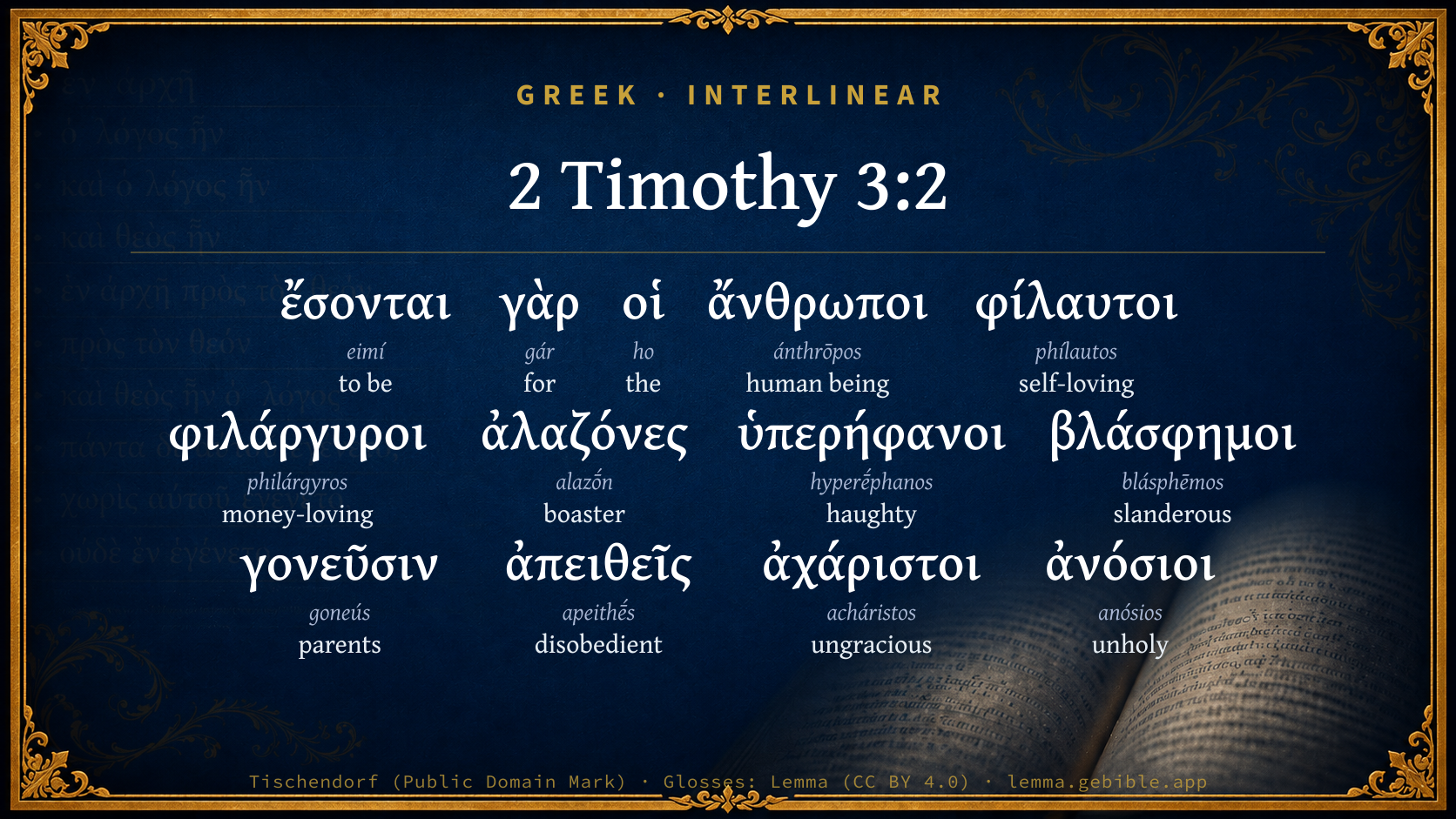
For men will be lovers of self, lovers of money, boastful, arrogant, blasphemers, disobedient to parents, unthankful, unholy,
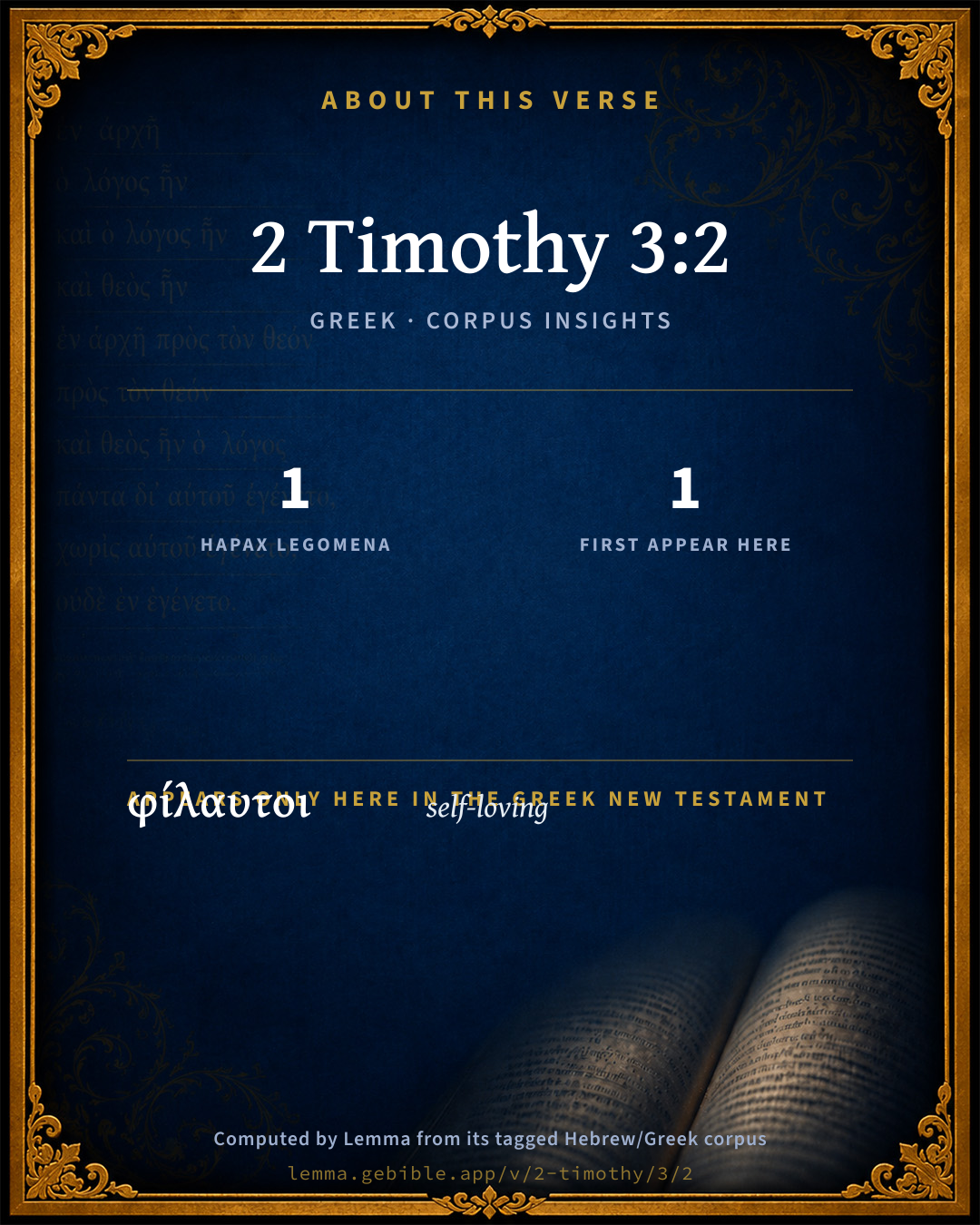
- 1 hapax legomenon — only here in the Greek New Testament
- 1 first appearance in the Greek New Testament
Download a study sheet
One document with this verse’s original text, its word-by-word gloss line, the meaning frame, cross-references with their text, attributed commentary, and full source and license credits — printable, and it pastes into notes with its structure intact.
This verse Autodidact and up
A passage Seminary Student
Up to 50 verses in one chapter. A passage sheet keeps up to 6 commentary sources and 12 cross-references per verse, in the order this page ranks them, and says so on the sheet whenever that leaves anything out. Ask for a single verse and you get the Autodidact verse sheet above.
Everything on this page stays free to read, with no account — the sheet is a download of what is already on screen, not access to it.
Compare translations 3
The same verse in 3 English versions, stacked beneath the original-language interlinear above. Click any original word for its lexicon entry.
Each is an independent rendering of the whole verse — the interlinear is not word-aligned to these translations.
Highlighted words mark where these versions differ — a whole-verse word diff, not a word-by-word alignment.
-
World English Bible Public Domain
For men will be lovers of self, lovers of money, boastful, arrogant, blasphemers, disobedient to parents, unthankful, unholy,
-
King James Version Public Domain
For men shall be lovers of their own selves, covetous, boasters, proud, blasphemers, disobedient to parents, unthankful, unholy,
-
unfoldingWord Literal Text CC BY-SA 4.0
For the men will be lovers of self, lovers of money, boastful, proud, blasphemous, disobedient to parents, ungrateful, unholy,
unfoldingWord Literal Text — © unfoldingWord, licensed CC BY-SA 4.0. Word-aligned USFM3 via Door43 (git.door43.org/unfoldingWord/en_ult).
Show all 19 translations
Every available English version of this verse, each an independent rendering of the whole verse.
-
World English Bible Public Domain
For men will be lovers of self, lovers of money, boastful, arrogant, blasphemers, disobedient to parents, unthankful, unholy,
-
Berean Standard Bible Public Domain
For men will be lovers of themselves, lovers of money, boastful, arrogant, abusive, disobedient to their parents, ungrateful, unholy,
-
Majority Standard Bible Public Domain
For men will be lovers of themselves, lovers of money, boastful, arrogant, abusive, disobedient to their parents, ungrateful, unholy,
-
King James Version Public Domain
For men shall be lovers of their own selves, covetous, boasters, proud, blasphemers, disobedient to parents, unthankful, unholy,
-
American Standard Version (1901) Public Domain
For men shall be lovers of self, lovers of money, boastful, haughty, railers, disobedient to parents, unthankful, unholy,
-
Revised Version (1885) Public Domain
For men shall be lovers of self, lovers of money, boastful, haughty, railers, disobedient to parents, unthankful, unholy,
-
Geneva Bible (1599) Public Domain
For men shalbe louers of their owne selues, couetous, boasters, proud, cursed speakers, disobedient to parents, vnthankefull, vnholy,
-
Douay-Rheims (1899) Public Domain
Men shall be lovers of themselves, covetous, haughty, proud, blasphemers, disobedient to parents, ungrateful, wicked,
-
Young's Literal Translation Public Domain
for men shall be lovers of themselves, lovers of money, boasters, proud, evil-speakers, to parents disobedient, unthankful, unkind,
-
Literal Standard Version CC BY-SA 4.0
for men will be lovers of themselves, lovers of money, boasters, proud, slanderous, disobedient to parents, unthankful, unkind,
-
Unlocked Literal Bible CC BY-SA 4.0
For people will be lovers of themselves, lovers of money, boastful, proud, blasphemers, disobedient to parents, ungrateful, and unholy.
-
unfoldingWord Literal Text CC BY-SA 4.0
For the men will be lovers of self, lovers of money, boastful, proud, blasphemous, disobedient to parents, ungrateful, unholy,
-
Darby Bible Public Domain
for men shall be lovers of self, lovers of money, boastful, arrogant, evil speakers, disobedient to parents, ungrateful, profane,
-
World Messianic Bible Public Domain
For men will be lovers of self, lovers of money, boastful, arrogant, blasphemers, disobedient to parents, unthankful, unholy,
-
Webster's Bible Public Domain
For men will be lovers of their own selves, covetous, boasters, proud, blasphemers, disobedient to parents, unthankful, unholy,
-
Free Bible Version CC BY-SA 4.0
People will love themselves and love money. They will be boastful, arrogant, abusive, disobedient to their parents, ungrateful, and without God in their lives.
-
Bible in Basic English Public Domain
For men will be lovers of self, lovers of money, uplifted in pride, given to bitter words, going against the authority of their fathers, never giving praise, having no religion,
-
Text-Critical English NT CC BY 4.0
For people will be lovers of themselves, lovers of money, boasters, proud, blasphemous, disobedient to parents, ungrateful, unholy,
-
Tyndale New Testament (1534) Public Domain
For the me shalbe lovers of their awne selves coveteous bosters proude cursed speakers disobedient to father and mother vnthakfull vnholy
Literal Standard Version (2020), Covenant Press — licensed CC BY-SA 4.0. Text via the HelloAO Bible API (eBible.org). Unlocked Literal Bible (unfoldingWord) — licensed CC BY-SA 4.0. Text via the HelloAO Bible API (eBible.org). unfoldingWord Literal Text — © unfoldingWord, licensed CC BY-SA 4.0. Word-aligned USFM3 via Door43 (git.door43.org/unfoldingWord/en_ult). Free Bible Version, Dr. Jonathan Gallagher — licensed CC BY-SA 4.0. Text via the HelloAO Bible API (eBible.org).
Word by word
More ways to search: Search by grammar → Find every occurrence → Compare this word →
Practice this passage: Drill this verse → Learn its vocabulary →
- Appears 1× in the Greek New Testament
- First appears here
- Part of Speech
- Adjective
- Case
- Nominative
- Number
- Plural
- Gender
- Masculine
Full Thayer's Definition
- ἔσονται eimí G1510 “to be” Verb, Future, Middle deponent, Indicative, 3rd person, Plural
- γὰρ gár G1063 “for” Conjunction
- οἱ ho G3588 “the” Article, Nominative, Plural, Masculine
- ἄνθρωποι ánthrōpos G444 “human being” Noun, Nominative, Plural, Masculine
- φίλαυτοι phílautos G5367 “self-loving” Adjective, Nominative, Plural, Masculine
- φιλάργυροι philárgyros G5366 “money-loving” Adjective, Nominative, Plural, Masculine
- ἀλαζόνες alazṓn G213 “boaster” Noun, Nominative, Plural, Masculine
- ὑπερήφανοι hyperḗphanos G5244 “haughty” Adjective, Nominative, Plural, Masculine
- βλάσφημοι blásphēmos G989 “slanderous” Adjective, Nominative, Plural, Masculine
- γονεῦσιν goneús G1118 “parents” Noun, Dative, Plural, Masculine
- ἀπειθεῖς apeithḗs G545 “disobedient” Adjective, Nominative, Plural, Masculine
- ἀχάριστοι acháristos G884 “ungracious” Adjective, Nominative, Plural, Masculine
- ἀνόσιοι anósios G462 “unholy” Adjective, Nominative, Plural, Masculine
About this verse
These counts appear in no published source. They are computed here, from the morphology-tagged text and Lemma’s own curated glosses. What Lemma adds →
- 13
- words
- 13
- distinct lemmas
- Pauline Epistles
- section
Notable vocabulary
1 hapax legomenon — a word that appears only here in the entire Greek New Testament:
- φίλαυτοι self-loving G5367
First appearance in Scripture
This word makes its first canonical appearance in the Greek New Testament here:
- φίλαυτοι self-loving G5367
Shared distinctive vocabulary
φιλάργυροι money-loving G5366 occurs in 2 verses of the Greek New Testament. Also found in:
Cross-references
39Topical passages linked to 2 Timothy 3:2 in the Treasury of Scripture Knowledge — connected by theme and wording, ordered by reader-vote popularity; previews shown in the World English Bible.
- Romans 1:29–31 being filled with all unrighteousness, sexual immorality, wickedness, covetousness, maliciousness; full of envy, murder, strife, deceit, evil habits, secret slanderers,
- Philippians 2:21 For they all seek their own, not the things of Jesus Christ.
- Psalms 10:3 For the wicked boasts of his heart's cravings, He blesses the greedy, and condemns Yahweh.
- Jude 1:16 These are murmurers and complainers, walking after their lusts (and their mouth speaks proud things), showing respect of persons to gain advantage.
- 2 Timothy 3:4 traitors, headstrong, conceited, lovers of pleasure rather than lovers of God;
- 2 Peter 2:14–15 having eyes full of adultery, and who can't cease from sin; enticing unsettled souls; having a heart trained in greed; children of cursing;
- 1 Timothy 6:10 For the love of money is a root of all kinds of evil. Some have been led astray from the faith in their greed, and have pierced themselves through with many sorrows.
- Colossians 3:5 Put to death therefore your members which are on the earth: sexual immorality, uncleanness, depraved passion, evil desire, and covetousness, which is idolatry;
- James 4:6 But he gives more grace. Therefore it says, "God resists the proud, but gives grace to the humble."
- 2 Peter 2:18 For, uttering great swelling words of emptiness, they entice in the lusts of the flesh, by licentiousness, those who are indeed escaping from those who live in error;
- Daniel 11:36 The king shall do according to his will; and he shall exalt himself, and magnify himself above every god, and shall speak marvelous things against the God of gods; and he shall prosper until the indignation be accomplished; for that which is determined shall be done.
- Luke 12:15 He said to them, "Beware! Keep yourselves from covetousness, for a man's life doesn't consist of the abundance of the things which he possesses."
- 1 Timothy 6:4 he is conceited, knowing nothing, but obsessed with arguments, disputes, and word battles, from which come envy, strife, reviling, evil suspicions,
- 1 Peter 5:5 Likewise, you younger ones, be subject to the elder. Yes, all of you gird yourselves with humility, to subject yourselves to one another; for "God resists the proud, but gives grace to the humble."
- 2 Peter 2:3 In covetousness they will exploit you with deceptive words: whose sentence now from of old doesn't linger, and their destruction will not slumber.
- 2 Peter 2:12 But these, as unreasoning creatures, born natural animals to be taken and destroyed, speaking evil in matters about which they are ignorant, will in their destroying surely be destroyed,
- Revelation 16:11 and they blasphemed the God of heaven because of their pains and their sores. They didn't repent of their works.
- Daniel 7:25 He shall speak words against the Most High, and shall wear out the saints of the Most High; and he shall think to change the times and the law; and they shall be given into his hand until a time and times and half a time.
- Romans 11:18 don't boast over the branches. But if you boast, it is not you who support the root, but the root supports you.
- 2 Thessalonians 2:4 he who opposes and exalts himself against all that is called God or that is worshiped; so that he sits as God in the temple of God, setting himself up as God.
- James 4:16 But now you glory in your boasting. All such boasting is evil.
- Luke 16:14 The Pharisees, who were lovers of money, also heard all these things, and they scoffed at him.
- Acts 5:36 For before these days Theudas rose up, making himself out to be somebody; to whom a number of men, about four hundred, joined themselves: who was slain; and all, as many as obeyed him, were dispersed, and came to nothing.
- Romans 15:1–3 Now we who are strong ought to bear the weaknesses of the weak, and not to please ourselves.
- 1 Timothy 1:20 of whom is Hymenaeus and Alexander; whom I delivered to Satan, that they might be taught not to blaspheme.
- 1 Timothy 3:3 not a drinker, not violent, not greedy for money, but gentle, not quarrelsome, not covetous;
- James 2:8 However, if you fulfill the royal law, according to the Scripture, "You shall love your neighbor as yourself," you do well.
- Revelation 16:21 Great hailstones, about the weight of a talent, came down out of the sky on people. People blasphemed God because of the plague of the hail, for this plague is exceedingly severe.
- Revelation 18:12–13 merchandise of gold, silver, precious stones, pearls, fine linen, purple, silk, scarlet, all expensive wood, every vessel of ivory, every vessel made of most precious wood, and of brass, and iron, and marble;
- Psalms 49:6 Those who trust in their wealth, And boast in the multitude of their riches--
- Proverbs 6:17 Haughty eyes, a lying tongue, Hands that shed innocent blood;
- Isaiah 10:15 Shall the axe boast itself against him who hews therewith? Shall the saw magnify itself against him who wields it? as if a rod should wield those who lift it up, [or] as if a staff should lift up [him who is] not wood.
- Matthew 15:6 he shall not honor his father or mother.' You have made the commandment of God void because of your tradition.
- Mark 7:11–12 But you say, 'If a man tells his father or his mother, "Whatever profit you might have received from me is Corban, that is to say, given to God;"'
- 2 Corinthians 5:15 He died for all, that those who live should no longer live to themselves, but to him who for their sakes died and rose again.
- Jude 1:10–11 But these speak evil of whatever things they don't know. What they understand naturally, like the creatures without reason, in these things are they destroyed.
- Revelation 13:1 Then I stood on the sand of the sea. I saw a beast coming up out of the sea, having ten horns and seven heads. On his horns were ten crowns, and on his heads, blasphemous names.
- Revelation 13:5–6 A mouth speaking great things and blasphemy was given to him. Authority to make war for forty-two months was given to him.
- Revelation 16:9 People were scorched with great heat, and people blasphemed the name of God who has the power over these plagues. They didn't repent and give him glory.
Cross-references courtesy of OpenBible.info (CC BY 4.0).
Lesson kit
Teaching starters — assembled from the data on this page, not authored interpretation. Every prompt links to the verse data it draws on. Edit before teaching.
2 Timothy, in the Pauline Epistles, opens this verse with 13 words (13 distinct Greek lemmas). Its most distinctive word is phílautos (“self-loving”). A historical commentator’s framing appears above. Read the whole chapter for the surrounding context.
Discussion questions
- The word phílautos carries the sense “self-loving.” How does it shape the verse?
- 1 word here appears nowhere else in the Greek New Testament. Why might the author reach for such rare wording?
- This is the first place “self-loving” appears in Scripture (first appears here). What does its debut here establish?
- How does Luke 16:14, which shares the word «money-loving», read alongside this verse?
- These translations render this verse differently; the difference is in the English rendering, not the original. What questions does that raise?
- Compare how Ellicott's Commentary for English Readers and The Biblical Illustrator read this verse. Where do they agree or differ?
Things to notice
- 1 word in this verse appears nowhere else in the Greek New Testament.
- 1 word makes its first canonical appearance in Scripture here.
- These translations choose different wording for 15 words in this verse.
- 13 distinct Greek lemmas span 13 words in this verse.
Commentary
Notes on 2 Timothy 3:2 from classic Christian and Jewish commentators (each source and its license shown beneath its notes). The classic Christian expositions comment on the surrounding passage and are grouped to its opening verse, so a note may address several verses; the Jewish commentaries on the Tanakh (Rashi and others) are per-verse, so they appear only where the commentator wrote on this verse.
Lemma curates 59 commentaries, every one of them public domain or Creative Commons licensed, each selected and text-cleaned for this edition rather than reprinted as found. About our sources →
Ellicott's Commentary for English Readers
A Bible Commentary for English Readers, edited by Charles John Ellicott (1878–1897) — public domain. Text from a community e-Sword module.
The Biblical Illustrator
Joseph S. Exell
The Biblical Illustrator, edited by Joseph S. Exell (c. 1880s–1900s) — public domain. Text from a community e-Sword module.
Bengel's Gnomon
Johann Albrecht Bengel
Bengel's Gnomon of the New Testament — English translation (T&T Clark, Edinburgh, 1860) — public domain. Text from a community e-Sword module.
Meyer's Critical & Exegetical Commentary
Heinrich August Wilhelm Meyer
Meyer — Critical and Exegetical Commentary on the New Testament — English translation by Peter Christie, edited by Frederick Crombie (T&T Clark, 1880) — public domain. Text from a community e-Sword module.
Expositor's Greek Testament
ed. W. Robertson Nicoll
The Expositor's Greek Testament, edited by W. Robertson Nicoll (1897–1910) — public domain. Text from a community e-Sword module.
Geneva Bible (1599)
Geneva Bible translators
Geneva Bible (1599) marginal notes — public domain. Text via Bolls.life.
Jamieson, Fausset & Brown
Robert Jamieson, A. R. Fausset & David Brown
Jamieson, Fausset & Brown — Commentary Critical and Explanatory on the Whole Bible (1871) — public domain (CC PDM 1.0). Text via the HelloAO Bible API.
Adam Clarke's Commentary
Adam Clarke's Commentary on the Bible (1810–1826) — public domain. Text from a community e-Sword/MySword module.
John Calvin's Commentaries
John Calvin's Commentaries (1540-1563) — public domain. Text from the Calvin Translation Society English edition (1840s-50s) via the Christian Classics Ethereal Library (ccel.org). Calvin's coverage is partial (roughly two-thirds of the Bible); uncommented books and verses are honest gaps, never fabricated. The 19th-century editor's footnotes and remarks are omitted so the notes are faithfully Calvin's own voice.
The Cambridge Bible for Schools and Colleges
gen. ed. J. J. S. Perowne
The Cambridge Bible for Schools and Colleges (gen. ed. J. J. S. Perowne; Cambridge University Press, 1878–1918) — public domain. Text from a community e-Sword module.
John Gill's Exposition
John Gill's Exposition of the Whole Bible (1746–1763) — public domain (CC PDM 1.0). Text via the HelloAO Bible API.
Trapp's Complete Commentary
John Trapp
John Trapp, A Commentary or Exposition upon All the Books of the Old and New Testament (1647–1656) — public domain. Text from a community e-Sword module.
Albert Barnes' Notes on the Bible
Albert Barnes' Notes on the Bible (1834–1885) — public domain. Text from a community e-Sword/MySword module.
Haydock's Catholic Bible Commentary
George Leo Haydock (1774–1849), Haydock's Catholic Family Bible and Commentary, 1859 edition — public domain. Excludes Psalms (Douay-Rheims chapter numbering differs from Protestant) and Deuterocanonical books (Catholic canon only).
Matthew Poole's English Annotations
Matthew Poole's English Annotations on the Holy Bible (1683–1685) — public domain. Text from a community e-Sword/MySword module.
Whedon's Commentary on the Bible
Daniel D. Whedon
Daniel D. Whedon (gen. ed.), Commentary on the Old and New Testaments (1874–1909) — public domain. Text from a community e-Sword module.
The Pulpit Commentary
The Pulpit Commentary (1880–1919), ed. H.D.M. Spence-Jones & Joseph S. Exell — public domain. Text from a community e-Sword module.
John Wesley's Explanatory Notes
John Wesley, Explanatory Notes Upon the Whole Bible (1754–1765) — public domain. Text via the GEBible commentary corpus.
Fairbairn on Ezekiel, Jonah & the Pastoral Epistles
Patrick Fairbairn
Patrick Fairbairn — An Exposition of Ezekiel (1851), Jonah (1849), and The Pastoral Epistles (1874) — public domain. Text from a community e-Sword module.
Burkitt's Expository Notes on the New Testament
William Burkitt
William Burkitt's Expository Notes on the New Testament (1700–1703) — public domain. Text from a community e-Sword module.
The People's New Testament
B. W. Johnson
B. W. Johnson's The People's New Testament with Notes (1889–1891) — public domain. Electronic text from the Christian Classics Ethereal Library (CCEL) ThML edition.
Cambridge Greek Testament for Schools and Colleges
Cambridge Greek Testament for Schools and Colleges (Cambridge University Press, 1896; 21 vols, various authors incl. Carr, Maclear, Plummer, Farrar, Lumby, Moule, M. R. James, Simcox) — public domain. Text from a community e-Sword module.
Alford’s Greek Testament
Henry Alford
Henry Alford, The Greek Testament (1849–1861) — public domain. Text from a community e-Sword module.
International Critical Commentary
International Critical Commentary — older volumes (1896–1929), various authors — public domain. Text from a community e-Sword module.
Vincent's Word Studies in the New Testament
Marvin R. Vincent
Marvin R. Vincent, Word Studies in the New Testament (1887–1900) — public domain. Text from a community e-Sword/MySword module.