
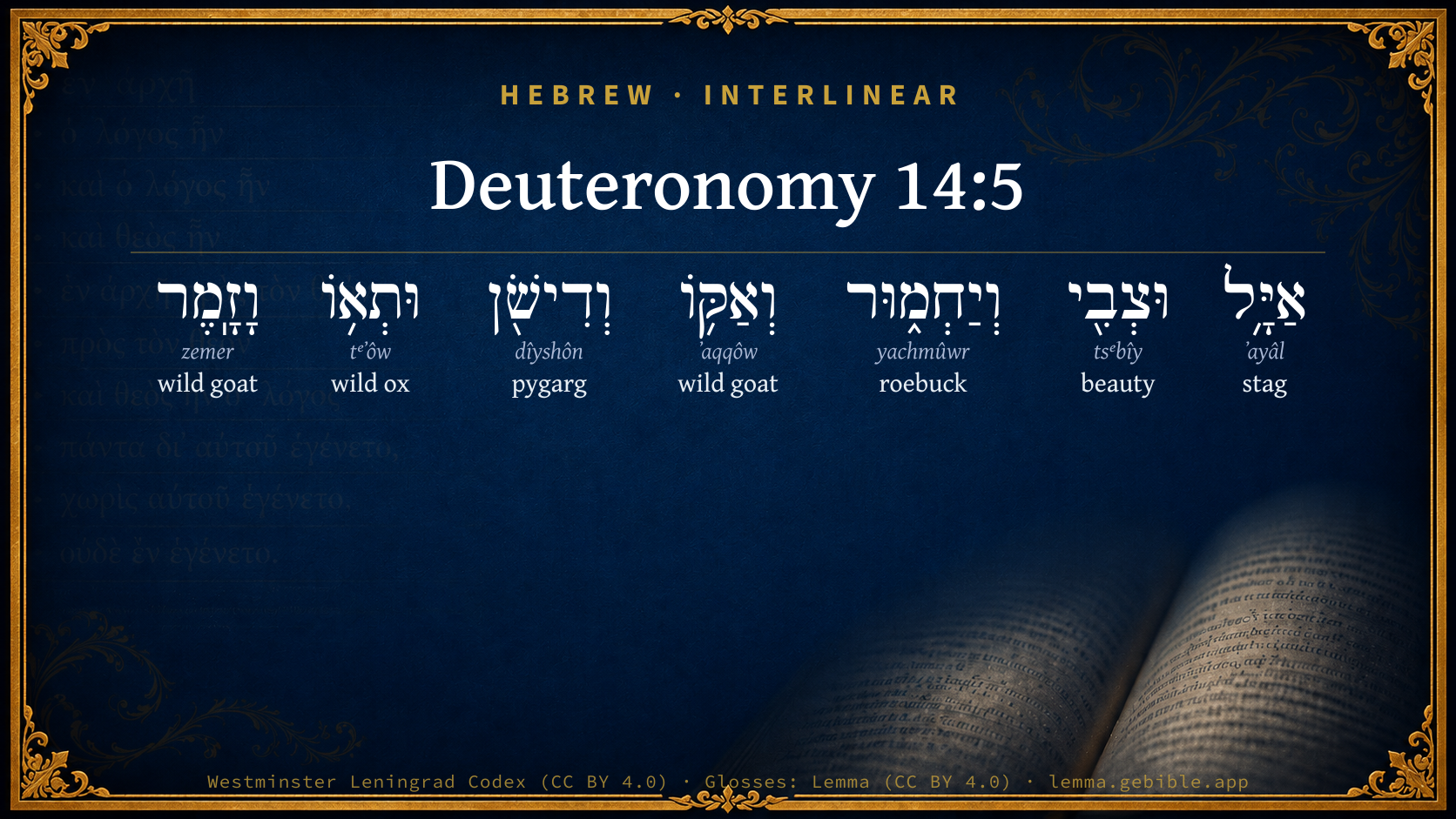
Deuteronomy 14:5

Hebrew (Westminster Leningrad Codex) Deuteronomy 14:5 appears in the Hebrew Old Testament. The text above is from the Westminster Leningrad Codex. Each word links to its Strong’s number, a concise gloss, and parsing drawn from the Open Scriptures Hebrew Bible morphology. Click any word for its full Brown-Driver-Briggs (BDB) entry.
Download image
Cite this verse

Deuteronomy 14:5 (World English Bible). Public Domain. Lemma interlinear Bible study tool, https://lemma.gebible.app/v/deuteronomy/14/5.

Show BibTeX & RIS
BibTeX
RIS
English Translation
the hart, and the gazelle, and the roebuck, and the wild goat, and the ibex, and the antelope, and the chamois.
World English Bible · Public Domain
Highlights Full analysis ↓
Download a study sheet

One document with this verse’s original text, its word-by-word gloss line, the meaning frame, cross-references with their text, attributed commentary, and full source and license credits — printable, and it pastes into notes with its structure intact.

This verse Autodidact and up

Study sheet (.html) Plain text (.txt)

A passage Seminary Student

Up to 50 verses in one chapter. A passage sheet keeps up to 6 commentary sources and 12 cross-references per verse, in the order this page ranks them, and says so on the sheet whenever that leaves anything out. Ask for a single verse and you get the Autodidact verse sheet above.

Everything on this page stays free to read, with no account — the sheet is a download of what is already on screen, not access to it.

Want to remove ads? Support Godless Engineer
Compare translations 3

The same verse in 3 English versions, stacked beneath the original-language interlinear above. Click any original word for its lexicon entry.

Each is an independent rendering of the whole verse — the interlinear is not word-aligned to these translations.

Highlighted words mark where these versions differ — a whole-verse word diff, not a word-by-word alignment.

  • World English Bible Public Domain
    the hart, and the gazelle, and the roebuck, and the wild goat, and the ibex, and the antelope, and the chamois.
  • King James Version Public Domain
    The hart, and the roebuck, and the fallow deer, and the wild goat, and the pygarg, and the wild ox, and the chamois.
  • unfoldingWord Literal Text CC BY-SA 4.0
    the deer and the gazelle and the roebuck and the wild goat and ibex and the antelope and the mountain sheep.

unfoldingWord Literal Text — © unfoldingWord, licensed CC BY-SA 4.0. Word-aligned USFM3 via Door43 (git.door43.org/unfoldingWord/en_ult).

Versions to compare (up to 4)

3 of 4 selected

Show all 18 translations

Every available English version of this verse, each an independent rendering of the whole verse.

  • World English Bible Public Domain
    the hart, and the gazelle, and the roebuck, and the wild goat, and the ibex, and the antelope, and the chamois.
  • Berean Standard Bible Public Domain
    the deer, the gazelle, the roe deer, the wild goat, the ibex, the antelope, and the mountain sheep.
  • Majority Standard Bible Public Domain
    the deer, the gazelle, the roe deer, the wild goat, the ibex, the antelope, and the mountain sheep.
  • King James Version Public Domain
    The hart, and the roebuck, and the fallow deer, and the wild goat, and the pygarg, and the wild ox, and the chamois.
  • American Standard Version (1901) Public Domain
    the hart, and the gazelle, and the roebuck, and the wild goat, and the pygarg, and the antelope, and the chamois.
  • Revised Version (1885) Public Domain
    the hart, and the gazelle, and the roebuck, and the wild goat, and the pygarg, and the antelope, and the chamois.
  • Geneva Bible (1599) Public Domain
    The hart, and the roe buck, and the bugle, and the wilde goate, and the vnicorne, and the wilde oxe, and the chamois.
  • Douay-Rheims (1899) Public Domain
    The hart and the roe, the buffle, the chamois, the pygarg, the wild goat, the camelopardalus.
  • Young's Literal Translation Public Domain
    hart, and roe, and fallow deer, and wild goat, and pygarg, and wild ox, and chamois;
  • Literal Standard Version CC BY-SA 4.0
    deer, and roe, and fallow deer, and wild goat, and ibex, and antelope, and zemer;
  • Unlocked Literal Bible CC BY-SA 4.0
    the deer, the gazelle, the roebuck, the wild goat, and ibex, and the antelope, and the mountain sheep.
  • unfoldingWord Literal Text CC BY-SA 4.0
    the deer and the gazelle and the roebuck and the wild goat and ibex and the antelope and the mountain sheep.
  • Darby Bible Public Domain
    the hart, and the gazelle, and the stag, and the wild goat, and the dishon and the oryx, and the wild sheep.
  • World Messianic Bible Public Domain
    the deer, the gazelle, the roebuck, the wild goat, the ibex, the antelope, and the chamois.
  • Webster's Bible Public Domain
    The hart, and the roebuck, and the fallow-deer, and the wild-goat, and the pygarg, and the wild ox, and the chamois.
  • Free Bible Version CC BY-SA 4.0
    deer, gazelles, wild goats, antelopes, and mountain sheep.
  • Bible in Basic English Public Domain
    The hart, the gazelle, and the roe, the mountain goat and the pygarg and the antelope and the mountain sheep.
  • JPS Tanakh (1917) Public Domain
    the hart, and the gazelle, and the roebuck, and the wild goat, and the pygarg, and the antelope, and the mountain-sheep.

Literal Standard Version (2020), Covenant Press — licensed CC BY-SA 4.0. Text via the HelloAO Bible API (eBible.org). Unlocked Literal Bible (unfoldingWord) — licensed CC BY-SA 4.0. Text via the HelloAO Bible API (eBible.org). unfoldingWord Literal Text — © unfoldingWord, licensed CC BY-SA 4.0. Word-aligned USFM3 via Door43 (git.door43.org/unfoldingWord/en_ult). Free Bible Version, Dr. Jonathan Gallagher — licensed CC BY-SA 4.0. Text via the HelloAO Bible API (eBible.org).

Word by word

More ways to search: Search by grammar → Find every occurrence → Compare this word →

Practice this passage: Drill this verse → Learn its vocabulary →

About this verse

These counts appear in no published source. They are computed here, from the morphology-tagged text and Lemma’s own curated glosses. What Lemma adds →

7
words
7
distinct lemmas
Pentateuch
section

Notable vocabulary

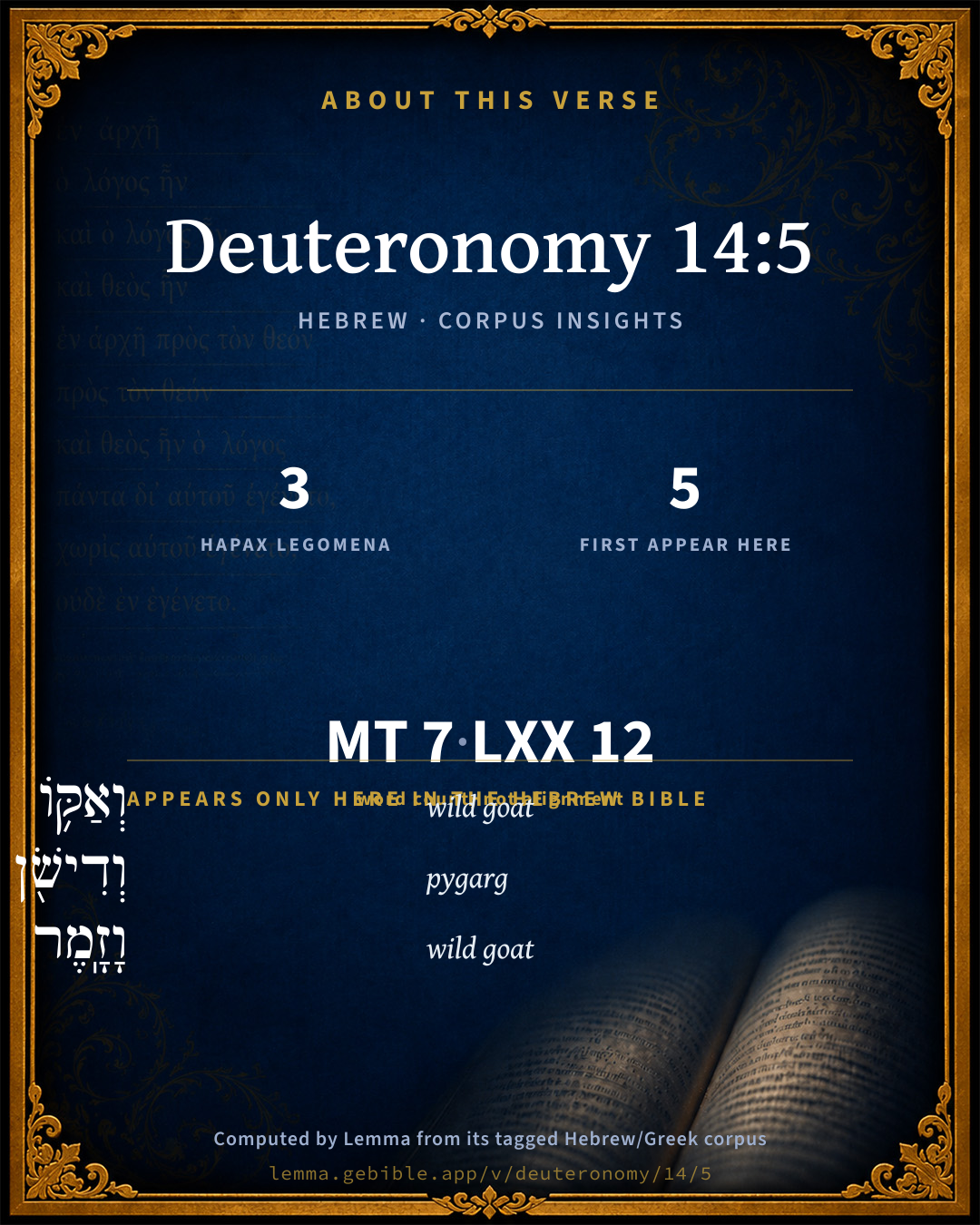
3 hapax legomena — words that appear only here in the entire Hebrew Bible:

  • וְאַקּ֥וֹ wild goat H689
  • וְדִישֹׁ֖ן pygarg H1788
  • וָזָֽמֶר wild goat H2169

First appearance in Scripture

These words make their first canonical appearance in the Hebrew Bible here:

  • וְיַחְמ֑וּר roebuck H3180
  • וְאַקּ֥וֹ wild goat H689
  • וְדִישֹׁ֖ן pygarg H1788
  • וּתְא֥וֹ wild ox H8377
  • וָזָֽמֶר wild goat H2169

Shared distinctive vocabulary

וְיַחְמ֑וּר roebuck H3180 occurs in 2 verses of the Hebrew Bible. Also found in:

Grammatical profile

  • 7 nouns

Hebrew & Septuagint length

In English translation the verse runs 21 words from the Hebrew and 11 from the Septuagint (LXX English) — the Septuagint runs noticeably shorter here. See the side-by-side →

A rough comparison of the two English renderings, which tokenize alike — not a word-level alignment.

Word counts can differ between the Hebrew and the Greek without any difference in meaning — e.g. the Hebrew direct-object marker אֵת has no separate Greek word, and Greek often adds the article ὁ.

In the original languages it is 7 Hebrew tokens and 12 Greek tokens — but the two are counted differently (Hebrew bundles its prefixes and suffixes into one token; the Greek is in lemma form), so that isn’t a like-for-like length.

Hebrew and Greek witnesses Masoretic Hebrew ↔ Greek Septuagint

The same verse in the two great witnesses to the Old Testament, shown verse-for-verse.

Here the Septuagint runs noticeably shorter than the Hebrew — LXX2012 (modern English Septuagint) 11 words vs World English Bible 21. A rough length comparison of the two English translations, not a word-level alignment — read both below.

These are two independent witnesses, not word-aligned to each other, and the Septuagint is shown in lemma (dictionary) form.

Hebrew Deuteronomy 14:5 Masoretic · Westminster Leningrad Codex

אַיָּ֥ל וּצְבִ֖י וְיַחְמ֑וּר וְאַקּ֥וֹ וְדִישֹׁ֖ן וּתְא֥וֹ וָזָֽמֶר

the hart, and the gazelle, and the roebuck, and the wild goat, and the ibex, and the antelope, and the chamois.

World English Bible · Public Domain

Greek LXX Deuteronomy 14:5 Septuagint · lemma form

ἔλαφος καί δορκάς καί βούβαλος καί τραγέλαφος καί πύγαργος ὄρυξ καί καμηλοπάρδαλις

the stag, and doe, and pygarg, and wild goat, and camelopard.

LXX2012 (modern English Septuagint) · Public Domain

On this verse, Jamieson, Fausset & Brown discusses the Septuagint’s reading. Read the note in Commentary ↓

Hebrew: Westminster Leningrad Codex (CC BY 4.0). Greek: Septuagint (public domain); English from LXX2012 (modern English Septuagint) (Public Domain). How the Septuagint differs from the Hebrew →

Targum (Aramaic paraphrase)

2

The Targum is the ancient Jewish Aramaic paraphrase of the Hebrew Scriptures — an interpretive translation, not the Hebrew text itself. Onkelos (literal) and Pseudo-Jonathan (expansive) render the Torah, and Jonathan the Prophets. Coverage is partial: where no permissively-licensed English translation exists for a verse, only the Aramaic is shown. This is verse-level text, not a word-by-word alignment to the Hebrew.

  1. Targum Onkelos Torah (Genesis–Deuteronomy)
    אַיָלָא וְטַבְיָא וְיַחְמוּרָא וְיַעְלָא וְרֵימָא וְתוֹרְבָּלָא וְדִיצָא

    (no public-domain English translation for this verse)

    Targum Onkelos — Aramaic: “Onkelos Genesis” (public domain); “Onkelos Exodus” (public domain); “Onkelos Leviticus” (public domain); “Onkelos Numbers” (public domain); “Onkelos Deuteronomy” (public domain). English: “Sefaria Community Translation” (CC0 1.0 (public-domain dedication)); “J.W. Etheridge. The Targums of Onkelos and Jonathan Ben Uzziel on the Pentateuch. London: Longmans, Green, 1862” (public domain). Text via Sefaria.

  2. Targum Pseudo-Jonathan Torah (Genesis–Deuteronomy)
    אַיְלִין וְטַבְיַן וְיַחֲמוּרִין יַעֲלִין וְרִימְנִין וְתוֹרֵי בַּר וְדִיצִין

    Harts and antelopes and fallow deer, rock goats and reems, wild oxen and pygargs;

    Targum Pseudo-Jonathan — Aramaic: “Targum Jonathan on Genesis” (public domain); “Targum Jonathan on Exodus” (public domain); “Targum Jonathan on Leviticus” (public domain); “Targum Jonathan on Numbers” (public domain); “Targum Jonathan on Deuteronomy” (public domain). English: “The Targum of Jonathan ben Uzziel, trans. J. W. Etheridge, London, 1862” (public domain). Text via Sefaria.

Commentary

Notes on Deuteronomy 14:5 from classic Christian and Jewish commentators (each source and its license shown beneath its notes). The classic Christian expositions comment on the surrounding passage and are grouped to its opening verse, so a note may address several verses; the Jewish commentaries on the Tanakh (Rashi and others) are per-verse, so they appear only where the commentator wrote on this verse.

Lemma curates 59 commentaries, every one of them public domain or Creative Commons licensed, each selected and text-cleaned for this edition rather than reprinted as found. About our sources →

Trapp's Complete Commentary

John Trapp

Deu 14:5 The hart, and the roebuck, and the fallow deer, and the wild goat, and the pygarg, and the wild ox, and the chamois.

Ver. 5. The hart and the roebuck.] These were dainties fit for a king. {1Ki 4:23} Rice and mutton is the cheer wherewith the great Turk entertaineth foreign ambassadors, and that so plainly and sparingly dressed, as if they would give check to our gormandise and excess.

And the wild ox.] Pliny saith, {a} that there are wild creatures answerable to all that are tame: like as others say there is no living creature on earth, but there are fishes of the same sort found in the sea, and those all harmless.

{a} Plin., lib. viii. cap. 53.

John Trapp, A Commentary or Exposition upon All the Books of the Old and New Testament (1647–1656) — public domain. Text from a community e-Sword module.

Joseph Benson's Commentary

Deu 14:5. The pygargs — A kind of goat. And the chamois — Hebrew, זמר, zemer, which Bochart takes for that kind of goat which is called in Latin Rupi-capra, or mountain-goat, from the Arabic zamara, to bound like a roe.

Joseph Benson's Commentary on the Old and New Testaments (1811–1818) — public domain. Text from a community e-Sword module.

Jamieson, Fausset & Brown

Robert Jamieson, A. R. Fausset & David Brown

OF BEASTS. (Deu 14:4-8)

The hart--(see on Deu 12:15).

fallow deer--The Hebrew word (Jachmur) so rendered, does not represent the fallow deer, which is unknown in Western Asia, but an antelope (Oryx leucoryx), called by the Arabs, jazmar. It is of a white color, black at the extremities, and a bright red on the thighs. It was used at Solomon's table.

wild goat--The word akko is different from that commonly used for a wild goat (Sa1 24:2; Psa 104:18; Pro 5:19), and it is supposed to be a goat-deer, having the body of a stag, but the head, horns, and beard of a goat. An animal of this sort is found in the East, and called Lerwee [SHAW, Travels].

pygarg--a species of antelope (Oryx addax) with white buttocks, wreathed horns two feet in length, and standing about three feet seven inches high at the shoulders. It is common in the tracks which the Israelites had frequented [SHAW].

wild ox--supposed to be the Nubian Oryx, which differs from the Oryx leucoryx (formerly mentioned) by its black color; and it is, moreover, of larger stature and more slender frame, with longer and more curved horns. It is called Bekkar-El-Wash by the Arabs.

chamois--rendered by the Septuagint Cameleopard; but, by others who rightly judge it must have been an animal more familiar to the Hebrews, it is thought to be the Kebsch (Ovis tragelaphus), rather larger than a common sheep, covered not with wool, but with reddish hair--a Syrian sheep-goat.

Jamieson, Fausset & Brown — Commentary Critical and Explanatory on the Whole Bible (1871) — public domain (CC PDM 1.0). Text via the HelloAO Bible API.

Adam Clarke's Commentary

Verse 5. The hart] איל aiyal, the deer, according to Dr. Shaw: See Clarke on De 12:15.

The roebuck] צבי tsebi, generally supposed to be the antelope, belonging to the fifth order Pecora, genus MAMMALIA, and species 38. It has round twisted spiral horns, hairy tufts on the knees, browses on tender shoots, lives in hilly countries, is fond of climbing rocks, and is remarkable for its beautiful black eyes. The flesh is good and well flavoured.

The fallow deer] יחמור yachmur, from חמר chamar, to be troubled, disturbed, disordered: this is supposed to mean, not the fallow deer, but the bubalus or buffalo, which is represented by Dr. Shaw, and other travellers and naturalists, as a sullen, malevolent, and spiteful animal, capricious, ferocious, and every way brutal. According to the Linnaean classification, the buffalo belongs to the fifth order Pecora, genus MAMMALIA, species bos. According to 1Kg 4:23, this was one of the animals which was daily served up at the table of Solomon. Though the flesh of the buffalo is not considered very delicious, yet in the countries where it abounds it is eaten as frequently by all classes of persons as the ox is in England. The yachmur is not mentioned in the parallel place, Le 11:1-47.

The wild goat] אקו akko. It is not easy to tell what creature is intended by the akko. Dr. Shaw supposed it to be a kind of very timorous goat, known in the East by the name fishtall and serwee, and bearing a resemblance both to the goat and the stag, whence the propriety of the name given it by the Septuagint and Vulgate, tragelaphus, the goat-stag; probably the rupicapra or rock-goat. The word is found nowhere else in the Hebrew Bible.

The pygarg] דישן dishon. As this word is nowhere else used, we cannot tell what animal is meant by it. The word pygarg πυγαργος, literally signifies white buttocks, and is applied to a kind of eagle with a white tail; but here it evidently means a quadruped. It was probably some kind of goat, common and well known in Judea.

The wild ox] תאו teo. This is supposed to be the oryx of the Greeks, which is a species of large stag. It may be the same with the bekker el wash, described by Dr. Shaw as "a species of the deer kind, whose horns are exactly in the fashion of our stag, but whose size is only between the red and fallow deer." In Isa 51:20 a creature of the name of to is mentioned, which we translate wild bull; it may be the same creature intended above, with the interchange of the two last letters.

The chamois] זמר zemer. This was probably a species of goat or deer, but of what kind we know not: that it cannot mean the chamois is evident from this circumstance, "that the chamois inhabits only the regions of snow and ice, and cannot bear the heat." - Buffon. The Septuagint and Vulgate translate it the Camelopard, but this creature is only found in the torrid zone and probably was never seen in Judea; consequently could never be prescribed as a clean animal, to be used as ordinary food. I must once more be permitted to say, that to ascertain the natural history of the Bible is a hopeless case. Of a few of its animals and vegetables we are comparatively certain, but of the great majority we know almost nothing. Guessing and conjecture are endless, and they have on these subjects been already sufficiently employed. What learning, deep, solid, extensive learning, and judgment could do, has already been done by the incomparable Bochart in his Hierozoicon. The learned reader may consult this work, and, while he gains much general information, will have to regret that he can apply so little of it to the main and grand question. As I have consulted every authority within my reach, on the subject of the clean and unclean animals mentioned in the law, and have detailed all the information I could collect in my notes on Lev. xi., I must refer my readers to what I have there laid down.

Adam Clarke's Commentary on the Bible (1810–1826) — public domain. Text from a community e-Sword/MySword module.

Ellicott's Commentary for English Readers

(5) The wild goat.—In German the “Steinbock” is given as the equivalent for this creature. The pygarg (dîshon) is sometimes taken to be the buffalo. If all these creatures were then to be found in Palestine, there must have been far more uncleared land than there has been for many centuries past.

A Bible Commentary for English Readers, edited by Charles John Ellicott (1878–1897) — public domain. Text from a community e-Sword module.

The Cambridge Bible for Schools and Colleges

gen. ed. J. J. S. Perowne

5. Seven varieties of game; LXX B gives only five: hart, gazelle, roebuck, wild-ox and giraffe (?); codd. AF, etc. add after gazelle, buffalo and tragelaphos. It may not be unnecessary to remark that neither to the nomads nor to the fellaḥîn is hunting sport; it is, especially to the former, a hard and hungry search for food. ‘The nomad is not a hunter’ (Doughty, i. 157). The hunters of Arabia are the Sleyb, wandering gypsies without cattle and camels: according to Burckhardt (p. 12) they live on dried gazelle-flesh. Besides the varieties of game given here as edible, the ancient Arabs relished also the flesh of the wild-ass (Georg Jacob, op. cit. 115).

hart and gazelle] ’Ayyal, ṣebi: see on Deu_12:22; cp. Deu_12:15, Deu_15:22; hart probably fallow deer, cervus dama; gazelle, gazella dorcas.

roebuck] Yaḥmûr also deut 1Ki_4:23 (Deu_5:3) A.V. fallow-deer. Yakhmûr is the name still given to a deer found on Mt Carmel (Conder, Tent Work, i. 173) and identified as the roebuck, cervus capreolus; called in Gilead khamûr (Post, PEFQ, 1890, 171 f.; Conder, id. 173); also seen on Lebanon (Tr. 4). Found throughout Europe it does not range farther S. than Palestine. As roebuck is the name of the male, roedeer is perhaps the better rendering.

wild goat] ’Aḳḳo only here, LXX AF τραγέλαφος, Targ. ya‘al, ibex such as about Engedi, 1Sa_24:2. With ’aḳḳo as if for ’anḳo cp. Ar. ’anaḳ (= long-necked) goat.

pygarg] As LXX πύγαργος ‘white-rump.’ The Heb. dîshon (as if from Heb. dash = tread, leap) is rather antelope: the large white addax (Tr. 5).

antelope] te‘o only here and Isa_51:20, LXX ὄρυξ, A.V. wild-ox. Tristram (p. 5) takes the name as generic and suggests that it covers both the antilope bubalis, which, he says, is called ‘wild-cow’ in Moab and Gilead, and a leucoryx ‘the Oryx or white antelope,’ to which the Arabs of Arabia give the name of ‘wild-ox’ (G. Jacob, op. cit. 117, citing from Ar. poets descriptions of it as shining like a white-washed house or as if with a white tunic); Post (Hastings’ D.B. ‘Ox’) proposes the oryx beatrix; Doughty (1. 328) takes the woṭhŷḥî of central Arabia, ‘an antelope beatrix,’ to be the O.T. re’em or wild-ox. R.V. antelope and A.V. wild-ox are thus probably both correct, the former giving the genus of the animal the latter its popular name among the Hebrews and the Arabs. With regard to the Heb. name te’o or the’o I notice that Lane gives the Ar. Sha’ (sh and the soft th correspond) as applied to the wild-bull or wild-cow.

chamois] Certainly not this! This animal is European and is not found so far S. as Palestine. Heb. zemer, Targ. diṣa, wild-goat. In the Mts of Yemen the wild maned sheep, ovis tragelaphus, was anciently numerous (G. Jacob, p. 21). Probably mountain-goat or -sheep.

Thus the names in this verse are all general and popular; each may have covered more than one species found in Syria or Arabia: to identify it with any one species is foolish.

The Cambridge Bible for Schools and Colleges (gen. ed. J. J. S. Perowne; Cambridge University Press, 1878–1918) — public domain. Text from a community e-Sword module.

John Gill's Exposition

And every beast that parted the hoof,.... In this and the two following verses two general rules are given, by which it might be known what beasts were fit for food and what not; one is if they parted the hoof, and the other if they chewed the cud, such might be eaten; but such that only chewed the cud, but did not divide the hoof, as the camel, hare, and coney, might not be eaten; and so if they divided the hoof, and did not chew the cud, as the swine, they were alike unlawful; See Gill on Lev 11:3; see Gill on Lev 11:4; see Gill on Lev 11:5; see Gill on Lev 11:6; see Gill on Lev 11:7; see Gill on Lev 11:8.

.

Deuteronomy 14:9

deu 14:9

deu 14:9

deu 14:9These ye shall eat of, all that are in the waters,.... The fishes there, even such as have fins and scales, but they that have not were not to be eaten: See Gill on Lev 11:9, Lev 11:10, Lev 11:11, Lev 11:12.

John Gill's Exposition of the Whole Bible (1746–1763) — public domain (CC PDM 1.0). Text via the HelloAO Bible API.

Haydock's Catholic Bible Commentary

Buffle. Hebrew yachmur, which some translate "the fallow-deer." The Arabs give this name to a beast resembling a hart, which has horns and red hair. (Calmet) --- It was served up on the table of Solomon, 3 Kings iv. 23. Pliny ([Natural History?] viii. 13,) mentions the bubalus of Africa, which is like a calf. (Menochius) --- Chamois, (tragelaphum) a beast which has the head of a he-goat, and the carcass of a hart. (Scaliger.) (Pliny, viii. 33.) --- Bochart translates akko after the Arabic, "the wild goat." --- Pygarg, another species of goat, (Pliny, viii. 53,) of the colour of ashes. (Bellon., q. 51.) Dishon means "ashes" in Hebrew. --- Goat, (orygem) "a wild goat, (Septuagint; Bochart; &c.) or ox." Aristotle allows it only one horn. Juvenal mentions that the Getulians feasted on its flesh; and the Egyptian priests, according to Horus, were allowed to eat it, without any scrupulous examination of the sealers. (Calmet) --- Camelopardalus. This animal resembles a camel in its head and longish neck, and the panther in the spotted skin. (Pliny, viii. 18.) --- Bochart (iii. 21,) thinks that the Hebrew zamer, means "a wild goat," noted for "leaping."

George Leo Haydock (1774–1849), Haydock's Catholic Family Bible and Commentary, 1859 edition — public domain. Excludes Psalms (Douay-Rheims chapter numbering differs from Protestant) and Deuterocanonical books (Catholic canon only).

Whedon's Commentary on the Bible

Daniel D. Whedon

5. The hart — The ordinary deer. The roebuck should be translated the gazelle.

The pygarg — A species of antelope. A kind of deer called yahmar is found on Carmel. Lieutenant Conder says it resembles the English roebuck. — Tent Work in Palestine, vol. i, p. 173.

The wild ox — Probably a kind of antelope or gazelle.

Chamois — Very likely another species of antelope is referred to.

Daniel D. Whedon (gen. ed.), Commentary on the Old and New Testaments (1874–1909) — public domain. Text from a community e-Sword module.

The Pulpit Commentary

The hart; ayyal (lYa), probably the fallow deer, or deer generally. The roebuck; tsebi (ybix), the gazelle (Gazella Arabica). The fallow deer; yachmur (rWmjy), the roebuck. The wild goat; akko (wOQa), the ibex. The pygarg; dishon (wOvydi), some kind of antelope, probably the Gazella Dorcas. The wild ox; the"o (wOat), probably the bubale , or wild cow of the Arabs (Alcephalus bubalis), a species of antelope. The chamois; zamer (rmz), probably the wild sheep (Ovis Tragelaphus.)

The Pulpit Commentary (1880–1919), ed. H.D.M. Spence-Jones & Joseph S. Exell — public domain. Text from a community e-Sword module.

Rashi

Rabbi Shlomo Yitzchaki (Rashi)

ואקו AND THE אקו — This is rendered in the Targum by יעלא, the same term as the Hebrew יעל in the expression יעלי סלע (Job 39:1). This is what is called in German 'Steinbock'.

ותאו — This is rendered in the Targum by תורבלא which is the same as תור יער, the ox of the forest (wild ox), for בלא means “forest״ in the Aramaic language.

Rashi on the Tanakh — English translations: “The Judaica Press complete Tanach with Rashi, translated by A. J. Rosenberg” (CC BY 4.0); “Pentateuch with Rashi's commentary by M. Rosenbaum and A.M. Silbermann, 1929-1934” (public domain); “The Metsudah Tanach series, Lakewood, N.J” (CC BY 4.0); and “The Book of Joshua, Metsudah Publications, 1997” (CC BY 4.0). Text via Sefaria.

Lesson kit

Teaching starters — assembled from the data on this page, not authored interpretation. Every prompt links to the verse data it draws on. Edit before teaching.

Deuteronomy, in the Pentateuch, opens this verse with 7 words (7 distinct Hebrew lemmas). Its most distinctive word is ʼaqqôw (“wild goat”). The Greek Septuagint runs shorter here. A historical commentator’s framing appears above. Read the whole chapter for the surrounding context.

Discussion questions

  1. How does “wild goat” (ʼaqqôw) shape what this verse is saying?
  2. 3 words here appear nowhere else in the Hebrew Bible. Why might the author reach for such rare wording?
  3. 5 words make their first appearance in Scripture here. What does this debut establish?
  4. How does 1 Kings 4:23, which shares the word «roebuck», read alongside this verse?
  5. The Septuagint runs shorter here than the Hebrew. What might account for the difference?
  6. These translations render this verse differently; the difference is in the English rendering, not the original. What questions does that raise?
  7. Compare how Trapp's Complete Commentary and Joseph Benson's Commentary read this verse. Where do they agree or differ?

Things to notice

Reading settings

Reading text

Shown beneath each verse's original-language words.

Old Testament
Old Testament edition

Read the OT as the Masoretic Hebrew (MT) or the Greek Septuagint (LXX).

English shown for the Greek Septuagint (in the Hebrew ↔ Greek comparison).

Comparing translations? Open the Compare panel on any verse page to stack up to four side by side.