Song of Solomon 2:9

Hebrew (Westminster Leningrad Codex) Song of Solomon 2:9 appears in the Hebrew Old Testament. The text above is from the Westminster Leningrad Codex. Each word links to its Strong’s number, a concise gloss, and parsing drawn from the Open Scriptures Hebrew Bible morphology. Click any word for its full Brown-Driver-Briggs (BDB) entry.
Download image
Cite this verse

Song of Solomon 2:9 (World English Bible). Public Domain. Lemma interlinear Bible study tool, https://lemma.gebible.app/v/song-of-solomon/2/9.

Show BibTeX & RIS
BibTeX
RIS
English Translation
My beloved is like a roe or a young hart. Behold, he stands behind our wall! He looks in at the windows. He glances through the lattice.
World English Bible · Public Domain
Highlights
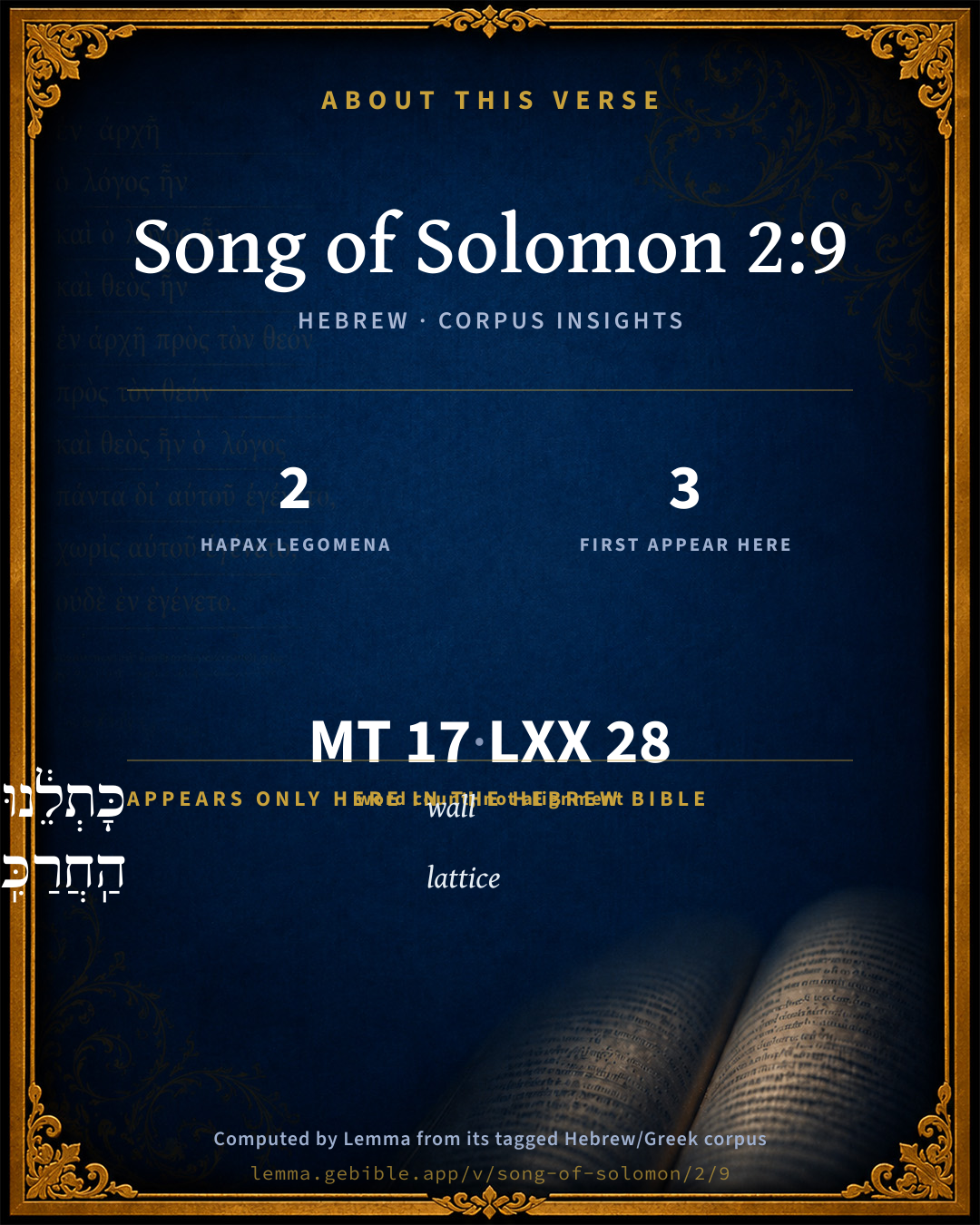
  • 2 hapax legomena — only here in the Hebrew Bible
  • 3 first appearances in the Hebrew Bible
Full analysis ↓
Download a study sheet

One document with this verse’s original text, its word-by-word gloss line, the meaning frame, cross-references with their text, attributed commentary, and full source and license credits — printable, and it pastes into notes with its structure intact.

This verse Autodidact and up

Study sheet (.html) Plain text (.txt)

A passage Seminary Student

Up to 50 verses in one chapter. A passage sheet keeps up to 6 commentary sources and 12 cross-references per verse, in the order this page ranks them, and says so on the sheet whenever that leaves anything out. Ask for a single verse and you get the Autodidact verse sheet above.

Everything on this page stays free to read, with no account — the sheet is a download of what is already on screen, not access to it.

Want to remove ads? Support Godless Engineer
Compare translations 3

The same verse in 3 English versions, stacked beneath the original-language interlinear above. Click any original word for its lexicon entry.

Each is an independent rendering of the whole verse — the interlinear is not word-aligned to these translations.

Highlighted words mark where these versions differ — a whole-verse word diff, not a word-by-word alignment.

  • World English Bible Public Domain
    My beloved is like a roe or a young hart. Behold, he stands behind our wall! He looks in at the windows. He glances through the lattice.
  • King James Version Public Domain
    My beloved is like a roe or a young hart: behold, he standeth behind our wall, he looketh forth at the windows, shewing himself through the lattice.
  • unfoldingWord Literal Text CC BY-SA 4.0
    My beloved is being like a gazelle or a young stag. Behold, this one is standing behind our wall, gazing through the windows, looking through the lattices.

unfoldingWord Literal Text — © unfoldingWord, licensed CC BY-SA 4.0. Word-aligned USFM3 via Door43 (git.door43.org/unfoldingWord/en_ult).

Versions to compare (up to 4)

3 of 4 selected

Show all 18 translations

Every available English version of this verse, each an independent rendering of the whole verse.

  • World English Bible Public Domain
    My beloved is like a roe or a young hart. Behold, he stands behind our wall! He looks in at the windows. He glances through the lattice.
  • Berean Standard Bible Public Domain
    My beloved is like a gazelle or a young stag. Look, he stands behind our wall, gazing through the windows, peering through the lattice.
  • Majority Standard Bible Public Domain
    My beloved is like a gazelle or a young stag. Look, he stands behind our wall, gazing through the windows, peering through the lattice.
  • King James Version Public Domain
    My beloved is like a roe or a young hart: behold, he standeth behind our wall, he looketh forth at the windows, shewing himself through the lattice.
  • American Standard Version (1901) Public Domain
    My beloved is like a roe or a young hart: Behold, he standeth behind our wall; He looketh in at the windows; He glanceth through the lattice.
  • Revised Version (1885) Public Domain
    My beloved is like a roe or a young hart: behold, he standeth behind our wall, he looketh in at the windows, he sheweth himself through the lattice.
  • Geneva Bible (1599) Public Domain
    My welbeloued is like a roe, or a yong hart: loe, he standeth behinde our wall, looking forth of the windowes, shewing him selfe through the grates.
  • Douay-Rheims (1899) Public Domain
    My beloved is like a roe, or a young hart. Behold he standeth behind our wall, looking through the windows, looking through the lattices.
  • Young's Literal Translation Public Domain
    My beloved `is' like to a roe, Or to a young one of the harts. Lo, this -- he is standing behind our wall, Looking from the windows, Blooming from the lattice.
  • Literal Standard Version CC BY-SA 4.0
    My beloved [is] like to a roe, || Or to a young one of the harts. Behold, this—he is standing behind our wall, || Looking from the windows, || Blooming from the lattice.
  • Unlocked Literal Bible CC BY-SA 4.0
    My beloved is like a gazelle or a young stag; look, he is standing behind our wall, gazing through the window, peering through the lattice.
  • unfoldingWord Literal Text CC BY-SA 4.0
    My beloved is being like a gazelle or a young stag. Behold, this one is standing behind our wall, gazing through the windows, looking through the lattices.
  • Darby Bible Public Domain
    My beloved is like a gazelle or a young hart. Behold, he standeth behind our wall, He looketh in through the windows, Glancing through the lattice.
  • World Messianic Bible Public Domain
    My beloved is like a roe or a young deer. Behold, he stands behind our wall! He looks in at the windows. He glances through the lattice.
  • Webster's Bible Public Domain
    My beloved is like a roe, or a young hart: behold, he standeth behind our wall, he looketh forth at the windows, showing himself through the lattice.
  • Free Bible Version CC BY-SA 4.0
    my love is like a gazelle or a young deer! Look, he's there, standing behind our wall, looking through the window, peering through the screen.
  • Bible in Basic English Public Domain
    My loved one is like a roe; see, he is on the other side of our wall, he is looking in at the windows, letting himself be seen through the spaces.
  • JPS Tanakh (1917) Public Domain
    My beloved is like a gazelle or a young hart; behold, he standeth behind our wall, he looketh in through the windows, he peereth through the lattice.

Literal Standard Version (2020), Covenant Press — licensed CC BY-SA 4.0. Text via the HelloAO Bible API (eBible.org). Unlocked Literal Bible (unfoldingWord) — licensed CC BY-SA 4.0. Text via the HelloAO Bible API (eBible.org). unfoldingWord Literal Text — © unfoldingWord, licensed CC BY-SA 4.0. Word-aligned USFM3 via Door43 (git.door43.org/unfoldingWord/en_ult). Free Bible Version, Dr. Jonathan Gallagher — licensed CC BY-SA 4.0. Text via the HelloAO Bible API (eBible.org).

Word by word

More ways to search: Search by grammar → Find every occurrence → Compare this word →

Practice this passage: Drill this verse → Learn its vocabulary →

כָּתְלֵ֔נוּ
kôthel
H3796
“wall · our”
Noun, Common, Masculine, Singular, Construct + Suffix, Personal, 1st Person, Common, Plural
Part of Speech
Noun
Type
Common
Gender
Masculine
Number
Singular
State
Construct
Full BDB Definition

Origin: from an unused root meaning to compact

TWOT: 1054a

wall (of house)
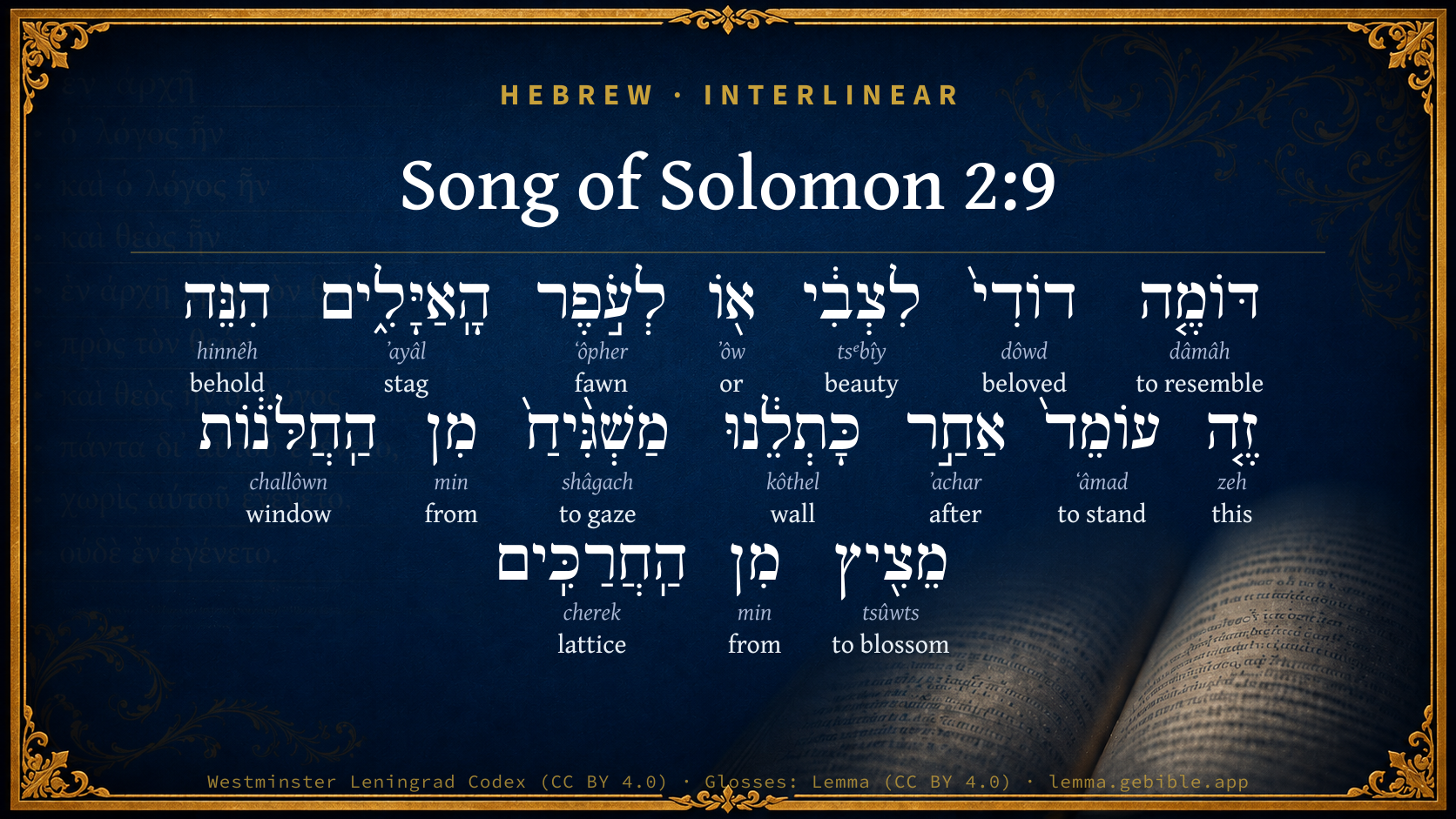
  1. דּוֹמֶ֤ה dâmâh H1819 “resembling” Verb, Qal, Participle Active, Masculine, Singular, Absolute
  2. דוֹדִי֙ dôwd H1730 “beloved · my” Noun, Common, Masculine, Singular, Construct + Suffix, Personal, 1st Person, Common, Singular
  3. לִצְבִ֔י tsᵉbîy H6643 “to/for · beauty” Preposition + Noun, Common, Both, Singular, Absolute
  4. א֖וֹ ʼôw H176 “or” Conjunction
  5. לְעֹ֣פֶר ʻôpher H6082 “to/for · fawn of” Preposition + Noun, Common, Masculine, Singular, Construct
  6. הָֽאַיָּלִ֑ים ʼayâl H354 “the · stags” Particle, Definite Article + Noun, Common, Both, Plural, Absolute
  7. הִנֵּה hinnêh H2009 “behold” Particle, Demonstrative
  8. זֶ֤ה zeh H2088 “this” Pronoun, Demonstrative, Masculine, Singular
  9. עוֹמֵד֙ ʻâmad H5975 “standing” Verb, Qal, Participle Active, Masculine, Singular, Absolute
  10. אַחַ֣ר ʼachar H310 “after” Preposition
  11. מַשְׁגִּ֨יחַ֙ shâgach H7688 “gazing” Verb, Hiphil, Participle Active, Masculine, Singular, Absolute
  12. מִן min H4480 “from” Preposition
  13. הַֽחֲלֹּנ֔וֹת challôwn H2474 “the · windows” Particle, Definite Article + Noun, Common, Both, Plural, Absolute
  14. מֵצִ֖יץ tsûwts H6692 “blossoming” Verb, Hiphil, Participle Active, Masculine, Singular, Absolute
  15. מִן min H4480 “from” Preposition
  16. הַֽחֲרַכִּֽים cherek H2762 “the · lattices” Particle, Definite Article + Noun, Common, Masculine, Plural, Absolute

About this verse

These counts appear in no published source. They are computed here, from the morphology-tagged text and Lemma’s own curated glosses. What Lemma adds →

17
words
16
distinct lemmas
Wisdom
section

Notable vocabulary

2 hapax legomena — words that appear only here in the entire Hebrew Bible:

  • כָּתְלֵ֔נוּ wall H3796
  • הַֽחֲרַכִּֽים lattice H2762

First appearance in Scripture

These words make their first canonical appearance in the Hebrew Bible here:

  • לְעֹ֣פֶר fawn H6082
  • כָּתְלֵ֔נוּ wall H3796
  • הַֽחֲרַכִּֽים lattice H2762

Shared distinctive vocabulary

מַשְׁגִּ֨יחַ֙ to gaze H7688 occurs in 3 verses of the Hebrew Bible. Also found in:

Grammatical profile

  • 4 verbs
  • 7 nouns
  • 1 pronoun
  • 3 prepositions
  • 1 conjunction
  • 1 particle

Verb forms

  • דּוֹמֶ֤ה Qal · Participle Active
  • עוֹמֵד֙ Qal · Participle Active
  • מַשְׁגִּ֨יחַ֙ Hiphil · Participle Active
  • מֵצִ֖יץ Hiphil · Participle Active

Repetition

A word recurs within this verse — often emphatic in Hebrew:

Hebrew & Septuagint length

In English translation the verse runs 27 words from the Hebrew and 29 from the Septuagint (LXX English) — closely comparable.

A rough comparison of the two English renderings, which tokenize alike — not a word-level alignment.

Word counts can differ between the Hebrew and the Greek without any difference in meaning — e.g. the Hebrew direct-object marker אֵת has no separate Greek word, and Greek often adds the article ὁ.

In the original languages it is 17 Hebrew tokens and 28 Greek tokens — but the two are counted differently (Hebrew bundles its prefixes and suffixes into one token; the Greek is in lemma form), so that isn’t a like-for-like length.

Cross-references

16

Topical passages linked to Song of Solomon 2:9 in the Treasury of Scripture Knowledge — connected by theme and wording, ordered by reader-vote popularity; previews shown in the World English Bible.

  • Song of Solomon 8:14 Come away, my beloved! Be like a gazelle or a young stag on the mountains of spices!
  • Song of Solomon 2:17 Until the day is cool, and the shadows flee away, Turn, my beloved, And be like a roe or a young hart on the mountains of Bether.
  • 2 Samuel 2:18 The three sons of Zeruiah were there, Joab, and Abishai, and Asahel: and Asahel was as light of foot as a wild gazelle.
  • Luke 24:35 They related the things that happened along the way, and how he was recognized by them in the breaking of the bread.
  • John 5:39 "You search the Scriptures, because you think that in them you have eternal life; and these are they which testify about me.
  • John 5:46 For if you believed Moses, you would believe me; for he wrote about me.
  • John 12:41 Isaiah said these things when he saw his glory, and spoke of him.
  • 1 Corinthians 13:12 For now we see in a mirror, dimly, but then face to face. Now I know in part, but then I will know fully, even as I was also fully known.
  • 2 Corinthians 3:13–18 and not as Moses, who put a veil on his face, that the children of Israel wouldn't look steadfastly on the end of that which was passing away.
  • Ephesians 2:14–15 For he is our peace, who made both one, and broke down the middle wall of partition,
  • Colossians 2:17 which are a shadow of the things to come; but the body is Christ's.
  • Hebrews 9:8–9 The Holy Spirit is indicating this, that the way into the Holy Place wasn't yet revealed while the first tabernacle was still standing;
  • Hebrews 10:1 For the law, having a shadow of the good to come, not the very image of the things, can never with the same sacrifices year by year, which they offer continually, make perfect those who draw near.
  • Hebrews 10:19–20 Having therefore, brothers, boldness to enter into the holy place by the blood of Jesus,
  • 1 Peter 1:10–12 Concerning this salvation, the prophets sought and searched diligently, who prophesied of the grace that would come to you,
  • Revelation 19:10 I fell down before his feet to worship him. He said to me, "Look! Don't do it! I am a fellow bondservant with you and with your brothers who hold the testimony of Jesus. Worship God, for the testimony of Jesus is the Spirit of Prophecy."

Cross-references courtesy of OpenBible.info (CC BY 4.0).

Hebrew and Greek witnesses Masoretic Hebrew ↔ Greek Septuagint

The same verse in the two great witnesses to the Old Testament, shown verse-for-verse.

These are two independent witnesses, not word-aligned to each other, and the Septuagint is shown in lemma (dictionary) form.

Hebrew Song of Solomon 2:9 Masoretic · Westminster Leningrad Codex

דּוֹמֶ֤ה דוֹדִי֙ לִצְבִ֔י א֖וֹ לְעֹ֣פֶר הָֽאַיָּלִ֑ים הִנֵּה זֶ֤ה עוֹמֵד֙ אַחַ֣ר כָּתְלֵ֔נוּ מַשְׁגִּ֨יחַ֙ מִן הַֽחֲלֹּנ֔וֹת מֵצִ֖יץ מִן הַֽחֲרַכִּֽים

My beloved is like a roe or a young hart. Behold, he stands behind our wall! He looks in at the windows. He glances through the lattice.

World English Bible · Public Domain

Greek LXX Song of Solomon 2:9 Septuagint · lemma form

ὅμοιος εἰμί ἀδελφιδός ἐγώ ὁ δορκάς ἤ νεβρός ἔλαφος ἐπί ὁ ὄρος βαιθηλ ἰδού οὗτος ἵστημι ὀπίσω ὁ τοῖχος ἐγώ παρακύπτω διά ὁ θυρίς ἐκκύπτω διά ὁ δίκτυον

My kinsman is like a roe or a young hart on the mountains of Baethel: behold, he is behind our wall, looking through the windows, peeping through the lattices.

LXX2012 (modern English Septuagint) · Public Domain

Hebrew: Westminster Leningrad Codex (CC BY 4.0). Greek: Septuagint (public domain); English from LXX2012 (modern English Septuagint) (Public Domain). How the Septuagint differs from the Hebrew →

Commentary

Notes on Song of Solomon 2:9 from classic Christian and Jewish commentators (each source and its license shown beneath its notes). The classic Christian expositions comment on the surrounding passage and are grouped to its opening verse, so a note may address several verses; the Jewish commentaries on the Tanakh (Rashi and others) are per-verse, so they appear only where the commentator wrote on this verse.

Lemma curates 59 commentaries, every one of them public domain or Creative Commons licensed, each selected and text-cleaned for this edition rather than reprinted as found. About our sources →

Trapp's Complete Commentary

John Trapp

Son 2:9 My beloved is like a roe or a young hart: behold, he standeth behind our wall, he looketh forth at the windows, shewing himself through the lattice.

Ver. 9. My beloved is like a roe or a young hart,] viz., For sweetness and swiftness, as in the former verse. His help seems long, because we are short. In the opportunity of time he will not be wanting to those that wait for him. The lion seems to leave her young ones till they have almost killed themselves with roaring and howling; but at last she relieves them; and hereby they become the more courageous. God seems to forget his people sometimes, but it is that they may the better remember themselves, and remind him. He seems, as here to have taken a long journey, and to be at a great distance from them, whenas indeed he is as near us as once he was to Mary Magdalene after his resurrection; but she was so bleared she could not see him. If he at any time absent himself for trial of our faith and love to him, and to let us know how ill we can be without him, yet he is no further off than behind some wall or screen. Or if he get out of doors from us, yet he looks in at the window, to see how we take it, and soon after shows himself through the lattice, that we may not altogether despond or despair of his return. Yea, he flourisheth or blossometh {a} through the lattices, like some flower or fruit tree that, growing under or near unto a window, sends in a sweet scent into the room, or perhaps some pleasant branches, to teach that Christ cometh not to his without profit and comfort to their souls.

{a} מציץ, Apparuit instar floris exorientis.

John Trapp, A Commentary or Exposition upon All the Books of the Old and New Testament (1647–1656) — public domain. Text from a community e-Sword module.

Joseph Benson's Commentary

Son 2:9. My beloved is like a roe — In swiftness. He is coming to me with all speed, and will not tarry a moment beyond the proper season. He standeth behind our wall — And while he doth, for wise reasons, forbear to come, he is not far from us. Both this and the following phrases may denote the obscure manner of Christ’s manifesting himself to his people, under the law, in comparison of his discoveries in the gospel. He looketh forth at the window — This phrase, and that, through the lattice, intimate that the church does indeed see Christ, but as through a glass, darkly, as it is said even of gospel revelations, (1Co 13:12,) which was much more true of legal administrations.

Joseph Benson's Commentary on the Old and New Testaments (1811–1818) — public domain. Text from a community e-Sword module.

Geneva Bible (1599)

Geneva Bible translators

Forasmuch as his divinity was hid under the cloak of our flesh.

So that we cannot have full knowledge of him in this life.

Geneva Bible (1599) marginal notes — public domain. Text via Bolls.life.

Adam Clarke's Commentary

Verse 9. He standeth behind our wall] This may refer to the wall by which the house was surrounded, the space between which and the house constituted the court. He was seen first behind the wall, and then in the court; and lastly came to the window of his bride's chamber.

Adam Clarke's Commentary on the Bible (1810–1826) — public domain. Text from a community e-Sword/MySword module.

Ellicott's Commentary for English Readers

(9) Wall.—As an instance of the fertility of allegorical interpretation, the variety of applications of this passage may be quoted. The wall = (1) the wall between us and Christ, i.e., our mortal condition; (2) “the middle wall of partition,” the law; (3) the iniquities separating man from God, so that He does not hear or His voice cannot reach us; (4) the creatures behind whom God Himself stands speaking through them, and “si fas dicere, (5) the flesh of Christ itself spread over His Divinity, through which it sounds sweetly and alters its voice” (Bossuet).

Looketh forth.—Rather, looking through, as in next clause, where the same Hebrew particle occurs. and may = either out or in, as context requires. Here plainly in at.

Shewing himself.—Marg., flourishing. The primitive idea seems to be “to look bright.” Hence the Hiphil conjugation = “to make to look bright;” here “making his eyes glance or twinkle as he peers in through the lattice.”

A Bible Commentary for English Readers, edited by Charles John Ellicott (1878–1897) — public domain. Text from a community e-Sword module.

The Cambridge Bible for Schools and Colleges

gen. ed. J. J. S. Perowne

9. My beloved is like a roe or a young hart] Preferably, like a gazelle or a young hart.

our wall] The possessive pronoun here must, on the hypothesis we have adopted, refer to the Shulammite and the court ladies among whom she is. She speaks of her lover as having now arrived, as standing outside the wall and looking into the chamber.

he looketh forth at the windows] Lit. he gazeth from the windows, glanceth from the lattices. These phrases may mean, either that the person referred to looks out, or that he looks in. All they imply is that the person looking directs his glances from the windows, and so they may legitimately be rendered, looketh in at the windows … glanceth through the lattices. The allegorical interpreters all made the bridegroom look out from a safe and quiet dwelling into which the bride desired to come. But, obviously, when the scene actually portrayed is realised, it is seen that he is outside, seeking her, and comes close up to the windows and lattices and peers in. The word translated glanceth denotes glimmering, shining, and indicates that the charakkim = ‘lattices’ are openings narrower than windows, and the lover had come so close to them that the gleam of his eyes could be seen.

The Cambridge Bible for Schools and Colleges (gen. ed. J. J. S. Perowne; Cambridge University Press, 1878–1918) — public domain. Text from a community e-Sword module.

Haydock's Catholic Bible Commentary

Hart, (Proverbs v. 18.) which is swifter that the dogs. (Xenophon, Cuneg.) --- This animal is said to destroy serpents, as Christ did the power of the devil. (Theodoret) --- Wall. Under the old law, Christ was only seen in figure. He manifested himself in the new. Yet our sins separate him from us, Isaias lix. 2. He is concealed in the sacred mysteries, (Calmet) and his humanity keeps from our sight the glory of his divinity, which alone can impart full content. (St. Ambrose; St. Bernard) --- He shewed a glimpse of it at his transfiguration, and by his miracles. (Menochius)

George Leo Haydock (1774–1849), Haydock's Catholic Family Bible and Commentary, 1859 edition — public domain. Excludes Psalms (Douay-Rheims chapter numbering differs from Protestant) and Deuterocanonical books (Catholic canon only).

Matthew Poole's English Annotations

Like a roe or a young hart; either,

1. In loveliness. Or rather,

2. In swiftness, by comparing this verse with the former. The swiftness of roes is noted 2Sa 2:18; 1Ch 12:8. He is coming to me with all speed, and will not tarry a moment beyond the appointed and proper season.

He standeth behind our wall; and whilst he doth for wise and just reasons forbear to come, he is not far from us. Though he be not yet come into the door of our house, yet he stands behind the wall of our house, and is always at hand, to give me that succour and comfort which I do or may need or desire. Both this and the following phrases seem to note the obscure and imperfect manner and degree of Christ’s manifesting himself to his people, either,

1. Under the law, in comparison of his discoveries in the gospel. Or,

2. In this life, in comparison of what he will do in the future life.

He looketh forth, from his high and heavenly palace, towards me, to watch over me, and refresh me with the prospect of his favour.

At the window: this phrase, and that,

through the lattice, intimate that the church doth indeed see Christ, but, as through a glass, darkly, as it is said even of gospel revelations, 1Co 13:12, and was much more true of legal administrations.

Matthew Poole's English Annotations on the Holy Bible (1683–1685) — public domain. Text from a community e-Sword/MySword module.

Whedon's Commentary on the Bible

Daniel D. Whedon

9. Like a… hart — He came quickly like the animals to which he is compared.

He standeth — More strictly, Now he stood behind our wall, he looketh through the window: showing himself through the lattice. The windows of Jewish houses were very narrow, and set with lattice-work, not glass.

Daniel D. Whedon (gen. ed.), Commentary on the Old and New Testaments (1874–1909) — public domain. Text from a community e-Sword module.

The Pulpit Commentary

My beloved is like a roe or a young hart; behold, he standeth behind our wall, he looketh in at the windows, he showeth himself through the lattice. The tsevi is the gazelle, Arabic ghazal. Our word is derived through the Spanish or Moorish gazela. The young hart, or chamois, is probably so called from the covering of young hair. (cf. 2Sa_2:18 Pro_6:5 Heb_3:19) Shulamith represents herself as within the house, waiting for her friend. Her beloved is standing behind the wall, outside before the house; he is playfully looking through the windows, now through one and now through another, seeking her with peering eyes of love. Both the words employed, convey, the meaning of searching and moving quickly. The windows; literally, the openings; i.e. a window broken through a wall, or the meaning may be a lattice window, a pierced wooden structure. The word is not the common word for a window, which is shevaka (now shabbaka), from a root meaning "to twist," "to make a lattice." Spiritually, we may see an allusion to the glimpses of truth and tastes of the goodness of religion, which precede the real fellowship of the soul with God.

The Pulpit Commentary (1880–1919), ed. H.D.M. Spence-Jones & Joseph S. Exell — public domain. Text from a community e-Sword module.

John Wesley's Explanatory Notes

Like a roe - In swiftness. He is coming to me with all speed and will not tarry a moment beyond the proper season. He standeth behind - And while he doth for wise reasons forbear to come; he is not far from us. Both this and the following phrases may denote the obscure manner of Christ's manifesting himself to his people, under the law, in comparison of his discoveries in the gospel. The window - This phrase, and that through the lattess, intimate that the church does indeed see Christ, but, as through a glass, darkly, as it is said even of gospel-Revelations, 1 Cor. xiii, 12, which was much more true of legal administrations.

John Wesley, Explanatory Notes Upon the Whole Bible (1754–1765) — public domain. Text via the GEBible commentary corpus.

Scofield Reference Notes

C. I. Scofield

our wall

"Our wall." The bride had returned to her own home: the Bridegroom seeks her.

The Scofield Reference Bible (1917 edition), notes by C. I. Scofield — public domain. Text from a community e-Sword module.

Rashi

Rabbi Shlomo Yitzchaki (Rashi)

My beloved resembles a gazelle in the swiftness of his running, for he hastened to come like a gazelle and like a fawn of the hinds. עֹפֶר is a young hind.

behold, he is standing, etc. I had expected to remain detained for many more days, and behold, he informed me that he was standing and peering from the windows of heaven at what was being done to me, as it is written (Exod. 3:7): “I have indeed seen the affliction of My people, etc.”

Rashi on the Tanakh — English translations: “The Judaica Press complete Tanach with Rashi, translated by A. J. Rosenberg” (CC BY 4.0); “Pentateuch with Rashi's commentary by M. Rosenbaum and A.M. Silbermann, 1929-1934” (public domain); “The Metsudah Tanach series, Lakewood, N.J” (CC BY 4.0); and “The Book of Joshua, Metsudah Publications, 1997” (CC BY 4.0). Text via Sefaria.

Lesson kit

Teaching starters — assembled from the data on this page, not authored interpretation. Every prompt links to the verse data it draws on. Edit before teaching.

Song of Solomon, in the Wisdom, opens this verse with 17 words (16 distinct Hebrew lemmas). Its most distinctive word is kôthel (“wall”). A historical commentator’s framing appears above. Read the whole chapter for the surrounding context.

Discussion questions

  1. What does “wall” (kôthel) contribute to the verse as a whole?
  2. This verse holds 2 words here found nowhere else in the Hebrew Bible. What might the rare words draw attention to?
  3. 3 words here appear for the first time in Scripture. What is being introduced at this debut?
  4. Psalms 33:14 shares the word «to gaze» with this verse. How do the two illuminate each other?
  5. “from” occurs 2× in this one verse. What is the effect of the repetition?
  6. The translations on this page render this verse differently — a whole-verse word diff, not a word-by-word alignment. What might account for the different wordings?
  7. The verb «דּוֹמֶ֤ה» is Qal Participle Active. How does its form color the action?
  8. Reading how Trapp's Complete Commentary and Joseph Benson's Commentary read this verse, where do the two commentators agree and where do they part?

Things to notice

  • 2 words in this verse appear nowhere else in the Hebrew Bible.
  • 3 words make their first canonical appearance in Scripture here.
  • This verse counts 17 Hebrew ↔ 28 Greek words.
  • These translations choose different wording for 19 words in this verse.
  • “from” occurs 2× in this single verse.

Reading settings

Reading text

Shown beneath each verse's original-language words.

Old Testament
Old Testament edition

Read the OT as the Masoretic Hebrew (MT) or the Greek Septuagint (LXX).

English shown for the Greek Septuagint (in the Hebrew ↔ Greek comparison).

Comparing translations? Open the Compare panel on any verse page to stack up to four side by side.