Jeremiah 5:4

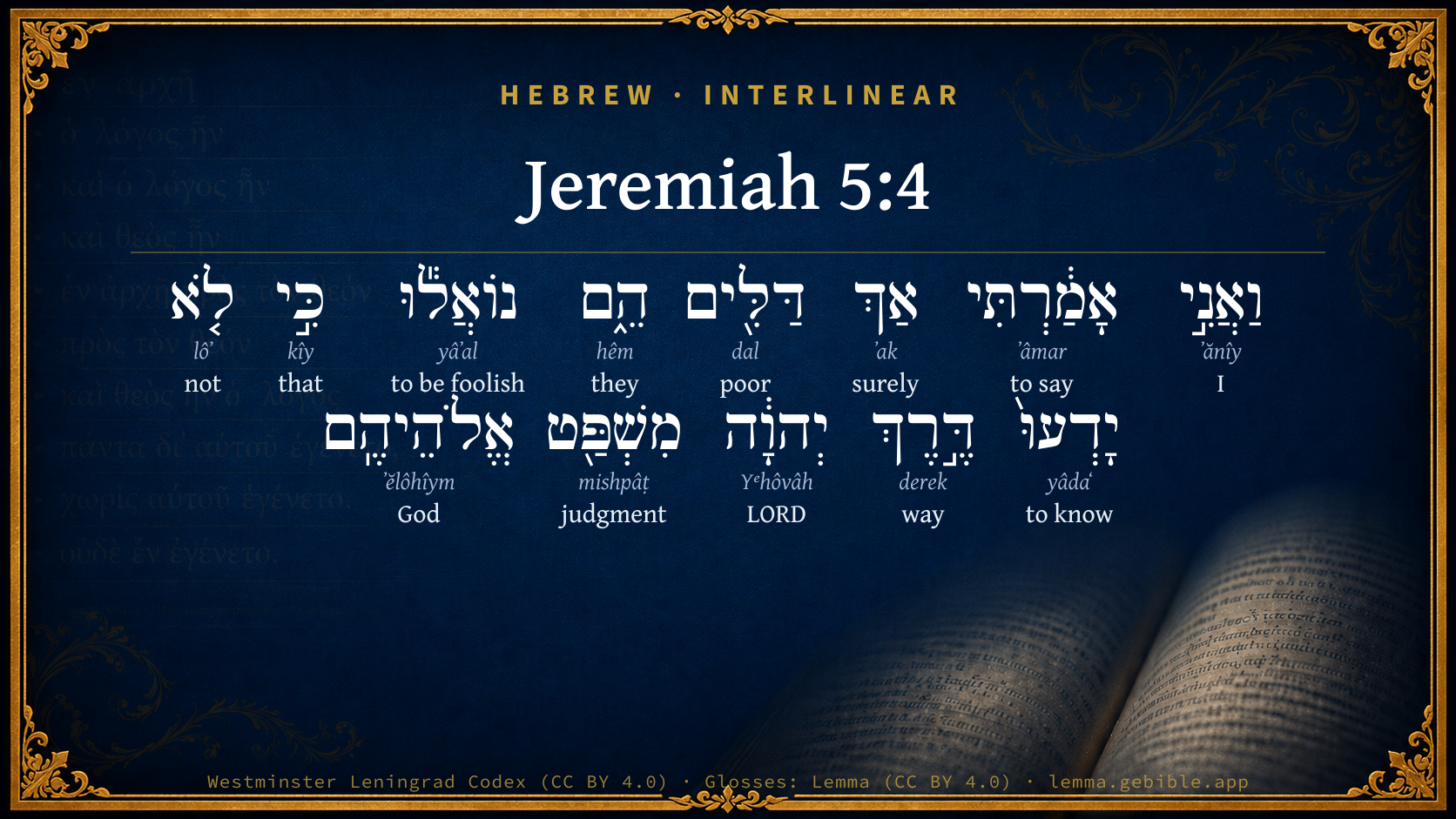
Hebrew (Westminster Leningrad Codex) Jeremiah 5:4 appears in the Hebrew Old Testament. The text above is from the Westminster Leningrad Codex. Each word links to its Strong’s number, a concise gloss, and parsing drawn from the Open Scriptures Hebrew Bible morphology. Click any word for its full Brown-Driver-Briggs (BDB) entry.
Download image
Cite this verse

Jeremiah 5:4 (World English Bible). Public Domain. Lemma interlinear Bible study tool, https://lemma.gebible.app/v/jeremiah/5/4.

Show BibTeX & RIS
BibTeX
RIS
English Translation
Then I said, Surely these are poor; they are foolish; for they don't know the way of Yahweh, nor the law of their God:
World English Bible · Public Domain
Download a study sheet

One document with this verse’s original text, its word-by-word gloss line, the meaning frame, cross-references with their text, attributed commentary, and full source and license credits — printable, and it pastes into notes with its structure intact.

This verse Autodidact and up

Study sheet (.html) Plain text (.txt)

A passage Seminary Student

Up to 50 verses in one chapter. A passage sheet keeps up to 6 commentary sources and 12 cross-references per verse, in the order this page ranks them, and says so on the sheet whenever that leaves anything out. Ask for a single verse and you get the Autodidact verse sheet above.

Everything on this page stays free to read, with no account — the sheet is a download of what is already on screen, not access to it.

Want to remove ads? Support Godless Engineer
Compare translations 3

The same verse in 3 English versions, stacked beneath the original-language interlinear above. Click any original word for its lexicon entry.

Each is an independent rendering of the whole verse — the interlinear is not word-aligned to these translations.

Highlighted words mark where these versions differ — a whole-verse word diff, not a word-by-word alignment.

  • World English Bible Public Domain
    Then I said, Surely these are poor; they are foolish; for they don't know the way of Yahweh, nor the law of their God:
  • King James Version Public Domain
    Therefore I said, Surely these are poor; they are foolish: for they know not the way of the LORD, nor the judgment of their God.
  • unfoldingWord Literal Text CC BY-SA 4.0
    So I myself said, “They are only ones who are poor. They are foolish, for they do not know the way of Yahweh, the ordinance of their God.

unfoldingWord Literal Text — © unfoldingWord, licensed CC BY-SA 4.0. Word-aligned USFM3 via Door43 (git.door43.org/unfoldingWord/en_ult).

Versions to compare (up to 4)

3 of 4 selected

Show all 18 translations

Every available English version of this verse, each an independent rendering of the whole verse.

  • World English Bible Public Domain
    Then I said, Surely these are poor; they are foolish; for they don't know the way of Yahweh, nor the law of their God:
  • Berean Standard Bible Public Domain
    Then I said, “They are only the poor; they have played the fool, for they do not know the way of the LORD, the justice of their God.
  • Majority Standard Bible Public Domain
    Then I said, “They are only the poor; they have played the fool, for they do not know the way of the LORD, the justice of their God.
  • King James Version Public Domain
    Therefore I said, Surely these are poor; they are foolish: for they know not the way of the LORD, nor the judgment of their God.
  • American Standard Version (1901) Public Domain
    Then I said, Surely these are poor; they are foolish; for they know not the way of Jehovah, nor the law of their God:
  • Revised Version (1885) Public Domain
    Then I said, Surely these are poor: they are foolish; for they know not the way of the LORD, nor the judgment of their God:
  • Geneva Bible (1599) Public Domain
    Therefore I saide, Surely they are poore, they are foolish, for they know not the way of the Lord, nor the iudgement of their God.
  • Douay-Rheims (1899) Public Domain
    But I said: Perhaps these are poor and foolish, that know not the way of the Lord, the judgement of their God.
  • Young's Literal Translation Public Domain
    And I -- I said, `Surely these `are' poor, They have been foolish, For they have not known the way of Jehovah, The judgment of their God.
  • Literal Standard Version CC BY-SA 4.0
    And I said, “Surely these [are] poor, || They have been foolish, || For they have not known the way of YHWH, || The judgment of their God.
  • Unlocked Literal Bible CC BY-SA 4.0
    So I said, “Surely these are only poor people. They are foolish, for they do not know Yahweh's ways, nor their God's decrees.
  • unfoldingWord Literal Text CC BY-SA 4.0
    So I myself said, “They are only ones who are poor. They are foolish, for they do not know the way of Yahweh, the ordinance of their God.
  • Darby Bible Public Domain
    And I said, Surely these are the wretched ones, they are foolish; for they know not the way of Jehovah, the judgment of their God.
  • World Messianic Bible Public Domain
    Then I said, “Surely these are poor. They are foolish; for they don’t know the LORD’s way, nor the law of their God.
  • Webster's Bible Public Domain
    Therefore I said, Surely these are poor; they are foolish: for they know not the way of the LORD, nor the judgment of their God.
  • Free Bible Version CC BY-SA 4.0
    Then I said to myself, “These people are only the poor—they're just fools who don't know any better. They certainly don't know what the Lord wants, God's right way of living.
  • Bible in Basic English Public Domain
    Then I said, But these are the poor: they are foolish, for they have no knowledge of the way of the Lord or of the behaviour desired by their God.
  • JPS Tanakh (1917) Public Domain
    And I said: 'Surely these are poor, they are foolish, for they know not the way of the LORD, nor the ordinance of their God;

Literal Standard Version (2020), Covenant Press — licensed CC BY-SA 4.0. Text via the HelloAO Bible API (eBible.org). Unlocked Literal Bible (unfoldingWord) — licensed CC BY-SA 4.0. Text via the HelloAO Bible API (eBible.org). unfoldingWord Literal Text — © unfoldingWord, licensed CC BY-SA 4.0. Word-aligned USFM3 via Door43 (git.door43.org/unfoldingWord/en_ult). Free Bible Version, Dr. Jonathan Gallagher — licensed CC BY-SA 4.0. Text via the HelloAO Bible API (eBible.org).

Word by word

More ways to search: Search by grammar → Find every occurrence → Compare this word →

Practice this passage: Drill this verse → Learn its vocabulary →

נוֹאֲל֕וּ
yâʼal
H2973
“to be foolish”
Verb, Niphal, Perfect, 3rd Person, Common, Plural
Part of Speech
Verb
Stem
Niphal
Form
Perfect
Person
3rd Person
Gender
Common
Number
Plural
Full BDB Definition

Origin: a primitive root

TWOT: 830

to be foolish, become fools, act foolishly, show wicked folly - (Niphal) - to show wicked folly - to become fools
  1. וַאֲנִ֣י ʼănîy H589 “and · I” Conjunction + Pronoun, Personal, 1st Person, Common, Singular
  2. אָמַ֔רְתִּי ʼâmar H559 “to say” Verb, Qal, Perfect, 1st Person, Common, Singular
  3. אַךְ ʼak H389 “surely” Particle, Accusative
  4. דַּלִּ֖ים dal H1800 “poor” Adjective, Adjective, Masculine, Plural, Absolute
  5. הֵ֑ם hêm H1992 “they” Pronoun, Personal, 3rd Person, Masculine, Plural
  6. כִּ֣י kîy H3588 “that” Conjunction
  7. לֹ֤א lôʼ H3808 “not” Particle, Negative
  8. יָדְעוּ֙ yâdaʻ H3045 “to know” Verb, Qal, Perfect, 3rd Person, Common, Plural
  9. דֶּ֣רֶךְ derek H1870 “way of” Noun, Common, Both, Singular, Construct
  10. יְהוָ֔ה Yᵉhôvâh H3068 “LORD” Noun, Proper
  11. מִשְׁפַּ֖ט mishpâṭ H4941 “judgment of” Noun, Common, Masculine, Singular, Construct
  12. אֱלֹהֵיהֶֽם ʼĕlôhîym H430 “God(s) · their” Noun, Common, Masculine, Plural, Construct + Suffix, Personal, 3rd Person, Masculine, Plural

About this verse

These counts appear in no published source. They are computed here, from the morphology-tagged text and Lemma’s own curated glosses. What Lemma adds →

13
words
13
distinct lemmas
Prophets
section

Notable vocabulary

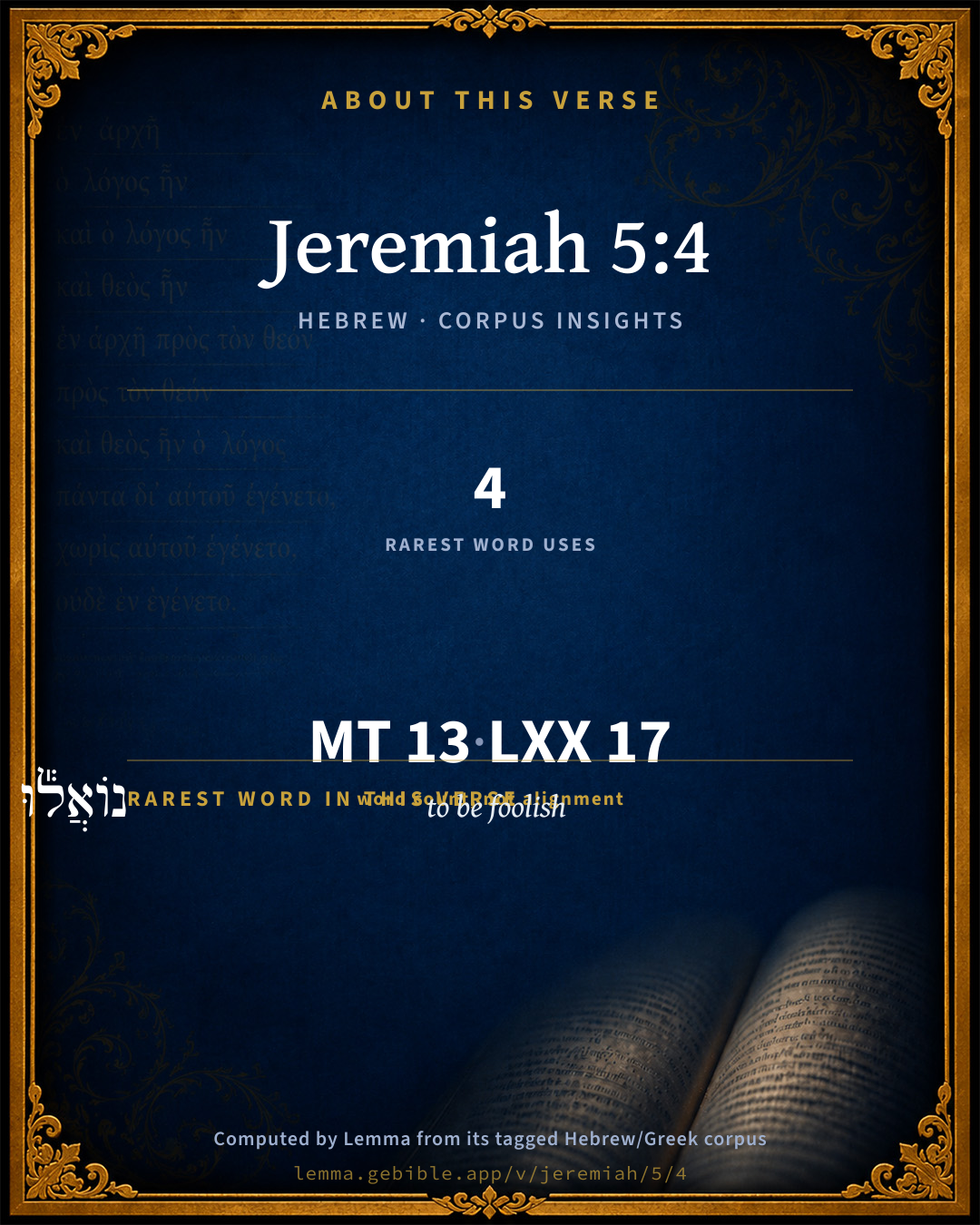
The rarest word here is נוֹאֲל֕וּ to be foolish H2973 — appearing just 4 times in the whole Hebrew Bible.

Shared distinctive vocabulary

נוֹאֲל֕וּ to be foolish H2973 occurs in 4 verses of the Hebrew Bible. Also found in:

Grammatical profile

  • 3 verbs
  • 4 nouns
  • 1 adjective
  • 2 pronouns
  • 1 conjunction
  • 2 particles

Verb forms

  • אָמַ֔רְתִּי Qal · Perfect
  • נוֹאֲל֕וּ Niphal · Perfect
  • יָדְעוּ֙ Qal · Perfect

Hebrew & Septuagint length

In the original languages it is 13 Hebrew tokens and 17 Greek tokens — but the two are counted differently (Hebrew bundles its prefixes and suffixes into one token; the Greek is in lemma form), so that isn’t a like-for-like length.

Cross-references

8

Topical passages linked to Jeremiah 5:4 in the Treasury of Scripture Knowledge — connected by theme and wording, ordered by reader-vote popularity; previews shown in the World English Bible.

  • Jeremiah 8:7 Yes, the stork in the sky knows her appointed times; and the turtle-dove and the swallow and the crane observe the time of their coming; but my people don't know Yahweh's law.
  • Hosea 4:6 My people are destroyed for lack of knowledge. Because you have rejected knowledge, I will also reject you, That you may be no priest to me. Because you have your God's law, I will also forget your children.
  • Isaiah 28:9–13 Whom will he teach knowledge? and whom will he make to understand the message? those who are weaned from the milk, and drawn from the breasts?
  • Matthew 11:5 the blind receive their sight, the lame walk, the lepers are cleansed, the deaf hear, the dead are raised up, and the poor have good news preached to them.
  • Isaiah 27:11 When the boughs of it are withered, they shall be broken off; the women shall come, and set them on fire; for it is a people of no understanding: therefore he who made them will not have compassion on them, and he who formed them will show them no favor.
  • Jeremiah 4:22 For my people are foolish, they don't know me; they are foolish children, and they have no understanding; they are wise to do evil, but to do good they have no knowledge.
  • Jeremiah 7:8 Behold, you trust in lying words, that can't profit.
  • John 7:48–49 Have any of the rulers believed in him, or of the Pharisees?

Cross-references courtesy of OpenBible.info (CC BY 4.0).

Hebrew and Greek witnesses Masoretic Hebrew ↔ Greek Septuagint

The same verse in the two great witnesses to the Old Testament, shown verse-for-verse.

These are two independent witnesses, not word-aligned to each other, and the Septuagint is shown in lemma (dictionary) form.

Hebrew Jeremiah 5:4 Masoretic · Westminster Leningrad Codex

וַאֲנִ֣י אָמַ֔רְתִּי אַךְ דַּלִּ֖ים הֵ֑ם נוֹאֲל֕וּ כִּ֣י לֹ֤א יָדְעוּ֙ דֶּ֣רֶךְ יְהוָ֔ה מִשְׁפַּ֖ט אֱלֹהֵיהֶֽם

Then I said, Surely these are poor; they are foolish; for they don't know the way of Yahweh, nor the law of their God:

World English Bible · Public Domain

Greek LXX Structure differs

In the Septuagint, Jeremiah is about an eighth shorter than the Hebrew and arranges its material differently — the Oracles Against the Nations (Hebrew chapters 46–51) appear in the middle of the Greek book, after 25:13. Because the chapter and verse boundaries do not line up, a verse-for-verse comparison with the Hebrew is not shown.

A verse-for-verse comparison isn’t shown here because the chapters and verses don’t line up. Switch to the LXX edition with the MT / LXX toggle above to read the Greek directly.

Hebrew: Westminster Leningrad Codex (CC BY 4.0). Greek: Septuagint (public domain); English from a public-domain English Septuagint. How the Septuagint differs from the Hebrew →

Targum (Aramaic paraphrase)

1

The Targum is the ancient Jewish Aramaic paraphrase of the Hebrew Scriptures — an interpretive translation, not the Hebrew text itself. Onkelos (literal) and Pseudo-Jonathan (expansive) render the Torah, and Jonathan the Prophets. Coverage is partial: where no permissively-licensed English translation exists for a verse, only the Aramaic is shown. This is verse-level text, not a word-by-word alignment to the Hebrew.

  1. Targum Jonathan Prophets (Joshua–Malachi)
    וַאֲנָא אֲמָרֵת בְּרַם מִדְמִסְכְּנִין אִינוּן אִטַפָּשׁוּ אֲרֵי לָא אֲלִיפוּ לְמֵידַע אוֹרְחַן דְתַקְנָן קָדָם יְיָ לְמֶעְבַּד דִין דִקְשׁוֹט קֳדָם אֱלָהָהוֹן:

    (no public-domain English translation for this verse)

    Targum Jonathan — Aramaic: “Mikraot Gedolot” (public domain). English: “Sefaria Community Translation” (CC0 1.0 (public-domain dedication)); “London "Chaldee Paraphrase," 1871” (public domain). Text via Sefaria.

Commentary

Notes on Jeremiah 5:4 from classic Christian and Jewish commentators (each source and its license shown beneath its notes). The classic Christian expositions comment on the surrounding passage and are grouped to its opening verse, so a note may address several verses; the Jewish commentaries on the Tanakh (Rashi and others) are per-verse, so they appear only where the commentator wrote on this verse.

Lemma curates 59 commentaries, every one of them public domain or Creative Commons licensed, each selected and text-cleaned for this edition rather than reprinted as found. About our sources →

Trapp's Complete Commentary

John Trapp

Jer 5:4 Therefore I said, Surely these [are] poor; they are foolish: for they know not the way of the LORD, [nor] the judgment of their God.

Ver. 4. Therefore I said,] i.e., I thought with myself.

Surely these,] scil., That swear falsely, and refuse to be reformed, &c.

Are poor.] Of the rascality, under law, base and beggarly, who neither know God’s will, nor hold themselves much bound to do it. Of the poorer sort in Swethland it is reported, that they do always break the Sabbath, saying that it is for gentlemen only to keep that day.

John Trapp, A Commentary or Exposition upon All the Books of the Old and New Testament (1647–1656) — public domain. Text from a community e-Sword module.

Tyndale Open Study Notes

Tyndale Open Resources

5:4-5 Jeremiah searched for an economic reason behind Jerusalem’s rebellion but found that the leaders, despite their advantages, were as rebellious as the uneducated poor. • A wooden yoke was placed on the neck of a farm animal, with chains attached to a plow or another implement for working the fields (cp. 27:2-12; Ps 2:3).

Tyndale Open Study Notes — © Tyndale Open Resources, licensed CC BY-SA 4.0. Text via the HelloAO Bible API.

Jamieson, Fausset & Brown

Robert Jamieson, A. R. Fausset & David Brown

poor--rather, "the poor." He supposes for the moment that this utter depravity is confined to the uninstructed poor, and that he would find a different state of things in the higher ranks: but there he finds unbridled profligacy.

Jamieson, Fausset & Brown — Commentary Critical and Explanatory on the Whole Bible (1871) — public domain (CC PDM 1.0). Text via the HelloAO Bible API.

Adam Clarke's Commentary

Verse 4. These are poor] They are ignorant; they have no education; they know no better.

Adam Clarke's Commentary on the Bible (1810–1826) — public domain. Text from a community e-Sword/MySword module.

John Calvin's Commentaries

Some think that the Prophet here makes an excuse for the people, and, as far as he could, extenuates their fault; but they are greatly mistaken. For there is no doubt but that he, by this comparison, more clearly shews how past remedy was then the state of things. The sum, then, of what he says is, — that corruptions so prevailed, not only among the multitude, but also among the chief men, that there remained no soundness, as they say, from the head to the sole of the foot. Nearly the same thing, only in other words, is stated by Isaiah in the twenty-eighth chapter; for after having spoken generally against the people, he assails the leading men, and says that they were inebriated no less than the common people, that they were inebriated with wine and strong drink. But the meaning is, that they were like drunken men, because they felt no shame, while they abandoned themselves to deeds the most disgraceful.

To the same purpose is what Jeremiah says here, when he declares, that he thought that they were the poor who had thus sinned, and obscure men and of no repute; but that he had found the same thing among the chief men as among the common people. He might, indeed, have only said, “Not only the lowest orders, the multitude, are become corrupt, but also the chief men, who ought to have excelled the rest.” But much more striking is the comparison, when he says, “It may be, that these miserable men have thus sinned because they understood not the law of God, nor is it a matter of wonder; but greater integrity will be found in the chief men.” By speaking thus the Prophet brings the reader into the midst of the scene, and shews to him that not only all the people were guilty, but also the priests and the prophets, and the chief men in the state. The design of the Prophet is thus evident.

I said, he says, not that he thought so; for he saw that all things were in such a disorder, that nothing better could be hoped from the chief men than from the common people. This was clearly seen by the Prophet: but, as I have said, he wished to shew here, by a striking representation, how wretched was the condition of the whole people. He says, Surely The particle אך, ak, is an affirmative, or, as in the next verse, an adversative. Some, indeed, take it here in the sense of אולי, auli, perhaps, or, it may be; and regard it as signifying a concession, “Let us grant this,” he says; “they are the poor, they are of no account, they are as it were the offscourings, who have thus sinned: it is nothing strange, if they conduct themselves thus foolishly, for they know not the way of Jehovah, nor the judgment of their God ”

The law was, indeed, given to all without any difference; so that the common people had no excuse. But this evil has prevailed almost in all ages, — that few attend to the teaching of the law; for there is no one who is not inclined to shake off this yoke. The common people, indeed, think that they have some excuse for neglecting it, because they have no leisure, and are not born for high stations. The Prophet then speaks according to this prevailing opinion; but he does not extenuate their fault who pleaded ignorance as an excuse, because they had not been taught in schools; for, as it has been said, God intended his law for the whole people without exception.

By the way of Jehovah and the judgment of God, the Prophet means the same thing: such a repetition is very common in Hebrew. God, in prescribing to us the rule of life, shews to us the way in which we are to walk: our life, indeed, is like to a course; and it is not God’s will that we should run at random, but he sets before us the goal to which we are to proceed, and also directs us in the only way that leads to it. For it is the office of the law to call us back from our wandering, and to lead us to the mark set before us. Hence the law is called the way of Jehovah; and judgment, משפת, meshephet, as it was said yesterday, means rectitude, or a rule of life. What he calls in the first clause the law of Jehovah, he calls in the second the judgment of God And thus he shews that they were inexcusable, who made the objection that they were miserably ignorant, and knew nothing; for it was God’s purpose to shew to them, no less than to the most learned, how they were to live.

John Calvin's Commentaries (1540-1563) — public domain. Text from the Calvin Translation Society English edition (1840s-50s) via the Christian Classics Ethereal Library (ccel.org). Calvin's coverage is partial (roughly two-thirds of the Bible); uncommented books and verses are honest gaps, never fabricated. The 19th-century editor's footnotes and remarks are omitted so the notes are faithfully Calvin's own voice.

Ellicott's Commentary for English Readers

(4) Therefore.—Literally, And. The prophet makes for the poor the half-pitying plea of ignorance. Looking upon the masses that toil for bread, those whom the Scribes afterwards called the “people of earth,” it was not strange that they who had been left untaught should have learnt so little. The thought finds a parallel in our Lord’s compassion for the multitude who were as “sheep having no shepherd” (Mat_9:36), for the servant who “knew not his Lord’s will” (Luk_12:48).

The way of the Lord.—That which He approves, that which leads to Him, as in Gen_18:19; Deu_31:29.

A Bible Commentary for English Readers, edited by Charles John Ellicott (1878–1897) — public domain. Text from a community e-Sword module.

The Cambridge Bible for Schools and Colleges

gen. ed. J. J. S. Perowne

4. The prophet thinks, Surely it is poverty and ignorance that mislead them. Cp. Hos_4:6.

the way of the Lord] the way prescribed by God to man.

judgement] primarily a decision given by a judge, and hence an ordinance, or a prescribed system of ordinances (so in Jer_8:7). See Dr. pp. 334 f. and cp. note on Jer_10:24. The sense here is well illustrated by 2Ki_17:26 f., where, however, “manner” in E. VV. is an inadequate rendering.

The Cambridge Bible for Schools and Colleges (gen. ed. J. J. S. Perowne; Cambridge University Press, 1878–1918) — public domain. Text from a community e-Sword module.

John Gill's Exposition

Then I said, surely these are poor, they are foolish,.... The prophet, observing that reproofs and corrections in providence had no effect upon the people, he thought within himself that surely the reason must be, because these people are poor, and in low circumstances in the world, and are so busy in their worldly employments to get bread for their families, that they were not at leisure to attend unto divine things; nor of capacity to receive instruction and correction by providences; therefore it is they were so foolish, stupid, and infatuated:

for they know not the way of the Lord, nor the judgment of their God; either the way which God takes in the salvation of the sons of men, and in justifying of them, which is revealed in his word; or that which he prescribes them to walk in, in his law, even the way of truth and righteousness, and for failure of which he judges and condemns them; but of these things they were ignorant; see Joh 7:48, not that this is observed in excuse for them, but in order to introduce what follows; and to show that this depravity, stupidity, and ignorance, obtained among all sort of people, high and low, rich and poor.

John Gill's Exposition of the Whole Bible (1746–1763) — public domain (CC PDM 1.0). Text via the HelloAO Bible API.

Albert Barnes' Notes on the Bible

Therefore - More simply “and.”

They are foolish - Or, they act foolishly (see Num 12:11), not having that knowledge which would enable them to guide their ways with discretion.

Albert Barnes' Notes on the Bible (1834–1885) — public domain. Text from a community e-Sword/MySword module.

Haydock's Catholic Bible Commentary

Foolish idiots, (Calmet) who have had no means of receiving instruction. (Haydock) --- Such might be more excusable; but when the chiefs offend, the evil is irremediable.

George Leo Haydock (1774–1849), Haydock's Catholic Family Bible and Commentary, 1859 edition — public domain. Excludes Psalms (Douay-Rheims chapter numbering differs from Protestant) and Deuterocanonical books (Catholic canon only).

Matthew Poole's English Annotations

Therefore I said; or, perhaps, I said with myself; not, possibly, that he thought so, but that he might thus express himself, as men use to speak.

Surely these are poor; poor, low-spirited, or of the meanest rank among the vulgar, understand but little; either men of greater ignorance, Joh 7:49, and therefore said not to know the way of the Lord; see Jer 8:7; being better skilled in fields and vineyards than in the law; or of less conscience than the better sort may be, and therefore said to be foolish, or infatuated, or put upon greater temptation by reason of their poverty, Pro 30:9.

The judgment of their God; the methods or ways of his providence, the usual manner of his dealing; so judgment is to be taken here for the same with ways, 1Sa 2:13, as it is also Jer 8:7.

Matthew Poole's English Annotations on the Holy Bible (1683–1685) — public domain. Text from a community e-Sword/MySword module.

Whedon's Commentary on the Bible

Daniel D. Whedon

4, 5. This corruption extends to high as well as low. The prophet thought that those who showed this lack of truth and uprightness were of the baser sort — the poor and the foolish; but on betaking himself to the great men he found the same state of things; these have altogether broken the yoke, and burst the bonds — that is, of duty.

Daniel D. Whedon (gen. ed.), Commentary on the Old and New Testaments (1874–1909) — public domain. Text from a community e-Sword module.

The Pulpit Commentary

Therefore I said; rather, and as for me, I said. They are foolish; rather, they act foolishly. (as Num_12:11) For; rather, because. Their want of religious instruction is the cause of their faulty conduct. In fact, it was only after the return from Babylon that any popular schools were founded in Judaea, and not till shortly before the destruction of the temple that the elementary instruction attained the regularity of a system (Edersheim, "Sketches of Jewish Social Life in the Time of Christ," pp. 134, 135). The judgment of their God. A similar phrase occurs in Jer_8:7. "Judgment (mishpat) here (as in some other passages) has acquired a technical sense. This may be illustrated by the corresponding word in Arabic (din), which means

(1) obedience,

(2) a religion,

(3) a statute or ordinance,

(4) a system of usages, rites, and ceremonies" (Lane"s "Lexicon," s.v.). "Judgment" is, therefore, here equivalent to "religious law," and "law" is a preferable rendering.

The moral disadvantages of the poor.

Jeremiah recognizes and refers to these disadvantages as a well-known fact, and he tells, how he expected to find in them an explanation of the deplorable wickedness with which Jerusalem was filled. Therefore I said, Surely these are poor," etc. We note

I THAT THESE ARE THE REAL EVILS OF THE LOT OF THE POOR. At once all manner of other distresses which attend poverty arise to our minds, and therefore we would observe:

1. That we do not deny that their physical and social disadvantages are also evils. To be ill fed, ill housed, ill clothed, as so many of the poor are, who can make light of a lot like theirs? Therefore:

a. Still less do we deny our duty to relieve their physical evils to the utmost of our power.

b. But we do deny that these are their chief evils. For:

(1) Many of these are more than counterbalanced by what is so commonly found amongst the rich. Dr. Channing says, "When I compare together different classes as existing at this moment in the civilized world, I cannot think the difference between the rich and the poor in regard to mere physical suffering so great as is sometimes imagined. That some of the indigent among us die of scanty food is undoubtedly true, but vastly more in this community die from eating too much than from eating too little, vastly more from excess than starvation. So as to clothing: many shiver from want of defenses against the cold; but there is vastly more suffering among the rich from absurd and criminal modes of dress, which fashion has sanctioned, than among the poor from deficiency of raiment. Our daughters are oftener brought to their grave by their rich attire than our beggars by their nakedness. So the poor are often overworked; but they suffer less than many among the rich, who have no work to do, no interesting object to fill up life, to satisfy the infinite cravings of man for action. According to our present modes of education, how many of our daughters are victims of ennui a misery unknown to the poor, and more intolerable than the weariness of excessive toil! The idle young man, spending the day in exhibiting his person in the street, ought not to excite the envy of the overtasked poor; and this cumberer of the ground is found exclusively among the rich.

(2) And their intellectual disadvantages are nearly as great an evil as those that belong to their outward lot. "Knowledge is power," but to be without knowledge is to lack the power to lighten, to elevate, to refine, to cheer, and in ways manifold to ameliorate our lot in life. Therefore to lack knowledge and education deserves to be looked upon with even more compassion than the lack of physical comforts. But still, the chief evil of poverty is its moral disadvantage. Now

II THESE MORAL DISADVANTAGES OF THE POOR ARE SUCH AS ARISE FROM:

1. The difficulty of maintaining self-respect. All the world seems agreed to regard the poor as the "lower orders," and to confine the term "respectable" to those who have enough and to spare. And when poverty necessitates the receiving, and yet more the asking, of charity, how hard it is then to maintain that erect moral bearing, that spirit of independence, which is so essential to the formation of all true, worthy moral character.

2. The almost impossibility of mental culture. How can the man who has to continue at prolonged and laborious bodily toil from morn to night, day after day all his life long, and only then can earn scarce sufficient to provide for his actual bodily necessities, be expected to be other than rough, rude, illiterate, and contented to be so? What mockery it seems to talk of mental cultivation to a man like that! But shut off from such cultivation, how utterly is the door closed upon him which leads to so much that would cheer and brighten his whole life, and would lift him up in the scale of moral being!

3. The risk to all moral delicacy and refinement which their crowded and wretched habitations involve. If men are obliged to herd like cattle, only less comfortably than they, how can "a man be better than a sheep" in such case?

4. The temptation to envy and sullen discontent at their beholding what seems to them the so much brighter tot of the well-to-do. The patience of the poor beneath the awful injustices and hardships which arise from the unequal distribution of wealth is a marvel. Especially, too, when they have daily to endure the supercilious and half-scornful treatment which the possession of wealth almost invariably begets towards those who have it not.

5. The hard struggle which faith in God and his goodness cannot but have amid the hardships of poverty. It is true that men would be far happier if they were better men, but it is also true that vast numbers of men would be better if they were only happier. When our children are happy they are good; it is unhappiness makes them cross and wrong. There is no more heartbreaking fact to a thoughtful and compassionate mind than this, that the-blessing of faith in God and the love of God, which the poor most of all need, is for them the hardest of all to win and keep.

6. The dread temptation to sensual indulgence which the hardships of their lot expose them to. Can we wonder that these men rush to the gin-shop, the tavern, and there in strong drink forget for a while the miseries of their common life? It is a piteous fact that it is the most wretched of the poor who- drink most desperately. (Let the reader turn to Dr. Channing"s sermon on "Ministry for the Poor," to see many of these points worked out.) Such are the real evils of the lot of the poor, beside which their outward hardships are small in comparison.

III FROM ALL THIS WE LEARN WHY WE SHOULD COMPASSIONATE THEIR LOT, AND WHAT IN IT WE SHOULD CHIEFLY ENDEAVOR TO RELIEVE. When their moral disadvantages move our compassion, as they should and as they did our Lord"s, we shall strive most of all to counteract and remove them. How shall we do this? We reply, After the manner of our Lord. Chiefly by ministering to their souls. He went about everywhere preaching and teaching. The very greatest kindness that can be done to a poor man is to bring him to Christ, to get him by God"s grace thoroughly converted. That will lift him up and bless him every way. It will not despise secondary means. Our Lord fed the poor, healed them, ministered to their temporal relief frequently. But he did not do this indiscriminately. They were by no means his chief works. That chief work was a ministry to their souls. And so those who copy his example will not despise secondary means charity, wise sanitary laws, education. But all these will be put in the second place, not in point of time and attention, but in esteem and worth. They will be counted only as aids to what is far better than themselves. It may be that the Church has not availed herself of these aids as she should, but has left them to the care of the State more than she should. Still, it is ever those who are most intent on the moral well-being of the poor who are found to the front in all schemes for their physical and social well-being. So that the excellence of our Lord"s method is that, whilst it aims at the highest good, it more than any other seeks to promote and indeed secures as a help to that highest, the lower and temporal good of those to whom it ministers. And it has a rich reward. "Blessed are ye poor," said our Lord, "rich in faith and heirs," etc. Not a few of the greatest saints, the martyrs, the heroes of the faith, have been drawn from the ranks of the poor. The grace of the Lord Jesus Christ has come to them, and straightway they have been as it were transformed. They have risen up above the low levels of their old life so mean, sordid, foul, godless oftentimes and have come to be like the Lord himself. And today, how perpetually may we see amid the godly poor all the disadvantages of their lot which we have enumerated above, completely overcome! They reverence conscience; they envy not the rich; they cultivate and rejoice in the purest and tenderest home affections; though ignorant of most of human learning, they have the fear of God and the knowledge of his Word, and so are wise with a wisdom before which mere human wisdom dwindles into insignificance. They keep themselves from all vice, they love and trust God with a simplicity of utter trust and calm confidence, beautiful and blessed even to contemplate-how much more to possess! "Blessed are ye poor!" Thus, then, after the manner of our Lord, would we strive to meet and overcome the moral disadvantages of the poor. C.

The Pulpit Commentary (1880–1919), ed. H.D.M. Spence-Jones & Joseph S. Exell — public domain. Text from a community e-Sword module.

John Wesley's Explanatory Notes

Poor - The vulgar, that understand but little, of less conscience than the better sort. Judgment - The methods or ways of his providence.

John Wesley, Explanatory Notes Upon the Whole Bible (1754–1765) — public domain. Text via the GEBible commentary corpus.

unfoldingWord translationNotes

Door43 World Missions Community

So I said

Jeremiah is speaking.

But they all broke their yoke together; they all tore apart the chains that bound them to God.

The yoke and chains represent the law which bind God and his people. (See: Metaphor)

So a lion ... A wolf ... A lurking panther

These are dangerous animals that can kill people. Possible meanings are that 1) this really is about wild animals killing people or 2) these wild animals are metaphors for enemy armies. (See: Metaphor)

So a lion ... A wolf ... A lurking panther ... torn apart

One possible meaning is that these are metaphors for enemy armies who will attack Judah. AT: "Like a lion from the thicket, a wolf from the Arabah, and a lurking panther, enemy armies will come against their cities, attack them, and destroy them. Anyone who goes outside his city will be killed" (See: Metaphor)

thicket

a set of bushes that grew closely together.

wolf

a large wild dangerous dog

lurking

watching for an opportunity to attack

panther

a large wild dangerous cat

For their transgressions increase

The abstract noun "transgressions" can be translated with the verb "sin." AT: "For they sin much" (See: Abstract Nouns)

Their acts of faithlessness are unlimited

The abstract nouns in "acts of faithlessness" can be translated as "the faithless things they do." AT: "The faithless things they do are many" or "They do many faithless things" (See: Abstract Nouns)

translationWords

fool

know

God

decree

yoke

bind

lions

Arabah

ruin

transgress

faithless

unfoldingWord translationNotes — © Distant Shores Media and the Door43 World Missions Community, licensed CC BY-SA 4.0. Source: git.door43.org/Door43/en_tn.

Rashi

Rabbi Shlomo Yitzchaki (Rashi)

And I said The prophet says so, “They are but impoverished of wisdom,” these with whom I speak.

they have become foolish Heb. נואלו, an expression of אויל, a fool, as the Targum renders: אטפשו.

Rashi on the Tanakh — English translations: “The Judaica Press complete Tanach with Rashi, translated by A. J. Rosenberg” (CC BY 4.0); “Pentateuch with Rashi's commentary by M. Rosenbaum and A.M. Silbermann, 1929-1934” (public domain); “The Metsudah Tanach series, Lakewood, N.J” (CC BY 4.0); and “The Book of Joshua, Metsudah Publications, 1997” (CC BY 4.0). Text via Sefaria.

Lesson kit

Teaching starters — assembled from the data on this page, not authored interpretation. Every prompt links to the verse data it draws on. Edit before teaching.

Jeremiah, in the Prophets, opens this verse with 13 words (13 distinct Hebrew lemmas). Its most distinctive word is yâʼal (“to be foolish”). A historical commentator’s framing appears above. Read the whole chapter for the surrounding context.

Discussion questions

  1. The word yâʼal carries the sense “to be foolish.” How does it shape the verse?
  2. Numbers 12:11 shares the word «to be foolish» with this verse. How do the two illuminate each other?
  3. These translations render this verse differently. What is at stake in choosing one wording over another?
  4. The verb «אָמַ֔רְתִּי» is Qal Perfect. How does its form color the action?
  5. Reading how Trapp's Complete Commentary and Tyndale Open Study Notes read this verse, where do the two commentators agree and where do they part?

Things to notice

Reading settings

Reading text

Shown beneath each verse's original-language words.

Old Testament
Old Testament edition

Read the OT as the Masoretic Hebrew (MT) or the Greek Septuagint (LXX).

English shown for the Greek Septuagint (in the Hebrew ↔ Greek comparison).

Comparing translations? Open the Compare panel on any verse page to stack up to four side by side.