
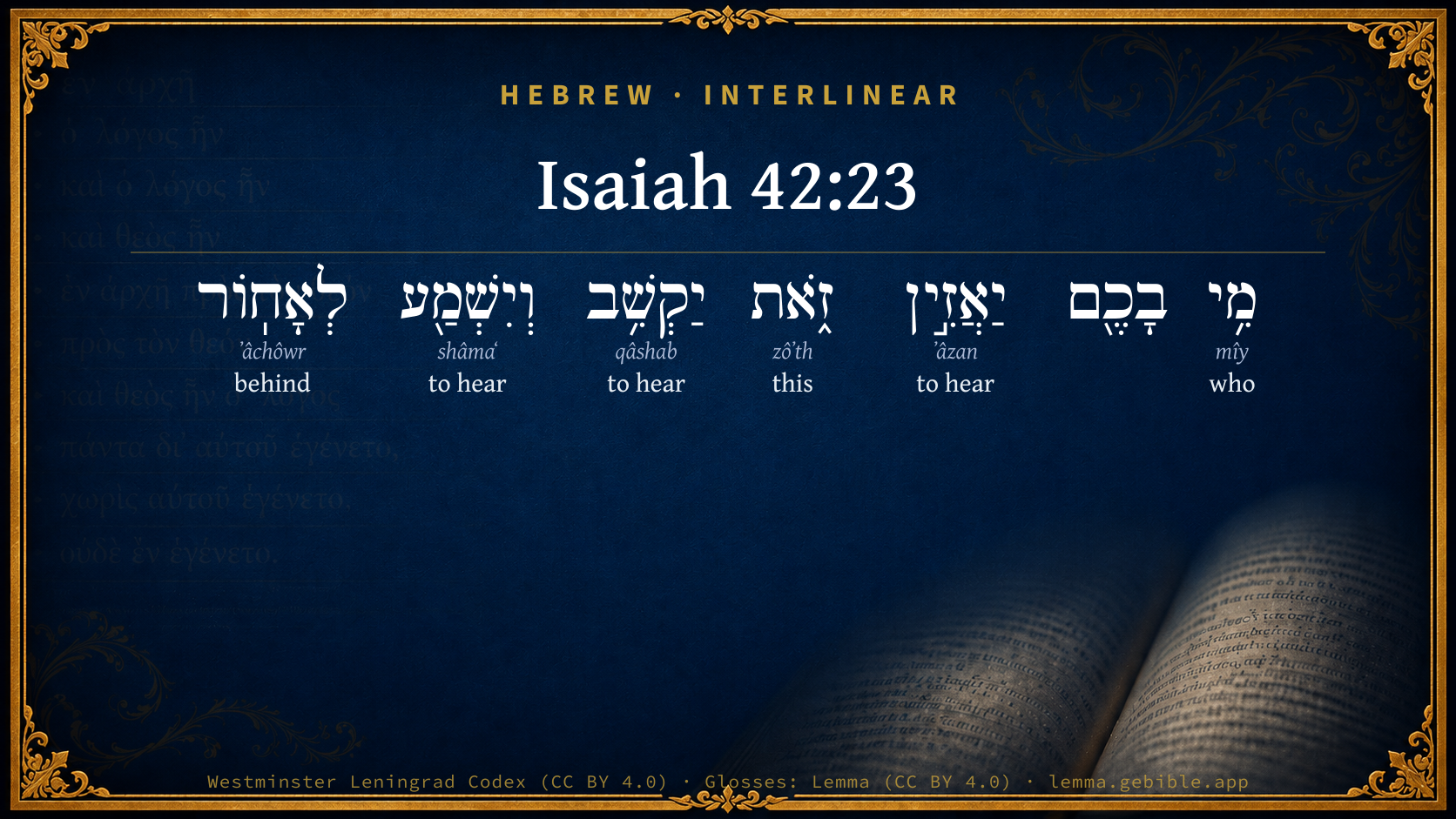
Isaiah 42:23

Hebrew (Westminster Leningrad Codex) Isaiah 42:23 appears in the Hebrew Old Testament. The text above is from the Westminster Leningrad Codex. Each word links to its Strong’s number, a concise gloss, and parsing drawn from the Open Scriptures Hebrew Bible morphology. Click any word for its full Brown-Driver-Briggs (BDB) entry.
Download image
Cite this verse

Isaiah 42:23 (World English Bible). Public Domain. Lemma interlinear Bible study tool, https://lemma.gebible.app/v/isaiah/42/23.

Show BibTeX & RIS
BibTeX
RIS
English Translation
Who is there among you who will give ear to this? who will listen and hear for the time to come?
World English Bible · Public Domain
Download a study sheet

One document with this verse’s original text, its word-by-word gloss line, the meaning frame, cross-references with their text, attributed commentary, and full source and license credits — printable, and it pastes into notes with its structure intact.

This verse Autodidact and up

Study sheet (.html) Plain text (.txt)

A passage Seminary Student

Up to 50 verses in one chapter. A passage sheet keeps up to 6 commentary sources and 12 cross-references per verse, in the order this page ranks them, and says so on the sheet whenever that leaves anything out. Ask for a single verse and you get the Autodidact verse sheet above.

Everything on this page stays free to read, with no account — the sheet is a download of what is already on screen, not access to it.

Want to remove ads? Support Godless Engineer
Compare translations 3

The same verse in 3 English versions, stacked beneath the original-language interlinear above. Click any original word for its lexicon entry.

Each is an independent rendering of the whole verse — the interlinear is not word-aligned to these translations.

Highlighted words mark where these versions differ — a whole-verse word diff, not a word-by-word alignment.

  • World English Bible Public Domain
    Who is there among you who will give ear to this? who will listen and hear for the time to come?
  • King James Version Public Domain
    Who among you will give ear to this? who will hearken and hear for the time to come?
  • unfoldingWord Literal Text CC BY-SA 4.0
    Who among you will listen to this, will attend and hear for afterward?

unfoldingWord Literal Text — © unfoldingWord, licensed CC BY-SA 4.0. Word-aligned USFM3 via Door43 (git.door43.org/unfoldingWord/en_ult).

Versions to compare (up to 4)

3 of 4 selected

Show all 18 translations

Every available English version of this verse, each an independent rendering of the whole verse.

  • World English Bible Public Domain
    Who is there among you who will give ear to this? who will listen and hear for the time to come?
  • Berean Standard Bible Public Domain
    Who among you will pay attention to this? Who will listen and obey hereafter?
  • Majority Standard Bible Public Domain
    Who among you will pay attention to this? Who will listen and obey hereafter?
  • King James Version Public Domain
    Who among you will give ear to this? who will hearken and hear for the time to come?
  • American Standard Version (1901) Public Domain
    Who is there among you that will give ear to this? that will hearken and hear for the time to come?
  • Revised Version (1885) Public Domain
    Who is there among you that will give ear to this? that will hearken and hear for the time to come?
  • Geneva Bible (1599) Public Domain
    Who among you shall hearken to this, and take heede, and heare for afterwardes?
  • Douay-Rheims (1899) Public Domain
    Who is there among you that will give ear to this, that will attend and hearken for times to come?
  • Young's Literal Translation Public Domain
    Who among you giveth ear `to' this? Attendeth, and heareth afterwards.
  • Literal Standard Version CC BY-SA 4.0
    Who among you gives ear [to] this? Attends, and hears afterward?
  • Unlocked Literal Bible CC BY-SA 4.0
    Who among you will listen to this? Who will listen and hear in the future?
  • unfoldingWord Literal Text CC BY-SA 4.0
    Who among you will listen to this, will attend and hear for afterward?
  • Darby Bible Public Domain
    Who among you will give ear to this, [who] will hearken and hear what is to come?
  • World Messianic Bible Public Domain
    Who is there among you who will give ear to this? Who will listen and hear for the time to come?
  • Webster's Bible Public Domain
    Who among you will give ear to this? who will hearken, and hear for the time to come?
  • Free Bible Version CC BY-SA 4.0
    Who of you is going to listen to this, or pay attention later on?
  • Bible in Basic English Public Domain
    Who is there among you who will give ear to this? who will give attention to it for the time to come?
  • JPS Tanakh (1917) Public Domain
    Who among you will give ear to this? Who will hearken and hear for the time to come?

Literal Standard Version (2020), Covenant Press — licensed CC BY-SA 4.0. Text via the HelloAO Bible API (eBible.org). Unlocked Literal Bible (unfoldingWord) — licensed CC BY-SA 4.0. Text via the HelloAO Bible API (eBible.org). unfoldingWord Literal Text — © unfoldingWord, licensed CC BY-SA 4.0. Word-aligned USFM3 via Door43 (git.door43.org/unfoldingWord/en_ult). Free Bible Version, Dr. Jonathan Gallagher — licensed CC BY-SA 4.0. Text via the HelloAO Bible API (eBible.org).

Word by word

More ways to search: Search by grammar → Find every occurrence → Compare this word →

Practice this passage: Drill this verse → Learn its vocabulary →

About this verse

These counts appear in no published source. They are computed here, from the morphology-tagged text and Lemma’s own curated glosses. What Lemma adds →

7
words
6
distinct lemmas
Prophets
section

Shared distinctive vocabulary

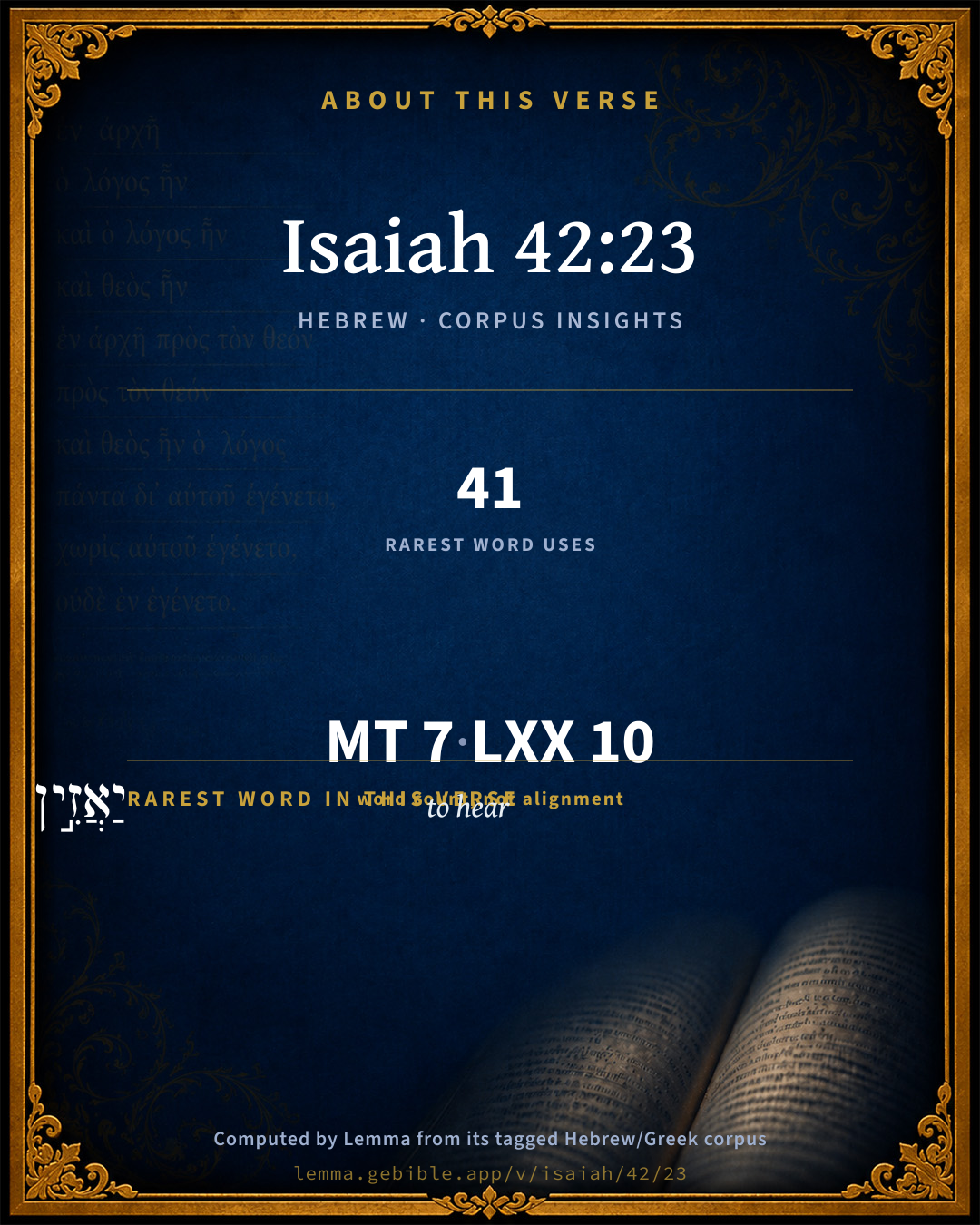
יַאֲזִ֣ין to hear H238 occurs in 41 verses of the Hebrew Bible. Also found in:

Grammatical profile

  • 3 verbs
  • 1 noun
  • 1 pronoun
  • 1 preposition
  • 1 particle

Verb forms

  • יַאֲזִ֣ין Hiphil · Imperfect
  • יַקְשִׁ֥ב Hiphil · Imperfect
  • וְיִשְׁמַ֖ע Qal · Imperfect

Hebrew & Septuagint length

In English translation the verse runs 21 words from the Hebrew and 22 from the Septuagint (LXX English) — closely comparable.

A rough comparison of the two English renderings, which tokenize alike — not a word-level alignment.

Word counts can differ between the Hebrew and the Greek without any difference in meaning — e.g. the Hebrew direct-object marker אֵת has no separate Greek word, and Greek often adds the article ὁ.

In the original languages it is 7 Hebrew tokens and 10 Greek tokens — but the two are counted differently (Hebrew bundles its prefixes and suffixes into one token; the Greek is in lemma form), so that isn’t a like-for-like length.

Cross-references

13

Topical passages linked to Isaiah 42:23 in the Treasury of Scripture Knowledge — connected by theme and wording, ordered by reader-vote popularity; previews shown in the World English Bible.

  • Isaiah 48:18 Oh that you had listened to my commandments! then had your peace been as a river, and your righteousness as the waves of the sea:
  • Acts 3:22–23 For Moses indeed said to the fathers, 'The Lord God will raise up a prophet for you from among your brothers, like me. You shall listen to him in all things whatever he says to you.
  • Leviticus 26:40–42 "'If they confess their iniquity, and the iniquity of their fathers, in their trespass which they trespassed against me, and also that, because they walked contrary to me,
  • Deuteronomy 4:29–31 But from there you shall seek Yahweh your God, and you shall find him, when you search after him with all your heart and with all your soul.
  • Deuteronomy 32:29 Oh that they were wise, that they understood this, That they would consider their latter end!
  • Proverbs 1:22–23 "How long, you simple ones, will you love simplicity? How long will mockers delight themselves in mockery, And fools hate knowledge?
  • Isaiah 1:18–20 "Come now, and let us reason together," says Yahweh: "Though your sins be as scarlet, they shall be as white as snow. Though they be red like crimson, they shall be as wool.
  • Jeremiah 3:4–7 Will you not from this time cry to me, My Father, you are the guide of my youth?
  • Jeremiah 3:13 Only acknowledge your iniquity, that you have transgressed against Yahweh your God, and have scattered your ways to the strangers under every green tree, and you have not obeyed my voice, says Yahweh.
  • Micah 6:9 Yahweh's voice calls to the city, And wisdom sees your name: "Listen to the rod, And he who appointed it.
  • Matthew 21:28–31 But what do you think? A man had two sons, and he came to the first, and said, 'Son, go work today in my vineyard.'
  • Acts 3:19 "Repent therefore, and turn again, that your sins may be blotted out, so that there may come times of refreshing from the presence of the Lord,
  • 1 Peter 4:2–3 that you no longer should live the rest of your time in the flesh for the lusts of men, but for the will of God.

Cross-references courtesy of OpenBible.info (CC BY 4.0).

Hebrew and Greek witnesses Masoretic Hebrew ↔ Greek Septuagint

The same verse in the two great witnesses to the Old Testament, shown verse-for-verse.

These are two independent witnesses, not word-aligned to each other, and the Septuagint is shown in lemma (dictionary) form.

Hebrew Isaiah 42:23 Masoretic · Westminster Leningrad Codex

מִ֥י בָכֶ֖ם יַאֲזִ֣ין זֹ֑את יַקְשִׁ֥ב וְיִשְׁמַ֖ע לְאָחֽוֹר

Who is there among you who will give ear to this? who will listen and hear for the time to come?

World English Bible · Public Domain

Greek LXX Isaiah 42:23 Septuagint · lemma form

τίς ἐν σύ ὅς ἐνωτίζομαι οὗτος εἰςἀκούω εἰς ὁ ἐπιἔρχομαι

Who is there among you that will give ear to these things? listen you⌃ to the things which are coming to pass.

LXX2012 (modern English Septuagint) · Public Domain

Hebrew: Westminster Leningrad Codex (CC BY 4.0). Greek: Septuagint (public domain); English from LXX2012 (modern English Septuagint) (Public Domain). How the Septuagint differs from the Hebrew →

Targum (Aramaic paraphrase)

1

The Targum is the ancient Jewish Aramaic paraphrase of the Hebrew Scriptures — an interpretive translation, not the Hebrew text itself. Onkelos (literal) and Pseudo-Jonathan (expansive) render the Torah, and Jonathan the Prophets. Coverage is partial: where no permissively-licensed English translation exists for a verse, only the Aramaic is shown. This is verse-level text, not a word-by-word alignment to the Hebrew.

  1. Targum Jonathan Prophets (Joshua–Malachi)
    מַן בְּכוֹן יָצֵית דָא יְקַבֵּל וִיסַבַּר לְסוֹפָא:

    Who is there among you that will listen to this? who will hearken, and consider for the time to come?

    Targum Jonathan — Aramaic: “Mikraot Gedolot” (public domain). English: “Sefaria Community Translation” (CC0 1.0 (public-domain dedication)); “London "Chaldee Paraphrase," 1871” (public domain). Text via Sefaria.

Commentary

Notes on Isaiah 42:23 from classic Christian and Jewish commentators (each source and its license shown beneath its notes). The classic Christian expositions comment on the surrounding passage and are grouped to its opening verse, so a note may address several verses; the Jewish commentaries on the Tanakh (Rashi and others) are per-verse, so they appear only where the commentator wrote on this verse.

Lemma curates 59 commentaries, every one of them public domain or Creative Commons licensed, each selected and text-cleaned for this edition rather than reprinted as found. About our sources →

Trapp's Complete Commentary

John Trapp

Isa 42:23 Who among you will give ear to this? [who] will hearken and hear for the time to come?

Ver. 23. Who among you will give ear to this?] Magna nimirum haec sunt, sed paucis persuasa. We shall have much ado to make you believe these things, though your liberties, lives, and souls lie upon it.

John Trapp, A Commentary or Exposition upon All the Books of the Old and New Testament (1647–1656) — public domain. Text from a community e-Sword module.

The Biblical Illustrator

Joseph S. Exell

Isa_42:23-25

Who among you will give ear to this?

--

National calamities

I. THE TRUE CAUSE OF NATIONAL CALAMITIES IS HERE POINTED OUT--SIN. The public distresses of the men of Judah and Israel did not proceed from fate or fortune, but from the Supreme Lord of the universe, who, as the just punishment of their atrocious wickedness, delivered them into the hands of them who spoiled and deprived them of their possessions. Their most powerful enemies could not have treated them in the manner here described had not He who rules in the kingdoms of men given them as a prey on account of their aggravated and multiplied transgressions. Though the various events, prosperous and adverse, that happen to nations and individuals are brought about by the intervention of means and instruments, the hand of the Almighty ought never to be overlooked, but humbly acknowledged. Is there any evil in the city, and the Lord hath not done it? Afflictions are necessary to the government of the world in its present state; they check the progress of wickedness, and show the dreadful consequences of incurring the wrath of the Almighty.

II. THE JUST CONSEQUENCE OF TRANSGRESSION IS HERE DESCRIBED. Therefore, because they would not walk in all His ways, etc. The deplorable state of the Jewish nation at the time this prophecy was delivered, and in succeeding periods, is here graphically described. An awful instance of the Divine judgments!

III. THE ONLY METHOD TO ESCAPE DIVINE JUDGMENT IS HERE SUGGESTED. The prophet directs his discourse to the hypocritical and disobedient, who were averse to admit light into their minds, to admit conviction of their sin and danger. They were neither affected by the calamities which they felt, nor feared those with which they were threatened, though the storm was gathering thick around them. Of such people the Jewish nation were mostly composed at the time of the prophecy; and the prophet inquires, Who among you will give ear to this, and hearken for the time to come? (T. Lewis.)

The Biblical Illustrator, edited by Joseph S. Exell (c. 1880s–1900s) — public domain. Text from a community e-Sword module.

The Preacher's Complete Homiletical Commentary

Joseph S. Exell (gen. ed.)

THE SUBJECTION OF THE JEWS AN ADMONITION TO THE WORLD

Isa_42:23-25. Who among you will give ear to this? &c.

I. The desolation brought upon the Jews. Terrible. Sent upon them by God. Defeated after their rejection of the Messiah. It continues to this day.

II. The justice of the sentence that is gone forth against them.

III. Their insensibility under these judgments. They do not see the sentence which, in evil hour, their own ancestors pronounced against them: “His blood be on us and on our children!”—and on them it hath been. This is the awful curse under which they are now drooping and groaning (H. E. I., 143).

IV. An appeal arising out of this awful dispensation as applicable to ourselves. The whole history of the Jews is intended to be an admonition to us. Sharing in their sins, we shall certainly share in their chastisements.—R. C. Dillon, M.A.: Sermons, pp. 72–103.

DEADENED BY SIN

Isa_42:25. And it burned him, yet he laid it not to heart.

One of the most evil results of sin is, that it hardens and deadens the soul. When persisted in it goes beyond the stage of arousing anxiety and alarm; it stupefies and benumbs, so that a man gets “past feeling.” What a pitiable object does he become who is so under the influence of poison that he is no longer himself! Fire burns him, yet so insensible is he, that where a healthy man would be active in self-defence, he lays it not to heart (H. E. I., 4535, 4540). We take the meaning of the text to be, that the corrupt part of Israel had become so depraved by their sins that they were not to be roused even though they witnessed the judgments of God inflicting upon the nation the just penalties of their rebellions: “they laid it not to heart.” It matters not whether we regard the judgment as a special interposition of God or as a natural result of sin, the doctrine is frequently illustrated in human experience. All sin carries with it a fire that burns the sinner; yet we see instances in which the sinner has been previously so hardened that he lays it not to heart, and the fire goes on burning him. E.g.,—

1. The fire of Covetousness takes hold upon some men. The just desire to secure a fitting recompense for honest effort is here distorted into a consuming fire of avarice. How seriously it deadens all the higher faculties of their nature. Selfishness is the centre of their life, and there they live in the midst of one raging desire, the desire for possessions, to the exclusion of God and divine things. Ponder this picture of insensibility as drawn by Christ’s own hand (Luk_12:15-21).

2. The fire of Lust does deadly damage upon others. Here the lurid flames of unholy passion obtain the mastery where God’s temple should be (1Co_6:19). The powers of body and mind sink down in debasement under the tyranny of this ruinous vice.

3. The fire of Intemperance has a destructive hold upon tens of thousands. And how insensible its victims become! Draw the too well known and familiar picture of a drunkard’s life, and a drunkard’s home. Health, property, reputation, comfort, all drop away: wife and family are debased; yet, whilst poverty and ruin are creeping over the scene, he can look upon it all with astonishing indifference. The fire burns him and his, yet he lays it not to heart.

These instances suggest many others. How fearfully true it is that men can live in such flames as these, and not lay it to heart.

They remain insensible—

1. To all Warning.

2. To most Impressive Examples in the fate of others.

3. To most Agonising Convictions which now and then haunt even themselves.

CONCLUSION.—Where fire is concerned, prompt, earnest, and wise attention is the duty of the moment. If there be some feeling left, begin with that, and lay hold of recovering help.—William Manning.

The Preacher's Complete Homiletical Commentary (gen. ed. Joseph S. Exell; Funk & Wagnalls, c. 1892) — public domain (pre-1929). A full-Bible homiletical/sermon-outline anthology covering 65 of 66 books (2 John is absent from the source module). Text from a community e-Sword module.

Keil & Delitzsch

C. F. Keil & F. Delitzsch

When they ceased to be deaf to this crying contradiction, they would recognise with penitence that it was but the merited punishment of God. "Who among you will give ear to this, attend, and hear afar off? Who has give up Jacob to plundering, and Israel to the spoilers? Is it not Jehovah, against whom we have sinned? and they would not walk in His ways, and hearkened not to His law. Then He poured upon it in burning heat His wrath, and the strength of the fury of war: and this set it in flames round about, and it did not come to be recognised; it set it on fire, and it did not lay it to heart." The question in Isa 42:23 has not the force of a negative sentence, "No one does this," but of a wish, "O that one would" (as in Sa2 23:15; Sa2 15:4; Ges. 136, 1). If they had but an inward ear for the contradiction which the state of Israel presented to its true calling, and the earlier manifestations of divine mercy, and would but give up their previous deafness for the time to come: this must lead to the knowledge and confession expressed in Isa 42:24. The names Jacob and Israel here follow one another in the same order as in Isa 29:23; Isa 40:27 (compare Isa 41:8, where this would have been impracticable). זוּ belongs to לו in the sense of cui. The punctuation does not acknowledge this relative use of זו (on which, see at Isa 43:21), and therefore puts the athnach in the wrong place (see Rashi). In the words "we have sinned" the prophet identifies himself with the exiles, in whose sin he knew and felt that he was really involved (cf., Isa 6:5). The objective affirmation which follows applies to the former generations, who had sinned on till the measure became full. הלוך takes the place of the object to אבוּ (see Isa 1:17); the more usual expression would be ללכת; the inverted order of the words makes the assertion all the more energetic. In Isa 42:25 the genitive relation אפּו חמת is avoided, probably in favour of the similar ring of חמה and מלחמה. חמה is either the accusative of the object, and אפּו a subordinate statement of what constituted the burning heat (cf., Ewald, 287, k), or else an accusative, of more precise definition = בּחמה in Isa 66:15 (Ges. 118, 3). The outpouring is also connected by zeugma with the "violence of war." The milchâmâh then becomes the subject. The war-fury raged without result. Israel was not brought to reflection.

Keil & Delitzsch — Biblical Commentary on the Old Testament (1861–1891) — public domain (CC PDM 1.0). Text via the HelloAO Bible API. (Old Testament only.)

Geneva Bible (1599)

Geneva Bible translators

Meaning, God’s wrath.

Geneva Bible (1599) marginal notes — public domain. Text via Bolls.life.

Jamieson, Fausset & Brown

Robert Jamieson, A. R. Fausset & David Brown

A call that they should be warned by the past judgments of God to obey Him for the time to come.

Jamieson, Fausset & Brown — Commentary Critical and Explanatory on the Whole Bible (1871) — public domain (CC PDM 1.0). Text via the HelloAO Bible API.

The Cambridge Bible for Schools and Colleges

gen. ed. J. J. S. Perowne

23. The question expresses the prophet’s wish that now at last some of the people should begin to realise the significance of their relation to Jehovah, and prepare themselves for the great deliverance.

will give ear to this] i.e. to the substance of the present exhortation,—the contrast between the ideal calling of Israel and its present position, its failure to realise its mission, and (especially) the reason of that failure (Isa_42:24 f.).

for the time to come] in contrast to past disobedience. It is evident that the prophet expects the mission of Israel to be realised by a conversion of the nation. The process of that conversion is powerfully described in ch. 53.

The Cambridge Bible for Schools and Colleges (gen. ed. J. J. S. Perowne; Cambridge University Press, 1878–1918) — public domain. Text from a community e-Sword module.

John Gill's Exposition

Who gave Jacob for a spoil, and Israel to the robbers?.... To the Roman soldiers, to be spoiled and robbed by them? this was not owing to chance and fortune, or to the superior skill and power of the Roman army:

did not the Lord, he against whom we have sinned? he did, but not without cause; he was justly provoked to it by the sins of the Jews, which were the meritorious and procuring causes of it; yet the Roman army could not have taken their city and plundered it had it not been the will of God, who for their sins, delivered it up to them; even Titus, the Heathen emperor, himself saw the hand of God in it, and acknowledged it;

"God favouring us (says he (c)) we have made war; it is God that drew the Jews out of those fortresses; for what could human hands and machines do against such towers?''

for they would not walk in his ways; in Christ, the way, the truth, and the life; nor in the ways of his commandments; or in the ordinances of the Gospel; all which they rejected:

neither were they obedient unto his law; or "doctrine" (d); the doctrine of the Gospel, particularly the doctrine of justification by faith in the righteousness of Christ; they went about to establish their own righteousness, and did not submit to his; and also every other doctrine respecting the person, office, and grace of Christ, whom they disbelieved, and refused to receive.

(c) lb. (De Bello Jud. l. 7. c. 9.) sect. 1. (d) "non acquieverunt in doctrina ejus", Forerius.

John Gill's Exposition of the Whole Bible (1746–1763) — public domain (CC PDM 1.0). Text via the HelloAO Bible API.

Albert Barnes' Notes on the Bible

Who among you will give ear to this? - Who is there in the nation that will be so warned by the judgments of God, that he will attend to the lessons which he designs to teach, and reform his life, and return to him? It is implied by these questions that such ought to be the effect; it is implied also that they were so sunken and abandoned that they would not do it. These judgments were a loud call on the nation to turn to God, and, in time to come, to avoid the sins which had made it necessary for him to interpose in this manner, and give them to spoil.

Albert Barnes' Notes on the Bible (1834–1885) — public domain. Text from a community e-Sword/MySword module.

Matthew Poole's English Annotations

Oh that you would learn from your former and dear bought experiences to be wiser for the future, and not to provoke God to your own total and final ruin!

Matthew Poole's English Annotations on the Holy Bible (1683–1685) — public domain. Text from a community e-Sword/MySword module.

The Pulpit Commentary

Who among you will give ear? Surely there are some among you, less hardened than the rest, who will take advantage of my warning, and repent at this, the eleventh hour. God"s arm was straitened; the people could not be delivered out of captivity unless they ceased in large numbers to be "blind" and "deaf unless they listened to the prophet"s words, and profited by them.

The Pulpit Commentary (1880–1919), ed. H.D.M. Spence-Jones & Joseph S. Exell — public domain. Text from a community e-Sword module.

J. A. Alexander on Isaiah

Joseph Addison Alexander

“Who among you will give ear to this, will hearken and hear for the time to come?” By this we are not to understand merely the fact recorded in the foregoing verse, but the doctrine of the whole preceding context as to the vocation and mission of Israel and his actual condition. God had appointed him to be a source or at least a medium of light and blessing to the nations; but instead of acting up to this high character, he not only left the nations without light, but was willfully blinded and insensible himself. Yet God would still be true to His engagements, and put honor on the special revelation which He had already given. Why, then, it might be asked, was Israel suffered to fall before his enemies? The answer to this question is introduced by an indirect caution to consider it and bear it in mind. The interrogative form implies the possibility of their neglecting or refusing to obey it. The last phrase relates either to the time of hearing (henceforth or hereafter) or the subject of the declarations to be heard (concerning the future).

Joseph Addison Alexander, The Prophecies of Isaiah (1846–1847; New York: Scribner, 1870–1878) — public domain. Text from a community e-Sword module.

unfoldingWord translationNotes

Door43 World Missions Community

General Information:

Here Isaiah begins speaking.

Who among you

Here "you" is plural and refers to the people of Israel. (See: Forms of You)

Who gave Jacob over to the robber, and Israel to the looters?

These two phrases mean the same thing. Isaiah uses this as a leading question in order to emphasize the answer that he will give in the next phrase. AT: "I will tell you who gave the people of Israel over to robbers and looters." (See: Rhetorical Question and Parallelism)

Was it not Yahweh ... refused to obey?

Isaiah uses this rhetorical question to emphasize that Yahweh alone was responsible for Israel's situation, and to explain the reason that Yahweh did it. AT: "It was certainly Yahweh ... refused to obey." (See: Rhetorical Question)

against whom we have sinned

Here the word "we" refers to the people of Israel and to Isaiah. (See: Inclusive "We")

in whose ways they refused to walk, and whose law they refused to obey

The word "they" also refers to the people of Israel and to Isaiah. The two phrases mean the same thing. In the first, obeying Yahweh's laws is spoken of as if it were walking in the paths in which Yahweh commanded them to walk. (See: Parallelism and Metaphor)

translationWords

Jacob

Israel

Yahweh

sin

walk

law, laws

obey

unfoldingWord translationNotes — © Distant Shores Media and the Door43 World Missions Community, licensed CC BY-SA 4.0. Source: git.door43.org/Door43/en_tn.

Rashi

Rabbi Shlomo Yitzchaki (Rashi)

will hearken to pay attention to this, “Who subjected Jacob to plunder?”

for the future Who will hearken and hear something that will stand him in good stead at the end? Jonathan, too, renders: לְסוֹפָא, at the end, and likewise, every לְאָחוֹר in Scripture refers to something that is destined to be.

Rashi on the Tanakh — English translations: “The Judaica Press complete Tanach with Rashi, translated by A. J. Rosenberg” (CC BY 4.0); “Pentateuch with Rashi's commentary by M. Rosenbaum and A.M. Silbermann, 1929-1934” (public domain); “The Metsudah Tanach series, Lakewood, N.J” (CC BY 4.0); and “The Book of Joshua, Metsudah Publications, 1997” (CC BY 4.0). Text via Sefaria.

Lesson kit

Teaching starters — assembled from the data on this page, not authored interpretation. Every prompt links to the verse data it draws on. Edit before teaching.

Isaiah, in the Prophets, opens this verse with 7 words (6 distinct Hebrew lemmas). Its most distinctive word is ʼâzan (“to hear”). A historical commentator’s framing appears above. Read the whole chapter for the surrounding context.

Discussion questions

  1. How does “to hear” (ʼâzan) shape what this verse is saying?
  2. Genesis 4:23 shares the word «to hear» with this verse. How do the two illuminate each other?
  3. These translations render this verse differently; the difference is in the English rendering, not the original. What questions does that raise?
  4. The verb «יַאֲזִ֣ין» is Hiphil Imperfect. How does its form color the action?
  5. Reading how Trapp's Complete Commentary and The Biblical Illustrator read this verse, where do the two commentators agree and where do they part?

Things to notice

Reading settings

Reading text

Shown beneath each verse's original-language words.

Old Testament
Old Testament edition

Read the OT as the Masoretic Hebrew (MT) or the Greek Septuagint (LXX).

English shown for the Greek Septuagint (in the Hebrew ↔ Greek comparison).

Comparing translations? Open the Compare panel on any verse page to stack up to four side by side.