
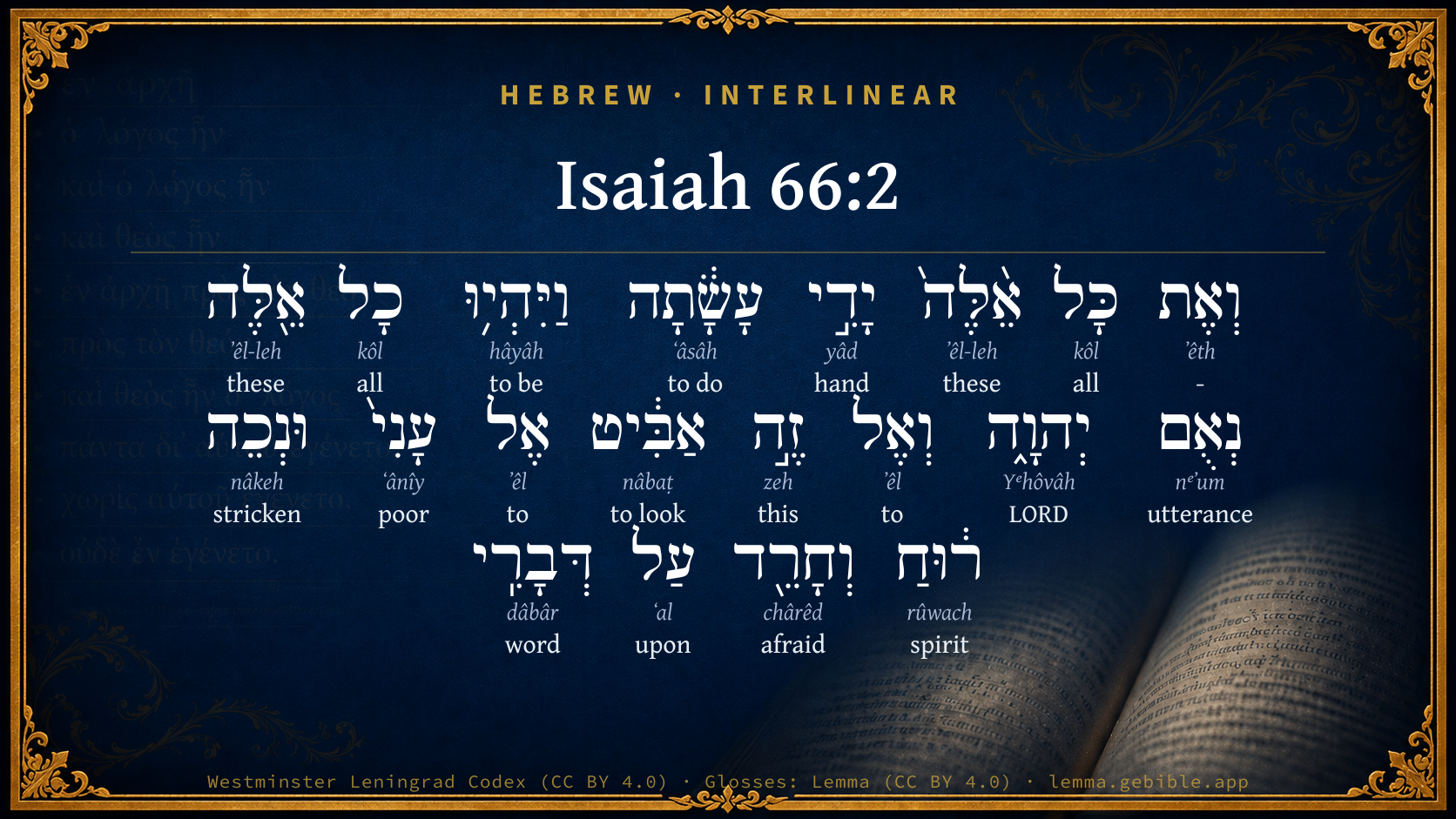
Isaiah 66:2

Hebrew (Westminster Leningrad Codex) Isaiah 66:2 appears in the Hebrew Old Testament. The text above is from the Westminster Leningrad Codex. Each word links to its Strong’s number, a concise gloss, and parsing drawn from the Open Scriptures Hebrew Bible morphology. Click any word for its full Brown-Driver-Briggs (BDB) entry.
Download image
Cite this verse

Isaiah 66:2 (World English Bible). Public Domain. Lemma interlinear Bible study tool, https://lemma.gebible.app/v/isaiah/66/2.

Show BibTeX & RIS
BibTeX
RIS
English Translation
For all these things has my hand made, and [so] all these things came to be, says Yahweh: but to this man will I look, even to him who is poor and of a contrite spirit, and who trembles at my word.
World English Bible · Public Domain
Download a study sheet

One document with this verse’s original text, its word-by-word gloss line, the meaning frame, cross-references with their text, attributed commentary, and full source and license credits — printable, and it pastes into notes with its structure intact.

This verse Autodidact and up

Study sheet (.html) Plain text (.txt)

A passage Seminary Student

Up to 50 verses in one chapter. A passage sheet keeps up to 6 commentary sources and 12 cross-references per verse, in the order this page ranks them, and says so on the sheet whenever that leaves anything out. Ask for a single verse and you get the Autodidact verse sheet above.

Everything on this page stays free to read, with no account — the sheet is a download of what is already on screen, not access to it.

Want to remove ads? Support Godless Engineer
Compare translations 3

The same verse in 3 English versions, stacked beneath the original-language interlinear above. Click any original word for its lexicon entry.

Each is an independent rendering of the whole verse — the interlinear is not word-aligned to these translations.

Highlighted words mark where these versions differ — a whole-verse word diff, not a word-by-word alignment.

  • World English Bible Public Domain
    For all these things has my hand made, and [so] all these things came to be, says Yahweh: but to this man will I look, even to him who is poor and of a contrite spirit, and who trembles at my word.
  • King James Version Public Domain
    For all those things hath mine hand made, and all those things have been, saith the LORD: but to this man will I look, even to him that is poor and of a contrite spirit, and trembleth at my word.
  • unfoldingWord Literal Text CC BY-SA 4.0
    For all of these, my hand has made; so all of these are” —the declaration of Yahweh. q1 “And to this I look, to the humble and contrite of spirit, and trembling at my word.

unfoldingWord Literal Text — © unfoldingWord, licensed CC BY-SA 4.0. Word-aligned USFM3 via Door43 (git.door43.org/unfoldingWord/en_ult).

Versions to compare (up to 4)

3 of 4 selected

Show all 18 translations

Every available English version of this verse, each an independent rendering of the whole verse.

  • World English Bible Public Domain
    For all these things has my hand made, and [so] all these things came to be, says Yahweh: but to this man will I look, even to him who is poor and of a contrite spirit, and who trembles at my word.
  • Berean Standard Bible Public Domain
    Has not My hand made all these things? And so they came into being,” declares the LORD. “This is the one I will esteem: he who is humble and contrite in spirit, who trembles at My word.
  • Majority Standard Bible Public Domain
    Has not My hand made all these things? And so they came into being,” declares the LORD. “This is the one I will esteem: he who is humble and contrite in spirit, who trembles at My word.
  • King James Version Public Domain
    For all those things hath mine hand made, and all those things have been, saith the LORD: but to this man will I look, even to him that is poor and of a contrite spirit, and trembleth at my word.
  • American Standard Version (1901) Public Domain
    For all these things hath my hand made, and `so' all these things came to be, saith Jehovah: but to this man will I look, even to him that is poor and of a contrite spirit, and that trembleth at my word.
  • Revised Version (1885) Public Domain
    For all these things hath mine hand made, and so all these things came to be, saith the LORD: but to this man will I look, even to him that is poor and of a contrite spirit, and that trembleth at my word.
  • Geneva Bible (1599) Public Domain
    For all these things hath mine hand made, and all these things haue bene, sayth the Lord: and to him will I looke, euen to him, that is poore, and of a contrite spirite and trembleth at my wordes.
  • Douay-Rheims (1899) Public Domain
    My hand made all these things, and all these things were made, saith the Lord. But to whom shall I have respect, but to him that is poor and little, and of a contrite spirit, and that trembleth at my words?
  • Young's Literal Translation Public Domain
    And all these My hand hath made, And all these things are, An affirmation of Jehovah! And unto this one I look attentively, Unto the humble and bruised in spirit, And who is trembling at My word.
  • Literal Standard Version CC BY-SA 4.0
    And My hand has made all these, || And all these things are,” || A declaration of YHWH! “And to this one I look attentively, || To the humble and bruised in spirit, || And who is trembling at My word.
  • Unlocked Literal Bible CC BY-SA 4.0
    My hand has made all these things; that is how these things came to be—this is Yahweh's declaration. This is the man of whom I approve, the broken and contrite in spirit, and who trembles at my word.
  • unfoldingWord Literal Text CC BY-SA 4.0
    For all of these, my hand has made; so all of these are” —the declaration of Yahweh. q1 “And to this I look, to the humble and contrite of spirit, and trembling at my word.
  • Darby Bible Public Domain
    Even all these things hath my hand made, and all these things have been, saith Jehovah. But to this man will I look: to the afflicted and contrite in spirit, and who trembleth at my word.
  • World Messianic Bible Public Domain
    For my hand has made all these things, and so all these things came to be,” says the LORD: “but I will look to this man, even to he who is poor and of a contrite spirit, and who trembles at my word.
  • Webster's Bible Public Domain
    For all these things hath my hand made, and all these things have been, saith the LORD: but to this man will I look, even to him that is poor and of a contrite spirit, and trembleth at my word.
  • Free Bible Version CC BY-SA 4.0
    I made everything; that's how it all came into existence, says the Lord. Those I look favorably on are humble and repentant, and they tremble when I speak.
  • Bible in Basic English Public Domain
    For all these things my hand has made, and they are mine, says the Lord; but to this man only will I give attention, to him who is poor and broken in spirit, fearing my word.
  • JPS Tanakh (1917) Public Domain
    For all these things hath My hand made, and so all these things came to be, saith the LORD; but on this man will I look, even on him that is poor and of a contrite spirit, and trembleth at My word.

Literal Standard Version (2020), Covenant Press — licensed CC BY-SA 4.0. Text via the HelloAO Bible API (eBible.org). Unlocked Literal Bible (unfoldingWord) — licensed CC BY-SA 4.0. Text via the HelloAO Bible API (eBible.org). unfoldingWord Literal Text — © unfoldingWord, licensed CC BY-SA 4.0. Word-aligned USFM3 via Door43 (git.door43.org/unfoldingWord/en_ult). Free Bible Version, Dr. Jonathan Gallagher — licensed CC BY-SA 4.0. Text via the HelloAO Bible API (eBible.org).

Word by word

More ways to search: Search by grammar → Find every occurrence → Compare this word →

Practice this passage: Drill this verse → Learn its vocabulary →

וּנְכֵה
nâkeh
H5223
“and · stricken of”
Conjunction + Adjective, Adjective, Masculine, Singular, Construct
Part of Speech
Conjunction + Adjective
Type
Adjective
Gender
Masculine
Number
Singular
State
Construct
Full BDB Definition

Origin: TWOT - H1364 a

TWOT: adj

stricken, smitten
  1. וְאֶת ʼêth H853 “and · -” Conjunction + Particle, Direct Object
  2. כָּל kôl H3605 “all of” Noun, Common, Masculine, Singular, Construct
  3. אֵ֨לֶּה֙ ʼêl-leh H428 “these” Pronoun, Demonstrative, Common, Plural
  4. יָדִ֣י yâd H3027 “hand · my” Noun, Common, Both, Singular, Construct + Suffix, Personal, 1st Person, Common, Singular
  5. עָשָׂ֔תָה ʻâsâh H6213 “to do” Verb, Qal, Perfect, 3rd Person, Feminine, Singular
  6. וַיִּהְי֥וּ hâyâh H1961 “and · to be” Conjunction + Verb, Qal, Sequential Imperfect, 3rd Person, Masculine, Plural
  7. כָל kôl H3605 “all of” Noun, Common, Masculine, Singular, Construct
  8. אֵ֖לֶּה ʼêl-leh H428 “these” Pronoun, Demonstrative, Common, Plural
  9. נְאֻם nᵉʼum H5002 “utterance of” Noun, Common, Masculine, Singular, Construct
  10. יְהוָ֑ה Yᵉhôvâh H3068 “LORD” Noun, Proper
  11. וְאֶל ʼêl H413 “and · to” Conjunction + Preposition
  12. זֶ֣ה zeh H2088 “this” Pronoun, Demonstrative, Masculine, Singular
  13. אַבִּ֔יט nâbaṭ H5027 “to look” Verb, Hiphil, Imperfect, 1st Person, Common, Singular
  14. אֶל ʼêl H413 “to” Preposition
  15. עָנִי֙ ʻânîy H6041 “poor” Adjective, Adjective, Masculine, Singular, Absolute
  16. ר֔וּחַ rûwach H7307 “spirit” Noun, Common, Both, Singular, Absolute
  17. וְחָרֵ֖ד chârêd H2730 “and · afraid” Conjunction + Adjective, Adjective, Masculine, Singular, Absolute
  18. עַל ʻal H5921 “upon” Preposition
  19. דְּבָרִֽי dâbâr H1697 “word · my” Noun, Common, Masculine, Singular, Construct + Suffix, Personal, 1st Person, Common, Singular

About this verse

These counts appear in no published source. They are computed here, from the morphology-tagged text and Lemma’s own curated glosses. What Lemma adds →

20
words
17
distinct lemmas
Prophets
section

Notable vocabulary

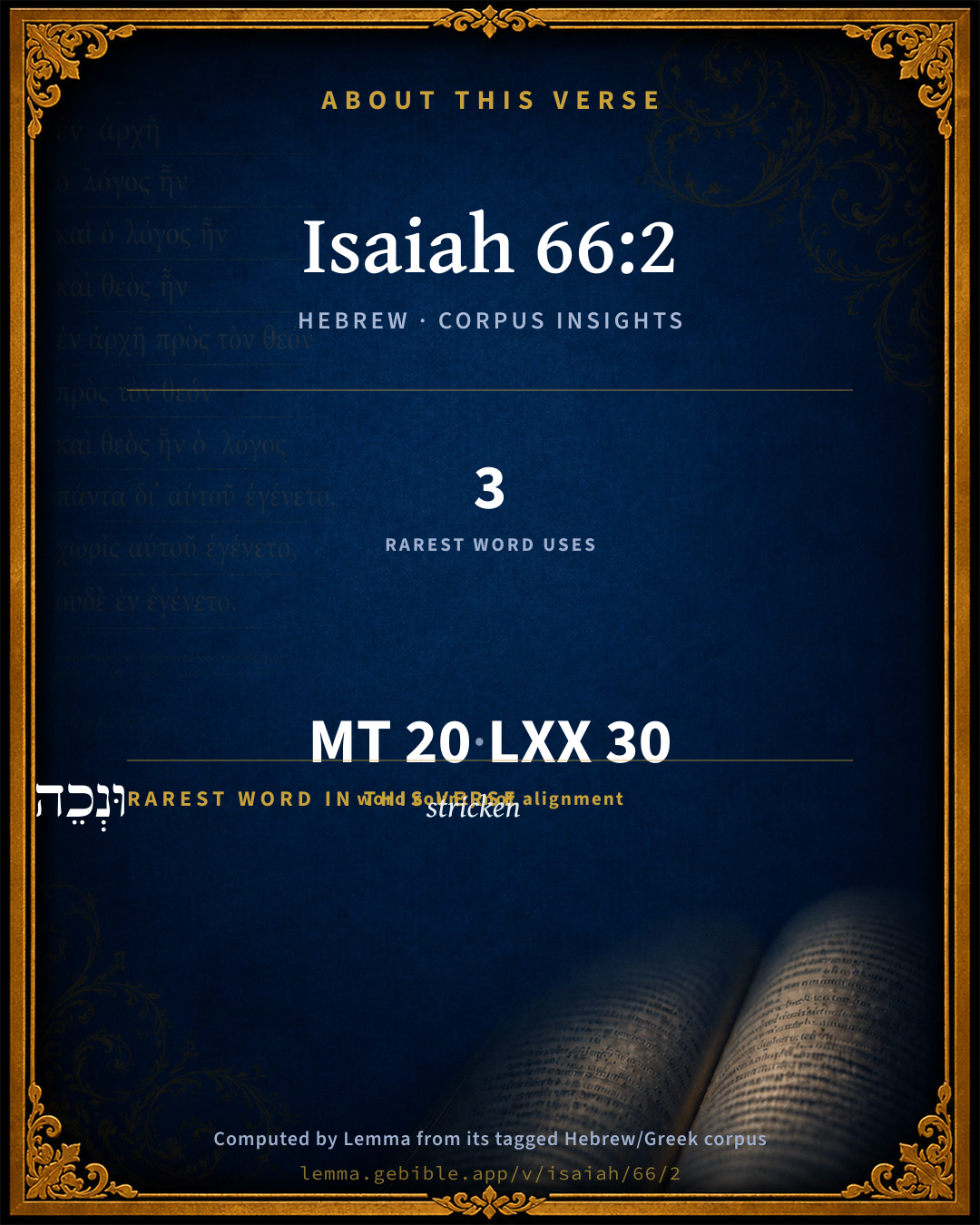
The rarest word here is וּנְכֵה stricken H5223 — appearing just 3 times in the whole Hebrew Bible.

Shared distinctive vocabulary

וּנְכֵה stricken H5223 occurs in 3 verses of the Hebrew Bible. Also found in:

Grammatical profile

  • 3 verbs
  • 7 nouns
  • 3 adjectives
  • 3 pronouns
  • 3 prepositions
  • 1 particle

Verb forms

  • עָשָׂ֔תָה Qal · Perfect
  • וַיִּהְי֥וּ Qal · Sequential Imperfect
  • אַבִּ֔יט Hiphil · Imperfect

Repetition

Words recur within this verse — often emphatic in Hebrew:

  • כָּל all H3605 ×2
  • אֵ֨לֶּה֙ these H428 ×2
  • וְאֶל to H413 ×2

Hebrew & Septuagint length

In English translation the verse runs 42 words from the Hebrew and 30 from the Septuagint (LXX English) — the Septuagint runs noticeably shorter here. See the side-by-side →

A rough comparison of the two English renderings, which tokenize alike — not a word-level alignment.

Word counts can differ between the Hebrew and the Greek without any difference in meaning — e.g. the Hebrew direct-object marker אֵת has no separate Greek word, and Greek often adds the article ὁ.

In the original languages it is 20 Hebrew tokens and 30 Greek tokens — but the two are counted differently (Hebrew bundles its prefixes and suffixes into one token; the Greek is in lemma form), so that isn’t a like-for-like length.

Cross-references

25

Topical passages linked to Isaiah 66:2 in the Treasury of Scripture Knowledge — connected by theme and wording, ordered by reader-vote popularity; previews shown in the World English Bible.

  • Isaiah 57:15 For thus says the high and lofty One who inhabits eternity, whose name is Holy: I dwell in the high and holy place, with him also who is of a contrite and humble spirit, to revive the spirit of the humble, and to revive the heart of the contrite.
  • Psalms 34:18 Yahweh is near to those who have a broken heart, And saves those who have a crushed spirit.
  • Psalms 51:17 The sacrifices of God are a broken spirit. A broken and contrite heart, O God, you will not despise.
  • Matthew 5:3–4 "Blessed are the poor in spirit, For theirs is the Kingdom of Heaven.
  • 2 Chronicles 34:27–28 because your heart was tender, and you did humble yourself before God, when you heard his words against this place, and against the inhabitants of it, and have humbled yourself before me, and have torn your clothes, and wept before me; I also have heard you, says Yahweh.
  • Proverbs 28:14 Blessed is the man who always fears; But one who hardens his heart falls into trouble.
  • Philippians 2:12 So then, my beloved, even as you have always obeyed, not only in my presence, but now much more in my absence, work out your own salvation with fear and trembling.
  • Psalms 119:120 My flesh trembles for fear of you. I am afraid of your judgments.
  • Psalms 138:6 For though Yahweh is high, yet he looks after the lowly; But the proud, he knows from afar.
  • Luke 18:13–14 But the tax collector, standing far away, wouldn't even lift up his eyes to heaven, but beat his breast, saying, 'God, be merciful to me, a sinner!'
  • Isaiah 66:5 Hear the word of Yahweh, you who tremble at his word: Your brothers who hate you, who cast you out for my name's sake, have said, Let Yahweh be glorified, that we may see your joy; but it is those who shall be disappointed.
  • Isaiah 61:1 The Spirit of the Lord Yahweh is on me; because Yahweh has anointed me to preach good news to the humble; he has sent me to bind up the broken-hearted, to proclaim liberty to the captives, and the opening [of the prison] to those who are bound;
  • Ezra 10:3 Now therefore let us make a covenant with our God to put away all the wives, and such as are born of them, according to the counsel of my lord, and of those who tremble at the commandment of our God; and let it be done according to the law.
  • Habakkuk 3:16 I heard, and my body trembled. My lips quivered at the voice. Rottenness enters into my bones, and I tremble in my place, Because I must wait quietly for the day of trouble, For the coming up of the people who invade us.
  • 2 Kings 22:19–20 because your heart was tender, and you did humble yourself before Yahweh, when you heard what I spoke against this place, and against the inhabitants of it, that they should become a desolation and a curse, and have torn your clothes, and wept before me; I also have heard you, says Yahweh.
  • Psalms 119:161 Princes have persecuted me without a cause, But my heart stands in awe of your words.
  • Ezra 9:4 Then were assembled to me everyone who trembled at the words of the God of Israel, because of the trespass of them of the captivity; and I sat confounded until the evening offering.
  • Jeremiah 31:19–20 Surely after that I was turned, I repented; and after that I was instructed, I struck on my thigh: I was ashamed, yes, even confounded, because I did bear the reproach of my youth.
  • Ezekiel 9:4–6 Yahweh said to him, Go through the midst of the city, through the midst of Jerusalem, and set a mark on the foreheads of the men that sigh and that cry over all the abominations that are done in the midst of it.
  • Acts 16:29–30 He called for lights and sprang in, and, fell down trembling before Paul and Silas,
  • Isaiah 40:26 Lift up your eyes on high, and see who has created these, who brings out their host by number; he calls them all by name; by the greatness of his might, and because he is strong in power, not one is lacking.
  • Colossians 1:17 He is before all things, and in him all things are held together.
  • Genesis 1:1–31 In the beginning God created the heavens and the earth.
  • Hebrews 1:2–3 has at the end of these days spoken to us by his Son, whom he appointed heir of all things, through whom also he made the worlds.
  • Acts 9:6 But rise up, and enter into the city, and you will be told what you must do."

Cross-references courtesy of OpenBible.info (CC BY 4.0).

Hebrew and Greek witnesses Masoretic Hebrew ↔ Greek Septuagint

The same verse in the two great witnesses to the Old Testament, shown verse-for-verse.

Here the Septuagint runs noticeably shorter than the Hebrew — LXX2012 (modern English Septuagint) 30 words vs World English Bible 42. A rough length comparison of the two English translations, not a word-level alignment — read both below.

These are two independent witnesses, not word-aligned to each other, and the Septuagint is shown in lemma (dictionary) form.

Hebrew Isaiah 66:2 Masoretic · Westminster Leningrad Codex

וְאֶת כָּל אֵ֨לֶּה֙ יָדִ֣י עָשָׂ֔תָה וַיִּהְי֥וּ כָל אֵ֖לֶּה נְאֻם יְהוָ֑ה וְאֶל זֶ֣ה אַבִּ֔יט אֶל עָנִי֙ וּנְכֵה ר֔וּחַ וְחָרֵ֖ד עַל דְּבָרִֽי

For all these things has my hand made, and [so] all these things came to be, says Yahweh: but to this man will I look, even to him who is poor and of a contrite spirit, and who trembles at my word.

World English Bible · Public Domain

Greek LXX Isaiah 66:2 Septuagint · lemma form

πᾶς γάρ οὗτος ποιέω ὁ χείρ ἐγώ καί εἰμί ἐμός πᾶς οὗτος λέγω κύριος καί ἐπί τίς ἐπιβλέπω ἀλλά ἤ ἐπί ὁ ταπεινός καί ἡσύχιος καί τρέμω ὁ λόγος ἐγώ

For all these things are mine, says the Lord: and to whom will I have respect, but to the humble and meek, and the man that trembles at my words?

LXX2012 (modern English Septuagint) · Public Domain

On this verse, Adam Clarke's Commentary discusses the Septuagint’s reading. Read the note in Commentary ↓

Hebrew: Westminster Leningrad Codex (CC BY 4.0). Greek: Septuagint (public domain); English from LXX2012 (modern English Septuagint) (Public Domain). How the Septuagint differs from the Hebrew →

Targum (Aramaic paraphrase)

1

The Targum is the ancient Jewish Aramaic paraphrase of the Hebrew Scriptures — an interpretive translation, not the Hebrew text itself. Onkelos (literal) and Pseudo-Jonathan (expansive) render the Torah, and Jonathan the Prophets. Coverage is partial: where no permissively-licensed English translation exists for a verse, only the Aramaic is shown. This is verse-level text, not a word-by-word alignment to the Hebrew.

  1. Targum Jonathan Prophets (Joshua–Malachi)
    וְיַת כָּל אִלֵין גְבוּרְתִי עֲבָדַת וַהֲלָא הֲוָאָה כָל אִלֵין אֲמַר יְיָ וּבְדֵין רַעֲוָא קֳדָמַי לְאִסְתַּכָּלָא בֵּיהּ בִּדְעַנְוְתָן וּמַכִּיךְ רוּחַ וּמִשְׁתְּוֵי לִקֳבֵל פִתְגָמִי:

    For all these things my power hath made, and have not all these things been? saith the Lord: but it shall be my delight to consider the man, eren him, who is of an humble and a contrite spirit, and trembleth on account of my word.

    Targum Jonathan — Aramaic: “Mikraot Gedolot” (public domain). English: “Sefaria Community Translation” (CC0 1.0 (public-domain dedication)); “London "Chaldee Paraphrase," 1871” (public domain). Text via Sefaria.

Commentary

Notes on Isaiah 66:2 from classic Christian and Jewish commentators (each source and its license shown beneath its notes). The classic Christian expositions comment on the surrounding passage and are grouped to its opening verse, so a note may address several verses; the Jewish commentaries on the Tanakh (Rashi and others) are per-verse, so they appear only where the commentator wrote on this verse.

Lemma curates 59 commentaries, every one of them public domain or Creative Commons licensed, each selected and text-cleaned for this edition rather than reprinted as found. About our sources →

Trapp's Complete Commentary

John Trapp

Isa 66:2 For all those [things] hath mine hand made, and all those [things] have been, saith the LORD: but to this [man] will I look, [even] to [him that is] poor and of a contrite spirit, and trembleth at my word.

Ver. 2. For all those things hath my hand made.] And could not I, then, have made myself a house without your help if I had listed or needed? Required I a temple for any other use or purpose but for the furtherance of your faith in Christ and love one to another? "These things have I made," yet these all I regard not in comparison. But

To this man will I look,] viz., With special intimation of my care and kindness - q.d., To thee be it spoken, I have an eye to thee.

Even to him that is poor and of a contrite spirit.] Sept., Humble and quiet, {a} Vera Sabbata agens, that being poor in spirit hath a Sabbath of spirit, comforting himself in the Lord his God: to such God looketh. He cannot look upwards, saith one, because he hath none above him; nor on either side, because he hath none equal unto him: therefore he is said to look down, and that also upon the humble and broken-hearted, with singular delight and complacence. Humilitas est thronus sapphirinus in quo Deus cum maiestate residet.

And trembleth at my word,] viz., With a filial fear flowing from faith in Christ, trembling at the threatenings before they come into execution. This is a point of singular prudence, for God therefore threateneth that he may not inflict punishment: but ‘they that tremble not in hearing, shall be crushed to pieces in feeling,’ said that martyr. What, then, will be the end of such as hear the menaces of God’s mouth no otherwise than they do the stories of foreign wars or the predictions of a prognostication, which they think may come to pass, and it may be not?

{a} ηουχον.

John Trapp, A Commentary or Exposition upon All the Books of the Old and New Testament (1647–1656) — public domain. Text from a community e-Sword module.

The Biblical Illustrator

Joseph S. Exell

Isa_66:2

To this man will I look

Gods regard for the humble

I.

THE CHARACTER MENTIONED.

II. JEHOVAHS ATTENTION TO SUCH AN ONE. (H. Davis.)

Religious affections attended with humility

Those that are destitute of true humility have no true religion. It is the object of the Gospel to produce this effect in the heart.

I. LEGAL HUMILITY. This attends the natural workings of the conscience, and the perception of Gods greatness, power and terrible majesty. It has in it no virtue; but yet it may be useful as a means to produce what is gracious.

II. EVANGELICAL HUMILITY. This arises from a sense of the transcendent beauty of Divine things in their moral quality, and a sense that a Christian has of his own utter insufficiency, despicableness and odiousness, with an answerable frame of mind.

1. It is the chief part in the doctrine of the Christian duty of self-denial.

2. Many hypocrites profess great humility and are loud in declaring their vileness. Yet, if a minister were to use, as Edwards suggests, the same language to them in private, and should signify that he feared they were very low and weak Christians, they would feel themselves highly injured, and ever after cherish a deep-rooted prejudice against that minister.

3. It is flee from the spirit of pride in ones own righteousness, goodness and the like. Some think themselves very humble and make a boast of it. This is spiritual pride.

III. SOME APPLICATIONS.

1. True humility is fundamental to the Christian life.

2. It is a bad sign to think we are better Christians than others.

3. If we think none are so bad as I, then have a care lest you think yourself better than others on this account.

4. Have a care also of self-conceit, lest you think too highly of your humility.

5. Let us think meanly of our attainments in religion and in humility.

6. Blessed are the poor in spirit. (Homiletic Review.)

The contrite heart

1. Such a spirit is the very essence of the religion of Christ.

2. There is no surer test of the genuineness of ones religious experience.

3. The exceeding value of this spirit in Gods sight, and the imperative duty of cultivating it, are too much lost sight of in this age of the world. (J. M. Sherwood, D. D.)

Poor and contrite spirits the objects of Divine favour

I. THE POOR MAN. This does not principally refer to those that are poor in this world: for though it be very common that the poor of this world are chosen to be rich in faith, and heirs of the kingdom, yet this is not an universal rule. The poor here signifies such as Christ characterizes more fully by the poor in spirit (Mat_5:3). And this character implies the following ingredients.

(1) The poor man to whom Jehovah looks is deeply sensible of his own insufficiency, and that nothing but the enjoyment of God can make him Psa_4:6-7; Psa_73:25-26; Psa_18:15).

(2) This spiritual poverty implies deep humility and self-abasement.

(3) He who is poor in spirit is sensible of his need of the influences of Divine grace to sanctify and enrich him.

(4) He is deeply sensible of the absolute necessity of the righteousness of Christ for his justification.

(5) He is an importunate beggar at the throne of grace.

II. CONTRITION OF SPIRIT. The word contrite signifies one that is beaten or bruised with hard blows, or a heavy burden. And it belongs to the mourning penitent whose heart is broken and wounded for sin. Sin is an intolerable burden that crushes and bruises him, and he feels himself pained and sore under it.

III. Consider the remaining character of the happy man to whom the Lord will look: HIM THAT TREMBLETH AT MY WORD. This character implies a tender sense of the great things of the Word, and a heart easily impressed with them as the most important realities. This was remarkably exemplified in the tender-hearted Josiah (2Ch_34:19-28). The threatenings of the Word do not appear vain terms, nor great swelling words of vanity, but the most tremendous realities. Such an one cannot bear up under them, but would tremble, and fall, and die away, if not relieved by some happy promise of deliverance. (S. Davies, M. A.)

Gods look towards the humble

1. He looks upon you with acceptance.

2. He looks to you so as to take particular notice of you. He sees all the workings of your hearts towards Him.

3. He looks to you so as to look after you, as we do after the sick and Psa_84:11). (S. Davies, M. A.)

Humility essential to success in prayer

The Times once, in recording petitions presented to the House of Lords, mentioned one which was rejected on account of an omission--the word humble was left out. How many petitions to a higher tribunal must be rejected for lack of humility in the hearts of those presenting them! (Free Methodist.)

The humility of Godliness

In the evening of the morning that Gordon, when in Palestine, received a telegram from England, asking him to undertake a mission which he had all his life longed to undertake, he was found outside the city wall, kneeling in prayer. When remonstrated with on account of the place being dangerous from Arabs, he replied, The telegrams from England this morning filled me with such elation, I felt I might get into trouble by being proud, and I thought I would just get upon my horse and go away by myself and humble myself before God. (Sunday School Chronicle.)

And trembleth at My word

Trembling at the word of the Lord

I. WHO ARE THESE PEOPLE THAT TREMBLE AT GODS WORD.

1. Who they are not.

(1) They are not a proud people: they do not cry, Who is the Lord, that I should obey His voice? ,

(2) They are not a profane people: they neither make a mock at sin nor at Gods word.

(3) They are not indifferent people.

(4) They are not a critical, sceptical people.

(5) They are not presumptuous people, who derive fictitious comfort from it.

2. Who they are.

(1) They are people who do believe that there is a Word of God.

(2) They are acquainted with Gods Word.

II. WHY DO THEY TREMBLE!,

1. Because of His exceeding majesty.

2. Because of the searching power of Gods Word.

3. They tremble at the word when it is in the form of threatening.

4. They tremble with fear lest they should break Gods law.

5. They tremble lest they should miss the promises when they are spread out before them. We hear of some who could not enter in because of unbelief; and we are taken with trembling lest we should be like them.

III. WHAT DOES GOD COMPARE THEM TO? To a temple (Isa_66:1-2). He prefers us to the temple; and, further, He prefers us even to the great temple of the universe, not made with human hands, which He Himself sets so much above the house that Solomon built. (C. H. Spurgeon.)

Trembling at Gods Word

What meaneth this trembling? It does not mean a slavish fear. They that tremble at Gods Word at the first may do so, because the word threatens them with death. But afterwards as they advance, and become familiar with the God of love, and enter into the secret of His covenant, they tremble for a very different reason. They tremble because they have a holy reverence of God, and consequently of that Word in which resides so much of the power and majesty of the Most High. (Ibid.)

Trembling at Gods Word

It was our privilege once to witness a very curious experiment by a scientific lecturer on the effects of musical sounds. The lecturer showed a disc of thin glass, delicately poised on a suitable apparatus. On this disc was spread a thin layer of very rink dust. A musical note was sounded underneath the disc, and the waves of sound caused the glass to vibrate, which again caused the fine dust on its surface to tremble and form itself into every conceivable shape of exquisite beauty, much after the manner of frost on the window pane. Thus, we presume, it is with the poor of the text, the dust of Gods footstool. The musical note of hope will cause them to vibrate and tremble and throb into the various forms of reverence, hope, joy, and gratitude. It implies precisely a similar attitude to that manifested on the memorable day of Pentecost. Here we have the multitude as the dust of the balance, and Peter, the Gospel experimentalist, sounding the musical note of Gospel hope, and behold! how the dust trembles and vibrates into such forms of spiritual beauty as faith and hope and gratitude and obedience. (A. J. Parry.)

The Biblical Illustrator, edited by Joseph S. Exell (c. 1880s–1900s) — public domain. Text from a community e-Sword module.

Tyndale Open Study Notes

Tyndale Open Resources

66:2 God is pleased to dwell with those who have humble and contrite hearts (57:15; Ps 51:17). • who tremble at my word: The humble and contrite submit themselves to God’s will, whereas the arrogant resist it.

Tyndale Open Study Notes — © Tyndale Open Resources, licensed CC BY-SA 4.0. Text via the HelloAO Bible API.

Geneva Bible (1599)

Geneva Bible translators

Seeing that both the Temple and the things therein, with the sacrifices, were made and done by his appointment, he showeth that he hath no need thereof, and that he can be without them, Ps. 50:10.

To him that is humble and pure in heart, which receiveth my doctrine with reverence and fear.

Geneva Bible (1599) marginal notes — public domain. Text via Bolls.life.

Jamieson, Fausset & Brown

Robert Jamieson, A. R. Fausset & David Brown

have been--namely, made by Me. Or, absolutely, were things made; and therefore belong to Me, the Creator [JEROME].

look--have regard.

poor--humble (Isa 57:15).

trembleth at . . . word-- (Kg2 22:11, Kg2 22:19; Ezr 9:4). The spiritual temple of the heart, though not superseding the outward place of worship, is God's favorite dwelling (Joh 14:23). In the final state in heaven there shall be "no temple," but "the Lord God" Himself (Rev 21:22).

Jamieson, Fausset & Brown — Commentary Critical and Explanatory on the Whole Bible (1871) — public domain (CC PDM 1.0). Text via the HelloAO Bible API.

Adam Clarke's Commentary

Verse 2. And all those things have been - "And all these things are mine"] A word absolutely necessary to the sense is here lost out of the text: לי li, mine. It is preserved by the Septuagint and Syriac.

Adam Clarke's Commentary on the Bible (1810–1826) — public domain. Text from a community e-Sword/MySword module.

Ellicott's Commentary for English Readers

(2) All those things . . .—The sequence of thought runs thus:—God, the Maker of the universe, can need nothing that belongs to it. The most stately temple is to Him as the infinitely little. What He does delight in is something which is generically different, the spiritual life which answers to His own, the “contrite heart,” which is the true correlative of His own holiness. He who offers that is a true worshipper, with or without the ritual of worship; in its absence, all worship is an abomination to the Eternal. Here 1 and 2 Isaiah are essentially one in teaching. (Comp. Isa_1:11-18; Isa_57:15.)

A Bible Commentary for English Readers, edited by Charles John Ellicott (1878–1897) — public domain. Text from a community e-Sword module.

The Cambridge Bible for Schools and Colleges

gen. ed. J. J. S. Perowne

2. all these things] i.e. the heavens and the earth, the whole visible creation. That the phrase refers to the Jewish community with its religious institutions (Duhm) is a thoroughly unnatural supposition. For have been read have come into being.

but to this man will I look (have regard) &c.] Cf. ch. Isa_57:15.

contrite is lit. “smitten”; it is the same word which is rendered “broken” or “wounded” (of the spirit) in Pro_15:13; Pro_17:22; Pro_18:14. In all the other passages where “contrite” is found in the E.V. (ch. Isa_57:15; Psa_34:18; Psa_51:17) it represents a formation from another root, meaning “to be crushed.”

trembleth at my word] Cf. Isa_66:5; Ezr_9:4; Ezr_10:3.

These two verses contain one of the most explicit declarations of the spirituality of religion to be found in the O.T., anticipating the principle enunciated by our Lord in Joh_4:24. It is not surprising that commentators have differed widely as to their precise significance in their present connexion. (1) The opinion of a few writers, that the prophet enters a protest against the rebuilding of the Temple at Jerusalem and desiderates a pure spiritual worship without sanctuary or sacrifice, is quite untenable. It is certain that no conception that would lead to a disparaging estimate of the Temple and its services can be attributed either to the second Isaiah or to any of his successors. (see to the contrary, ch. Isa_44:28, Isa_56:5; Isa_56:7, Isa_60:7, Isa_66:6; Isa_66:20 f. &c.) The idea suggested lies entirely beyond the most spiritual writers in the O.T.; and in the passages most nearly akin to this (e.g. Psa_40:6; Psa_50:8-15; Psa_51:16 f.) there is no suggestion that a material sanctuary and ritual could be dispensed with. (2) Hitzig and some others have supposed a reference to a project entertained by some of the exiles to erect a Temple of Jehovah in Babylonia. Not only, however, is the assumption absolutely destitute of historical evidence, but it is almost incredible that such an intention should have entered the thoughts of any Jews in exile. (3) If the passage was written in the near prospect of a return to Palestine, there is but one explanation which is at all plausible. The prophet is thinking of the character of the mass of the people who are eagerly looking forward to the restoration of the national worship; and he warns them that Jehovah needs no temple, and that their whole service of Him will be vitiated by the want of a right religious disposition. In other words, the polemic is directed not against the existence of the Temple in itself, but against the building of it being undertaken by such men as those addressed. (4) If, on the other hand, the prophecy was written some time after the restoration, it seems impossible to evade the conclusion reached by Duhm and Cheyne, that the reference is to a design of the Samaritans to erect a rival temple to that of Jerusalem. This theory is perhaps less improbable than it may at first sight appear. In the first place we know that such a temple was actually erected on Mt. Gerizim some time after Nehemiah’s second reformation in Judæa (see Ryle’s note on Neh_13:28); and it is to be supposed that the project had been talked of for some time previously. Nor is it any formidable objection to say that the argument here employed would tell equally against the pretensions of the sanctuary at Jerusalem. The prophet’s assertion must in any case be qualified by the fundamental principle of the Jewish religion that the validity of every act of worship rests on the positive enactment of Jehovah. While Jehovah needs no human service, He is graciously pleased to accept it if rendered in accordance with His expressed will. Now this sanction had been bestowed on the one sanctuary at Jerusalem, but could not possibly belong to any temple built elsewhere. The erection of such a temple could only be justified on the assumption that man could arbitrarily assign a dwelling-place to the Most High, and to show the futility of this assumption is the purpose of the prophet’s lofty declaration. The question turns largely on the interpretation of Isa_66:3. If that verse is rightly understood to mean that the worship of the parties spoken of was really infected by degrading superstitions, it may well be that the persons described are the Samaritans, and in that case it will follow almost of necessity that these are also addressed in Isa_66:1. At the same time, it must be admitted that if the erection of a schismatic Temple were referred to, we should have expected a much more explicit and vigorous condemnation of the project.

The Cambridge Bible for Schools and Colleges (gen. ed. J. J. S. Perowne; Cambridge University Press, 1878–1918) — public domain. Text from a community e-Sword module.

John Gill's Exposition

For all those things hath mine hand made,.... The heavens and the earth, which are his throne and footstool; and therefore, since he is the Creator of all things, he must be immense, omnipresent, and cannot be included in any space or place:

and all those things have been, saith the Lord; or "are" (l); they are in being, and continue, and will, being supported by the hand that made them; and what then can be made by a creature? or what house be built for God? or what need of any?

but to this man will I look. The Septuagint and Arabic versions read, by way of interrogation, "and to whom shall I look?" and so the Syriac version, which adds, "in whom shall I dwell?" not in temples made with hands; not in the temple of Jerusalem; but in the true tabernacle which God pitched, and not man; in Christ the antitypical temple, in whom the fulness of the Godhead dwells bodily, and in whom Jehovah the Father dwells personally; see Heb 8:2 as also in every true believer, who is the temple of the living God, later described, for these words may both respect Christ and his members; the characters well agree with him:

even to him that is poor and of a contrite spirit, and trembleth at my word; Christ was poor literally, and his estate and condition in this world was very low and mean, Co2 8:9, or "afflicted" (m), as some render it, as he was by God, and by men, and by devils; or "humble" (n), meek and lowly, as the Septuagint and Targum; it was foretold of him that he should be lowly; and this character abundantly appeared in him, Zac 9:9 and he was of a "contrite" or broken spirit, not only was his body broken, but his spirit also; not through a sense of sin, and consciousness of it, but through his sorrows and sufferings:

he also trembled at the word of God; that is, had a suitable and becoming reverence of it; it was at the word of the Lord he assumed human nature; and according as his Father taught, and gave him commandment, so he spake; and, agreeably to it, laid down his life, and became obedient to death: and now the Lord looks, to him; he looks to him as his own Son, with a look of love, and even as in human nature, and is well pleased with all he did and suffered in it; he looked to him as the surety of his people, for the payment of their debts, and the security and salvation of their persons; and he now looks to his obedience and righteousness, with which he is well pleased, and imputes it to his people, and to his blood, sacrifice, and satisfaction, on account of which he forgives their sins, and to his person for the acceptance of theirs; and he looks to them in him, and has a gracious regard for them: they also may be described as "poor"; poor in spirit, spiritually poor, as they see and own themselves to be, and seek to Christ for the riches of grace and glory, which they behold in him, and expect from him; and are both "afflicted and humble", and become the one by being the other;

and of a contrite spirit, their hard hearts being broken by the Spirit and word of God, and melted by the love and grace of God; and so contrite, not in a mere legal, but evangelical manner:

and such tremble at the Word of God; not at the threatenings of wrath in it, or in a servile slavish manner; but have a holy reverence for it (o), and receive it, not as the word of man, but as the word of God: and to such the Lord looks; he looks on these poor ones, and feeds them; on these afflicted ones, and sympathizes with them; on these contrite ones, and delights in their sacrifices, and dwells with them, and among them; see Psa 51:17.

(l) sunt, Forerius, Gataker. (m) "ad afflictum", Pagninus, Montanus. (n) "Ad humilem", Calvin, Tigurine version, Vitringa; "qui est pauper vel humilis", Munster. (o) Gussetius observes, that the word does not design a mere trembling, but care, pains, and labour to serve, as one friend has for another; and, when applied to the service of God, is no other than a generous fear, flowing from love. Vid. Ebr. Comment. p. 285.

John Gill's Exposition of the Whole Bible (1746–1763) — public domain (CC PDM 1.0). Text via the HelloAO Bible API.

Albert Barnes' Notes on the Bible

For all those things hath mine hand made - That is the heaven and the earth, and all that is in them. The sense is, ‘I have founded for myself a far more magnificent and appropriate temple than you can make; I have formed the heavens as my dwelling-place, and I need not a dwelling reared by the hand of man.’

And all those things have been - That is, have been made by me, or for me. The Septuagint renders it, ‘All those things are mine?’ Jerome renders it, ‘All those things were made;’ implying that God claimed to be the Creator of them all, and that, therefore, they all belonged to him.

But to this man will I look - That is, ‘I prefer a humble heart and a contrite spirit to the most magnificent earthly temple’ (see the notes at Isa 57:15).

That is poor - Or rather ‘humble.’ The word rendered ‘poor’ (עני ‛ânı̂y), denotes not one who has no property, but one who is down-trodden, crushed, afflicted, oppressed; often, as here, with the accessory idea of pious feeling Exo 24:12; Psa 10:2, Psa 10:9. The Septuagint renders it, Ταπεινὸν Tapeinon - ‘Humble;’ not πτωχόν ptōchon (poor). The idea is, not that God looks with favor on a poor man merely because he is poor - which is not true, for his favors are not bestowed in view of external conditions in life - but that he regards with favor the man that is humble and subdued in spirit.

And of a contrite spirit - A spirit that is broken, crushed, or deeply affected by sin. It stands opposed to a spirit that is proud, haughty, self-confident, and self-righteous.

And that trembleth at my word - That fears me, or that reveres my commands.

Albert Barnes' Notes on the Bible (1834–1885) — public domain. Text from a community e-Sword/MySword module.

Matthew Poole's English Annotations

For all those things hath my hand made; the heavens and the earth are the work of my hands, Gen 1:1; Joh 1:3. (Some expound it of the temple and the sacrifices.)

All those things have been; they were not only made by God, but subsisted and were kept in being by him. These things were not therefore valued by him, nor could he have any need of or respect to any house, which is but a very little part of the earth; he having made the heavens and the earth, had all them at his command; and how could he need a temple, or wherein could he be advantaged from it? But God will look with a respect, and with a favourable eye, to him that hath

a broken and contrite spirit, whose heart is subdued to the will of God, and who is poor and low in his own eyes, Mat 5:3; Luk 6:20, and who trembleth when he heareth God’s threatening words, nor ever heareth any revelation of the Divine will without a just reverence.

Matthew Poole's English Annotations on the Holy Bible (1683–1685) — public domain. Text from a community e-Sword/MySword module.

Whedon's Commentary on the Bible

Daniel D. Whedon

2. All those things hath mine hand made — The heavens and the earth just mentioned, the universe created by me — those are to me an infinitely more magnificent temple than man can make.

But to this man will I look — The man of humble, contrite, reverent spirit, who is tremblingly penitent before me — to him will I give heed — not to you, proud, conceited worldlings, who hypocritically affect to worship Jehovah in profane, though professedly sacred, grandeur. To all such I give no heed.

Daniel D. Whedon (gen. ed.), Commentary on the Old and New Testaments (1874–1909) — public domain. Text from a community e-Sword module.

The Pulpit Commentary

All these thingsi.e. heaven and earth hath mine hand made; i.e. have I, Jehovah, brought into existence. How, then, can I need that men should build me a house? All these things have been, saith the Lord. The sentence seems incomplete. Mr. Cheyne supplies, "I spoke." The sentence will then run, "I spoke, and all these things crone into being, saith Jehovah;" i.e. heaven and earth, and all things that are therein, came into being at my word. (comp. Gen_1:1 Gen_2:1) But to this man will I look; i.e. though I have made all things and all men, I will not equally regard all. Him only will I respect who is of a poor and contrite spirit, etc.. (Isa_57:15)

The Pulpit Commentary (1880–1919), ed. H.D.M. Spence-Jones & Joseph S. Exell — public domain. Text from a community e-Sword module.

John Wesley's Explanatory Notes

Have been - They were not only made by God, but kept in being by him. Look - Yet God will look with a favourable eye to him that hath a broken and contrite spirit, whose heart is subdued to the will of God, and who is poor, and low in his own eyes. Trembleth - Who trembleth when he hears God's threatening words, and hears every Revelation of his will with reverence.

John Wesley, Explanatory Notes Upon the Whole Bible (1754–1765) — public domain. Text via the GEBible commentary corpus.

J. A. Alexander on Isaiah

Joseph Addison Alexander

“And all these my own hand made, and all these were (or are), saith Jehovah; and to this one will I look, to the afflicted and contrite in spirit and trembling at my word.” By all these it is universally admitted that we are to understand the heavens and the earth, of which He claims to be not only the sovereign, as in the preceding verse, but the creator. The next expression may be differently understood. The reference in the first clause is to the time of actual creation, ‘my hand made them and they were, (i.e., began to be.’ (See Gen 1:3; Psa 33:9)). Both tenses of the verb are combined to express the same idea in Rev 4:11. It is important to the just interpretation of these verses to observe the climax in them. First the temples made by men are contrasted with the great material temple of the universe; then this is itself disparaged by Jehovah as His own handiwork, and still more in comparison with a nobler temple of a spiritual nature, the renewed and contrite heart. (See Isa 57:15; 2Co 6:16). The same condescending favour is expressed for the same objects elsewhere (Psa 34:18; Psa 138:6). To look to, is to have regard to, and implies both approbation and affection. (See Gen 4:4-5; Exo 2:25; Num 16:15; Jdg 6:14; Psa 25:16). Contrite or broken in heart or spirit is a scriptural description of the subjects of divine grace in its humbling and subduing influences (Isa 61:1).

Joseph Addison Alexander, The Prophecies of Isaiah (1846–1847; New York: Scribner, 1870–1878) — public domain. Text from a community e-Sword module.

unfoldingWord translationNotes

Door43 World Missions Community

General Information:

Yahweh continues speaking.

My hand has made all these things

Yahweh is represented by his hand which emphasizes his power and authority. AT: "I have made all these things" (See: Synecdoche)

this is Yahweh's declaration

Yahweh speaks of himself by name to express the certainty of what he is declaring. Translate as in Isaiah 30:1. AT: "this is what Yahweh has declared" or "this is what I, Yahweh, have declared" (See: First, Second, or Third Person)

the broken and contrite in spirit

Here "broken" and "contrite" refers to a person who is truly humble and who suffers for his faith.

translationWords

hand

Yahweh

declare

spirit

word

unfoldingWord translationNotes — © Distant Shores Media and the Door43 World Missions Community, licensed CC BY-SA 4.0. Source: git.door43.org/Door43/en_tn.

Rashi

Rabbi Shlomo Yitzchaki (Rashi)

And all these The heavens and the earth, and for this reason I confined My Shechinah among you when you obeyed Me, for so is My wont, to look at one poor and of crushed spirit, who hastens to do My bidding. But now, I have no desire for you, for whoever slaughters an ox, has smitten its owner and robbed him of it. Therefore, whoever slaughters a lamb seems to Me as one who beheads a dog, and whoever offers up a meal offering is before Me like swine blood, and מַזְכִּיר, he who burns incense. Comp. (Lev. 5:12) “its memorial part (אַזְכָּרָתָהּ).” Also (ibid. 24:7), “and it shall be for the bread as a memorial (לְאַזְכָּרָה).”

Rashi on the Tanakh — English translations: “The Judaica Press complete Tanach with Rashi, translated by A. J. Rosenberg” (CC BY 4.0); “Pentateuch with Rashi's commentary by M. Rosenbaum and A.M. Silbermann, 1929-1934” (public domain); “The Metsudah Tanach series, Lakewood, N.J” (CC BY 4.0); and “The Book of Joshua, Metsudah Publications, 1997” (CC BY 4.0). Text via Sefaria.

Ibn Ezra

Rabbi Abraham ibn Ezra

For all, etc. This is a second reason, why all is in the power of God, why all is His; namely, that throne and that footstool are made by me.

ויהיו כל אלה And all those things have been, all those things, which my hand has made.

But to this man will I look, etc. Although heaven is my throne, yet will I look to the poor and to him that is of a contrite spirit. I will look, I will direct my eye, my attention to him; it is the opposite of I will hide my face from you (1:15)

Ibn Ezra on the Tanakh — English translations: “Sefaria Community Translation” (CC0 1.0 (public-domain dedication)); “Yalkut, Sifsei Chachomim Chumash, Metsudah Publications, 2009” (CC BY 4.0); and “Commentary of Ibn Ezra on Isaiah - trans. by M. Friedlander, 1873” (public domain). Text via Sefaria.

Lesson kit

Teaching starters — assembled from the data on this page, not authored interpretation. Every prompt links to the verse data it draws on. Edit before teaching.

Isaiah, in the Prophets, opens this verse with 20 words (17 distinct Hebrew lemmas). Its most distinctive word is nâkeh (“stricken”). The Greek Septuagint runs shorter here. A historical commentator’s framing appears above. Read the whole chapter for the surrounding context.

Discussion questions

  1. What does “stricken” (nâkeh) contribute to the verse as a whole?
  2. How does 2 Samuel 4:4, which shares the word «stricken», read alongside this verse?
  3. What does the repetition of “all” (2× in this one verse) do in this verse?
  4. The Septuagint runs shorter here than the Hebrew. What might account for the difference?
  5. The translations on this page render this verse differently — a whole-verse word diff, not a word-by-word alignment. What might account for the different wordings?
  6. «עָשָׂ֔תָה» is a Qal Perfect verb. How does that grammatical form shape the action described?
  7. Compare how Trapp's Complete Commentary and The Biblical Illustrator read this verse. Where do they agree or differ?

Things to notice

Reading settings

Reading text

Shown beneath each verse's original-language words.

Old Testament
Old Testament edition

Read the OT as the Masoretic Hebrew (MT) or the Greek Septuagint (LXX).

English shown for the Greek Septuagint (in the Hebrew ↔ Greek comparison).

Comparing translations? Open the Compare panel on any verse page to stack up to four side by side.