Jeremiah 44:11

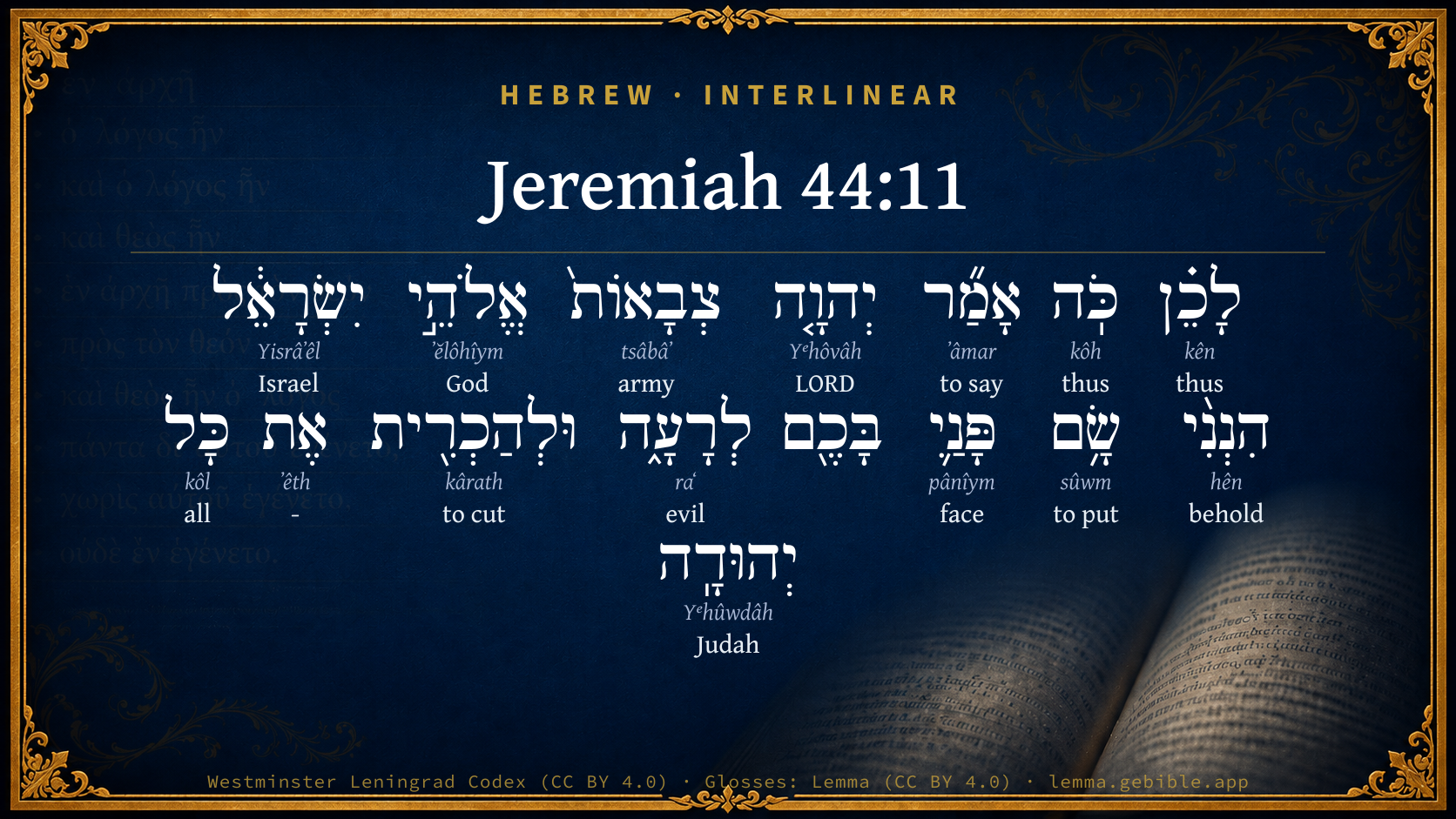
Hebrew (Westminster Leningrad Codex) Jeremiah 44:11 appears in the Hebrew Old Testament. The text above is from the Westminster Leningrad Codex. Each word links to its Strong’s number, a concise gloss, and parsing drawn from the Open Scriptures Hebrew Bible morphology. Click any word for its full Brown-Driver-Briggs (BDB) entry.
Download image
Cite this verse

Jeremiah 44:11 (World English Bible). Public Domain. Lemma interlinear Bible study tool, https://lemma.gebible.app/v/jeremiah/44/11.

Show BibTeX & RIS
BibTeX
RIS
English Translation
Therefore thus says Yahweh of Hosts, the God of Israel: Behold, I will set my face against you for evil, even to cut off all Judah.
World English Bible · Public Domain
Download a study sheet

One document with this verse’s original text, its word-by-word gloss line, the meaning frame, cross-references with their text, attributed commentary, and full source and license credits — printable, and it pastes into notes with its structure intact.

This verse Autodidact and up

Study sheet (.html) Plain text (.txt)

A passage Seminary Student

Up to 50 verses in one chapter. A passage sheet keeps up to 6 commentary sources and 12 cross-references per verse, in the order this page ranks them, and says so on the sheet whenever that leaves anything out. Ask for a single verse and you get the Autodidact verse sheet above.

Everything on this page stays free to read, with no account — the sheet is a download of what is already on screen, not access to it.

Want to remove ads? Support Godless Engineer
Compare translations 3

The same verse in 3 English versions, stacked beneath the original-language interlinear above. Click any original word for its lexicon entry.

Each is an independent rendering of the whole verse — the interlinear is not word-aligned to these translations.

Highlighted words mark where these versions differ — a whole-verse word diff, not a word-by-word alignment.

  • World English Bible Public Domain
    Therefore thus says Yahweh of Hosts, the God of Israel: Behold, I will set my face against you for evil, even to cut off all Judah.
  • King James Version Public Domain
    Therefore thus saith the LORD of hosts, the God of Israel; Behold, I will set my face against you for evil, and to cut off all Judah.
  • unfoldingWord Literal Text CC BY-SA 4.0
    Therefore Yahweh of hosts, God of Israel, says this, ‘See, I am about to set my face against you to bring disaster to you and to destroy all of Judah.

unfoldingWord Literal Text — © unfoldingWord, licensed CC BY-SA 4.0. Word-aligned USFM3 via Door43 (git.door43.org/unfoldingWord/en_ult).

Versions to compare (up to 4)

3 of 4 selected

Show all 18 translations

Every available English version of this verse, each an independent rendering of the whole verse.

  • World English Bible Public Domain
    Therefore thus says Yahweh of Hosts, the God of Israel: Behold, I will set my face against you for evil, even to cut off all Judah.
  • Berean Standard Bible Public Domain
    Therefore this is what the LORD of Hosts, the God of Israel, says: I will set My face to bring disaster and to cut off all Judah.
  • Majority Standard Bible Public Domain
    Therefore this is what the LORD of Hosts, the God of Israel, says: I will set My face to bring disaster and to cut off all Judah.
  • King James Version Public Domain
    Therefore thus saith the LORD of hosts, the God of Israel; Behold, I will set my face against you for evil, and to cut off all Judah.
  • American Standard Version (1901) Public Domain
    Therefore thus saith Jehovah of hosts, the God of Israel: Behold, I will set my face against you for evil, even to cut off all Judah.
  • Revised Version (1885) Public Domain
    Therefore thus saith the LORD of hosts, the God of Israel: Behold, I will set my face against you for evil, even to cut off all Judah.
  • Geneva Bible (1599) Public Domain
    Therefore thus sayeth the Lord of hostes the God of Israel, Beholde, I will set my face against you to euill and to destroy all Iudah,
  • Douay-Rheims (1899) Public Domain
    Therefore thus saith the Lord of hosts the God of Israel: Behold I will set my face upon you for evil: and I will destroy all Juda.
  • Young's Literal Translation Public Domain
    `Therefore, thus said Jehovah of Hosts, God of Israel: Lo, I am setting my face against you for evil, even to cut off all Judah,
  • Literal Standard Version CC BY-SA 4.0
    Therefore, thus said YHWH of Hosts, God of Israel: Behold, I am setting My face against you for calamity, even to cut off all Judah,
  • Unlocked Literal Bible CC BY-SA 4.0
    Therefore Yahweh of hosts, God of Israel, says this, 'See, I am about to set my face against you to bring disaster to you and to destroy all of Judah.
  • unfoldingWord Literal Text CC BY-SA 4.0
    Therefore Yahweh of hosts, God of Israel, says this, ‘See, I am about to set my face against you to bring disaster to you and to destroy all of Judah.
  • Darby Bible Public Domain
    Therefore thus saith Jehovah of hosts, the God of Israel: Behold, I will set my face against you for evil, and to cut off all Judah.
  • World Messianic Bible Public Domain
    “Therefore the LORD of Hosts, the God of Israel, says: ‘Behold, I will set my face against you for evil, even to cut off all Judah.
  • Webster's Bible Public Domain
    Therefore thus saith the LORD of hosts, the God of Israel; Behold, I will set my face against you for evil, and to cut off all Judah.
  • Free Bible Version CC BY-SA 4.0
    So this is what the Lord Almighty, the God of Israel, says: I am determined to bring disaster and to wipe out everyone from Judah.
  • Bible in Basic English Public Domain
    So this is what the Lord of armies, the God of Israel, has said: See, my face will be turned against you for evil, for the cutting off of all Judah;
  • JPS Tanakh (1917) Public Domain
    Therefore thus saith the LORD of hosts, the God of Israel: Behold, I will set My face against you for evil, even to cut off all Judah.

Literal Standard Version (2020), Covenant Press — licensed CC BY-SA 4.0. Text via the HelloAO Bible API (eBible.org). Unlocked Literal Bible (unfoldingWord) — licensed CC BY-SA 4.0. Text via the HelloAO Bible API (eBible.org). unfoldingWord Literal Text — © unfoldingWord, licensed CC BY-SA 4.0. Word-aligned USFM3 via Door43 (git.door43.org/unfoldingWord/en_ult). Free Bible Version, Dr. Jonathan Gallagher — licensed CC BY-SA 4.0. Text via the HelloAO Bible API (eBible.org).

Word by word

More ways to search: Search by grammar → Find every occurrence → Compare this word →

Practice this passage: Drill this verse → Learn its vocabulary →

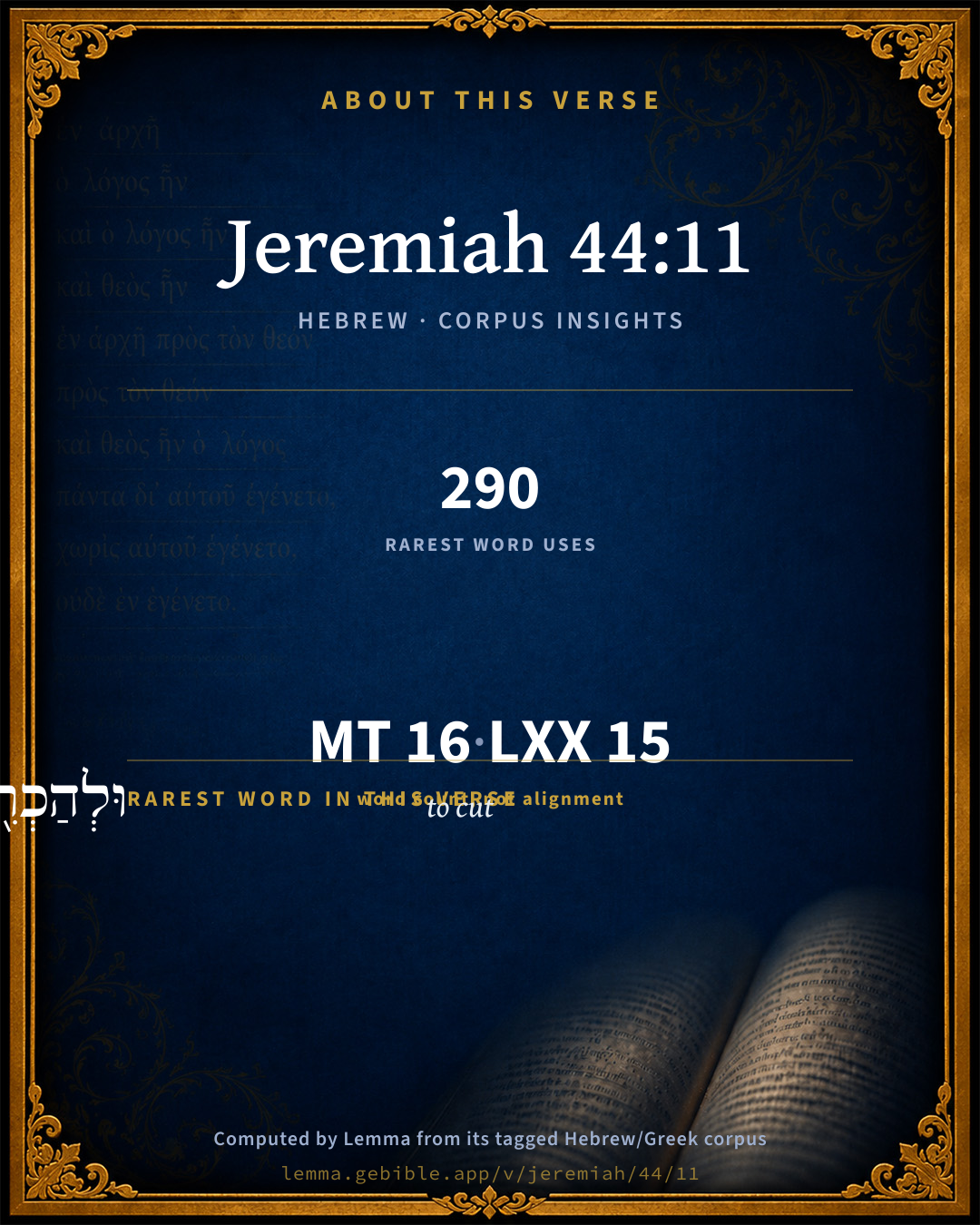
וּלְהַכְרִ֖ית
kârath
H3772
“and · to cut”
Conjunction + Preposition + Verb, Hiphil, Infinitive Construct
Part of Speech
Conjunction + Preposition + Verb
Stem
Hiphil
Form
Infinitive Construct
Full BDB Definition

Origin: a primitive root

TWOT: 1048

to cut, cut off, cut down, cut off a body part, cut out, eliminate, kill, cut a covenant - (Qal) - to cut off - to cut off a body part, behead - to cut down - to hew - to cut or make a covenant - (Niphal) - to be cut off - to be cut down - to be chewed - to be cut off, fail - (Pual) - to be cut off - to be cut down - (Hiphil) - to cut off - to cut off, destroy - to cut down, destroy - to take away - to permit to perish - (Hophal) cut off
  1. לָכֵ֗ן kên H3651 “to/for · thus” Preposition + Adverb
  2. כֹּֽה kôh H3541 “thus” Adverb
  3. אָמַ֞ר ʼâmar H559 “to say” Verb, Qal, Perfect, 3rd Person, Masculine, Singular
  4. יְהוָ֤ה Yᵉhôvâh H3068 “LORD” Noun, Proper
  5. צְבָאוֹת֙ tsâbâʼ H6635 “armies” Noun, Common, Both, Plural, Absolute
  6. אֱלֹהֵ֣י ʼĕlôhîym H430 “God(s) of” Noun, Common, Masculine, Plural, Construct
  7. יִשְׂרָאֵ֔ל Yisrâʼêl H3478 “Israel” Noun, Proper
  8. הִנְנִ֨י hên H2005 “behold · me” Particle, Demonstrative + Suffix, Personal, 1st Person, Common, Singular
  9. שָׂ֥ם sûwm H7760 “putting” Verb, Qal, Participle Active, Masculine, Singular, Absolute
  10. פָּנַ֛י pânîym H6440 “face(s) · my” Noun, Common, Both, Plural, Construct + Suffix, Personal, 1st Person, Common, Singular
  11. לְרָעָ֑ה raʻ H7451 “to/for · evil” Preposition + Noun, Common, Feminine, Singular, Absolute
  12. אֶת ʼêth H853 “-” Particle, Direct Object
  13. כָּל kôl H3605 “all of” Noun, Common, Masculine, Singular, Construct
  14. יְהוּדָֽה Yᵉhûwdâh H3063 “Judah” Noun, Proper

About this verse

These counts appear in no published source. They are computed here, from the morphology-tagged text and Lemma’s own curated glosses. What Lemma adds →

16
words
15
distinct lemmas
Prophets
section

Grammatical profile

  • 3 verbs
  • 8 nouns
  • 1 preposition
  • 2 adverbs
  • 2 particles

Verb forms

  • אָמַ֞ר Qal · Perfect
  • שָׂ֥ם Qal · Participle Active
  • וּלְהַכְרִ֖ית Hiphil · Infinitive Construct

Hebrew & Septuagint length

In the original languages it is 16 Hebrew tokens and 15 Greek tokens — but the two are counted differently (Hebrew bundles its prefixes and suffixes into one token; the Greek is in lemma form), so that isn’t a like-for-like length.

Cross-references

8

Topical passages linked to Jeremiah 44:11 in the Treasury of Scripture Knowledge — connected by theme and wording, ordered by reader-vote popularity; previews shown in the World English Bible.

  • Jeremiah 21:10 For I have set my face on this city for evil, and not for good, says Yahweh: it shall be given into the hand of the king of Babylon, and he shall burn it with fire.
  • Leviticus 17:10 "'Any man of the house of Israel, or of the strangers who live as foreigners among them, who eats any kind of blood, I will set my face against that soul who eats blood, and will cut him off from among his people.
  • Leviticus 20:5–6 then I will set my face against that man, and against his family, and will cut him off, and all who play the prostitute after him, to play the prostitute with Molech, from among their people.
  • Leviticus 26:17 I will set my face against you, and you will be struck before your enemies. Those who hate you will rule over you; and you will flee when no one pursues you.
  • Psalms 34:16 Yahweh's face is against those who do evil, To cut off the memory of them from the earth.
  • Amos 9:4 Though they go into captivity before their enemies, there I will command the sword, and it will kill them. I will set my eyes on them for evil, and not for good.
  • Ezekiel 14:7–8 For everyone of the house of Israel, or of the strangers who sojourn in Israel, who separates himself from me, and takes his idols into his heart, and puts the stumbling block of his iniquity before his face, and comes to the prophet to inquire for himself of me; I Yahweh will answer him by myself:
  • Ezekiel 15:7 I will set my face against them; they shall go forth from the fire, but the fire shall devour them; and you shall know that I am Yahweh, when I set my face against them.

Cross-references courtesy of OpenBible.info (CC BY 4.0).

Hebrew and Greek witnesses Masoretic Hebrew ↔ Greek Septuagint

The same verse in the two great witnesses to the Old Testament, shown verse-for-verse.

These are two independent witnesses, not word-aligned to each other, and the Septuagint is shown in lemma (dictionary) form.

Hebrew Jeremiah 44:11 Masoretic · Westminster Leningrad Codex

לָכֵ֗ן כֹּֽה אָמַ֞ר יְהוָ֤ה צְבָאוֹת֙ אֱלֹהֵ֣י יִשְׂרָאֵ֔ל הִנְנִ֨י שָׂ֥ם פָּנַ֛י בָּכֶ֖ם לְרָעָ֑ה וּלְהַכְרִ֖ית אֶת כָּל יְהוּדָֽה

Therefore thus says Yahweh of Hosts, the God of Israel: Behold, I will set my face against you for evil, even to cut off all Judah.

World English Bible · Public Domain

Greek LXX Structure differs

In the Septuagint, Jeremiah is about an eighth shorter than the Hebrew and arranges its material differently — the Oracles Against the Nations (Hebrew chapters 46–51) appear in the middle of the Greek book, after 25:13. Because the chapter and verse boundaries do not line up, a verse-for-verse comparison with the Hebrew is not shown.

A verse-for-verse comparison isn’t shown here because the chapters and verses don’t line up. Switch to the LXX edition with the MT / LXX toggle above to read the Greek directly.

Hebrew: Westminster Leningrad Codex (CC BY 4.0). Greek: Septuagint (public domain); English from a public-domain English Septuagint. How the Septuagint differs from the Hebrew →

Targum (Aramaic paraphrase)

1

The Targum is the ancient Jewish Aramaic paraphrase of the Hebrew Scriptures — an interpretive translation, not the Hebrew text itself. Onkelos (literal) and Pseudo-Jonathan (expansive) render the Torah, and Jonathan the Prophets. Coverage is partial: where no permissively-licensed English translation exists for a verse, only the Aramaic is shown. This is verse-level text, not a word-by-word alignment to the Hebrew.

  1. Targum Jonathan Prophets (Joshua–Malachi)
    בְּכֵן כִּדְנַן אֲמַר יְיָ צְבָאוֹת אֱלָהָא דְיִשְׂרָאֵל הָא אֲנָא מְשַׁוֵי אַפִּי בְּכוֹן לְבִישָׁא וּלְשֵׁיצָאָה יַת כָּל דְבֵית יְהוּדָה:

    (no public-domain English translation for this verse)

    Targum Jonathan — Aramaic: “Mikraot Gedolot” (public domain). English: “Sefaria Community Translation” (CC0 1.0 (public-domain dedication)); “London "Chaldee Paraphrase," 1871” (public domain). Text via Sefaria.

Commentary

Notes on Jeremiah 44:11 from classic Christian and Jewish commentators (each source and its license shown beneath its notes). The classic Christian expositions comment on the surrounding passage and are grouped to its opening verse, so a note may address several verses; the Jewish commentaries on the Tanakh (Rashi and others) are per-verse, so they appear only where the commentator wrote on this verse.

Lemma curates 59 commentaries, every one of them public domain or Creative Commons licensed, each selected and text-cleaned for this edition rather than reprinted as found. About our sources →

Trapp's Complete Commentary

John Trapp

Jer 44:11 Therefore thus saith the LORD of hosts, the God of Israel; Behold, I will set my face against you for evil, and to cut off all Judah.

Ver. 11. Behold, I will set my face against you for evil.] I will be implacable, as you are irreclaimable.

John Trapp, A Commentary or Exposition upon All the Books of the Old and New Testament (1647–1656) — public domain. Text from a community e-Sword module.

Joseph Benson's Commentary

Jer 44:11-14. I will set my face against you for evil — See note on Jer 21:10. And I will take — Or, I will take away, namely, by destruction; the remnant of Judah, &c. — The direful punishments denounced against those who went to Egypt were not denounced because it was a sin in itself for the Jews to leave their country, and seek a securer habitation in Egypt, but because, in so doing, they showed their distrust of God’s power or goodness, as if he were not able or willing to protect them in Judea, and also were guilty of disobeying his express commands, and disbelieving his faithful promises, whereby he had engaged to protect them. To which must be further added, the great danger and probability, not to say certainty, there was that they would fall into the idolatry of the Egyptians. Therefore God uttered grievous threatenings against their going thither, that they might be deterred from it. For I will punish them that dwell in the land of Egypt, &c. — See notes on Jer 42:15-18. So that none of the remnant of Judah which are gone, &c. — Blaney translates this more agreeably to the Hebrew, thus: “And the remnant of Judah, those who are come into the land of Egypt, with a view to sojourn there, and to return into the land of Judah, &c., shall not have one escaper or surviver; whereas none shall return but escapers.” And he observes, “It is evident, from Jer 44:28, that some Jews were to escape the general destruction in Egypt, and to return into their own country, although but a few; and the same thing is implied in the latter sentence of this verse. But the former part of this verse excludes out of the number of the escapers every individual of those that were called properly the remnant of Judah, those that had set their faces to enter Egypt to sojourn there, in opposition to the express command of God, upon a presumption that they knew better than God how to consult their own restoration. The few then who were destined to escape, and to return back to the land of Judah, were to be such as had come into the land of Egypt in a less offensive manner, and happened to be there when the storm burst upon them.”

Joseph Benson's Commentary on the Old and New Testaments (1811–1818) — public domain. Text from a community e-Sword module.

Tyndale Open Study Notes

Tyndale Open Resources

44:11 The Lord pronounced a death sentence, backed by the authority of his own name.

Tyndale Open Study Notes — © Tyndale Open Resources, licensed CC BY-SA 4.0. Text via the HelloAO Bible API.

Jamieson, Fausset & Brown

Robert Jamieson, A. R. Fausset & David Brown

Behold, I will set my face against you for evil--(See on Lev 17:10).

and to cut off all Judah--that is, all the idolaters; Jer 44:28 shows that some returned to Judea (compare Jer 42:17).

Jamieson, Fausset & Brown — Commentary Critical and Explanatory on the Whole Bible (1871) — public domain (CC PDM 1.0). Text via the HelloAO Bible API.

John Calvin's Commentaries

He again denounces punishment on the obstinate; nor is it a wonder that these threatenings were so often repeated, since he had to do with men so ferocious and refractory. The reason then why he denounced on them God’s judgment, was because they boldly derided him; and it will become more evident from what follows how necessary was such vehemence.

John Calvin's Commentaries (1540-1563) — public domain. Text from the Calvin Translation Society English edition (1840s-50s) via the Christian Classics Ethereal Library (ccel.org). Calvin's coverage is partial (roughly two-thirds of the Bible); uncommented books and verses are honest gaps, never fabricated. The 19th-century editor's footnotes and remarks are omitted so the notes are faithfully Calvin's own voice.

The Cambridge Bible for Schools and Colleges

gen. ed. J. J. S. Perowne

11. I will set my face] See on Jer_21:10.

11–14. See introd. summary to the ch.

The Cambridge Bible for Schools and Colleges (gen. ed. J. J. S. Perowne; Cambridge University Press, 1878–1918) — public domain. Text from a community e-Sword module.

John Gill's Exposition

Therefore thus saith the Lord of hosts, the God of Israel,.... Because of these sins of idolatry, impenitence, and disobedience:

I will set my face against you for evil; to bring the evil of punishment upon them, for the evil of sin committed by them: this the Lord determined with himself, and resolved to do; which the phrase, "setting his face against them", is expressive of, by way of retaliation for their setting their faces to go down to Egypt, as well as of his wrath and indignation against them:

and to cut off all Judah; not the whole tribe of Judah; not those that were in Babylon, which were by far the greatest number of that tribe; but those that were in Egypt.

John Gill's Exposition of the Whole Bible (1746–1763) — public domain (CC PDM 1.0). Text via the HelloAO Bible API.

Albert Barnes' Notes on the Bible

All Judah - i. e., all Judah in Egypt, yet even there with exceptions (see Jer 44:14, Jer 44:28), while Judah in Babylon was entirely exempt from this denunciation.

Albert Barnes' Notes on the Bible (1834–1885) — public domain. Text from a community e-Sword/MySword module.

Haydock's Catholic Bible Commentary

Face, to punish grievously, Ezechiel iv. 3., and xx. 35. (Calmet) --- All did not perish, but the far greatest part, ver. 14, 28. (Worthington)

George Leo Haydock (1774–1849), Haydock's Catholic Family Bible and Commentary, 1859 edition — public domain. Excludes Psalms (Douay-Rheims chapter numbering differs from Protestant) and Deuterocanonical books (Catholic canon only).

Matthew Poole's English Annotations

Therefore thus saith the lord of hosts, the God of Israel: these names are frequently given to God in threatening prophecies, partly to let this people know that God is able to make good his word, and to bring the threatened evils upon them; and partly to let them know that the dealing thus with them would not make him quit his relation to Israel, but he was and still would approve himself the God of those who were his true Israel.

Behold, I will set my face against you for evil, and to cut off all Judah; the meaning is, My full design against you is to bring evil upon you; this is expressed under the notion of setting his face, and, Amo 9:4, setting his eyes against them.

Matthew Poole's English Annotations on the Holy Bible (1683–1685) — public domain. Text from a community e-Sword/MySword module.

Whedon's Commentary on the Bible

Daniel D. Whedon

11. All Judah — Namely, all Judah in Egypt. The passage has no reference to those in Babylon.

Daniel D. Whedon (gen. ed.), Commentary on the Old and New Testaments (1874–1909) — public domain. Text from a community e-Sword module.

The Pulpit Commentary

To cut off all Judah; i.e. the Judah in Egypt, not that in Babylon. Notice the qualification of this too absolute statement in vers. 14, 28.

Vers. 11-14. The doom on those making sure of safety in Egypt.

I A FIXED RESOLUTION. The obstinate self-will of man brings into relief the inflexibility of the righteous judgments of God. The remnant of Judah set their faces to go into the land of Egypt to sojourn there. What, then, is to be expected but that Jehovah should set his face against them? The more self-will becomes a power in the life, the more nearly does it move in direct opposition to him who is the true Sovereign and Disposer of every human life. We can guess something of the thoughts of these Egypt seekers. They say to themselves, "Henceforth we shall consult for our own safety." They speak as if the peculiar perils hitherto besetting them were the perils of one place rather than another. Perhaps even they reckoned that outside the land of Israel they were beyond Jehovah"s reach. Here there is a lesson for us in our selfish aims and pursuits. All selfishness is bad, but even in selfishness a lesser badness is a degree of goodness, and it is well for a man if he gets frequently shaken in his selfishness; for then, his face not being steadily against God, he will find God looking on him encouragingly, to draw him out of his selfishness altogether.

II A COMPLETE DESTRUCTION. Complete, that is, in the sense of general and final. There was but a remnant to begin with, and of that a very small remnant might escape. The very smallness of the remnant, however, would but magnify the completeness of the destruction, no place is secure against the visitations of God"s righteous wrath. Indeed, the greater the appearance of natural security, the more manifest will be the breaking in on this security of the Divine justice. Men must be taught, even by terrible lessons, that, as there is the best kind of safety under the shadow of God"s wings, so there is the worst kind of danger the further we go from God. To multiply our own defences is really to multiply our own perils.

III A NULLIFIED PURPOSE. This remnant, not finding in Egypt the expected safety, thinks there is nothing easier than to go back again to the land of Judah. Whereas they find too late that, while departure from their own proper place is easy enough, return to it may be impossible. Opening the door to get out was one thing; opening it to get in again quite another. Seventy years was to pass before they of the Captivity should return from Babylon indeed, it would really be another generation altogether; and should those who sought Egypt in contumacy and rebellion expect to fare better? We must be wise in time. To be wise too late gives suffering its keenest edge. So Judas brought back in vain the thirty pieces of silver, and Esau found no place of repentance though he sought it carefully with tears. This is why God is so earnest in promising wisdom and light to those who seek for them, that we may seek for them at the right time, at the beginning of the great opportunity of life, and at the beginning of every smaller opportunity. Y.

The Pulpit Commentary (1880–1919), ed. H.D.M. Spence-Jones & Joseph S. Exell — public domain. Text from a community e-Sword module.

unfoldingWord translationNotes

Door43 World Missions Community

Yahweh of hosts ... says this

Jeremiah often uses these words to introduce an important message from Yahweh. See how you translated this in Jeremiah 6:6.

I am about to set my face against you

This idiom means he "firmly decided." See how you translated a similar phrase in Jeremiah 21:10. AT: "I have made up my mind to oppose you" (See: Idiom)

set my face against

"stare angrily at"

to bring disaster to you

Causing disaster to happen is spoken of as if disaster were an object that can be brought to someone. AT: "to cause disaster to happen to you" (See: Metaphor)

They will fall by sword and famine

Here "fall" means to die. And "sword" represents the enemies carrying weapons. AT: "Enemies will kill some of them and others will die of hunger" (See: Idiom and Metonymy)

From the least to the greatest

This is a way to refer to people from every social status. Here "least" and "greatest" represent those who are least important and those who are most important. AT: "all the people from every social status" or "all the people, including the least important and the most important people" (See: Merism)

will become an object of swearing, cursing, reproaching, and a horrible thing

"people will be horrified because of what happened to the people of Judah, and people will mock and curse them"

translationWords

Yahweh of hosts

face

Judah

Egypt

perish

sword

famine

die

oath

curse

reproach

unfoldingWord translationNotes — © Distant Shores Media and the Door43 World Missions Community, licensed CC BY-SA 4.0. Source: git.door43.org/Door43/en_tn.

Lesson kit

Teaching starters — assembled from the data on this page, not authored interpretation. Every prompt links to the verse data it draws on. Edit before teaching.

Jeremiah, in the Prophets, opens this verse with 16 words (15 distinct Hebrew lemmas). Its most distinctive word is kârath (“to cut”). A historical commentator’s framing appears above. Read the whole chapter for the surrounding context.

Discussion questions

  1. What does “to cut” (kârath) contribute to the verse as a whole?
  2. How does Jeremiah 21:10, which shares this passage’s theme, read alongside this verse?
  3. These translations render this verse differently; the difference is in the English rendering, not the original. What questions does that raise?
  4. «אָמַ֞ר» is a Qal Perfect verb. How does that grammatical form shape the action described?
  5. Compare how Trapp's Complete Commentary and Joseph Benson's Commentary read this verse. Where do they agree or differ?

Things to notice

Reading settings

Reading text

Shown beneath each verse's original-language words.

Old Testament
Old Testament edition

Read the OT as the Masoretic Hebrew (MT) or the Greek Septuagint (LXX).

English shown for the Greek Septuagint (in the Hebrew ↔ Greek comparison).

Comparing translations? Open the Compare panel on any verse page to stack up to four side by side.