
1 John 5:11

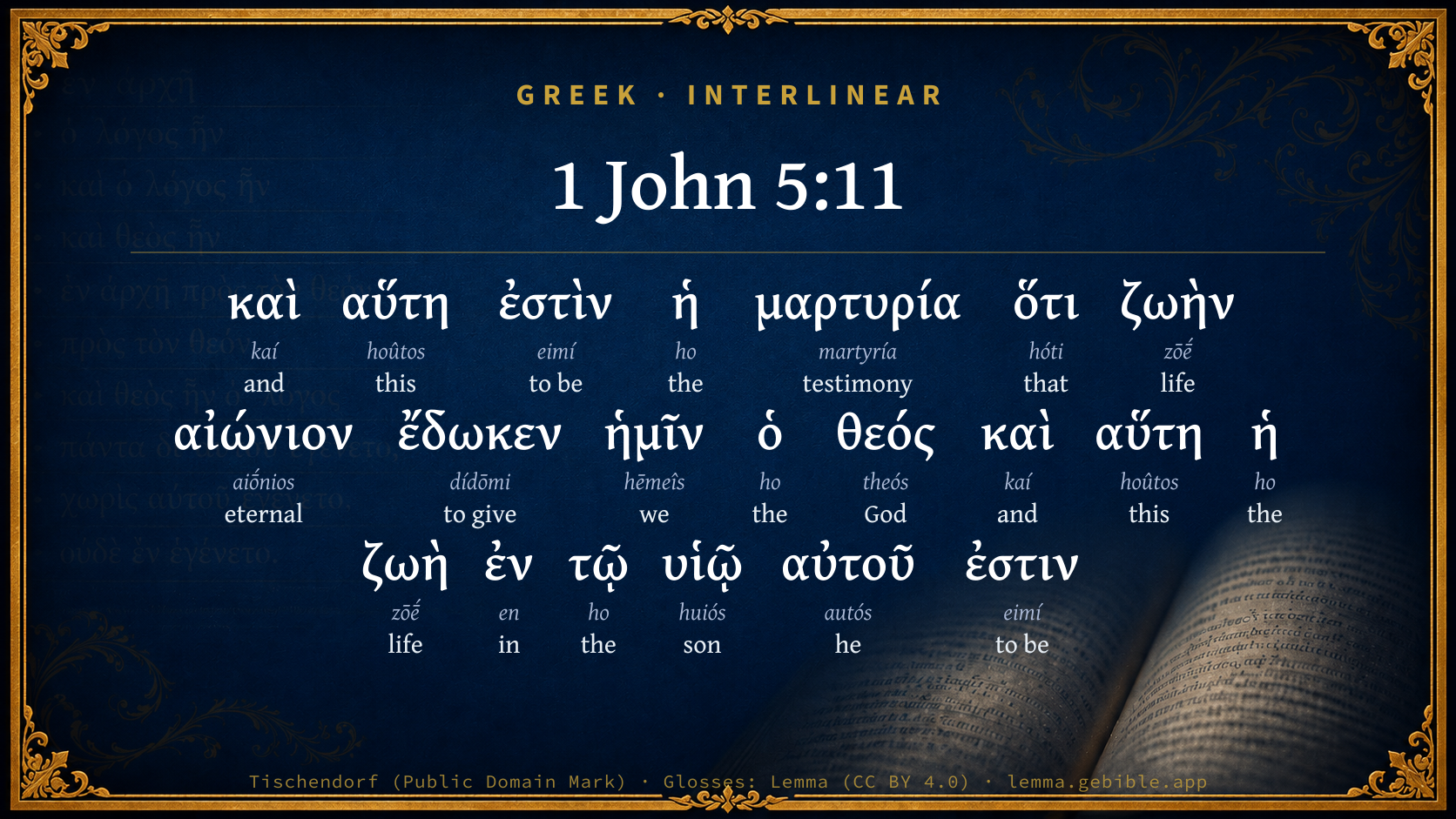
Greek (Tischendorf 8th ed.) 1 John 5:11 appears in the Greek New Testament. The text above is from the Tischendorf 8th edition. Each word links to its Strong’s number and a concise gloss. Click any word for its full Thayer’s Greek Lexicon entry.
Download image
Cite this verse

1 John 5:11 (World English Bible). Public Domain. Lemma interlinear Bible study tool, https://lemma.gebible.app/v/1-john/5/11.

Show BibTeX & RIS
BibTeX
RIS
English Translation
The testimony is this, that God gave to us eternal life, and this life is in his Son.
World English Bible · Public Domain
Download a study sheet

One document with this verse’s original text, its word-by-word gloss line, the meaning frame, cross-references with their text, attributed commentary, and full source and license credits — printable, and it pastes into notes with its structure intact.

This verse Autodidact and up

Study sheet (.html) Plain text (.txt)

A passage Seminary Student

Up to 50 verses in one chapter. A passage sheet keeps up to 6 commentary sources and 12 cross-references per verse, in the order this page ranks them, and says so on the sheet whenever that leaves anything out. Ask for a single verse and you get the Autodidact verse sheet above.

Everything on this page stays free to read, with no account — the sheet is a download of what is already on screen, not access to it.

Want to remove ads? Support Godless Engineer
Compare translations 3

The same verse in 3 English versions, stacked beneath the original-language interlinear above. Click any original word for its lexicon entry.

Each is an independent rendering of the whole verse — the interlinear is not word-aligned to these translations.

Highlighted words mark where these versions differ — a whole-verse word diff, not a word-by-word alignment.

  • World English Bible Public Domain
    The testimony is this, that God gave to us eternal life, and this life is in his Son.
  • King James Version Public Domain
    And this is the record, that God hath given to us eternal life, and this life is in his Son.
  • unfoldingWord Literal Text CC BY-SA 4.0
    And this is the testimony: that God gave us eternal life, and this life is in his Son.

unfoldingWord Literal Text — © unfoldingWord, licensed CC BY-SA 4.0. Word-aligned USFM3 via Door43 (git.door43.org/unfoldingWord/en_ult).

Versions to compare (up to 4)

3 of 4 selected

Show all 19 translations

Every available English version of this verse, each an independent rendering of the whole verse.

  • World English Bible Public Domain
    The testimony is this, that God gave to us eternal life, and this life is in his Son.
  • Berean Standard Bible Public Domain
    And this is that testimony: God has given us eternal life, and this life is in His Son.
  • Majority Standard Bible Public Domain
    And this is that testimony: God has given us eternal life, and this life is in His Son.
  • King James Version Public Domain
    And this is the record, that God hath given to us eternal life, and this life is in his Son.
  • American Standard Version (1901) Public Domain
    And the witness is this, that God gave unto us eternal life, and this life is in his Son.
  • Revised Version (1885) Public Domain
    And the witness is this, that God gave unto us eternal life, and this life is in his Son.
  • Geneva Bible (1599) Public Domain
    And this is that record, to wit, that God hath giuen vnto vs eternall life, and this life is in that his Sonne.
  • Douay-Rheims (1899) Public Domain
    And this is the testimony, that God hath given to us eternal life. And this life is in his Son.
  • Young's Literal Translation Public Domain
    and this is the testimony, that life age-during did God give to us, and this -- the life -- is in His Son;
  • Literal Standard Version CC BY-SA 4.0
    and this is the testimony, that God gave continuous life to us, and this life is in His Son;
  • Unlocked Literal Bible CC BY-SA 4.0
    And the witness is this: God gave us eternal life, and this life is in his Son.
  • unfoldingWord Literal Text CC BY-SA 4.0
    And this is the testimony: that God gave us eternal life, and this life is in his Son.
  • Darby Bible Public Domain
    And this is the witness, that God has given to us eternal life; and this life is in his Son.
  • World Messianic Bible Public Domain
    The testimony is this: that God gave to us eternal life, and this life is in his Son.
  • Webster's Bible Public Domain
    And this is the testimony, that God hath given to us eternal life: and this life is in his Son.
  • Free Bible Version CC BY-SA 4.0
    The evidence is this: God has given eternal life to us, and we have this life through his Son.
  • Bible in Basic English Public Domain
    And his witness is this, that God has given us eternal life, and this life is in his Son.
  • Text-Critical English NT CC BY 4.0
    And this is the testimony, that God has given us eternal life, and this life is in his Son.
  • Tyndale New Testament (1534) Public Domain
    And this ys that recorde how that god hath geven vnto vs eternall lyfe and this lyfe is in his sonne.

Literal Standard Version (2020), Covenant Press — licensed CC BY-SA 4.0. Text via the HelloAO Bible API (eBible.org). Unlocked Literal Bible (unfoldingWord) — licensed CC BY-SA 4.0. Text via the HelloAO Bible API (eBible.org). unfoldingWord Literal Text — © unfoldingWord, licensed CC BY-SA 4.0. Word-aligned USFM3 via Door43 (git.door43.org/unfoldingWord/en_ult). Free Bible Version, Dr. Jonathan Gallagher — licensed CC BY-SA 4.0. Text via the HelloAO Bible API (eBible.org).

Word by word

More ways to search: Search by grammar → Find every occurrence → Compare this word →

Practice this passage: Drill this verse → Learn its vocabulary →

μαρτυρία
martyría
G3141
“testimony”
Noun, Nominative, Singular, Feminine
Part of Speech
Noun
Case
Nominative
Number
Singular
Gender
Feminine
Full Thayer's Definition

Origin: from G3144

TDNT: 11:54,6

1. a testifying a. the office committed to the prophets of testifying concerning future events 2. what one testifies, testimony, i.e. before a judge
  1. καὶ kaí G2532 “and” Conjunction
  2. αὕτη hoûtos G3778 “this” Demonstrative pronoun, Nominative, Singular, Feminine
  3. ἐστὶν eimí G1510 “to be” Verb, Present, Active, Indicative, 3rd person, Singular
  4. ἡ ho G3588 “the” Article, Nominative, Singular, Feminine
  5. ὅτι hóti G3754 “that” Conjunction
  6. ζωὴν zōḗ G2222 “life” Noun, Accusative, Singular, Feminine
  7. αἰώνιον aiṓnios G166 “eternal” Adjective, Accusative, Singular, Feminine
  8. ἔδωκεν dídōmi G1325 “to give” Verb, Aorist, Active, Indicative, 3rd person, Singular
  9. ἡμῖν hēmeîs G2249 “we” Personal pronoun, 1st person, Dative, Plural
  10. ὁ ho G3588 “the” Article, Nominative, Singular, Masculine
  11. θεός theós G2316 “God” Noun, Nominative, Singular, Masculine
  12. καὶ kaí G2532 “and” Conjunction
  13. αὕτη hoûtos G3778 “this” Demonstrative pronoun, Nominative, Singular, Feminine
  14. ἡ ho G3588 “the” Article, Nominative, Singular, Feminine
  15. ζωὴ zōḗ G2222 “life” Noun, Nominative, Singular, Feminine
  16. ἐν en G1722 “in” Preposition
  17. τῷ ho G3588 “the” Article, Dative, Singular, Masculine
  18. υἱῷ huiós G5207 “son” Noun, Dative, Singular, Masculine
  19. αὐτοῦ autós G846 “he” Personal pronoun, Genitive, Singular, Masculine
  20. ἐστιν eimí G1510 “to be” Verb, Present, Active, Indicative, 3rd person, Singular

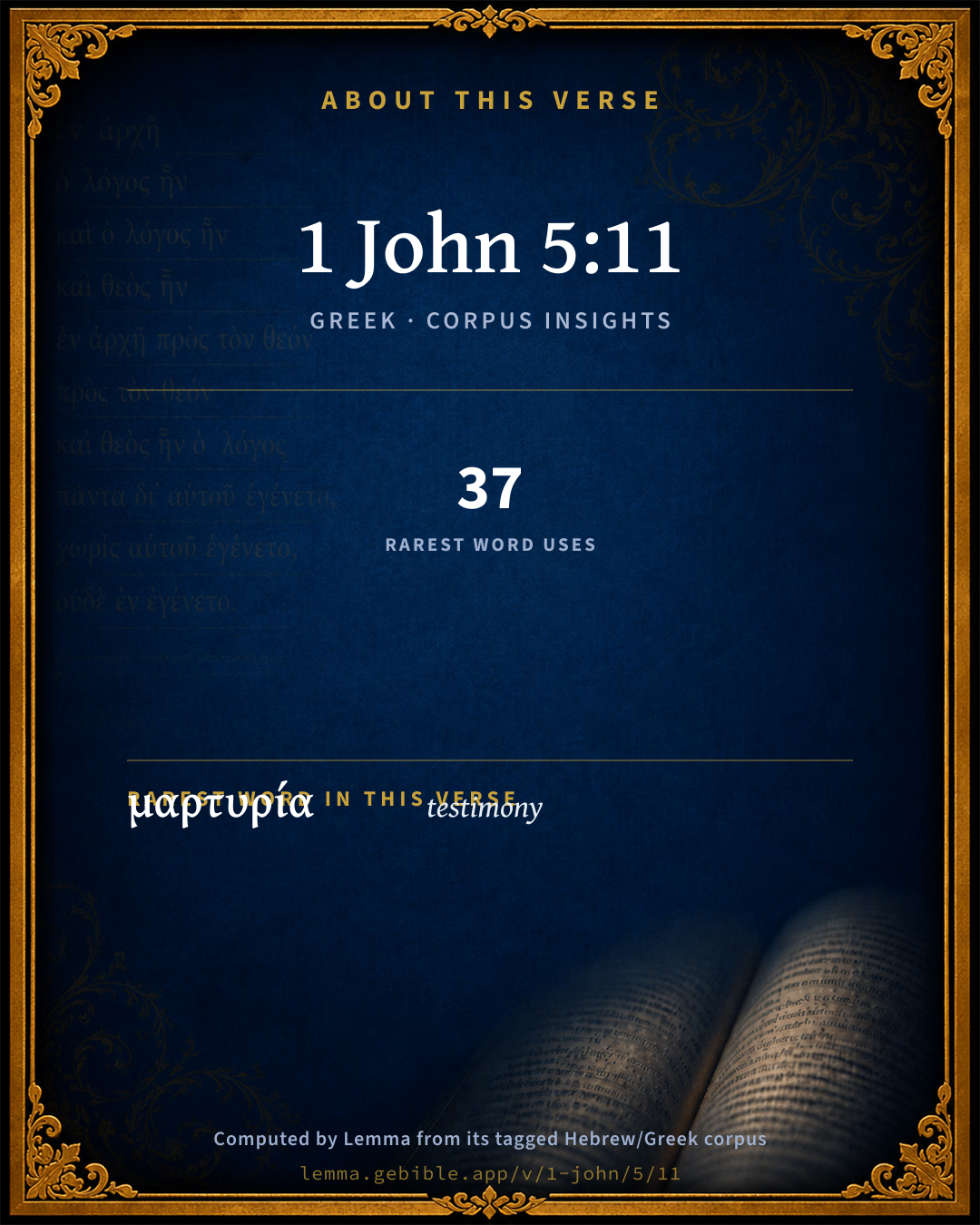
About this verse

These counts appear in no published source. They are computed here, from the morphology-tagged text and Lemma’s own curated glosses. What Lemma adds →

21
words
14
distinct lemmas
General Epistles
section

Shared distinctive vocabulary

μαρτυρία testimony G3141 occurs in 33 verses of the Greek New Testament. Also found in:
Repetition

Words recur within this verse:

Cross-references

35

Topical passages linked to 1 John 5:11 in the Treasury of Scripture Knowledge — connected by theme and wording, ordered by reader-vote popularity; previews shown in the World English Bible.

  • Romans 6:23 For the wages of sin is death, but the free gift of God is eternal life in Christ Jesus our Lord.
  • 1 John 2:25 This is the promise which he promised us, the eternal life.
  • John 3:36 One who believes in the Son has eternal life, but one who disobeys the Son won't see life, but the wrath of God remains on him."
  • 1 John 5:20 We know that the Son of God has come, and has given us an understanding, that we know him who is true, and we are in him who is true, in his Son Jesus Christ. This is the true God, and eternal life.
  • John 1:4 In him was life, and the life was the light of men.
  • 1 John 4:9 By this was God's love revealed in us, that God has sent his one and only Son into the world that we might live through him.
  • 1 John 1:1–3 That which was from the beginning, that which we have heard, that which we have seen with our eyes, that which we saw, and our hands touched, concerning the Word of life
  • John 17:2–3 even as you gave him authority over all flesh, he will give eternal life to all whom you have given him.
  • John 5:26 For as the Father has life in himself, even so he gave to the Son also to have life in himself.
  • John 10:28 I give eternal life to them. They will never perish, and no one will snatch them out of my hand.
  • John 6:40 This is the will of the one who sent me, that everyone who sees the Son, and believes in him, should have eternal life; and I will raise him up at the last day."
  • John 6:68 Simon Peter answered him, "Lord, to whom would we go? You have the words of eternal life.
  • John 19:35 He who has seen has testified, and his testimony is true. He knows that he tells the truth, that you may believe.
  • 1 John 5:10 He who believes in the Son of God has the testimony in himself. He who doesn't believe God has made him a liar, because he has not believed in the testimony that God has given concerning his Son.
  • John 14:6 Jesus said to him, "I am the way, the truth, and the life. No one comes to the Father, except through me.
  • 1 Timothy 1:16 However, for this cause I obtained mercy, that in me first, Jesus Christ might display all his patience, for an example of those who were going to believe in him for eternal life.
  • Titus 1:2 in hope of eternal life, which God, who can't lie, promised before eternal times;
  • 1 John 5:12–13 He who has the Son has the life. He who doesn't have God's Son doesn't have the life.
  • John 3:15–16 that whoever believes in him should not perish, but have eternal life.
  • John 4:36 He who reaps receives wages, and gathers fruit to eternal life; that both he who sows and he who reaps may rejoice together.
  • John 11:25–26 Jesus said to her, "I am the resurrection and the life. He who believes in me, though he die, yet will he live.
  • John 12:50 I know that his commandment is eternal life. The things therefore which I speak, even as the Father has said to me, so I speak."
  • Colossians 3:3–4 For you died, and your life is hidden with Christ in God.
  • 1 John 5:7 For there are three who testify:
  • 3 John 1:12 Demetrius has the testimony of all, and of the truth itself; yes, we also testify, and you know that our testimony is true.
  • Jude 1:21 Keep yourselves in the love of God, looking for the mercy of our Lord Jesus Christ to eternal life.
  • Matthew 25:46 These will go away into eternal punishment, but the righteous into eternal life."
  • John 1:32–34 John testified, saying, "I have seen the Spirit descending like a dove out of heaven, and it remained on him.
  • John 5:21 For as the Father raises the dead and gives them life, even so the Son also gives life to whom he desires.
  • John 6:47 Most assuredly, I tell you, he who believes in me has eternal life.
  • Revelation 1:2 who testified to God's word, and of the testimony of Jesus Christ, about everything that he saw.
  • Revelation 22:1 He showed me a river of water of life, clear as crystal, proceeding out of the throne of God and of the Lamb,
  • John 8:13–14 The Pharisees therefore said to him, "You testify about yourself. Your testimony is not valid."
  • Romans 5:21 that as sin reigned in death, even so might grace reign through righteousness to eternal life through Jesus Christ our Lord.
  • John 1:19 This is John's testimony, when the Jews sent priests and Levites from Jerusalem to ask him, "Who are you?"

Cross-references courtesy of OpenBible.info (CC BY 4.0).

Commentary

Notes on 1 John 5:11 from classic Christian and Jewish commentators (each source and its license shown beneath its notes). The classic Christian expositions comment on the surrounding passage and are grouped to its opening verse, so a note may address several verses; the Jewish commentaries on the Tanakh (Rashi and others) are per-verse, so they appear only where the commentator wrote on this verse.

Lemma curates 59 commentaries, every one of them public domain or Creative Commons licensed, each selected and text-cleaned for this edition rather than reprinted as found. About our sources →

The Biblical Illustrator

Joseph S. Exell

1Jn_5:11

And this is the record, that God hath given to us eternal life, and this life is in His Son

The Divine record

It is obvious that the designs of God respecting the work of His hands entirely depend on His own will, and that, unless He please to favour us with an express declaration of those designs, we may, indeed, by debating about the probabilities of the case, bewilder ourselves in all the mazes of metaphysical conjecture; but, as for anything like certainty respecting what so deeply concerns us, that is a point which it is utterly beyond our abilities to attain.

Such a declaration, however, God has been pleased to make. In the record of the Old and New Testaments we have an express revelation of His will.

I. The unmerited grant of our God.

1. The nature of the blessing here said to be granted to us.

(1) It is life, life worthy of the name, a life perfectly exempt from every kind and degree of evil, and accompanied by every conceivable and by every inconceivable good.

(2) This life is eternal, not like our present life, which is but as a vapour that appeareth for a short time and then vanisheth away.

(3) It is a life, too, which includes everything that appertains to it, the pardon of our sins, reconciliation with God, adoption into His family, and all those sanctifying influences of the Holy Spirit which constitute the foretaste of this eternal life in the heart of the Christian.

2. The person to whom this grant is here also said to be made. To us, the sinful children of sinful parents; to us, miserable sinners, who thus were lying in darkness and in the shadow of death, provided only we will accept the boon in His appointed way; to us hath God given eternal life.

3. The gratuitous nature of the grant. For in what way but in that of a free gift could eternal life be made over to those who have both forfeited the blessing and incurred the curse?

II. The channel through which this grant is conveyed to us.

1. The obstacles which stood in the way of this grant were of the most formidable description. These were no other than the severer perfections of the Divine nature, and the honour both of Gods law and of His universal government.

2. But by the determination that this free gift of life should be in the Son of God, to be sought for through Him alone, all the obstacles to the grant, which presented themselves from the quarters just referred to, were at once removed.

III. The character of the individuals who will obtain the benefit of this grant and of these who will fail of it. He that hath the Son hath life, and he that hath not the Son of God hath not life.

1. It is clear, then, on the one hand, that we are interested in this grant of eternal life if we have the Son.

2. And it is the undisputed testimony of the record that he that thus hath the Son hath life, and that he that hath not the Son of God hath not life. (John Natt, B. D.)

Eternal life a gift

I. The subject of the record--eternal life. What is it? It is not endless existence. The record refers not to this point. The Bible assumes mans immortality. Eternal life consists in the souls well-being--its intrinsic, internal blessedness: the kingdom of God is within you. This life is eternal. It is drawn from the Eternal One; His principles of rectitude imbedded in the heart and springing up into everlasting life.

II. The doctrine of the record, god hath given to us eternal life, and this is in his son.

1. It is gift. Not something for which men need to toil, but something to be simply received.

2. It is a gift already given. God hath given, etc. The believer has its foretaste.

3. It is a gift already given in His Son. Not in systems, churches; grace and truth come by Jesus Christ.

4. This is for record. It is testified that men may know it on Gods authority and live. (Homilist.)

Eternal life

Before opening up the passage there are two preliminary questions that press for answer. In the first place, what is meant by the Scriptural phrase, eternal life? The term, eternal life, is hardly at all one of quantity, but of quality. Just as there is wheat life in the wheat plant, bird life in the winged creatures, lion life in the lion, so there is Christ life in the Christian. It is a condition of existence in which the very life of God pulsates through every faculty of the life of man, bringing him into affinity of love and purpose and aspiration with the Eternal Himself. Eternal life is, therefore, the imparting of Christs own life to those who accept Him as Saviour and Master. A second preliminary question presses for answer. When and where is this eternal life attained? It seems clear from the Word of God that it is attained in this world and not in the world to come. Men do not go to heaven to get it, but they go to heaven because they have it. If these things are true it surely becomes a pressing interest to every thoughtful man as to how this priceless gift may become his own personal possession, as to how he may grow in eternal life and eternal life grow in him, and as to how he may have the joy, the power, and the prospect of it. These questions are all clearly answered in the text.

I. Eternal life is provided in Christ. This life is in His Son. It is of the very last importance to note well the fountain of this eternal life. It is not in man as natural, for as natural he is fallen, and the fall implied the loss of this life of God in the soul of man, the passing away of all conscious affinity with God, and the coming in of a spirit of alienation and hostility. And as it is not in man naturally, neither does man find it in what is called his environment. We think that the power of environment over human life is greatly exaggerated in our day, and is essentially the reversal of a central principle in Gods dealings with the world. It is never the new environment that makes the new man, but it is the new man that creates the new environment. Let us, therefore, face the fact that eternal life is provided only in Jesus Christ our Lord. Those in quest of it have, therefore, not to wander over a wilderness of abstract thought, and not to whip the energies of mind and heart to attain this great end; but, as a person deeply convinced that this gift is not now theirs, to come humbly and trustfully to the feet of the living personality of the Lord Jesus Christ, who alone has this gift to give, and who is longing to bestow it.

II. Eternal life is published in Christ. This is the record that God hath given to us eternal life, and this life is in His Son essentially. The whole Word of God is an apocalypse or unveiling of Christ. The testimony of God Himself, of the Holy Spirit, of inspired historian, poet, prophet, and evangelist, all converges on the Lord Jesus Christ.

III. Eternal life is possessed in Christ. God hath given to us eternal life, and this life is in His Son; he that hath the Son hath life. The gift has not only been provided and published, but it has in a very real sense actually been given. God has given to us eternal life. We stand firm on the ground that Christs part, both in provision and offer, has already been finished; but salvation by gift implies the part of the receiver as well as the part of the giver, and while the gift has been offered there is no salvation, and there can be no salvation till the gift is accepted. This view of the possession of eternal life delivers man from all perplexity as to the ground of his acceptance with God, and as to his humble assurance of the certainty of his salvation. It causes feelings, for example, to fall into due perspective in spiritual experiences. When a man comes to see that he possesses Christ, and on that possession can call eternal life his own, there will come, and must come, those feelings of peace and rest and certainty and enjoyment, and until he is quite sure that he possesses Christ, and with Him all things, the feelings will be fitful and the whole life will be clouded.

IV. Eternal life is perpetuated in Christ. These things have I written unto you that believe on the name of the Son of God that ye may know that ye have eternal life, and that ye may believe on the name of the Son of God. The entrance of eternal life into the soul of man is the entrance of Christ Himself to dwell and reign and unfold the nature that He inhabits and permeates. The whole Christ, and only Christ, is needed to save, and the whole Christ in perpetual indwelling is needed to sanctify. There is no possible life for the Christian apart from his abiding in Christ and Christ abiding in him. Out of this flows all the sweetness of sanctity, all the dignity of lowliness, all the enlarging of love, all the practical power of obedience, and all the finished graces of a complete character. (G. Wilson.)

Example and life

It will be admitted, of course, that Christ has given us a perfect example. He has not only told us what to do, He has shown us how to live. He was Himself, by the method which He followed, the great object teacher, and His life was the great object lesson. Example is more powerful than precept; its influence goes deeper and takes hold of us with a stronger grasp; but after all it is of the same nature as precept. You can give a child in words some idea of the rules of polite behaviour; you can give him an example of politeness which will be much more instructive and effective in forming his manner than any verbal rules; but the rules and the example would both operate in the same way; they would reach and influence him through his intellect and his will. In both cases the effect produced would be the result of a voluntary effort. It is easier for him to imitate your actions than it is to remember and obey your rules; but both address the will through the intelligence. Now, while the imitation of an action is easier and pleasanter than the obedience of a precept, there is still a great lack of beauty and of vigour in the conduct that is simply the result of imitation. There is a perceptible hardness and stiffness and unreality about it; it is artificial. So, then, if a perfect example were put before us, and we should set ourselves resolutely and carefully to the copying of that example, we should be sure to fail; our lives, though they might seem outwardly very like the life we were trying to imitate, would resemble it only as the artificial flower resembles the real one. When God gave you being He gave you character and personality of your own. What He meant you to be is indicated in the very constitution of your soul, And although by disobedience and alienation from Him you may have badly injured your own character, though the Divine perfection in which it ought to shine may but dimly appear in it, yet the ground plan, so to speak, is there, and that is the plan on which your character is to be built; the thing for you to do is simply to become what God meant you to be, and this you cannot do by trying to imitate the character and conduct of some one else. What men most need is the healing, the quickening, the replenishing of their spiritual life. It is not a model to live by, it is new life and fuller that we want. And this is the want that Christ supplies. I am come, He says, that they might have life and that they might have it more abundantly. How is it that He imparts to men this life? Ah, I do not know that. How does the sun impart life to the seeds and roots and bulbs that during all this long winter have been waiting for him under ground? I do not know how he does it, but I know that he does it. Some of them have heard his voice already and have come forth from their graves. The subtle might of his regenerating rays is seeking them out; they begin to feel in every fibre the influence of his power; life is quickened within them by his genial influence. And as many as receive Jesus Christ, as many as will accept Him as the Lord of their life, and will let Him instruct them and lead them and inspire them, sweetly yielding to the influences of His grace, will find that He is doing for them something like what the sun does for the germs beneath the soil; that He is imparting spiritual life to them; that He is kindling in their souls the love of all things right and true and good, and increasing in them the power to realise such things in their lives. This is what He does for all who will receive Him. But the text says that this life is eternal life. The witness is that God has given to us eternal life and the life is in His Son. Yea, verily! The life whose organising principles are righteousness and truth and love is a life that takes hold of the aeons to come with a sure grasp. God has so made the universe that these principles are indestructible; in the nature of things virtue is immortal; the life that is incorporate with it has the promise of an everlasting day. (W. Gladden, D. D.)

Life in Christ

Mark the grammatical form. The statement is not part of the record, but the record itself, as if God had given none else. This is the record, standing out alone in its sublime grandeur. This is the record that transcends all others by its brilliancy, upon which every conscience might rest. So in 1Jn_2:25 he uses exactly the same emphatic expression--This is the promise that He hath promised us, even eternal life, as if not a single star shone in the firmament above except this; as if not one promise had been given except this, standing out distinct, full, alone in hopes and comfort to all. And not only he, but St. Paul, so different in the characteristic order of intellect, uses the same kind of expression--The wages of sin is death, but the gift of God is eternal life through Jesus Christ our Lord (Rom_6:23); the gift, as if no other boon had been granted--the gift towering out above all, and standing in its holy Alpine grandeur, the noblest blessing God had ever given to His people. Put these three passages together, and then we have brought before us this glorious truth, that He is emphatically the gift, the record to us, the promise of God of life eternal through His Son.

I. The religion which we profess, true practical Christianity, is life. This truth lies at the foundation of this passage; and what type can be more glorious of good conferred? The most despised creature upon earth clings to life. I need not say that the life here spoken of is not physical life, not a life in common with an ungodly man, not a life in common with the beasts that perish, but spiritual life, life in the soul, life in the thinking elements of our nature, life in that part of our nature which links us with God Himself, and which, if lost, consigns us to everlasting ruin. Such then is the boon; the Christian lives. Religion is no dead thing; it is not formalism, it is not mere professionalism, it is not the assent of the understanding to certain dogmas, it is not the experience in the heart even of certain sentimental emotions. Religion, if it be anything at all, is a living, practical reality. I have the conviction that I have spiritual life, because I think with God, I feel the presence of God, I move in the ways of God. The Christian, then, lives; that life may be mysterious, but it is the distinguishing character of the Christian man that he has this spiritual life in him. I add that it is, moreover, a progressive thing. Here religion harmonises with all the phenomena and rules of life.

II. This life is divine in its origin--God hath given to us eternal life. All life is of Divine production. Pierce as far as you may into eternity, the deeper and closer our examination of its realities, the more fully and simply are we thrown on our conviction of the Divine origin. All life is the production of the eternal God. The spiritual life of which I speak is, therefore, certainly of His production. The old Greek fable, myth, to use the fashionable expression of modern times, brings out the truth in a simple shape--You may take a man and set him up by the pillar of the temple, but unless the god who inhabits it touches him he cannot move a step. Or, according to another Greek fable, you may take clay and form and fashion it into the mould of a man, but unless the celestial fire penetrates the frame and imparts life it has no power of action. Paul may plant, and Apollos may water, but God gives the increase. All means and appliances are in vain until the power of God Himself shall visit the Church--all in vain until Jesus Christ, who, when His message is proclaimed, shall accompany that message with His own living power and waken up dead spirits into eternal life.

III. This life is in Christ. The source, I say, of that life which is the gift of God, the source of all life, is Christ Himself. Again, for this purpose He is described as having life in Himself. Mark the emphatic expression. It corresponds with that expression of the living God, I am that I am--Jehovah. Pray for this gift, but pray for it in union with Christs sacrifice, for without His death the Spirit never had come down.

IV. This life is not only through the Son, but is in the Son, and will just be in us as it is in Him. In other words, the character of the life of the Son of God is a model character to all the brotherhood of Christ; every Christian is a Christian just in the degree that he is Christ-like.

V. This life, this divine gift, is eternal. Now the soul is eternal, and as such, therefore, this life must endure forever. That man is a fool who tries to procure something by great labour which will last only till tomorrow. But this eternal life never conies to a close. Moreover it is a life which shall expand. I can set no limits to it.

VI. Who have that life? What man possesses it? Who has a distinct credential that he does possess it? He became the author of eternal salvation unto all them that obey Him. Tell me not of spasmodic enjoyments of spiritual elevation, of occasional paroxysms of spiritual life. I ask, is Christs life in you? Is His law in your hearts, and is it exemplified in your lives? If so, you have clear proof of the possession of that gift which is everlasting. (T. Archer, D. D.)

The Biblical Illustrator, edited by Joseph S. Exell (c. 1880s–1900s) — public domain. Text from a community e-Sword module.

Joseph Benson's Commentary

1Jn 5:11-12. And this is the record — Η μαρτυρια, the testimony; the sum of God’s testimony concerning his Son, and salvation through him:

this is the thing testified by the six witnesses — the three in heaven, and the three on earth; that God hath given to us — Hath sincerely and freely offered to mankind in general, and hath actually conferred on true believers in particular; eternal life — Namely, a title to it, in their justification and adoption, Tit 3:7; Rom 8:17; a meetness for it, in their new creation or sanctification, Col 1:12; 2Co 5:17; Eph 4:22; Eph 4:24; and a foretaste or earnest of it, by the indwelling of the Holy Spirit in their hearts, Eph 1:14; giving them to enjoy communion with the Father and the Son, 1Jn 1:3; and through that, as it were, to sit in heavenly places in Christ Jesus, and have their conversation in heaven, Eph 2:6; Php 3:20. And this life is in his Son — Whose doctrine hath revealed it; whose merits have procured it; whose Spirit hath imparted the beginning of it; and whose example will conduct us to the complete possession of it. In other words, by whom it is purchased, and in whom it is treasured up; so that he has all the springs, and the fulness of it, in himself, to communicate to his body, the church, first in grace and then in glory. “Though the apostle, in what goes before, has spoken particularly of the three in heaven, and of the three on earth, who bear witness continually, he deferred mentioning, till now, what it is they are witnessing; that by introducing it last of all, and after so much preparation, it might make the stronger impression on the minds of his readers.” He that hath the Son — That hath the saving knowledge of him communicated by the Spirit of wisdom and revelation, Eph 1:17; Mat 11:27; that hath living faith in him, working by love, Gal 2:20; Gal 5:6; and hereby hath a real interest in him, as a wife hath in her husband, Rom 7:4; and vital union with him, such as a branch hath with the tree in which it grows, Joh 15:4; or such as a member of the human body has with the head thereof, 1Co 12:27; Rom 12:5; and who, in consequence of that interest in him, and union with him, hath a conformity to him; hath in him the mind that was in Christ, and walks as he walked, Php 2:5; or he, to whom Christ is made of God wisdom, righteousness, sanctification, and redemption; see on 1Co 1:30; such a one in these respects having the Son, hath life — Hath spiritual life here, and is entitled to, made in a degree meet for, and has an earnest of, eternal life hereafter. But he that hath not the Son of God — Hath not that interest in his merits, that union with him through the Spirit, that conformity, more or less, to his image: he, whom Christ has not enlightened as his wisdom, justified as his righteousness, renewed as his sanctification; whatever he may profess, whatever orthodoxy of sentiment, regularity of conduct, or form of godliness; hath not life — Hath neither spiritual life here, being still alienated from the life of God, Eph 4:18; nor is in the way to eternal life hereafter. He hath no part or lot therein.

Joseph Benson's Commentary on the Old and New Testaments (1811–1818) — public domain. Text from a community e-Sword module.

Whedon's Commentary on the Bible

Daniel D. Whedon

3. The results of faith are eternal life, with present answered prayer, 1Jn_5:11-17.

11, 12. Of this testimony, so divinely sure, we now are to have, through the rest of the chapter, the result. It is summed up in the word life; life in Christ and Christ in us, so that in us is the life. In the background, death, 1Jn_5:16, and the wicked one, 18, and the world, 19, shadow a dark contrast. So we have the great antithesis, the battle-array, in which faith is the sure conqueror, 1Jn_5:4, and life, present and future, the sure prize.

Daniel D. Whedon (gen. ed.), Commentary on the Old and New Testaments (1874–1909) — public domain. Text from a community e-Sword module.

Tyndale Open Study Notes

Tyndale Open Resources

5:11-12 Whoever has the Son has life: Those who have the Son of God living in them have God’s eternal life now—they enjoy the presence of God’s Spirit (2:20, 25, 27), and they have the guarantee of eternity with God (see Eph 1:13-14).

Tyndale Open Study Notes — © Tyndale Open Resources, licensed CC BY-SA 4.0. Text via the HelloAO Bible API.

Meyer's Critical & Exegetical Commentary

Heinrich August Wilhelm Meyer

states in what way that witness of God shows itself as internal to the believer; to him who, by believing, has the objective witness of God in himself, it is no longer purely objective, but he experiences it in himself as a divine power, or as the ζωὴ αἰώνιος which God has given him

1Jn_5:11 states in what way that witness of God shows itself as internal to the believer; to him who, by believing, has the objective witness of God in himself, it is no longer purely objective, but he experiences it in himself as a divine power, or as the ζωὴ αἰώνιος which God has given him.[318] Hence the apostle says: And this is the record, ὅτι ζωὴν αἰώνιον ἔδωκεν ἡμῖν ὁ Θεός. With ἩΜῖΝ, ΤΟῖς ΠΕΠΙΣΤΕΥΚΌΣΙΝ is to be mentally supplied.

ΖΩῊ ΑἸΏΝΙΟς is not the hope of eternal life (Bede: dedit nobis vitam aeternam, sed adhuc in terra peregrinantibus in spe, quam daturus est in coelis ad se pervenientibus in re), but it is this itself, the divine life, of which the believer is even here a partaker; what the believer hopes for, that he has already.

ζωὴν αἰώνιον, as the principal idea, is put first.

ἜΔΩΚΕΝ means: he gave; it is not = promisit (Socinus), nor does it express merely the firmitatem et certitudinem promissionis divinae (a Lapide).

Myrberg incorrectly finds the import of the μαρτυρία of God stated in ὍΤΙ Κ.Τ.Λ., which is in opposition to the context. The second part of the verse: ΚΑῚ ΑὝΤΗ Ἡ ΖΩῊ ἘΝ Τῷ ΥἹῷ ΑὐΤΟῦ ἘΣΤΙΝ, which is not dependent on ὍΤΙ (Baumgarten-Crusius), but forms a co-ordinate principal clause, gives a further explanation in regard to ΖΩῊ ΑἸΏΝΙΟς. Several commentators find this thought expressed in these words, that we possess the ΖΩῊ ΑἸΏΝ. in the Son, i.e. in fellowship with the Son; but this the words do not say; they rather state where the ζωὴ αἰών., which God gave to believers, had its original place, namely, in the Son; comp. Joh_1:4. Frommann (p. 405): the eternal life of which the Christian is by faith a partaker, is one with the life that dwells in Christ (so also Düsterdieck, etc.). Braune incorrectly separates ΑὝΤΗ from Ἡ ΖΩΉ, as he puts ἘΣΤΊΝ between them in the thought, and refers ΑὝΤΗ to the idea ΑἸΏΝΙΟς: and this … namely, ΑἸΏΝΙΟς … is the life, etc.

[318] According to Braune, by ὅτι the import of the record is meant to be stated; but then John would be speaking of a different record from that which he mentioned before.

Meyer — Critical and Exegetical Commentary on the New Testament — English translation by Peter Christie, edited by Frederick Crombie (T&T Clark, 1880) — public domain. Text from a community e-Sword module.

Expositor's Greek Testament

ed. W. Robertson Nicoll

1Jn 5:11 . The Testimony of the Incarnation. cf. 1Jn 1:2 . ἔδωκεν , “gave,” aorist referring to a definite historic act, the Incarnation.

The Expositor's Greek Testament, edited by W. Robertson Nicoll (1897–1910) — public domain. Text from a community e-Sword module.

Geneva Bible (1599)

Geneva Bible translators

Now at length he showeth what this testimony is, that is confirmed with so many witnesses: to wit, that life or everlasting felicity, is the mere, and only gift of God, which is in the Son, and proceedeth from him unto us, which by faith are joined with him, so that without him life is nowhere to be found.

Geneva Bible (1599) marginal notes — public domain. Text via Bolls.life.

Jamieson, Fausset & Brown

Robert Jamieson, A. R. Fausset & David Brown

hath given--Greek, aorist: "gave" once for all. Not only "promised" it.

life is in his Son--essentially (Joh 1:4; Joh 11:25; Joh 14:6); bodily (Col 2:9); operatively (Ti2 1:10) [LANGE in ALFORD]. It is in the second Adam, the Son of God, that this life is secured to us, which, if left to depend on us, we should lose, like the first Adam.

Jamieson, Fausset & Brown — Commentary Critical and Explanatory on the Whole Bible (1871) — public domain (CC PDM 1.0). Text via the HelloAO Bible API.

Adam Clarke's Commentary

Verse 11. This is the record] The great truth to which the Spirit, the water, and the blood bear testimony. God hath given us eternal life-a right to endless glory, and a meetness for it. And this life is in his Son; it comes by and through him; he is its author and its purchaser; it is only in and through HIM. No other scheme of salvation can be effectual; God has provided none other, and in such a case a man's invention must be vain.

Adam Clarke's Commentary on the Bible (1810–1826) — public domain. Text from a community e-Sword/MySword module.

John Calvin's Commentaries

11 That God hath given us eternal life Having now set forth the benefit, he invites us to believe. It is, indeed, a reverence due to God, immediately to receive, as beyond controversy, whatever he declares to us. But since he freely offers life to us, our ingratitude will be intolerable, except with prompt faith we receive a doctrine so sweet and so lovely. And, doubtless, the words of the Apostle are intended to shew, that we ought, not only reverently to obey the gospel, lest we should affront God; but, that we ought to love it, because it brings to us eternal life. We hence also learn what is especially to be sought in the gospel, even the free gift of salvation; for that God there exhorts us to repentance and fear, ought not to be separated from the grace of Christ.

But the Apostle, that he might keep us together in Christ, again repeats that life is found in him; as though he had said, that no other way of obtaining life has been appointed for us by God the Father. And the Apostle, indeed, briefly includes here three things: that we are all given up to death until God in his gratuitous favor restores us to life; for he plainly declares that life is a gift from God: and hence also it follows that we are destitute of it, and that it cannot be acquired by merits; secondly, he teaches us that this life is conferred on us by the gospel, because there the goodness and the paternal love of God is made known to us; lastly, he says that we cannot otherwise become partakers of this life than by believing in Christ.

John Calvin's Commentaries (1540-1563) — public domain. Text from the Calvin Translation Society English edition (1840s-50s) via the Christian Classics Ethereal Library (ccel.org). Calvin's coverage is partial (roughly two-thirds of the Bible); uncommented books and verses are honest gaps, never fabricated. The 19th-century editor's footnotes and remarks are omitted so the notes are faithfully Calvin's own voice.

The Cambridge Bible for Schools and Colleges

gen. ed. J. J. S. Perowne

11. And this is the record] Better, as R.V., And the witness is this, as in 1Jn_5:9 : this is what the external witness of God, when it is internally appropriated by the believer, consists in; viz. the Divine gift of eternal life.

eternal life] See on 1Jn_1:2 and on Joh_3:36; Joh_5:24. ‘Hath given’ is more literally gave; but perhaps this is a case in which the English perfect may represent the Greek aorist. But at any rate ‘gave’ must not be weakened into ‘offered’, still less into ‘promised’. The believer already possesses eternal life.

this life is in his Son] This is a new independent statement, coordinate with the first clause: it is not, like the second clause, dependent upon the first. Eternal life has its seat and source in the Son, who is the ‘Prince’ or ‘Author of life’ (Act_3:15): see on Joh_1:4; Joh_5:26.

The Cambridge Bible for Schools and Colleges (gen. ed. J. J. S. Perowne; Cambridge University Press, 1878–1918) — public domain. Text from a community e-Sword module.

John Gill's Exposition

And this is the record,.... The sum and substance of it, with respect to the person of Christ, and the security of salvation in him, who is the true God, and eternal life:

that God hath given to us eternal life; which is a life of glory and happiness hereafter; in the present state is unseen, but will in the world to come be a life of vision, free from all the sorrows and imperfections of this; and will be of the utmost perfection and pleasure, and for ever. This is a pure free grace gift of God the Father, proceeding from his sovereigns good will and pleasure, and which he gives to all his chosen ones, for they are ordained unto eternal life; to as many as he has given to his Son; to all that are redeemed by his blood, and are brought to believe in him: to these he gave it in his Son before the world began; and to the same in time he gives the right unto it, the meetness for it, and the pledge and earnest of it; and will hereafter give them the thing itself, the whole of it, to be possessed and enjoyed by them in person, to all eternity.

And this life is in his Son: not only the purpose and promise of it, but that itself; Christ asked it of his Father in the covenant of peace, and he gave it to him, that he might have it in himself for all his people; and here it is safe and secure, it is hid with Christ in God, it is bound up in the bundle of life with him; and because he lives, this life will never be lost, or they come short of it.

John Gill's Exposition of the Whole Bible (1746–1763) — public domain (CC PDM 1.0). Text via the HelloAO Bible API.

Trapp's Complete Commentary

John Trapp

11 And this is the record, that God hath given to us eternal life, and this life is in his Son.

Ver. 11. That God hath given to us, &c.] How plain is the Holy Scripture in things needful to salvation! These God hath written for us, as it were, with the beam of the sun, that none may plead difficulty. But we are, most of us, of the Athenian strain, of whom Cicero says the proverb went, Athenienses scire quae recta sunt, sed facere nolle, that they knew what was right, but had no mind to make use of it. (Cic. de Senect.)

John Trapp, A Commentary or Exposition upon All the Books of the Old and New Testament (1647–1656) — public domain. Text from a community e-Sword module.

Albert Barnes' Notes on the Bible

And this is the record - This is the sum, or the amount, of the testimony (μαρτυρία marturia) which God has given respecting him.

That God hath given to us eternal life - Has provided, through the Saviour, the means of obtaining eternal life. See the notes at Joh 5:24; Joh 17:2-3.

And this life is in his Son - Is treasured up in him, or is to be obtained through him. See the Joh 1:4; Joh 11:25; Joh 14:6 notes; Col 3:3 note.

Albert Barnes' Notes on the Bible (1834–1885) — public domain. Text from a community e-Sword/MySword module.

Matthew Poole's English Annotations

His testimony, that this is his Son and the Christ, imports so much, that eternal life is in him, as the source and fountain of it; so that he gives it to us in no other way than in and by him.

Matthew Poole's English Annotations on the Holy Bible (1683–1685) — public domain. Text from a community e-Sword/MySword module.

The Pulpit Commentary

"And the substance of the internal testimony is this we are conscious of the Divine gift of eternal life, and this we have in the Son of God." St. John"s zwhniov is not "everlasting life:" the idea of endlessness may be included in it, but it is not the main one. The distinction between eternity and time is one which the human mind feels to be real and necessary. But we are apt to lose ourselves when we try to think of eternity. We admit that it is not time, that it is the very antithesis of time, and yet we attempt to measure it while we declare it to be immeasurable. We make it simply a very long time. The main idea of "eternal life" in St. John"s writings has no direct reference to time. Eternal life is possessed already by believers; it is not a thing of the future. (Joh_3:36 Joh_5:24 Joh_6:47, 54 17:3) It is that life in God which includes all blessedness, and which is not broken by physical death. (Joh_11:25) Its opposite is exclusion from God.

The Pulpit Commentary (1880–1919), ed. H.D.M. Spence-Jones & Joseph S. Exell — public domain. Text from a community e-Sword module.

John Wesley's Explanatory Notes

And this is the sum of that testimony, that God hath given us a title to, and the real beginning of, eternal life; and that this is purchased by, and treasured up in, his Son, who has all the springs and the fulness of it in himself, to communicate to his body, the church, first in grace and then in glory.

John Wesley, Explanatory Notes Upon the Whole Bible (1754–1765) — public domain. Text via the GEBible commentary corpus.

Burkitt's Expository Notes on the New Testament

William Burkitt

As if our apostle had said, "The sum of God’s testimony recorded in the gospel is this, concerning his Son Jesus Christ, namely, that God for his sake has made a free deed of gift, of pardon and salvation to the world, assuring them of grace here, and eternal life hereafter, upon condition of their believing acceptance, that is, of faith and obedience; and accordingly he that thus has Christ, he that accepts the merit of his blood, and submits to the authority of his law, hath eternal life, that is, he has an undoubted right unto it, and assurance of it, yea, he has it already initally, and in the first fruits; but he that, either by unbelief or disobedience, refuses Christ, shall not see life, but the wrath of God abideth on him.

Learn hence, 1. That eternal life is the gift of God.

2. That this gift of eternal life is laid up for us in his Son.

3. That upon our having or not having union with and interest in the Son, depends our having or not having eternal life. He that hath the Son hath life, and he that hath not the Son, &c.

William Burkitt's Expository Notes on the New Testament (1700–1703) — public domain. Text from a community e-Sword module.

The People's New Testament

B. W. Johnson

11–13. This is the witness (Revision). God gives us eternal life through this Son. We know that we have it because we know that we have a new life.

B. W. Johnson's The People's New Testament with Notes (1889–1891) — public domain. Electronic text from the Christian Classics Ethereal Library (CCEL) ThML edition.

unfoldingWord translationNotes

Door43 World Missions Community

And the witness is this

"This is what God says"

life

Here "life" stands for the right to live forever by God's grace and love. See how you translated this in 1 John 1:1-2. (See: Abstract Nouns)

this life is in his Son

"this life is through his Son" or "we will live forever if we are joined with his Son" or "we will live forever if we are united with his Son"

Son

This is an important title for Jesus, the Son of God. (See: Translating Son and Father)

The one who has the Son has life. The one who does not have the Son of God does not have life

Being in a close relationship to the Son is spoken of as having the Son. AT: "He who believes in the Son of God has eternal life. He who does not believe in the Son of God does not have eternal life" (See: Metaphor)

translationWords

eternity

Son of God

unfoldingWord translationNotes — © Distant Shores Media and the Door43 World Missions Community, licensed CC BY-SA 4.0. Source: git.door43.org/Door43/en_tn.

Cambridge Greek Testament for Schools and Colleges

11. καὶ αὕτη ἐστὶν ἡ μαρτ. As R.V., And the witness is this, as in 1Jn 5:9: this is what the external witness of God, when it is internally appropriated by the believer, consists in; viz. the Divine gift of eternal life.

ζωὴν αἰώνιον. See on 1Jn 1:2 and on Joh 3:36; Joh 5:24. Ἔδωκεν is literally gave; but perhaps this is a case in which the English perfect may represent the Greek aorist. But at any rate ‘gave’ must not be weakened into ‘offered’, still less into ‘promised’. The believer already possesses eternal life.

καὶ αὕτη ἡ ζωὴ κ.τ.λ. This is a new independent statement, coordinate with the first clause: it is not, like the second clause, dependent upon the first. Eternal life has its seat and source in the Son, who is the ‘Prince’ or ‘Author of life’ (Act 3:15): see on Joh 1:4; Joh 5:26.

Cambridge Greek Testament for Schools and Colleges (Cambridge University Press, 1896; 21 vols, various authors incl. Carr, Maclear, Plummer, Farrar, Lumby, Moule, M. R. James, Simcox) — public domain. Text from a community e-Sword module.

Alford’s Greek Testament

Henry Alford

11.] Wherein this testimony consists. And the testimony (just spoken of) is this, that (consists in this, namely, that …) God gave (not, “hath given.” This is of especial importance here, where not the endurance of a state, but the fact of the gift having been once made, is brought out. The present assurance of our possessing this gift follows in the next clause, and in ver. 12) to us (not “decrevit,” “promisit,” as Socinus, Schlichting, Episcopius, &c.,—nor as Bede, “dedit … sed adhuc in terra peregrinantibus in spe, quam daturus est in cœlis ad se pervenientibus in re”) eternal life, and (ὅτι is not to be supplied, nor does this clause depend on αὕτη ἐστὶν κ.τ.λ., but it is appositional and co-ordinate with it) this life is in His Son (is, as Düsterd. quotes from Joachim Lange, in Him, οὐσιωδῶς (Joh 1:4, Joh 11:25, Joh 14:6), σωματικῶς (Col 2:9), ἐνεργητικῶς (2Ti 1:10). Here again, as ever in this Epistle, we have to guard against the evasive and rationalistic interpretations of Socinus, Grotius, Schlichting, al., such as “vitæ æternæ a Deo consequendæ rationem totam inveniri in ipso Jesu” of Socinus: “in pro per,” and “est pro contingit,” of Grot.: “illa vita æterna ipsa est quam Jesus revelavit,” of the same).

Henry Alford, The Greek Testament (1849–1861) — public domain. Text from a community e-Sword module.

International Critical Commentary

11. At last the witness, some of the essential characteristics of which have been already described, is actually defined. So far the writer has only taught his readers that it is Divine witness, borne by a father to his son, and that those who believe on the son have it in themselves, as a possession which experience has made part of themselves. Now he definitely states in what it consists. God bore witness to His Son when He gave life to men,—that higher spiritual life which they can realize and make their own only in so far as they unite themselves to Jesus, the Christ, the Son of God.

αὕτη … ὅτι] Cf. Joh 3:19 (αὕτη δέ ἐστιν ἡ κρίσις, ὅτι τὸ φῶς ἐλήλυθεν κ.τ.λ.); 1Jn 5:14, αὕτη ἐστὶν ἡ παρρησία … ὅτι ἐάν τι αἰτώμεθα … ἀκούει ἡμῶν. The constructions with ἵνα, and with the nominative, are rather common in S. John.

The witness which God bore consisted in the fact that He gave life to men, by sending His Son that men might have life in Him. Cf. Joh 10:10, ἐγὼ ἦλθον ἵνα ζωὴν ἔχωσιν καὶ περισσὸν ἔχωσιν. The sending of the Son on a mission, truly characterized by the Water of the Baptism and the Blood shed on the Cross, and of which the object was to implant a new life in men, was the witness borne by God to the nature and character of Jesus of Nazareth.

ζωὴν αἰώνιον] The anarthrous phrase emphasizes character or quality. The gift was something which is best described as “spiritual life.”ἔδωκεν] The tense emphasizes the fact, apart from its consequences. The reference is to the historic fact of the mission of Him who came by Water and by Blood.

ἡμῖν] We Christians. The gift of life is a witness only where it has been received.

καὶ αὕτη ἡ ζωὴ κ.τ.λ.] This clause is part of the “witness,” not an additional statement made about the life. The witness is the gift of a life which is in the Son.

εδωκεν] δεδωκεν 69. 99 ascr 1scr | ο θεος B 31. 38. 137 h.scr syrp] post ημιν א A K L P al. pler. cat. vg. syr. arm. | αυτη] + εστιν A | om. εστιν A 100.

International Critical Commentary — older volumes (1896–1929), various authors — public domain. Text from a community e-Sword module.

Vincent's Word Studies in the New Testament

Marvin R. Vincent

Hath given [εδωκεν] . The aorist tense, gave. So Rev. The reference is to the historic fact of the gift. So 1Jo 3:23 : "We should love one another as He gave [εδωκεν] us commandment." Ver 24 "We know that He abideth in us by the Spirit which He gave [εδωκεν] us." On the other hand, 1Jo 3:1 : "Behold what manner of love the Father hath bestowed [δεδωκεν] upon us." The gift of love abides in the fact that we are now children of God (ver. 2).

Eternal life [ζωην αιωνιον] . Compare the phrase thn zwhn thn aijwnion the life, the eternal life (i. 2), and hJ aijwniov zwh the eternal life (Joh 17:3). For the distinction between the phrases see on 1 2. The phrase here, without either article, merely defines the character of the life.

Marvin R. Vincent, Word Studies in the New Testament (1887–1900) — public domain. Text from a community e-Sword/MySword module.

Westcott on Hebrews & the Epistles of John

Brooke Foss Westcott

11. καὶ αὕτη... ‘The witness of God’ (v. 9) is in part unfolded: the witness - that He hath given concerning His Son is this, that He gave us eternal The Mission of His Son, which He attested, was the gift of life (John (John xx. 31, ἐν τῷ ὀνόματι).

ζ. ai. ἔδωκεν] gave eternal life, not hath given. Compare ὁ. iii 23 f. (δέδωκεν. The reference is to the historic facts by which this life was communicated to humanity. That which before Christ’s coming was a great hope, by His coming was realised and given. The gift, as far as St John here regards it, was made to Christians (ἡμῖν), who appropriate it.

This’ form is to be distinguished from ἡ ¢. ἡ αἰών. (c. i. 2, note) and ἡ αἰώνιος ¢. which occurs only John xvii. 3. It simply defines the character of the life, and does not identify it with the only true life.

ἐν τῷ vip] The life is not separate from God but in God. Believers united with Christ are in Him united with God. Comp. Rom. vi. 23; 2 Tim. LI.

Brooke Foss Westcott (1825–1901), The Epistle to the Hebrews (1889) and The Epistles of St John (1883) — public domain (pre-1929). Text recovered from Internet Archive / Google Books OCR scans. Westcott’s Gospel of John commentary is not included (its OCR lost the chapter running-heads required for reliable verse-keying). Some Greek quoted in the Hebrews volume is imperfectly rendered by the OCR.

Lesson kit

Teaching starters — assembled from the data on this page, not authored interpretation. Every prompt links to the verse data it draws on. Edit before teaching.

1 John, in the General Epistles, opens this verse with 21 words (14 distinct Greek lemmas). Its most distinctive word is martyría (“testimony”). A historical commentator’s framing appears above. Read the whole chapter for the surrounding context.

Discussion questions

  1. What does “testimony” (martyría) contribute to the verse as a whole?
  2. How does Mark 14:55, which shares the word «testimony», read alongside this verse?
  3. What does the repetition of “to be” (2× in this one verse) do in this verse?
  4. The translations on this page render this verse differently — a whole-verse word diff, not a word-by-word alignment. What might account for the different wordings?
  5. Compare how The Biblical Illustrator and Joseph Benson's Commentary read this verse. Where do they agree or differ?

Things to notice

  • These translations choose different wording for 4 words in this verse.
  • “to be” occurs 2× in this single verse.
  • 14 distinct Greek lemmas span 21 words in this verse.

Reading settings

Reading text

Shown beneath each verse's original-language words.

Old Testament
Old Testament edition

Read the OT as the Masoretic Hebrew (MT) or the Greek Septuagint (LXX).

English shown for the Greek Septuagint (in the Hebrew ↔ Greek comparison).

Comparing translations? Open the Compare panel on any verse page to stack up to four side by side.