
Ezekiel 16:23

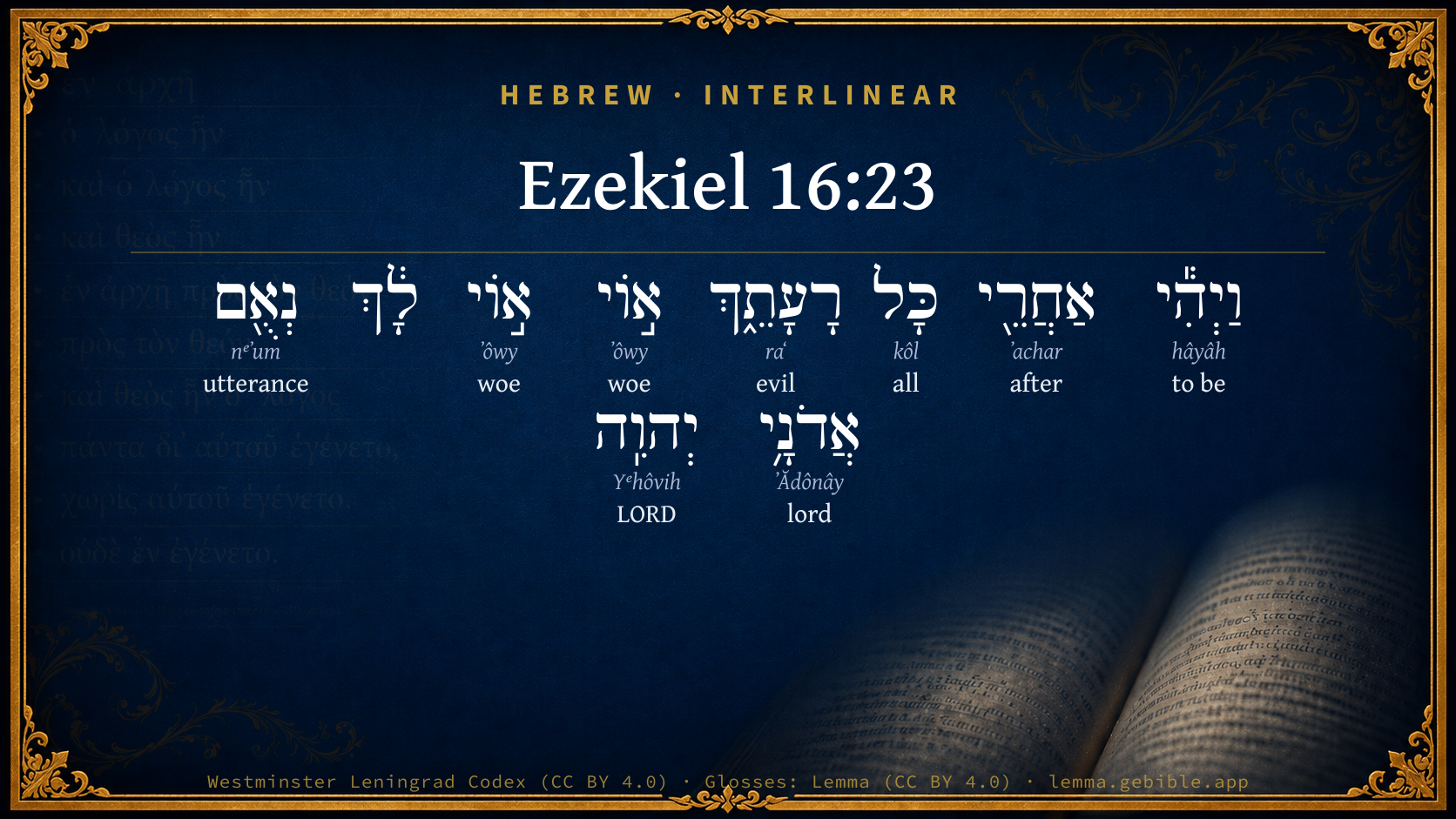
Hebrew (Westminster Leningrad Codex) Ezekiel 16:23 appears in the Hebrew Old Testament. The text above is from the Westminster Leningrad Codex. Each word links to its Strong’s number, a concise gloss, and parsing drawn from the Open Scriptures Hebrew Bible morphology. Click any word for its full Brown-Driver-Briggs (BDB) entry.
Download image
Cite this verse

Ezekiel 16:23 (World English Bible). Public Domain. Lemma interlinear Bible study tool, https://lemma.gebible.app/v/ezekiel/16/23.

Show BibTeX & RIS
BibTeX
RIS
English Translation
It is happen after all your wickedness, (woe, woe to you! says the Lord Yahweh),
World English Bible · Public Domain
Download a study sheet

One document with this verse’s original text, its word-by-word gloss line, the meaning frame, cross-references with their text, attributed commentary, and full source and license credits — printable, and it pastes into notes with its structure intact.

This verse Autodidact and up

Study sheet (.html) Plain text (.txt)

A passage Seminary Student

Up to 50 verses in one chapter. A passage sheet keeps up to 6 commentary sources and 12 cross-references per verse, in the order this page ranks them, and says so on the sheet whenever that leaves anything out. Ask for a single verse and you get the Autodidact verse sheet above.

Everything on this page stays free to read, with no account — the sheet is a download of what is already on screen, not access to it.

Want to remove ads? Support Godless Engineer
Compare translations 3

The same verse in 3 English versions, stacked beneath the original-language interlinear above. Click any original word for its lexicon entry.

Each is an independent rendering of the whole verse — the interlinear is not word-aligned to these translations.

Highlighted words mark where these versions differ — a whole-verse word diff, not a word-by-word alignment.

  • World English Bible Public Domain
    It is happen after all your wickedness, (woe, woe to you! says the Lord Yahweh),
  • King James Version Public Domain
    And it came to pass after all thy wickedness, (woe, woe unto thee! saith the LORD GOD;)
  • unfoldingWord Literal Text CC BY-SA 4.0
    Woe! Woe to you!—this is the Lord Yahweh’s declaration—therefore, in addition to all this wickedness,

unfoldingWord Literal Text — © unfoldingWord, licensed CC BY-SA 4.0. Word-aligned USFM3 via Door43 (git.door43.org/unfoldingWord/en_ult).

Versions to compare (up to 4)

3 of 4 selected

Show all 18 translations

Every available English version of this verse, each an independent rendering of the whole verse.

  • World English Bible Public Domain
    It is happen after all your wickedness, (woe, woe to you! says the Lord Yahweh),
  • Berean Standard Bible Public Domain
    Woe! Woe to you, declares the Lord GOD. And in addition to all your other wickedness,
  • Majority Standard Bible Public Domain
    Woe! Woe to you, declares the Lord GOD. And in addition to all your other wickedness,
  • King James Version Public Domain
    And it came to pass after all thy wickedness, (woe, woe unto thee! saith the LORD GOD;)
  • American Standard Version (1901) Public Domain
    And it is come to pass after all thy wickedness, (woe, woe unto thee! saith the Lord Jehovah,)
  • Revised Version (1885) Public Domain
    And it is come to pass after all thy wickedness, (woe, woe unto thee! saith the Lord GOD,)
  • Geneva Bible (1599) Public Domain
    And beside all thy wickednes (wo, wo vnto thee, saith the Lord God)
  • Douay-Rheims (1899) Public Domain
    And it came to pass after all thy wickedness (woe, woe to thee, saith the Lord God)
  • Young's Literal Translation Public Domain
    And it cometh to pass, after all thy wickedness, (Wo, wo, to thee -- an affirmation of the Lord Jehovah),
  • Literal Standard Version CC BY-SA 4.0
    And it comes to pass, after all your wickedness || (Woe, woe, to you—a declaration of Lord YHWH),
  • Unlocked Literal Bible CC BY-SA 4.0
    Woe! Woe to you!—this is the Lord Yahweh's declaration—therefore, in addition to all this wickedness,
  • unfoldingWord Literal Text CC BY-SA 4.0
    Woe! Woe to you!—this is the Lord Yahweh’s declaration—therefore, in addition to all this wickedness,
  • Darby Bible Public Domain
    And it came to pass after all thy wickedness (woe, woe unto thee! saith the Lord Jehovah),
  • World Messianic Bible Public Domain
    “‘“It has happened after all your wickedness—woe, woe to you!” says the Lord GOD—
  • Webster's Bible Public Domain
    And it came to pass after all thy wickedness, (woe, woe to thee! saith the Lord GOD;)
  • Free Bible Version CC BY-SA 4.0
    Disaster is coming! Disaster is coming on you, declares the Lord God. As well as all the other evil things you did,
  • Bible in Basic English Public Domain
    And it came about, after all your evil-doing, says the Lord,
  • JPS Tanakh (1917) Public Domain
    And it came to pass after all thy wickedness — woe, woe unto thee! saith the Lord GOD —

Literal Standard Version (2020), Covenant Press — licensed CC BY-SA 4.0. Text via the HelloAO Bible API (eBible.org). Unlocked Literal Bible (unfoldingWord) — licensed CC BY-SA 4.0. Text via the HelloAO Bible API (eBible.org). unfoldingWord Literal Text — © unfoldingWord, licensed CC BY-SA 4.0. Word-aligned USFM3 via Door43 (git.door43.org/unfoldingWord/en_ult). Free Bible Version, Dr. Jonathan Gallagher — licensed CC BY-SA 4.0. Text via the HelloAO Bible API (eBible.org).

Word by word

More ways to search: Search by grammar → Find every occurrence → Compare this word →

Practice this passage: Drill this verse → Learn its vocabulary →

About this verse

These counts appear in no published source. They are computed here, from the morphology-tagged text and Lemma’s own curated glosses. What Lemma adds →

10
words
8
distinct lemmas
Prophets
section

Notable vocabulary

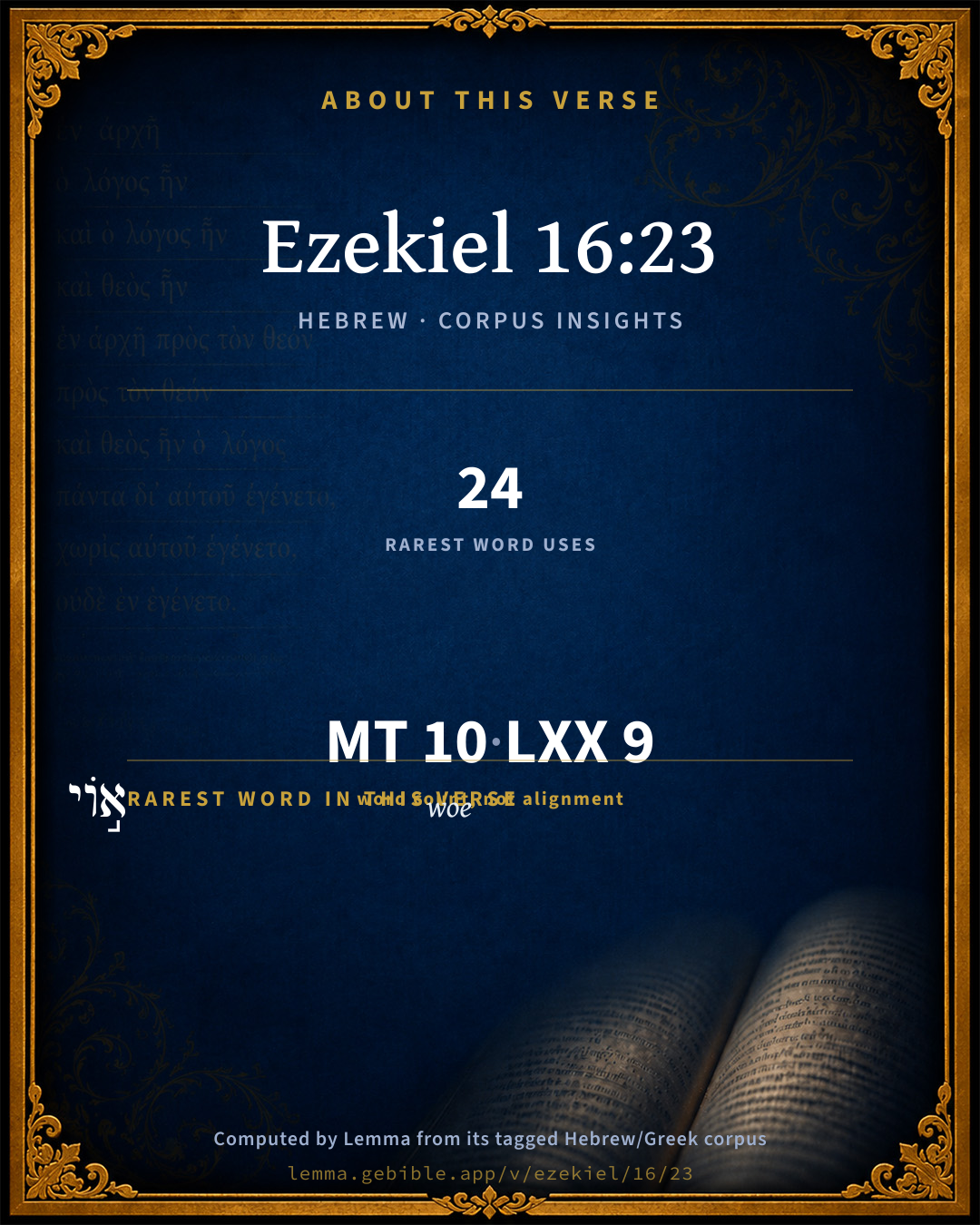
The rarest word here is א֣וֹי woe H188 — appearing just 24 times in the whole Hebrew Bible.

Shared distinctive vocabulary

א֣וֹי woe H188 occurs in 23 verses of the Hebrew Bible. Also found in:

Grammatical profile

  • 1 verb
  • 5 nouns
  • 2 prepositions
  • 2 particles

Verb forms

  • וַיְהִ֕י Qal · Sequential Imperfect

Repetition

A word recurs within this verse — often emphatic in Hebrew:

  • א֣וֹי woe H188 ×2

Hebrew & Septuagint length

In English translation the verse runs 15 words from the Hebrew and 12 from the Septuagint (LXX English) — closely comparable.

A rough comparison of the two English renderings, which tokenize alike — not a word-level alignment.

Word counts can differ between the Hebrew and the Greek without any difference in meaning — e.g. the Hebrew direct-object marker אֵת has no separate Greek word, and Greek often adds the article ὁ.

In the original languages it is 10 Hebrew tokens and 9 Greek tokens — but the two are counted differently (Hebrew bundles its prefixes and suffixes into one token; the Greek is in lemma form), so that isn’t a like-for-like length.

Cross-references

10

Topical passages linked to Ezekiel 16:23 in the Treasury of Scripture Knowledge — connected by theme and wording, ordered by reader-vote popularity; previews shown in the World English Bible.

  • Jeremiah 13:27 I have seen your abominations, even your adulteries, and your neighing, the lewdness of your prostitution, on the hills in the field. Woe to you, Jerusalem! you will not be made clean; how long shall it yet be?
  • Ezekiel 2:10 He spread it before me: and it was written within and without; and there were written therein lamentations, and mourning, and woe.
  • Ezekiel 13:3 Thus says the Lord Yahweh, Woe to the foolish prophets, who follow their own spirit, and have seen nothing!
  • Ezekiel 13:18 and say, Thus says the Lord Yahweh: Woe to the women who sew pillows on all elbows, and make kerchiefs for the head of [persons of] every stature to hunt souls! Will you hunt the souls of my people, and save souls alive for yourselves?
  • Ezekiel 24:6 Therefore thus says the Lord Yahweh: Woe to the bloody city, to the caldron whose rust is therein, and whose rust is not gone out of it! take out of it piece after piece; No lot is fallen on it.
  • Zephaniah 3:1 Woe to her who is rebellious and polluted, the oppressing city!
  • Matthew 11:21 "Woe to you, Chorazin! Woe to you, Bethsaida! For if the mighty works had been done in Tyre and Sidon which were done in you, they would have repented long ago in sackcloth and ashes.
  • Matthew 23:13–29 "Woe to you, scribes and Pharisees, hypocrites! For you devour widows' houses, and as a pretense you make long prayers. Therefore you will receive greater condemnation.
  • Revelation 8:13 I saw, and I heard an eagle, flying in mid heaven, saying with a loud voice, "Woe! Woe! Woe for those who dwell on the earth, because of the other voices of the trumpets of the three angels, who are yet to sound!"
  • Revelation 12:12 Therefore rejoice, heavens, and you who dwell in them. Woe to the earth and to the sea, because the devil has gone down to you, having great wrath, knowing that he has but a short time."

Cross-references courtesy of OpenBible.info (CC BY 4.0).

Hebrew and Greek witnesses Masoretic Hebrew ↔ Greek Septuagint

The same verse in the two great witnesses to the Old Testament, shown verse-for-verse.

These are two independent witnesses, not word-aligned to each other, and the Septuagint is shown in lemma (dictionary) form.

Hebrew Ezekiel 16:23 Masoretic · Westminster Leningrad Codex

וַיְהִ֕י אַחֲרֵ֖י כָּל רָעָתֵ֑ךְ א֣וֹי א֣וֹי לָ֔ךְ נְאֻ֖ם אֲדֹנָ֥י יְהוִֽה

It is happen after all your wickedness, (woe, woe to you! says the Lord Yahweh),

World English Bible · Public Domain

Greek LXX Ezekiel 16:23 Septuagint · lemma form

καί γίγνομαι μετά πᾶς ὁ κακία σύ λέγω κύριος

And it came to pass after all your wickedness, says the Lord,

LXX2012 (modern English Septuagint) · Public Domain

On this verse, The Cambridge Bible for Schools and Colleges discusses the Septuagint’s reading. Read the note in Commentary ↓

Hebrew: Westminster Leningrad Codex (CC BY 4.0). Greek: Septuagint (public domain); English from LXX2012 (modern English Septuagint) (Public Domain). How the Septuagint differs from the Hebrew →

Targum (Aramaic paraphrase)

1

The Targum is the ancient Jewish Aramaic paraphrase of the Hebrew Scriptures — an interpretive translation, not the Hebrew text itself. Onkelos (literal) and Pseudo-Jonathan (expansive) render the Torah, and Jonathan the Prophets. Coverage is partial: where no permissively-licensed English translation exists for a verse, only the Aramaic is shown. This is verse-level text, not a word-by-word alignment to the Hebrew.

  1. Targum Jonathan Prophets (Joshua–Malachi)
    מַה יְהֵי בְסוֹפַיִךְ עַל כָּל בִּישְׁתִּיךְ נְבִיָא אֲמַר יַהּ וַי לִיךְ עַל דְחַבְתְּ וַי לִיךְ עַל דְלָא תַבְתְּ אֲמַר יְיָ אֱלֹהִים:

    (no public-domain English translation for this verse)

    Targum Jonathan — Aramaic: “Mikraot Gedolot” (public domain). English: “Sefaria Community Translation” (CC0 1.0 (public-domain dedication)); “London "Chaldee Paraphrase," 1871” (public domain). Text via Sefaria.

Commentary

Notes on Ezekiel 16:23 from classic Christian and Jewish commentators (each source and its license shown beneath its notes). The classic Christian expositions comment on the surrounding passage and are grouped to its opening verse, so a note may address several verses; the Jewish commentaries on the Tanakh (Rashi and others) are per-verse, so they appear only where the commentator wrote on this verse.

Lemma curates 59 commentaries, every one of them public domain or Creative Commons licensed, each selected and text-cleaned for this edition rather than reprinted as found. About our sources →

The Cambridge Bible for Schools and Colleges

gen. ed. J. J. S. Perowne

23. after all thy wickedness] The wickedness described in preceding verses as idolatries of Canaan; after this followed foreign idolatry. LXX. omits the words “woe, woe unto thee.”

23–34. Her infidelities with strangers from abroad, i.e. her alliances with idolatrous nations and adoption of their religious rites: Egypt (Eze_16:23-27), Assyria (Eze_16:28), and Chaldea (Eze_16:29 seq.). Hosea already stigmatized foreign alliances as whoredoms; it is not, however, so much the political aspect of these alliances as their religious consequences that Ezekiel reprobates. Such alliances were followed by the fashions and worship of the nations with which they were formed (Isa_2:5 seq.). Naturally also when Israel became subject to the great eastern empires, the overwhelming influence of these states, with their customs and religions, was widely felt. The gods which had given them universal empire were introduced and worshipped. There appears to have been a great invasion of foreign idolatry in Judah in the declining years of the state, and the kingdom sank to a level in this respect to which the North had never fallen.

The Cambridge Bible for Schools and Colleges (gen. ed. J. J. S. Perowne; Cambridge University Press, 1878–1918) — public domain. Text from a community e-Sword module.

Trapp's Complete Commentary

John Trapp

Eze 16:23 And it came to pass after all thy wickedness, (woe, woe unto thee! saith the Lord GOD;)

Ver. 23. Woe, woe unto thee, saith the Lord God.] A double woe will fall very heavy here and hereafter; woe and alas for evermore.

John Trapp, A Commentary or Exposition upon All the Books of the Old and New Testament (1647–1656) — public domain. Text from a community e-Sword module.

Keil & Delitzsch

C. F. Keil & F. Delitzsch

Extent and Magnitude of the Idolatry

Eze 16:23. And it came to pass after all thy wickedness - Woe, woe to thee! is the saying of the Lord Jehovah - Eze 16:24. Thou didst build thyself arches, and didst make thyself high places in all the streets. Eze 16:25. Thou didst build thy high places at every cross road, and didst disgrace thy beauty, and stretch open thy feet for every one that passed by, and didst increase thy whoredom. Eze 16:26. Thou didst commit fornication with the sons of Egypt thy neighbours, great in flesh, and didst increase thy whoredom to provoke me. Eze 16:27. And, behold, I stretched out my hand against thee, and diminished thine allowance, and gave thee up to the desire of those who hate thee, the daughters of the Philistines, who are ashamed of thy lewd way. Eze 16:28. And thou didst commit fornication with the sons of Asshur, because thou art never satisfied; and didst commit fornication with them, and wast also not satisfied. Eze 16:29. And thou didst increase thy whoredom to Canaan's land, Chaldaea, and even thereby wast not satisfied. Eze 16:30. How languishing is thy heart! is the saying of the Lord Jehovah, that thou doest all this, the doings of a dissolute prostitute. Eze 16:31. When thou buildest thy arches at every cross road, and madest thy high places in every road, thou wast not like the harlot, since thou despisedst payment. Eze 16:32. The adulterous wife taketh strangers instead of her husband. Eze 16:33. Men give presents to all prostitutes; but thou gavest thy presents to all thy suitors, and didst reward them for coming to thee from all sides, for fornication with thee. Eze 16:34. And there was in thee the very opposite of the women in thy whoredom, that men did not go whoring after thee. In that thou givest payment, and payment was not given to thee, thou wast the very opposite. - By אחרי כל־רעתך, the picture of the wide spread of idolatry, commenced in Eze 16:22, is placed in the relation of chronological sequence to the description already given of the idolatry itself. For all sin, all evil, must first exist before it can spread. The spreading of idolatry was at the same time an increase of apostasy from God. This is not to be sought, however, in the face that Israel forsook the sanctuary, which God had appointed for it as the scene of His gracious presence, and built itself idol-temples (Kliefoth). It consisted rather in this, that it erected idolatrous altars and little temples at all street-corners and cross-roads (Eze 16:24, Eze 16:25), and committed adultery with all heathen nations (Eze 16:26, Eze 16:28, Eze 16:29), and could not be induced to relinquish idolatry either by the chastisements of God (Eze 16:27), or by the uselessness of such conduct (Eze 16:32-34). כל־רעתך is the whole of the apostasy from the Lord depicted in Eze 16:15-22, which prevailed more and more as idolatry spread. The picture of this extension of idolatry is introduced with woe! woe! to indicate at the outset the fearful judgment which Jerusalem was bringing upon itself thereby. The exclamation of woe is inserted parenthetically; for ותּבני (Eze 16:24) forms the apodosis to ויהי in Eze 16:23. גּב and רמה are to be taken as general terms; but, as the singular גּבּך with the plural רמתיך in Eze 16:39 plainly shows, גּב is a collective word. Hvernick has very properly called attention to the analogy between גּב and קבּה in Num 25:8, which is used there to denote an apartment furnished or used for the service of Baal-peor. As קבּה, from קבב, signifies literally that which is arched, a vault; so גּב, from גּבב, is literally that which is curved or arched, a hump or back, and hence is used here for buildings erected for idolatrous purposes, small temples built on heights, which were probably so called to distinguish them as chapels for fornication. The ancient translations suggest this, viz.: lxx οἴκημα πορνικόν and ἔκθεμα, which Polychron. explains thus: προαγώγιον ἔνθα τὰς πόρνας τρέφειν εἴωθασι; Vulg.: lupanar and prostibulum. רמה signifies artificial heights, i.e., altars built upon eminences, commonly called bâmōth. The word râ̂̂mâh is probably chosen here with an allusion to the primary signification, height, as Jerome has said: quod excelsus sit ut volentibus fornicari procul appareat fornicationis locus et non necesse sit quaeri.

The increase of the whoredom, i.e., of the idolatry and illicit intercourse with heathenish ways, is individualized in Eze 16:26-29 by a specification of historical facts. We cannot agree with Hitzig in restricting the illicit intercourse with Egypt (Eze 16:26), Asshur (Eze 16:28), and Chaldaea (Eze 16:29) to political apostasy, as distinguished from the religious apostasy already depicted. There is nothing to indicate any such distinction. Under the figure of whoredom, both in what precedes and what follows, the inclination of Israel to heathen ways in all its extent, both religious and political, is embraced. Egypt stands first; for the apostasy of Israel from the Lord commenced with the worship of the golden calf, and the longing in the wilderness for the fleshpots of Egypt. From time immemorial Egypt was most deeply sunken in the heathenish worship of nature. The sons of Egypt as therefore described, in accordance with the allegory, as גּדלי , magni carne (bâzâr, a euphemism; cf. Eze 23:20), i.e., according to the correct explanation of Theodoret: μεθ ̓ὑπερβολῆς τῇ τῶν εἰδώλων θεραπείᾳ προστετηκότας ου. The way in which God punished this erring conduct was, that, like a husband who endeavours by means of chastisement to induce his faithless wife to return, He diminished the supply of food, clothing, etc. (chōg, as in Pro 30:8), intended for the wife (for the fact compare Hos 2:9-10); this He did by "not allowing Israel to attain to the glory and power which would otherwise have been conferred upon it; that is to say, by not permitting it to acquire the undisturbed and undivided possession of Canaan, but giving it up to the power and scorn of the princes of the Philistines" (Kliefoth). נתן בּנפשׁ, to give any one up to the desire of another. The daughters of the Philistines are the Philistian states, corresponding to the representation of Israel as an adulterous wife. The Philistines are mentioned as the principal foes, because Israel fell completely into their power at the end of the period of the Judges (cf. Judg 13-16; Sa1 4:1); and they are referred to here, for the deeper humiliation of Israel, as having been ashamed of the licentious conduct of the Israelites, because they adhered to their gods, and did not exchange them for others as Israel had done (compare Jer 2:10-11). זמּה (v. 27) is in apposition to דּרכּך: thy way, which is zimmâh. Zimmâh is applied to the sin of profligacy, as in Lev 18:17. - But Israel was not improved by this chastisement. It committed adultery with Asshur also from the times of Ahaz, who sought help from the Assyrians (Kg2 16:7.); and even with this it was not satisfied; that is to say, the serious consequences brought upon the kingdom of Judah by seeking the friendship of Assyria did not sober it, so as to lead it to give up seeking for help from the heathen and their gods. In Eze 16:28, תּזני אל is distinguished from תּזנים (זנה, with accus.). The former denotes the immoral pursuit of a person for the purpose of procuring his favour; the latter, adulterous intercourse with him, when his favour has been secured. The thought of the verse is this: Israel sought the favour of Assyria, because it was not satisfied with illicit intercourse with Egypt, and continued to cultivate it; yet it did not find satisfaction or sufficiency even in this, but increased its adultery אל־ארץ כּנען כּשׂדּימה, to the Canaan's-land Chaldaea. ארץ כּנען is not the proper name of the land of Canaan here, but an appellative designation applied to Chaldaea (Kasdim) or Babylonia, as in Eze 17:4 (Raschi). The explanation of the words, as signifying the land of Canaan, is precluded by the fact that an allusion to Canaanitish idolatry and intercourse after the mention of Asshur would be out of place, and would not coincide with the historical order of things; since it cannot be shown that "a more general diffusion of the religious customs of Canaan took place after the Assyrian era." And it is still more decidedly precluded by the introduction of the word כּשׂדּימה, which cannot possibly mean as far as, or unto, Chaldaea, and can only be a more precise definition of ארץ כנען. The only thing about which a question can be raised, is the reason why the epithet כנען should have been applied to Chaldaea; whether it merely related to the commercial spirit, in which Babylon was by no means behind the Canaanitish Tyre and Sidon, or whether allusion was also made to the idolatry and immorality of Canaan. The former is by no means to be excluded, as we find that in Eze 17:4 "the land of Canaan" is designated "a city of merchants" (rōkhelim). But we must not exclude the latter either, inasmuch as in the Belus- and Mylitta-worship of Babylon the voluptuous character of the Baal- and Astarte-worship of Canaan had degenerated into shameless unchastity (cf. Herodotus, i. 199).

In Eze 16:30, the contents of Eze 16:16-29 are summed up in the verdict which the Lord pronounces upon the harlot and adulteress: "yet how languishing is thy heart!" אמלה (as a participle Kal απ. λεγ..; since the verb only occurs elsewhere in the Pual, and that in the sense of faded or pining away) can only signify a morbid pining or languishing, or the craving of immodest desire, which has grown into a disease. The form לבּה is also ἁπ. λεγ..; but it is analogous to the plural לבּות.

(Note: Hitzig objects to the two forms, which do not occur elsewhere; and with the help of the Sept. rendering τὶ διαθῶ τὴν θυγατέρα σου, which is a mere guess founded upon the false reading מה אמלה, he adopts the conjectural reading מה אמלה לבתּך, "what hope is there for thy daughter?" by which he enriches the Hebrew language with a new word (אמלה ), and the prophecy contained in this chapter with a thought which is completely foreign to it, and altogether unsuitable.)

שׁלּטת, powerful, commanding; as an epithet applied to zōnâh, one who knows no limit to her actions, unrestrained; hence in Arabic, insolent, shameless. Eze 16:31 contains an independent sentence, which facilitates the transition to the thought expanded in Eze 16:32-34, namely, that Jerusalem had surpassed all other harlots in her whoredoms. If we take Eze 16:31 as dependent upon the protasis in Eze 16:30, we not only get a very dragging style of expression, but the new thought expressed in Eze 16:31 is reduced to a merely secondary idea; whereas the expansion of it in Eze 16:32. shows that it introduces a new feature into the address. And if this is the case, ולא־הייתי cannot be taken as co-ordinate with עשׂיתי htiw etanidro-oc, but must be construed as the apodosis: "in thy building of rooms...thou wast not like the (ordinary) harlot, since thou disdainest payment." For the plural suffix attached to בּבנותיך, see the commentary on Eze 6:8. The infinitive לקלּס answers to the Latin gerund in ndo (vid., Ewald, 237c and 280d), indicating wherein, or in what respect, the harlot Jerusalem differed from an ordinary prostitute; namely, in the fact that she disdained to receive payment for her prostitution. That this is the meaning of the words, is rendered indisputable by Eze 16:32-34. But the majority of expositors have taken לקלּס as indicating the point of comparison between Israel and other harlots, i.e., as defining in what respect Israel resembled other prostitutes; and then, as this thought is at variance with what follows, have attempted to remove the discrepancy by various untenable explanations. Most of them resort to the explanation: thou wast not like the other prostitutes, who disdain to receive their payment offered for their prostitution, in the hope of thereby obtaining still more,

(Note: Jerome adopts this rendering: non facta es quasi meretrix fastidio augens pretium, and gives the following explanation: "thou hast not imitated the cunning prostitutes, who are accustomed to raise the price of lust by increasing the difficulties, and in this way to excite their lovers to greater frenzy." Rosenmller and Maurer have adopted a similar explanation: "thou differest greatly from other harlots, who despise the payment offered them by their lovers, that they may get still more; for thou acceptest any reward, being content with the lowest payment; yea, thou dost even offer a price to thine own lovers.")

an explanation which imports into the words a thought that has no existence in them at all. Hvernick seeks to fix upon קלס, by means of the Aramaean, the meaning to cry out (crying out payment), in opposition to the ordinary meaning of קלס, to disdain, or ridicule, in which sense Ezekiel also uses the noun קלּסה in Eze 22:4. Hitzig falls back upon the handy method of altering the text; and finally, Kliefoth gives to ל the imaginary meaning "so far as," i.e., "to such a degree that," which cannot be defended either through Exo 39:19 or from Deu 24:5.

With the loose way in which the infinitive construct with ל is used, we grant that the words are ambiguous, and might have the meaning which the majority of the commentators have discovered in them; but this view is by no means necessary, inasmuch as the subordinate idea introduced by לקלּס אתנן may refer quite as well to the subject of the sentence, "thou," as to the zōnâh with whom the subject is compared. Only in the latter case the קלּס would apply to other harlots as well as to Israel; whereas in the former it applies to Israel alone, and shows in what it was that Israel did not resemble ordinary prostitutes. But the explanation which followed was a sufficient safeguard against mistake. In this explanation adulteresses are mentioned first (v. 32), and then common prostitutes (vv. 33, 34). V. 32 must not be taken, as it has been by the majority of commentators, as an exclamation, or a reproof addressed to the adulteress Jerusalem: O thou adulterous wife, that taketh strangers instead of her husband! Such an exclamation as this does not suit the connection at all. But the verse is not to be struck out on that account, as Hitzig proposes. It has simply to be construed in another way, and taken as a statement of what adulteresses do (Kliefoth). They take strangers instead of their husband, and seek their recompense in the simple change, and the pleasure of being with other men. תּחת אישׁהּ, lit., under her husband, i.e., as a wife subject to her husband, as in the connection with זנה in Eze 23:5 and Hos 4:12 (see the comm. on Num 5:19). - Eze 16:33, Eze 16:34. Common prostitutes give themselves up for presents; but Israel, on the contrary, gave presents to its lovers, so that it did the very opposite to all other harlots, and the practice of ordinary prostitutes was left far behind by that of Israel. The change of forms נדא and נדן (a present) is probably to be explained simply on the ground that the form נדא was lengthened into נדן with a consonant as the termination, because the suffix could be attached more easily to the other. הפך, the reverse, the opposite, i.e., with the present context, something unheard of, which never occurred in the case of any other harlot. - Ezekiel has thus fulfilled the task appointed him in Eze 16:2, to charge Jerusalem with her abominations. The address now turns to an announcement of the punishment.

Keil & Delitzsch — Biblical Commentary on the Old Testament (1861–1891) — public domain (CC PDM 1.0). Text via the HelloAO Bible API. (Old Testament only.)

Tyndale Open Study Notes

Tyndale Open Resources

16:23-25 Prophets commonly described idolatry in terms of adultery (see Hos 2), but Ezekiel goes into much more detail than any other prophet. He depicts Jerusalem as not just foolish or misguided, but rotten to the core. Her adultery had taken place on every street corner, and she had an inexhaustible appetite for increasingly depraved entertainments.

Tyndale Open Study Notes — © Tyndale Open Resources, licensed CC BY-SA 4.0. Text via the HelloAO Bible API.

Jamieson, Fausset & Brown

Robert Jamieson, A. R. Fausset & David Brown

woe, woe unto thee, &c.--This parenthetical exclamation has an awful effect coming like a lightning flash of judgment amidst the black clouds of Israel's guilt.

Jamieson, Fausset & Brown — Commentary Critical and Explanatory on the Whole Bible (1871) — public domain (CC PDM 1.0). Text via the HelloAO Bible API.

John Calvin's Commentaries

The first verse is variously explained. Some read the clause separately, ויהי אחרי כל רעתך, vihi achri kel regnethek — it was after all thy wickedness: and they think that God threatens the Jews here as he did in Hosea, (Hosea 2:9,10.) For after God had there complained that his wool and his flax had been taken away, and offered as gifts to idols, he afterwards adds, I will demand all things back again, and then all thy beauty shall be taken from thee, and thy nakedness shall be laid bare, so that you shall be deservedly ashamed. Thus then they explain these words, that the condition of the Jews should be as it formerly was; as if he had said in one word, I will so avenge myself, that whether you will or not, you shall be compelled to feel the disgrace of your nakedness, since I will manifest it again. But this sense seems forced; therefore I unite it with the remainder of the verse which follows it. Thus then the language of the Prophet flows on: and it was after all thy wickedness that you built a high place for thyself — you made for thyself a lofty place in every street: there are two different words, but the sense is the same: you did set up thy high places in all the principal ways, and so, says he, thy beauty became abominable. But this is inserted by way of parenthesis, Alas! alas for thee! This exclamation is abruptly interposed. But, at the same time, I have no doubt that these things all adhere together, since the Jews added sin to sin, and never made an end of sinning. He says, therefore, after they had been perfidious and ungrateful to God, after they had basely devoted all they had to perverse worship, then this new crime was added, that they had erected high places in every street and in every path.

If any one objects that this was not a greater crime than others, the answer is easy, that God does not speak of one high place only, or of one altar, but he comprehends all the signs of idolatry by which they had infected the land; for it was the height of impudence to erect everywhere the standard of their superstitions. For every high place and every altar was a testimony of their backsliding; just as if they had openly boasted that they would not magnify the worship of the law, and intended purposely to overthrow whatever God had prescribed. God therefore, not without cause, burns with wrath because the Jews had erected high places and altars everywhere. Now, then, we understand the Holy Spirit’s meaning as far as these words are concerned. It is added, after all thy wickedness, says he; that is, in addition to all thy crimes, this sin and impudence is added, that you have built not only one, but innumerable high places in every street, nay, in every pathway of importance, that is, in the most celebrated places. For the heads of the pathways are the most conspicuous places, and whatever is done there is more exposed to the eyes of all.

We must now notice the exclamation which is interposed. Alas! alas! for thee, says the Lord Jehovah. Since the Jews, through their sloth, were not at all attentive to the reproofs of the prophets, that God might waken them up, he here pronounces his curse twice. It is clear that they were not moved by it: but this vehemence tended to their severer condemnation, since, though they were drowned and sunk in deep sleep, yet they might be raised by this formidable voice. There is no doubt that they applauded themselves for their own superstitions; but it is on that account profitable to estimate the weight of these words of God. For we gather from hence, that when idolaters indulge in their own fictions, and think themselves entirely free from blame, the word of God is sufficient, by which he thunders against them, saying, alas! alas! for thee. Hence men cease to judge according to their own notions, and are rather attentive to the sentence of God, and acknowledge his curse passing on them when they think that they are rightly discharging the duty of piety in worshipping idols.

John Calvin's Commentaries (1540-1563) — public domain. Text from the Calvin Translation Society English edition (1840s-50s) via the Christian Classics Ethereal Library (ccel.org). Calvin's coverage is partial (roughly two-thirds of the Bible); uncommented books and verses are honest gaps, never fabricated. The 19th-century editor's footnotes and remarks are omitted so the notes are faithfully Calvin's own voice.

Ellicott's Commentary for English Readers

(23) After all thy wickedness.—The sin and idolatry hitherto described had been derived by Israel chiefly from the Canaanites, the old inhabitants of the land; but now. in accordance with what was said in Eze_16:15, the prophet goes on to speak of the other abundant idolatries adopted eagerly by the Israelites from foreign nations.

A Bible Commentary for English Readers, edited by Charles John Ellicott (1878–1897) — public domain. Text from a community e-Sword module.

John Gill's Exposition

That thou hast also built unto thee an eminent place,.... Or a "brothel" (k); and so the Septuagint version, "a whoring house"; not content to commit idolatry privately, they built a public place for idolatrous worship. The Targum renders it, "altar", The word has the signification of a pit or ditch; with which compare Pro 22:14;

and hast made thee an high place in every street; of Jerusalem, and other cities; it was usual to erect high places in streets, where altars were built, and idols set up to be worshipped: it denotes the public manner in which they committed idolatry, and the multitude of their idols; which shows their impudence and hardness of heart.

(k) , Sept. "lupanar", V. L. "prostibulum", so some in Starckius.

John Gill's Exposition of the Whole Bible (1746–1763) — public domain (CC PDM 1.0). Text via the HelloAO Bible API.

Albert Barnes' Notes on the Bible

After all ... - Besides these things, there was the introduction of other idolatrous rites from the nations with whom Israel had contact.

Albert Barnes' Notes on the Bible (1834–1885) — public domain. Text from a community e-Sword/MySword module.

Matthew Poole's English Annotations

It came to pass; it shall come to pass; so the Hebrew may be read, and then this verse will be a dreadful threat of misery to come upon the Jews for all their wickednesses; when they have filled up the measure of their sins, God will fill them with his judgments, and bring one woe after another upon them, as they proceeded from one wickedness to another. But as we read the words, they are an introduction to a further declaring of this people’s multiplied wickedness, with a dreadful menace introduced somewhat abruptly to express God’s great displeasure against them: the threat is doubled, because it is certainly coming, and will be great when come.

Matthew Poole's English Annotations on the Holy Bible (1683–1685) — public domain. Text from a community e-Sword/MySword module.

The Pulpit Commentary

Woe unto thee, etc.! The interjectional parenthesis, half anathema and half lamentation, looks forward rather than backward. Up to this point Ezekiel had dwelt on the forms of idolatry which were indigenous to Canaan and the nations in immediate contact with it. Now he enters on the later forms of evil which had been adopted from more distant nations. We pass from the time of Solomon to that of Ahaz and Manasseh.

The Pulpit Commentary (1880–1919), ed. H.D.M. Spence-Jones & Joseph S. Exell — public domain. Text from a community e-Sword module.

unfoldingWord translationNotes

Door43 World Missions Community

General Information:

Yahweh continues to speak about Jerusalem as if the city were his unfaithful wife. The city represents the people who live there. (See: Metaphor and Metonymy)

this is the Lord Yahweh's declaration

Yahweh speaks of himself by name to express the certainty of what he is declaring. See how you translated this in Ezekiel 5:11. AT: "this is what the Lord Yahweh has declared" or "this is what I, the Lord Yahweh, have declared" (See: First, Second, or Third Person)

you built yourself a vaulted chamber in every public place

Possible meanings are that she built a place where 1) she could worship her idols or 2) she could practice her prostitution.

translationWords

woe

Lord Yahweh

declare

evil

high place

unfoldingWord translationNotes — © Distant Shores Media and the Door43 World Missions Community, licensed CC BY-SA 4.0. Source: git.door43.org/Door43/en_tn.

Rashi

Rabbi Shlomo Yitzchaki (Rashi)

Woe, woe is to you Woe is to you because you have sinned! Woe is to you because you have not repented!

Rashi on the Tanakh — English translations: “The Judaica Press complete Tanach with Rashi, translated by A. J. Rosenberg” (CC BY 4.0); “Pentateuch with Rashi's commentary by M. Rosenbaum and A.M. Silbermann, 1929-1934” (public domain); “The Metsudah Tanach series, Lakewood, N.J” (CC BY 4.0); and “The Book of Joshua, Metsudah Publications, 1997” (CC BY 4.0). Text via Sefaria.

Lesson kit

Teaching starters — assembled from the data on this page, not authored interpretation. Every prompt links to the verse data it draws on. Edit before teaching.

Ezekiel, in the Prophets, opens this verse with 10 words (8 distinct Hebrew lemmas). Its most distinctive word is ʼôwy (“woe”). A historical commentator’s framing appears above. Read the whole chapter for the surrounding context.

Discussion questions

  1. How does “woe” (ʼôwy) shape what this verse is saying?
  2. How does Numbers 21:29, which shares the word «woe», read alongside this verse?
  3. What does the repetition of “woe” (2× in this one verse) do in this verse?
  4. These translations render this verse differently. What is at stake in choosing one wording over another?
  5. «וַיְהִ֕י» is a Qal Sequential Imperfect verb. How does that grammatical form shape the action described?
  6. Compare how The Cambridge Bible for Schools and Colleges and Trapp's Complete Commentary read this verse. Where do they agree or differ?

Things to notice

Reading settings

Reading text

Shown beneath each verse's original-language words.

Old Testament
Old Testament edition

Read the OT as the Masoretic Hebrew (MT) or the Greek Septuagint (LXX).

English shown for the Greek Septuagint (in the Hebrew ↔ Greek comparison).

Comparing translations? Open the Compare panel on any verse page to stack up to four side by side.