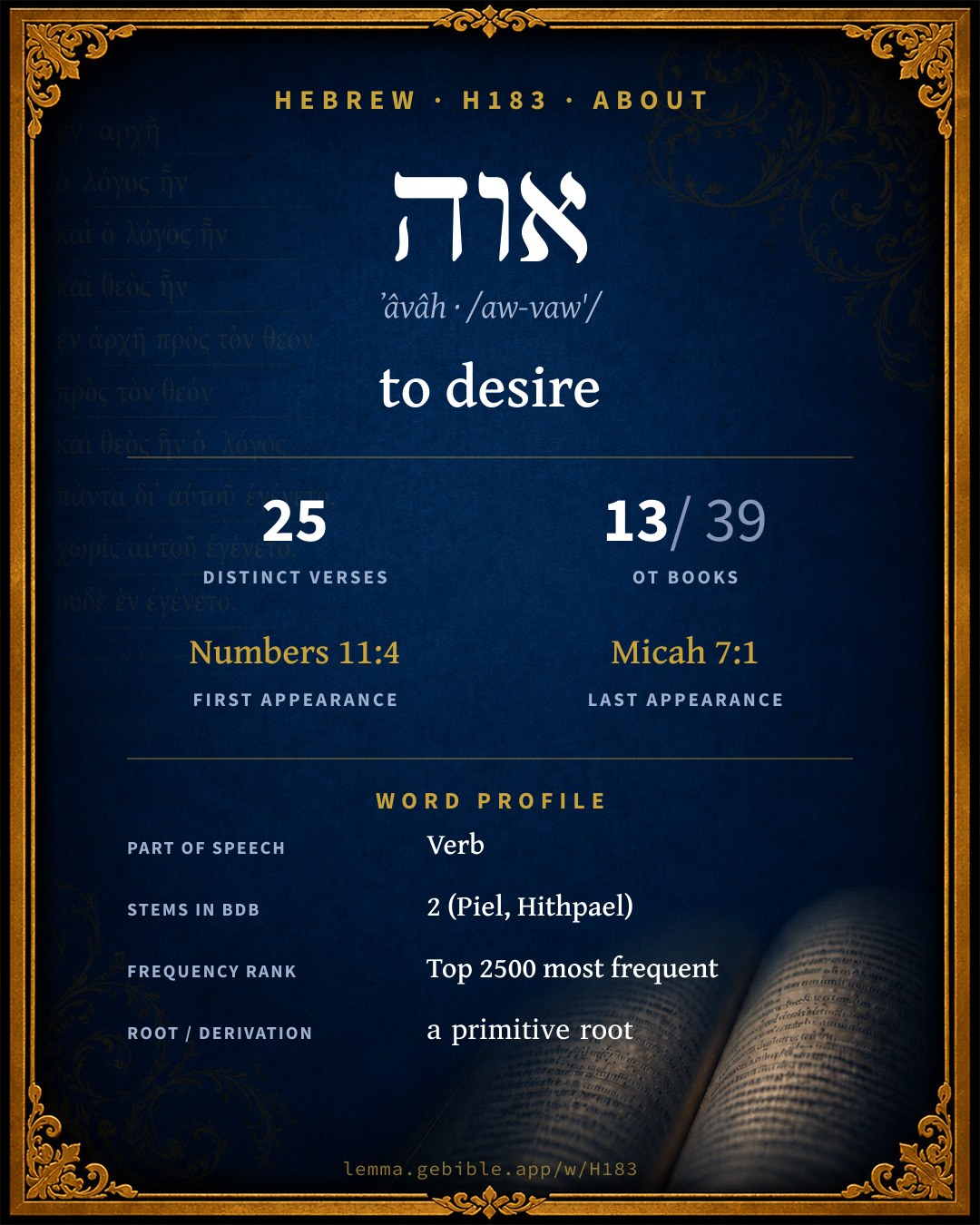
אָוָה
to desire
‘to desire’ is one of 3 main senses fuller range ↓
Full lexicon entry — Brown-Driver-Briggs (BDB)
From Brown-Driver-Briggs (BDB)
Where this word appears
See every Hithpael verb in the Hebrew Bible →
Grammar key — what these labels mean
Part of speech
- Verb
- An action or state-of-being word.
Stem
- Hithpael
- The reflexive or reciprocal stem (the subject acts on itself).
- Piel
- An intensive or resultative active stem.
Form
- Jussive
- A third- or second-person volitional form expressing wish or command (“let him write”).
- Imperfect
- An incomplete, ongoing, or future action (“he will / would write”).
- Sequential Imperfect
- An imperfect with prefixed waw — the standard past-narrative form (waw-consecutive imperfect).
- Perfect
- A completed action or state — Hebrew marks aspect (completeness) more than strict tense (“he wrote”).
- Participle Active
- A verbal adjective expressing ongoing or characteristic action (“writing / one who writes”).
State
- Absolute
- The independent form of a noun, not bound to a following word.
Person
- 2nd Person
- The one addressed (“you”).
- 3rd Person
- The one spoken about (“he / she / it / they”).
- 1st Person
- The speaker (“I / we”).
Gender
- Masculine
- Grammatically masculine.
- Feminine
- Grammatically feminine.
- Common
- Either gender — not distinguished for this form.
Number
- Singular
- One.
- Plural
- More than one (in Hebrew, generally three or more).
Grammatical forms 14 distinct
- Verb, Hithpael, Jussive, 2nd Person, Masculine, Singular 5 times (18%)
- Verb, Piel, Imperfect, 3rd Person, Feminine, Singular 4 times (14%)
- Verb, Hithpael, Sequential Imperfect, 3rd Person, Masculine, Singular 3 times (11%)
- Verb, Piel, Perfect, 3rd Person, Feminine, Singular 3 times (11%)
- Verb, Hithpael, Participle Active, Masculine, Plural, Absolute 2 times (7%)
- Verb, Hithpael, Imperfect, 3rd Person, Masculine, Singular 2 times (7%)
- Verb, Piel, Perfect, 1st Person, Common, Singular 2 times (7%)
- Verb, Hithpael, Sequential Imperfect, 3rd Person, Masculine, Plural 1 time (4%)
+6 more forms (6 occurrences)
Parsed forms decoded from the imported morphology (morphhb / Westminster Leningrad Codex — WLC text public domain, morphhb tagging CC BY 4.0), counted across 28 parsed occurrences — not distinct verses.
Every verse where H183 appears — 25 distinct verses across 13 books. Click any verse to open its interlinear word-by-word view. Verse text shown in the World English Bible for context — . Each verse’s Hebrew form is shown with its reference; the English is not keyword-highlighted, since the data carries no word-level English alignment. Use “Compare translations” on any verse to read it across multiple English versions. This concordance covers the Hebrew Bible; Septuagint (Greek Old Testament) occurrences are not indexed here.
Numbers 2 verses
- Numbers 11:4 הִתְאַוּ֖וּ Hithpael pf 3cp The mixed multitude that was among them lusted exceedingly: and the children of Israel also wept again, and said, Who shall give us flesh to eat?
- Numbers 11:34 הַ/מִּתְאַוִּֽים ptcl def.art + Hithpael ptcp.act mp The name of that place was called Kibrothhattaavah, because there they buried the people who lusted.
Deuteronomy 3 verses
- Deuteronomy 5:21 תִתְאַוֶּ֜ה Hithpael impf 2ms "Neither shall you covet your neighbor's wife; neither shall you desire your neighbor's house, his field, or his man-servant, or his maid-servant, his ox, or his donkey, or anything that is your neighbor's."
- Deuteronomy 12:20 תְאַוֶּ֥ה Piel impf 3fs When Yahweh your God shall enlarge your border, as he has promised you, and you shall say, I will eat flesh, because your soul desires to eat flesh; you may eat flesh, after all the desire of your soul.
- Deuteronomy 14:26 תְּאַוֶּ֨ה Piel impf 3fs and you shall bestow the money for whatever your soul desires, for oxen, or for sheep, or for wine, or for strong drink, or for whatever your soul asks of you; and you shall eat there before Yahweh your God, and you shall rejoice, you and your household.
2 Samuel 2 verses
- 2 Samuel 3:21 תְּאַוֶּ֖ה Piel impf 3fs Abner said to David, I will arise and go, and will gather all Israel to my lord the king, that they may make a covenant with you, and that you may reign over all that your soul desires. David sent Abner away; and he went in peace.
- 2 Samuel 23:15 וַ/יִּתְאַוֶּ֥ה conj + Hithpael wimpf 3ms David longed, and said, Oh that one would give me water to drink of the well of Bethlehem, which is by the gate!
1 Kings 1 verse
1 Chronicles 1 verse
Job 1 verse
Psalms 4 verses
- Psalms 45:11 וְ/יִתְאָ֣ו conj + Hithpael impf 3ms So the king will desire your beauty, Honor him, for he is your lord.
- Psalms 106:14 וַ/יִּתְאַוּ֣וּ conj + Hithpael wimpf 3mp But gave in to craving in the desert, And tested God in the wasteland.
- Psalms 132:13 אִ֝וָּ֗/הּ Piel pf 3ms + sfx pers 3fs For Yahweh has chosen Zion. He has desired it for his habitation.
- Psalms 132:14 אִוִּתִֽי/הָ Piel pf 1cs + sfx pers 3fs "This is my resting place forever. Here I will live, for I have desired it.
Proverbs 6 verses
- Proverbs 13:4 מִתְאַוָּ֣ה Hithpael ptcp.act fs The soul of the sluggard desires, and has nothing, But the desire of the diligent shall be fully satisfied.
- Proverbs 21:10 אִוְּתָה Piel pf 3fs The soul of the wicked desires evil; His neighbor finds no mercy in his eyes.
- Proverbs 21:26 הִתְאַוָּ֣ה Hithpael pf 3ms There are those who covet greedily all the day long; But the righteous give and don't withhold.
- Proverbs 23:3 תִּ֭תְאָו Hithpael juss 2ms Don't be desirous of his dainties, Seeing they are deceitful food.
- Proverbs 23:6 תתאו תִּ֝תְאָ֗יו Hithpael juss 2ms Hithpael juss 2ms Don't eat the food of him who has a stingy eye, And don't crave his delicacies:
- Proverbs 24:1 תתאו תִּ֝תְאָ֗יו Hithpael juss 2ms Hithpael juss 2ms Don't be envious of evil men; Neither desire to be with them:
Ecclesiastes 1 verse
Isaiah 1 verse
Jeremiah 1 verse
Amos 1 verse
Micah 1 verse
About this entry
At a glance — auto-summarized from this page’s data, not written by a person. Every figure links to its source below. This summary describes the numbers; it doesn’t interpret them.
The Hebrew verb אוה centers on the idea of “to desire.” First canonically at Numbers 11:4, it enters the text early. The Hebrew Bible uses it across 25 verses — uncommon. Across 2 stems, its meaning turns on the binyan (Piel, Hithpael). Related forms include אוה, אוי and אי. For the data behind this summary, explore the sense tree and the renderings breakdown below.
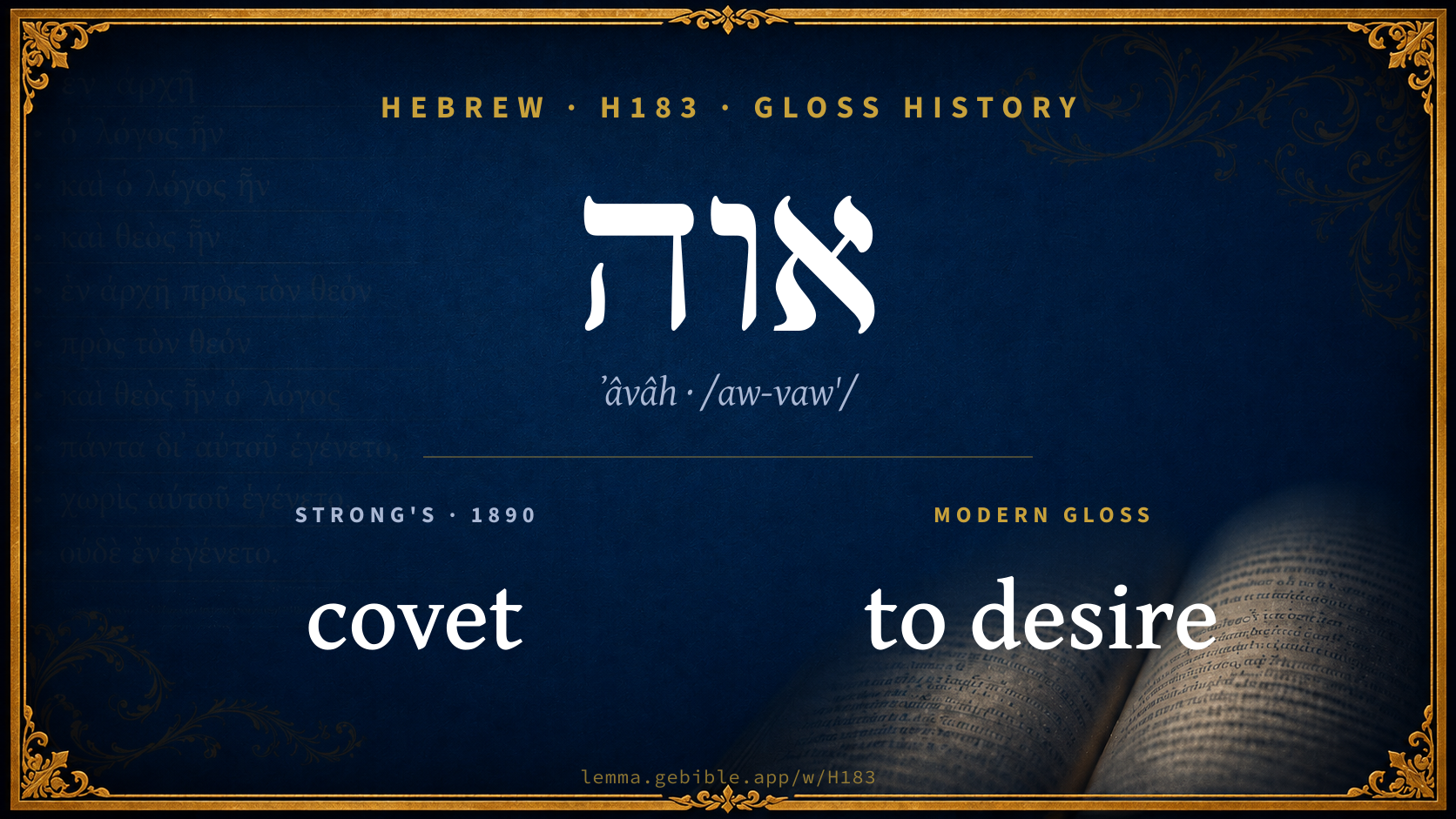
Gloss history
Strong's 1890 vs modern scholarship
About this word
Strong's H183 catalogs a Hebrew word from the Hebrew Old Testament.
These counts are not copied from any lexicon or concordance. They are computed here, from the morphology-tagged Hebrew Old Testament. What Lemma adds →
- 25
- distinct verses
- The word appears in 25 distinct verses.
- 13 / 39
- OT books
- The word appears in 13 of 39 Old Testament books.
- #1,190
- by frequency
- Top 2500 most frequent Hebrew words (rank 1,190 of 8,640 Hebrew words by occurrence).
View all 25 occurrences in the concordance →
Most concentrated in
- Proverbs 6 verses 24%
- Psalms 4 verses 16%
- Deuteronomy 3 verses 12%
By section of the Old Testament
By traditional corpus
Conventional, traditional groupings — biblical authorship is debated, so this is a traditional corpus grouping, not an authorship claim. Each share is this word’s portion of its verses in that division of the Hebrew canon. Each figure is a share of the word’s 25 distinct verses.
- Writings (Ketuvim) 13 verses · 52%
- Prophets (Nevi'im) 7 verses · 28%
- Torah (Pentateuch) 5 verses · 20%
How translations render this word
Counts come from each version’s own published word-to-Strong’s tagging or interlinear alignment — an approximate guide to how each version renders this word, not a word-level alignment the data otherwise carries. Because each total is that version’s own tagged count, the per-version totals vary from one another and need not match the appearance or distinct-verse counts above. These counts may also differ from a printed concordance because Lemma counts each distinctly tagged rendering and does not collapse phrase taggings into a single head-word total. This is a fixed set of word-tagged versions (KJV, ASV, BSB, ULT) and does not change with the reading translation you choose elsewhere. Each version’s license is shown beside its name below (and on Sources).
BDB lists this Strong’s number as 2 distinct words (homographs). Each count above pools all of them and is not split by sense — see the Senses section below. A low-frequency rendering may belong to a different one of those words, not the primary meaning.
- King James Version†: Desireth 6×, Desire 2×, Longed 2×
- American Standard Version†: Desireth 7×, Lusted 3×, Desire 2×
- Berean Standard Bible†: Desires 4×, Crave 2×, Craves 2×
- unfoldingWord Literal Text†: Desired 4×, Desires 4×, Desire 3×
King James Version Public Domain
Renders H183 across 26† tagged occurrences — most commonly:
Plus 14 renderings that appear only once — usually multi-word phrases or single function words the recovered tagging swept in, not distinct renderings.
American Standard Version Public Domain
Renders H183 across 25† tagged occurrences — most commonly:
Plus 11 renderings that appear only once — usually multi-word phrases or single function words the recovered tagging swept in, not distinct renderings.
Berean Standard Bible Public Domain
Renders H183 across 25† tagged occurrences — most commonly:
Plus 17 renderings that appear only once — usually multi-word phrases or single function words the recovered tagging swept in, not distinct renderings.
unfoldingWord Literal Text CC BY-SA 4.0
Renders H183 across 34† tagged occurrences — most commonly:
Plus 16 renderings that appear only once — usually multi-word phrases or single function words the recovered tagging swept in, not distinct renderings.
Senses in the full BDB
Hebrew verbs can shift meaning by stem (binyan): Qal is the basic action, Niphal is often passive or reflexive, Piel often intensifies or makes it factitive, and Hiphil is typically causative. The senses below are grouped under the stem BDB assigns to each. This entry also uses Hithpael (reflexive or reciprocal).
What do BDB’s symbols mean?
BDB uses these scholarly abbreviations:
| Symbol | Meaning |
|---|---|
| 𝔊 | the Septuagint (the ancient Greek translation, LXX) |
| 𝔙 | the Vulgate (the Latin translation) |
| 𝔖 | the Syriac version (the Peshitta) |
| 𝔗 | the Targum (the Aramaic translation) |
| ψ | the Psalms |
| √ | root (the underlying root or stem) |
| ‖ | parallel passage (a synonymous or contrasted parallel) |
| † | the dagger: every passage where the word occurs is cited |
The 3 senses and sub-senses the full Brown-Driver-Briggs lexicon distinguishes for this word, in lexicon order (not ranked by frequency), with BDB’s own verbatim wording and sub-sense lettering. Shown in Hebrew script with BDB’s own scholarly abbreviations. The condensed entry is in the Lexicon Entry tab. See also the Forms in the corpus table below.
אוה I incline, desire (cf. Stem 2).
Piel
- Pf. אִוָּה ψ 132:13; אִוְּתָה Mi 7:1 +, etc.; Impf. 3 fs. תְּאַוֶּה Dt 12:20 + 4 times—desire subj. usually נֶפֶשׁ, obj. fruit Mi 7:1 (in metaph.); flesh (to eat) 1 S 2:16, cf. Dt 12:20 (sq. inf. לֶאֱכֹל בָּשָׂר); food & drink Dt 14:26; of king desiring rule, וּמָלַכְתָּ בְּכֹל אֲשֶׁר־תְּאַוֶּה נַפְשֶׁ֑ךָ 2 S 3:21; 1 K 11:37; obj. evil (רַע) Pr 21:10; once obj. י׳ Is 26:9 נַפְשִׁי אִוִּיתִךָ בַּלַּיְלָה; of God וְנַפְשׁוֹ אִוְּתָה וַיַּעַשׂ Jb 23:13; as desiring Zion for dwelling-place (late, only cases without נפשׁ) ψ 132:13, 14; e.g. Psalms 132:13
Hithpael
- Pf. הִתְאַוָּה Pr 21:26; הִתְאַוֵּיתִי Je 17:16; הִתְאַוּוּ Nu 11:4; וְהִתְאַוִּיתֶם Nu 34:10; Impf. יִתְאַוֶּה Ec 6:2; וַיִּתְאַוֶּה 2 S 23:15; apoc. וְיִתְאַו ψ 45:12, וַיִּתְאַו 1 Ch 11:17, etc.—Pt. fs. מִתְאַוָּה Pr 13:4; mpl. מִתְאַוִּים Am 5:18; Nu 11:34—desire, long for, lust after, of bodily appetites; for dainty food Nu 11:4 (E; sq. acc. cogn.) = ψ 106:14, Nu 11:34 (E); sq. ל Pr 23:3, 6 cf. Ec 6:2 (sq. acc.), v. also Pr 13:4 (abs., subj. נֶפֶשׁ); abs. of extreme thirst 2 S 23:15 = 1 Ch 11:17; of king desiring the beauty (יֳפִי) of princess ψ 45:12 (sq. acc.); of covetous man Pr 21:26 (sq. acc. cogn.); obj. בֵּית רֵעֲךָ Dt 5:18 (‖ חמד); sq. inf. Pr 24:1 (of desiring evil companionship); obj. יוֹם י׳ Am 5:18 (acc.; of presumptuous, reckless longing) cf. Je 17:16. (Nu 34:7, 8 for תְּתָאוּ—Pi. of תאה—Di proposes תִּתְאַוֻּ, & queries whether this & הִתְאַוִּיתֶם v 10 are not from אוה, = desire for yourselves.) e.g. Proverbs 21:26
אוה II sign, mark, describe with a mark (so Ges (who compares תאה, תוה) DlPr 116 (not W)) only
Hithpael
- Pf. הִתְאַוִּיתֶם לָכֶם mark you out, measure, Nu 34:10 (P), so Vrss (cf. תְּתָאוּ לָכֶם v 7, 8; v. however Di, & sub I. אוה).—V. also [תָּאַר] on p. 1061. e.g. Numbers 34:10
Senses from the full Brown-Driver-Briggs lexicon (Brown, Driver, Briggs; Oxford 1906 — public domain), digitized via Sefaria, supplemented by the OpenScriptures HebrewLexicon (CC BY 4.0). Full attribution on Sources.
Word origin
I. vb. incline, desire (cf. Stem 2).
II. vb. sign, mark, describe with a mark (so Ges (who compares תאה, תוה) DlPr 116 (not W)) only
— Brown-Driver-Briggs (Oxford 1906, public domain), digitized via Sefaria, supplemented by the OpenScriptures HebrewLexicon (CC BY 4.0). See Sources.
Origin: a primitive root
Jastrow Dictionary
A second Hebrew/Aramaic lexicon for comparison, covering Aramaic and post-biblical (Talmudic, Targumic, Midrashic) usage that the biblical-Hebrew BDB does not. Matched by lemma rather than by Strong’s number, so a lemma may carry more than one Jastrow headword (shown separately below), and the entries cover usage well beyond the Bible.
אָוָה
- , v. אוי
אוי
- , Pi. אִיוָּה to desire, covet. Snh. 63ᵃ אִיוּוּ אלוהות וכ׳ (Ab. Zar. 53ᵇ לאלוהות, v. Rabb. D. S. a. l. note 8) they had a desire for many deities. Denom. תַּאֲוָה. Cmp. אוּת.
- (b. h.), Nithpa. נִתְאַוֶּה (denom. of תַּאֲוָה) to desire, to be seized with a desire. Num. R. s. 10 (play on י̇ת̇א̇ד̇ם̇ Prov. XXIII, 31) the drunken man וכ׳ לד̇ם̇ יִ֗תְ֗אַ֗וֶּה will covet blood (forbidden intercourse). Gen. R. s. 51. Ex. R. s. 24, end.—Num. R. s. 2 התחילו מִתְאַוִּים וכ׳ they began to express a desire for standards (in imitation of the angelic hosts). Ib. divide them into standards כמו שנִתְאַוּוּ as they desired. e.g. Proverbs 23:31
אוי ²
- , a. Ges. H. Dict. s. v. אָוָה III) to point, mark. Denom. אוֹת II, תְּאָו, תַּאֲוָה.
- (denom. of תַּאֲוָה, תְּאָו) to mark, to mark out. Koh. R. to XII, 7 התחיל מִתְאַוֶּה תאוים he began to put up marks.
A Dictionary of the Targumim, the Talmud Babli and Yerushalmi, and the Midrashic Literature (Marcus Jastrow; London, Luzac, 1903) — Public Domain. Digitized via Sefaria. Digitized via Sefaria. Full attribution on Sources.
Forms in the corpus
The 25 distinct written forms H183 takes in the Hebrew Bible, most frequent first — each parse links to that stem’s occurrences in the concordance. Hebrew forms include their vowel points and cantillation, so a single lemma takes many written forms.
Same root — word family
Other BDB entries built from the same root as H183, grouped by Strong’s listed origin. These share a root / origin per the lexicon — not necessarily a shared meaning. Each links to that word’s own entry.
Derived from this word
- אוה ʼavvâh H185 desire
- אוי ʼôwy H188 woe
- אי ʼîy H339 island
- הוא hâvâʼ H1933 to be
- מאוי maʼăvay H3970 desire
- תאוה taʼăvâh H8378 desire
Proper names from this root
People and places named from this root — a name, not an additional meaning of the word.
Compare all same-root words → Showing 4 of 8 — not the complete family. 1 of the same-root words is a proper name (a person or place). They share a root, not necessarily a meaning.
Septuagint verse parallels
This word appears in 23 verses that also exist in the Greek Old Testament (Septuagint), out of the 25 Hebrew verses it occurs in. You can read those verses in Greek by switching the Old Testament edition to the Septuagint.
Read these verses in the Septuagint
- Numbers 11:4
- Deuteronomy 5:21
- 2 Samuel 3:21
- 1 Kings 11:37
- 1 Chronicles 11:17
- Job 23:13
- Psalms 45:11
- Proverbs 13:4
- Ecclesiastes 6:2
- Isaiah 26:9
- Jeremiah 17:16
- Amos 5:18
This is a verse-level parallel only — the same verses exist in both the Hebrew and Greek Old Testaments. No word-level Hebrew↔Greek correspondence is claimed: the data carries no such alignment, so no Greek word is shown as this Hebrew word’s translation. Coverage is not total — the Septuagint omits the deuterocanon and renumbers the Psalms, so some Hebrew verses have no direct Greek parallel.