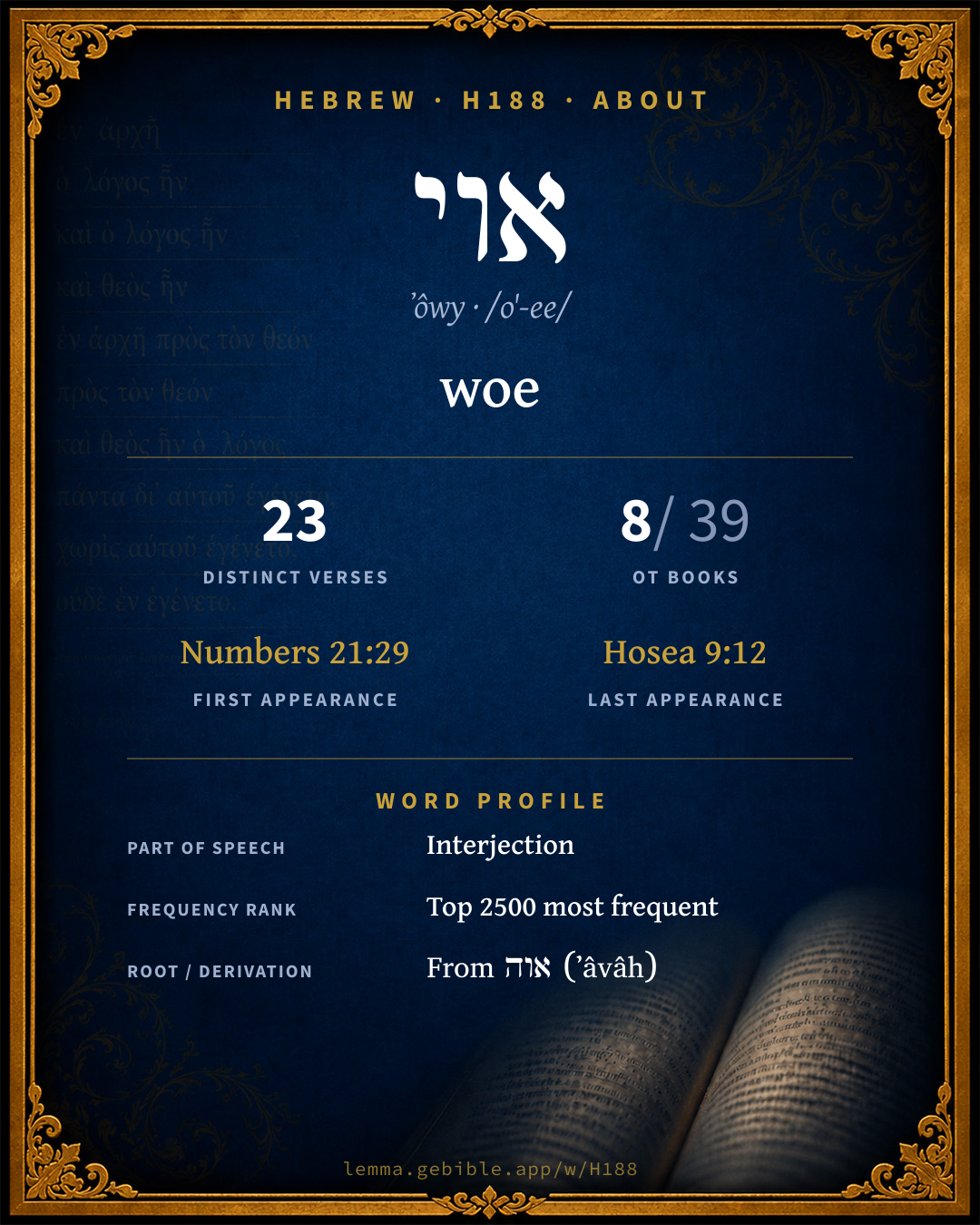
אוֹי
woe
‘woe’ is one of 2 main senses fuller range ↓
Full lexicon entry — Brown-Driver-Briggs (BDB)
From Brown-Driver-Briggs (BDB)
Where this word appears
Grammar key — what these labels mean
Part of speech
- Particle
- A short function word — article, negation, interrogative, the sign of the direct object, and the like.
Every verse where H188 appears — 23 distinct verses across 8 books. Click any verse to open its interlinear word-by-word view. Verse text shown in the World English Bible for context — . Each verse’s Hebrew form is shown with its reference; the English is not keyword-highlighted, since the data carries no word-level English alignment. Use “Compare translations” on any verse to read it across multiple English versions. This concordance covers the Hebrew Bible; Septuagint (Greek Old Testament) occurrences are not indexed here.
Numbers 2 verses
1 Samuel 2 verses
- 1 Samuel 4:7 א֣וֹי ptcl intj The Philistines were afraid, for they said, God is come into the camp. They said, Woe to us! for there has not been such a thing heretofore.
- 1 Samuel 4:8 א֣וֹי ptcl intj Woe to us! who shall deliver us out of the hand of these mighty gods? these are the gods that struck the Egyptians with all manner of plagues in the wilderness.
Proverbs 1 verse
Isaiah 4 verses
- Isaiah 3:9 א֣וֹי ptcl intj The look of their faces testify against them. They parade their sin like Sodom. They don't hide it. Woe to their soul! For they have brought disaster upon themselves.
- Isaiah 3:11 א֖וֹי ptcl intj Woe to the wicked! Disaster is upon them; For the deeds of his hands will be paid back to him.
- Isaiah 6:5 אֽוֹי ptcl intj Then I said, "Woe is me! For I am undone, because I am a man of unclean lips, and I dwell in the midst of a people of unclean lips: for my eyes have seen the King, Yahweh of Hosts!"
- Isaiah 24:16 א֣וֹי ptcl intj From the uttermost part of the earth have we heard songs: Glory to the righteous. But I said, I pine away, I pine away, woe is me! the treacherous have dealt treacherously; yes, the treacherous have dealt very treacherously.
Jeremiah 8 verses
- Jeremiah 4:13 א֥וֹי ptcl intj Behold, he shall come up as clouds, and his chariots [shall be] as the whirlwind: his horses are swifter than eagles. Woe to us! for we are ruined.
- Jeremiah 4:31 אֽוֹי ptcl intj For I have heard a voice as of a woman in travail, the anguish as of her who brings forth her first child, the voice of the daughter of Zion, who gasps for breath, who spreads her hands, [saying], Woe is me now! for my soul faints before the murderers.
- Jeremiah 6:4 א֥וֹי ptcl intj Prepare you war against her; arise, and let us go up at noon. Woe to us! for the day declines, for the shadows of the evening are stretched out.
- Jeremiah 10:19 א֥וֹי ptcl intj Woe is me because of my hurt! my wound is grievous: but I said, Truly this is [my] grief, and I must bear it.
- Jeremiah 13:27 א֥וֹי ptcl intj I have seen your abominations, even your adulteries, and your neighing, the lewdness of your prostitution, on the hills in the field. Woe to you, Jerusalem! you will not be made clean; how long shall it yet be?
- Jeremiah 15:10 אֽוֹי ptcl intj Woe is me, my mother, that you have borne me a man of strife and a man of contention to the whole earth! I have not lent, neither have men lent to me; [yet] everyone of them does curse me.
- Jeremiah 45:3 אֽוֹי ptcl intj You did say, Woe is me now! for Yahweh has added sorrow to my pain; I am weary with my groaning, and I find no rest.
- Jeremiah 48:46 אוֹי ptcl intj Woe to you, O Moab! the people of Chemosh is undone; for your sons are taken away captive, and your daughters into captivity.
Lamentations 1 verse
Ezekiel 3 verses
- Ezekiel 16:23 א֣וֹי א֣וֹי ptcl intj ptcl intj It is happen after all your wickedness, (woe, woe to you! says the Lord Yahweh),
- Ezekiel 24:6 אוֹי֮ ptcl intj Therefore thus says the Lord Yahweh: Woe to the bloody city, to the caldron whose rust is therein, and whose rust is not gone out of it! take out of it piece after piece; No lot is fallen on it.
- Ezekiel 24:9 א֖וֹי ptcl intj Therefore thus says the Lord Yahweh: Woe to the bloody city! I also will make the pile great.
Hosea 2 verses
- Hosea 7:13 א֤וֹי ptcl intj Woe to them! For they have wandered from me. Destruction to them! For they have trespassed against me. Though I would redeem them, Yet they have spoken lies against me.
- Hosea 9:12 א֥וֹי ptcl intj Though they bring up their children, Yet I will bereave them, so that not a man shall be left. Indeed, woe also to them when I depart from them!
About this entry
At a glance — auto-summarized from this page’s data, not written by a person. Every figure links to its source below. This summary describes the numbers; it doesn’t interpret them.
At its core, אוי (ʼôwy) means “woe.” First canonically at Numbers 21:29, it enters the text early. With 23 verses in 8 books, it is an uncommon word in the Hebrew Bible. Its uses concentrate in Jeremiah (35% of all occurrences). Catalogued under 2 senses, its meaning is not single-sense. See the sense tree, 23-verse concordance, and the renderings breakdown below.
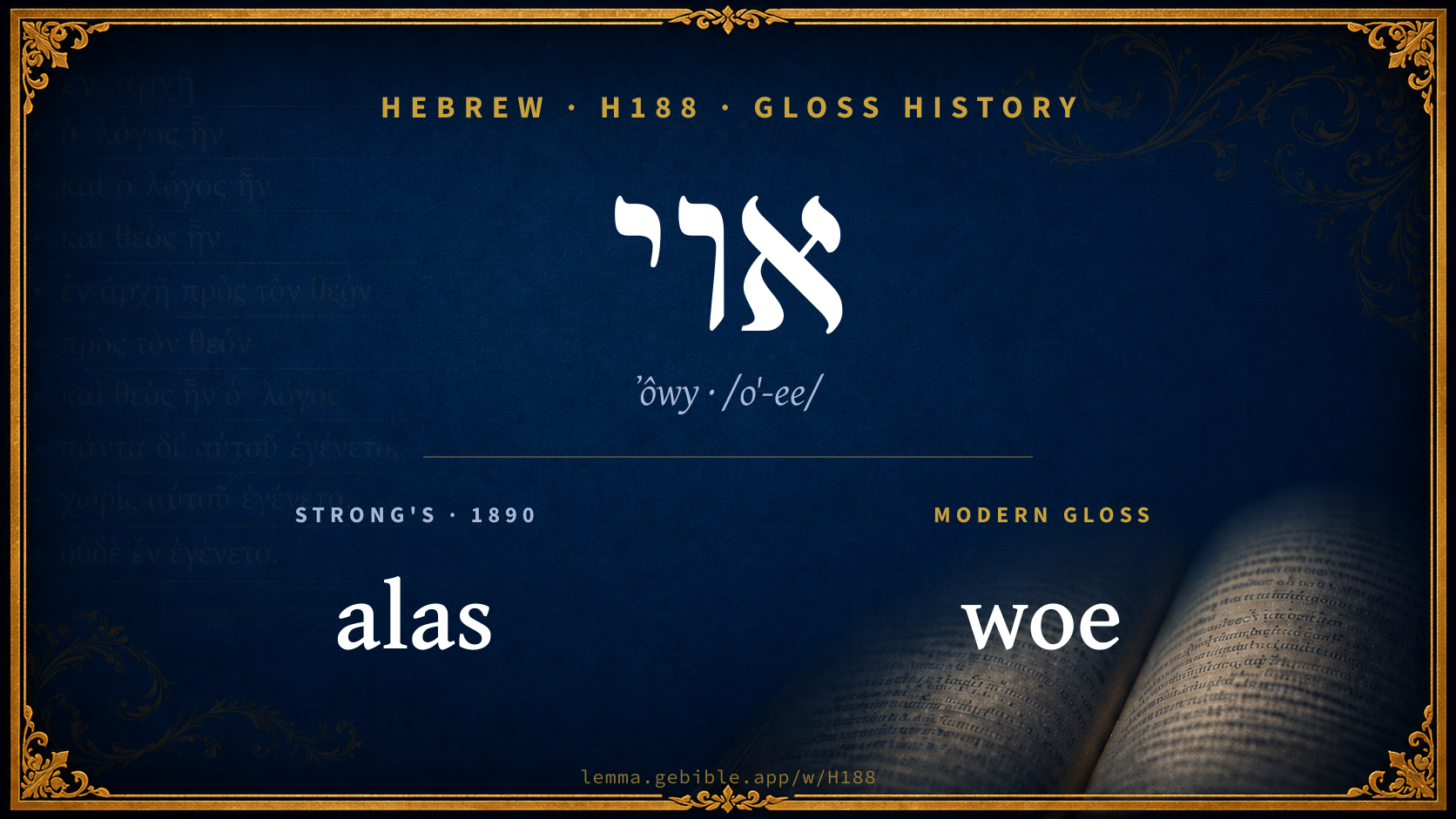
Gloss history
Strong's 1890 vs modern scholarship
About this word
Strong's H188 catalogs a Hebrew word from the Hebrew Old Testament.
These counts are not copied from any lexicon or concordance. They are computed here, from the morphology-tagged Hebrew Old Testament. What Lemma adds →
- 23
- distinct verses
- The word appears in 23 distinct verses.
- 8 / 39
- OT books
- The word appears in 8 of 39 Old Testament books.
- #1,327
- by frequency
- Top 2500 most frequent Hebrew words (rank 1,327 of 8,640 Hebrew words by occurrence).
View all 23 occurrences in the concordance →
By section of the Old Testament
By traditional corpus
Conventional, traditional groupings — biblical authorship is debated, so this is a traditional corpus grouping, not an authorship claim. Each share is this word’s portion of its verses in that division of the Hebrew canon. Each figure is a share of the word’s 23 distinct verses.
- Prophets (Nevi'im) 19 verses · 83%
- Torah (Pentateuch) 2 verses · 9%
- Writings (Ketuvim) 2 verses · 9%
How translations render this word
Counts come from each version’s own published word-to-Strong’s tagging or interlinear alignment — an approximate guide to how each version renders this word, not a word-level alignment the data otherwise carries. Because each total is that version’s own tagged count, the per-version totals vary from one another and need not match the appearance or distinct-verse counts above. These counts may also differ from a printed concordance because Lemma counts each distinctly tagged rendering and does not collapse phrase taggings into a single head-word total. This is a fixed set of word-tagged versions (KJV, ASV, BSB, ULT) and does not change with the reading translation you choose elsewhere. Each version’s license is shown beside its name below (and on Sources).
- King James Version: Woe 19×
- American Standard Version: Woe 17×
- Berean Standard Bible: Woe 20×
- unfoldingWord Literal Text: Woe 21×
King James Version Public Domain
Renders H188 across 24 tagged occurrences — most commonly:
Plus 5 renderings that appear only once — usually multi-word phrases or single function words the recovered tagging swept in, not distinct renderings.
American Standard Version Public Domain
Renders H188 across 24 tagged occurrences — most commonly:
Plus 7 renderings that appear only once — usually multi-word phrases or single function words the recovered tagging swept in, not distinct renderings.
Berean Standard Bible Public Domain
Renders H188 across 24 tagged occurrences — most commonly:
Plus 4 renderings that appear only once — usually multi-word phrases or single function words the recovered tagging swept in, not distinct renderings.
unfoldingWord Literal Text CC BY-SA 4.0
Renders H188 across 22 tagged occurrences — most commonly:
Plus 1 rendering that appears only once — usually multi-word phrases or single function words the recovered tagging swept in, not distinct renderings.
Senses in BDB
The 2 senses BDB distinguishes for this word, in lexicon order (not ranked by frequency or importance). The full entry — with sub-senses — is in the Lexicon Entry tab.
- woe! alas! oh!
- passionate cry of grief or despair
Word origin
interj. (onomatop.; cf. ܐܘܽܝ, ܘܳܝ) woe! an impassioned expression of grief and despair: usually with dative אוֹי לִי Is 6:5 woe to me! for I am undone, so 24:16; Je 10:19; 15:10; אוֹי לָנוּ woe to us! 1 S 4:7, 8; Je 4:13; 6:4; אוֹי־נָא לִי Je 4:31; 45:3; אוֹי־נָא לָנוּ La 5:16. With the 2nd or 3rd ps. often implying a denunciation; אוֹי־לְךָ מוֹאָב Nu 21:29 (= Je 48:46) Je 13:27; Ez 16:23 repeated אוֹי אוֹי לָךְ; Is. 3:9 אוֹי לְנַפְשָׁם v 11 Ho 7:13 (‖ שֹׁד לָהֶם) 9:12. With a voc. (or implicit accus.) Ez 24:6, 9 אוֹי עִיר הַדָּמִים; absol. Nu 24:23. Used as a subst. Pr 23:29 לִמִי אוֹי (‖ לְמִי אֲבוֹי).
— Brown-Driver-Briggs (Oxford 1906, public domain), digitized via Sefaria, supplemented by the OpenScriptures HebrewLexicon (CC BY 4.0). See Sources.
Derived from אוה (ʼâvâh) (H183) — to desire.
Jastrow Dictionary
A second Hebrew/Aramaic lexicon for comparison, covering Aramaic and post-biblical (Talmudic, Targumic, Midrashic) usage that the biblical-Hebrew BDB does not. Matched by lemma rather than by Strong’s number, so a lemma may carry more than one Jastrow headword (shown separately below), and the entries cover usage well beyond the Bible.
אוי
- , Pi. אִיוָּה to desire, covet. Snh. 63ᵃ אִיוּוּ אלוהות וכ׳ (Ab. Zar. 53ᵇ לאלוהות, v. Rabb. D. S. a. l. note 8) they had a desire for many deities. Denom. תַּאֲוָה. Cmp. אוּת.
- (b. h.), Nithpa. נִתְאַוֶּה (denom. of תַּאֲוָה) to desire, to be seized with a desire. Num. R. s. 10 (play on י̇ת̇א̇ד̇ם̇ Prov. XXIII, 31) the drunken man וכ׳ לד̇ם̇ יִ֗תְ֗אַ֗וֶּה will covet blood (forbidden intercourse). Gen. R. s. 51. Ex. R. s. 24, end.—Num. R. s. 2 התחילו מִתְאַוִּים וכ׳ they began to express a desire for standards (in imitation of the angelic hosts). Ib. divide them into standards כמו שנִתְאַוּוּ as they desired. e.g. Proverbs 23:31
אוי ²
- , a. Ges. H. Dict. s. v. אָוָה III) to point, mark. Denom. אוֹת II, תְּאָו, תַּאֲוָה.
- (denom. of תַּאֲוָה, תְּאָו) to mark, to mark out. Koh. R. to XII, 7 התחיל מִתְאַוֶּה תאוים he began to put up marks.
אוֹי
- (v. אוי I) [pressure] woe, sorrow. Gen. R. s. 46 בי לא אוי there is no (cause for) woe with me. Num. R. s. 10 (play on ăboy, Prov. XXIII, 29) אַב אוי father of woe.—2) interj. woe! alas! Kel. XVII, 16; a. v. fr. e.g. Proverbs 23:29
A Dictionary of the Targumim, the Talmud Babli and Yerushalmi, and the Midrashic Literature (Marcus Jastrow; London, Luzac, 1903) — Public Domain. Digitized via Sefaria. Digitized via Sefaria. Full attribution on Sources.
Forms in the corpus
The 8 distinct written forms H188 takes in the Hebrew Bible, most frequent first — each parse links to that state’s occurrences in the concordance. Hebrew forms include their vowel points and cantillation, so a single lemma takes many written forms.
| Form | Parsing | Example | Uses |
|---|---|---|---|
| א֣וֹי | Particle, Interjection | Ezekiel 16:23 | 6 |
| א֥וֹי | Particle, Interjection | Hosea 9:12 | 6 |
| אֽוֹי | Particle, Interjection | Isaiah 6:5 | 5 |
| א֖וֹי | Particle, Interjection | Ezekiel 24:9 | 2 |
| אוֹי | Particle, Interjection | Jeremiah 48:46 | 2 |
| א֕וֹי | Particle, Interjection | Numbers 24:23 | 1 |
| א֤וֹי | Particle, Interjection | Hosea 7:13 | 1 |
| אוֹי֮ | Particle, Interjection | Ezekiel 24:6 | 1 |
Same root — word family
Other BDB entries built from the same root as H188, grouped by Strong’s listed origin. These share a root / origin per the lexicon — not necessarily a shared meaning. Each links to that word’s own entry.
Derives from
Shares the same root
- אוה ʼavvâh H185 desire
- אי ʼîy H339 island
- הוא hâvâʼ H1933 to be
- מאוי maʼăvay H3970 desire
- תאוה taʼăvâh H8378 desire
Derived from this word
Proper names from this root
People and places named from this root — a name, not an additional meaning of the word.
Compare all same-root words → Showing 4 of 10 — not the complete family. 1 of the same-root words is a proper name (a person or place). They share a root, not necessarily a meaning.
Septuagint verse parallels
This word appears in 22 verses that also exist in the Greek Old Testament (Septuagint), out of the 23 Hebrew verses it occurs in. You can read those verses in Greek by switching the Old Testament edition to the Septuagint.
Read these verses in the Septuagint
- Numbers 21:29
- 1 Samuel 4:7
- Proverbs 23:29
- Isaiah 3:9
- Jeremiah 4:13
- Lamentations 5:16
- Ezekiel 16:23
- Hosea 7:13
This is a verse-level parallel only — the same verses exist in both the Hebrew and Greek Old Testaments. No word-level Hebrew↔Greek correspondence is claimed: the data carries no such alignment, so no Greek word is shown as this Hebrew word’s translation. Coverage is not total — the Septuagint omits the deuterocanon and renumbers the Psalms, so some Hebrew verses have no direct Greek parallel.