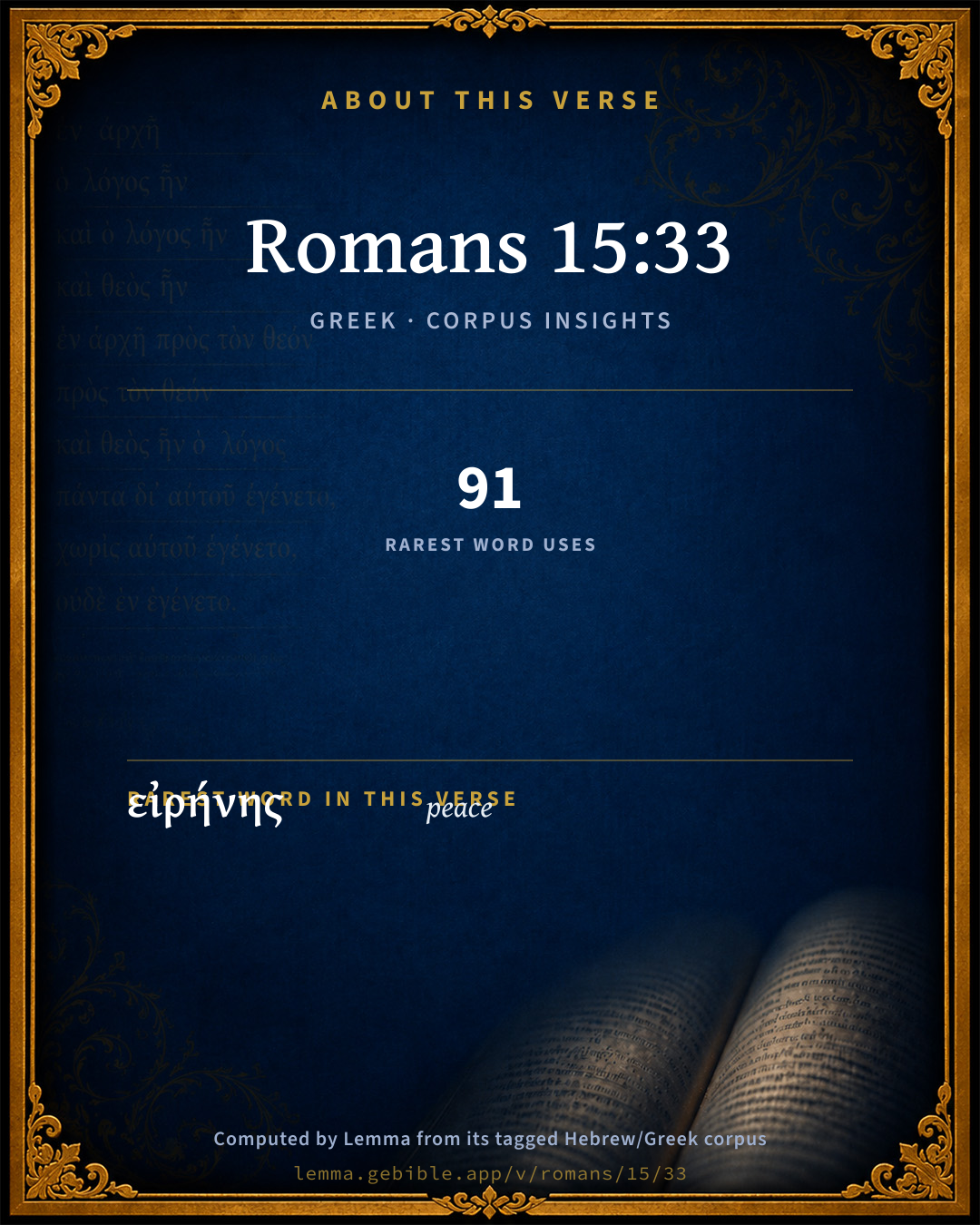
Romans 15:33

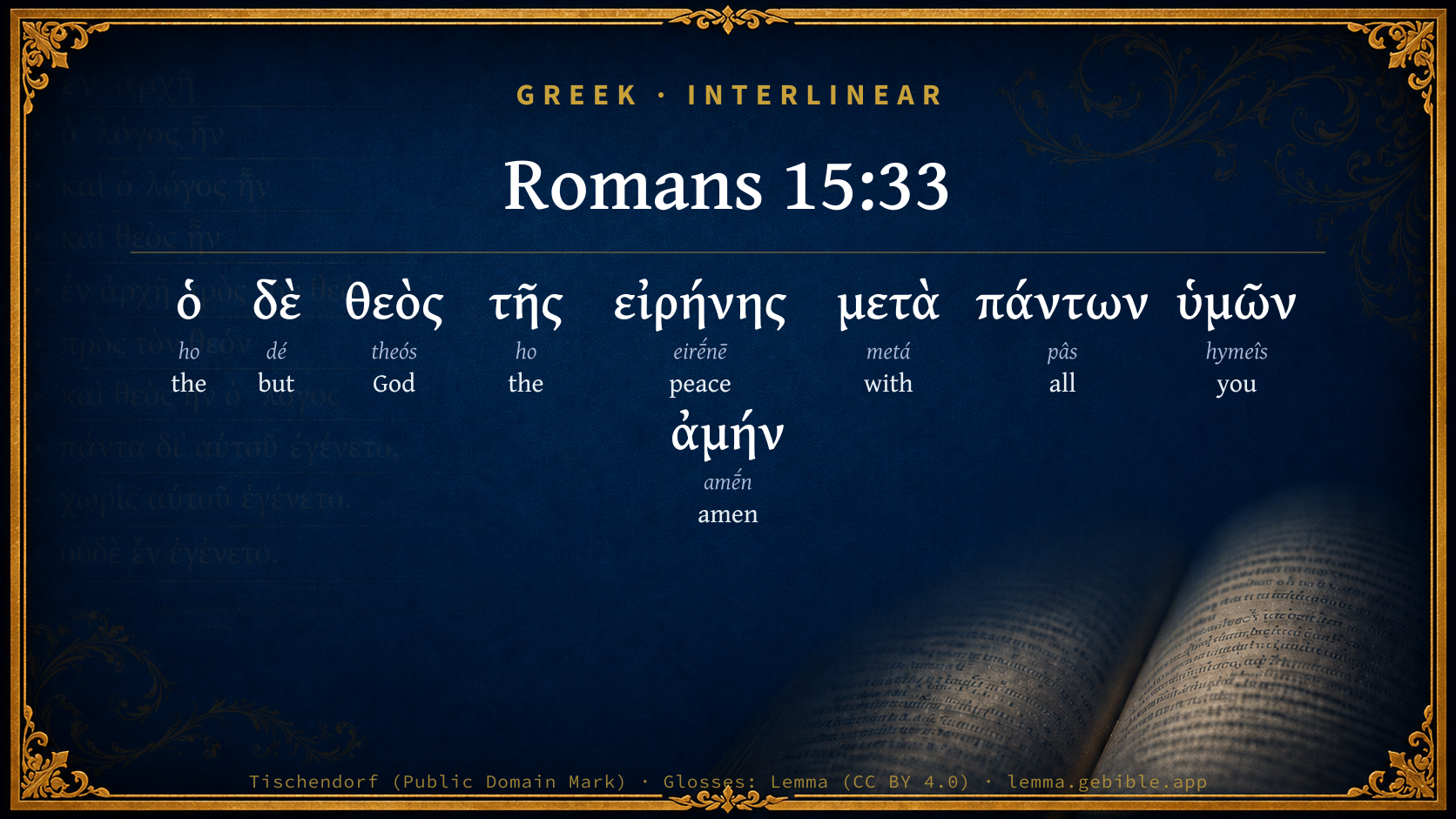
Greek (Tischendorf 8th ed.) Romans 15:33 appears in the Greek New Testament. The text above is from the Tischendorf 8th edition. Each word links to its Strong’s number and a concise gloss. Click any word for its full Thayer’s Greek Lexicon entry.
Download image
Cite this verse

Romans 15:33 (World English Bible). Public Domain. Lemma interlinear Bible study tool, https://lemma.gebible.app/v/romans/15/33.

Show BibTeX & RIS
BibTeX
RIS
English Translation
Now the God of peace be with you all. Amen.
World English Bible · Public Domain
Download a study sheet

One document with this verse’s original text, its word-by-word gloss line, the meaning frame, cross-references with their text, attributed commentary, and full source and license credits — printable, and it pastes into notes with its structure intact.

This verse Autodidact and up

Study sheet (.html) Plain text (.txt)

A passage Seminary Student

Up to 50 verses in one chapter. A passage sheet keeps up to 6 commentary sources and 12 cross-references per verse, in the order this page ranks them, and says so on the sheet whenever that leaves anything out. Ask for a single verse and you get the Autodidact verse sheet above.

Everything on this page stays free to read, with no account — the sheet is a download of what is already on screen, not access to it.

Want to remove ads? Support Godless Engineer
Compare translations 3

The same verse in 3 English versions, stacked beneath the original-language interlinear above. Click any original word for its lexicon entry.

Each is an independent rendering of the whole verse — the interlinear is not word-aligned to these translations.

Highlighted words mark where these versions differ — a whole-verse word diff, not a word-by-word alignment.

  • World English Bible Public Domain
    Now the God of peace be with you all. Amen.
  • King James Version Public Domain
    Now the God of peace be with you all. Amen.
  • unfoldingWord Literal Text CC BY-SA 4.0
    Now the God of peace with you all. Amen.

unfoldingWord Literal Text — © unfoldingWord, licensed CC BY-SA 4.0. Word-aligned USFM3 via Door43 (git.door43.org/unfoldingWord/en_ult).

Versions to compare (up to 4)

3 of 4 selected

Show all 19 translations

Every available English version of this verse, each an independent rendering of the whole verse.

  • World English Bible Public Domain
    Now the God of peace be with you all. Amen.
  • Berean Standard Bible Public Domain
    The God of peace be with all of you. Amen.
  • Majority Standard Bible Public Domain
    The God of peace be with all of you. Amen.
  • King James Version Public Domain
    Now the God of peace be with you all. Amen.
  • American Standard Version (1901) Public Domain
    Now the God of peace be with you all. Amen.
  • Revised Version (1885) Public Domain
    Now the God of peace be with you all. Amen.
  • Geneva Bible (1599) Public Domain
    Thus the God of peace be with you all. Amen.
  • Douay-Rheims (1899) Public Domain
    Now the God of peace be with you all. Amen.
  • Young's Literal Translation Public Domain
    and the God of the peace `be' with you all. Amen.
  • Literal Standard Version CC BY-SA 4.0
    and the God of peace [be] with you all. Amen.
  • Unlocked Literal Bible CC BY-SA 4.0
    May the God of peace be with you all. Amen.
  • unfoldingWord Literal Text CC BY-SA 4.0
    Now the God of peace with you all. Amen.
  • Darby Bible Public Domain
    And the God of peace be with you all. Amen.
  • World Messianic Bible Public Domain
    Now the God of peace be with you all. Amen.
  • Webster's Bible Public Domain
    Now the God of peace be with you all. Amen.
  • Free Bible Version CC BY-SA 4.0
    May the God of peace be with you all. Amen.
  • Bible in Basic English Public Domain
    Now may the God of peace be with you all. So be it.
  • Text-Critical English NT CC BY 4.0
    May the God of peace be with you all. Amen.
  • Tyndale New Testament (1534) Public Domain
    The God of peace be with you. Amen.

Literal Standard Version (2020), Covenant Press — licensed CC BY-SA 4.0. Text via the HelloAO Bible API (eBible.org). Unlocked Literal Bible (unfoldingWord) — licensed CC BY-SA 4.0. Text via the HelloAO Bible API (eBible.org). unfoldingWord Literal Text — © unfoldingWord, licensed CC BY-SA 4.0. Word-aligned USFM3 via Door43 (git.door43.org/unfoldingWord/en_ult). Free Bible Version, Dr. Jonathan Gallagher — licensed CC BY-SA 4.0. Text via the HelloAO Bible API (eBible.org).

Word by word

More ways to search: Search by grammar → Find every occurrence → Compare this word →

Practice this passage: Drill this verse → Learn its vocabulary →

εἰρήνης
eirḗnē
G1515
“peace”
Noun, Genitive, Singular, Feminine
Part of Speech
Noun
Case
Genitive
Number
Singular
Gender
Feminine
Full Thayer's Definition

Origin: probably from a primary verb eiro (to join)

TDNT: 08:40,2

1. a state of national tranquillity a. exemption from the rage and havoc of war 2. peace between individuals, i.e. harmony, concord 3. security, safety, prosperity, felicity, (because peace and harmony make and keep things safe and prosperous) 4. of the Messiah's peace a. the way that leads to peace (salvation) 5. of Christianity, the tranquil state of a soul assured of its salvation through Christ, and so fearing nothing from God and content with its earthly lot, of whatsoever sort that is 6. the blessed state of devout and upright men after death
  1. ὁ ho G3588 “the” Article, Nominative, Singular, Masculine
  2. δὲ dé G1161 “but” Conjunction
  3. θεὸς theós G2316 “God” Noun, Nominative, Singular, Masculine
  4. τῆς ho G3588 “the” Article, Genitive, Singular, Feminine
  5. μετὰ metá G3326 “with” Preposition
  6. πάντων pâs G3956 “all” Adjective, Genitive, Plural, Masculine
  7. ὑμῶν hymeîs G5210 “you” Personal pronoun, 2nd person, Genitive, Plural
  8. ἀμήν amḗn G281 “amen” Hebrew transliteration

About this verse

These counts appear in no published source. They are computed here, from the morphology-tagged text and Lemma’s own curated glosses. What Lemma adds →

9
words
8
distinct lemmas
Pauline Epistles
section

Repetition

A word recurs within this verse:

Cross-references

14

Topical passages linked to Romans 15:33 in the Treasury of Scripture Knowledge — connected by theme and wording, ordered by reader-vote popularity; previews shown in the World English Bible.

  • 2 Corinthians 13:11 Finally, brothers, rejoice. Be perfected, be comforted, be of the same mind, live in peace, and the God of love and peace will be with you.
  • Philippians 4:9 The things which you learned, received, heard, and saw in me: do these things, and the God of peace will be with you.
  • 1 Thessalonians 5:23 May the God of peace himself sanctify you completely. May your whole spirit, soul, and body be preserved blameless at the coming of our Lord Jesus Christ.
  • Romans 16:20 And the God of peace will quickly crush Satan under your feet. The grace of our Lord Jesus Christ be with you.
  • 2 Thessalonians 3:16 Now may the Lord of peace himself give you peace at all times in all ways. The Lord be with you all.
  • Hebrews 13:20 Now may the God of peace, who brought again from the dead the great shepherd of the sheep with the blood of an eternal covenant, our Lord Jesus,
  • 2 Corinthians 13:14 The grace of the Lord Jesus Christ, the love of God, and the communion of the Holy Spirit, be with you all. Amen.
  • 1 Corinthians 14:33 for God is not a God of confusion, but of peace. As in all the assemblies of the saints,
  • Ruth 2:4 Behold, Boaz came from Bethlehem, and said to the reapers, Yahweh be with you. They answered him, Yahweh bless you.
  • Matthew 1:23 "Behold, the virgin shall be with child, And shall bring forth a son. They shall call his name Immanuel;" Which is, being interpreted, "God with us."
  • Matthew 28:20 teaching them to observe all things that I commanded you. Behold, I am with you always, even to the end of the age." Amen.
  • Romans 16:23 Gaius, my host and host of the whole assembly, greets you. Erastus, the treasurer of the city, greets you, as does Quartus, the brother.
  • 2 Timothy 4:22 The Lord Jesus Christ be with your spirit. Grace be with you. Amen.
  • 2 Corinthians 5:19–20 namely, that God was in Christ reconciling the world to himself, not reckoning to them their trespasses, and having committed to us the word of reconciliation.

Cross-references courtesy of OpenBible.info (CC BY 4.0).

Commentary

Notes on Romans 15:33 from classic Christian and Jewish commentators (each source and its license shown beneath its notes). The classic Christian expositions comment on the surrounding passage and are grouped to its opening verse, so a note may address several verses; the Jewish commentaries on the Tanakh (Rashi and others) are per-verse, so they appear only where the commentator wrote on this verse.

Lemma curates 59 commentaries, every one of them public domain or Creative Commons licensed, each selected and text-cleaned for this edition rather than reprinted as found. About our sources →

Tyndale Open Study Notes

Tyndale Open Resources

15:33 Some manuscripts do not include Amen. One very early manuscript places the doxology (16:25-27) here. This has led some scholars to conclude that the original letter to the Romans consisted of only 1:1–15:33, but few now follow this theory. The best early manuscripts place the doxology at the end of ch 16, and the whole of ch 16 was most likely part of Paul’s original letter to the Romans. See also study note on 16:1-16.

Tyndale Open Study Notes — © Tyndale Open Resources, licensed CC BY-SA 4.0. Text via the HelloAO Bible API.

Bengel's Gnomon

Johann Albrecht Bengel

Rom 15:33. Ὁ Θεὸς τῆς εἰρήνης, the God of peace) A gradation in reference to Rom 15:5; Rom 15:13: The God of patience, hope; so, the God of love and peace, 2Co 13:11, The God of peace, ch. Rom 16:20; 1Co 14:33; Php 4:9; 1Th 5:23; Heb 13:20[164]

[164] Ἀμὴν, the Greek transcribers loved to add the final Amen from its very frequent use, not to say, in doxologies only, which have Amen in Ps. 41:14, Psa 72:19, etc., but in prayers and at the conclusions of books.—Not. crit.

AGg omit ἀμήν. B (judging from its silence), CD(Λ)f Vulg. have it. Tischend. therefore supports it. Lachm. brackets it.—ED.

Bengel's Gnomon of the New Testament — English translation (T&T Clark, Edinburgh, 1860) — public domain. Text from a community e-Sword module.

Expositor's Greek Testament

ed. W. Robertson Nicoll

Rom 15:33 . ὁ δὲ θεὸς τῆς εἰρήνης : there is an appropriateness in this designation after Rom 15:31 , but “peace” is one of the ruling ideas in Paul’s mind always, and needs no special explanation in a benediction: 2Co 13:2 , Php 4:9 , 1Th 5:23 .

The Expositor's Greek Testament, edited by W. Robertson Nicoll (1897–1910) — public domain. Text from a community e-Sword module.

Hodge's Commentary on Romans, Ephesians & First Corinthians

Charles Hodge

Rom_15:33

Now the peace of God be with you all. As he begged them to pray for him, so he prays for them. It is a prayer of one petition; so full of meaning, however, that no other need be added. The peace of God, that peace which God gives, includes all the mercies necessary for the perfect blessedness of the soul.

Doctrine

1. The sacred Scriptures are designed for men in all ages of the world, and are the great source of religious knowledge and consolation, Rom_15:4.

2. The moral excellences which we are justly required to attain. and the consolations which we are commanded to seek in the use of appropriate means, are still the gifts of God. There is, therefore, no inconsistency between the doctrines of free agency and dependence, Rom_15:5, Rom_15:13.

3. Those are to be received and treated as Christians whom Christ himself has received. Men have no right to make terms of communion which Christ has not made, Rom_15:7.

4. There is no distinction, under the gospel, between the Jew and Gentile; Christ has received both classes upon the same terms and to the same privileges, Rom_15:8-12.

5. The quotation of the predictions of the Old Testament by the sacred writers of the New, and the application of them in proof of their doctrines, involves an acknowledgment of the divine authority of the ancient prophets. And as these predictions are quoted from the volume which the Jews recognize as their Bible, or the word of God, it is evident that the apostles believed in the inspiration of all the books included in the sacred canon by the Jews, Rom_15:9-12.

6. Christian ministers are not priests, i.e. they are not appointed to offer gifts and sacrifices for sins. It is no part of their work to make atonement for the people; this Christ has done by the one offering up of himself, whereby he has for ever perfected them that are sanctified, Rom_15:16. A priest, according to the Scriptures, is one appointed for men who have not liberty of access to God, to draw nigh to him in their behalf, and to offer both gifts and sacrifices for sin. In this sense Christ is our only Priest. The priesthood of believers consists in their having (through Christ) liberty of access unto God, and offering themselves and their services as a living sacrifice unto him. In one aspect, the fundamental error of the church of Rome is the doctrine that Christian ministers are priests. This assumes that sinners cannot come to God through Christ, and that it is only through the intervention of the priests men can be made partakers of the benefits of redemption. This is to put the keys of heaven into the hands of priests. It is to turn men from Christ to those who cannot save.

7. The truth of the gospel has been confirmed by God, by signs and wonders, and by the power of the Holy Ghost. Infidelity, therefore, is a disbelief of the testimony of God. When God has given satisfactory evidence of the mission of his servants, the sin of unbelief is not relieved by the denial that the evidence is satisfactory. If the gospel is true, therefore, infidelity will be found not merely to be a mistake, but a crime, Rom_15:19.

8. The success of a minister in winning souls to Christ may be fairly appealed to as evidence that he preaches the truth. It is, when clearly ascertained, as decisive an evidence as the performance of a miracle; because it is as really the result of a divine agency. This, however, like all other evidence, to be of any value, must be carefully examined and faith fully applied. The success may be real, and the evidence decisive, but it may be applied improperly. The same man may preach (and doubtless every uninspired man does preach) both truth and error; God may sanction and bless the truth, and men may appeal to this blessing in support of the error. This is often done. Success therefore is of itself a very difficult test for us to apply, and must ever be held subject to the authority of the Scriptures. Nothing can prove that to be true which the Bible pronounces to be false, Rom_15:18, Rom_15:19.

9. Prayer (and even intercessory prayer) has a real and important efficacy; not merely in its influence on the mind of him who offers it, but also in securing the blessings for which we pray. Paul directed the Roman Christians to pray for the exercise of the divine providence in protecting him from danger, and for the Holy Spirit to influence the minds of the brethren in Jerusalem. This he would not have done, were such petitions of no avail, Rom_15:30, Rom_15:31.

Remarks

1. The duty of a disinterested and kind regard to others, in the exercise of our Christian liberty, is one of the leading topics of this, as it is of the preceding chapter, Rom_15:1-13.

2. The desire to please others should be wisely directed, and spring from right motives. We should not please them to their own injury, nor from the wish to secure their favor; but for their good, that they may be edified, Rom_15:2.

3. The character and conduct of Jesus Christ are at once the most perfect model of excellence and the most persuasive motive to obedience. The dignity of his person, the greatness of his condescension, the severity of his sufferings, the fervor of his love towards us, all combine to render his example effective in humbling us, in view of our own shortcomings, and in exciting us to walk even as he walked, Rom_15:4-13.

4. We should constantly resort to the Scriptures for instruction and consolation. They were written for this purpose; and we have no right to expect these blessings unless we use the means appointed for their attainment. As God, however, by the power of the Holy Ghost, works all good in us, we should rely neither on the excellence of the means, nor the vigor and diligence of our own exertions, but on his blessing, which is to be sought by prayer, Rom_15:4, Rom_15:5, Rom_15:13.

5. The dissensions of Christians are dishonorable to God. They must be of one mind, i.e., sincerely and affectionately united, if they would glorify their Father in heaven, Rom_15:5-7.

6. A monitor or instructor should be full of goodness and knowledge. The human heart resists censoriousness, pride, and ill-feeling, in an admonisher; and is thrown into such a state, by the exhibition of these evil dispositions, that the truth is little likely to do it any good. As oil poured on water smooths its surface, and renders it transparent, so does kindness calm the minds of men, and prepare them for the ready entrance of the truth. Besides these qualifications, he who admonishes others should be entitled thus to act. It is not necessary that this title should rest on his official station; but there should be superiority of some kind of age, excellence or knowledge to give his admonitions due effect. Pauls peculiar modesty, humility, and mildness, should serve as an example to us, Rom_15:14, Rom_15:15.

7. We should be careful not to build improperly on another mans foundation. Pastors and preachers must of course preach Christ where he had before been known; but they should not appropriate to themselves the results of the labors of others, or boast of things which Christ has not wrought by them. The man who reaps the harvest, is not always he who sowed the seed. One plants, and another waters, but God giveth the increase. So then neither is he that planteth anything, neither he that watereth, but God that giveth the increase, Rom_15:19, Rom_15:20.

8. It is the duty of those who have the means, to contribute to the necessities of others, and especially to the wants of those from whom they themselves have received good, Rom_15:26, Rom_15:27.

9. The fact that men are prejudiced against us, is no reason why we should not do them good. The Jewish Christians were ready to denounce Paul, and cast out his name as evil; yet he collected contributions for them, and was very solicitous that they should accept of his services, Rom_15:31.

10. Danger is neither to be courted nor fled from; but encountered with humble trust in God, Rom_15:31.

11. We should pray for others in such a way as really to enter into their trials and conflicts; and believe that our prayers, when sincere, are a real and great assistance to them. It is a great blessing to have an interest in the prayers of the righteous.

Charles Hodge — Commentary on Romans (1835), First Corinthians (1857), and Ephesians (1856) — public domain. Text from a community e-Sword module.

Jamieson, Fausset & Brown

Robert Jamieson, A. R. Fausset & David Brown

Now the God of peace be with you all. Amen--The peace here sought is to be taken in its widest sense: the peace of reconciliation to God, first, "through the blood of the everlasting covenant" (Heb 13:20; Th1 5:23; Th2 3:16; Phi 4:9); then the peace which that reconciliation diffuses among all the partakers of it (Co1 14:33; Co2 13:11; and see on Rom 16:20); more widely still, that peace which the children of God, in beautiful imitation of their Father in Heaven, are called and privileged to diffuse far and wide through this sin-distracted and divided world (Rom 12:18; Mat 5:9; Heb 12:14; Jam 3:18).

Note, (1) Did "the chiefest of the apostles" apologize for writing to a Christian church which he had never seen, and a church that he was persuaded was above the need of it, save to "stir up their pure minds by way of remembrance" (Pe2 1:13; Pe2 3:1); and did he put even this upon the sole plea of apostolic responsibility (Rom 15:14-16)? What a contrast is thus presented to hierarchical pride, and in particular to the affected humility of the bishop of this very Rome! How close the bond which the one spirit draws between ministers and people--how wide the separation produced by the other! (2) There is in the Christian Church no real priesthood, and none but figurative sacrifices. Had it been otherwise, it is inconceivable that Rom 15:16 should have been expressed as it is. Paul's only priesthood and sacrificial offerings lay, first, in ministering to them as "the apostle of the Gentiles," not the sacrament with the "real presence" of Christ in it, or the sacrifice of the mass, but "the Gospel of God," and then, when gathered under the wing of Christ, presenting them to God as a grateful offering, "being sanctified [not by sacrificial gifts, but] by the Holy Ghost." (See Heb 13:9-16). (3) Though the debt we owe to those by whom we have been brought to Christ can never be discharged, we should feel it a privilege when we render them any lower benefit in return (Rom 15:26-27). (4) Formidable designs against the truth and the servants of Christ should, above all other ways of counteracting them, be met by combined prayer to Him who rules all hearts and controls all events; and the darker the cloud, the more resolutely should all to whom Christ's cause is dear "strive together in their prayers to God" for the removal of it (Rom 15:30-31). (5) Christian fellowship is so precious that the most eminent servants of Christ, amid the toils and trials of their work, find it refreshing and invigorating; and it is no good sign of any ecclesiastic, that he deems it beneath him to seek and enjoy it even amongst the humblest saints in the Church of Christ (Rom 15:24, Rom 15:32).

Next: Romans Chapter 16

Jamieson, Fausset & Brown — Commentary Critical and Explanatory on the Whole Bible (1871) — public domain (CC PDM 1.0). Text via the HelloAO Bible API.

Adam Clarke's Commentary

Verse 33. The God of peace be with you] The whole object of the epistle is to establish peace between the believing Jews and Gentiles, and to show them their mutual obligations, and the infinite mercy of God to both; and now he concludes with praying that the God of peace-he from whom it comes, and by whom it is preserved - may be for ever with them. The word Amen, at the end, does not appear to have been written by the apostle: it is wanting in some of the most ancient MSS.

1. IN the preceding chapters the apostle enjoins a very hard, but a very important and necessary, duty - that of bearing with each other, and endeavouring to think and let think, in those religious matters which are confessedly not essential to the salvation of the soul. Most of the disputes among Christians have been concerning non-essential points. Rites and ceremonies, even in the simple religion of Christ, have contributed their part in promoting those animosities by which Christians have been divided. Forms in worship and sacerdotal garments have not been without their influence in this general disturbance. Each side has been ready to take out of the 14th and 15th chapters of this epistle such expressions as seemed suitable to their own case; but few have been found who have taken up the whole. You believe that a person who holds such and such opinions is wrong: pity him and set him right, lovingly, if possible. He believes you to be wrong because you do not hold those points; he must bear with you. Both of you stand precisely on the same ground, and are mutually indebted to mutual forbearance.

2. Beware of contentions in religion, if you dispute concerning any of its doctrines, let it be to find out truth; not to support a preconceived and pre-established opinion. Avoid all polemical heat and rancour; these prove the absence of the religion of Christ. Whatever does not lead you to love God and man more, is most assuredly from beneath. The God of peace is the author of Christianity; and the Prince of peace, the priest and sacrifice of it: therefore love one another, and leave off contention before it be meddled with. On this subject the advice of the pious Mr. Herbert is good: -

Be calm in arguing; for fierceness makes

Error a fault, and truth discourtesy.

Why should I feel another man's mistakes

More than his sickness or his poverty?

In love I should; but anger is not love;

Nor wisdom neither: - therefore g-e-n-t-l-y m-o-v-e.

Adam Clarke's Commentary on the Bible (1810–1826) — public domain. Text from a community e-Sword/MySword module.

Ellicott's Commentary for English Readers

(33) Amen.—The weight of MS. authority is decidedly in favour of retaining this word, though it is omitted by three MSS. of some importance.

It does not, however, follow that the benediction was intended, as some have thought, to close the Epistle. Intercalated benedictions and doxologies are frequent in the writings of St. Paul. (Comp. Rom_9:5; Rom_11:36; Galatians 5; Eph_3:20-21, et al.)

A Bible Commentary for English Readers, edited by Charles John Ellicott (1878–1897) — public domain. Text from a community e-Sword module.

The Cambridge Bible for Schools and Colleges

gen. ed. J. J. S. Perowne

33. the God of peace] So also Rom_16:20; 1Co_14:33; 2Co_13:11; Php_4:9; 1Th_5:23; Heb_13:20. In some of these passages, the Sacred Title indicates the peace of reconciliation (ch. Rom_5:1) with which God regards His people; in others, the peace of outward quiet or inward concord which He grants to them. Here, probably, we have the latter meaning. St Paul is led to think of the precious gift of rest and calm both by the dangers he is about to face in Judæa, and by the loving intercourse for which he looks at Rome.

It is quite needless to take this verse as an intended close to the Epistle. We may be sure that some personal greetings must have been all along in St Paul’s intention; and none have yet been written. The wish here expressed quite naturally follows the previous context, (see this note, just above,) and also marks the pause before the commendation and salutations now to follow.

The Cambridge Bible for Schools and Colleges (gen. ed. J. J. S. Perowne; Cambridge University Press, 1878–1918) — public domain. Text from a community e-Sword module.

John Gill's Exposition

Now the God of peace be with you all, Amen. As God is in this chapter before styled the God of patience, Rom 15:5, and the God of hope, Rom 15:13, because of his concern in these graces; so he is here styled "the God of peace", because of his concern in that peace which is made between him and his people, by the blood of Christ. This peace was first upon his thoughts, which are therefore called thoughts of peace; a council of peace was held between him and his Son upon this head; the scheme of reconciliation was drawn by him in it; he entered into a covenant of peace with Christ, which takes its name from this momentous article of it; he appointed Christ to be the peacemaker, and laid on him the chastisement of our peace; and it pleased him by him to reconcile all things to himself, Col 1:20. Moreover, he is so called because he is the giver of all true solid conscience peace, the peace of God, which passeth all understanding of natural men; and which when he gives, none can give trouble; and is what he fills his people with in a way of believing, leading their faith to the blood, righteousness, and sacrifice of his Son. He is also the author of happiness and prosperity, temporal, spiritual, and eternal, and likewise of all the peace and concord which is in his churches, and among his saints; so that when the apostle wishes that the God of peace might be with them, he not only prays that the presence of God might be with them; but that they might have fresh views of their interest in peace, made by the blood of Christ; that they might enjoy peace in their own consciences, arising from thence; that they might be possessed of felicity of every kind, and that unity and harmony might subsist among them; that the peace of God might rule in their hearts, and they live in love and peace one with another, laying aside all their differences as Jews and Gentiles, about the rites and ceremonies of the law of Moses; to which the apostle may have a particular respect in this concluding wish of his, and here indeed properly the epistle ends; the following chapter being as a sort of postscript, filled up with salutations and recommendations of particular persons; wherefore the word "Amen" is placed here, though it is wanting in the Alexandrian copy.

. Moreover, he is so called because he is the giver of all true solid conscience peace, the peace of God, which passeth all understanding of natural men; and which when he gives, none can give trouble; and is what he fills his people with in a way of believing, leading their faith to the blood, righteousness, and sacrifice of his Son. He is also the author of happiness and prosperity, temporal, spiritual, and eternal, and likewise of all the peace and concord which is in his churches, and among his saints; so that when the apostle wishes that the God of peace might be with them, he not only prays that the presence of God might be with them; but that they might have fresh views of their interest in peace, made by the blood of Christ; that they might enjoy peace in their own consciences, arising from thence; that they might be possessed of felicity of every kind, and that unity and harmony might subsist among them; that the peace of God might rule in their hearts, and they live in love and peace one with another, laying aside all their differences as Jews and Gentiles, about the rites and ceremonies of the law of Moses; to which the apostle may have a particular respect in this concluding wish of his, and here indeed properly the epistle ends; the following chapter being as a sort of postscript, filled up with salutations and recommendations of particular persons; wherefore the word "Amen" is placed here, though it is wanting in the Alexandrian copy.

Romans 15:1

rom 15:1

rom 15:1

rom 15:1We then that are strong,.... Meaning not only ministers of the Gospel, who are men of strong parts, great abilities, mighty in the Scriptures, valiant for the truth on earth, and pillars in God's house; for though the apostle includes himself, yet not merely as such, but as expressing it to be his duty in common with other Christians; and the rather he does this, to engage them to the practice of it: but the stronger and more knowing part of private Christians are here intended; the Apostle John's young men, who are strong, in distinction from little children, or new born babes, that are at present weaklings; and from fathers who are on the decline of life, and just going off the stage; see Jo1 2:12; when these young men are in the bloom and flower of a profession, in the prime of their judgment, and exercise of grace; who are strong in Christ, and not in themselves, in the grace that is in him, out of which they continually receive; who are strong in the grace of faith, and are established and settled in the doctrine of it; and have a large and extensive knowledge of the several truths of the Gospel; and, among the rest, of that of Christian liberty:

ought to bear the infirmities of the weak; of them that are weak in faith and knowledge, particularly in the knowledge of their freedom from Mosaical observances: their "infirmities" are partly their ignorance, mistakes, and errors, about things indifferent; which they consider and insist on, and would impose upon others, as necessary and obliging; and partly the peevishness and moroseness which they show, the hard words they give, and the rash judgment and rigid censures they pass on their brethren, that differ from them: such persons and their infirmities are to be borne with; they are not to be despised for their weakness; and if in the church, are not to be excluded for their mistakes; and if not members, are not to be refused on account of them; since they arise from weakness, and are not subversive of the fundamental doctrines of the Gospel: they are not to be treated as wicked men, but as weak brethren; and their peevish tempers, morose dispositions and conduct, their hard speeches and censorious expressions, are patiently to be endured; they should be considered as from whence they arise, not from malice and ill will, from a malignant spirit, but from weakness and misguided zeal, for what they take to be in force, when it is abolished: moreover, they are to be complied with in cases not sinful, as the apostle did in circumcising Timothy, Act 16:3, and purifying himself according to the law, Act 21:26; and so to the weak he became weak, to gain some, Co1 9:22, and therefore could urge this exhortation by his own example with greater force; and which he represents, not only as what would be honourable, and a point of good nature, and as doing a kind action, but as what "ought" to be; what the law of love obliges to, and what the grace of love, which "bears all things", Co1 13:7, constrains unto; and which indeed if not done, they that are strong do not answer one end of their having that spiritual strength they have; and it is but complying with the golden rule of Christ, to do as we would be done by, Mat 7:12,

and not please ourselves: either entertain pleasing thoughts of, and make pleasing reflections on their stronger faith, greater degree of knowledge, superior light and understanding; which being indulged, are apt to excite and encourage spiritual pride and vanity, and generally issue in the contempt of weaker brethren; nor do those things, which are pleasing and grateful to themselves, to the offence and detriment of others; for instance, and which is what the apostle has reference to, to gratify their appetite, by eating such meat as is forbidden by the law of Moses, to the grieving of the weak brethren, wounding their consciences, and destroying their peace; these things should not be done; stronger Christians should deny themselves the use of their Christian liberty in things indifferent, when they cannot make use of it without offence.

John Gill's Exposition of the Whole Bible (1746–1763) — public domain (CC PDM 1.0). Text via the HelloAO Bible API.

Trapp's Complete Commentary

John Trapp

33 Now the God of peace be with you all. Amen.

Ver. 33. Now the God of peace] A fit attribute for the present purpose. It is a commendable policy in Christians, when they pray, to propound God to their mind in such notions, and under such titles, as whereby they may see in God the things they desire of God.

John Trapp, A Commentary or Exposition upon All the Books of the Old and New Testament (1647–1656) — public domain. Text from a community e-Sword module.

Albert Barnes' Notes on the Bible

Now the God of peace - God, the author or promoter of peace and union. In Rom 15:13, he is called the God of hope. Here the apostle desires that the God who gives peace would impart to them union of sentiment and feeling, particularly between the Jewish and Gentile Christians - the great object for which he labored in his journey to Judea, and which he had been endeavoring to promote throughout this Epistle; see 1Co 14:33; Heb 13:20.

This is the close of the doctrinal and hortatory parts of this Epistle. The remainder is made up chiefly of salutations. In the verses concluding this chapter, Paul expressed his earnest desire to visit Rome. He besought his brethren to pray that he might be delivered from the unbelievers among the Jews. His main desire was granted. He was permitted to visit Rome; yet the very thing from which he sought to be delivered, the very opposition of the Jews, made it necessary for him to appeal to Caesar, and this was the means of his accomplishing his desire. (See the closing chapters of the Acts of the Apostles.) God thus often grants our “main desire;” he hears our prayer; but he may make use of that from which we pray to be delivered as the “means” of fulfilling our own requests. The Christian prays that he may be sanctified; yet at the same time he may pray to be delivered from affliction. God will hear his main desire, to be made holy; will convert what he fears into a blessing, and make it the means of accomplishing the great end. It is right to express our “desires - all” our desires - to God; but it should be with a willingness that he should choose his own means to accomplish the object of our wishes. Provided the “God of peace” is with us, all is well.

Albert Barnes' Notes on the Bible (1834–1885) — public domain. Text from a community e-Sword/MySword module.

Matthew Poole's English Annotations

The God of peace; this is a frequent title of God in Scripture; he is called the God of peace, Rom 16:20; 2Co 13:11; Phi 4:9; 1Th 5:23; 2Th 3:16; Heb 13:20. Here it fits his great argument, which was to persuade the believing Romans to be at peace amongst themselves, and not to contend about indifferent things.

Be with you all: three times in this chapter doth the apostle lift up a prayer for the believing Romans; see Rom 16:5,13; and this is more comprehensive than the other two. If God be with us, no good thing can be wanting to us. God’s presence is inclusive of all good, and exclusive of all evil.

Amen: see Rom 16:27.

Matthew Poole's English Annotations on the Holy Bible (1683–1685) — public domain. Text from a community e-Sword/MySword module.

Whedon's Commentary on the Bible

Daniel D. Whedon

33. God of peace—In the midst of these scenes of strife and danger.

Daniel D. Whedon (gen. ed.), Commentary on the Old and New Testaments (1874–1909) — public domain. Text from a community e-Sword module.

Burkitt's Expository Notes on the New Testament

William Burkitt

The apostle had desired their prayers for him: here he concludes with a fervent prayer for them.

In which observe, The title or attribute given unto God, The God of peace; the lover, the author, and giver of peace. The apostle having exhorted the believing Romans to be at peace among themselves, and not to contend about indifferent things, implores the dispenser of this grace to be with them, to dwell among them, and to pour out the great and invaluable blessings of peace and unity, of love and concord upon them: The God of peace be with you all. Amen. As we honour the God of peace, whom we serve; as we love the Prince of peace, in whom we believe; as we hope for the comfort of the Spirit of peace; and as we tender the success of the gospel of peace; let us preserve it where it is, and pursue it where it flies from us.

William Burkitt's Expository Notes on the New Testament (1700–1703) — public domain. Text from a community e-Sword module.

McGarvey & Pendleton's Commentaries

J. W. McGarvey

Now the God of peace be with you all. Amen . [The prayer is fourfold. (1) Personal safety. (2) A successful mission with the offering. (3) Divine permission to reach Rome. (4) Joyful rest in Rome. The prayer designates as "saints" those thousands of believers whose prejudice against Paul amounted to hatred (Acts 21:20-21). As to these Paul asks prayer that they may fully appreciate the offering which the Gentiles have made them, and that they may be properly softened and broadened by it. This prayer, as we have seen ( Rom_15:26 ), was answered. He describes as "disobedient" those Jews who were beyond all hope of conversion. Paul was already filled with dark forebodings and painful presentiments as to these latter, and like feelings were soon expressed by others (see Act_20:22-23 ; Act_21:4-14 ); yet God, who restrains the wrath of men ( Psa_76:10 ), caused the very illwill of these disobedient to provide for Paul the long rest at Cæsarea and the free journey to Rome, attended with no greater hardship than usually accompanied his travels. Here, too, prayer was answered. He closes with his prayer for them, which is, as Lard remarks, "the sum of all prayers, the embodiment of all good wishes."]

J. W. McGarvey (with Philip Y. Pendleton), Commentaries on the New Testament (The Fourfold Gospel, 1914; Acts; and the epistles) — public domain. Text from a community e-Sword/MySword module.

The People's New Testament

B. W. Johnson

33. Now the God of peace be with you all. Amen. Asking their prayers, it was but natural that he should ask God to bless them. Compare other benedictions, in 2 Cor. 13:11; Phil. 4:9; 1 Thess. 5:23.

B. W. Johnson's The People's New Testament with Notes (1889–1891) — public domain. Electronic text from the Christian Classics Ethereal Library (CCEL) ThML edition.

unfoldingWord translationNotes

Door43 World Missions Community

May the God of peace

The "God of peace" means the God who causes believers to have inner peace. AT: "I pray that God who causes all of us to have inner peace" (See: Assumed Knowledge and Implicit Information)

translationWords

God

peace

amen

unfoldingWord translationNotes — © Distant Shores Media and the Door43 World Missions Community, licensed CC BY-SA 4.0. Source: git.door43.org/Door43/en_tn.

Cambridge Greek Testament for Schools and Colleges

33. ὁ θεὸς τῆς εἰρήνης. The GOD who has given and will secure the peace, which Christ has won, and which is now at stake; cf. Rom 15:5 n. The prayer naturally concludes the impassioned appeal of the last few verses; cf. Hort, R. and E., p. 52.

Cambridge Greek Testament for Schools and Colleges (Cambridge University Press, 1896; 21 vols, various authors incl. Carr, Maclear, Plummer, Farrar, Lumby, Moule, M. R. James, Simcox) — public domain. Text from a community e-Sword module.

International Critical Commentary

33. ὁ δὲ Θεὸς τῆς εἰρήνης: cf. ver. 5. St. Paul concludes his request for a prayer with a prayer of his own for them. ‘Peace,’ a keynote of the Epistle, is one of his last thoughts.

A F G and some minuscules omit ἀμήν. On the importance ascribed to this word by some commentators see the Introduction, § 9.

Ign. Ignatius.

Lft. Lightfoot.

T. R. Textus Receptus.

F Cod. Augiensis

G Cod. Boernerianus

P Cod. Porphyrianus

Vulg. Vulgate.

B Cod. Vaticanus

Orig.-lat. Latin Version of Origen

אԠCod. Sinaiticus

אԠCod. Sinaiticus, corrector c

A Cod. Alexandrinus

L Cod. Angelicus

&c. always qualify the word which precedes, not that which follows:

D Cod. Claromontanus

E Cod. Sangermanensis

Boh. Bohairic.

Harcl. Harclean.

Chrys. Chrysostom.

C Cod. Ephraemi Rescriptus

Mey.-W. Meyer-Weisa.

Gif. Gifford.

Lid. Liddon.

Lips. Lipsius.

Va. Vaughan.

Oltr. Oltramare.

Go. Godet.

Syrr. Syriac.

בԠCod. Patiriensis

Mey. Meyer.

RV. Revised Version.

Theodrt. Theodoret.

WH. Westcott and Hort.

Orig. Origen.

Aug. Augustine.

Arm. Armenian.

Ath. Athanasius.

Fri. Fritzsche (C. F. A.).

AV. Authorized Version.

Jos. Josephus.

Aeth. Ethiopic.

Eus. Eusebius.

d Latin version of D

e Latin version of E

f Latin version of F

g Latin version of G

International Critical Commentary — older volumes (1896–1929), various authors — public domain. Text from a community e-Sword module.

Lesson kit

Teaching starters — assembled from the data on this page, not authored interpretation. Every prompt links to the verse data it draws on. Edit before teaching.

Romans, in the Pauline Epistles, opens this verse with 9 words (8 distinct Greek lemmas). Its most distinctive word is eirḗnē (“peace”). A historical commentator’s framing appears above. Read the whole chapter for the surrounding context.

Discussion questions

  1. How does “peace” (eirḗnē) shape what this verse is saying?
  2. 2 Corinthians 13:11 shares this passage’s theme. How do the two illuminate each other?
  3. “the” occurs 2× in this one verse. What is the effect of the repetition?
  4. Reading how Tyndale Open Study Notes and Bengel's Gnomon read this verse, where do the two commentators agree and where do they part?

Things to notice

Reading settings

Reading text

Shown beneath each verse's original-language words.

Old Testament
Old Testament edition

Read the OT as the Masoretic Hebrew (MT) or the Greek Septuagint (LXX).

English shown for the Greek Septuagint (in the Hebrew ↔ Greek comparison).

Comparing translations? Open the Compare panel on any verse page to stack up to four side by side.