1 Peter 5:4

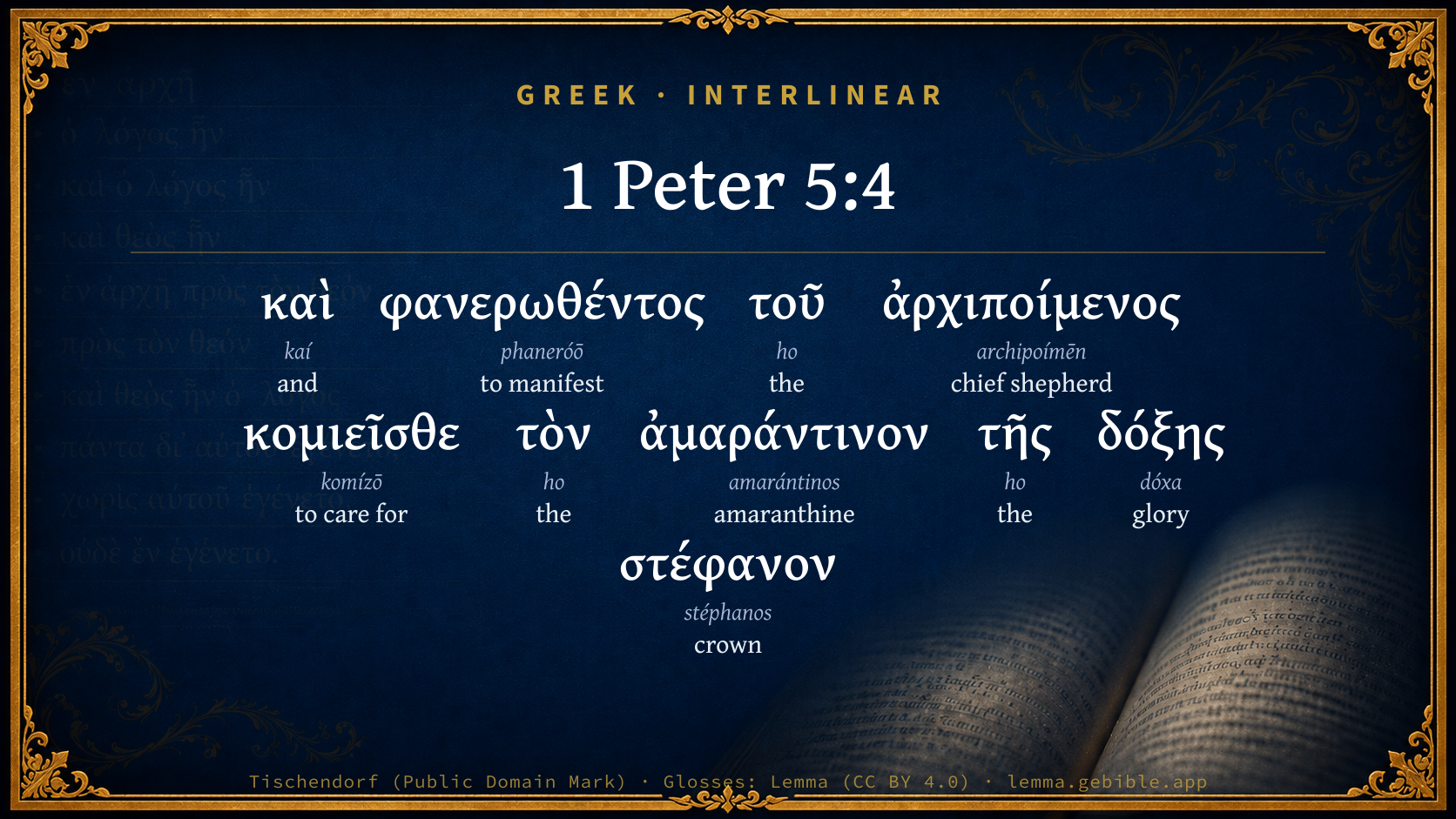
Greek (Tischendorf 8th ed.) 1 Peter 5:4 appears in the Greek New Testament. The text above is from the Tischendorf 8th edition. Each word links to its Strong’s number and a concise gloss. Click any word for its full Thayer’s Greek Lexicon entry.
Download image
Cite this verse

1 Peter 5:4 (World English Bible). Public Domain. Lemma interlinear Bible study tool, https://lemma.gebible.app/v/1-peter/5/4.

Show BibTeX & RIS
BibTeX
RIS
English Translation
When the chief Shepherd is revealed, you will receive the crown of glory that doesn't fade away.
World English Bible · Public Domain
Highlights
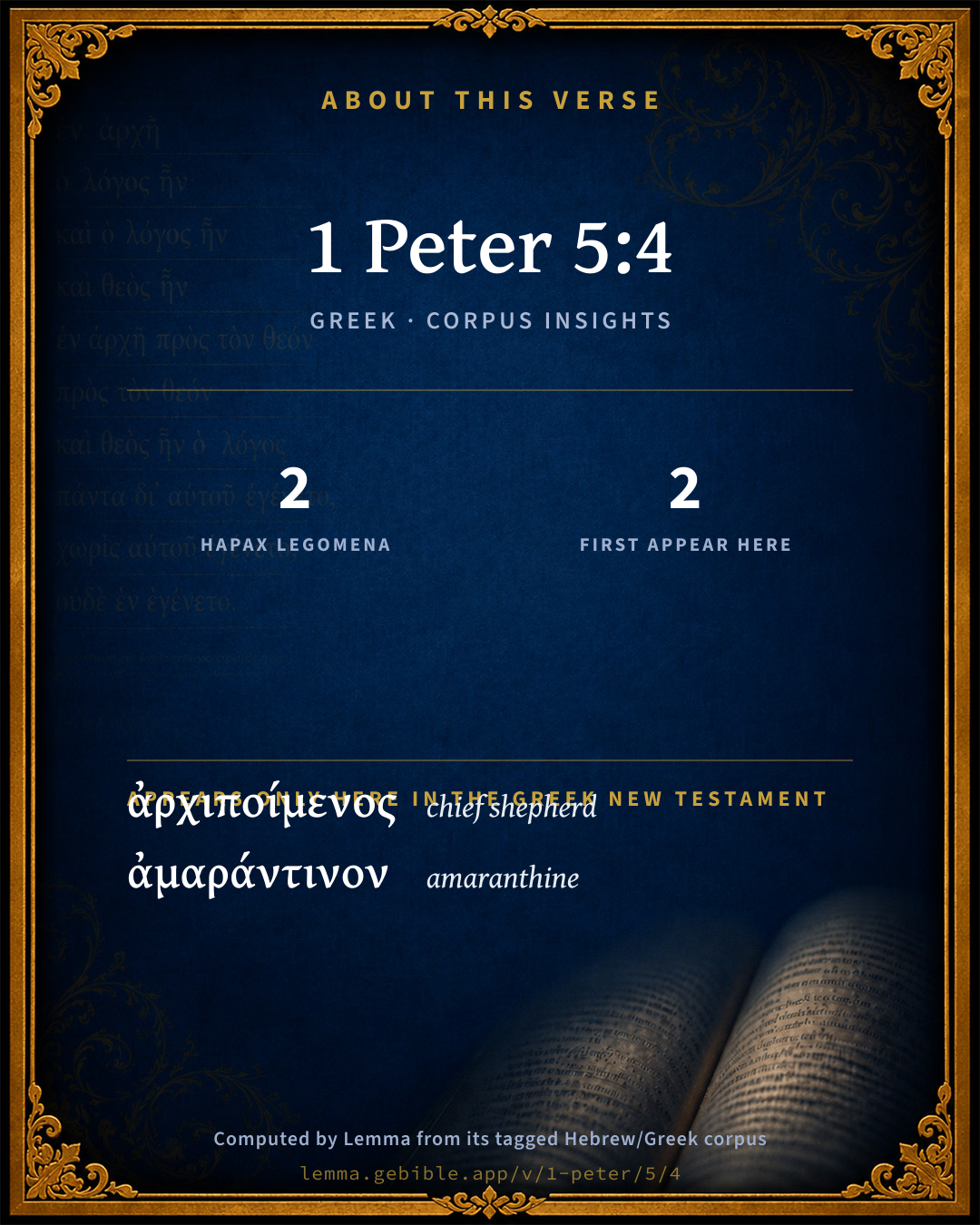
  • 2 hapax legomena — only here in the Greek New Testament
  • 2 first appearances in the Greek New Testament
Full analysis ↓
Download a study sheet

One document with this verse’s original text, its word-by-word gloss line, the meaning frame, cross-references with their text, attributed commentary, and full source and license credits — printable, and it pastes into notes with its structure intact.

This verse Autodidact and up

Study sheet (.html) Plain text (.txt)

A passage Seminary Student

Up to 50 verses in one chapter. A passage sheet keeps up to 6 commentary sources and 12 cross-references per verse, in the order this page ranks them, and says so on the sheet whenever that leaves anything out. Ask for a single verse and you get the Autodidact verse sheet above.

Everything on this page stays free to read, with no account — the sheet is a download of what is already on screen, not access to it.

Want to remove ads? Support Godless Engineer
Compare translations 3

The same verse in 3 English versions, stacked beneath the original-language interlinear above. Click any original word for its lexicon entry.

Each is an independent rendering of the whole verse — the interlinear is not word-aligned to these translations.

Highlighted words mark where these versions differ — a whole-verse word diff, not a word-by-word alignment.

  • World English Bible Public Domain
    When the chief Shepherd is revealed, you will receive the crown of glory that doesn't fade away.
  • King James Version Public Domain
    And when the chief Shepherd shall appear, ye shall receive a crown of glory that fadeth not away.
  • unfoldingWord Literal Text CC BY-SA 4.0
    And when the Chief Shepherd has been revealed, you will receive the unfading crown of glory.

unfoldingWord Literal Text — © unfoldingWord, licensed CC BY-SA 4.0. Word-aligned USFM3 via Door43 (git.door43.org/unfoldingWord/en_ult).

Versions to compare (up to 4)

3 of 4 selected

Show all 19 translations

Every available English version of this verse, each an independent rendering of the whole verse.

  • World English Bible Public Domain
    When the chief Shepherd is revealed, you will receive the crown of glory that doesn't fade away.
  • Berean Standard Bible Public Domain
    And when the Chief Shepherd appears, you will receive the crown of glory that will never fade away.
  • Majority Standard Bible Public Domain
    And when the Chief Shepherd appears, you will receive the crown of glory that will never fade away.
  • King James Version Public Domain
    And when the chief Shepherd shall appear, ye shall receive a crown of glory that fadeth not away.
  • American Standard Version (1901) Public Domain
    And when the chief Shepherd shall be manifested, ye shall receive the crown of glory that fadeth not away.
  • Revised Version (1885) Public Domain
    And when the chief Shepherd shall be manifested, ye shall receive the crown of glory that fadeth not away.
  • Geneva Bible (1599) Public Domain
    And when that chiefe shepheard shall appeare, ye shall receiue an incorruptible crowne of glory.
  • Douay-Rheims (1899) Public Domain
    And when the prince of pastors shall appear, you shall receive a never fading crown of glory.
  • Young's Literal Translation Public Domain
    and at the manifestation of the chief Shepherd, ye shall receive the unfading crown of glory.
  • Literal Standard Version CC BY-SA 4.0
    and the Chief Shepherd having appeared, you will receive the unfading garland of glory.
  • Unlocked Literal Bible CC BY-SA 4.0
    Then when the Chief Shepherd is revealed, you will receive an unfading crown of glory.
  • unfoldingWord Literal Text CC BY-SA 4.0
    And when the Chief Shepherd has been revealed, you will receive the unfading crown of glory.
  • Darby Bible Public Domain
    And when the chief shepherd is manifested ye shall receive the unfading crown of glory.
  • World Messianic Bible Public Domain
    When the chief Shepherd is revealed, you will receive the crown of glory that doesn’t fade away.
  • Webster's Bible Public Domain
    And when the chief Shepherd shall appear, ye shall receive a crown of glory that fadeth not away.
  • Free Bible Version CC BY-SA 4.0
    When the chief Shepherd appears, you will receive a glorious crown that will never fade.
  • Bible in Basic English Public Domain
    And at the coming of the chief Keeper of the sheep, you will be given the eternal crown of glory.
  • Text-Critical English NT CC BY 4.0
    And when the chief Shepherd appears, you will receive the unfading crown of glory.
  • Tyndale New Testament (1534) Public Domain
    And when the chef shepheerde shall appere ye shall receave an incorruptible croune of glorye.

Literal Standard Version (2020), Covenant Press — licensed CC BY-SA 4.0. Text via the HelloAO Bible API (eBible.org). Unlocked Literal Bible (unfoldingWord) — licensed CC BY-SA 4.0. Text via the HelloAO Bible API (eBible.org). unfoldingWord Literal Text — © unfoldingWord, licensed CC BY-SA 4.0. Word-aligned USFM3 via Door43 (git.door43.org/unfoldingWord/en_ult). Free Bible Version, Dr. Jonathan Gallagher — licensed CC BY-SA 4.0. Text via the HelloAO Bible API (eBible.org).

Word by word

More ways to search: Search by grammar → Find every occurrence → Compare this word →

Practice this passage: Drill this verse → Learn its vocabulary →

About this verse

These counts appear in no published source. They are computed here, from the morphology-tagged text and Lemma’s own curated glosses. What Lemma adds →

10
words
8
distinct lemmas
General Epistles
section

Notable vocabulary

2 hapax legomena — words that appear only here in the entire Greek New Testament:

  • ἀρχιποίμενος chief shepherd G750
  • ἀμαράντινον amaranthine G262

First appearance in Scripture

These words make their first canonical appearance in the Greek New Testament here:

  • ἀρχιποίμενος chief shepherd G750
  • ἀμαράντινον amaranthine G262

Shared distinctive vocabulary

κομιεῖσθε to care for G2865 occurs in 12 verses of the Greek New Testament. Also found in:

Repetition

A word recurs within this verse:

Cross-references

22

Topical passages linked to 1 Peter 5:4 in the Treasury of Scripture Knowledge — connected by theme and wording, ordered by reader-vote popularity; previews shown in the World English Bible.

  • James 1:12 Blessed is the man who endures temptation, for when he has been approved, he will receive the crown of life, which the Lord promised to those who love him.
  • 1 Corinthians 9:25 Every man who strives in the games exercises self-control in all things. Now they do it to receive a corruptible crown, but we an incorruptible.
  • Isaiah 40:11 He will feed his flock like a shepherd, he will gather the lambs in his arm, and carry them in his bosom, [and] will gently lead those who have their young.
  • 2 Timothy 4:8 From now on, there is stored up for me the crown of righteousness, which the Lord, the righteous judge, will give to me on that day; and not to me only, but also to all those who have loved his appearing.
  • 1 John 3:2 Beloved, now we are children of God, and it is not yet revealed what we will be. But we know that, when he is revealed, we will be like him; for we will see him just as he is.
  • Psalms 23:1 Yahweh is my shepherd: I shall lack nothing.
  • Revelation 2:10 Don't be afraid of the things which you are about to suffer. Behold, the devil is about to throw some of you into prison, that you may be tested; and you will have oppression for ten days. Be faithful to death, and I will give you the crown of life.
  • Revelation 3:11 I am coming quickly! Hold firmly that which you have, so that no one takes your crown.
  • 1 Peter 1:4 to an incorruptible and undefiled inheritance that doesn't fade away, reserved in heaven for you,
  • Ezekiel 37:24 My servant David shall be king over them; and they all shall have one shepherd: they shall also walk in my ordinances, and observe my statutes, and do them.
  • Daniel 12:3 Those who are wise shall shine as the brightness of the expanse; and those who turn many to righteousness as the stars forever and ever.
  • Matthew 25:31–46 "But when the Son of Man comes in his glory, and all the holy angels with him, then he will sit on the throne of his glory.
  • John 10:11 I am the good shepherd. The good shepherd lays down his life for the sheep.
  • Colossians 3:3–4 For you died, and your life is hidden with Christ in God.
  • Hebrews 13:20 Now may the God of peace, who brought again from the dead the great shepherd of the sheep with the blood of an eternal covenant, our Lord Jesus,
  • 1 Peter 2:25 For you were going astray like sheep; but are now returned to the Shepherd and Overseer of your souls.
  • 1 Peter 5:2 Shepherd the flock of God which is among you, exercising the oversight, not under compulsion, but voluntarily, not for dishonest gain, but willingly;
  • Revelation 20:11–12 I saw a great white throne, and him who sat on it, from whose face the earth and the heaven fled away. There was found no place for them.
  • Zechariah 13:7 "Awake, sword, against my shepherd, And against the man who is close to me," says Yahweh of Hosts. Strike the shepherd, and the sheep will be scattered; And I will turn my hand against the little ones.
  • Ezekiel 34:23 I will set up one shepherd over them, and he shall feed them, even my servant David; he shall feed them, and he shall be their shepherd.
  • 2 Thessalonians 1:7–10 and to give relief to you that are afflicted with us, when the Lord Jesus is revealed from heaven with his mighty angels in flaming fire,
  • Revelation 1:7 Behold, he is coming with the clouds, and every eye will see him, including those who pierced him. All the tribes of the earth will mourn over him. Even so, Amen.

Cross-references courtesy of OpenBible.info (CC BY 4.0).

Commentary

Notes on 1 Peter 5:4 from classic Christian and Jewish commentators (each source and its license shown beneath its notes). The classic Christian expositions comment on the surrounding passage and are grouped to its opening verse, so a note may address several verses; the Jewish commentaries on the Tanakh (Rashi and others) are per-verse, so they appear only where the commentator wrote on this verse.

Lemma curates 59 commentaries, every one of them public domain or Creative Commons licensed, each selected and text-cleaned for this edition rather than reprinted as found. About our sources →

Bengel's Gnomon

Johann Albrecht Bengel

1Pe 5:4. Φανερωθέντος, is manifested) It is the part of faith to serve the Lord, though yet unseen.—ἀρχιποίμενος) the Chief Shepherd. Ἀρχιποίμην has the acute accent on the penultimate, as φιλοποίμην, βουποίμην.

Bengel's Gnomon of the New Testament — English translation (T&T Clark, Edinburgh, 1860) — public domain. Text from a community e-Sword module.

Meyer's Critical & Exegetical Commentary

Heinrich August Wilhelm Meyer

1Pe_5:4. Assurance of the future reward for the faithful fulfilment of the exhortation just given.

καί] simply connects the result with the exhortation (cf. Winer, p. 406 [E. T. 542]), and is not to be taken αἰτιολογικῶς for ἵνα.

φανερωθέντος τοῦ ἀρχιποιμένος] With φανερ. cf. Col_3:4; 1Jn_2:28; Christ is here termed ἀρχιποιμήν (ἅπ. λεγ., chap. 1Pe_2:25 : ὁ ποιμήν; Heb_13:20 : ὁ ποιμὴν ὁ μεγάς) as He to whom the elders, with the flock they tend, are subject (Hofmann).

κομιεῖσθε (cf. chap. 1Pe_1:9) τὸν ἀμαράντινον τῆς δόξης στέφανον] The greater number of commentators consider ἀμαράντινος as equal to ἀμάραντος in chap. 1Pe_1:4; but the direct derivation of the word from μαραίνεσθαι is hardly to be justified. It comes rather from the substantive ἀμάραντος, and therefore means, as Beza explains: ex amaranto videlicet, cujus floris (inquit Plinius) summa natura in nomine est, sic appellato quoniam non marcescit. Accordingly the figure present to the mind of the apostle was an amaranthine wreath; thus also Schott.[271] It is at least uncertain whether ΣΤΈΦΑΝΟς here (as frequently in the writings of Paul) is thought of as a wreath of victory (thus the greater number of commentators), since among the Jews, also, wreaths of flowers and leaves were in use as tokens of honour and rejoicing (cf. Winers bibl. Realwörterbuch, s.v. Kränze).

τῆς δόξης is the genitive of apposition; cf. 2Ti_4:8; Jam_1:12; Rev_2:10 : the ΔΌΞΑ is the unfading crown which they shall obtain.

[271] Perhaps, however, Hofmann may be right when he supposes that ἀμαράντινος stands in the same relation to ἀμάραντος as ἀληθινός to ἀληθής and ὑγιεινός to ὑγιής, and that accordingly the word should be written ἀμαραντινός.

Meyer — Critical and Exegetical Commentary on the New Testament — English translation by Peter Christie, edited by Frederick Crombie (T&T Clark, 1880) — public domain. Text from a community e-Sword module.

Expositor's Greek Testament

ed. W. Robertson Nicoll

1Pe 5:4 . φανερωθέντος τοῦ ἀρχιποίμενος , at the manifestation of the chief Shepherd, i.e. , Christ, ἀρχιποίμην is the equivalent of ὁ ποίμην ὁ μέγας of Heb 13:20 , being formed on them analogy of ἀρχιερεύς = בהן הגדל ; else it occurs only as Symmachus’ rendering of נקד (LXX, νωκηδ ) in 2Ki 3:4 and in a papyrus. Cf. appeal to Jehovah, ὁ ποιμαίνων τὸν Ἰσραὴλ … ἐμφάνηθι of Psa 80:1 τὸν … στέφανον = the crown of life which He promised (Jas 1:12 ). The metaphor is probably derived from the wreath of fading flowers presented to the victor in the games ( cf. ἀμαράντινον ); but it may also be due to the conception of the future age as a banquet, at which the guests were crowned with garlands (Sap. 1Pe 2:8 , στεψώμεθα ῥόδων κάλυξιν πρὶν ἢ μαρανθῆναι ). See on 1Pe 1:4 .

The Expositor's Greek Testament, edited by W. Robertson Nicoll (1897–1910) — public domain. Text from a community e-Sword module.

Geneva Bible (1599)

Geneva Bible translators

That the shepherds’ minds be not overcome either with the wickedness of men, or their cruelty, he warneth them to cast their eyes continually upon that chief Shepherd, and the crown which is laid up for them in heaven.

Geneva Bible (1599) marginal notes — public domain. Text via Bolls.life.

Jamieson, Fausset & Brown

Robert Jamieson, A. R. Fausset & David Brown

And--"And so": as the result of "being ensamples" (Pe1 5:3).

chief Shepherd--the title peculiarly Christ's own, not Peter's or the pope's.

when . . . shall appear--Greek, "be manifested" (Col 3:4). Faith serves the Lord while still unseen.

crown--Greek, "stephanos," a garland of victory, the prize in the Grecian games, woven of ivy, parsley, myrtle, olive, or oak. Our crown is distinguished from theirs in that it is "incorruptible" and "fadeth not away," as the leaves of theirs soon did. "The crown of life." Not a kingly "crown" (a different Greek word, diadema): the prerogative of the Lord Jesus (Rev 19:12).

glory--Greek, "the glory," namely, to be then revealed (Pe1 5:1; Pe1 4:13).

that fadeth not away--Greek, "amaranthine" (compare Pe1 1:4).

Jamieson, Fausset & Brown — Commentary Critical and Explanatory on the Whole Bible (1871) — public domain (CC PDM 1.0). Text via the HelloAO Bible API.

Adam Clarke's Commentary

Verse 4. When the chief Shepherd] That is, the Lord Jesus Christ, whose is the flock, and who provides the pasture, and from whom, if ye are legally called to the most awful work of preaching the Gospel, ye have received your commission; when he shall appear to judge the world in righteousness, ye who have fed his flock, who have taken the superintendency of it, not by constraint, nor for filthy lucre's sake, not as lords over the heritage, but with a ready mind, employing body, soul, spirit, time and talents, in endeavouring to pluck sinners as brands from eternal burnings, and build up the Church of Christ on its most holy faith; YE shall receive a crown of glory that fadeth not away, an eternal nearness and intimacy with the ineffably glorious God; so that ye who have turned many to righteousness shall shine, not merely as stars, but as suns in the kingdom of your Father! O ye heavenly-minded, diligent, self-denying pastors after God's own heart, whether ye be in the Church established by the state, or in those divisions widely separated from, or nearly connected with it, take courage; preach Jesus; press through all difficulties in the faith of your God; fear no evil while meditating nothing but good. Ye are stars in the right hand of Jesus, who walks among your golden candlesticks, and has lighted that lamp of life which ye are appointed to trim; fear not, your labour in the Lord cannot be in vain! Never, never can ye preach one sermon in the spirit of your office, which the God of all grace shall permit to be unfruitful; ye carry and sow the seed of the kingdom by the command and on the authority of your God; ye sow it, and the heavens shall drop down dew upon it. Ye may go forth weeping, though bearing this precious seed; but ye shall doubtless come again with rejoicing, bringing your sheaves with you. Amen, even so, Lord Jesus!

Adam Clarke's Commentary on the Bible (1810–1826) — public domain. Text from a community e-Sword/MySword module.

John Calvin's Commentaries

4 When the chief Shepherd shall appear Except pastors retain this end in view, it can by no means be that they will in good earnest proceed in the course of their calling, but will, on the contrary, become often faint; for there are innumerable hindrances which are sufficient to discourage the most prudent. They have often to do with ungrateful men, from whom they receive an unworthy reward; long and great labors are often in vain; Satan sometimes prevails in his wicked devices. Lest, then, the faithful servant of Christ should be broken down, there is for him one and only one remedy, — to turn his eyes to the coming of Christ. Thus it will be, that he, who seems to derive no encouragement from men, will assiduously go on in his labors, knowing that a great reward is prepared for him by the Lord. And further, lest a protracted expectation should produce languor, he at the same time sets forth the greatness of the reward, which is sufficient to compensate for all delay: An unfading crown of glory, he says, awaits you.

It ought also to be observed, that he calls Christ the chief Pastor; for we are to rule the Church under him and in his name, in no other way but that he should be still really the Pastor. So the word chief here does not only mean the principal, but him whose power all others ought to submit to, as they do not represent him except according to his command and authority.

John Calvin's Commentaries (1540-1563) — public domain. Text from the Calvin Translation Society English edition (1840s-50s) via the Christian Classics Ethereal Library (ccel.org). Calvin's coverage is partial (roughly two-thirds of the Bible); uncommented books and verses are honest gaps, never fabricated. The 19th-century editor's footnotes and remarks are omitted so the notes are faithfully Calvin's own voice.

Ellicott's Commentary for English Readers

(4) And when the chief Shepherd shall appear.—Or, And at the chief Shepherd’s appearing. The “and” treats it as a simple natural consequence of acting as just indicated. The beautiful word for “chief Shepherd” seems to have been invented by St. Peter, and it has been apparently imitated in Heb_13:20. How could an office be more honoured than by speaking of Christ as the chief bearer of that office?

“A crown of glory that fadeth not away.—It might perhaps be more closely, though less beautifully, represented by the glorious crown of amaranth, or the amaranthine crown of glory. Amaranth is the name of a flower which, like our immortelles, does not lose its colour or form. St. Peter immediately adds “of glory,” lest we should think too literally of the wreath of immortelles.

A Bible Commentary for English Readers, edited by Charles John Ellicott (1878–1897) — public domain. Text from a community e-Sword module.

The Cambridge Bible for Schools and Colleges

gen. ed. J. J. S. Perowne

4. And when the chief Shepherd shall appear] The word for “chief Shepherd” is not found elsewhere, and would seem therefore to have been coined by St Peter, to express the thought which had been impressed on his mind by his Lord’s words, “I am the good Shepherd” (Joh_10:14). In his own work, as in that of all pastors of the Church, he saw the reproduction of that of which Christ had set the great example. For “shall appear” it would be better to read is manifested.

a crown of glory that fadeth not away] More accurately, as the Greek has the article, “the crown of glory.” The four last words answer to the one Greek word, “amaranthine,” or “unfading,” the adjective being a cognate form of that in chap. 1Pe_1:4. The crown here is the wreath or chaplet of flowers worn by conquerors and heroes, as in 1Co_9:25, Jas_1:12, and differs from the “crowns” or diadems of Rev_12:3; Rev_19:12, which were distinctively the badge of sovereignty. It is possible, as the adjective “amaranth” was applied to the kind of flowers which we know as “everlastings,” that there may be an allusive reference to the practice of using those flowers for wreaths that were placed in funerals upon the brows of the dead. The word and the thought reappear in one of Milton’s noblest passages:

“Immortal Amaranth, a flower which once

In Paradise, hard by the tree of life,

Began to bloom, but soon, for man’s offence

To heaven removed, where first it grew, there grows

And flowers aloft, shading the fount of life;

And where the river of bliss through midst of Heaven

Rolls o’er Elysian flowers her amber stream

With these, that never fade, the spirits elect

Bind their resplendent locks, inwreathed with beams.”

Paradise Lost, III. 353–361.

The Cambridge Bible for Schools and Colleges (gen. ed. J. J. S. Perowne; Cambridge University Press, 1878–1918) — public domain. Text from a community e-Sword module.

John Gill's Exposition

And when the chief Shepherd shall appear,.... This is the encouraging motive and argument to engage the elders and pastors of churches to discharge their office faithfully, cheerfully, and in an humble manner: by "the chief Shepherd" is meant Christ, who may well be called so, since he is God's fellow, and in all respects equal with him, and is the Shepherd and Bishop of the souls of men; all other bishops, pastors, and elders, are under him; they receive their commissions from him to feed his lambs and sheep; are made pastors and overseers by him; and have their gifts, qualifying them for such offices, from him; and have their several flocks assigned unto them by him; and from him have they all the food with which they feed them, and are accountable to him for them, and the discharge of their office; so that Christ is the chief Shepherd, in the dignity of his person, he being God over all, blessed for ever; in his qualifications for his office, having all power, grace, and wisdom in him, to protect his flock, supply their wants, guide and direct them; and in the nature and number of his flock, being rational creatures, the souls of men, even elect men; and though they are, when compared with others, but a little flock, yet, considered by themselves, are a great number; and especially the general assembly will be, in comparison of the little bodies and societies of saints under pastors and teachers, of Christ's setting over them, with respect to whom, principally, he is called the chief Shepherd: the allusion is to the principal shepherd, whose own the sheep were, or, however, had the principal charge of them; who used to have others under him, to do the several things relating to the flocks he directed, and were called "little shepherds"; so Aben Ezra says (s), it was customary for the shepherd to have under him , "little shepherds": the same perhaps with the hirelings, whose own the sheep are not, Joh 10:12 who are retained, or removed, according to their behaviour; these, in the Talmudic language, are called (t), or though, according to Guido (u), the word, pronounced in the latter way, signifies a "chief shepherd", who takes care of men, and has other shepherds, servants under him; and such an one used to be called , "the great", or "chief shepherd"; so Maimonides (w) says, it was the custom of shepherds to have servants under them, to whom they committed the flocks to keep; so that when , "the chief shepherd", delivered to other shepherds what was under his care, these came in his room; and if there was any loss, the second shepherd, who was under the "chief shepherd", was obliged to make good the loss, and not the first shepherd, who was the chief shepherd; and to the same purpose says another of their commentators (x); it is the custom of , "the chief shepherd", to deliver (the flock) to the little shepherd that is under him; wherefore the shepherd that is under him is obliged to make good any loss: now, such a shepherd is Christ; he has others under him, whom he employs in feeding his sheep, and who are accountable to him, and must give up their account when he appears: at present he is out of the bodily sight of men, being received up to heaven, where he will be retained till the time of the restitution of all things; and then he will appear a second time in great glory, in his own, and in his Father's, and in the glory of his holy angels: and when he thus appears,

ye shall receive a crown of glory which fadeth not away; in distinction from those crowns which were given to the conqueror, in the Olympic games; which were made of divers flowers, of the olive, wild olive, pine tree, and of parsley, and inserted in a branch of the wild olive tree (y) and which quickly faded away; or in allusion to crowns made of amaranthus (z), the plant "everlasting", so called, from the nature of it, because it never fades: the eternal glory and happiness, which is here meant by a crown of glory, or a glorious crown, never fades away, but ever shines in its full lustre; and this faithful ministers shall receive at the hands of the chief Shepherd, as a gift of his, as a reward of grace; when they have finished their work, they will enter into the joy of their Lord, and shine as the stars for ever and ever; they shall reign with Christ, as kings, on a throne of glory, wearing a crown of glory, and enjoying a kingdom and glory to all eternity.

(s) Comment. in Zech. xi. 8. (t) T. Bab. Bava Kama, fol. 56. 2. (u) Dictionar. Syr. Chald. p. 102. (w) In Misn. Bava Kama, c. 6. sect. 2. (x) Bartenora in Misn. Bava Kama, c. 6. sect. 2. (y) Vide Paschalium de Coronis, l. 6. c. 1. p. 339. c. 16. p. 391. c. 18. p. 399. c. 19. p. 413. (z) Ib. l. 3. c. 11. p. 178.

John Gill's Exposition of the Whole Bible (1746–1763) — public domain (CC PDM 1.0). Text via the HelloAO Bible API.

Trapp's Complete Commentary

John Trapp

4 And when the chief Shepherd shall appear, ye shall receive a crown of glory that fadeth not away.

Ver. 4. Ye shall receive a crown] A crown imports perpetuity, plenty, dignity, the height of human ambition. Quarta perennis erit It will be the fourth part of eternity, was Sir Thomas Bodly’s posy. Manet ultima caelo It remains by the greatest heaven, was Henry III’s of France, who was first crowned king of Poland. {See Trapp on "Jas 1:12"}

John Trapp, A Commentary or Exposition upon All the Books of the Old and New Testament (1647–1656) — public domain. Text from a community e-Sword module.

Albert Barnes' Notes on the Bible

And when the chief Shepherd shall appear - The prince of the pastors - the Lord Jesus Christ. “Peter, in the passage above, ranks himself with the elders; here he ranks Christ himself with the pastors” - Benson. See the notes at 1Pe 2:25. Compare Heb 13:20.

Ye shall receive a crown of glory - A glorious crown or diadem. Compare the notes at 2Ti 4:8.

That fadeth not away - This is essentially the same word, though somewhat different in form, which occurs in 1Pe 1:4. See the notes at that verse. The word occurs nowhere else in the New Testament. Compare the notes at 1Co 9:25.

Albert Barnes' Notes on the Bible (1834–1885) — public domain. Text from a community e-Sword/MySword module.

Matthew Poole's English Annotations

And when the chief Shepherd; the Lord Jesus Christ, the only Prince of pastors, called the great Shepherd of the sheep, Heb 13:20, as here the chief Shepherd, not only for his supereminent dignity over all other pastors, but because of the power he hath over them, they being all subject to his authority, receiving their charge from him, and exercising their office in his name, and being accountable to him for their administrations.

Shall appear: see 1Pe 1:7,13; 4:13.

Ye shall receive; or, carry away, viz. from Christ, who, as the Judge, shall award it to you.

A crown of glory; either, a glorious crown; or, that glory which shall be as a crown to you. It is called a crown of righteousness, 2Ti 4:8; a crown of life, Jam 1:12.

That fadeth not away; in opposition to those crowns which were given to conquerors in war, and in public games, which were made of perishable flowers or herbs: see 1Pe 1:4; 1Co 9:25.

Matthew Poole's English Annotations on the Holy Bible (1683–1685) — public domain. Text from a community e-Sword/MySword module.

Whedon's Commentary on the Bible

Daniel D. Whedon

4. The chief Shepherd—”Our Lord Jesus, that great Shepherd of the sheep,” (Heb_13:20,) whose is the flock, and to whom all pastors must give account.

A crown—Rather, the crown; the amaranthine crown of glory, a crown as if made of glory, and, like the amaranth, or everlasting flower, unfading. Such bliss will the faithful pastor receive when Christ shall appear at his second advent.

Daniel D. Whedon (gen. ed.), Commentary on the Old and New Testaments (1874–1909) — public domain. Text from a community e-Sword module.

The Pulpit Commentary

And when the chief Shepherd shall appear; rather, is manifested. The word rendered "chief Shepherd" ajrcipoimhn occurs only here; it reminds us of the Lord"s description of himself as "the good Shepherd," and of the "great Shepherd of the sheep". (Heb_13:20) Ye shall receive a crown of glory that fadeth not away. This is the true reward of the faithful presbyter, not power or filthy lucre. Literally, it is "the crown of glory," the promised glory, the glory of the Lord which he hath promised to his chosen. "The glory which thou gavest me, I have given them". (Joh_17:22) The crown is the glory; the genitive seemsto be one of apposition. The Greek word here rendered "that fadeth not away" ajmarantinov is not exactly the same with that so rendered in 1Pe_1:4 XXX; taken literally, the words used here mean an amaranthine wreath a wreath of amaranth flowers; the general meaning remains the same, "unfading." St. Peter is thinking, not of a kingly crown, but of the wreaths worn on festive occasions or bestowed on conquerors.

The Pulpit Commentary (1880–1919), ed. H.D.M. Spence-Jones & Joseph S. Exell — public domain. Text from a community e-Sword module.

Burkitt's Expository Notes on the New Testament

William Burkitt

As if our apostle nad said, "It is possible you may miss of your reward here from the hands of men; but when Christ, the great and good Shepherd, shall appear, when the owner, ruler, and lover of his church shall come to judgment, you shall have from him your full reward, a never-fading, ever-flourishing crown of glory, for faithfully discharging your duty to God and his people."

Learn hence, 1. That Jesus Christ, the chief Shepherd, will at length appear.

2. That when he doth appear, he will call the under shepherds to account, how they have discharged every part of their ministerial office, as well private inspection, as public preaching.

3. That to all such, and to only such, as have been faithful to the interest of Christ and souls, shall the reward be assigned, even a crown of glory that fadeth not away: When the chief Shepherd shall appear, ye shall receive a crown of glory, &c.

William Burkitt's Expository Notes on the New Testament (1700–1703) — public domain. Text from a community e-Sword module.

The People's New Testament

B. W. Johnson

4. And when the chief Shepherd. Christ, to whom all the under shepherds shall give account. Shall receive the crown of glory. The eternal reward of faithful duty.

B. W. Johnson's The People's New Testament with Notes (1889–1891) — public domain. Electronic text from the Christian Classics Ethereal Library (CCEL) ThML edition.

Cambridge Greek Testament for Schools and Colleges

4. φανερωθέντος. The Chief Shepherd is always present among His under-shepherds, and at last His presence will be manifested. The verb is used of the First Coming of Christ in 1Pe 1:20 and 1Ti 3:16, but here it refers to the Second Advent as in Col 3:4; 1Jn 2:28; 1Jn 3:2.

ἀρχιποίμενος. The word occurs nowhere else. It refers to Christ, who was described as ποιμήν in 1Pe 2:25. Our Lord described Himself as “the good Shepherd,” John 10, and in Mat 25:32 compared His work as Judge to “a shepherd separating the sheep from the goats.” In Heb 13:20 He is called “the great Shepherd of the Sheep.” Here St Peter uses the title “chief shepherd,” to remind the presbyters that in shepherding God’s flock they are working under and with the good Shepherd Himself.

κομιεῖσθε. Cf. note on 1Pe 1:9.

ἀμαράντινον is not quite the same as ἀμάραντον (= unfading, cf. 1Pe 1:4), but means made of amaranth, a supposed unfading flower. Adjectives in -ινος denote the material of which a thing is made, e.g. ξύλινος, λίθινος, ὀστράκινος.

τῆς δόξης is not simply a “genitive of quality,” but “of apposition” or “epexegetic.” The crown consists in sharing the glory; cf. στέφανον τῆς ζωῆς Jas 1:12; Rev 2:10. The phrase στέφανος δόξης occurs in Jer 13:18; cf. Psa 8:6 δόξῃ καὶ τιμῇ ἐστεφάνωσας αὐτόν.

στέφανος might possibly mean a festal garland, but more probably the victor’s crown, which is its regular meaning in the N.T. as contrasted with διάδημα, the royal crown. But στέφανος is used of the crown of thorns, which was certainly intended as an emblem of royalty, and in the Apocalypse also it may denote a royal crown, as it does sometimes in the LXX.

Cambridge Greek Testament for Schools and Colleges (Cambridge University Press, 1896; 21 vols, various authors incl. Carr, Maclear, Plummer, Farrar, Lumby, Moule, M. R. James, Simcox) — public domain. Text from a community e-Sword module.

Alford’s Greek Testament

Henry Alford

4.] and (then) (καί of the result of something previously treated, as Mat 26:55; Joh 10:16 al. fr.: see Winer, § 53. 3) when the chief Shepherd (see ch. 2:25; Heb 13:20: and compare Eze 34:15, Eze 34:16, Eze 34:23; Mat 25:32) is manifested (used by St. Peter, as ἀποκαλύπτω, in a double reference, to Christ’s first coming, and His second also: cf. ch. 1:20: so also by St. Paul, Col 3:4; 1Ti 3:16: by St. John, 1Jn 2:28, 1Jn 2:3:2, 1Jn 2:5, 1Jn 2:8. Here, clearly of the second coming. It would not be clear, from this passage alone, whether St. Peter regarded the coming of the Lord as likely to occur in the life of these his readers, or not: but as interpreted by the analogy of his other expressions on the same subject, it would appear that he did), ye shall receive (reff.) the amarantine (ἀμαράντινος is adj. from ἀμάραντος, the everlasting, or unfading, flower. Most Commentators have assumed without reason that it = ἀμάραντος, ch. 1:4, unfading. Philostr. in Heroicis, p. 741, cited in Wolf, has ὅθεν καὶ στεφάνους ἀμαραντίνους εἰς τὰ κήδη πρῶτοι Θετταλοὶ ἐνόμισαν: see also Palm and Rost, sub voce. In the sense, there will be no difference: but the Apostle would hardly have used two derivatives of the same word, to express one and the same quality) crown (reff.) of His glory (or, of glory: but I prefer the other. That we shall share His glory, is a point constantly insisted on by St. Peter: cf. ver. 1, ch. 4:13, 1:7: and above all, ver. 10 below. This idea reaches its highest in St. John, with whom the inner unity of the divine life with the life of Christ is all in all. Cf. especially 1Jn 3:2 f.).

Henry Alford, The Greek Testament (1849–1861) — public domain. Text from a community e-Sword module.

Vincent's Word Studies in the New Testament

Marvin R. Vincent

The chief Shepherd [αρχιποιμενος] . Only here in New Testament. In harmony with ver. 2. "The last thing Peter could have dreamed of as possible would be its misapplication to himself or his so - called successors" (Cook). Compare Heb 13:20, great Shepherd; and Joh 10:11, 14, good Shepherd. Also, Eze 34:15, 16, 23.

Ye shall receive. See on receiving, 1Pe 1:9.

Crown [στεφανον] . From stefw, to put round, encircle. It is the crown of victory in the games; of military valor; the marriage wreath, or the festal garland, woven of leaves or made of gold in imitation of leaves. Thus it is distinguished from the royal crown, which is diadhma, of which diadem is a transcript. In Paul, stefanov is always used of the conqueror's crown, not of the king's (1Co 9:24 - 26; 2Ti 2:5). Though it is urged that Peter would not have employed a reference to the crown of the victors in the games, because of the abhorrence of the Palestinian Jews for heathen spectacles, yet the reference to the crown of leaves seems to be determined by the epithet unfading, as compared with garlands of earthly leaves. The crown of thorns woven for Jesus is called stefanov, with reference rather to its being twined than to its being a caricature of a kingly crown.

Marvin R. Vincent, Word Studies in the New Testament (1887–1900) — public domain. Text from a community e-Sword/MySword module.

Lesson kit

Teaching starters — assembled from the data on this page, not authored interpretation. Every prompt links to the verse data it draws on. Edit before teaching.

1 Peter, in the General Epistles, opens this verse with 10 words (8 distinct Greek lemmas). Its most distinctive word is archipoímēn (“chief shepherd”). A historical commentator’s framing appears above. Read the whole chapter for the surrounding context.

Discussion questions

  1. How does “chief shepherd” (archipoímēn) shape what this verse is saying?
  2. This verse holds 2 words here found nowhere else in the Greek New Testament. What might the rare words draw attention to?
  3. 2 words here appear for the first time in Scripture. What is being introduced at this debut?
  4. Matthew 25:27 shares the word «to care for» with this verse. How do the two illuminate each other?
  5. “the” occurs 3× in this one verse. What is the effect of the repetition?
  6. These translations render this verse differently. What is at stake in choosing one wording over another?
  7. Reading how Bengel's Gnomon and Meyer's Critical & Exegetical Commentary read this verse, where do the two commentators agree and where do they part?

Things to notice

  • 2 words in this verse appear nowhere else in the Greek New Testament.
  • 2 words make their first canonical appearance in Scripture here.
  • These translations choose different wording for 12 words in this verse.
  • “the” occurs 3× in this single verse.
  • 8 distinct Greek lemmas span 10 words in this verse.

Reading settings

Reading text

Shown beneath each verse's original-language words.

Old Testament
Old Testament edition

Read the OT as the Masoretic Hebrew (MT) or the Greek Septuagint (LXX).

English shown for the Greek Septuagint (in the Hebrew ↔ Greek comparison).

Comparing translations? Open the Compare panel on any verse page to stack up to four side by side.