Ezekiel 38:9

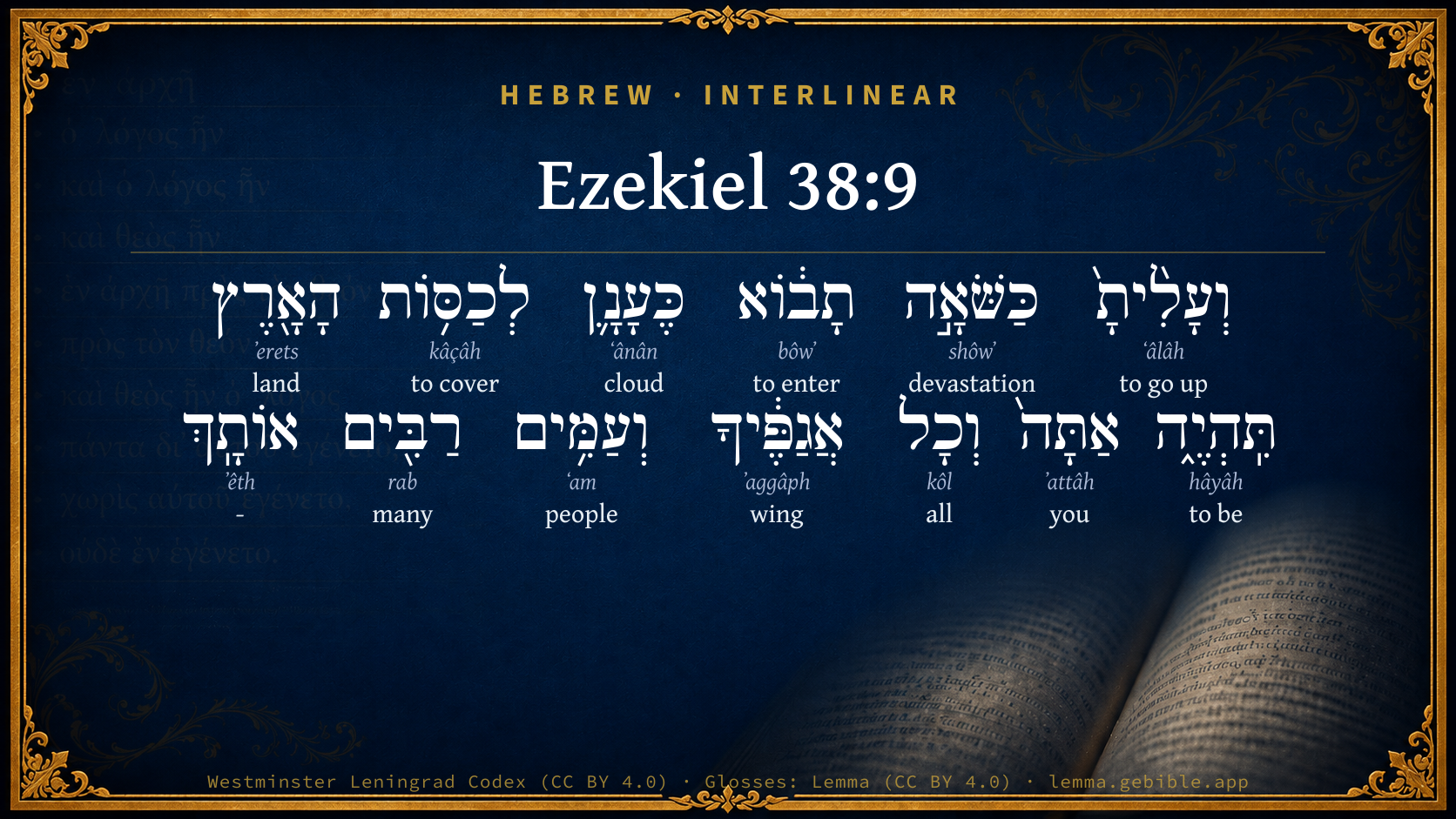
Hebrew (Westminster Leningrad Codex) Ezekiel 38:9 appears in the Hebrew Old Testament. The text above is from the Westminster Leningrad Codex. Each word links to its Strong’s number, a concise gloss, and parsing drawn from the Open Scriptures Hebrew Bible morphology. Click any word for its full Brown-Driver-Briggs (BDB) entry.
Download image
Cite this verse

Ezekiel 38:9 (World English Bible). Public Domain. Lemma interlinear Bible study tool, https://lemma.gebible.app/v/ezekiel/38/9.

Show BibTeX & RIS
BibTeX
RIS
English Translation
You shall ascend, you shall come like a storm, you shall be like a cloud to cover the land, you, and all your hordes, and many peoples with you.
World English Bible · Public Domain
Download a study sheet

One document with this verse’s original text, its word-by-word gloss line, the meaning frame, cross-references with their text, attributed commentary, and full source and license credits — printable, and it pastes into notes with its structure intact.

This verse Autodidact and up

Study sheet (.html) Plain text (.txt)

A passage Seminary Student

Up to 50 verses in one chapter. A passage sheet keeps up to 6 commentary sources and 12 cross-references per verse, in the order this page ranks them, and says so on the sheet whenever that leaves anything out. Ask for a single verse and you get the Autodidact verse sheet above.

Everything on this page stays free to read, with no account — the sheet is a download of what is already on screen, not access to it.

Want to remove ads? Support Godless Engineer
Compare translations 3

The same verse in 3 English versions, stacked beneath the original-language interlinear above. Click any original word for its lexicon entry.

Each is an independent rendering of the whole verse — the interlinear is not word-aligned to these translations.

Highlighted words mark where these versions differ — a whole-verse word diff, not a word-by-word alignment.

  • World English Bible Public Domain
    You shall ascend, you shall come like a storm, you shall be like a cloud to cover the land, you, and all your hordes, and many peoples with you.
  • King James Version Public Domain
    Thou shalt ascend and come like a storm, thou shalt be like a cloud to cover the land, thou, and all thy bands, and many people with thee.
  • unfoldingWord Literal Text CC BY-SA 4.0
    So you will go up as a storm goes; you will be like a cloud covering the land, you and all your troops, all the many soldiers with you.

unfoldingWord Literal Text — © unfoldingWord, licensed CC BY-SA 4.0. Word-aligned USFM3 via Door43 (git.door43.org/unfoldingWord/en_ult).

Versions to compare (up to 4)

3 of 4 selected

Show all 18 translations

Every available English version of this verse, each an independent rendering of the whole verse.

  • World English Bible Public Domain
    You shall ascend, you shall come like a storm, you shall be like a cloud to cover the land, you, and all your hordes, and many peoples with you.
  • Berean Standard Bible Public Domain
    You and all your troops, and many peoples with you will go up, advancing like a thunderstorm; you will be like a cloud covering the land.
  • Majority Standard Bible Public Domain
    You and all your troops, and many peoples with you will go up, advancing like a thunderstorm; you will be like a cloud covering the land.
  • King James Version Public Domain
    Thou shalt ascend and come like a storm, thou shalt be like a cloud to cover the land, thou, and all thy bands, and many people with thee.
  • American Standard Version (1901) Public Domain
    And thou shalt ascend, thou shalt come like a storm, thou shalt be like a cloud to cover the land, thou, and all thy hordes, and many peoples with thee.
  • Revised Version (1885) Public Domain
    And thou shalt ascend, thou shalt come like a storm, thou shalt be like a cloud to cover the land, thou, and all thy hordes, and many peoples with thee.
  • Geneva Bible (1599) Public Domain
    Thou shalt ascende and come vp like a tempest, and shalt be like a cloude to couer the land, both thou, and all thy bandes, and many people with thee.
  • Douay-Rheims (1899) Public Domain
    And thou shalt go up and come like a storm, and like a cloud to cover the land, thou and all thy bands and many people with thee.
  • Young's Literal Translation Public Domain
    And thou hast gone up -- as wasting thou comest in, As a cloud to cover the land art thou, Thou and all thy bands, and many peoples with thee.
  • Literal Standard Version CC BY-SA 4.0
    And you have gone up—you come in as desolation, || You are as a cloud to cover the land, || You and all your bands, and many peoples with you.
  • Unlocked Literal Bible CC BY-SA 4.0
    So you will go up as a storm goes; you will be like a cloud covering the land, you and all your troops, all the many soldiers with you.
  • unfoldingWord Literal Text CC BY-SA 4.0
    So you will go up as a storm goes; you will be like a cloud covering the land, you and all your troops, all the many soldiers with you.
  • Darby Bible Public Domain
    And thou shalt ascend, thou shalt come like a storm, thou shalt be like a cloud to cover the land, thou, and all thy bands, and many peoples with thee.
  • World Messianic Bible Public Domain
    You will ascend. You will come like a storm. You will be like a cloud to cover the land, you and all your hordes, and many peoples with you.”
  • Webster's Bible Public Domain
    Thou shalt ascend and come like a storm, thou shalt be like a cloud to cover the land, thou, and all thy bands, and many people with thee.
  • Free Bible Version CC BY-SA 4.0
    You and your whole army, and the armies of many nations with you, will advance like an incoming storm, like a cloud that covers the land.
  • Bible in Basic English Public Domain
    And you will go up, you will come like a storm, you will be like a cloud covering the land, you and all your forces, and a great number of peoples with you.
  • JPS Tanakh (1917) Public Domain
    And thou shalt ascend, thou shalt come like a storm, thou shalt be like a cloud to cover the land, thou, and all thy bands, and many peoples with thee.

Literal Standard Version (2020), Covenant Press — licensed CC BY-SA 4.0. Text via the HelloAO Bible API (eBible.org). Unlocked Literal Bible (unfoldingWord) — licensed CC BY-SA 4.0. Text via the HelloAO Bible API (eBible.org). unfoldingWord Literal Text — © unfoldingWord, licensed CC BY-SA 4.0. Word-aligned USFM3 via Door43 (git.door43.org/unfoldingWord/en_ult). Free Bible Version, Dr. Jonathan Gallagher — licensed CC BY-SA 4.0. Text via the HelloAO Bible API (eBible.org).

Word by word

More ways to search: Search by grammar → Find every occurrence → Compare this word →

Practice this passage: Drill this verse → Learn its vocabulary →

אֲגַפֶּ֔יךָ
ʼaggâph
H102
“wings · your”
Noun, Common, Masculine, Plural, Construct + Suffix, Personal, 2nd Person, Masculine, Singular
Part of Speech
Noun
Type
Common
Gender
Masculine
Number
Plural
State
Construct
Full BDB Definition

Origin: probably from H5062 (through the idea of impending)

TWOT: 21a

wing (of an army), band, army, hordes
  1. וְעָלִ֨יתָ֙ ʻâlâh H5927 “and · to go up” Conjunction + Verb, Qal, Sequential Perfect, 2nd Person, Masculine, Singular
  2. כַּשֹּׁאָ֣ה shôwʼ H7722 “like/as the · devastation” Preposition, Determined + Noun, Common, Feminine, Singular, Absolute
  3. תָב֔וֹא bôwʼ H935 “to enter” Verb, Qal, Imperfect, 2nd Person, Masculine, Singular
  4. כֶּעָנָ֛ן ʻânân H6051 “like/as the · cloud” Preposition, Determined + Noun, Common, Masculine, Singular, Absolute
  5. לְכַסּ֥וֹת kâçâh H3680 “to cover” Preposition + Verb, Piel, Infinitive Construct
  6. הָאָ֖רֶץ ʼerets H776 “the · land” Particle, Definite Article + Noun, Common, Both, Singular, Absolute
  7. תִּֽהְיֶ֑ה hâyâh H1961 “to be” Verb, Qal, Imperfect, 2nd Person, Masculine, Singular
  8. אַתָּה֙ ʼattâh H859 “you” Pronoun, Personal, 2nd Person, Masculine, Singular
  9. וְכָל kôl H3605 “and · all of” Conjunction + Noun, Common, Masculine, Singular, Construct
  10. וְעַמִּ֥ים ʻam H5971 “and · peoples” Conjunction + Noun, Common, Masculine, Plural, Absolute
  11. רַבִּ֖ים rab H7227 “many” Adjective, Adjective, Masculine, Plural, Absolute
  12. אוֹתָֽךְ ʼêth H853 “- · you” Particle, Direct Object + Suffix, Personal, 2nd Person, Feminine, Singular

About this verse

These counts appear in no published source. They are computed here, from the morphology-tagged text and Lemma’s own curated glosses. What Lemma adds →

13
words
13
distinct lemmas
Prophets
section

Notable vocabulary

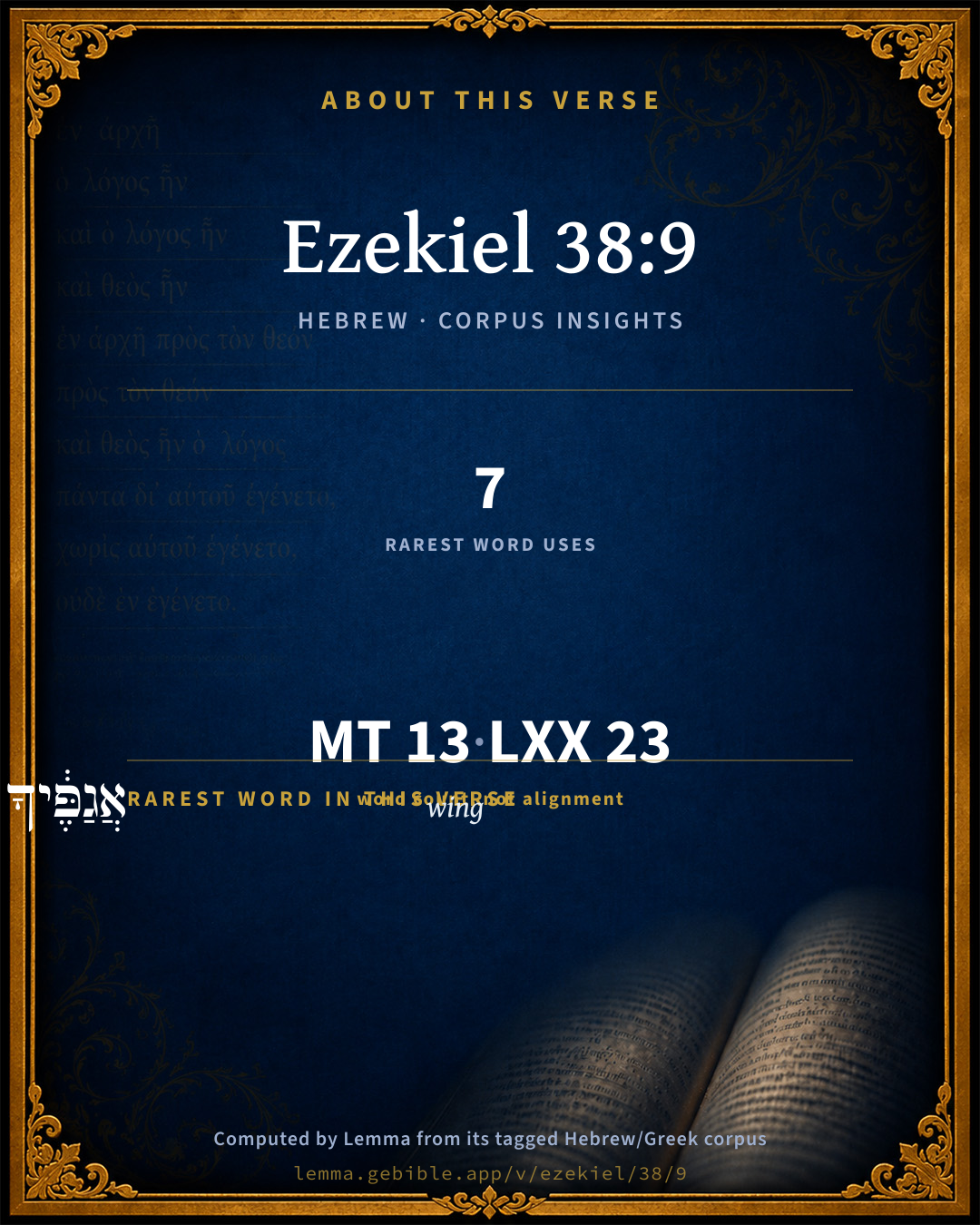
The rarest word here is אֲגַפֶּ֔יךָ wing H102 — appearing just 7 times in the whole Hebrew Bible.

Shared distinctive vocabulary

אֲגַפֶּ֔יךָ wing H102 occurs in 6 verses of the Hebrew Bible. Also found in:

Grammatical profile

  • 4 verbs
  • 6 nouns
  • 1 adjective
  • 1 pronoun
  • 1 particle

Verb forms

  • וְעָלִ֨יתָ֙ Qal · Sequential Perfect
  • תָב֔וֹא Qal · Imperfect
  • לְכַסּ֥וֹת Piel · Infinitive Construct
  • תִּֽהְיֶ֑ה Qal · Imperfect

Hebrew & Septuagint length

In English translation the verse runs 29 words from the Hebrew and 33 from the Septuagint (LXX English) — closely comparable.

A rough comparison of the two English renderings, which tokenize alike — not a word-level alignment.

Word counts can differ between the Hebrew and the Greek without any difference in meaning — e.g. the Hebrew direct-object marker אֵת has no separate Greek word, and Greek often adds the article ὁ.

In the original languages it is 13 Hebrew tokens and 23 Greek tokens — but the two are counted differently (Hebrew bundles its prefixes and suffixes into one token; the Greek is in lemma form), so that isn’t a like-for-like length.

Cross-references

9

Topical passages linked to Ezekiel 38:9 in the Treasury of Scripture Knowledge — connected by theme and wording, ordered by reader-vote popularity; previews shown in the World English Bible.

  • Isaiah 28:2 Behold, the Lord has a mighty and strong one; as a tempest of hail, a destroying storm, as a tempest of mighty waters overflowing, will he cast down to the earth with the hand.
  • Jeremiah 4:13 Behold, he shall come up as clouds, and his chariots [shall be] as the whirlwind: his horses are swifter than eagles. Woe to us! for we are ruined.
  • Joel 2:2 A day of darkness and gloominess, A day of clouds and thick darkness. As the dawn spreading on the mountains, A great and strong people; There has never been the like, Neither will there be any more after them, Even to the years of many generations.
  • Isaiah 25:4 For you have been a stronghold to the poor, a stronghold to the needy in his distress, a refuge from the storm, a shade from the heat, when the blast of the awesome ones is as a storm against the wall.
  • Ezekiel 38:16 and you shall come up against my people Israel, as a cloud to cover the land: it shall happen in the latter days, that I will bring you against my land, that the nations may know me, when I shall be sanctified in you, Gog, before their eyes.
  • Isaiah 8:9–10 Make an uproar, O you peoples, and be broken in pieces! And give ear, all you of far countries: gird yourselves, and be broken in pieces! Gird yourselves, and be broken in pieces!
  • Isaiah 21:1–2 The burden of the wilderness of the sea. As whirlwinds in the South sweep through, it comes from the wilderness, from an awesome land.
  • Ezekiel 13:11 tell those who daub it with whitewash, that it shall fall: there shall be an overflowing shower; and you, great hailstones, shall fall; and a stormy wind shall tear it.
  • Daniel 11:40 At the time of the end shall the king of the south contend with him; and the king of the north shall come against him like a whirlwind, with chariots, and with horsemen, and with many ships; and he shall enter into the countries, and shall overflow and pass through.

Cross-references courtesy of OpenBible.info (CC BY 4.0).

Hebrew and Greek witnesses Masoretic Hebrew ↔ Greek Septuagint

The same verse in the two great witnesses to the Old Testament, shown verse-for-verse.

These are two independent witnesses, not word-aligned to each other, and the Septuagint is shown in lemma (dictionary) form.

Hebrew Ezekiel 38:9 Masoretic · Westminster Leningrad Codex

וְעָלִ֨יתָ֙ כַּשֹּׁאָ֣ה תָב֔וֹא כֶּעָנָ֛ן לְכַסּ֥וֹת הָאָ֖רֶץ תִּֽהְיֶ֑ה אַתָּה֙ וְכָל אֲגַפֶּ֔יךָ וְעַמִּ֥ים רַבִּ֖ים אוֹתָֽךְ

You shall ascend, you shall come like a storm, you shall be like a cloud to cover the land, you, and all your hordes, and many peoples with you.

World English Bible · Public Domain

Greek LXX Ezekiel 38:9 Septuagint · lemma form

καί ἀναβαίνω ὡς ὑετός καί ἥκω ὡς νεφέλη κατακαλύπτω γῆ καί εἰμί σύ καί πᾶς ὁ περί σύ καί ἔθνος πολύς μετά σύ

And you shall go up as rain, and shall arrive as a cloud to cover the land, and there shall be you, and all that are about you, and many nations with you.

LXX2012 (modern English Septuagint) · Public Domain

Hebrew: Westminster Leningrad Codex (CC BY 4.0). Greek: Septuagint (public domain); English from LXX2012 (modern English Septuagint) (Public Domain). How the Septuagint differs from the Hebrew →

Targum (Aramaic paraphrase)

1

The Targum is the ancient Jewish Aramaic paraphrase of the Hebrew Scriptures — an interpretive translation, not the Hebrew text itself. Onkelos (literal) and Pseudo-Jonathan (expansive) render the Torah, and Jonathan the Prophets. Coverage is partial: where no permissively-licensed English translation exists for a verse, only the Aramaic is shown. This is verse-level text, not a word-by-word alignment to the Hebrew.

  1. Targum Jonathan Prophets (Joshua–Malachi)
    וְתִסַק בְּאִתְרְגוּשְׁתָּא תֵּיתֵי כַּעֲנָנָא דְסָלֵיק וְחָפֵי יַת אַרְעָא תְּהֵי אַתְּ וְכָל מַשִׁרְיָתָךְ וְעַמְמִין סַגִיאִין דִי עִמָךְ:

    (no public-domain English translation for this verse)

    Targum Jonathan — Aramaic: “Mikraot Gedolot” (public domain). English: “Sefaria Community Translation” (CC0 1.0 (public-domain dedication)); “London "Chaldee Paraphrase," 1871” (public domain). Text via Sefaria.

Commentary

Notes on Ezekiel 38:9 from classic Christian and Jewish commentators (each source and its license shown beneath its notes). The classic Christian expositions comment on the surrounding passage and are grouped to its opening verse, so a note may address several verses; the Jewish commentaries on the Tanakh (Rashi and others) are per-verse, so they appear only where the commentator wrote on this verse.

Lemma curates 59 commentaries, every one of them public domain or Creative Commons licensed, each selected and text-cleaned for this edition rather than reprinted as found. About our sources →

Trapp's Complete Commentary

John Trapp

Eze 38:9 Thou shalt ascend and come like a storm, thou shalt be like a cloud to cover the land, thou, and all thy bands, and many people with thee.

Ver. 9. Thou shalt ascend and come like a storm.] With great hurry and terror, but it shall soon blow over.

Thou shalt be like a cloud.] Sed cito transibis.

John Trapp, A Commentary or Exposition upon All the Books of the Old and New Testament (1647–1656) — public domain. Text from a community e-Sword module.

Tyndale Open Study Notes

Tyndale Open Resources

38:9 roll down on them like a storm: This is reminiscent of the threatening imagery of ch 1, when God was Israel’s enemy. At that time, Israel looked to the surrounding rebellious nations for protection; this time, Israel would look to God for protection from the nations.

Tyndale Open Study Notes — © Tyndale Open Resources, licensed CC BY-SA 4.0. Text via the HelloAO Bible API.

Jamieson, Fausset & Brown

Robert Jamieson, A. R. Fausset & David Brown

cloud to cover the land--with the multitude of thy forces.

Jamieson, Fausset & Brown — Commentary Critical and Explanatory on the Whole Bible (1871) — public domain (CC PDM 1.0). Text via the HelloAO Bible API.

Adam Clarke's Commentary

Verse 9. Thou shalt ascend and come like a storm] It is observable that Antiochus is thus spoken of by Daniel, Da 11:40: The king of the north - Antiochus, shall come against him (the king of the south is the king of Egypt) like a whirlwind.

Adam Clarke's Commentary on the Bible (1810–1826) — public domain. Text from a community e-Sword/MySword module.

The Cambridge Bible for Schools and Colleges

gen. ed. J. J. S. Perowne

9. like a storm] Cf. on the figure Isa_21:1; Isa_28:2; Jer_4:13. The rapidity of the movements of Gog (Hos_8:1), and their destructiveness, as well as the infinite masses of his host (Num_22:5; Jdg_6:5) are expressed by the comparison with the storm and cloud.

The Cambridge Bible for Schools and Colleges (gen. ed. J. J. S. Perowne; Cambridge University Press, 1878–1918) — public domain. Text from a community e-Sword module.

John Gill's Exposition

Thus saith the Lord, it shall also come to pass,.... Who is the Lord God omniscient, and knows the thoughts of men's hearts afar off; which, though they are contingent and voluntary, yet certain to the foreknowledge of God; who knows them before they are conceived, and can foretell what they will be, and which come to pass accordingly: it is now above two thousand years ago since this was said, and as yet is not fulfilled, but certainly will be: that

at the same time shall things come into thy mind; when the Jews shall be in their own land, dwelling in great security; and when Gog or the Turk shall make preparation to disturb them, and shall enter into their land suddenly and furiously; many thoughts shall come into his mind, many schemes and devices, but not good ones:

and thou shall think an evil thought; to do mischief to the Jews; to disturb their peace, to dispossess them of their land, and plunder their substance.

John Gill's Exposition of the Whole Bible (1746–1763) — public domain (CC PDM 1.0). Text via the HelloAO Bible API.

Matthew Poole's English Annotations

Thou shalt: sometimes such phrase declares duty and is perceptive, but here it declares the event and is predictive, Gog will, though he should not. The Hebrew might be read thus,

Thou shalt ascend as a storm, thou shalt come as a cloud. This storm is violent, with confused, tumultuous noises, and with devastation, as the word implieth; and come as a cloud, that is, as dark, as large, and as inevitable, and which continueth the violent waving storm.

To cover the land; Gog and his bands shall be a storm that overspreads the whole land.

All thy bands; troops, or wings.

Many people; many in number, great in courage and strength.

Matthew Poole's English Annotations on the Holy Bible (1683–1685) — public domain. Text from a community e-Sword/MySword module.

The Pulpit Commentary

Like a storm, and like a cloud. Gog"s invasion, his "ascension," or "going up" (compare the Greek term ajnabasiv for a military expedition), should be like a storm in its suddenness and violence, as in Eze_1:27, and like a cloud in its threatening aspect and overshadowing nearness. (see ver. 16; and comp. Jer_4:13) Taken together, the images suggest that Gog"s invasion should burst forth suddenly, rage violently, spread quickly, alarm greatly, but cease finally. Storms roar and crash, alarm and destroy, but do not continue. Clouds diffuse gloom and fear, but ultimately disperse.

The Pulpit Commentary (1880–1919), ed. H.D.M. Spence-Jones & Joseph S. Exell — public domain. Text from a community e-Sword module.

Rashi

Rabbi Shlomo Yitzchaki (Rashi)

like mist [Heb. כַּשּׁוֹאָה,] like darkness that covers the earth, שּׁוֹאָה is broine, bruine in Old French, fog, mist.

Rashi on the Tanakh — English translations: “The Judaica Press complete Tanach with Rashi, translated by A. J. Rosenberg” (CC BY 4.0); “Pentateuch with Rashi's commentary by M. Rosenbaum and A.M. Silbermann, 1929-1934” (public domain); “The Metsudah Tanach series, Lakewood, N.J” (CC BY 4.0); and “The Book of Joshua, Metsudah Publications, 1997” (CC BY 4.0). Text via Sefaria.

Lesson kit

Teaching starters — assembled from the data on this page, not authored interpretation. Every prompt links to the verse data it draws on. Edit before teaching.

Ezekiel, in the Prophets, opens this verse with 13 words (13 distinct Hebrew lemmas). Its most distinctive word is ʼaggâph (“wing”). A historical commentator’s framing appears above. Read the whole chapter for the surrounding context.

Discussion questions

  1. The word ʼaggâph carries the sense “wing.” How does it shape the verse?
  2. How does Ezekiel 12:14, which shares the word «wing», read alongside this verse?
  3. These translations render this verse differently; the difference is in the English rendering, not the original. What questions does that raise?
  4. «וְעָלִ֨יתָ֙» is a Qal Sequential Perfect verb. How does that grammatical form shape the action described?
  5. Compare how Trapp's Complete Commentary and Tyndale Open Study Notes read this verse. Where do they agree or differ?

Things to notice

Reading settings

Reading text

Shown beneath each verse's original-language words.

Old Testament
Old Testament edition

Read the OT as the Masoretic Hebrew (MT) or the Greek Septuagint (LXX).

English shown for the Greek Septuagint (in the Hebrew ↔ Greek comparison).

Comparing translations? Open the Compare panel on any verse page to stack up to four side by side.