
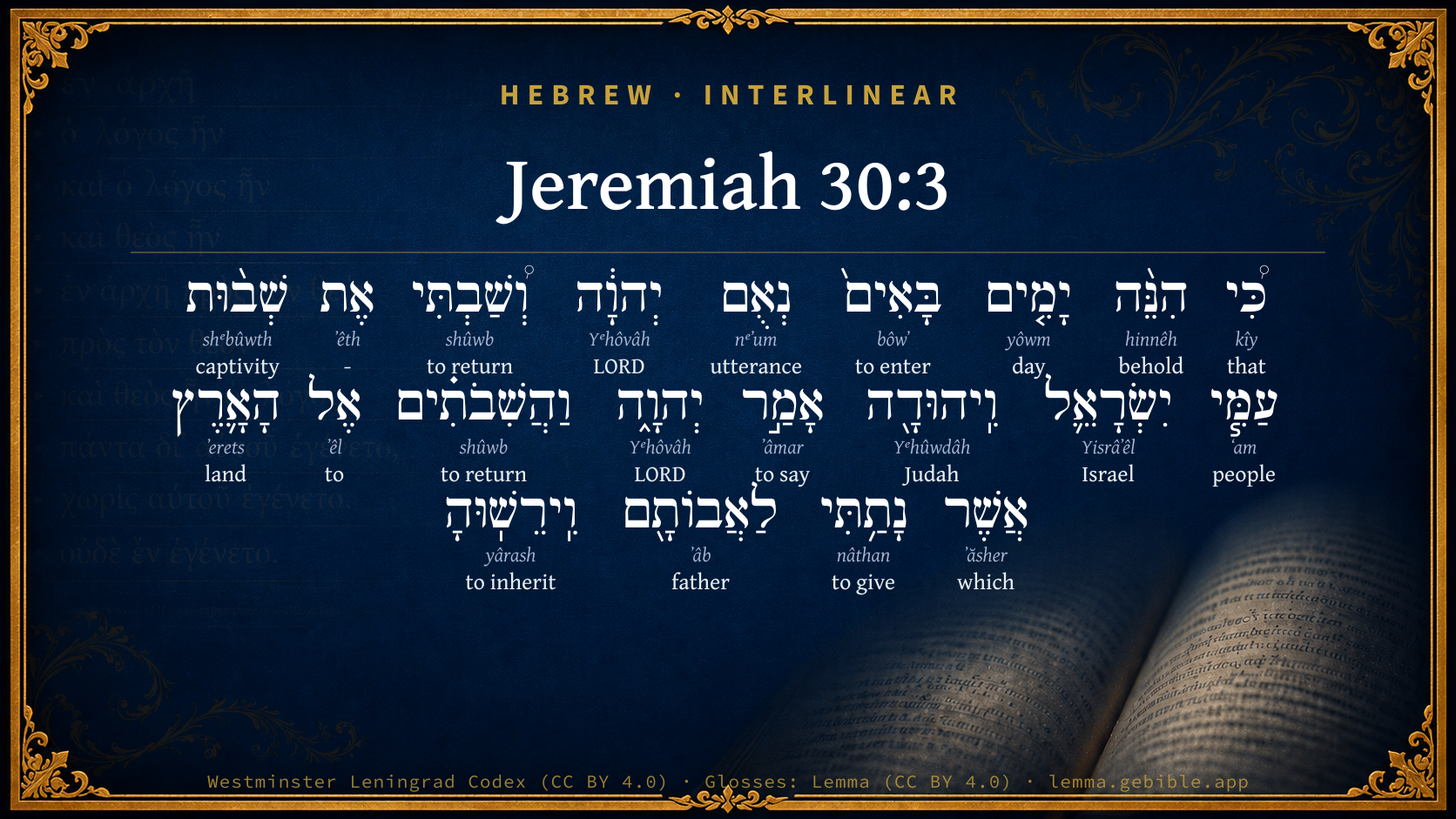
Jeremiah 30:3

Hebrew (Westminster Leningrad Codex) Jeremiah 30:3 appears in the Hebrew Old Testament. The text above is from the Westminster Leningrad Codex. Each word links to its Strong’s number, a concise gloss, and parsing drawn from the Open Scriptures Hebrew Bible morphology. Click any word for its full Brown-Driver-Briggs (BDB) entry.
Download image
Cite this verse

Jeremiah 30:3 (World English Bible). Public Domain. Lemma interlinear Bible study tool, https://lemma.gebible.app/v/jeremiah/30/3.

Show BibTeX & RIS
BibTeX
RIS
English Translation
For, behold, the days come, says Yahweh, that I will turn again the captivity of my people Israel and Judah, says Yahweh; and I will cause them to return to the land that I gave to their fathers, and they shall possess it.
World English Bible · Public Domain
Download a study sheet

One document with this verse’s original text, its word-by-word gloss line, the meaning frame, cross-references with their text, attributed commentary, and full source and license credits — printable, and it pastes into notes with its structure intact.

This verse Autodidact and up

Study sheet (.html) Plain text (.txt)

A passage Seminary Student

Up to 50 verses in one chapter. A passage sheet keeps up to 6 commentary sources and 12 cross-references per verse, in the order this page ranks them, and says so on the sheet whenever that leaves anything out. Ask for a single verse and you get the Autodidact verse sheet above.

Everything on this page stays free to read, with no account — the sheet is a download of what is already on screen, not access to it.

Want to remove ads? Support Godless Engineer
Compare translations 3

The same verse in 3 English versions, stacked beneath the original-language interlinear above. Click any original word for its lexicon entry.

Each is an independent rendering of the whole verse — the interlinear is not word-aligned to these translations.

Highlighted words mark where these versions differ — a whole-verse word diff, not a word-by-word alignment.

  • World English Bible Public Domain
    For, behold, the days come, says Yahweh, that I will turn again the captivity of my people Israel and Judah, says Yahweh; and I will cause them to return to the land that I gave to their fathers, and they shall possess it.
  • King James Version Public Domain
    For, lo, the days come, saith the LORD, that I will bring again the captivity of my people Israel and Judah, saith the LORD: and I will cause them to return to the land that I gave to their fathers, and they shall possess it.
  • unfoldingWord Literal Text CC BY-SA 4.0
    For look, days are coming—this is Yahweh’s declaration—when I will restore the fortunes of my people, Israel and Judah. I, Yahweh, have said it. For I will bring them back to the land that I gave their ancestors, and they will possess it.’”

unfoldingWord Literal Text — © unfoldingWord, licensed CC BY-SA 4.0. Word-aligned USFM3 via Door43 (git.door43.org/unfoldingWord/en_ult).

Versions to compare (up to 4)

3 of 4 selected

Show all 18 translations

Every available English version of this verse, each an independent rendering of the whole verse.

  • World English Bible Public Domain
    For, behold, the days come, says Yahweh, that I will turn again the captivity of my people Israel and Judah, says Yahweh; and I will cause them to return to the land that I gave to their fathers, and they shall possess it.
  • Berean Standard Bible Public Domain
    For behold, the days are coming, declares the LORD, when I will restore from captivity My people Israel and Judah, declares the LORD. I will restore them to the land that I gave to their fathers, and they will possess it.’”
  • Majority Standard Bible Public Domain
    For behold, the days are coming, declares the LORD, when I will restore from captivity My people Israel and Judah, declares the LORD. I will restore them to the land that I gave to their fathers, and they will possess it.’”
  • King James Version Public Domain
    For, lo, the days come, saith the LORD, that I will bring again the captivity of my people Israel and Judah, saith the LORD: and I will cause them to return to the land that I gave to their fathers, and they shall possess it.
  • American Standard Version (1901) Public Domain
    For, lo, the days come, saith Jehovah, that I will turn again the captivity of my people Israel and Judah, saith Jehovah; and I will cause them to return to the land that I gave to their fathers, and they shall possess it.
  • Revised Version (1885) Public Domain
    For, lo, the days come, saith the LORD, that I will turn again the captivity of my people Israel and Judah, saith the LORD: and I will cause them to return to the land that I gave to their fathers, and they shall possess it.
  • Geneva Bible (1599) Public Domain
    For loe, the dayes come, saith the Lord, that I wil bring againe the captiuitie of my people Israel and Iudah, saith the Lord: for I will restore them vnto the lande, that I gaue to their fathers, and they shall possesse it.
  • Douay-Rheims (1899) Public Domain
    For behold the days come, saith the Lord, and I will bring again the captivity of my people Israel and Juda, saith the Lord: and I will cause them to return to the land which I gave to their fathers, and they shall possess it.
  • Young's Literal Translation Public Domain
    For, lo, days are coming -- an affirmation of Jehovah -- and I have turned back `to' the captivity of My people Israel and Judah, said Jehovah, and I have caused them to turn back unto the land that I gave to their fathers, and they do possess it.'
  • Literal Standard Version CC BY-SA 4.0
    For behold, days are coming—a declaration of YHWH—and I have turned back [to] the captivity of My people Israel and Judah, said YHWH, and I have caused them to return to the land that I gave to their fathers, and they possess it.”
  • Unlocked Literal Bible CC BY-SA 4.0
    For look, days are coming—this is Yahweh's declaration—when I will restore the fortunes of my people, Israel and Judah. I, Yahweh, have said it. For I will bring them back to the land that I gave their ancestors, and they will possess it.'”
  • unfoldingWord Literal Text CC BY-SA 4.0
    For look, days are coming—this is Yahweh’s declaration—when I will restore the fortunes of my people, Israel and Judah. I, Yahweh, have said it. For I will bring them back to the land that I gave their ancestors, and they will possess it.’”
  • Darby Bible Public Domain
    For behold, the days come, saith Jehovah, when I will turn the captivity of my people Israel and Judah, saith Jehovah; and I will cause them to return to the land that I gave to their fathers, and they shall possess it.
  • World Messianic Bible Public Domain
    For, behold, the days come,’ says the LORD, ‘that I will reverse the captivity of my people Israel and Judah,’ says the LORD. ‘I will cause them to return to the land that I gave to their fathers, and they will possess it.’”
  • Webster's Bible Public Domain
    For lo, the days come, saith the LORD; that I will bring again the captivity of my people Israel and Judah, saith the LORD: and I will cause them to return to the land that I gave to their fathers, and they shall possess it.
  • Free Bible Version CC BY-SA 4.0
    Look, the time is coming, declares the Lord, when I will bring back my people Israel and Judah from captivity, declares the Lord. I will bring them back to the country I gave to their forefathers, and they will own it again.
  • Bible in Basic English Public Domain
    For see, the days are coming, says the Lord, when I will let the fate of my people Israel and Judah be changed, says the Lord: and I will make them come back to the land which I gave to their fathers, so that they may take it for their heritage.
  • JPS Tanakh (1917) Public Domain
    For, lo, the days come, saith the LORD, that I will turn the captivity of My people Israel and Judah, saith the LORD; and I will cause them to return to the land that I gave to their fathers, and they shall possess it.'

Literal Standard Version (2020), Covenant Press — licensed CC BY-SA 4.0. Text via the HelloAO Bible API (eBible.org). Unlocked Literal Bible (unfoldingWord) — licensed CC BY-SA 4.0. Text via the HelloAO Bible API (eBible.org). unfoldingWord Literal Text — © unfoldingWord, licensed CC BY-SA 4.0. Word-aligned USFM3 via Door43 (git.door43.org/unfoldingWord/en_ult). Free Bible Version, Dr. Jonathan Gallagher — licensed CC BY-SA 4.0. Text via the HelloAO Bible API (eBible.org).

Word by word

More ways to search: Search by grammar → Find every occurrence → Compare this word →

Practice this passage: Drill this verse → Learn its vocabulary →

שְׁב֨וּת
shᵉbûwth
H7622
“captivity of”
Noun, Common, Feminine, Singular, Construct
Part of Speech
Noun
Type
Common
Gender
Feminine
Number
Singular
State
Construct
Full BDB Definition

Origin: from H7617

TWOT: 2311d

captivity, captives
  1. כִּ֠י kîy H3588 “that” Conjunction
  2. הִנֵּ֨ה hinnêh H2009 “behold” Particle, Demonstrative
  3. יָמִ֤ים yôwm H3117 “days” Noun, Common, Masculine, Plural, Absolute
  4. בָּאִים֙ bôwʼ H935 “entering” Verb, Qal, Participle Active, Masculine, Plural, Absolute
  5. נְאֻם nᵉʼum H5002 “utterance of” Noun, Common, Masculine, Singular, Construct
  6. יְהוָ֔ה Yᵉhôvâh H3068 “LORD” Noun, Proper
  7. וְ֠שַׁבְתִּי shûwb H7725 “and · to return” Conjunction + Verb, Qal, Sequential Perfect, 1st Person, Common, Singular
  8. אֶת ʼêth H853 “-” Particle, Direct Object
  9. עַמִּ֧י ʻam H5971 “people · my” Noun, Common, Masculine, Singular, Construct + Suffix, Personal, 1st Person, Common, Singular
  10. יִשְׂרָאֵ֛ל Yisrâʼêl H3478 “Israel” Noun, Proper
  11. וִֽיהוּדָ֖ה Yᵉhûwdâh H3063 “and · Judah” Conjunction + Noun, Proper
  12. אָמַ֣ר ʼâmar H559 “to say” Verb, Qal, Perfect, 3rd Person, Masculine, Singular
  13. יְהוָ֑ה Yᵉhôvâh H3068 “LORD” Noun, Proper
  14. וַהֲשִׁבֹתִ֗ים shûwb H7725 “and · to return · them” Conjunction + Verb, Hiphil, Perfect, 1st Person, Common, Singular + Suffix, Personal, 3rd Person, Masculine, Plural
  15. אֶל ʼêl H413 “to” Preposition
  16. הָאָ֛רֶץ ʼerets H776 “the · land” Particle, Definite Article + Noun, Common, Both, Singular, Absolute
  17. אֲשֶׁר ʼăsher H834 “which” Particle, Relative
  18. נָתַ֥תִּי nâthan H5414 “to give” Verb, Qal, Perfect, 1st Person, Common, Singular
  19. לַאֲבוֹתָ֖ם ʼâb H1 “to/for · fathers · their” Preposition + Noun, Common, Masculine, Plural, Construct + Suffix, Personal, 3rd Person, Masculine, Plural
  20. וִֽירֵשֽׁוּהָ yârash H3423 “and · to inherit · her” Conjunction + Verb, Qal, Sequential Perfect, 3rd Person, Common, Plural + Suffix, Personal, 3rd Person, Feminine, Singular

About this verse

These counts appear in no published source. They are computed here, from the morphology-tagged text and Lemma’s own curated glosses. What Lemma adds →

21
words
19
distinct lemmas
Prophets
section

Shared distinctive vocabulary

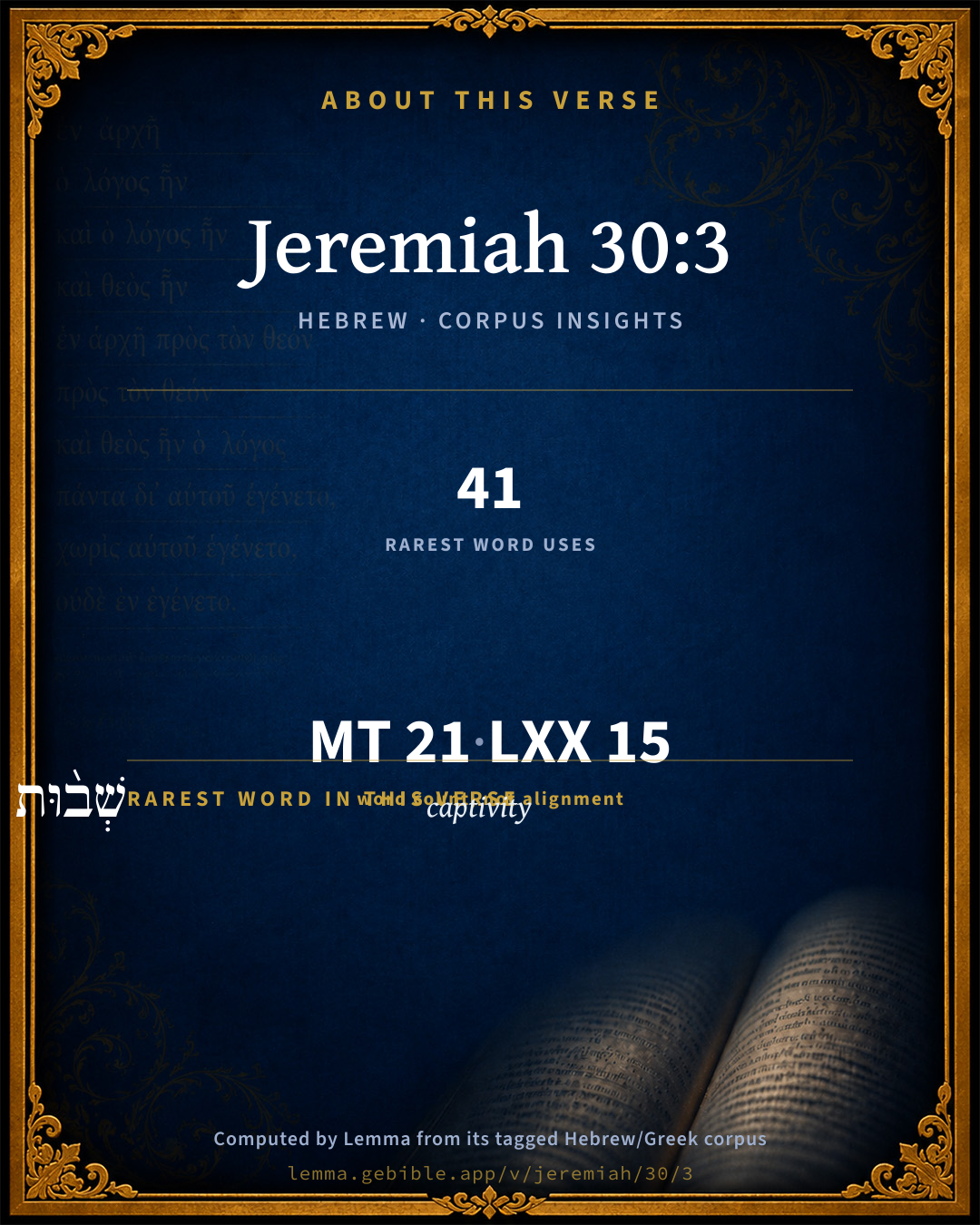
שְׁב֨וּת captivity H7622 occurs in 26 verses of the Hebrew Bible. Also found in:

Grammatical profile

  • 6 verbs
  • 10 nouns
  • 1 preposition
  • 1 conjunction
  • 3 particles

Verb forms

  • בָּאִים֙ Qal · Participle Active
  • וְ֠שַׁבְתִּי Qal · Sequential Perfect
  • אָמַ֣ר Qal · Perfect
  • וַהֲשִׁבֹתִ֗ים Hiphil · Perfect
  • נָתַ֥תִּי Qal · Perfect
  • וִֽירֵשֽׁוּהָ Qal · Sequential Perfect

Repetition

Words recur within this verse — often emphatic in Hebrew:

  • יְהוָ֔ה LORD H3068 ×2
  • וְ֠שַׁבְתִּי to return H7725 ×2

Hebrew & Septuagint length

In the original languages it is 21 Hebrew tokens and 15 Greek tokens — but the two are counted differently (Hebrew bundles its prefixes and suffixes into one token; the Greek is in lemma form), so that isn’t a like-for-like length.

Cross-references

36

Topical passages linked to Jeremiah 30:3 in the Treasury of Scripture Knowledge — connected by theme and wording, ordered by reader-vote popularity; previews shown in the World English Bible.

  • Jeremiah 29:14 I will be found by you, says Yahweh, and I will turn again your captivity, and I will gather you from all the nations, and from all the places where I have driven you, says Yahweh; and I will bring you again to the place from where I caused you to be carried away captive.
  • Jeremiah 16:15 but, As Yahweh lives, who brought up the children of Israel from the land of the north, and from all the countries where he had driven them. I will bring them again into their land that I gave to their fathers.
  • Jeremiah 30:18 Thus says Yahweh: Behold, I will turn again the captivity of Jacob's tents, and have compassion on his dwelling-places; and the city shall be built on its own hill, and the palace shall be inhabited after its own manner.
  • Ezekiel 20:42 You shall know that I am Yahweh, when I shall bring you into the land of Israel, into the country which I swore to give to your fathers.
  • Jeremiah 23:7–8 Therefore, behold, the days come, says Yahweh, that they shall no more say, As Yahweh lives, who brought up the children of Israel out of the land of Egypt;
  • Jeremiah 32:44 Men shall buy fields for money, and subscribe the deeds, and seal them, and call witnesses, in the land of Benjamin, and in the places about Jerusalem, and in the cities of Judah, and in the cities of the hill-country, and in the cities of the lowland, and in the cities of the South: for I will cause their captivity to return, says Yahweh.
  • Jeremiah 33:26 then will I also cast away the seed of Jacob, and of David my servant, so that I will not take of his seed to be rulers over the seed of Abraham, Isaac, and Jacob: for I will cause their captivity to return, and will have mercy on them.
  • Zephaniah 3:20 At that time will I bring you in, and at that time will I gather you; for I will give you honor and praise among all the peoples of the earth, when I bring back your captivity before your eyes, says Yahweh.
  • Psalms 53:6 Oh that the salvation of Israel would come out of Zion! When God brings back the captivity of his people, Then Jacob shall rejoice. Israel shall be glad.
  • Jeremiah 33:14–15 Behold, the days come, says Yahweh, that I will perform that good word which I have spoken concerning the house of Israel and concerning the house of Judah.
  • Ezekiel 36:24 For I will take you from among the nations, and gather you out of all the countries, and will bring you into your own land.
  • Joel 3:1 "For, behold, in those days, And in that time, When I restore the fortunes of Judah and Jerusalem,
  • Amos 9:14–15 I will bring back the captivity of my people Israel, And they will rebuild the ruined cities, and inhabit them; and they will plant vineyards, and drink wine from them. They shall also make gardens, And eat the fruit of them.
  • Hebrews 8:8 For finding fault with them, he said, "Behold, the days come," says the Lord, "That I will make a new covenant with the house of Israel and with the house of Judah;
  • Deuteronomy 30:3 that then Yahweh your God will turn your captivity, and have compassion on you, and will return and gather you from all the peoples, where Yahweh your God has scattered you.
  • Ezra 3:1 When the seventh month was come, and the children of Israel were in the cities, the people gathered themselves together as one man to Jerusalem.
  • Ezra 3:8 Now in the second year of their coming to the house of God at Jerusalem, in the second month, began Zerubbabel the son of Shealtiel, and Jeshua the son of Jozadak, and the rest of their brothers the priests and the Levites, and all those who were come out of the captivity to Jerusalem, and appointed the Levites, from twenty years old and upward, to have the oversight of the work of the house of Yahweh.
  • Ezra 3:12 But many of the priests and Levites and heads of fathers' [houses], the old men who had seen the first house, when the foundation of this house was laid before their eyes, wept with a loud voice; and many shouted aloud for joy:
  • Jeremiah 23:5 Behold, the days come, says Yahweh, that I will raise to David a righteous Branch, and he shall reign as king and deal wisely, and shall execute justice and righteousness in the land.
  • Jeremiah 27:11 But the nation that shall bring their neck under the yoke of the king of Babylon, and serve him, that [nation] will I let remain in their own land, says Yahweh; and they shall till it, and dwell therein.
  • Jeremiah 27:22 They shall be carried to Babylon, and there shall they be, until the day that I visit them, says Yahweh; then will I bring them up, and restore them to this place.
  • Jeremiah 30:10 Therefore don't you be afraid, O Jacob my servant, says Yahweh; neither be dismayed, Israel: for, behold, I will save you from afar, and your seed from the land of their captivity; and Jacob shall return, and shall be quiet and at ease, and none shall make him afraid.
  • Jeremiah 31:27 Behold, the days come, says Yahweh, that I will sow the house of Israel and the house of Judah with the seed of man, and with the seed of animal.
  • Jeremiah 31:31 Behold, the days come, says Yahweh, that I will make a new covenant with the house of Israel, and with the house of Judah:
  • Jeremiah 31:38 Behold, the days come, says Yahweh, that the city shall be built to Yahweh from the tower of Hananel to the gate of the corner.
  • Jeremiah 32:37 Behold, I will gather them out of all the countries, where I have driven them in my anger, and in my wrath, and in great indignation; and I will bring them again to this place, and I will cause them to dwell safely:
  • Jeremiah 33:7–11 I will cause the captivity of Judah and the captivity of Israel to return, and will build them, as at the first.
  • Ezekiel 28:25–26 Thus says the Lord Yahweh: When I shall have gathered the house of Israel from the peoples among whom they are scattered, and shall be sanctified in them in the sight of the nations, then shall they dwell in their own land which I gave to my servant Jacob.
  • Ezekiel 37:21–25 Say to them, Thus says the Lord Yahweh: Behold, I will take the children of Israel from among the nations, where they are gone, and will gather them on every side, and bring them into their own land:
  • Ezekiel 39:25–28 Therefore thus says the Lord Yahweh: Now will I bring back the captivity of Jacob, and have mercy on the whole house of Israel; and I will be jealous for my holy name.
  • Ezekiel 47:14 You shall inherit it, one as well as another; for I swore to give it to your fathers: and this land shall fall to you for inheritance.
  • Obadiah 1:19–20 Those of the South will possess the mountain of Esau, and those of the lowland, the Philistines. They will possess the field of Ephraim, and the field of Samaria. Benjamin will possess Gilead.
  • Luke 17:22 He said to the disciples, "The days will come, when you will desire to see one of the days of the Son of Man, and you will not see it.
  • Luke 19:43 For the days will come on you, when your enemies will throw up a barricade against you, surround you, hem you in on every side,
  • Luke 21:6 "As for these things which you see, the days will come, in which there will not be left here one stone on another that will not be thrown down."
  • Jeremiah 31:23 Thus says Yahweh of Hosts, the God of Israel, Yet again shall they use this speech in the land of Judah and in the cities of it, when I shall bring again their captivity: Yahweh bless you, habitation of righteousness, mountain of holiness.

Cross-references courtesy of OpenBible.info (CC BY 4.0).

Hebrew and Greek witnesses Masoretic Hebrew ↔ Greek Septuagint

The same verse in the two great witnesses to the Old Testament, shown verse-for-verse.

These are two independent witnesses, not word-aligned to each other, and the Septuagint is shown in lemma (dictionary) form.

Hebrew Jeremiah 30:3 Masoretic · Westminster Leningrad Codex

כִּ֠י הִנֵּ֨ה יָמִ֤ים בָּאִים֙ נְאֻם יְהוָ֔ה וְ֠שַׁבְתִּי אֶת שְׁב֨וּת עַמִּ֧י יִשְׂרָאֵ֛ל וִֽיהוּדָ֖ה אָמַ֣ר יְהוָ֑ה וַהֲשִׁבֹתִ֗ים אֶל הָאָ֛רֶץ אֲשֶׁר נָתַ֥תִּי לַאֲבוֹתָ֖ם וִֽירֵשֽׁוּהָ

For, behold, the days come, says Yahweh, that I will turn again the captivity of my people Israel and Judah, says Yahweh; and I will cause them to return to the land that I gave to their fathers, and they shall possess it.

World English Bible · Public Domain

Greek LXX Structure differs

In the Septuagint, Jeremiah is about an eighth shorter than the Hebrew and arranges its material differently — the Oracles Against the Nations (Hebrew chapters 46–51) appear in the middle of the Greek book, after 25:13. Because the chapter and verse boundaries do not line up, a verse-for-verse comparison with the Hebrew is not shown.

A verse-for-verse comparison isn’t shown here because the chapters and verses don’t line up. Switch to the LXX edition with the MT / LXX toggle above to read the Greek directly.

Hebrew: Westminster Leningrad Codex (CC BY 4.0). Greek: Septuagint (public domain); English from a public-domain English Septuagint. How the Septuagint differs from the Hebrew →

Targum (Aramaic paraphrase)

1

The Targum is the ancient Jewish Aramaic paraphrase of the Hebrew Scriptures — an interpretive translation, not the Hebrew text itself. Onkelos (literal) and Pseudo-Jonathan (expansive) render the Torah, and Jonathan the Prophets. Coverage is partial: where no permissively-licensed English translation exists for a verse, only the Aramaic is shown. This is verse-level text, not a word-by-word alignment to the Hebrew.

  1. Targum Jonathan Prophets (Joshua–Malachi)
    אֲרֵי הָא יוֹמַיָא אָתָן אֲמַר יְיָ וַאֲתֵיב יַת גָלוּת עַמִי יִשְׂרָאֵל וִיהוּדָה אֲמַר יְיָ וַאֲתֵיבִינוּן לְאַרְעָא דִיהָבֵית לַאֲבָהַתְכוֹן וְיַחְסוּנָהּ:

    (no public-domain English translation for this verse)

    Targum Jonathan — Aramaic: “Mikraot Gedolot” (public domain). English: “Sefaria Community Translation” (CC0 1.0 (public-domain dedication)); “London "Chaldee Paraphrase," 1871” (public domain). Text via Sefaria.

Commentary

Notes on Jeremiah 30:3 from classic Christian and Jewish commentators (each source and its license shown beneath its notes). The classic Christian expositions comment on the surrounding passage and are grouped to its opening verse, so a note may address several verses; the Jewish commentaries on the Tanakh (Rashi and others) are per-verse, so they appear only where the commentator wrote on this verse.

Lemma curates 59 commentaries, every one of them public domain or Creative Commons licensed, each selected and text-cleaned for this edition rather than reprinted as found. About our sources →

Trapp's Complete Commentary

John Trapp

Jer 30:3 For, lo, the days come, saith the LORD, that I will bring again the captivity of my people Israel and Judah, saith the LORD: and I will cause them to return to the land that I gave to their fathers, and they shall possess it.

Ver. 3. I will bring again the captivity {a} of Israel and Judah.] This promise, Oecolampadius thinketh, was written in the book in greater letters than the rest; it was fulfilled according to the letter in carnal Israel sent back by Cyrus (upon Daniel’s prayer, who understood by that book here mentioned that the time of deliverance, yea, the set time was come, Dan 9:2), but more fully in those "Jews inwardly," {Rom 2:29} those "Israelites indeed" who are set at liberty by Christ, {Joh 8:36} and shall be much more at the last day.

{a} Convertam conversionem. - Vulg.

John Trapp, A Commentary or Exposition upon All the Books of the Old and New Testament (1647–1656) — public domain. Text from a community e-Sword module.

Tyndale Open Study Notes

Tyndale Open Resources

30:3 The new messages expand on the theme of 29:10-14 (see 3:18; 16:15; 24:6). The fall of Jerusalem and the Exile did not mark the end of the Lord’s relationship with Israel. The Lord had a wonderful future for the remnant of his people. Descendants of people from the northern kingdom of Israel who were taken into exile by the Assyrians in 722 BC would be restored. Likewise, descendants of the people of Judah who were taken into Babylonian exile in 597 and 586 BC would return to the Promised Land. • I will bring them home: The first major return from exile occurred in 538 BC (Ezra 1:1–6:22), the second in 458 BC (Ezra 7:1–10:44), and the third in 445 BC (Neh 1–13).

Tyndale Open Study Notes — © Tyndale Open Resources, licensed CC BY-SA 4.0. Text via the HelloAO Bible API.

Jamieson, Fausset & Brown

Robert Jamieson, A. R. Fausset & David Brown

bring again . . . captivity of . . . Israel and Judah--the restoration not merely of the Jews (treated of in this thirtieth chapter), but also of the ten tribes ("Israel"; treated in the thirty-first chapter), together forming the whole nation (Jer 30:18; Jer 32:44; Eze 39:25; Amo 9:14-15). "Israel" is mentioned first because its exile was longer than that of Judah. Some captives of the Israelite ten tribes returned with those of Judah (Luk 2:36; "Aser" is mentioned). But these are only a pledge of the full restoration hereafter (Rom 11:26, "All Israel"). Compare Jer 16:15. This third verse is a brief statement of the subject before the prophecy itself is given.

Jamieson, Fausset & Brown — Commentary Critical and Explanatory on the Whole Bible (1871) — public domain (CC PDM 1.0). Text via the HelloAO Bible API.

Adam Clarke's Commentary

Verse 3. The days come] First, After the conclusion of the seventy years. Secondly, Under the Messiah.

That I will bring again the captivity of Israel] The ten tribes, led captive by the king of Assyria, and dispersed among the nations.

And Judah] The people carried into Babylon at two different times; first, under Jeconiah, and, secondly, under Zedekiah, by Nebuchadnezzar.

Adam Clarke's Commentary on the Bible (1810–1826) — public domain. Text from a community e-Sword/MySword module.

John Calvin's Commentaries

We now, then, see why he says, come shall the days; for every hope after two years would have been extinguished, had not God interposed. Come, then, shall the days in which I wll restore the captivity of Israel and Judah The ten tribes, we know, had been already led into exile; the tribe of Judah and the half tribe of Benjamin only remained. Hence the ten tribes, the whole kingdom of Israel, are mentioned first. The exile of Israel was much longer than that of Judah. It afterwards follows, —

John Calvin's Commentaries (1540-1563) — public domain. Text from the Calvin Translation Society English edition (1840s-50s) via the Christian Classics Ethereal Library (ccel.org). Calvin's coverage is partial (roughly two-thirds of the Bible); uncommented books and verses are honest gaps, never fabricated. The 19th-century editor's footnotes and remarks are omitted so the notes are faithfully Calvin's own voice.

Ellicott's Commentary for English Readers

(3) I will bring again the captivity of my people Israel and Judah . . .—The oracle of Jer_29:10-14 becomes, as it were, the text of a new utterance, and that with a wider range more distinctly including the ten tribes of Israel as well as the two of Judah and Benjamin. There is no narrow provincialism in the prophet’s heart. He yearns for the exiles who are far off on the Euphrates; he yearns also for those who are yet farther in Assyria and the cities of the Medes (2Ki_17:6).

A Bible Commentary for English Readers, edited by Charles John Ellicott (1878–1897) — public domain. Text from a community e-Sword module.

The Cambridge Bible for Schools and Colleges

gen. ed. J. J. S. Perowne

3. turn again the captivity] See on Jer_29:14.

The Cambridge Bible for Schools and Colleges (gen. ed. J. J. S. Perowne; Cambridge University Press, 1878–1918) — public domain. Text from a community e-Sword module.

John Gill's Exposition

For, lo, the days come, saith the Lord,.... And they are yet to come; the prophecy is not yet fulfilled. Kimchi says this belongs to the days of the Messiah; but not to his first coming, or to his coming in the flesh, which the Jews vainly expect; but to his spiritual coming in the latter day:

that I will bring again the captivity of my people Israel and Judah,

saith the Lord; which cannot be understood of their return from the Babylonish captivity; for, as Kimchi rightly observes, only Judah and Benjamin returned from thence; and though there were some few of the other tribes that came with them, especially of the tribe of Levi, yet not sufficient to answer to so great a prophecy as this, which refers to the same time as that in Hos 3:5; as appears by comparing that with Jer 30:9; and when, as the Apostle Paul says, "all Israel shall be saved", Rom 11:25;

and I will cause them to return to the land that I gave to their fathers, and they shall possess it; the land of Canaan, given to Abraham, Isaac, and Jacob; and which shall be again by the Jews their posterity; for, without that the Jews upon their call and conversion shall return to their own land, in a literal sense, I see not how we can understand this, and many other prophecies.

John Gill's Exposition of the Whole Bible (1746–1763) — public domain (CC PDM 1.0). Text via the HelloAO Bible API.

Haydock's Catholic Bible Commentary

Come. Some in St. Jerome explain this and the following chapter of the end of the world, when all shall confess Christ. Others refer them to the preaching of the gospel alone. (Estius) (Tirinus) --- But the return from captivity is specified, as prefiguring that event. (St. Thomas Aquinas, &c.) (Calmet) --- It is probable that many of the ten tribes returned to Samaria, chap. xxxi., and Ezechiel xxxiii. (Worthington)

George Leo Haydock (1774–1849), Haydock's Catholic Family Bible and Commentary, 1859 edition — public domain. Excludes Psalms (Douay-Rheims chapter numbering differs from Protestant) and Deuterocanonical books (Catholic canon only).

Matthew Poole's English Annotations

The reason why God would have the prophecy written, was for a memorial of God’s truth in his promises. Israel never returned as to the body of the people, but those of the ten tribes which were God’s people did return; we read, Luk 2:36, of one Anna who was of the tribe of Asher, and many more doubtless did return according to the promises, Jer 3:12,14; 23:6; 31:1,6; Eze 37:21,22. It is uncertain whether this promise of returning to their own land was fulfilled in those few of the ten tribes who joined themselves with those of Judah after they were returned from Babylon, or remaineth yet in part to be fulfilled. The former is most probable, and that there shall be no such time when the Jews shall return again to Jerusalem, and possess their own land, for it is hard now to give an account where the posterity of the ten tribes be by whose return the promise should be justified. Besides that the phrase in the beginning of this verse, For, lo, the days come, seem to import a more speedy fulfilling of the promise than after some thousands of years, though it is certain the Jews feed themselves with some such expectations.

Matthew Poole's English Annotations on the Holy Bible (1683–1685) — public domain. Text from a community e-Sword/MySword module.

Whedon's Commentary on the Bible

Daniel D. Whedon

3. Israel and Judah — The prophet does not restrict himself to the kingdom of Judah, whose fate then hung in the balance, but includes Israel as being a component part of the theocracy. Though the kingdom of Israel had been extinct for generations, yet his faith staggers not at God’s covenant promise. From such allusions as that in Luk_2:36, we are led to infer that some of the tribal remnants of Israel returned with Judah to Palestine.

Daniel D. Whedon (gen. ed.), Commentary on the Old and New Testaments (1874–1909) — public domain. Text from a community e-Sword module.

Rashi

Rabbi Shlomo Yitzchaki (Rashi)

For, behold, days are coming And you shall not say, Why should I write it, since they all will perish, and no one will read it, neither will anyone remember it anymore, for, “behold, days are coming, etc.”

Rashi on the Tanakh — English translations: “The Judaica Press complete Tanach with Rashi, translated by A. J. Rosenberg” (CC BY 4.0); “Pentateuch with Rashi's commentary by M. Rosenbaum and A.M. Silbermann, 1929-1934” (public domain); “The Metsudah Tanach series, Lakewood, N.J” (CC BY 4.0); and “The Book of Joshua, Metsudah Publications, 1997” (CC BY 4.0). Text via Sefaria.

Lesson kit

Teaching starters — assembled from the data on this page, not authored interpretation. Every prompt links to the verse data it draws on. Edit before teaching.

Jeremiah, in the Prophets, opens this verse with 21 words (19 distinct Hebrew lemmas). Its most distinctive word is shᵉbûwth (“captivity”). A historical commentator’s framing appears above. Read the whole chapter for the surrounding context.

Discussion questions

  1. What does “captivity” (shᵉbûwth) contribute to the verse as a whole?
  2. How does Deuteronomy 30:3, which shares the word «captivity», read alongside this verse?
  3. What does the repetition of “LORD” (2× in this one verse) do in this verse?
  4. These translations render this verse differently; the difference is in the English rendering, not the original. What questions does that raise?
  5. «בָּאִים֙» is a Qal Participle Active verb. How does that grammatical form shape the action described?
  6. Compare how Trapp's Complete Commentary and Tyndale Open Study Notes read this verse. Where do they agree or differ?

Things to notice

Reading settings

Reading text

Shown beneath each verse's original-language words.

Old Testament
Old Testament edition

Read the OT as the Masoretic Hebrew (MT) or the Greek Septuagint (LXX).

English shown for the Greek Septuagint (in the Hebrew ↔ Greek comparison).

Comparing translations? Open the Compare panel on any verse page to stack up to four side by side.