Isaiah 29:6

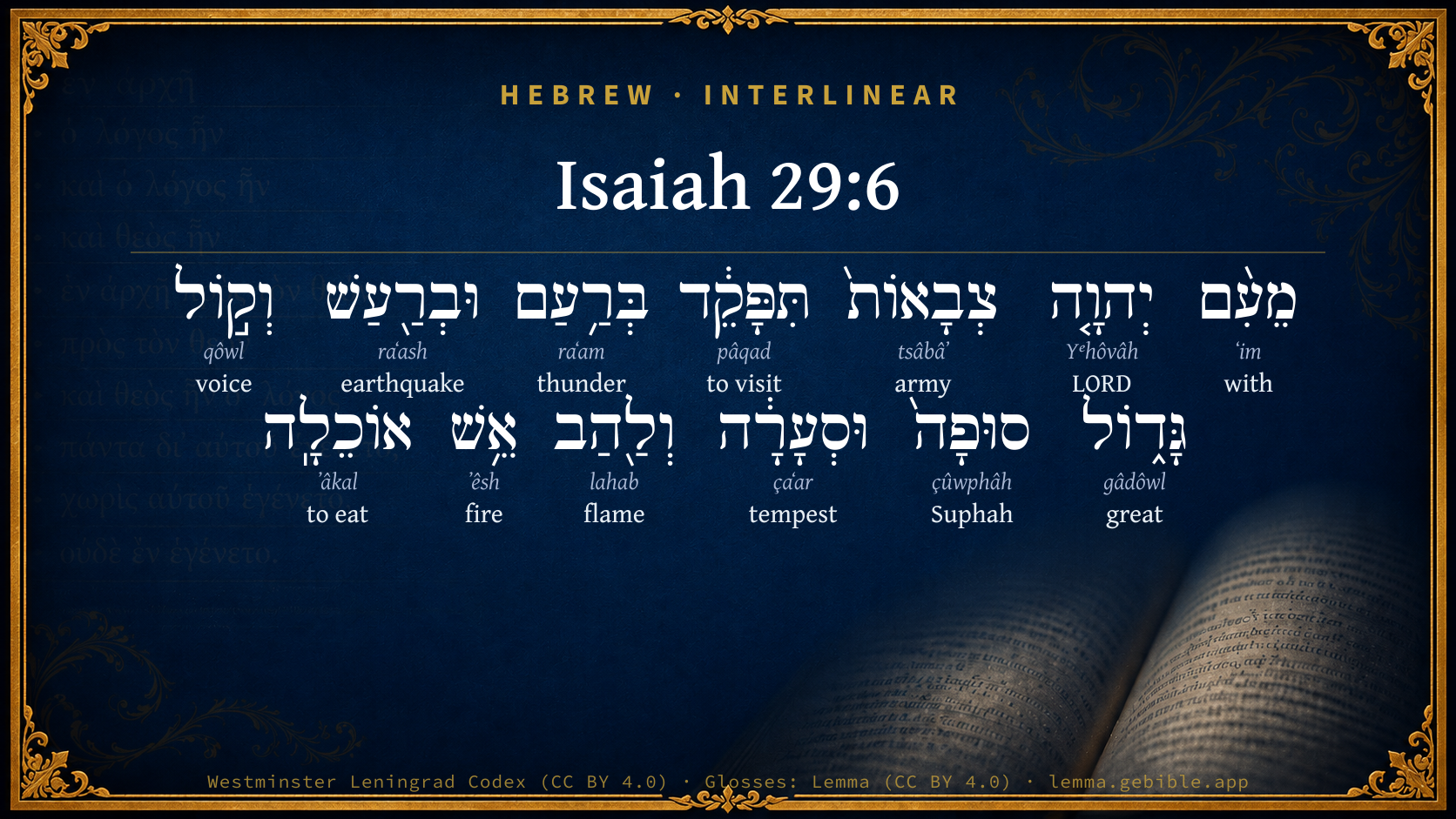
Hebrew (Westminster Leningrad Codex) Isaiah 29:6 appears in the Hebrew Old Testament. The text above is from the Westminster Leningrad Codex. Each word links to its Strong’s number, a concise gloss, and parsing drawn from the Open Scriptures Hebrew Bible morphology. Click any word for its full Brown-Driver-Briggs (BDB) entry.
Download image
Cite this verse

Isaiah 29:6 (World English Bible). Public Domain. Lemma interlinear Bible study tool, https://lemma.gebible.app/v/isaiah/29/6.

Show BibTeX & RIS
BibTeX
RIS
English Translation
She shall be visited of Yahweh of Hosts with thunder, and with earthquake, and great noise, with whirlwind and tempest, and the flame of a devouring fire.
World English Bible · Public Domain
Download a study sheet

One document with this verse’s original text, its word-by-word gloss line, the meaning frame, cross-references with their text, attributed commentary, and full source and license credits — printable, and it pastes into notes with its structure intact.

This verse Autodidact and up

Study sheet (.html) Plain text (.txt)

A passage Seminary Student

Up to 50 verses in one chapter. A passage sheet keeps up to 6 commentary sources and 12 cross-references per verse, in the order this page ranks them, and says so on the sheet whenever that leaves anything out. Ask for a single verse and you get the Autodidact verse sheet above.

Everything on this page stays free to read, with no account — the sheet is a download of what is already on screen, not access to it.

Want to remove ads? Support Godless Engineer
Compare translations 3

The same verse in 3 English versions, stacked beneath the original-language interlinear above. Click any original word for its lexicon entry.

Each is an independent rendering of the whole verse — the interlinear is not word-aligned to these translations.

Highlighted words mark where these versions differ — a whole-verse word diff, not a word-by-word alignment.

  • World English Bible Public Domain
    She shall be visited of Yahweh of Hosts with thunder, and with earthquake, and great noise, with whirlwind and tempest, and the flame of a devouring fire.
  • King James Version Public Domain
    Thou shalt be visited of the LORD of hosts with thunder, and with earthquake, and great noise, with storm and tempest, and the flame of devouring fire.
  • unfoldingWord Literal Text CC BY-SA 4.0
    From Yahweh of Armies it will be visited with thunder and with earthquake and a great noise, storm and tempest and the flame of a devouring fire.

unfoldingWord Literal Text — © unfoldingWord, licensed CC BY-SA 4.0. Word-aligned USFM3 via Door43 (git.door43.org/unfoldingWord/en_ult).

Versions to compare (up to 4)

3 of 4 selected

Show all 18 translations

Every available English version of this verse, each an independent rendering of the whole verse.

  • World English Bible Public Domain
    She shall be visited of Yahweh of Hosts with thunder, and with earthquake, and great noise, with whirlwind and tempest, and the flame of a devouring fire.
  • Berean Standard Bible Public Domain
    you will be visited by the LORD of Hosts with thunder and earthquake and loud noise, with windstorm and tempest and consuming flame of fire.
  • Majority Standard Bible Public Domain
    you will be visited by the LORD of Hosts with thunder and earthquake and loud noise, with windstorm and tempest and consuming flame of fire.
  • King James Version Public Domain
    Thou shalt be visited of the LORD of hosts with thunder, and with earthquake, and great noise, with storm and tempest, and the flame of devouring fire.
  • American Standard Version (1901) Public Domain
    She shall be visited of Jehovah of hosts with thunder, and with earthquake, and great noise, with whirlwind and tempest, and the flame of a devouring fire.
  • Revised Version (1885) Public Domain
    She shall be visited of the LORD of hosts with thunder, and with earthquake, and great noise, with whirlwind and tempest, and the flame of a devouring fire.
  • Geneva Bible (1599) Public Domain
    Thou shalt be visited of the Lord of hostes with thunder, and shaking, and a great noyse, a whirlewinde, and a tempest, and a flame of a deuouring fire.
  • Douay-Rheims (1899) Public Domain
    And it shall be at an instant suddenly. A visitation shall come from the Lord of hosts in thunder, and with earthquake, and with a great noise of whirlwind and tempest, and with the flame of devouring fire.
  • Young's Literal Translation Public Domain
    By Jehovah of Hosts thou art inspected, With thunder, and with an earthquake, And great noise, hurricane, and whirlwind, And flame of devouring fire.
  • Literal Standard Version CC BY-SA 4.0
    You are inspected by YHWH of Hosts, || With thunder, and with an earthquake, || And great noise, windstorm, and whirlwind, || And flame of devouring fire.
  • Unlocked Literal Bible CC BY-SA 4.0
    Yahweh of hosts will come to you with thunder, earthquake, great noise, with strong winds and violent storm, and the flames of a devouring fire.
  • unfoldingWord Literal Text CC BY-SA 4.0
    From Yahweh of Armies it will be visited with thunder and with earthquake and a great noise, storm and tempest and the flame of a devouring fire.
  • Darby Bible Public Domain
    Thou shalt be visited by Jehovah of hosts with thunder and with earthquake and great noise, with whirlwind and tempest, and the flame of devouring fire.
  • World Messianic Bible Public Domain
    She will be visited by the LORD of Hosts with thunder, with earthquake, with great noise, with whirlwind and storm, and with the flame of a devouring fire.
  • Webster's Bible Public Domain
    Thou shalt be visited by the LORD of hosts with thunder, and with earthquake, and great noise, with storm and tempest, and the flame of devouring fire.
  • Free Bible Version CC BY-SA 4.0
    the Lord Almighty will arrive with thunder, earthquake, and tremendous noise, with whirlwind, storm, and flames of fire that burn everything up.
  • Bible in Basic English Public Domain
    The Lord of armies will come in with thunder and earth-shaking and great noise, with rushing wind and storm, and the flame of burning fire.
  • JPS Tanakh (1917) Public Domain
    There shall be a visitation from the LORD of hosts with thunder, and with earthquake, and great noise, with whirlwind and tempest, and the flame of a devouring fire.

Literal Standard Version (2020), Covenant Press — licensed CC BY-SA 4.0. Text via the HelloAO Bible API (eBible.org). Unlocked Literal Bible (unfoldingWord) — licensed CC BY-SA 4.0. Text via the HelloAO Bible API (eBible.org). unfoldingWord Literal Text — © unfoldingWord, licensed CC BY-SA 4.0. Word-aligned USFM3 via Door43 (git.door43.org/unfoldingWord/en_ult). Free Bible Version, Dr. Jonathan Gallagher — licensed CC BY-SA 4.0. Text via the HelloAO Bible API (eBible.org).

Word by word

More ways to search: Search by grammar → Find every occurrence → Compare this word →

Practice this passage: Drill this verse → Learn its vocabulary →

בְּרַ֥עַם
raʻam
H7482
“in/at · thunder”
Preposition + Noun, Common, Masculine, Singular, Absolute
Part of Speech
Preposition + Noun
Type
Common
Gender
Masculine
Number
Singular
State
Absolute
Full BDB Definition

Origin: from H7481

TWOT: 2189a

thunder
  1. מֵעִ֨ם ʻim H5973 “from · with” Preposition + Preposition
  2. יְהוָ֤ה Yᵉhôvâh H3068 “LORD” Noun, Proper
  3. צְבָאוֹת֙ tsâbâʼ H6635 “armies” Noun, Common, Both, Plural, Absolute
  4. תִּפָּקֵ֔ד pâqad H6485 “to visit” Verb, Niphal, Imperfect, 2nd Person, Masculine, Singular
  5. וּבְרַ֖עַשׁ raʻash H7494 “and · in/at · earthquake” Conjunction + Preposition + Noun, Common, Masculine, Singular, Absolute
  6. וְק֣וֹל qôwl H6963 “and · voice” Conjunction + Noun, Common, Masculine, Singular, Absolute
  7. גָּד֑וֹל gâdôwl H1419 “great” Adjective, Adjective, Masculine, Singular, Absolute
  8. סוּפָה֙ çûwphâh H5492 “Suphah” Noun, Common, Feminine, Singular, Absolute
  9. וּסְעָרָ֔ה çaʻar H5591 “and · tempest” Conjunction + Noun, Common, Feminine, Singular, Absolute
  10. וְלַ֖הַב lahab H3851 “and · flame of” Conjunction + Noun, Common, Masculine, Singular, Construct
  11. אֵ֥שׁ ʼêsh H784 “fire” Noun, Common, Both, Singular, Absolute
  12. אוֹכֵלָֽה ʼâkal H398 “eating” Verb, Qal, Participle Active, Feminine, Singular, Absolute

About this verse

These counts appear in no published source. They are computed here, from the morphology-tagged text and Lemma’s own curated glosses. What Lemma adds →

13
words
13
distinct lemmas
Prophets
section

Notable vocabulary

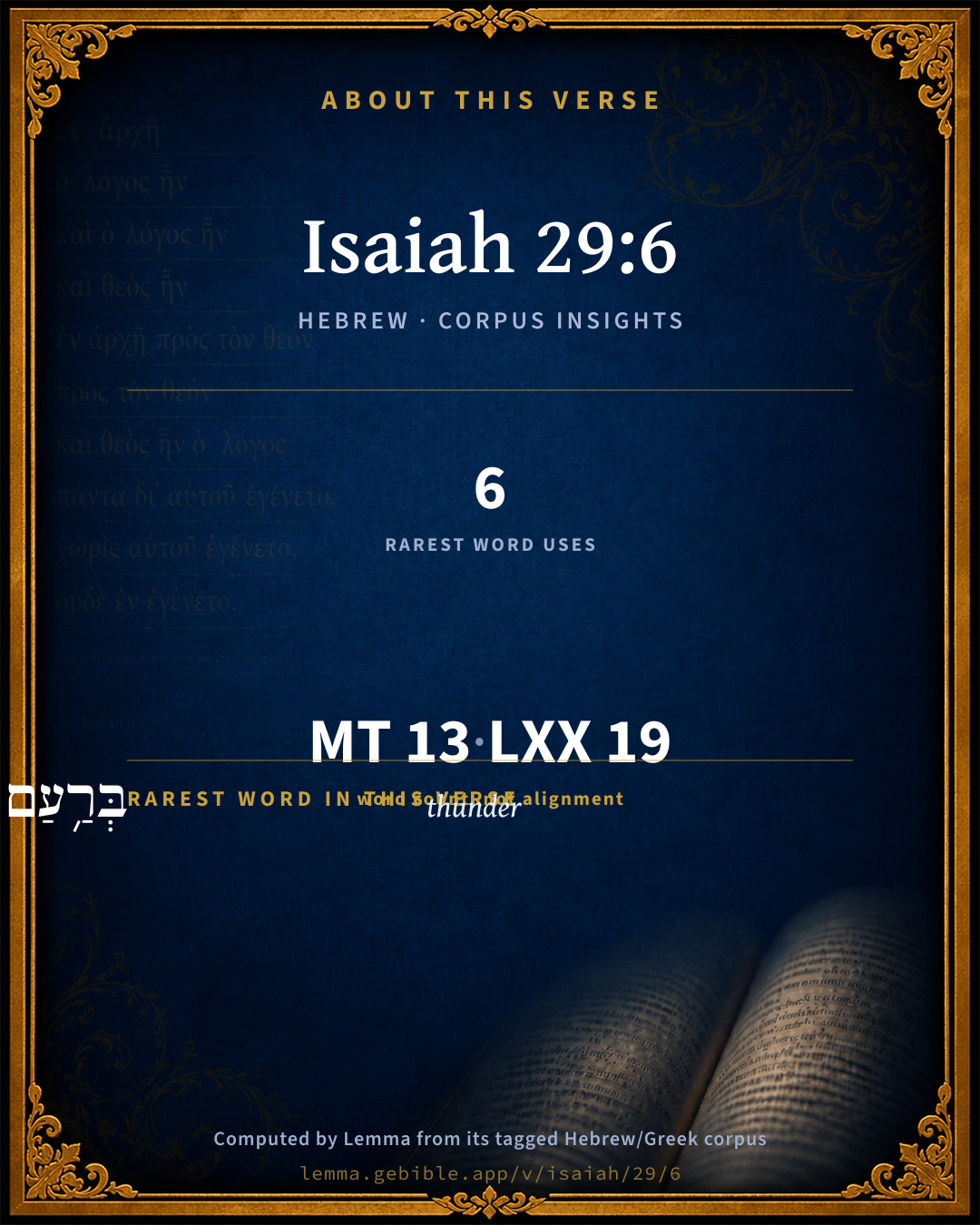
The rarest word here is בְּרַ֥עַם thunder H7482 — appearing just 6 times in the whole Hebrew Bible.

Shared distinctive vocabulary

בְּרַ֥עַם thunder H7482 occurs in 6 verses of the Hebrew Bible. Also found in:

Grammatical profile

  • 2 verbs
  • 9 nouns
  • 1 adjective
  • 1 preposition

Verb forms

  • תִּפָּקֵ֔ד Niphal · Imperfect
  • אוֹכֵלָֽה Qal · Participle Active

Hebrew & Septuagint length

In English translation the verse runs 27 words from the Hebrew and 27 from the Septuagint (LXX English) — the same length.

A rough comparison of the two English renderings, which tokenize alike — not a word-level alignment.

Word counts can differ between the Hebrew and the Greek without any difference in meaning — e.g. the Hebrew direct-object marker אֵת has no separate Greek word, and Greek often adds the article ὁ.

In the original languages it is 13 Hebrew tokens and 19 Greek tokens — but the two are counted differently (Hebrew bundles its prefixes and suffixes into one token; the Greek is in lemma form), so that isn’t a like-for-like length.

Cross-references

13

Topical passages linked to Isaiah 29:6 in the Treasury of Scripture Knowledge — connected by theme and wording, ordered by reader-vote popularity; previews shown in the World English Bible.

  • Mark 13:8 For nation will rise against nation, and kingdom against kingdom. There will be earthquakes in various places. There will be famines and troubles. These things are the beginning of birth pains.
  • 1 Samuel 2:10 Those who strive with Yahweh shall be broken to pieces; Against them will he thunder in the sky: Yahweh will judge the ends of the earth; He will give strength to his king, Exalt the horn of his anointed.
  • Matthew 24:7 For nation will rise against nation, and kingdom against kingdom; and there will be famines, plagues, and earthquakes in various places.
  • Revelation 11:19 God's temple that is in heaven was opened, and the ark of the Lord's covenant was seen in his temple. Lightnings, sounds, thunders, an earthquake, and great hail followed.
  • Revelation 16:18 There were lightnings, sounds, and thunders; and there was a great earthquake, such as was not since there were men on the earth, so great an earthquake, so mighty.
  • 1 Samuel 12:17–18 Isn't it wheat harvest today? I will call to Yahweh, that he may send thunder and rain; and you shall know and see that your wickedness is great, which you have done in the sight of Yahweh, in asking you a king.
  • 2 Samuel 22:14 Yahweh thundered from heaven, The Most High uttered his voice.
  • Isaiah 28:2 Behold, the Lord has a mighty and strong one; as a tempest of hail, a destroying storm, as a tempest of mighty waters overflowing, will he cast down to the earth with the hand.
  • Isaiah 30:30 Yahweh will cause his glorious voice to be heard, and will show the lighting down of his arm, with the indignation of [his] anger, and the flame of a devouring fire, with a blast, and tempest, and hailstones.
  • Luke 21:11 There will be great earthquakes, famines, and plagues in various places. There will be terrors and great signs from heaven.
  • Revelation 11:13 In that day there was a great earthquake, and a tenth of the city fell. Seven thousand people were killed in the earthquake, and the rest were terrified, and gave glory to the God of heaven.
  • Isaiah 5:26–30 He will lift up a banner to the nations from far, And he will whistle for them from the end of the earth. Behold, they will come speedily and swiftly.
  • Isaiah 33:11–14 You shall conceive chaff, you shall bring forth stubble: your breath is a fire that shall devour you.

Cross-references courtesy of OpenBible.info (CC BY 4.0).

Hebrew and Greek witnesses Masoretic Hebrew ↔ Greek Septuagint

The same verse in the two great witnesses to the Old Testament, shown verse-for-verse.

These are two independent witnesses, not word-aligned to each other, and the Septuagint is shown in lemma (dictionary) form.

Hebrew Isaiah 29:6 Masoretic · Westminster Leningrad Codex

מֵעִ֨ם יְהוָ֤ה צְבָאוֹת֙ תִּפָּקֵ֔ד בְּרַ֥עַם וּבְרַ֖עַשׁ וְק֣וֹל גָּד֑וֹל סוּפָה֙ וּסְעָרָ֔ה וְלַ֖הַב אֵ֥שׁ אוֹכֵלָֽה

She shall be visited of Yahweh of Hosts with thunder, and with earthquake, and great noise, with whirlwind and tempest, and the flame of a devouring fire.

World English Bible · Public Domain

Greek LXX Isaiah 29:6 Septuagint · lemma form

παρά κύριος σαβαωθ ἐπισκοπή γάρ εἰμί μετά βροντή καί σεισμός καί φωνή μέγας καταιγίς φέρω καί φλόξ πῦρ καταἐσθίω

from the Lord of Hosts: for there shall be a visitation with thunder, and earthquake, and a loud noise, a rushing tempest, and devouring flame of fire.

LXX2012 (modern English Septuagint) · Public Domain

Hebrew: Westminster Leningrad Codex (CC BY 4.0). Greek: Septuagint (public domain); English from LXX2012 (modern English Septuagint) (Public Domain). How the Septuagint differs from the Hebrew →

Targum (Aramaic paraphrase)

1

The Targum is the ancient Jewish Aramaic paraphrase of the Hebrew Scriptures — an interpretive translation, not the Hebrew text itself. Onkelos (literal) and Pseudo-Jonathan (expansive) render the Torah, and Jonathan the Prophets. Coverage is partial: where no permissively-licensed English translation exists for a verse, only the Aramaic is shown. This is verse-level text, not a word-by-word alignment to the Hebrew.

  1. Targum Jonathan Prophets (Joshua–Malachi)
    מִן קֳדָם יְיָ צְבָאוֹת תִּתְפַּקֵיד בְּרַעַם וּבְזִיעַ וְקַל סַגִי בְּעַלְעוֹל וּבְרוּחַ וְשַׁלְהוֹבֵי אֶשָׁא דִמְשֵׁיצַיָא:

    Thou shalt be visited with thunder from the Lord of hosts, and with earthquake, and with a great noise; with storm, and tempest, and a flame of devouring fire.

    Targum Jonathan — Aramaic: “Mikraot Gedolot” (public domain). English: “Sefaria Community Translation” (CC0 1.0 (public-domain dedication)); “London "Chaldee Paraphrase," 1871” (public domain). Text via Sefaria.

Commentary

Notes on Isaiah 29:6 from classic Christian and Jewish commentators (each source and its license shown beneath its notes). The classic Christian expositions comment on the surrounding passage and are grouped to its opening verse, so a note may address several verses; the Jewish commentaries on the Tanakh (Rashi and others) are per-verse, so they appear only where the commentator wrote on this verse.

Lemma curates 59 commentaries, every one of them public domain or Creative Commons licensed, each selected and text-cleaned for this edition rather than reprinted as found. About our sources →

Trapp's Complete Commentary

John Trapp

Isa 29:6 Thou shalt be visited of the LORD of hosts with thunder, and with earthquake, and great noise, with storm and tempest, and the flame of devouring fire.

Ver. 6. Thou shalt be visited with thunder and earthquake,] i.e., Fragosis, repentinis, vehementibus, et immedicabilibus plagis, with rattling, sudden, violent, and unmedicinable miseries and mischiefs, as if heaven and earth had conspired thine utter undoing. Some apply this to the prodigies that went before the last devastation of Jerusalem whereof see Joseph., lib. vii. cap. 12.

John Trapp, A Commentary or Exposition upon All the Books of the Old and New Testament (1647–1656) — public domain. Text from a community e-Sword module.

Tyndale Open Study Notes

Tyndale Open Resources

29:6 will act for you (literally you will be visited): God would bring rescue for his people. • thunder and earthquake . . . storm and consuming fire: These phenomena indicate a theophany (see study note on 5:25).

Tyndale Open Study Notes — © Tyndale Open Resources, licensed CC BY-SA 4.0. Text via the HelloAO Bible API.

Jamieson, Fausset & Brown

Robert Jamieson, A. R. Fausset & David Brown

Thou--the Assyrian army.

thunder, &c.--not literally, in the case of the Assyrians (Isa 37:36); but figuratively for an awful judgment (Isa 30:30; Isa 28:17). The ulterior fulfilment, in the case of the Jews' foes in the last days, may be more literal (see as to "earthquake," Zac 14:4).

Jamieson, Fausset & Brown — Commentary Critical and Explanatory on the Whole Bible (1871) — public domain (CC PDM 1.0). Text via the HelloAO Bible API.

Ellicott's Commentary for English Readers

(6) Thou shalt be visited . . .—Better, She (i.e., Jerusalem). The words may be figurative, but they may also be literal. Some terrific storm, acting as an “angel of the Lord” (Isa_37:36; Psa_104:4), should burst at once upon Jerusalem and the hosts that were encamped against her, bringing to her safety, but to them destruction. As in the next verse, the “multitude of all nations” of the great host of Assyria should be as “a dream, a vision of the night.”

A Bible Commentary for English Readers, edited by Charles John Ellicott (1878–1897) — public domain. Text from a community e-Sword module.

The Cambridge Bible for Schools and Colleges

gen. ed. J. J. S. Perowne

6. See ch. Isa_30:27-33. The last words of Isa_29:5 should be read as part of this sentence. And suddenly, full suddenly, she shall be visited, &c. The word for “visit” is ambiguous, being freely used both of punishment and mercy, but the passive appears never to be employed in a good sense except here.

The Cambridge Bible for Schools and Colleges (gen. ed. J. J. S. Perowne; Cambridge University Press, 1878–1918) — public domain. Text from a community e-Sword module.

John Gill's Exposition

Thou shalt be visited of the Lord of hosts with thunder, and with earthquake, and great noise,.... That is, not the multitude of strangers and terrible ones, unless they could be understood of the wicked among the Jews; but thou Ariel, or Jerusalem, shalt be punished by the Lord of hosts; for this visitation or punishment was from him, for their sins and iniquities; the Romans were only the instruments he made use of, and the executioners of his vengeance; which was attended with thunder in the heavens, a shaking of the earth, and a great noise or voice heard in the temple, saying, let us depart hence; at which time comets were seen in the heavens, and chariots and armed men in the air, and one of the gates of the temple opened of itself (r): it is added,

with storm and tempest, and the flame of devouring fire; with which the temple was burnt by the Roman army, when it came in like a storm and tempest, and carried all before it.

(r) Joseph. de Bello Jud. l. 6. c. 5. sect. 5.

John Gill's Exposition of the Whole Bible (1746–1763) — public domain (CC PDM 1.0). Text via the HelloAO Bible API.

Albert Barnes' Notes on the Bible

Thou shalt be visited - This is an address to the mighty army of the Assyrian. Such transitions are not uncommon in the writings of Isaiah. His eye seems to have been directed in vision to the hosts of Sennacherib, and to their sudden dispersion and destruction Isa 29:5, and by a sudden, but not unnatural transition, he turns and addresses the army itself, with the assurance that it should be punished (compare Isa 30:30).

With thunder ... - The army of the Assyrian was cut off by an angel sent forth from God Isa 37:36. It is “possible” that all the agents here referred to may have been employed in the destruction of the Assyrian host, though they are not particularly specified in the history. But it is not absolutely. necessary to understand this verse in this manner. The image of thunder, earthquakes, and lightning, is an impressive representation of sudden and awful judgment in any manner. The sense is, that they should be suddenly destroyed by the direct visitation of God (see Isa 9:5; Isa 26:11).

And the flame of devouring fire - Lightning, that seems to “devour,” or that suddenly consumes.

Albert Barnes' Notes on the Bible (1834–1885) — public domain. Text from a community e-Sword/MySword module.

Haydock's Catholic Bible Commentary

Thunder. Psalm lxxv. 7. Tharaca was coming to assist Ezechias, chap. xxxvii. 36. (Calmet)

George Leo Haydock (1774–1849), Haydock's Catholic Family Bible and Commentary, 1859 edition — public domain. Excludes Psalms (Douay-Rheims chapter numbering differs from Protestant) and Deuterocanonical books (Catholic canon only).

Matthew Poole's English Annotations

Thou, O Ariel or Jerusalem, of or to whom this whole context manifestly speaks, shalt be visited with dreadful judgments, which are frequently expressed in the prophets by these and such-like metaphors.

Matthew Poole's English Annotations on the Holy Bible (1683–1685) — public domain. Text from a community e-Sword/MySword module.

The Pulpit Commentary

Thou shalt be visited; literally, shall there be a visitation. On whom the visitation will fall is not expressed; but the context shows that it is on the enemies of Judah. The terrible nature of the visitation is signified by an enumeration of the most fearful of God"s judgments earthquake, great noise, whirlwind, tern-pest, and a flame of devouring fire." All the expressions are probably metaphorical.

The Pulpit Commentary (1880–1919), ed. H.D.M. Spence-Jones & Joseph S. Exell — public domain. Text from a community e-Sword module.

John Wesley's Explanatory Notes

Thou - Thou, O Jerusalem. Fire - With dreadful judgments, which are frequently expressed by these metaphors.

John Wesley, Explanatory Notes Upon the Whole Bible (1754–1765) — public domain. Text via the GEBible commentary corpus.

J. A. Alexander on Isaiah

Joseph Addison Alexander

“From with (i.e., from the presence of) Jehovah of hosts shall it be visited with thunder and earthquake and great noise, tempest and storm and flame of devouring fire.” Some refer this to the singular phenomena which are said to have preceded and accompanied the taking of Jerusalem by Titus. This application may be admitted, in the same sense and on the same ground with the allusion to Sennacherib’s host in the foregoing verse. But that the prophecy is not a prophecy of either catastrophe, may be inferred from the fact that neither is described in the context. Indeed, the direct application of this verse to the fall of Jerusalem is wholly inadmissible, since the preceding verse describes the assailants as dispersed, and this appears to continue the description.

Joseph Addison Alexander, The Prophecies of Isaiah (1846–1847; New York: Scribner, 1870–1878) — public domain. Text from a community e-Sword module.

Rashi

Rabbi Shlomo Yitzchaki (Rashi)

From the Lord of Hosts shall he be visited And after you become humble and your speech chirps, Ariel shall be visited by Me to save them, with thunder and with earthquake, etc.

Rashi on the Tanakh — English translations: “The Judaica Press complete Tanach with Rashi, translated by A. J. Rosenberg” (CC BY 4.0); “Pentateuch with Rashi's commentary by M. Rosenbaum and A.M. Silbermann, 1929-1934” (public domain); “The Metsudah Tanach series, Lakewood, N.J” (CC BY 4.0); and “The Book of Joshua, Metsudah Publications, 1997” (CC BY 4.0). Text via Sefaria.

Ibn Ezra

Rabbi Abraham ibn Ezra

By the Lord, etc. From the Lord will this visitation come against the besiegers.

With thunder from above.

With earthquake below.

With great noise, with storm and tempest, and flame of fire. All this refers to the angel that was sent to destroy the Assyrian army.

Ibn Ezra on the Tanakh — English translations: “Sefaria Community Translation” (CC0 1.0 (public-domain dedication)); “Yalkut, Sifsei Chachomim Chumash, Metsudah Publications, 2009” (CC BY 4.0); and “Commentary of Ibn Ezra on Isaiah - trans. by M. Friedlander, 1873” (public domain). Text via Sefaria.

Lesson kit

Teaching starters — assembled from the data on this page, not authored interpretation. Every prompt links to the verse data it draws on. Edit before teaching.

Isaiah, in the Prophets, opens this verse with 13 words (13 distinct Hebrew lemmas). Its most distinctive word is raʻam (“thunder”). A historical commentator’s framing appears above. Read the whole chapter for the surrounding context.

Discussion questions

  1. What does “thunder” (raʻam) contribute to the verse as a whole?
  2. Job 26:14 shares the word «thunder» with this verse. How do the two illuminate each other?
  3. These translations render this verse differently; the difference is in the English rendering, not the original. What questions does that raise?
  4. The verb «תִּפָּקֵ֔ד» is Niphal Imperfect. How does its form color the action?
  5. Reading how Trapp's Complete Commentary and Tyndale Open Study Notes read this verse, where do the two commentators agree and where do they part?

Things to notice

Reading settings

Reading text

Shown beneath each verse's original-language words.

Old Testament
Old Testament edition

Read the OT as the Masoretic Hebrew (MT) or the Greek Septuagint (LXX).

English shown for the Greek Septuagint (in the Hebrew ↔ Greek comparison).

Comparing translations? Open the Compare panel on any verse page to stack up to four side by side.