
Psalms 69:5

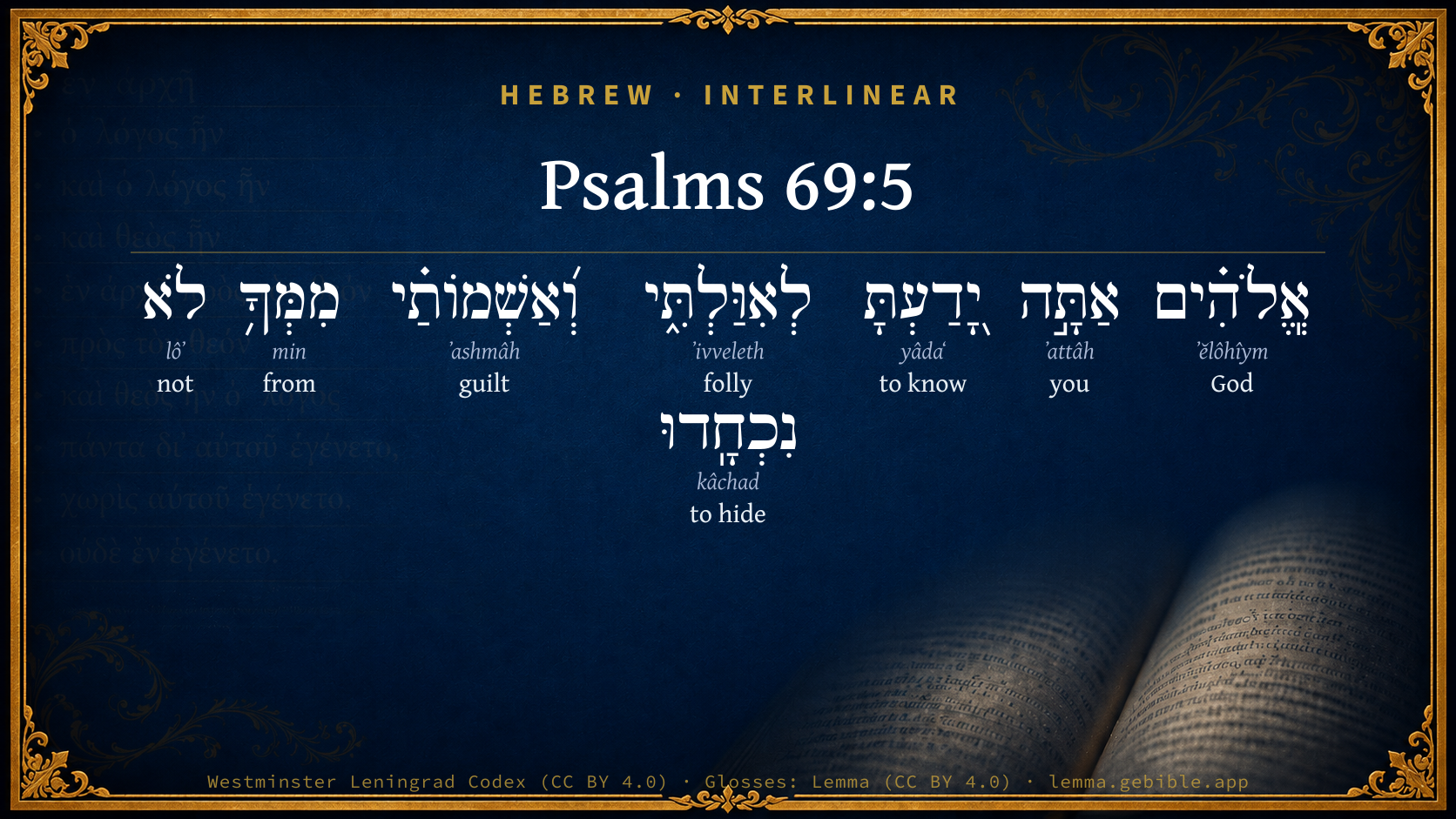
Hebrew (Westminster Leningrad Codex) Psalms 69:5 appears in the Hebrew Old Testament. The text above is from the Westminster Leningrad Codex. Each word links to its Strong’s number, a concise gloss, and parsing drawn from the Open Scriptures Hebrew Bible morphology. Click any word for its full Brown-Driver-Briggs (BDB) entry.
Download image
Cite this verse

Psalms 69:5 (World English Bible). Public Domain. Lemma interlinear Bible study tool, https://lemma.gebible.app/v/psalms/69/5.

Show BibTeX & RIS
BibTeX
RIS
English Translation
God, you know my foolishness. My sins aren't hidden from you.
World English Bible · Public Domain
Download a study sheet

One document with this verse’s original text, its word-by-word gloss line, the meaning frame, cross-references with their text, attributed commentary, and full source and license credits — printable, and it pastes into notes with its structure intact.

This verse Autodidact and up

Study sheet (.html) Plain text (.txt)

A passage Seminary Student

Up to 50 verses in one chapter. A passage sheet keeps up to 6 commentary sources and 12 cross-references per verse, in the order this page ranks them, and says so on the sheet whenever that leaves anything out. Ask for a single verse and you get the Autodidact verse sheet above.

Everything on this page stays free to read, with no account — the sheet is a download of what is already on screen, not access to it.

Want to remove ads? Support Godless Engineer
Compare translations 3

The same verse in 3 English versions, stacked beneath the original-language interlinear above. Click any original word for its lexicon entry.

Each is an independent rendering of the whole verse — the interlinear is not word-aligned to these translations.

Highlighted words mark where these versions differ — a whole-verse word diff, not a word-by-word alignment.

  • World English Bible Public Domain
    God, you know my foolishness. My sins aren't hidden from you.
  • King James Version Public Domain
    O God, thou knowest my foolishness; and my sins are not hid from thee.
  • unfoldingWord Literal Text CC BY-SA 4.0
    God, you, you know my foolishness, and my sins are not hidden from you.

unfoldingWord Literal Text — © unfoldingWord, licensed CC BY-SA 4.0. Word-aligned USFM3 via Door43 (git.door43.org/unfoldingWord/en_ult).

Versions to compare (up to 4)

3 of 4 selected

Show all 18 translations

Every available English version of this verse, each an independent rendering of the whole verse.

  • World English Bible Public Domain
    God, you know my foolishness. My sins aren't hidden from you.
  • Berean Standard Bible Public Domain
    You know my folly, O God, and my guilt is not hidden from You.
  • Majority Standard Bible Public Domain
    You know my folly, O God, and my guilt is not hidden from You.
  • King James Version Public Domain
    O God, thou knowest my foolishness; and my sins are not hid from thee.
  • American Standard Version (1901) Public Domain
    O God, thou knowest my foolishness; And my sins are not hid from thee.
  • Revised Version (1885) Public Domain
    O God, thou knowest my foolishness; and my sins are not hid from thee.
  • Geneva Bible (1599) Public Domain
    O God, thou knowest my foolishnesse, and my fautes are not hid from thee.
  • Douay-Rheims (1899) Public Domain
    They are multiplied above the hairs of my head, who hate me without cause. My enemies are grown strong who have wrongfully persecuted me: then did I pay that which I took not away.
  • Young's Literal Translation Public Domain
    O God, Thou -- Thou hast known Concerning my overturn, And my desolations from Thee have not been hid.
  • Literal Standard Version CC BY-SA 4.0
    O God, You have known || Concerning my overturn, || And my desolations have not been hid from You.
  • Unlocked Literal Bible CC BY-SA 4.0
    God, you know my foolishness, and my sins are not hidden from you.
  • unfoldingWord Literal Text CC BY-SA 4.0
    God, you, you know my foolishness, and my sins are not hidden from you.
  • Darby Bible Public Domain
    Thou, O God, knowest my foolishness, and my trespasses are not hidden from thee.
  • World Messianic Bible Public Domain
    God, you know my foolishness. My sins aren’t hidden from you.
  • Webster's Bible Public Domain
    \\69:4\\They that hate me without a cause are more than the hairs of my head: they that would destroy me, being my enemies wrongfully, are mighty: then I restored that which I took not away.
  • Free Bible Version CC BY-SA 4.0
    God, you know how foolish I am! My sins are not hidden from you.
  • Bible in Basic English Public Domain
    O God, you see how foolish I am; and my wrongdoing is clear to you.
  • JPS Tanakh (1917) Public Domain
    (69-6) O God, Thou knowest my folly; and my trespasses are not hid from Thee.

Literal Standard Version (2020), Covenant Press — licensed CC BY-SA 4.0. Text via the HelloAO Bible API (eBible.org). Unlocked Literal Bible (unfoldingWord) — licensed CC BY-SA 4.0. Text via the HelloAO Bible API (eBible.org). unfoldingWord Literal Text — © unfoldingWord, licensed CC BY-SA 4.0. Word-aligned USFM3 via Door43 (git.door43.org/unfoldingWord/en_ult). Free Bible Version, Dr. Jonathan Gallagher — licensed CC BY-SA 4.0. Text via the HelloAO Bible API (eBible.org).

Word by word

More ways to search: Search by grammar → Find every occurrence → Compare this word →

Practice this passage: Drill this verse → Learn its vocabulary →

וְ֝אַשְׁמוֹתַ֗י
ʼashmâh
H819
“and · guilty acts · my”
Conjunction + Noun, Common, Feminine, Plural, Construct + Suffix, Personal, 1st Person, Common, Singular
Part of Speech
Conjunction + Noun
Type
Common
Gender
Feminine
Number
Plural
State
Construct
Full BDB Definition

Origin: from H817

TWOT: 180c

guiltiness, guilt, offense, sin, wrong-doing - doing wrong, committing a trespass or offense - becoming guilty, guilt - bringing a guilt-offering
  1. אֱֽלֹהִ֗ים ʼĕlôhîym H430 “God(s)” Noun, Common, Masculine, Plural, Absolute
  2. אַתָּ֣ה ʼattâh H859 “you” Pronoun, Personal, 2nd Person, Masculine, Singular
  3. יָ֭דַעְתָּ yâdaʻ H3045 “to know” Verb, Qal, Perfect, 2nd Person, Masculine, Singular
  4. לְאִוַּלְתִּ֑י ʼivveleth H200 “to/for · folly · my” Preposition + Noun, Common, Feminine, Singular, Construct + Suffix, Personal, 1st Person, Common, Singular
  5. מִמְּךָ֥ min H4480 “from · you” Preposition + Suffix, Personal, 2nd Person, Masculine, Singular
  6. לֹא lôʼ H3808 “not” Particle, Negative
  7. נִכְחָֽדוּ kâchad H3582 “to hide” Verb, Niphal, Perfect, 3rd Person, Common, Plural

About this verse

These counts appear in no published source. They are computed here, from the morphology-tagged text and Lemma’s own curated glosses. What Lemma adds →

8
words
8
distinct lemmas
Wisdom
section

Notable vocabulary

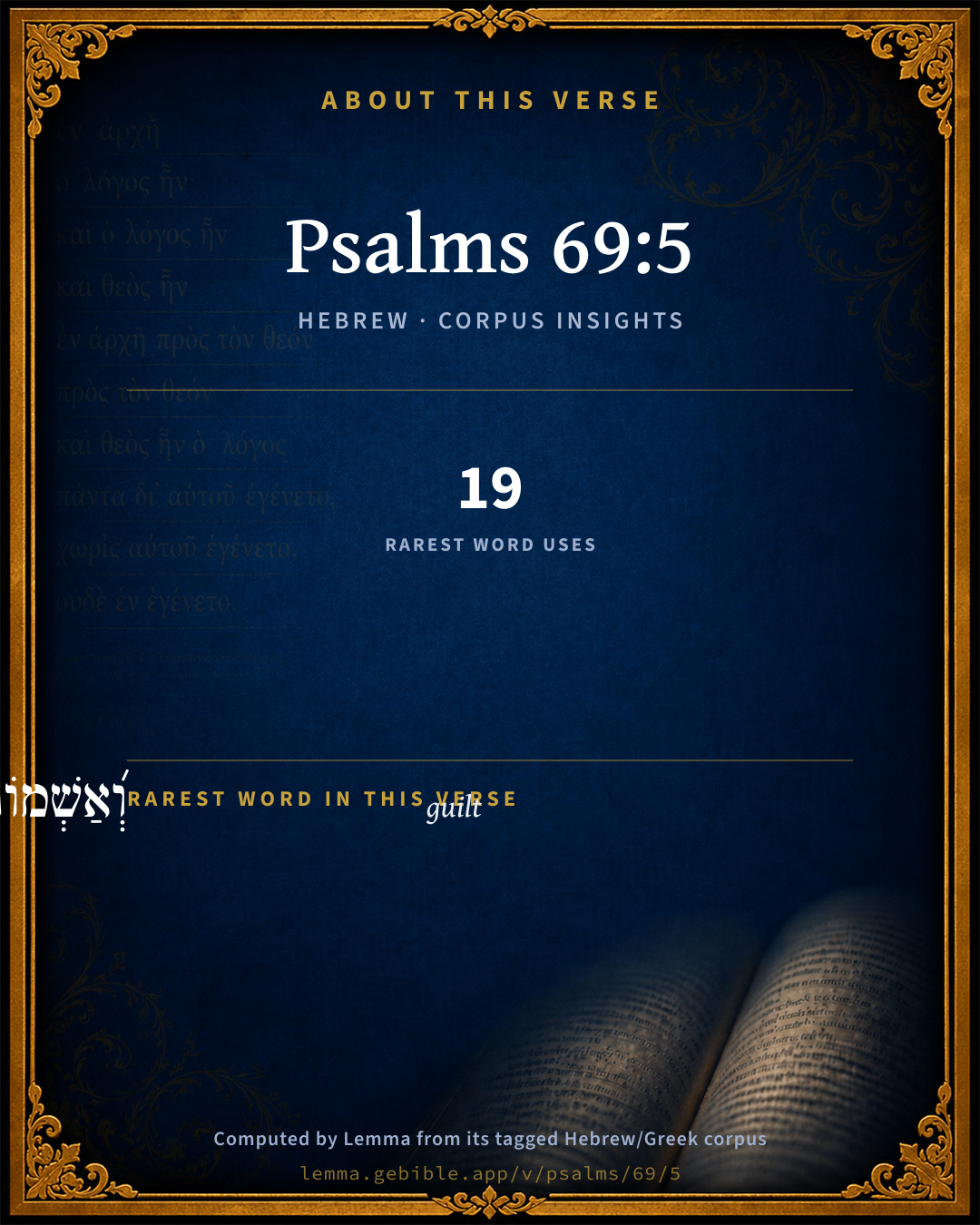
The rarest word here is וְ֝אַשְׁמוֹתַ֗י guilt H819 — appearing just 19 times in the whole Hebrew Bible.

Shared distinctive vocabulary

וְ֝אַשְׁמוֹתַ֗י guilt H819 occurs in 17 verses of the Hebrew Bible. Also found in:

Grammatical profile

  • 2 verbs
  • 3 nouns
  • 1 pronoun
  • 1 preposition
  • 1 particle

Verb forms

  • יָ֭דַעְתָּ Qal · Perfect
  • נִכְחָֽדוּ Niphal · Perfect

Hebrew & Septuagint length

In English translation the verse runs 11 words from the Hebrew and 14 from the Septuagint (LXX English) — closely comparable.

A rough comparison of the two English renderings, which tokenize alike — not a word-level alignment.

Word counts can differ between the Hebrew and the Greek without any difference in meaning — e.g. the Hebrew direct-object marker אֵת has no separate Greek word, and Greek often adds the article ὁ.

Cross-references

6

Topical passages linked to Psalms 69:5 in the Treasury of Scripture Knowledge — connected by theme and wording, ordered by reader-vote popularity; previews shown in the World English Bible.

  • Psalms 38:9 Lord, all my desire is before you. My groaning is not hidden from you.
  • Jeremiah 16:17 For my eyes are on all their ways; they are not hidden from my face, neither is their iniquity concealed from my eyes.
  • Psalms 17:3 You have proved my heart; you have visited me in the night; You have tried me, and found nothing; I have resolved that my mouth shall not disobey.
  • Psalms 19:12 Who can discern his errors? Forgive me from hidden errors.
  • Psalms 38:5 My wounds are loathsome and corrupt, Because of my foolishness.
  • Psalms 44:20–21 If we have forgotten the name of our God, Or spread forth our hands to a strange god;

Cross-references courtesy of OpenBible.info (CC BY 4.0).

Hebrew and Greek witnesses Masoretic Hebrew ↔ Greek Septuagint

The same verse in the two great witnesses to the Old Testament, shown verse-for-verse.

You’re reading Greek Psalm 68 (Hebrew Psalm 69). The Septuagint counts the superscription, so verse numbers can differ from the Hebrew — chapter-level alignment, not verse-by-verse. Numbering follows Rahlfs.

These are two independent witnesses, not word-aligned to each other, and the Septuagint is shown in lemma (dictionary) form.

Hebrew Psalms 69:5 Masoretic · Westminster Leningrad Codex

אֱֽלֹהִ֗ים אַתָּ֣ה יָ֭דַעְתָּ לְאִוַּלְתִּ֑י וְ֝אַשְׁמוֹתַ֗י מִמְּךָ֥ לֹא נִכְחָֽדוּ

God, you know my foolishness. My sins aren't hidden from you.

World English Bible · Public Domain

Greek LXX Greek Psalm 68:5 Septuagint · lemma form

πληθύνω ὑπέρ ὁ θρίξ ὁ κεφαλή ἐγώ ὁ μισέω ἐγώ δωρεά κραταιόω ὁ ἐχθρός ἐγώ ὁ ἐκδιώκω ἐγώ ἀδίκως ὅς οὐ ἁρπάζω τότε ἀποτιννύω

O God, you know my foolishness; and my transgressions are not hidden from you.

LXX2012 (modern English Septuagint) · Public Domain

Hebrew: Westminster Leningrad Codex (CC BY 4.0). Greek: Septuagint (public domain); English from LXX2012 (modern English Septuagint) (Public Domain). How the Septuagint differs from the Hebrew →

Commentary

Notes on Psalms 69:5 from classic Christian and Jewish commentators (each source and its license shown beneath its notes). The classic Christian expositions comment on the surrounding passage and are grouped to its opening verse, so a note may address several verses; the Jewish commentaries on the Tanakh (Rashi and others) are per-verse, so they appear only where the commentator wrote on this verse.

Lemma curates 59 commentaries, every one of them public domain or Creative Commons licensed, each selected and text-cleaned for this edition rather than reprinted as found. About our sources →

Trapp's Complete Commentary

John Trapp

Psa 69:5 O God, thou knowest my foolishness; and my sins are not hid from thee.

Ver. 5. O God, thou knowest my foolishness] Secundum dici, non secundum esse; ironica enim est locutio. Thou knowest mine innocence, and how free I am of that folly, and those foul faults, wherewith they falsely charge me.

John Trapp, A Commentary or Exposition upon All the Books of the Old and New Testament (1647–1656) — public domain. Text from a community e-Sword module.

The Biblical Illustrator

Joseph S. Exell

Psa_69:5

O God, Thou knowest my foolishness; and my sins are not hid from Thee.

Gods knowledge of sin

I. God must have knowledge of mans sin. Because--

1. He is infinite in knowledge.

2. He is everywhere present.

3. He is everywhere perceiving.

4. He is ever reading the heart.

5. He knows what is yet to be.

You are all books, and every page is open to the eye of the great Reader, who reads you from the first letter to the last. There is nothing which any man here can possibly conceal from God. It is so, it must be so; if God be God, He knows my foolishness, and my sins are not hid from Him.

II. Now, let us just turn the current of our thought while I ask, concerning Gods knowledge of mans sin, after what fashion is it? If God knows, in what particular way does He know?

1. It is complete knowledge; the Lord knows us altogether. I must confess that I cower down beneath that thought. That the Lord should know my public service is sufficiently awe-striking; but that He should know my private thoughts, ah! this sinks me into the very dust!

2. It is the knowledge of a holy being.

3. It is an abiding knowledge.

4. It is an eternal knowledge.

III. What then?

1. How frivolous must those be who never think about it t

2. What care this ought to work in us!

3. What holy trembling this ought to put in us! (C. H. Spurgeon.)

The Biblical Illustrator, edited by Joseph S. Exell (c. 1880s–1900s) — public domain. Text from a community e-Sword module.

Joseph Benson's Commentary

Psa 69:5. O God, thou knowest my foolishness — Hebrew, אולתי, ivalti, rendered in the Liturgy version, my simpleness. As if he had said, Thou knowest the simplicity and uprightness of my heart, that I have never intentionally injured those that thus cruelly hate and persecute me, but have always designed and endeavoured to act right toward them. And my sins are not hid from thee — But, O Lord, although I have been innocent toward mine enemies, yet I must confess I am guilty of many sins and follies against thee, and have given thee just cause to punish me by giving me up into their hands, and by denying or delaying to help me.

Joseph Benson's Commentary on the Old and New Testaments (1811–1818) — public domain. Text from a community e-Sword module.

J. A. Alexander on Psalms

Joseph Addison Alexander

6. (Psa 69:5). O God, thou knowest of (or as to) my foolishness, and my trespasses from thee have not been hid. He does not deny his own demerit in the sight of God, but nevertheless prays to be delivered from destruction. See above, on Psa 6:1; Psa 38:3-5; Psa 40:12. As if he had said, "True, I am a sinner; it is vain to deny it; thou, God, knowest it; but nevertheless," etc.

Joseph Addison Alexander, The Psalms Translated and Explained (1850) — public domain. Text from a community e-Sword module.

Tyndale Open Study Notes

Tyndale Open Resources

69:5-6 The psalmist confesses his sins and prays that God’s response to him will encourage others in similar conditions to place their hope in the Lord.

Tyndale Open Study Notes — © Tyndale Open Resources, licensed CC BY-SA 4.0. Text via the HelloAO Bible API.

Geneva Bible (1599)

Geneva Bible translators

Though I be guilty to theeward, yet am I innocent toward them.

Geneva Bible (1599) marginal notes — public domain. Text via Bolls.life.

Jamieson, Fausset & Brown

Robert Jamieson, A. R. Fausset & David Brown

This may be regarded as an appeal, vindicating his innocence, as if he had said, "If sinful, thou knowest," &c. Though David's condition as a sufferer may typify Christ's, without requiring that a parallel be found in character.

Jamieson, Fausset & Brown — Commentary Critical and Explanatory on the Whole Bible (1871) — public domain (CC PDM 1.0). Text via the HelloAO Bible API.

Adam Clarke's Commentary

Verse 5. Thou knowest my foolishness] Though we have been brought into captivity in consequence of the crimes of our fathers, yet we have guilt enough of our own to merit a continuation of our miseries. How can such words as are in this verse be attributed to our blessed Lord, however they may be twisted or turned?

Adam Clarke's Commentary on the Bible (1810–1826) — public domain. Text from a community e-Sword/MySword module.

John Calvin's Commentaries

5. O God! thou knowest my foolishness Augustine has labored to little purpose to show in what way these words are applicable to Christ; and at length he transfers to his members that which could not properly be said of the Head. David here uses the language of irony; and by this mode of expressing himself he meant to intimate, that, overwhelmed with the unrighteous judgments of men, he betakes himself to God, and implores him to appear as the defender of his cause. This is much more emphatic than if he had affirmed plainly, and without figure, that his integrity was known to God. In this way he administers a sharp rebuke to his enemies, and as it were looks down with a noble contempt upon the calumnious speeches which they uttered against him; as Jeremiah does when he says,

“O Lord! thou hast deceived me, and I was deceived.” (Psalm 20:7)

Some ignorant people put a violent construction on these words of Jeremiah, as if they implied that he was actually deceived; whereas he is rather to be understood as deriding with bitter sarcasm his calumniators, who, in speaking evil of him, were chargeable with reproaching and blaspheming God himself. David in like manner, in the passage before us, as a means of preserving himself from succumbing under the perverse judgments of men, appeals to God as the judge of his cause; and possessing as he did the approving testimony of a good conscience, he regards in a great measure with indifference the unjust estimate which men might form of his character. It were indeed desirable that our integrity should also be acknowledged and approved of by men, and that not so much on our own account as for the edification of our brethren. But if, after we have done all in our power to make men form a favorable opinion respecting us, they misconstruct and pervert every good word which we utter, and every good action which we perform, we ought to maintain such greatness of mind as boldly to despise the world and all false accusers, resting contented with the judgment of God and with that alone; for those who are over anxious about maintaining their good name cannot but often experience fainting of heart. Let us be always ready to satisfy men; but if they refuse to listen to what we have to say in self-vindication, let us proceed in our course through evil report as well as good report, following the example of Paul where he fearlessly appeals to the judgment of God,

“who will bring to light the hidden things of dark,” (1 Corinthians 4:5)

John Calvin's Commentaries (1540-1563) — public domain. Text from the Calvin Translation Society English edition (1840s-50s) via the Christian Classics Ethereal Library (ccel.org). Calvin's coverage is partial (roughly two-thirds of the Bible); uncommented books and verses are honest gaps, never fabricated. The 19th-century editor's footnotes and remarks are omitted so the notes are faithfully Calvin's own voice.

Ellicott's Commentary for English Readers

(5) My foolishness.—This does not conflict with a true Messianic application of the Psalm, but is fatal to that which would see in the author not an imperfect type, but a prophetic mouthpiece of Christ.

A Bible Commentary for English Readers, edited by Charles John Ellicott (1878–1897) — public domain. Text from a community e-Sword module.

The Cambridge Bible for Schools and Colleges

gen. ed. J. J. S. Perowne

5, 6. Chastisement is not undeserved; but he commits himself to the mercy of the Omniscient, and pleads for a hearing on the ground that the cause of all God’s servants is bound up with his cause. If he is abandoned they must be discouraged and exposed to the contempt of the world.

Thou is emphatic. Similar appeals to God’s omniscience are characteristic of Jeremiah (ch. Jer_12:3; Jer_15:15; Jer_17:16; Psa_18:23). Sin is designated as ‘foolishness’ in Psa_38:5, where, as here, the Psalmist acknowledges that his sufferings are the chastisement of his sin. This is the only other passage in which the word occurs, except in the Book of Proverbs, where it is common.

sins] Lit. guiltinesses; cp. Psa_68:21.

The Cambridge Bible for Schools and Colleges (gen. ed. J. J. S. Perowne; Cambridge University Press, 1878–1918) — public domain. Text from a community e-Sword module.

John Gill's Exposition

O God, thou knowest my foolishness,.... Not that there was real foolishness in him, who, as man, from his infancy was filled with wisdom, and increased in it; and, as Mediator, had the spirit of wisdom on him, and the treasures of wisdom in him; and, as a divine Person, he is the Wisdom of God, and the only wise God; and, as in our nature, there was no foolishness in his heart, nor in his words, nor in his actions: but this is to be understood either of what was accounted so by others; he and his followers were reckoned foolish and illiterate men, and the Gospel preached by him and his apostles was foolishness to them that perished; or of what he was charged with by his enemies; even with immorality, heresy, blasphemy, and sedition; of all which he was innocent, and therefore could appeal to his divine Father, who knows all things, that he was clear of all such folly; for it may be rendered, "thou knowest as to my foolishness" (x), with respect to what he was charged with, that there was none in him; or else it regards the foolishness of his people imputed to him, the sin that folly of follies, together with all the foolishness in the heart, lip, and lives of his people, before and after conversion; these were all reckoned to him, and reckoned by him, as his own in some sense; and which is confirmed by what follows:

and my sins are not hid from thee; meaning not any committed by him; for then he could not have said what he does in Psa 69:4; but the sins of his people imputed to him, which be calls his own; see Gill on Psa 40:12, these must be known to his divine Father, since he is God omniscient, and since he laid them upon him, and he made satisfaction for them to him; and which he observes to enforce his petition, Psa 69:1; with this compare Isa 53:11.

(x) "tu nosti ut res se habeat quoad stultitiam meam", Gussetius, p. 312.

John Gill's Exposition of the Whole Bible (1746–1763) — public domain (CC PDM 1.0). Text via the HelloAO Bible API.

Albert Barnes' Notes on the Bible

O God, thou knowest my foolishness - The errors and follies of my life. Though conscious of innocence in this case - though he felt that his enemies hated him “without cause,” and that they took what belonged to him and not to them, yet he was not insensible to the fact that he was a sinner, and he was not unwilling to confess before God, that, however conscious of uprightness he might be in his dealings toward people, yet toward God, he was a sinful man. From him he deserved all that had come upon him. Indeed the very calamities which had been permitted to come upon him were proof to his own mind that he was a sinner, and served, as they were doubtless designed, to turn his mind to that fact, and to humble him. The effect of calamities coming upon us, as reminding us of the fact that we are sinners, is often referred to in the Psalms. See Psa 38:2-4; Psa 40:12.

And my sins are not hid from thee - Margin, “guiltiness.” The word used here has always attached to it the idea of “guilt.” The meaning is, that God knew all his life; and that however unjust the conduct of “men” toward him might be when they treated him as if he had wronged them, yet considered as a part of the dealings of God, or as having been suffered to come upon him from God, all that had occurred was right, for it was a proper expression of the divine displeasure against his sins. We may feel that we have not wronged our fellow-men; yet even the treatment which we receive from them, however unjust so far as they are concerned, may be regarded as deserved by us at the hand of God, and as proper on his part as an expression of his displeasure for our transgressions against him, and as a proof that we are sinners. Trial never comes to us from any quarter except as founded on the fact that we are sinners; and even where there is entire innocence toward our fellow-men, God may make use of their passions to rebuke and discipline us for our sins toward himself.

Albert Barnes' Notes on the Bible (1834–1885) — public domain. Text from a community e-Sword/MySword module.

Matthew Poole's English Annotations

This is added, either,

1. As a proof of his innocency, which he had now asserted by way of appeal to God. Do thou, O Lord, judge between me and them, whether I be guilty of those rallies and sins which they lay to my charge. And such appeals indeed David useth, Psa 7:3,4, and elsewhere; but then they are delivered in form of a supposition, and not a positive assertion, as this is. Or rather,

2. As an exception to what he last said. But, O Lord, although I have been innocent to mine enemies, and have given them no cause to hate or persecute me, as they do; yet I must confess I am guilty of many sins and follies against thee, and have given thee just cause to punish me, and to give me up into their hands, and to deny or delay thine help unto me. By foolishness he means sin, as he explains it, which is commonly so called in Scripture; or by his

foolishness he means lesser sins, committed through ignorance or inconsiderateness, and by sins those of a grosser nature.

Matthew Poole's English Annotations on the Holy Bible (1683–1685) — public domain. Text from a community e-Sword/MySword module.

The Treasury of David

Charles H. Spurgeon

Ver. 5. O God, thou knowest my foolishness. David might well say this, but not David's Lord; unless it be understood as an appeal to God as to his freedom from the folly which men imputed to him when they said he was mad. That which was foolishness to men was superlative wisdom before God. How often might we use these words in their natural sense, and if we were not such fools as to be blind to our own folly, this confession would be frequently on our lips. When we feel that we have been foolish we are not, therefore, to cease from prayer, but rather to be more eager and fervent in it. Fools had good need consult with the infinitely wise.

And my sins are not hid from thee. They cannot be hid with any fig leaves of mine; only the covering which thou wilt bring me can conceal their nakedness and mine. It ought to render confession easy, when we are assured that all is known already. That prayer which has no confession in it may please a Pharisee's pride, but will never bring down justification. They who have never seen their sins in the light of God's omniscience are quite unable to appeal to that omniscience in proof of their piety. He who can say,

Thou knowest my foolishness, is the only man who can add, "But thou knowest that I love thee."

Ver. 5. Thou knowest. The knowledge of God is of a double use to pious men. The first is, as we observe in this place, to console the innocent: the second is, to make them circumspect, since all their thoughts, and words, and deeds are under the very eye of God. Musculus.

Ver. 5. Thou knowest my offences, etc., that is to say, that I am not an offender. This verse is not a confession of sin, but a protestation of innocence, The writer maintains that he is a sufferer, not for his sins, but for his piety. See Ps 69:7, etc. George R. Noyes, in "A New Translation of the Book of Psalms, with Notes, "etc. 1846.

Ver. 5. My sins are not hid from thee. The sins of those for whom Christ died, by being imputed to him, no doubt became his in the eyes of the law, in such a sense as to make him answerable for them. But the Scriptures, be it observed, while they speak of him as "wounded for our transgressions, and bruised for our iniquities, "and as "bearing our sins in his own body on the tree, "as if afraid to use any forms of expression which would even seem to derogate from his immaculate purity, never speak of the sins of those for whom he died as his own sins. James Anderson's Note to Calvin in loc.

Ver. 5. My sins are not hid. Not as the first Adam, do I, the second Adam, hide myself or my sins, especially in thy sight, O God; but lifted up upon the cross I suffered without the gate for sins in such a way, that I desire that my sins should be conspicuous to every creature in heaven, earth, and hell--my sins which, as they refer to my person, are marked with no taint, and, as they pertain to my people believing in me, are blotted out by my blood. Gerhohus.

Ver. 5. Our foolishness. Wherein it appears generally, how it may display itself in individuals, what it occasions, and what are the divine provisions to meet it.

Ver. 5.

I. God's knowledge of sin is an inducement to repent.

1. Because it is foolish to endeavour to hide any sin from him.

2. Because it is impossible to confess all our sin to him. II. It is an encouragement to hope for pardon.

1. Because, in the full knowledge of sin, he has declared himself to be merciful and ready to forgive.

2. Because he has made provision for pardon, not according to our knowledge of sin, but his own.

Psalms 69:6*

Charles H. Spurgeon's The Treasury of David (1869–1885) — public domain. Psalms only. Text from a community e-Sword/MySword module.

Whedon's Commentary on the Bible

Daniel D. Whedon

5. Thou knowest my foolishness—Suddenly complaint turns to confession. Suffering connects with remembered sin, which, though now forgiven, still develops its consequences. David never fully recovered from the deadly effects of the great sin of his life. “He does not attempt to assert his innocence before God, but that his enemies are unjust and malicious in their attacks.”—Perowne.

Daniel D. Whedon (gen. ed.), Commentary on the Old and New Testaments (1874–1909) — public domain. Text from a community e-Sword module.

The Pulpit Commentary

Vers. 5-12. David follows up his complaint by a confession of sin (ver. 5), which shows that his sufferings are, at any rate, in some measure, deserved; but, at the same time, he pleads that, as his enemies are really persecuting him for his righteous deeds and his adherence to God (vers. 7, 11), God is bound to come to his aid, in order that his own honour may be vindicated, and that the godly may not be put to shame on his (David"s) account.

O God, thou knowest my foolishness. (see Psa_38:5) According to the teaching both of the Old Testament (Proverbs, passim) and of the New, (Mar_7:22 Rom_1:21, 22 Gal_3:1, etc.) folly is a form of sin. And my sins are not hid from thee. The rebuke of Nathan and the death of his child (2Sa_12:7-19) had fully convinced David of this. Thenceforward his sins were ever before him, (Psa_51:3) continually confessed by him, and felt to be as well known to God as to himself. Compare the opening of Psa 139: "Lord, thou hast searched me, and known me. Thou knowest my downsitting and mine uprising, thou understandest my thought afar off. Thou compassest my path and my lying down, and art acquainted with all my ways. For there is not a word in my tongue, but, lo, O Lord, thou knowest it altogether" (vers. 1-4).

The Pulpit Commentary (1880–1919), ed. H.D.M. Spence-Jones & Joseph S. Exell — public domain. Text from a community e-Sword module.

John Wesley's Explanatory Notes

My sins - But O Lord, although I have been innocent to mine enemies, I am guilty of many sins and follies against thee.

John Wesley, Explanatory Notes Upon the Whole Bible (1754–1765) — public domain. Text via the GEBible commentary corpus.

unfoldingWord translationNotes

Door43 World Missions Community

my foolishness

The abstract noun "foolishness" can be stated as "foolish." AT: "the foolish things that I have done" (See: Abstract Nouns)

my sins are not hidden from you

This can be expressed as a positive statement. AT: "you know all my sins" (See: Litotes)

Let not those ... let not those

"Do not let those ... do not let those"

Let not those who hope in you be put to shame because of me

This can be stated in active form. AT: "Please do not allow anyone to put those who wait for you to shame because of me" (See: Active or Passive)

let not those who seek you be brought to dishonor because of me

This can be stated in active form. AT: "Please do not allow anyone to bring dishonor on those who seek you because of me" (See: Active or Passive)

those who seek you

Seeking God represents either 1) asking God for help or 2) thinking about God and obeying him. AT: 1) "those who ask you for help" or 2) "those who worship and obey you" (See: Metaphor)

translationWords

fool

sin

shame

Lord Yahweh

Yahweh of hosts

dishonor

Israel

unfoldingWord translationNotes — © Distant Shores Media and the Door43 World Missions Community, licensed CC BY-SA 4.0. Source: git.door43.org/Door43/en_tn.

Rashi

Rabbi Shlomo Yitzchaki (Rashi)

who are my enemies because of lies They hate me because of a lie, because I do not pursue their lies to adopt their error.

I will then return When they gather against me, I bribe them with money that I did not steal from them.

Rashi on the Tanakh — English translations: “The Judaica Press complete Tanach with Rashi, translated by A. J. Rosenberg” (CC BY 4.0); “Pentateuch with Rashi's commentary by M. Rosenbaum and A.M. Silbermann, 1929-1934” (public domain); “The Metsudah Tanach series, Lakewood, N.J” (CC BY 4.0); and “The Book of Joshua, Metsudah Publications, 1997” (CC BY 4.0). Text via Sefaria.

Lesson kit

Teaching starters — assembled from the data on this page, not authored interpretation. Every prompt links to the verse data it draws on. Edit before teaching.

Psalms, in the Wisdom, opens this verse with 8 words (8 distinct Hebrew lemmas). Its most distinctive word is ʼashmâh (“guilt”). A historical commentator’s framing appears above. Read the whole chapter for the surrounding context.

Discussion questions

  1. What does “guilt” (ʼashmâh) contribute to the verse as a whole?
  2. Leviticus 4:3 shares the word «guilt» with this verse. How do the two illuminate each other?
  3. These translations render this verse differently; the difference is in the English rendering, not the original. What questions does that raise?
  4. The verb «יָ֭דַעְתָּ» is Qal Perfect. How does its form color the action?
  5. Reading how Trapp's Complete Commentary and The Biblical Illustrator read this verse, where do the two commentators agree and where do they part?

Things to notice

Reading settings

Reading text

Shown beneath each verse's original-language words.

Old Testament
Old Testament edition

Read the OT as the Masoretic Hebrew (MT) or the Greek Septuagint (LXX).

English shown for the Greek Septuagint (in the Hebrew ↔ Greek comparison).

Comparing translations? Open the Compare panel on any verse page to stack up to four side by side.