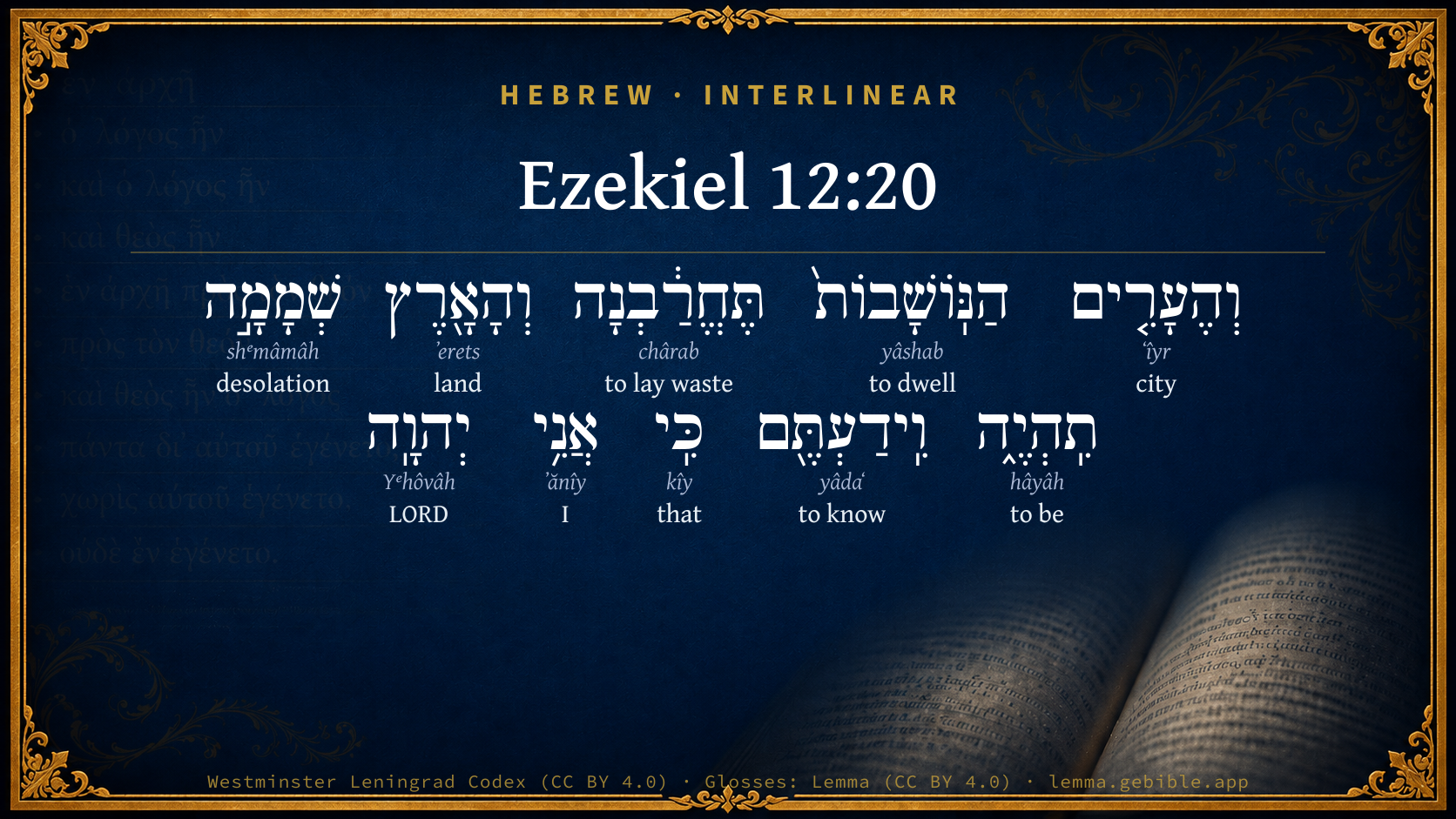
Ezekiel 12:20

Hebrew (Westminster Leningrad Codex) Ezekiel 12:20 appears in the Hebrew Old Testament. The text above is from the Westminster Leningrad Codex. Each word links to its Strong’s number, a concise gloss, and parsing drawn from the Open Scriptures Hebrew Bible morphology. Click any word for its full Brown-Driver-Briggs (BDB) entry.
Download image
Cite this verse

Ezekiel 12:20 (World English Bible). Public Domain. Lemma interlinear Bible study tool, https://lemma.gebible.app/v/ezekiel/12/20.

Show BibTeX & RIS
BibTeX
RIS
English Translation
The cities that are inhabited shall be laid waste, and the land shall be a desolation; and you shall know that I am Yahweh.
World English Bible · Public Domain
Download a study sheet

One document with this verse’s original text, its word-by-word gloss line, the meaning frame, cross-references with their text, attributed commentary, and full source and license credits — printable, and it pastes into notes with its structure intact.

This verse Autodidact and up

Study sheet (.html) Plain text (.txt)

A passage Seminary Student

Up to 50 verses in one chapter. A passage sheet keeps up to 6 commentary sources and 12 cross-references per verse, in the order this page ranks them, and says so on the sheet whenever that leaves anything out. Ask for a single verse and you get the Autodidact verse sheet above.

Everything on this page stays free to read, with no account — the sheet is a download of what is already on screen, not access to it.

Want to remove ads? Support Godless Engineer
Compare translations 3

The same verse in 3 English versions, stacked beneath the original-language interlinear above. Click any original word for its lexicon entry.

Each is an independent rendering of the whole verse — the interlinear is not word-aligned to these translations.

Highlighted words mark where these versions differ — a whole-verse word diff, not a word-by-word alignment.

  • World English Bible Public Domain
    The cities that are inhabited shall be laid waste, and the land shall be a desolation; and you shall know that I am Yahweh.
  • King James Version Public Domain
    And the cities that are inhabited shall be laid waste, and the land shall be desolate; and ye shall know that I am the LORD.
  • unfoldingWord Literal Text CC BY-SA 4.0
    So the cities that were inhabited will be desolate, and the land will become a wasteland; so you will know that I am Yahweh.”’”

unfoldingWord Literal Text — © unfoldingWord, licensed CC BY-SA 4.0. Word-aligned USFM3 via Door43 (git.door43.org/unfoldingWord/en_ult).

Versions to compare (up to 4)

3 of 4 selected

Show all 18 translations

Every available English version of this verse, each an independent rendering of the whole verse.

  • World English Bible Public Domain
    The cities that are inhabited shall be laid waste, and the land shall be a desolation; and you shall know that I am Yahweh.
  • Berean Standard Bible Public Domain
    The inhabited cities will be laid waste, and the land will become desolate. Then you will know that I am the LORD.’”
  • Majority Standard Bible Public Domain
    The inhabited cities will be laid waste, and the land will become desolate. Then you will know that I am the LORD.’”
  • King James Version Public Domain
    And the cities that are inhabited shall be laid waste, and the land shall be desolate; and ye shall know that I am the LORD.
  • American Standard Version (1901) Public Domain
    And the cities that are inhabited shall be laid waste, and the land shall be a desolation; and ye shall know that I am Jehovah.
  • Revised Version (1885) Public Domain
    And the cities that are inhabited shall be laid waste, and the land shall be a desolation; and ye shall know that I am the LORD.
  • Geneva Bible (1599) Public Domain
    And the cities that are inhabited, shall be left voyde, and the land shall be desolate, and yee shall knowe that I am the Lord.
  • Douay-Rheims (1899) Public Domain
    And the cities that are now inhabited shall be laid waste, and the land shall be desolate: and you shall know that I am the Lord.
  • Young's Literal Translation Public Domain
    And the cities that are inhabited are laid waste, and the land is a desolation, and ye have known that I `am' Jehovah.'
  • Literal Standard Version CC BY-SA 4.0
    And the cities that are inhabited are laid waste, and the land is a desolation, and you have known that I [am] YHWH.”
  • Unlocked Literal Bible CC BY-SA 4.0
    So the cities that were inhabited will be desolate, and the land will become a wasteland; so you will know that I am Yahweh.”'”
  • unfoldingWord Literal Text CC BY-SA 4.0
    So the cities that were inhabited will be desolate, and the land will become a wasteland; so you will know that I am Yahweh.”’”
  • Darby Bible Public Domain
    And the cities that are inhabited shall be laid waste, and the land shall be a desolation; and ye shall know that I [am] Jehovah.
  • World Messianic Bible Public Domain
    The cities that are inhabited will be laid waste, and the land will be a desolation. Then you will know that I am the LORD.”’”
  • Webster's Bible Public Domain
    And the cities that are inhabited shall be laid waste, and the land shall be desolate; and ye shall know that I am the LORD.
  • Free Bible Version CC BY-SA 4.0
    The towns will be destroyed, and the countryside turned into a wasteland. Then you will know that I am the Lord.”
  • Bible in Basic English Public Domain
    And the peopled towns will be made waste, and the land will become a wonder; and you will be certain that I am the Lord.
  • JPS Tanakh (1917) Public Domain
    And the cities that are inhabited shall be laid waste, and the land shall be desolate; and ye shall know that I am the LORD.'

Literal Standard Version (2020), Covenant Press — licensed CC BY-SA 4.0. Text via the HelloAO Bible API (eBible.org). Unlocked Literal Bible (unfoldingWord) — licensed CC BY-SA 4.0. Text via the HelloAO Bible API (eBible.org). unfoldingWord Literal Text — © unfoldingWord, licensed CC BY-SA 4.0. Word-aligned USFM3 via Door43 (git.door43.org/unfoldingWord/en_ult). Free Bible Version, Dr. Jonathan Gallagher — licensed CC BY-SA 4.0. Text via the HelloAO Bible API (eBible.org).

Word by word

More ways to search: Search by grammar → Find every occurrence → Compare this word →

Practice this passage: Drill this verse → Learn its vocabulary →

תֶּחֱרַ֔בְנָה
chârab
H2717
“to lay waste”
Verb, Qal, Imperfect, 3rd Person, Feminine, Plural
Part of Speech
Verb
Stem
Qal
Form
Imperfect
Person
3rd Person
Gender
Feminine
Number
Plural
Full BDB Definition

Origin: a primitive root

TWOT: 731 , 732

to be waste, lay waste, make desolate, be desolate, be in ruins - (Qal) to be waste, be desolate - (Niphal) - to be made desolate - desolate (participle) - (Hiphil) to lay waste, make desolate - (Hophal) to be laid waste - to be dry, be dried up - (Qal) to be dried, be dried up - (Pual) to be dried - (Hiphil) to dry up - (Hophal) to be dried up - to attack, smite down, slay, fight
  1. וְהֶעָרִ֤ים ʻîyr H5892 “and · the · cities” Conjunction + Particle, Definite Article + Noun, Common, Feminine, Plural, Absolute
  2. הַנּֽוֹשָׁבוֹת֙ yâshab H3427 “the · dwelled” Particle, Definite Article + Verb, Niphal, Participle Passive, Feminine, Plural, Absolute
  3. וְהָאָ֖רֶץ ʼerets H776 “and · the · land” Conjunction + Particle, Definite Article + Noun, Common, Both, Singular, Absolute
  4. שְׁמָמָ֣ה shᵉmâmâh H8077 “desolation” Noun, Common, Feminine, Singular, Absolute
  5. תִֽהְיֶ֑ה hâyâh H1961 “to be” Verb, Qal, Imperfect, 3rd Person, Feminine, Singular
  6. וִֽידַעְתֶּ֖ם yâdaʻ H3045 “and · to know” Conjunction + Verb, Qal, Sequential Perfect, 2nd Person, Masculine, Plural
  7. כִּֽי kîy H3588 “that” Conjunction
  8. אֲנִ֥י ʼănîy H589 “I” Pronoun, Personal, 1st Person, Common, Singular
  9. יְהוָֽה Yᵉhôvâh H3068 “LORD” Noun, Proper

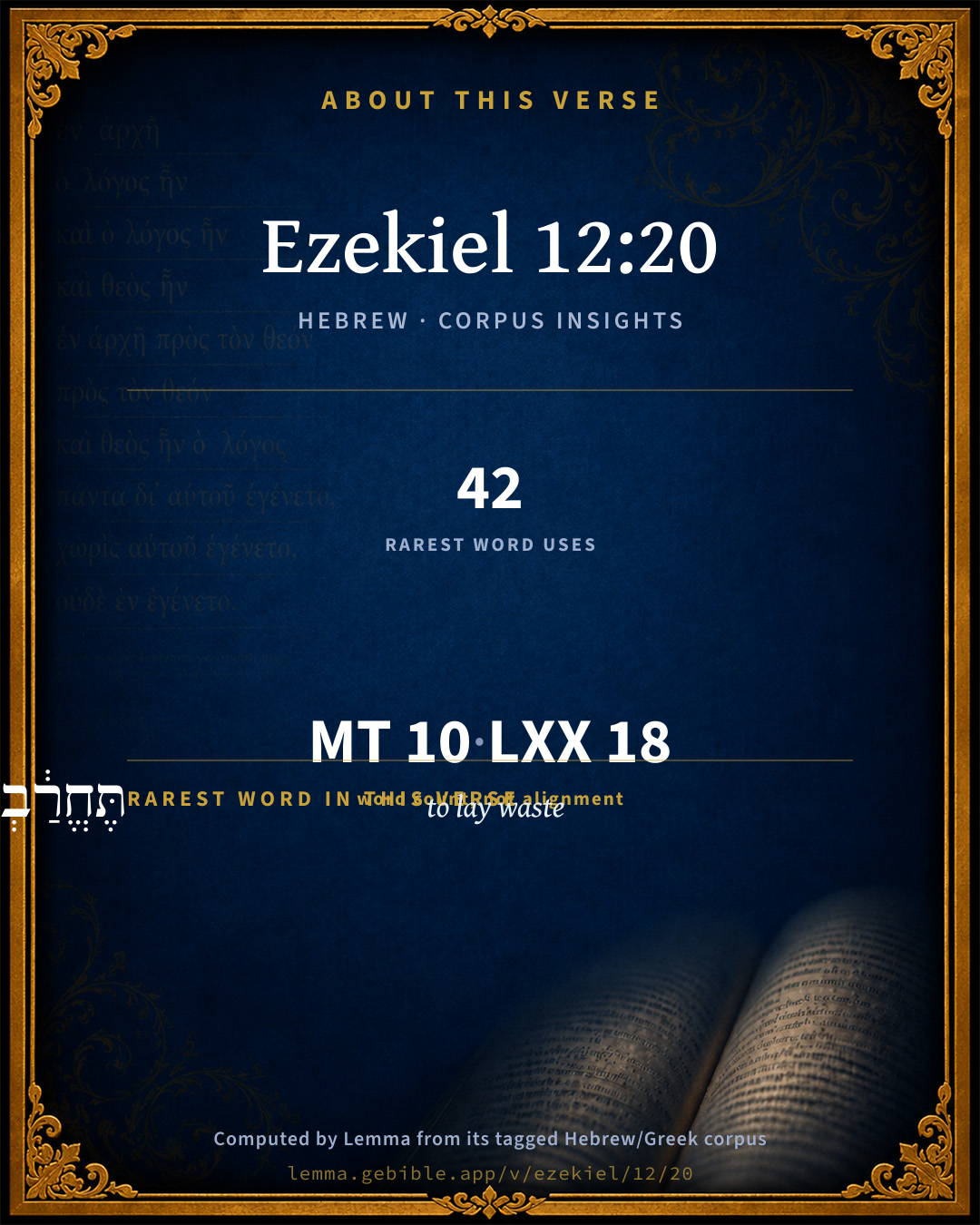
About this verse

These counts appear in no published source. They are computed here, from the morphology-tagged text and Lemma’s own curated glosses. What Lemma adds →

10
words
10
distinct lemmas
Prophets
section

Shared distinctive vocabulary

תֶּחֱרַ֔בְנָה to lay waste H2717 occurs in 38 verses of the Hebrew Bible. Also found in:

Grammatical profile

  • 4 verbs
  • 4 nouns
  • 1 pronoun
  • 1 conjunction

Verb forms

  • הַנּֽוֹשָׁבוֹת֙ Niphal · Participle Passive
  • תֶּחֱרַ֔בְנָה Qal · Imperfect
  • תִֽהְיֶ֑ה Qal · Imperfect
  • וִֽידַעְתֶּ֖ם Qal · Sequential Perfect

Hebrew & Septuagint length

In English translation the verse runs 24 words from the Hebrew and 24 from the Septuagint (LXX English) — the same length.

A rough comparison of the two English renderings, which tokenize alike — not a word-level alignment.

Word counts can differ between the Hebrew and the Greek without any difference in meaning — e.g. the Hebrew direct-object marker אֵת has no separate Greek word, and Greek often adds the article ὁ.

In the original languages it is 10 Hebrew tokens and 18 Greek tokens — but the two are counted differently (Hebrew bundles its prefixes and suffixes into one token; the Greek is in lemma form), so that isn’t a like-for-like length.

Cross-references

17

Topical passages linked to Ezekiel 12:20 in the Treasury of Scripture Knowledge — connected by theme and wording, ordered by reader-vote popularity; previews shown in the World English Bible.

  • Isaiah 7:23–24 It will happen in that day that every place where there were a thousand vines at a thousand silver shekels, shall be for briers and thorns.
  • Jeremiah 4:7 A lion is gone up from his thicket, and a destroyer of nations; he is on his way, he is gone forth from his place, to make your land desolate, that your cities be laid waste, without inhabitant.
  • Isaiah 3:26 Her gates shall lament and mourn; And she shall be desolate and sit on the ground.
  • Jeremiah 25:9 behold, I will send and take all the families of the north, says Yahweh, and [I will send] to Nebuchadrezzar the king of Babylon, my servant, and will bring them against this land, and against the inhabitants of it, and against all these nations round about; and I will utterly destroy them, and make them an astonishment, and a hissing, and perpetual desolations.
  • Isaiah 24:3 The earth shall be utterly emptied, and utterly laid waste; for Yahweh has spoken this word.
  • Isaiah 24:12 In the city is left desolation, and the gate is struck with destruction.
  • Isaiah 64:10–11 Your holy cities are become a wilderness, Zion is become a wilderness, Jerusalem a desolation.
  • Jeremiah 4:23–29 I saw the earth, and, behold, it was waste and void; and the heavens, and they had no light.
  • Jeremiah 12:10–12 Many shepherds have destroyed my vineyard, they have trodden my portion under foot, they have made my pleasant portion a desolate wilderness.
  • Jeremiah 16:9 For thus says Yahweh of Hosts, the God of Israel: Behold, I will cause to cease out of this place, before your eyes and in your days, the voice of mirth and the voice of gladness, the voice of the bridegroom and the voice of the bride.
  • Jeremiah 19:11 and shall tell them, Thus says Yahweh of Hosts: Even so will I break this people and this city, as one breaks a potter's vessel, that can't be made whole again; and they shall bury in Topheth, until there be no place to bury.
  • Jeremiah 24:8–10 As the bad figs, which can't be eaten, they are so bad, surely thus says Yahweh, So will I give up Zedekiah the king of Judah, and his princes, and the residue of Jerusalem, who remain in this land, and those who dwell in the land of Egypt,
  • Lamentations 5:18 For the mountain of Zion, which is desolate: The foxes walk on it.
  • Ezekiel 15:6 Therefore thus says the Lord Yahweh: As the vine tree among the trees of the forest, which I have given to the fire for fuel, so will I give the inhabitants of Jerusalem.
  • Ezekiel 15:8 I will make the land desolate, because they have committed a trespass, says the Lord Yahweh.
  • Daniel 9:17 Now therefore, our God, listen to the prayer of your servant, and to his petitions, and cause your face to shine on your sanctuary that is desolate, for the Lord's sake.
  • Jeremiah 34:22 Behold, I will command, says Yahweh, and cause them to return to this city; and they shall fight against it, and take it, and burn it with fire: and I will make the cities of Judah a desolation, without inhabitant.

Cross-references courtesy of OpenBible.info (CC BY 4.0).

Hebrew and Greek witnesses Masoretic Hebrew ↔ Greek Septuagint

The same verse in the two great witnesses to the Old Testament, shown verse-for-verse.

These are two independent witnesses, not word-aligned to each other, and the Septuagint is shown in lemma (dictionary) form.

Hebrew Ezekiel 12:20 Masoretic · Westminster Leningrad Codex

וְהֶעָרִ֤ים הַנּֽוֹשָׁבוֹת֙ תֶּחֱרַ֔בְנָה וְהָאָ֖רֶץ שְׁמָמָ֣ה תִֽהְיֶ֑ה וִֽידַעְתֶּ֖ם כִּֽי אֲנִ֥י יְהוָֽה

The cities that are inhabited shall be laid waste, and the land shall be a desolation; and you shall know that I am Yahweh.

World English Bible · Public Domain

Greek LXX Ezekiel 12:20 Septuagint · lemma form

καί ὁ πόλις αὐτός ὁ καταοἰκέω ἐκἐρημόω καί ὁ γῆ εἰς ἀφανισμός εἰμί καί ἐπιγιγνώσκω διότι ἐγώ κύριος

And their inhabited cities shall be laid utterly waste, and the land shall be desolate; and you⌃ shall know that I am the Lord.

LXX2012 (modern English Septuagint) · Public Domain

On this verse, John Gill's Exposition discusses the Septuagint’s reading. Read the note in Commentary ↓

Hebrew: Westminster Leningrad Codex (CC BY 4.0). Greek: Septuagint (public domain); English from LXX2012 (modern English Septuagint) (Public Domain). How the Septuagint differs from the Hebrew →

Targum (Aramaic paraphrase)

1

The Targum is the ancient Jewish Aramaic paraphrase of the Hebrew Scriptures — an interpretive translation, not the Hebrew text itself. Onkelos (literal) and Pseudo-Jonathan (expansive) render the Torah, and Jonathan the Prophets. Coverage is partial: where no permissively-licensed English translation exists for a verse, only the Aramaic is shown. This is verse-level text, not a word-by-word alignment to the Hebrew.

  1. Targum Jonathan Prophets (Joshua–Malachi)
    וְקִרְוַיָא דַהֲוָאָה יָתְבָן יֶחֱרְבָן וְאַרְעָא לְצָדוּ תְהֵי וְתִידְעוּן אֲרֵי אֲנָא יְיָ:

    (no public-domain English translation for this verse)

    Targum Jonathan — Aramaic: “Mikraot Gedolot” (public domain). English: “Sefaria Community Translation” (CC0 1.0 (public-domain dedication)); “London "Chaldee Paraphrase," 1871” (public domain). Text via Sefaria.

Commentary

Notes on Ezekiel 12:20 from classic Christian and Jewish commentators (each source and its license shown beneath its notes). The classic Christian expositions comment on the surrounding passage and are grouped to its opening verse, so a note may address several verses; the Jewish commentaries on the Tanakh (Rashi and others) are per-verse, so they appear only where the commentator wrote on this verse.

Lemma curates 59 commentaries, every one of them public domain or Creative Commons licensed, each selected and text-cleaned for this edition rather than reprinted as found. About our sources →

Trapp's Complete Commentary

John Trapp

Eze 12:20 And the cities that are inhabited shall be laid waste, and the land shall be desolate; and ye shall know that I [am] the LORD.

Ver. 20. And ye shall know.] By woeful experience. {Eze 12:15}

John Trapp, A Commentary or Exposition upon All the Books of the Old and New Testament (1647–1656) — public domain. Text from a community e-Sword module.

Jamieson, Fausset & Brown

Robert Jamieson, A. R. Fausset & David Brown

the cities--left in Judea after the destruction of Jerusalem.

Jamieson, Fausset & Brown — Commentary Critical and Explanatory on the Whole Bible (1871) — public domain (CC PDM 1.0). Text via the HelloAO Bible API.

John Calvin's Commentaries

He pursues the same sentiment. He had threatened destruction to Jerusalem and its citizens: he now adds the other cities of Judah which were still inhabited. Lastly, he speaks of the whole land, as if he said that no single corner should suppose itself free from slaughter, since God’s vengeance should attack it as well as the cruelty of enemies through all regions. Jerusalem was the head of the whole nation; Ezekiel predicts its siege, and after that it became easy to overthrow and spoil other cities, so that the whole region was rendered subject to the lust of the enemies. He afterwards adds what we have noticed previously, ye shall know that I am Jehovah They had heard this instruction from the Prophets, they ought to have been imbued with it from their earliest childhood, for God had borne witness by many proofs that he was the true God. For his power had become sufficiently known and understood by the frequent succors by which that wretched people had been snatched from even immediate death. But as their impiety had stupified them, so that they carelessly despised not only the Prophet’s teaching, but the very judgments of God, when he openly punished them, this knowledge is not mentioned without reason. When therefore God puts forth his hand for the last time to chastise them, he says that his power should be so manifest among them, that it should no longer escape them; but yet they were so hardened in their depravity that they almost entirely forgot God. For a contrast is always to be observed between that knowledge which springs from performance and that arising from utterance; for those who had closed their ears when God invites them to himself as servants, must be compelled to feel him to be God when he is silent and is executing his vengeance upon them. It follows —

John Calvin's Commentaries (1540-1563) — public domain. Text from the Calvin Translation Society English edition (1840s-50s) via the Christian Classics Ethereal Library (ccel.org). Calvin's coverage is partial (roughly two-thirds of the Bible); uncommented books and verses are honest gaps, never fabricated. The 19th-century editor's footnotes and remarks are omitted so the notes are faithfully Calvin's own voice.

John Gill's Exposition

For there shall be no more any vain vision,.... Or prophecy; such as the false prophets had given out, that the people should be in peace and safety, and not be delivered into the hands of the king of Babylon; which they gave heed to, and so encouraged the lying prophets to go on prophesying smooth things; when the prophecies of the true prophets were accomplished, then the false ones were rejected, and their prophecies no more regarded; nor could there be any more a place for them, or a reception of them:

nor flattering divination within the house of Israel; the Septuagint, Vulgate Latin, Syriac, and Arabic versions, read, "in the midst of the children of Israel"; and so the Targum; but Kimchi says, that copies that so read are wrong; and which is confirmed by the Masora, which observes, that the reading is so in all places but in this. The Syriac version renders it "doubtful prediction"; and the Vulgate Latin version, "ambiguous divination"; like the prophecies and answers of the Heathen oracles, which were delivered in terms of doubtful signification, and might be taken in more senses than one. The Septuagint version is, "he that divines for grace"; in order to ingratiate himself into the people, to gain their good will, or their money, or both; and therefore divines smooth things, and flatters them with that which is most agreeable to their inclination; but when they shall see the city taken, and themselves carried captive, they will no more regard such soothing diviners, who pretended from the stars to tell what shall come to pass, as the Arabic version suggests.

John Gill's Exposition of the Whole Bible (1746–1763) — public domain (CC PDM 1.0). Text via the HelloAO Bible API.

Matthew Poole's English Annotations

The cities, the lesser cities up and down the land, which now are and will be inhabited when Jerusalem is destroyed,

shall be wasted with the sword, as the word seems to imply. Then shall you, who are now in Chaldea, know how the goodness of God brought you hither, that you had no real cause to complain that your condition was worse than your brethren’s in Judea. You shall know the truth and severity of God against sinners.

Matthew Poole's English Annotations on the Holy Bible (1683–1685) — public domain. Text from a community e-Sword/MySword module.

Rashi

Rabbi Shlomo Yitzchaki (Rashi)

the inhabited Heb. הַנוֹשָבוֹת, les assiyes, inhabited.

Rashi on the Tanakh — English translations: “The Judaica Press complete Tanach with Rashi, translated by A. J. Rosenberg” (CC BY 4.0); “Pentateuch with Rashi's commentary by M. Rosenbaum and A.M. Silbermann, 1929-1934” (public domain); “The Metsudah Tanach series, Lakewood, N.J” (CC BY 4.0); and “The Book of Joshua, Metsudah Publications, 1997” (CC BY 4.0). Text via Sefaria.

Lesson kit

Teaching starters — assembled from the data on this page, not authored interpretation. Every prompt links to the verse data it draws on. Edit before teaching.

Ezekiel, in the Prophets, opens this verse with 10 words (10 distinct Hebrew lemmas). Its most distinctive word is chârab (“to lay waste”). A historical commentator’s framing appears above. Read the whole chapter for the surrounding context.

Discussion questions

  1. How does “to lay waste” (chârab) shape what this verse is saying?
  2. Genesis 8:13 shares the word «to lay waste» with this verse. How do the two illuminate each other?
  3. These translations render this verse differently. What is at stake in choosing one wording over another?
  4. The verb «הַנּֽוֹשָׁבוֹת֙» is Niphal Participle Passive. How does its form color the action?
  5. Reading how Trapp's Complete Commentary and Jamieson, Fausset & Brown read this verse, where do the two commentators agree and where do they part?

Things to notice

Reading settings

Reading text

Shown beneath each verse's original-language words.

Old Testament
Old Testament edition

Read the OT as the Masoretic Hebrew (MT) or the Greek Septuagint (LXX).

English shown for the Greek Septuagint (in the Hebrew ↔ Greek comparison).

Comparing translations? Open the Compare panel on any verse page to stack up to four side by side.