
Job 23:16

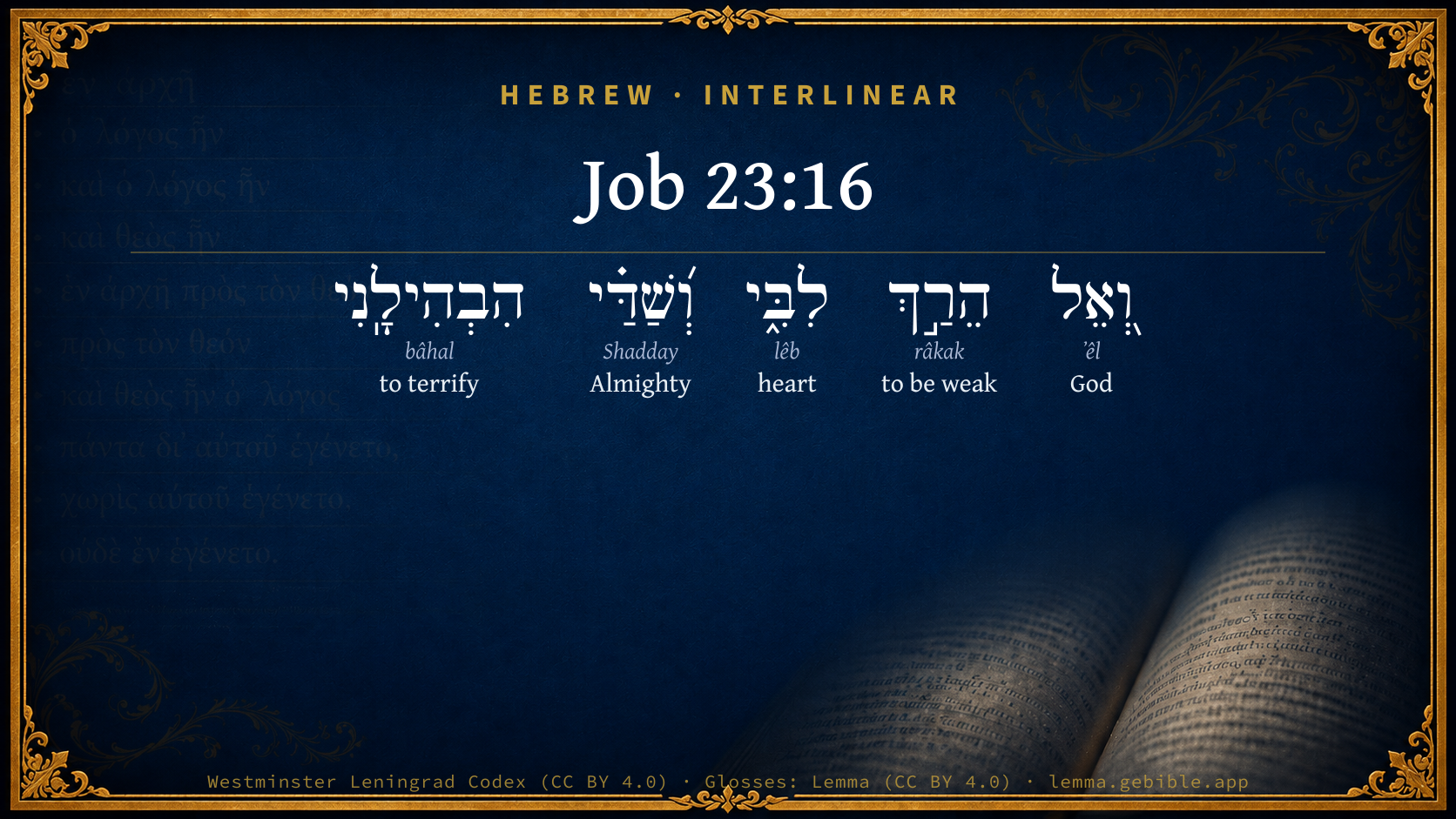
Hebrew (Westminster Leningrad Codex) Job 23:16 appears in the Hebrew Old Testament. The text above is from the Westminster Leningrad Codex. Each word links to its Strong’s number, a concise gloss, and parsing drawn from the Open Scriptures Hebrew Bible morphology. Click any word for its full Brown-Driver-Briggs (BDB) entry.
Download image
Cite this verse

Job 23:16 (World English Bible). Public Domain. Lemma interlinear Bible study tool, https://lemma.gebible.app/v/job/23/16.

Show BibTeX & RIS
BibTeX
RIS
English Translation
For God has made my heart faint. The Almighty has terrified me.
World English Bible · Public Domain
Download a study sheet

One document with this verse’s original text, its word-by-word gloss line, the meaning frame, cross-references with their text, attributed commentary, and full source and license credits — printable, and it pastes into notes with its structure intact.

This verse Autodidact and up

Study sheet (.html) Plain text (.txt)

A passage Seminary Student

Up to 50 verses in one chapter. A passage sheet keeps up to 6 commentary sources and 12 cross-references per verse, in the order this page ranks them, and says so on the sheet whenever that leaves anything out. Ask for a single verse and you get the Autodidact verse sheet above.

Everything on this page stays free to read, with no account — the sheet is a download of what is already on screen, not access to it.

Want to remove ads? Support Godless Engineer
Compare translations 3

The same verse in 3 English versions, stacked beneath the original-language interlinear above. Click any original word for its lexicon entry.

Each is an independent rendering of the whole verse — the interlinear is not word-aligned to these translations.

Highlighted words mark where these versions differ — a whole-verse word diff, not a word-by-word alignment.

  • World English Bible Public Domain
    For God has made my heart faint. The Almighty has terrified me.
  • King James Version Public Domain
    For God maketh my heart soft, and the Almighty troubleth me:
  • unfoldingWord Literal Text CC BY-SA 4.0
    For God has softened my heart, and the Almighty has terrified me.

unfoldingWord Literal Text — © unfoldingWord, licensed CC BY-SA 4.0. Word-aligned USFM3 via Door43 (git.door43.org/unfoldingWord/en_ult).

Versions to compare (up to 4)

3 of 4 selected

Show all 18 translations

Every available English version of this verse, each an independent rendering of the whole verse.

  • World English Bible Public Domain
    For God has made my heart faint. The Almighty has terrified me.
  • Berean Standard Bible Public Domain
    God has made my heart faint; the Almighty has terrified me.
  • Majority Standard Bible Public Domain
    God has made my heart faint; the Almighty has terrified me.
  • King James Version Public Domain
    For God maketh my heart soft, and the Almighty troubleth me:
  • American Standard Version (1901) Public Domain
    For God hath made my heart faint, And the Almighty hath terrified me;
  • Revised Version (1885) Public Domain
    For God hath made my heart faint, and the Almighty hath troubled me:
  • Geneva Bible (1599) Public Domain
    For God hath softened mine heart, and the Almightie hath troubled me.
  • Douay-Rheims (1899) Public Domain
    God hath softened my heart, and the Almighty hath troubled me.
  • Young's Literal Translation Public Domain
    And God hath made my heart soft, And the Mighty hath troubled me.
  • Literal Standard Version CC BY-SA 4.0
    And God has made my heart soft, || And the Mighty has troubled me.
  • Unlocked Literal Bible CC BY-SA 4.0
    For God has made my heart weak; the Almighty has terrified me.
  • unfoldingWord Literal Text CC BY-SA 4.0
    For God has softened my heart, and the Almighty has terrified me.
  • Darby Bible Public Domain
    For ùGod hath made my heart soft, and the Almighty troubleth me;
  • World Messianic Bible Public Domain
    For God has made my heart faint. The Almighty has terrified me.
  • Webster's Bible Public Domain
    For God maketh my heart soft, and the Almighty troubleth me:
  • Free Bible Version CC BY-SA 4.0
    God has made me faint-hearted; the Almighty has scared me to death.
  • Bible in Basic English Public Domain
    For God has made my heart feeble, and my mind is troubled before the Ruler of all.
  • JPS Tanakh (1917) Public Domain
    Yea, God hath made my heart faint, and the Almighty hath affrighted me;

Literal Standard Version (2020), Covenant Press — licensed CC BY-SA 4.0. Text via the HelloAO Bible API (eBible.org). Unlocked Literal Bible (unfoldingWord) — licensed CC BY-SA 4.0. Text via the HelloAO Bible API (eBible.org). unfoldingWord Literal Text — © unfoldingWord, licensed CC BY-SA 4.0. Word-aligned USFM3 via Door43 (git.door43.org/unfoldingWord/en_ult). Free Bible Version, Dr. Jonathan Gallagher — licensed CC BY-SA 4.0. Text via the HelloAO Bible API (eBible.org).

Word by word

More ways to search: Search by grammar → Find every occurrence → Compare this word →

Practice this passage: Drill this verse → Learn its vocabulary →

About this verse

These counts appear in no published source. They are computed here, from the morphology-tagged text and Lemma’s own curated glosses. What Lemma adds →

5
words
5
distinct lemmas
Wisdom
section

Notable vocabulary

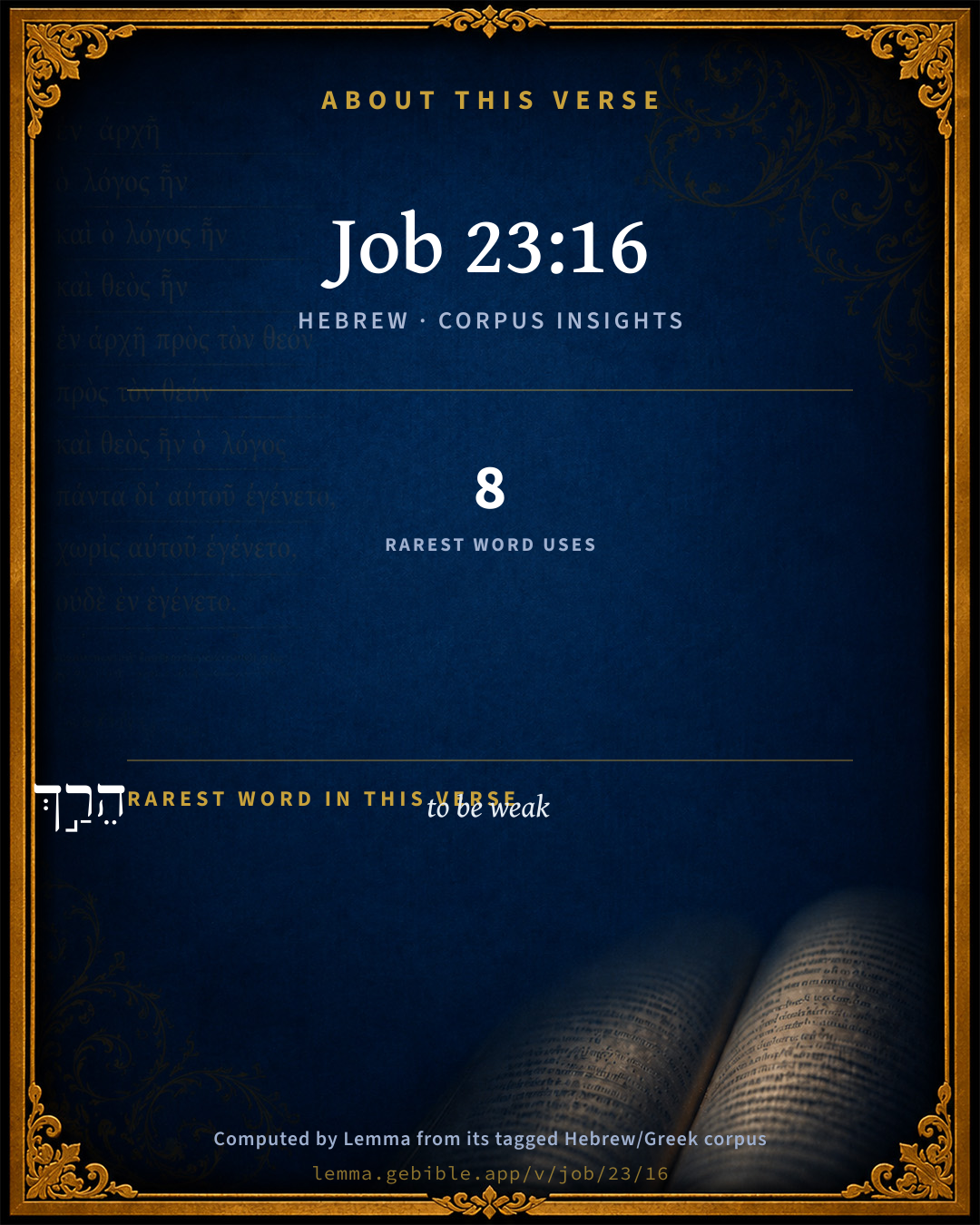
The rarest word here is הֵרַ֣ךְ to be weak H7401 — appearing just 8 times in the whole Hebrew Bible.

Shared distinctive vocabulary

הֵרַ֣ךְ to be weak H7401 occurs in 8 verses of the Hebrew Bible. Also found in:

Grammatical profile

  • 2 verbs
  • 3 nouns

Verb forms

  • הֵרַ֣ךְ Hiphil · Perfect
  • הִבְהִילָֽנִי Hiphil · Perfect

Hebrew & Septuagint length

In English translation the verse runs 12 words from the Hebrew and 13 from the Septuagint (LXX English) — closely comparable.

A rough comparison of the two English renderings, which tokenize alike — not a word-level alignment.

Word counts can differ between the Hebrew and the Greek without any difference in meaning — e.g. the Hebrew direct-object marker אֵת has no separate Greek word, and Greek often adds the article ὁ.

Cross-references

9

Topical passages linked to Job 23:16 in the Treasury of Scripture Knowledge — connected by theme and wording, ordered by reader-vote popularity; previews shown in the World English Bible.

  • Psalms 22:14 I am poured out like water. All my bones are out of joint. My heart is like wax; It is melted within me.
  • Job 27:2 "As God lives, who has taken away my right, The Almighty, who has made my soul bitter.
  • Deuteronomy 20:3 and shall tell them, Hear, Israel, you draw near this day to battle against your enemies: don't let your heart faint; don't be afraid, nor tremble, neither be scared of them;
  • Psalms 88:16 Your fierce wrath has gone over me. Your terrors have cut me off.
  • Isaiah 6:5 Then I said, "Woe is me! For I am undone, because I am a man of unclean lips, and I dwell in the midst of a people of unclean lips: for my eyes have seen the King, Yahweh of Hosts!"
  • Ruth 1:20 She said to them, "Don't call me Naomi, call me Mara; for the Almighty has dealt very bitterly with me.
  • Isaiah 57:16 For I will not contend forever, neither will I be always angry; for the spirit would faint before me, and the souls who I have made.
  • Joel 1:15 Alas for the day! For the day of Yahweh is at hand, And it will come as destruction from the Almighty.
  • Jeremiah 51:46 Don't let your heart faint, neither fear for the news that shall be heard in the land; for news shall come one year, and after that in another year [shall come] news, and violence in the land, ruler against ruler.

Cross-references courtesy of OpenBible.info (CC BY 4.0).

Hebrew and Greek witnesses Masoretic Hebrew ↔ Greek Septuagint

The same verse in the two great witnesses to the Old Testament, shown verse-for-verse.

These are two independent witnesses, not word-aligned to each other, and the Septuagint is shown in lemma (dictionary) form.

Hebrew Job 23:16 Masoretic · Westminster Leningrad Codex

וְ֭אֵל הֵרַ֣ךְ לִבִּ֑י וְ֝שַׁדַּ֗י הִבְהִילָֽנִי

For God has made my heart faint. The Almighty has terrified me.

World English Bible · Public Domain

Greek LXX Job 23:16 Septuagint · lemma form

κύριος δέ μαλακύνω ὁ καρδία ἐγώ ὁ δέ παντοκράτωρ σπουδάζω ἐγώ

But the Lord has softened my heart, and the Almighty has troubled me.

LXX2012 (modern English Septuagint) · Public Domain

Hebrew: Westminster Leningrad Codex (CC BY 4.0). Greek: Septuagint (public domain); English from LXX2012 (modern English Septuagint) (Public Domain). How the Septuagint differs from the Hebrew →

Commentary

Notes on Job 23:16 from classic Christian and Jewish commentators (each source and its license shown beneath its notes). The classic Christian expositions comment on the surrounding passage and are grouped to its opening verse, so a note may address several verses; the Jewish commentaries on the Tanakh (Rashi and others) are per-verse, so they appear only where the commentator wrote on this verse.

Lemma curates 59 commentaries, every one of them public domain or Creative Commons licensed, each selected and text-cleaned for this edition rather than reprinted as found. About our sources →

Trapp's Complete Commentary

John Trapp

Job 23:16 For God maketh my heart soft, and the Almighty troubleth me:

Ver. 16. For God maketh my heart soft] Methinks I feel it fall asunder in my bosom like drops of water, and dissolved with manifold afflictions, so that I am hardly able to bear up any longer; I am almost done, as we use to speak, and my heart faileth me. How should it do otherwise when God withdraweth from his own the supplies of his Spirit, Php 1:19, that Spirit of power, of love, and of a sound mind, 2Ti 1:7 Act 20:22, saith that great apostle, "And now, behold, I go bound in the spirit up to Jerusalem," &c. Whereupon Dr Preston gives this good note, The Spirit hemmeth us about, comprehendeth and keepeth us. When a man’s own strength would fall loose, this supernatural strength stayeth and strengtheneth it. Hence that of David, Psa 138:3, "In the day when I cried unto thee thou answeredst me, and strengthenedst me with strength in my soul." So Psa 27:14, "Be of good courage, and he shall strengthen thy heart," which else will melt (as did the hearts of the men of Jericho, Jos 2:11), like metal melted with fire, or like ice thawed into water and spilt upon the ground, which cannot be taken up again. And this is the soft heart Job here complaineth of. God had dispirited him, and

The Almighty troubleth me] sc. With the thoughts of his Almightiness; see Psa 39:11; and with so many miseries growing upon him, Tot malis ingruentibus (Jun.). Now it is not amiss for God’s people thus to be melted and troubled otherwise; for by this means shall the iniquity of Jacob be purged, and this is all the fruit, to take away his sin, Isa 37:9-14.

John Trapp, A Commentary or Exposition upon All the Books of the Old and New Testament (1647–1656) — public domain. Text from a community e-Sword module.

The Biblical Illustrator

Joseph S. Exell

Job_23:16

God maketh my heart soft, and the Almighty troubleth me.

God the softener of the heart

This is not a Jewish idea. The dispensation of Moses was a religious state, in which the harder features of the Divine countenance were brought to light, and by which the severer characteristics of the Divine nature were developed before the people, rather than their opposites. The ideas with which the dispensation familiarised their minds were more especially those of justice, judgment, retribution, and punishment. To speak of the softening of the heart, and to ascribe, as Job doth, the process and the operations by which it is softened unto God, must project our thoughts to other days which the prophets and kings have desired to see, but, except by faith, did not see them. It directs us to the days of the Son of Man; it leads us to think of the humanity of God, with all its consequent and concurrent tendernesses towards our own. Hardness of heart or spiritual insensibility is no isolated evil. It hath a numerous progeny. Hardness of heart, let it take what shape it will, is something to be prayed against. There is a moral ossification of the heart, as well as a physical The Pharisees of our Lords day were thus morally diseased. These hard bones, these intractable sinews of a perverse disposition and a rebellious will, these horns of the ungodly, must be broken, dissolved, ground to powder. Let it not be supposed that this softness of heart can be any reproach to us, or is in any way derogatory to moral and intellectual manliness. Our nature cannot be too tender so long as it is not weak. The sensibility of woman, joined with the intellect of man, would not render us too sensitive. Piety is softness of heart, tenderness of affection, sensitiveness of conscience to Godward. But how does God make the heart soft? He doth it by the influence of His Holy Spirit. This is so obvious as to need no proof. But the Spirit useth different means, and operateth upon us in a variety of ways, not only through the particular channels which He hath ordained, but in all manner of ways. Some other methods may be mentioned.

1. God maketh the heart soft by the influence upon us of the natural world.

2. By His Holy Word. This is an agency whereby the Spirit of God more peculiarly worketh upon the soul; and the natural objects to which the Word is compared show how softening its influences are. Dew; showers; small rain; snow; honey out of a rock; all which similitudes bespeak its tender, melting, mollifying power.

3. By the discipline of life. Trouble is a mighty mollifier of the heart. Trouble prepareth us for the sympathies of Nature and the consolations of Gods Word. Next to the Lord Jesus it is humanitys best friend, and the more as it is no mans flatterer. (Alfred Bowen Evans.)

God maketh my heart soft

Prosperity is often a curse, adversity is often a blessing. Observe the advantages of affliction. Confine attention to the softening of the heart.

1. The Scriptures speak of the hardness of the heart as the cause of impenitence and unbelief. Suppose that you were offered, on the one hand, temporal prosperity with a stony heart, or temporal prosperity with a new and softened heart, what would be your choice? If you are in adversity it may be that God saw prosperity to be dangerous for you. It is the Almighty that troubleth you. Thank Him for having troubled you. Pray Him to soften your heart wholly.

2. Since God certainly designs affliction for your profit, have a care that you do profit by it.

3. How are we to profit by affliction? To this end, we must repent us truly of our sins past, and resolve, by Gods grace, to abandon them. Our good resolution must not be impulsive and evanescent, it must be deliberate and decided, in order that it may be permanent. God has promised to help us, and He alone can give us the strength to succeed; but He requires a concurrent will. If you would profit by affliction, you must be instant in prayer, and diligent in the study of Gods Word. Learn, then, to look at affliction in the true light, and from a Christian point of view. It is designed by God to make your heart soft. (James Mackay, B. D.)

.

The Biblical Illustrator, edited by Joseph S. Exell (c. 1880s–1900s) — public domain. Text from a community e-Sword module.

Joseph Benson's Commentary

Job 23:16-17. For God maketh my heart soft — Or, tender; he hath bruised and broken, or melted it, so that I have no spirit, or courage, or strength in me: so this, or the like phrase, frequently signifies. There is a gracious softness of heart, like that of Josiah, whose heart was tender, and trembled at the word of God: but this is meant of an afflictive and painful softness, which apprehends every thing that is present to be pressing, and every thing that is future to be threatening. Because I was not cut off before the darkness — Because God did not cut me off by death before these dark and dismal miseries came upon me. Or, as מפני חשׁךְ, mippenei choshech, may be properly rendered, before the face, or, by reason of the darkness; that is, God hath not yet cut me off by these calamities, but prolonged my days under them, to the great increase of my misery. Neither hath he covered the darkness from my face — That I might no longer see or feel my miseries, but might be taken out of them by my long-desired death. Thus Job seems to be disposed to quarrel with God, because he did not die before his troubles; and yet, it is probable, that if, in the height of his prosperity, he had received a summons to the grave, he would have thought it hard. It may help to reconcile us to death, whenever it comes, to consider that we do not know from what evil we may be taken away. But when trouble is actually come upon us, it is folly to wish we had not lived to see it; and it is much better to look to God for grace, that we may be enabled to make the best of it; and to remember, amidst the darkness, that frequently to the upright there ariseth a marvellous light in the darkness, and that there is reserved for them a much more marvellous light after it.

Joseph Benson's Commentary on the Old and New Testaments (1811–1818) — public domain. Text from a community e-Sword module.

Geneva Bible (1599)

Geneva Bible translators

That I should not be without fear.

Geneva Bible (1599) marginal notes — public domain. Text via Bolls.life.

Jamieson, Fausset & Brown

Robert Jamieson, A. R. Fausset & David Brown

soft--faint; hath melted my courage. Here again Job's language is that of Jesus Christ (Psa 22:14).

Jamieson, Fausset & Brown — Commentary Critical and Explanatory on the Whole Bible (1871) — public domain (CC PDM 1.0). Text via the HelloAO Bible API.

Adam Clarke's Commentary

Verse 16. For God maketh my heart soft] Prostrates my strength, deprives me of courage, so that I sink beneath my burden, and I am troubled at the thought of the Almighty, the self-sufficient and eternal Being.

Adam Clarke's Commentary on the Bible (1810–1826) — public domain. Text from a community e-Sword/MySword module.

Ellicott's Commentary for English Readers

(16) For God maketh my heart soft.—That is, “He has made it full of apprehension and fear, and the Almighty hath troubled me in these two respects: that He did not cut me off before the darkness, so that I had never been born, or that He did not hide darkness from mine eyes after giving me life.” (Comp. Job_3:11; Job_3:20, &c.) We may understand this of the physical suffering to which he was subjected, or of the mental distress and perplexity under which he laboured.

A Bible Commentary for English Readers, edited by Charles John Ellicott (1878–1897) — public domain. Text from a community e-Sword module.

The Cambridge Bible for Schools and Colleges

gen. ed. J. J. S. Perowne

16. For God maketh] Or, and God. The emphasis is on God; it is God,—the thought that God should act in this unrighteous manner—that makes his heart “soft,” i. e. makes him faint-hearted and terror-stricken.

The Cambridge Bible for Schools and Colleges (gen. ed. J. J. S. Perowne; Cambridge University Press, 1878–1918) — public domain. Text from a community e-Sword module.

John Gill's Exposition

Because I was not cut off before the darkness,.... That is, it was amazing to him, and troubled him when he thought of it, that he was not cut off by death, before the darkness of afflictions, or this dark dispensation came upon him; as sometimes righteous ones are taken from the evil to come, as Methuselah was before the flood, Gen 5:27; and Job wonders this was not his case, or at least he wishes it had been; for so Aben Ezra seems to understand and read the words, "why was I not cut off?" &c. as if it was a wish, and expressive of his desire, that this had been done; which was what he had expostulated with God about at first, in the third chapter, and death was what he always desired, and still continued to wish for: or else the sense is, that he was amazed that he "was not cut off, because", "at", "through", or "by darkness" (b); by means of his afflictions; he wondered how he was supported under them, and carried through them, that they did not press him down to death; how such a poor wasted creature as he was, reduced to skin and bones, should ever be able to endure what he did;

neither hath he covered the darkness from my face; that I should not see and feel the afflictions I do; or rather, "he hath covered the darkness from my face", for the word "neither" is not in the text, though repeated by many interpreters from the foregoing clause; and then the sense is though I am sensible of the darkness of affliction upon me, yet he has covered it so from me, that I cannot see an end of it, or any way to escape out of it; or, which is the sense Drusius gives, he hath covered death and the grave from me, which is a state of darkness, a land of darkness, or darkness itself, as he calls Job 10:21; that he could not see it, and enjoy it; he wished for death, but could not have it, it was hid from him. Cocceius renders the words very differently, he, that is, "God, hath covered himself with darkness from my face"; and interprets it of divine desertion, which troubled and terrified Job; and because he thus covered himself as it were with a cloud, this was the reason why he knew not where he was, and could not find him, when he made the most diligent search for him, and this grieved and astonished him, see Lam 3:44.

(b) "propter tenebras", Pagninus, Piscator, Cocceius; so V. L. "a tenebris", Drusius; "a praesentibus, tenebris", Beza.

Next: Job Chapter 24

John Gill's Exposition of the Whole Bible (1746–1763) — public domain (CC PDM 1.0). Text via the HelloAO Bible API.

Albert Barnes' Notes on the Bible

For God maketh my heart soft - That is, “faint.” He takes away my strength; compare the notes at Isa 7:4. This effect was produced on Job by the contemplation of the eternal plan and the power of God.

Albert Barnes' Notes on the Bible (1834–1885) — public domain. Text from a community e-Sword/MySword module.

Matthew Poole's English Annotations

Soft, or tender. He hath bruised, and broken, or melted it, so that I have no spirit, nor courage, nor strength in me, as this or the like phrase is used, Deu 20:3; Psa 39:11; Isa 7:4; Jer 51:46.

Matthew Poole's English Annotations on the Holy Bible (1683–1685) — public domain. Text from a community e-Sword/MySword module.

Whedon's Commentary on the Bible

Daniel D. Whedon

16. For — Better, And.

Soft — Faint.

Daniel D. Whedon (gen. ed.), Commentary on the Old and New Testaments (1874–1909) — public domain. Text from a community e-Sword module.

The Pulpit Commentary

For God maketh my heart soft; of faint as in Lev_26:36 and Deu_20:3. He takes away my courage, and leaves me a prey to terror. And the Almighty troubleth me. The verb used (the hiph. form of lhb) is a very strong one, and means "hath filled me with horror and consternation?

The Pulpit Commentary (1880–1919), ed. H.D.M. Spence-Jones & Joseph S. Exell — public domain. Text from a community e-Sword module.

John Wesley's Explanatory Notes

Soft - He hath bruised, and broken, or melted it, so that I have no spirit in me.

John Wesley, Explanatory Notes Upon the Whole Bible (1754–1765) — public domain. Text via the GEBible commentary corpus.

Lesson kit

Teaching starters — assembled from the data on this page, not authored interpretation. Every prompt links to the verse data it draws on. Edit before teaching.

Job, in the Wisdom, opens this verse with 5 words (5 distinct Hebrew lemmas). Its most distinctive word is râkak (“to be weak”). A historical commentator’s framing appears above. Read the whole chapter for the surrounding context.

Discussion questions

  1. How does “to be weak” (râkak) shape what this verse is saying?
  2. How does Deuteronomy 20:3, which shares the word «to be weak», read alongside this verse?
  3. These translations render this verse differently; the difference is in the English rendering, not the original. What questions does that raise?
  4. «הֵרַ֣ךְ» is a Hiphil Perfect verb. How does that grammatical form shape the action described?
  5. Compare how Trapp's Complete Commentary and The Biblical Illustrator read this verse. Where do they agree or differ?

Things to notice

Reading settings

Reading text

Shown beneath each verse's original-language words.

Old Testament
Old Testament edition

Read the OT as the Masoretic Hebrew (MT) or the Greek Septuagint (LXX).

English shown for the Greek Septuagint (in the Hebrew ↔ Greek comparison).

Comparing translations? Open the Compare panel on any verse page to stack up to four side by side.