Psalms 90:2

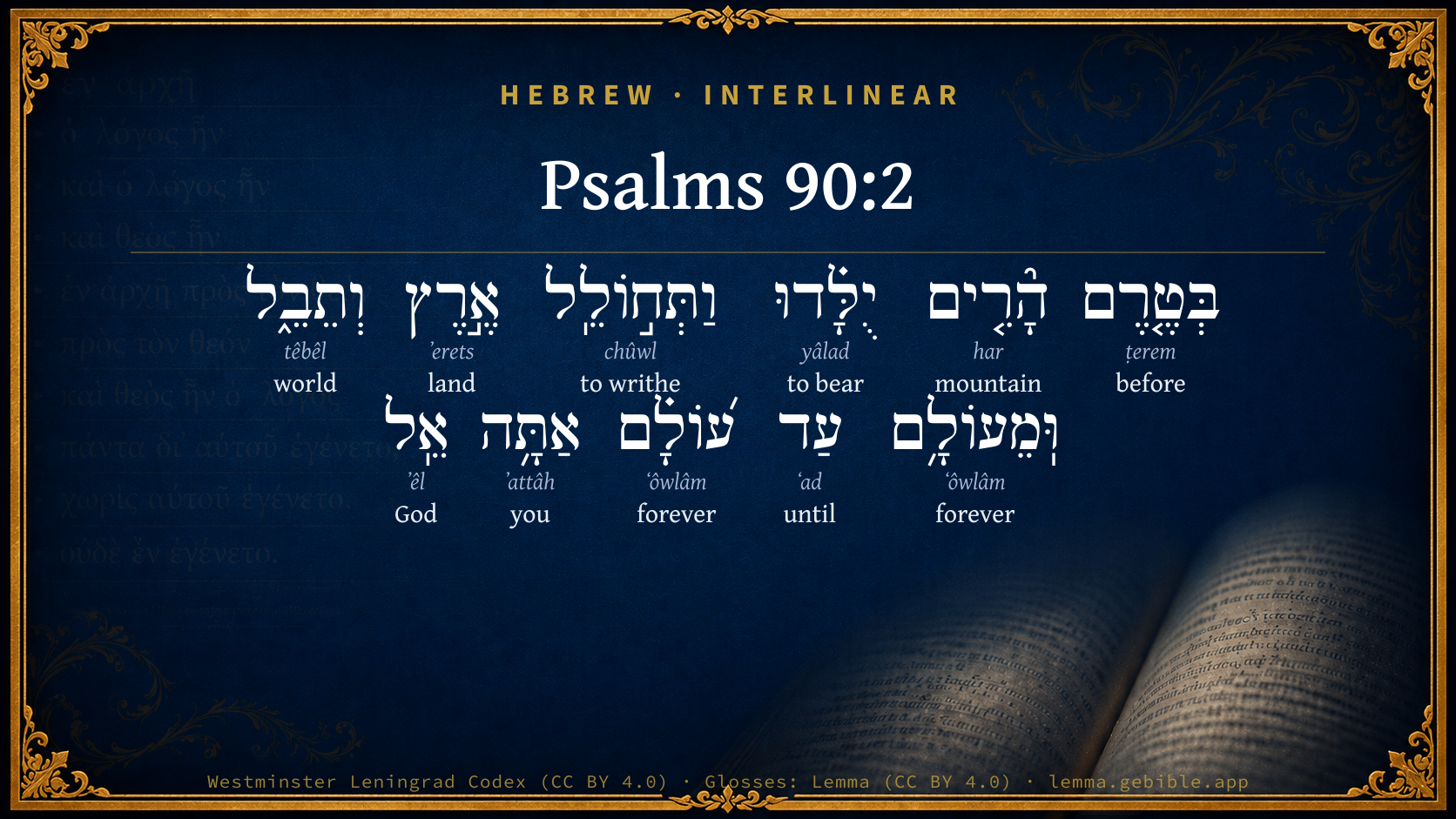
Hebrew (Westminster Leningrad Codex) Psalms 90:2 appears in the Hebrew Old Testament. The text above is from the Westminster Leningrad Codex. Each word links to its Strong’s number, a concise gloss, and parsing drawn from the Open Scriptures Hebrew Bible morphology. Click any word for its full Brown-Driver-Briggs (BDB) entry.
Download image
Cite this verse

Psalms 90:2 (World English Bible). Public Domain. Lemma interlinear Bible study tool, https://lemma.gebible.app/v/psalms/90/2.

Show BibTeX & RIS
BibTeX
RIS
English Translation
Before the mountains were brought forth, Or ever you had formed the earth and the world, Even from everlasting to everlasting, you are God.
World English Bible · Public Domain
Download a study sheet

One document with this verse’s original text, its word-by-word gloss line, the meaning frame, cross-references with their text, attributed commentary, and full source and license credits — printable, and it pastes into notes with its structure intact.

This verse Autodidact and up

Study sheet (.html) Plain text (.txt)

A passage Seminary Student

Up to 50 verses in one chapter. A passage sheet keeps up to 6 commentary sources and 12 cross-references per verse, in the order this page ranks them, and says so on the sheet whenever that leaves anything out. Ask for a single verse and you get the Autodidact verse sheet above.

Everything on this page stays free to read, with no account — the sheet is a download of what is already on screen, not access to it.

Want to remove ads? Support Godless Engineer
Compare translations 3

The same verse in 3 English versions, stacked beneath the original-language interlinear above. Click any original word for its lexicon entry.

Each is an independent rendering of the whole verse — the interlinear is not word-aligned to these translations.

Highlighted words mark where these versions differ — a whole-verse word diff, not a word-by-word alignment.

  • World English Bible Public Domain
    Before the mountains were brought forth, Or ever you had formed the earth and the world, Even from everlasting to everlasting, you are God.
  • King James Version Public Domain
    Before the mountains were brought forth, or ever thou hadst formed the earth and the world, even from everlasting to everlasting, thou art God.
  • unfoldingWord Literal Text CC BY-SA 4.0
    Before the mountains were born or you brought forth the earth and the world, even from forever to forever, you God.

unfoldingWord Literal Text — © unfoldingWord, licensed CC BY-SA 4.0. Word-aligned USFM3 via Door43 (git.door43.org/unfoldingWord/en_ult).

Versions to compare (up to 4)

3 of 4 selected

Show all 18 translations

Every available English version of this verse, each an independent rendering of the whole verse.

  • World English Bible Public Domain
    Before the mountains were brought forth, Or ever you had formed the earth and the world, Even from everlasting to everlasting, you are God.
  • Berean Standard Bible Public Domain
    Before the mountains were born or You brought forth the earth and the world, from everlasting to everlasting You are God.
  • Majority Standard Bible Public Domain
    Before the mountains were born or You brought forth the earth and the world, from everlasting to everlasting You are God.
  • King James Version Public Domain
    Before the mountains were brought forth, or ever thou hadst formed the earth and the world, even from everlasting to everlasting, thou art God.
  • American Standard Version (1901) Public Domain
    Before the mountains were brought forth, Or ever thou hadst formed the earth and the world, Even from everlasting to everlasting, thou art God.
  • Revised Version (1885) Public Domain
    Before the mountains were brought forth, or ever thou hadst formed the earth and the world, even from everlasting to everlasting, thou art God.
  • Geneva Bible (1599) Public Domain
    Before the mountaines were made, and before thou hadst formed the earth, and the world, euen from euerlasting to euerlasting thou art our God.
  • Douay-Rheims (1899) Public Domain
    Before the mountains were made, or the earth and the world was formed; from eternity and to eternity thou art God.
  • Young's Literal Translation Public Domain
    Before mountains were brought forth, And Thou dost form the earth and the world, Even from age unto age Thou `art' God.
  • Literal Standard Version CC BY-SA 4.0
    Before mountains were brought forth, || And You form the earth and the world, || Even from age to age You [are] God.
  • Unlocked Literal Bible CC BY-SA 4.0
    Before the mountains were formed, or you formed the earth and the world, from everlasting to everlasting, you are God.
  • unfoldingWord Literal Text CC BY-SA 4.0
    Before the mountains were born or you brought forth the earth and the world, even from forever to forever, you God.
  • Darby Bible Public Domain
    Before the mountains were brought forth, and thou hadst formed the earth and the world, even from eternity to eternity thou art ùGod.
  • World Messianic Bible Public Domain
    Before the mountains were born, before you had formed the earth and the world, even from everlasting to everlasting, you are God.
  • Webster's Bible Public Domain
    Before the mountains were brought forth, or ever thou hadst formed the earth and the world, even from everlasting to everlasting, thou art God.
  • Free Bible Version CC BY-SA 4.0
    Before the mountains were born, before you gave birth to the earth and the universe, from eternity past to eternity future, you are God.
  • Bible in Basic English Public Domain
    Before the mountains were made, before you had given birth to the earth and the world, before time was, and for ever, you are God.
  • JPS Tanakh (1917) Public Domain
    Before the mountains were brought forth, or ever Thou hadst formed the earth and the world, even from everlasting to everlasting, Thou art God.

Literal Standard Version (2020), Covenant Press — licensed CC BY-SA 4.0. Text via the HelloAO Bible API (eBible.org). Unlocked Literal Bible (unfoldingWord) — licensed CC BY-SA 4.0. Text via the HelloAO Bible API (eBible.org). unfoldingWord Literal Text — © unfoldingWord, licensed CC BY-SA 4.0. Word-aligned USFM3 via Door43 (git.door43.org/unfoldingWord/en_ult). Free Bible Version, Dr. Jonathan Gallagher — licensed CC BY-SA 4.0. Text via the HelloAO Bible API (eBible.org).

Word by word

More ways to search: Search by grammar → Find every occurrence → Compare this word →

Practice this passage: Drill this verse → Learn its vocabulary →

וְתֵבֵ֑ל
têbêl
H8398
“and · world”
Conjunction + Noun, Common, Feminine, Singular, Absolute
Part of Speech
Conjunction + Noun
Type
Common
Gender
Feminine
Number
Singular
State
Absolute
Full BDB Definition

Origin: from H2986

TWOT: 835h

world
  1. בְּטֶ֤רֶם ṭerem H2962 “in/at · before” Preposition + Adverb
  2. הָ֘רִ֤ים har H2022 “mountains” Noun, Common, Masculine, Plural, Absolute
  3. יֻלָּ֗דוּ yâlad H3205 “to bear” Verb, Pual, Imperfect, 3rd Person, Masculine, Plural
  4. וַתְּח֣וֹלֵֽל chûwl H2342 “and · to writhe” Conjunction + Verb, Polel, Sequential Imperfect, 2nd Person, Masculine, Singular
  5. אֶ֣רֶץ ʼerets H776 “land” Noun, Common, Both, Singular, Absolute
  6. וּֽמֵעוֹלָ֥ם ʻôwlâm H5769 “and · from · forever” Conjunction + Preposition + Noun, Common, Masculine, Singular, Absolute
  7. עַד ʻad H5704 “until” Preposition
  8. ע֝וֹלָ֗ם ʻôwlâm H5769 “forever” Noun, Common, Masculine, Singular, Absolute
  9. אַתָּ֥ה ʼattâh H859 “you” Pronoun, Personal, 2nd Person, Masculine, Singular
  10. אֵֽל ʼêl H410 “God” Noun, Common, Masculine, Singular, Absolute

About this verse

These counts appear in no published source. They are computed here, from the morphology-tagged text and Lemma’s own curated glosses. What Lemma adds →

11
words
10
distinct lemmas
Wisdom
section

Shared distinctive vocabulary

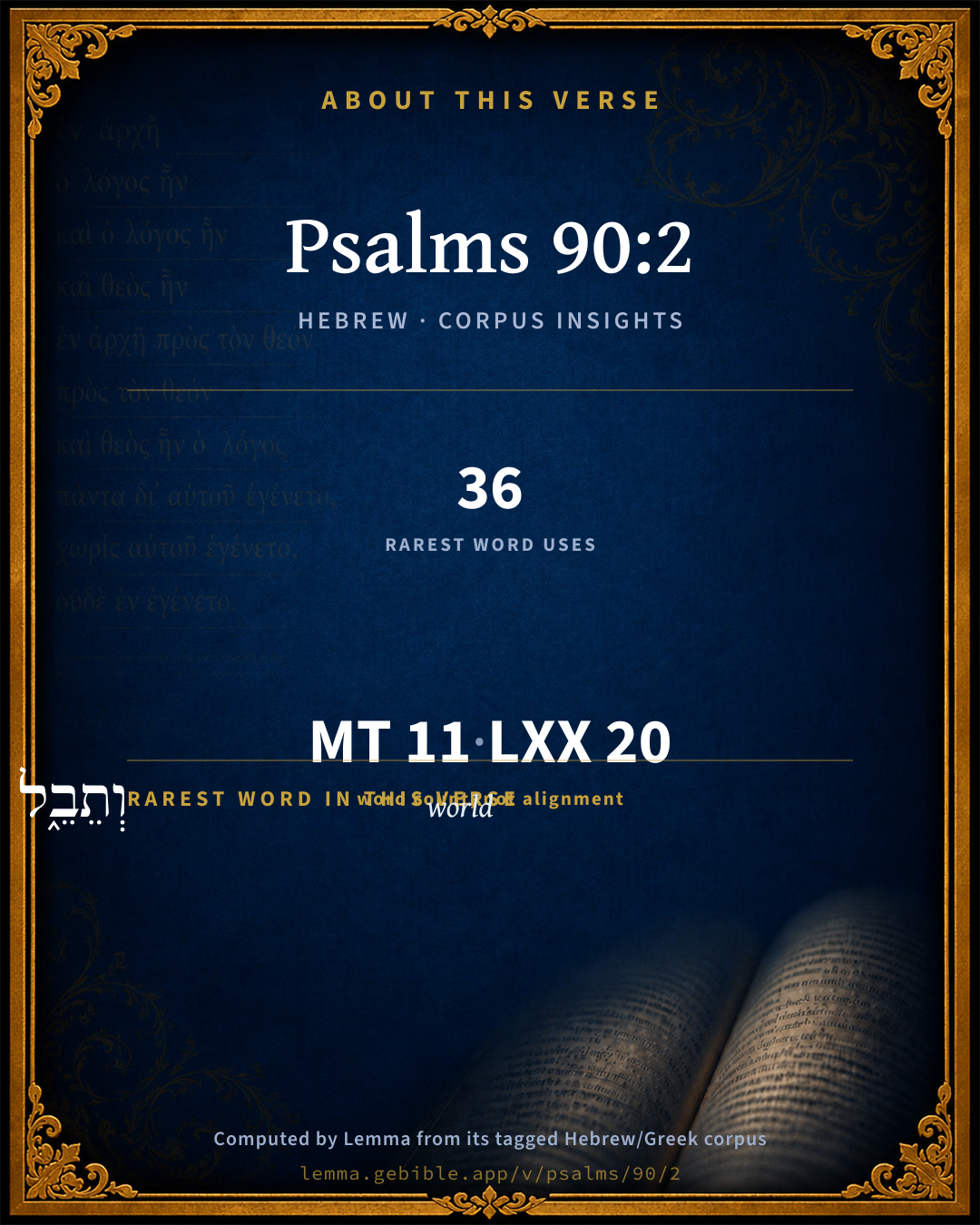
וְתֵבֵ֑ל world H8398 occurs in 36 verses of the Hebrew Bible. Also found in:

Grammatical profile

  • 2 verbs
  • 6 nouns
  • 1 pronoun
  • 1 preposition
  • 1 adverb

Verb forms

  • יֻלָּ֗דוּ Pual · Imperfect
  • וַתְּח֣וֹלֵֽל Polel · Sequential Imperfect

Repetition

A word recurs within this verse — often emphatic in Hebrew:

  • וּֽמֵעוֹלָ֥ם forever H5769 ×2

Hebrew & Septuagint length

In English translation the verse runs 24 words from the Hebrew and 20 from the Septuagint (LXX English) — closely comparable.

A rough comparison of the two English renderings, which tokenize alike — not a word-level alignment.

Word counts can differ between the Hebrew and the Greek without any difference in meaning — e.g. the Hebrew direct-object marker אֵת has no separate Greek word, and Greek often adds the article ὁ.

In the original languages it is 11 Hebrew tokens and 20 Greek tokens — but the two are counted differently (Hebrew bundles its prefixes and suffixes into one token; the Greek is in lemma form), so that isn’t a like-for-like length.

Cross-references

19

Topical passages linked to Psalms 90:2 in the Treasury of Scripture Knowledge — connected by theme and wording, ordered by reader-vote popularity; previews shown in the World English Bible.

  • Hebrews 13:8 Jesus Christ is the same yesterday, today, and forever.
  • Genesis 1:1 In the beginning God created the heavens and the earth.
  • Psalms 102:24–27 I said, "My God, don't take me away in the midst of my days. Your years are throughout all generations.
  • Psalms 93:2 Your throne is established from long ago. You are from everlasting.
  • Revelation 1:8 "I am the Alpha and the Omega," says the Lord God, "who is and who was and who is to come, the Almighty."
  • Psalms 33:9 For he spoke, and it was done. He commanded, and it stood firm.
  • 1 Timothy 6:15–16 which in its own times he will show, who is the blessed and only Ruler, the King of kings, and Lord of lords;
  • Habakkuk 1:12 Aren't you from everlasting, Yahweh my God, my Holy One? We will not die. Yahweh, you have appointed him for judgment. You, Rock, have established him to punish.
  • Hebrews 1:10–12 And, "You, Lord, in the beginning, laid the foundation of the earth. The heavens are the works of your hands.
  • Psalms 146:6 Who made heaven and earth, The sea, and all that is in them; Who keeps truth forever;
  • Isaiah 44:6 Thus says Yahweh, the King of Israel, and his Redeemer, Yahweh of Hosts: I am the first, and I am the last; and besides me there is no God.
  • Job 15:7 "Are you the first man who was born? Or were you brought forth before the hills?
  • Job 38:28–29 Does the rain have a father? Or who fathers the drops of dew?
  • Isaiah 57:15 For thus says the high and lofty One who inhabits eternity, whose name is Holy: I dwell in the high and holy place, with him also who is of a contrite and humble spirit, to revive the spirit of the humble, and to revive the heart of the contrite.
  • Job 38:4–6 "Where were you when I laid the foundations of the earth? Declare, if you have understanding.
  • Psalms 103:17 But Yahweh's loving kindness is from everlasting to everlasting with those who fear him, His righteousness to children's children;
  • Proverbs 8:25–26 Before the mountains were settled in place, Before the hills, I was brought forth;
  • Isaiah 45:22 Look to me, and be you saved, all the ends of the earth; for I am God, and there is none else.
  • Micah 5:2 But you, Bethlehem Ephrathah, Being small among the clans of Judah, Out of you one will come forth to me that is to be ruler in Israel; Whose goings forth are from of old, from everlasting.

Cross-references courtesy of OpenBible.info (CC BY 4.0).

Hebrew and Greek witnesses Masoretic Hebrew ↔ Greek Septuagint

The same verse in the two great witnesses to the Old Testament, shown verse-for-verse.

You’re reading Greek Psalm 89 (Hebrew Psalm 90). The Septuagint counts the superscription, so verse numbers can differ from the Hebrew — chapter-level alignment, not verse-by-verse. Numbering follows Rahlfs.

These are two independent witnesses, not word-aligned to each other, and the Septuagint is shown in lemma (dictionary) form.

Hebrew Psalms 90:2 Masoretic · Westminster Leningrad Codex

בְּטֶ֤רֶם הָ֘רִ֤ים יֻלָּ֗דוּ וַתְּח֣וֹלֵֽל אֶ֣רֶץ וְתֵבֵ֑ל וּֽמֵעוֹלָ֥ם עַד ע֝וֹלָ֗ם אַתָּ֥ה אֵֽל

Before the mountains were brought forth, Or ever you had formed the earth and the world, Even from everlasting to everlasting, you are God.

World English Bible · Public Domain

Greek LXX Greek Psalm 89:2 Septuagint · lemma form

πρό ὁ ὄρος γίγνομαι καί πλάσσω ὁ γῆ καί ὁ οἰκέω καί ἀπό ὁ αἰών ἕως ὁ αἰών σύ εἰμί

Before the mountains existed, and before the earth and the world were formed, even from age to age, You are.

LXX2012 (modern English Septuagint) · Public Domain

On this verse, Ellicott's Commentary for English Readers discusses the Septuagint’s reading. Read the note in Commentary ↓

Hebrew: Westminster Leningrad Codex (CC BY 4.0). Greek: Septuagint (public domain); English from LXX2012 (modern English Septuagint) (Public Domain). How the Septuagint differs from the Hebrew →

Commentary

Notes on Psalms 90:2 from classic Christian and Jewish commentators (each source and its license shown beneath its notes). The classic Christian expositions comment on the surrounding passage and are grouped to its opening verse, so a note may address several verses; the Jewish commentaries on the Tanakh (Rashi and others) are per-verse, so they appear only where the commentator wrote on this verse.

Lemma curates 59 commentaries, every one of them public domain or Creative Commons licensed, each selected and text-cleaned for this edition rather than reprinted as found. About our sources →

Trapp's Complete Commentary

John Trapp

Psa 90:2 Before the mountains were brought forth, or ever thou hadst formed the earth and the world, even from everlasting to everlasting, thou [art] God.

Ver. 2. Before the mountains were brought forth] And they were made at the creation, not cast up by the flood, as some have held. Moses first celebrateth God’s eternity, and then setteth forth man’s mortality; that the one being set over against the other, as Solomon speaketh in another case, Ecc 7:14, God may be glorified, and man comforted, which is the main end of the Holy Scriptures, Rom 15:4, and far beyond those consolatiunculae Philosophicae.

John Trapp, A Commentary or Exposition upon All the Books of the Old and New Testament (1647–1656) — public domain. Text from a community e-Sword module.

The Biblical Illustrator

Joseph S. Exell

Psa_90:2

Even from everlasting to everlasting Thou art God.

The eternity o God

I. In what respects God is eternal.

1. Without beginning.

2. Without end.

3. Without succession or change.

Of a creature it may be said, he was, or he is, or he shall be. As it may be said of the flame of a candle, it is flame, but it is not the same individual flame as was before, nor is it the same that will be presently after; there is a continual dissolution of it into air, and a continual supply for the generation of more; while it continues it may be said there is a flame, yet not entirely one, but in a succession of parts: so of a man it may be said, he is in a succession of parts; but he is not the same that he was, and will not be the same that he is. But God is the same without any succession of parts, and of time; of Him it may be said, He is; He is no more now than He was, and He shall be no more hereafter than He is.

II. God is eternal, and must needs be so.

1. This is evident by the name God gives Himself (Exo_3:14). The eternity of God is opposed to the volubility of time, which is extended into past, present, and to come. Our time is but a small drop, as sand to all the atoms and small particles of which the world is made; but God is an unbounded sea of Being,--I am that I am, i.e. an infinite life.

2. God hath life in Himself (Joh_5:26). He hath life by His essence, not by participation. He is a sun to give light and life to all creatures, but receives not light, or life from anything, and therefore He hath an unlimited life; not a drop of life, but a fountain; not a spark of a limited life, but a life transcending all bounds. He hath life in Himself; all creatures have their life in Him, and from Him. He that hath life in himself doth necessarily exist, and could never be made to exist, for then he had not life in himself, but in that which made him to exist, and gave him life. What doth necessarily exist, therefore, exists from eternity; what hath being of itself could never be produced in time, could not want being one moment, because it hath being from its essence, without influence of any efficient cause.

3. If God were not eternal, He were not--

(1) Immutable in His nature;

(2) An infinitely perfect being;

(3) Omnipotent;

(4) The first cause of all.

III. Eternity is only proper to God, and not communicable (1Ti_6:16). All other things receive their being from Him, and can be deprived of their being by Him. All things depend on Him, He of none. All other things are like clothes, which would consume if God preserved them not. Whatsoever is not God, is temporary; whatsoever is eternal, is God.

IV. Uses--

1. Of information.

(1) If God be of an eternal duration, then Christ is God (Col_1:16-17; Heb_13:8; Rev_1:8; Joh_16:28; Joh_17:5). As the eternity of God is the ground of all religion, so the eternity of Christ is the ground of the Christian religion. Could our sins be perfectly expiated had He not an eternal divinity to answer for the offences committed against an eternal God? Temporary sufferings had been of little validity, without an infiniteness and eternity in His person to add weight to His passion.

(2) If God be eternal, He knows all things as present.

(3) How bold and foolish is it for a mortal creature to censure the counsels and actions of an eternal God, or be too curious in his inquisitions!

(4) What a folly and boldness is there in sin, since an eternal God is offended thereby!

(5) How dreadful is it to lie under the stroke of an eternal God!

2. Of comfort.

(1) If God be eternal, His covenant will be so.

(2) If God be eternal, He being our God in covenant is an eternal good and possession.

(3) The enjoyment of God will be as fresh and glorious after many ages as it was at first.

(4) If God be eternal, here is a strong ground of comfort against all the distresses of the Church, and the threats of the Churchs enemies. Gods abiding for ever is the plea Jeremiah makes for his return to his forsaken Church (Lam_5:19).

(5) Since God is eternal, He hath as much power as will to be as good as His word. His promises are established upon His eternity, and this perfection is a main ground of trust (Isa_26:4).

3. For exhortation.

(1) Let us be deeply affected with our sins long since committed. Though they are past with us, they are in regard of Gods eternity present with Him; there is no succession in eternity as there is in time.

(2) Let the consideration of Gods eternity abate our pride.

(3) Let the consideration of Gods eternity take off our love and confidence from the world, and the things thereof. The eternity of God reproaches a pursuit of the world, as preferring a momentary pleasure before an everlasting God; as though a temporal world could be a better supply than a God whose years never fail. (S. Charnock.)

The eternity of God

I. Explication. Eternity is a duration without bounds or limits; now there are two limits of duration, beginning and ending; that which hath always been, is without beginning; that which always shall be, is without ending. But eternity, absolutely taken, comprehends both these, and signifies an infinite duration, which had no beginning, nor shall have any end: so that when we say God is eternal, we mean that He always was, and shall be for ever; that He had no beginning of life, nor shall have any end of days; but that He is from everlasting to everlasting.

II. Proof.

1. From the dictates of natural reason. This attribute of God is of all others least disputed among the philosophers; all agree that God is eternal, and are agreed what eternity is; viz. a boundless duration; and however they did attribute a beginning to their heroes and demons, whence come the genealogies of their gods, yet the Supreme God they looked upon as without beginning; and it is a good evidence that this perfection doth clearly belong to God, that Epicurus, who had the lowest and meanest conceptions of God, yet is forced to attribute this to Him: Tully (do Nat. Deor. lib. I) saith to the Epicureans, Where, then, is your happy and eternal Being, by which two epithets you express God? And Lucretius gives this account of the Divine nature, It is absolutely necessary to the nature of the gods to pass an eternity in profound peace and quiet.

2. From Scripture and Divine revelation. St. Peters conversion of the words, One day is as a thousand years, etc., only signifies this, that the longest duration of time is so inconsiderable to God, that it is as the shortest; that is, bears no proportion to the eternity of God. But directly, the Scripture frequently mentions this attribute (Gen_21:33; Deu_33:27; Isa_57:15); and this, as it is attributed to Him in respect of His being, so in respect of all His other perfections (Psa_103:17; Rom_1:20; 1Ti_1:17; Gal_1:5).

III. Doctrinal corollaries.

1. From the eternity of God, we may infer, that He is of Himself. That which always is can have nothing before it to be a cause of its being.

2. We may infer the necessity of His being. It is necessary everything should be, when it is; now, that which is always is absolutely necessary, because always so.

3. The immutability of the Divine nature; for being always, He is necessarily; and being necessarily, He cannot but be what He is; a change of His being is as impossible as a cessation.

IV. Practical inferences. The consideration of Gods eternity may serve--

1. For the support of our faith. There are two attributes which are the proper objects of our faith and confidence--Gods goodness, and His power; both these are eternal.

2. For the encouragement of our obedience. We serve the God who can give us an everlasting reward.

3. For the terror of wicked men. (J. Tillotson.)

The eternity of God

Time and space are not God; but creations of God: with Him it is universal here; so it is an everlasting how. (T. Carlyle.)

The Biblical Illustrator, edited by Joseph S. Exell (c. 1880s–1900s) — public domain. Text from a community e-Sword module.

Joseph Benson's Commentary

Psa 90:2. Before the mountains — The most fixed and stable parts of the earth; were brought forth — That is, arose out of the waters; or ever thou hadst formed the earth, &c. — That is, from eternity, which is frequently described in this manner; even from everlasting thou art God — Thou hadst thy power and thy perfections from all eternity. And this eternity of God is here mentioned for two reasons: 1st, That men, by the contemplation thereof, might be brought to a deeper sense of their own frailty, which is the foundation of humility and of all true piety; and to a greater reverence for, and admiration of, the Divine Majesty. And, 2d, For the comfort of God’s people, who, notwithstanding all their present miseries, have a sure and everlasting refuge and portion in him.

Joseph Benson's Commentary on the Old and New Testaments (1811–1818) — public domain. Text from a community e-Sword module.

J. A. Alexander on Psalms

Joseph Addison Alexander

2. (Psa 90:2) Before mountains were born, and (before) thou hadst brought forth earth and land, and (indeed) from eternity to eternity, thou (art) God. The mountains are first mentioned, according to a scriptural usage which de scribes them as the oldest portions of the earth. See Gen 49:26, Num 23:7, Deu 33:15, Hab 3:6. By a strong but common and intelligible figure, creation is here described as generation. This is true not only of the first verb but of the second, which is too vaguely rendered in the common version (thou hadst formed). Earth, as opposed to heaven; land, as opposed to sea. These are separately mentioned, as in the account of the creation. See Gen 1:1; Gen 1:9. The last clause may also be translated, thou art, O God! It then simply asserts his existence from eternity. According to the other and more usual construction, it likewise asserts his omnipotence, the attribute denoted by the divine name here employed. This is the fuller and more comprehensive sense; but in favour of the other may be urged, that it is simpler and agrees best with the proximate design of the Psalmist to contrast the eternal God with short-lived man.

Joseph Addison Alexander, The Psalms Translated and Explained (1850) — public domain. Text from a community e-Sword module.

Tyndale Open Study Notes

Tyndale Open Resources

90:2 The Lord is the eternal God. • The Lord gave birth to the earth by creating it.

Tyndale Open Study Notes — © Tyndale Open Resources, licensed CC BY-SA 4.0. Text via the HelloAO Bible API.

Geneva Bible (1599)

Geneva Bible translators

Thou hast chosen us to be thy people before the foundations of the world were laid.

Geneva Bible (1599) marginal notes — public domain. Text via Bolls.life.

Adam Clarke's Commentary

Verse 2. Before the mountains were brought forth] The mountains and hills appear to have been everlasting; but as they were brought forth out of the womb of eternity, there was a time when they were not: but THOU hast been ab aeternitate a parte ante, ad aeternitatem a parte post; from the eternity that is past, before time began; to the eternity that is after, when time shall have an end. This is the highest description of the eternity of God to which human language can reach.

Adam Clarke's Commentary on the Bible (1810–1826) — public domain. Text from a community e-Sword/MySword module.

John Calvin's Commentaries

2 Before the mountains were brought forth. Moses designs to set forth some high and hidden mystery, and yet he seems to speak feebly, and, as it were, in a puerile manner. For who does not know that God existed before the world? This we grant is a truth which all men admit; but we will scarcely find one in a hundred who is thoroughly persuaded that God remains unchangeably the same. God is here contrasted with created beings, who, as all know, are subject to continual changes, so that there is nothing stable under heaven. As, in a particular manner, nothing is fuller of vicissitude than human life, that men may not judge of the nature of God by their own fluctuating condition, he is here placed in a state of settled and undisturbed tranquillity. Thus the everlastingness of which Moses speaks is to be referred not only to the essence of God, but also to his providence, by which he governs the world. Although he subjects the world to many alterations, he remains unmoved; and that not only in regard to himself, but also in regard to the faithful, who find from experience, that instead of being wavering, he is steadfast in his power, truth, righteousness, and goodness, even as he has been from the beginning. This eternal and unchangeable steadfastness of God could not be perceived prior to the creation of the world, since there were as yet no eyes to be witnesses of it. But it may be gathered a posteriori; for while all things are subject to revolution and incessant vicissitude, his nature continues always the same. There may be also here a contrast between him and all the false gods of the heathen, who have, by little and little, crept into the world in such vast numbers, through the error and folly of men. But I have already shown the object which Moses has in view, which is, that we mistake if we measure God by our own understanding; and that we must mount above the earth, yea, even above heaven itself, whenever we think upon him.

John Calvin's Commentaries (1540-1563) — public domain. Text from the Calvin Translation Society English edition (1840s-50s) via the Christian Classics Ethereal Library (ccel.org). Calvin's coverage is partial (roughly two-thirds of the Bible); uncommented books and verses are honest gaps, never fabricated. The 19th-century editor's footnotes and remarks are omitted so the notes are faithfully Calvin's own voice.

Ellicott's Commentary for English Readers

(2) Before the mountains.—Render either,

“Before the mountains were born,

Or ever the earth and world were brought forth,”

in synonymous parallelism, or, better, in progressive,

“Before the mountains were born,

Or ever the earth and world brought forth”—

i.e., before vegetation or life appeared. (Comp. Job_15:7.) “Mountains” are a frequent symbol of antiquity, as well as of enduring strength. (See Gen_49:26; Pro_8:25.) The expression, “earth and the world,” may be taken as meaning the earth, as distinguished from either heaven or the sea, and the habitable globe (LXX., οἰκουμένη). (Comp. Pro_8:31.)

From everlasting to everlasting—i.e., from an indefinite past to an indefinite future (literally, from hidden time to hidden).

A Bible Commentary for English Readers, edited by Charles John Ellicott (1878–1897) — public domain. Text from a community e-Sword module.

The Cambridge Bible for Schools and Colleges

gen. ed. J. J. S. Perowne

2. the mountains] Named first because they were regarded as the most ancient parts of the earth. Cp. Deu_33:15; Pro_8:25; Hab_3:6.

thou hadst formed] Lit. didst travail in birth with. The LXX and some other Ancient Versions, startled perhaps by the boldness of the metaphor, read the passive, and hence P.B.V., were made. For the metaphor of the birth of Creation cp. Job_38:8; Job_38:28-29; Gen_2:4. The same words are used of Israel in Deu_32:18.

the world] The Heb. word tçbhçl denotes the fruitful, habitable part of the earth. Cp. Pro_8:31.

from everlasting to everlasting &c.] From eternity to eternity: from the infinite past (as men speak) into the infinite future, thou art El, the God of sovereign power. Cp. Isa_44:6; Isa_48:12. It is also possible to render, Even from everlasting to everlasting art thou, O God (cp. Psa_93:2).

The Cambridge Bible for Schools and Colleges (gen. ed. J. J. S. Perowne; Cambridge University Press, 1878–1918) — public domain. Text from a community e-Sword module.

John Gill's Exposition

Before the mountains were brought forth,.... Or "were born" (b), and came forth out of the womb and bowels of the earth, and were made to rise and stand up at the command of God, as they did when he first created the earth; and are mentioned not only because of their firmness and stability, but their antiquity: hence we read of the ancient mountains and everlasting hills, Gen 49:26, for they were before the flood, and as soon as the earth was; or otherwise the eternity of God would not be so fully expressed by this phrase as it is here, and elsewhere the eternity of Christ, Pro 8:25, or "ever thou hadst formed the earth and the world"; the whole terraqueous globe, and all the inhabitants of it; so the Targum; or "before the earth brought forth; or thou causedst it to bring forth" (c) its herbs, plants, and trees, as on the third day:

even from everlasting to everlasting, thou art God; and so are his love, grace, and mercy towards his people, and his covenant with them; and this is as true of Jehovah the Son as of the Father, whose eternity is described in the same manner as his; see Pro 8:22, and may be concluded from his name, the everlasting Father; from his having the same nature and perfections with his Father; from his concern in eternal election, in the everlasting covenant of grace, and in the creation of all things; and his being the eternal and unchangeable I AM, yesterday, today, and for ever, is matter of comfort to his people.

(b) "nascerentur", Pagninus, Montanus, Tigurine version, Michaelis; so Ainsworth; "geniti essent", Piscator, Gejerus. (c) "antequam parturiret terra", Syr. "aut peperisses terram", Piscator, Amama.

John Gill's Exposition of the Whole Bible (1746–1763) — public domain (CC PDM 1.0). Text via the HelloAO Bible API.

Albert Barnes' Notes on the Bible

Before the mountains were brought forth - Before the earth brought forth or produced the mountains. In the description of the creation it would be natural to represent the mountains as the first objects that appeared, as emerging from the waters; and, therefore, as the “first” or “most ancient” of created objects. The phrase, therefore, is equivalent to saying, Before the earth was created. The literal meaning of the expression, “were brought forth,” is, in the Hebrew, “were born.” The mountains are mentioned as the most ancient things in creation, in Deu 33:15. Compare Gen 49:26; Hab 3:6.

Or ever thou hadst formed - literally, “hadst brought forth.” Compare Job 39:1.

The earth and the world - The word “earth” here is used to denote the world as distinguished either from heaven Gen 1:1, or from the sea Gen 1:10. The term “world” in the original is commonly employed to denote the earth considered as “inhabited,” or as capable of being inhabited - a dwelling place for living beings.

Even from everlasting to everlasting - From duration stretching backward without limit to duration stretching forward without limit; that is, from eternal ages to eternal ages; or, forever.

Thou art God - Or, “Thou, O God.” The idea is, that he was always, and ever will be, God: the God; the true God; the only God; the unchangeable God. At any period in the past, during the existence of the earth, or the heavens, or before either was formed, he existed, with all the attributes essential to Deity; at any period in the future - during the existence of the earth and the heavens, or beyond - far as the mind can reach into the future, and even beyond that - he will still exist unchanged, with all the attributes of Deity. The creation of the universe made no change in him; its destruction would not vary the mode of his existence, or make him in any respect a different being. There could not be a more absolute and unambiguous declaration, as there could not be one more sublime, of the eternity of God. The mind cannot take in a grander thought than that there is one eternal and immutable Being.

Albert Barnes' Notes on the Bible (1834–1885) — public domain. Text from a community e-Sword/MySword module.

Matthew Poole's English Annotations

The mountains; which he mentions as the most fixed and stable part of the earth. Or ever thou hadst formed the earth and the world, i.e. from eternity; which is frequently described in this manner, as Pro 8:25,26; Joh 17:24; Eph 1:4, because there was nothing before the creation of the world but eternity. And thus the words here following do explain it. And this eternity of God is here mentioned, partly that men by the contemplation thereof might be wrought to a deeper sense of their own frailty and nothingness, which is the foundation of humility and of all true piety, and to a greater reverence and admiration of the Divine Majesty; and partly for the comfort of God’s people, who notwithstanding all their present miseries have a sure and everlasting refuge and portion. Thou art God; or, thou art the strong God. Thou hast thy power and all thy perfections, not by degrees, as men have theirs, but from all eternity. Or, thou art or wast, O God.

Matthew Poole's English Annotations on the Holy Bible (1683–1685) — public domain. Text from a community e-Sword/MySword module.

The Treasury of David

Charles H. Spurgeon

Ver. 2. Before the mountains were brought forth. Before those elder giants had struggled forth from nature's womb, as her dread firstborn, the Lord was glorious and self sufficient. Mountains to him, though hoar with the snows of ages, are but new born babes, young things whose birth was but yesterday, mere novelties of an hour.

Or ever thou hadst formed the earth and the world. Here too the allusion is to a birth. Earth was born but the other day, and her solid land was delivered from the flood but a short while ago.

Even from everlasting to everlasting, thou art God, or, "thou art, O God." God was, when nothing else was. He was God when the earth was not a world but a chaos, when mountains were not upheaved, and the generation of the heavens and the earth had not commenced. In this Eternal One there is a safe abode for the successive generations of men. If God himself were of yesterday, he would not be a suitable refuge for mortal men; if he could change and cease to be God he would be but an uncertain dwelling place for his people. The eternal existence of God is here mentioned to set forth, by contrast, the brevity of human life.

Ver. 2. The earth and the world. The word earth here is used to denote the world as distinguished either from heaven (Ge 1:1), or from the sea (Ge 1:10). The term "world" in the original is commonly employed to denote the earth considered as inhabited, or as capable of being inhabited, a dwelling place for living beings. —Albert Barnes.

Ver. 2. From everlasting to everlasting, thou art God. The everlastingness of which Moses speaks is to be referred not only to the essence of God, but also to his providence, by which he governs the world. He intends not merely that he is, but that he is God. —John Calvin.

Ver. 2. Such a God (he says) have we, such a God do we worship, to such a God do we pray, at whose command all created things sprang into being. Why then should we fear if this God favours us? Why should we tremble at the anger of the whole world? If He is our dwelling place, shall we not be safe though the heavens should go to wrack? For we have a Lord greater than all the world. We have a Lord so mighty that at his word all things sprang into being. And yet we are so fainthearted that if the anger of a single prince or king, nay, even of a single neighbour, is to be borne, we tremble and droop in spirit. Yet in comparison with this King, all things beside in the whole world are but as the lightest dust which a slight breath moves from its place, and suffers not to be still. In this way this description of God is consolatory, and trembling spirits ought to look to this consolation in their temptations and dangers. —Martin Luther.

Ver. 2. A Discourse upon the Eternity of God. S. Charnock. Works

1. pg 344-373, Nichol's Edition.

Ver. 2. (last clause). —The consideration of God's eternity may serve,

1. For the support of our faith; in reference to our own condition for the future; in reference to our posterity; and to the condition of God's church to the end of the world.

2. For the encouragement of our obedience. We serve the God who can give us an everlasting reward.

3. For the terror of wicked men.

—Tillotson's Sermon on the Eternity of God.

Psalms 90:3*

Charles H. Spurgeon's The Treasury of David (1869–1885) — public domain. Psalms only. Text from a community e-Sword/MySword module.

Whedon's Commentary on the Bible

Daniel D. Whedon

2. Mountains were brought forth—Or, born. A poetic figure in beautiful harmony with the teachings of geological science. The earth and the [terraqueous] world—The dry land and the globe, for ארצ, (erets,) must here be understood of dry land as distinguished from the ocean. The fundamental passage is Gen_1:10. The description forms an ascending climax as to the age of the oldest things known—mountains, dry land, world, or globe. Having reached the date of creation, all beyond is “from eternity to eternity.”

Thou art God—Thou alone art God, the Being of absolute power, as the name אל, el, denotes. On the absolute power and eternity of this Being hangs the existence of frail man.

Daniel D. Whedon (gen. ed.), Commentary on the Old and New Testaments (1874–1909) — public domain. Text from a community e-Sword module.

The Pulpit Commentary

Before the mountains were brought forth. (comp. Pro_8:25) The "mountains" are mentioned as perhaps the grandest, and certainly among the oldest, of all the works of God. Or ever thou hadst formed the earth and the world; literally, or thou gavest birth to the earth and the world. (comp. Deu_32:18) Even from everlasting to everlasting thou art God. (comp. Psa_93:2 Pro_8:23 Mic_5:2 Hab_1:12)

The past, present, and future eternity of God.

"There is something in the psalm that is wonderfully striking and solemn, acquainting us with the profoundest depths of the Divine nature" (Ewald). In contrast with the ever-passing, ever-changing generations, God is the Abiding, Never-changing One. Independent of all things that exist, God is before all, and is the absolute Creator and Controller of all. The mountains have ever been man"s best image of the stable and permanent, yet he is helped to conceive of God as before the mountains, more stable than the mountains, more enduring than the mountains. "From everlasting to everlasting" is, poetically, "from hidden time to hidden." There are time measures which we can use. There are eternity measures of which we can only think; they are now beyond our mental grasp. The eternity measures alone can be properly applied to God. Two things are the subjects of meditation in the first two verses of this psalm the Divine independence, and the Divine relations. God is the Absolute Being the "I am." God is in gracious, voluntary, relations the "God of Abraham, of Isaac, and of Jacob." Beyond us as the subject suggested may be, it does us good to try our minds with it, and fill our souls with the wonder and the glory of it.

I GOD WAS BEFORE ALL THINGS. Philosophers try to persuade themselves that matter is eternal; or they fix upon the atom, or upon water, as the essential primary thing. They are always driven back behind their conclusions, and urged to say whence comes the atom or the moisture. There is no consistent thinking that does not bring us to the conclusion that there was some self-existent, immaterial Being, who was the absolute originator of all material existence, and still exists in complete and conscious independence of everything he has made. He is beyond and above all the chances and changes of his own handiwork.

II GOD IS IN ALL THINGS. Separable from them, but voluntarily interested in them. The life and light of all this wondrous world we see. The poetical faculty discerns his presence. Human experience attests his practical working. The religious sentiment opens the eyes, and makes the recognition of God easy. When we say all things, we mean absolutely all, not merely those which we are pleased to call religious.

III GOD WILL BE AFTER ALL THINGS. This can but appeal to faith. To us the time is inconceivable when things will no longer exist. Conceive the time when material things exist no longer, you must think of God as still the One Being. In the One who never passes, never changes, we may put the perfect trust. R.T.

The Pulpit Commentary (1880–1919), ed. H.D.M. Spence-Jones & Joseph S. Exell — public domain. Text from a community e-Sword module.

John Wesley's Explanatory Notes

Thou - Thou hadst thy power, and all thy perfections, from all eternity.

John Wesley, Explanatory Notes Upon the Whole Bible (1754–1765) — public domain. Text via the GEBible commentary corpus.

Rashi

Rabbi Shlomo Yitzchaki (Rashi)

Before the mountains were born [i.e., before they] were created, and before You brought forth the earth and the inhabited world, and from the first world to the last world, You are God.

Rashi on the Tanakh — English translations: “The Judaica Press complete Tanach with Rashi, translated by A. J. Rosenberg” (CC BY 4.0); “Pentateuch with Rashi's commentary by M. Rosenbaum and A.M. Silbermann, 1929-1934” (public domain); “The Metsudah Tanach series, Lakewood, N.J” (CC BY 4.0); and “The Book of Joshua, Metsudah Publications, 1997” (CC BY 4.0). Text via Sefaria.

Lesson kit

Teaching starters — assembled from the data on this page, not authored interpretation. Every prompt links to the verse data it draws on. Edit before teaching.

Psalms, in the Wisdom, opens this verse with 11 words (10 distinct Hebrew lemmas). Its most distinctive word is têbêl (“world”). A historical commentator’s framing appears above. Read the whole chapter for the surrounding context.

Discussion questions

  1. What does “world” (têbêl) contribute to the verse as a whole?
  2. How does 1 Samuel 2:8, which shares the word «world», read alongside this verse?
  3. What does the repetition of “forever” (2× in this one verse) do in this verse?
  4. These translations render this verse differently; the difference is in the English rendering, not the original. What questions does that raise?
  5. «יֻלָּ֗דוּ» is a Pual Imperfect verb. How does that grammatical form shape the action described?
  6. Compare how Trapp's Complete Commentary and The Biblical Illustrator read this verse. Where do they agree or differ?

Things to notice

Reading settings

Reading text

Shown beneath each verse's original-language words.

Old Testament
Old Testament edition

Read the OT as the Masoretic Hebrew (MT) or the Greek Septuagint (LXX).

English shown for the Greek Septuagint (in the Hebrew ↔ Greek comparison).

Comparing translations? Open the Compare panel on any verse page to stack up to four side by side.