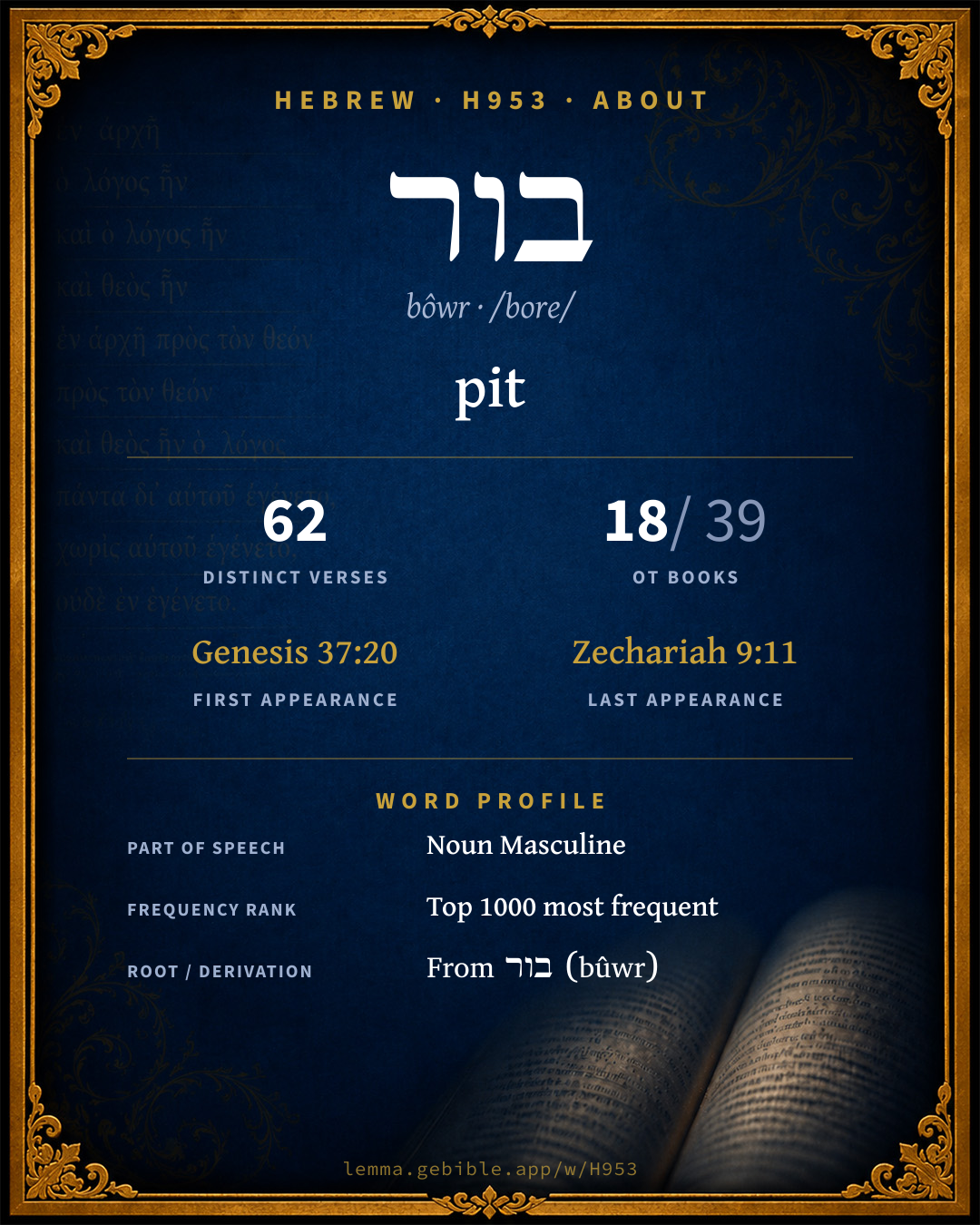
בּוֹר
pit
Full lexicon entry — Brown-Driver-Briggs (BDB)
From Brown-Driver-Briggs (BDB)
Where this word appears
See every Absolute-state word in the Hebrew Bible →
Grammar key — what these labels mean
Part of speech
- Noun
- A naming word — a person, place, thing, or idea.
Noun type
- Common
- A common noun — a general class of person, place, or thing (“king,” “city,” “water”), not a specific name.
- Proper
- A name of a specific person, place, or people (e.g. Abraham, Zion, Israel).
State
- Absolute
- The independent form of a noun, not bound to a following word.
- Construct
- A noun bound to a following noun in a possessive / “of” relationship (the construct chain).
Gender
- Masculine
- Grammatically masculine.
Number
- Singular
- One.
- Plural
- More than one (in Hebrew, generally three or more).
Every verse where H953 appears in the Book of Proverbs — 3 distinct verses. Click any verse to open its interlinear word-by-word view. Verse text shown in the World English Bible for context — . Each verse’s Hebrew form is shown with its reference; the English is not keyword-highlighted, since the data carries no word-level English alignment. Use “Compare translations” on any verse to read it across multiple English versions. This concordance covers the Hebrew Bible; Septuagint (Greek Old Testament) occurrences are not indexed here.
Proverbs
- Proverbs 1:12 בֽוֹר n c ms Let's swallow them up alive like Sheol, And whole, like those who go down into the pit.
- Proverbs 5:15 מִ/בּוֹרֶ֑/ךָ prep + n c ms cs + sfx pers 2ms Drink water out of your own cistern, Running water out of your own well.
- Proverbs 28:17 בּ֥וֹר n c ms A man who is tormented by life blood will be a fugitive until death; No one will support him.
About this entry
At a glance — auto-summarized from this page’s data, not written by a person. Every figure links to its source below. This summary describes the numbers; it doesn’t interpret them.
בור — transliterated bôwr — is a Hebrew noun carrying the sense “pit.” It first appears in Genesis 37:20. The Hebrew Bible uses it across 62 verses — moderately common. Each statement above links to its evidence; the full detail follows below.
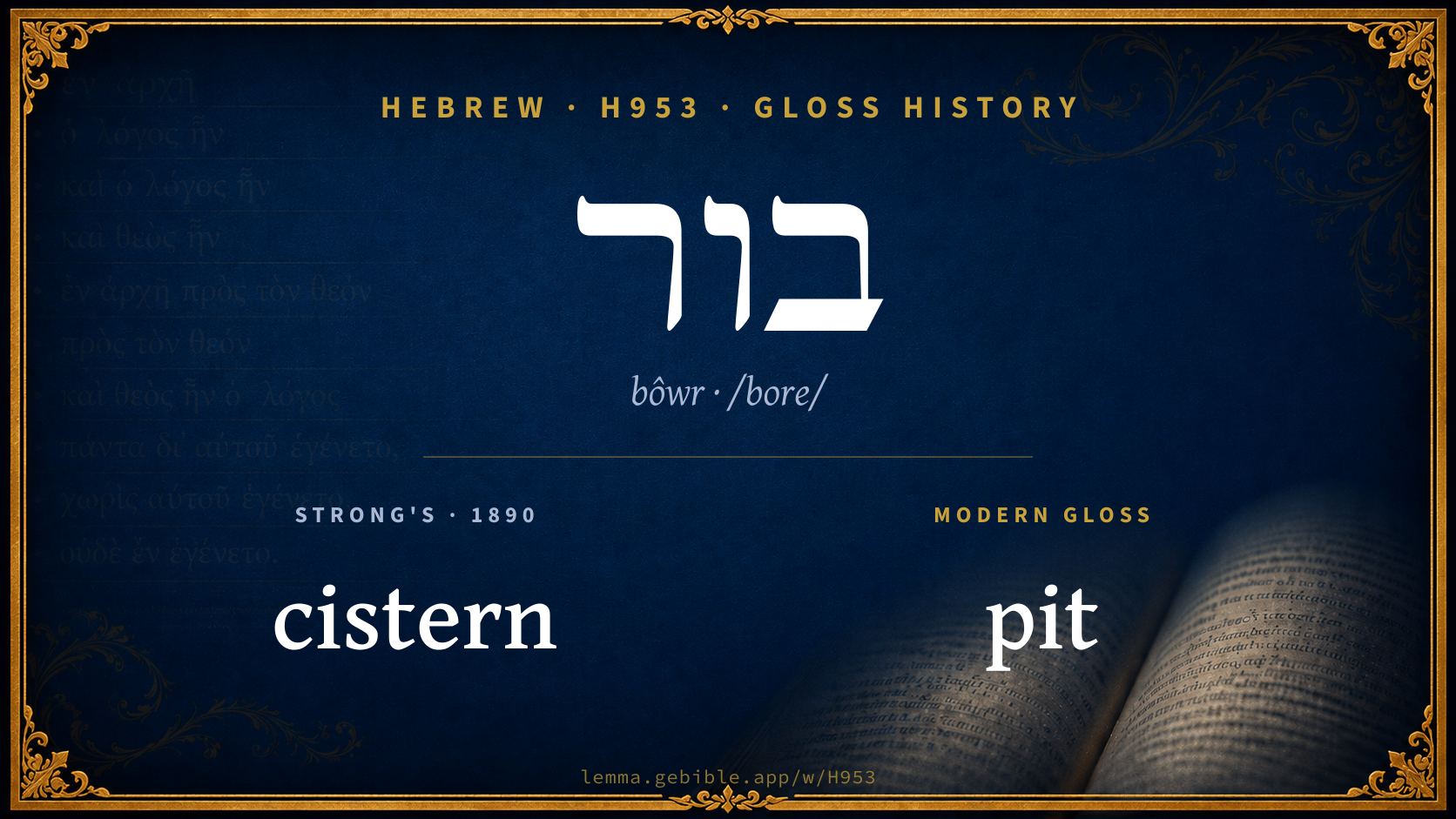
Gloss history
Strong's 1890 vs modern scholarship
About this word
Strong's H953 catalogs a Hebrew word from the Hebrew Old Testament.
These counts are not copied from any lexicon or concordance. They are computed here, from the morphology-tagged Hebrew Old Testament. What Lemma adds →
- 62
- distinct verses
- The word appears in 62 distinct verses.
- 18 / 39
- OT books
- The word appears in 18 of 39 Old Testament books.
- #582
- by frequency
- Top 1000 most frequent Hebrew words (rank 582 of 8,640 Hebrew words by occurrence).
View all 62 occurrences in the concordance →
By section of the Old Testament
By traditional corpus
Conventional, traditional groupings — biblical authorship is debated, so this is a traditional corpus grouping, not an authorship claim. Each share is this word’s portion of its verses in that division of the Hebrew canon. Each figure is a share of the word’s 62 distinct verses.
- Prophets (Nevi'im) 32 verses · 52%
- Writings (Ketuvim) 18 verses · 29%
- Torah (Pentateuch) 12 verses · 19%
How translations render this word
Counts come from each version’s own published word-to-Strong’s tagging or interlinear alignment — an approximate guide to how each version renders this word, not a word-level alignment the data otherwise carries. Because each total is that version’s own tagged count, the per-version totals vary from one another and need not match the appearance or distinct-verse counts above. These counts may also differ from a printed concordance because Lemma counts each distinctly tagged rendering and does not collapse phrase taggings into a single head-word total. This is a fixed set of word-tagged versions (KJV, ASV, BSB, ULT) and does not change with the reading translation you choose elsewhere. Each version’s license is shown beside its name below (and on Sources).
BDB lists this Strong’s number as 6 distinct words (homographs). Each count above pools all of them and is not split by sense — see the Senses section below. A low-frequency rendering may belong to a different one of those words, not the primary meaning.
- King James Version†: Pit 38×, Dungeon 11×, Well 6×
- American Standard Version†: Pit 32×, Dungeon 11×, Well 7×
- Berean Standard Bible†: Pit 33×, Cistern 9×, Well 6×
- unfoldingWord Literal Text†: Pit 28×, Cistern 11×, Cisterns 5×
King James Version Public Domain
Renders H953 across 67† tagged occurrences — most commonly:
Plus 5 renderings that appear only once — usually multi-word phrases or single function words the recovered tagging swept in, not distinct renderings. Not rendered by a distinct English word in 2 further occurrences.
American Standard Version Public Domain
Renders H953 across 67† tagged occurrences — most commonly:
Plus 10 renderings that appear only once — usually multi-word phrases or single function words the recovered tagging swept in, not distinct renderings.
Berean Standard Bible Public Domain
Renders H953 across 62† tagged occurrences — most commonly:
Plus 5 renderings that appear only once — usually multi-word phrases or single function words the recovered tagging swept in, not distinct renderings. Not rendered by a distinct English word in 5 further occurrences.
unfoldingWord Literal Text CC BY-SA 4.0
Renders H953 across 59† tagged occurrences — most commonly:
Plus 6 renderings that appear only once — usually multi-word phrases or single function words the recovered tagging swept in, not distinct renderings.
Senses in the full BDB
What do BDB’s symbols mean?
BDB uses these scholarly abbreviations:
| Symbol | Meaning |
|---|---|
| 𝔊 | the Septuagint (the ancient Greek translation, LXX) |
| 𝔙 | the Vulgate (the Latin translation) |
| 𝔖 | the Syriac version (the Peshitta) |
| 𝔗 | the Targum (the Aramaic translation) |
| ψ | the Psalms |
| √ | root (the underlying root or stem) |
| ‖ | parallel passage (a synonymous or contrasted parallel) |
| † | the dagger: every passage where the word occurs is cited |
The 5 senses and sub-senses the full Brown-Driver-Briggs lexicon distinguishes for this word, in lexicon order (not ranked by frequency), with BDB’s own verbatim wording and sub-sense lettering. Shown in Hebrew script with BDB’s own scholarly abbreviations. The condensed entry is in the Lexicon Entry tab. See also the Forms in the corpus table below.
בור I
- 1. cistern, containing water, made by digging (חצב) Dt 6:11 2 Ch 26:10 Ne 9:25; also (without ref. to origin) Pr 5:15 (‖ בְּאֵר), Lv 11:36 (‖ מַעְיָן), 1 S 19:22 Is 36:16 = 2 K 18:31. e.g. Deuteronomy 6:11
- 2. later appar. well (= בְּאֵר) 1 Ch 11:17, 18 = Qr 2 S 23:15, 16 (yet now no well at Bethlehem RobBR i. 470, 473 cf. also Surveyiii. 28 Guérin Judée i. 130) cf. Ec 12:6 & Je 6:7 Kt כְּהָקִיר בו֯ר מֵימֶיהָ as a well casteth out its water (Qr בַּיִר); but הקיר perhaps keep cool, fresh 𝔊 𝔙 Hi Gf e.g. 1 Chronicles 11:17
- 3. pit Ex 21:33 (vb. פתח), v 33 (כרה), cf. v 34; cf. fig. ψ 7:16 of wickedness (‖ שַׁחַת; vb. כרה, חפר); 1 S 13:6 as hiding-place; 2 S 23:20 (Qr) = 1 Ch 11:22 2 K 10:14 בּוֹר בֵּית עֵ֫קֶד; of pit into wh. Joseph was cast Gn 37:20, 22, 24 (וְהַבּוֹר רֵק אֵין בּוֹ מ֑יִם) v 28, 29(×2) (JE) cf. further Je 41:7, 9; fig. of Sarah as mother of Israel מַקֶּבֶת בּ׳ Is 51:1; fig. of calamity ψ 40:3 בּוֹר שָׁאוֹן; cf. ψ 88:7 בּ׳ תַּחְתִּיּוֹת. e.g. Exodus 21:33
- 4. dungeon (pit with no water in it Je 38:6 Zc 9:11 cf. Gn 37:24 supr.) Gn 40:15; 41:14 (E) Is 24:22 Je 38:6(×2) (בּ׳ אֵין מַיִם) v 7, 9, 10, 11, 13; also בֵּית הַבּוֹר prison Ex 12:29 Je 37:16; fig. of exile Zc 9:11 (מִבּוֹר אֵין מַיִם בּוֹ); cf. also La 3:53, 55. e.g. Jeremiah 38:6
- 5. (poet. & late; never c. art.) pit of the grave Pr 28:17; so אַבְנֵי ב׳ stones of the pit Is 14:19 (of sepulchre, walled with stones) & of Sheʾôl ψ 30:4 (‖ שׁאול); יַרְכְּתֵי ב׳ loins of (the) pit, i.e. remotest pit Is 14:15 (‖ שׁאול) Ez 32:23 especially in phrase יוֹרְדֵי בוֹר those going down to (the) pit ψ 28:1; 143:7 Is 38:18 Ez 26:20; 32:25, 29, 30; also, (‖ שׁאול), ψ 88:5 Pr 1:12; further Ez 26:20 32:18, 24 (all ‖ אֶרֶץ תַּחְתִּיּוֹת), 31:14, 16 (both ‖ אֶרֶץ תַּחְתִּית; v 14 ‖ also מָוֶת, v 16 שְׁאוֹל). e.g. Proverbs 28:17
בור II loc. 2 S 3
בור III cistern, v. sub באר.
בור IV cleanness, v. בֹּר sub ברר.
Senses from the full Brown-Driver-Briggs lexicon (Brown, Driver, Briggs; Oxford 1906 — public domain), digitized via Sefaria, supplemented by the OpenScriptures HebrewLexicon (CC BY 4.0). Full attribution on Sources.
Word origin
I. n.m. Gn 37:20 pit, cistern, well (= בְּאֹר, MI בר, Arabic بُؤْرَةٌ hole or hollow for cooking, Assyrian bûrtum DlPr 182, bûru Lotz TP 169)—בּ׳ abs. Gn 37:22 +; בֹּר Ex 21:33 (2 S 23:20 Qr, v. באר supr.); cstr. בּוֹר 2 K 10:14 + (2 S 23:15, 16 Qr, v. באר supr.); בֹּ֫רָה (ָה loc.) Gn 37:24; sf. בּוֹרוֹ Is 36:16 = בֹּרוֹ 2 K 18:31; בּוֹרֶ֑ךָ Pr 5:15; pl. בֹּרוֹת Gn 37:20 + 3 times; בֹּרֹת Dt 6:11:—
I. n.pr.loc. 2 S 3:26 (cistern of Sirah, Thes cist.declinationis, MV of the pot, v. סיר)
I. Qr Je 6:7 v. בּוֹר (supra).
II. cistern, v. sub באר.
III. cleanness, v. בֹּר sub ברר.
— Brown-Driver-Briggs (Oxford 1906, public domain), digitized via Sefaria, supplemented by the OpenScriptures HebrewLexicon (CC BY 4.0). See Sources.
Derived from בור (bûwr) (H952) — to explain.
Jastrow Dictionary
A second Hebrew/Aramaic lexicon for comparison, covering Aramaic and post-biblical (Talmudic, Targumic, Midrashic) usage that the biblical-Hebrew BDB does not. Matched by lemma rather than by Strong’s number, so a lemma may carry more than one Jastrow headword (shown separately below), and the entries cover usage well beyond the Bible.
בּוּר I
- (√בה, v. בהה) to be empty, waste, uncultivated. Y. Dem. VI, 25ᵇ top שלא תָבוּר א"י in order that Palestine should not lie waste. Ib. יובירו ואל וכ׳; (read as) Y. Ab. Zar. I, end, 40ᵇ יָבוּרוּ let them rather lie waste than rent them to a gentile.—Part. בָּר, בָּרָה a. בֹּורָה. B. Mets. 101ᵃ שתהא ברה בידו in order that the field may rather lie waste in his own possession; cmp. Y. l. c. [Rashi fr. ברר to be clear and firm in his possession, by buying it back from the gentile. R. Ḥan., in Tosaf. a. l., בֹּורָה, lying waste in the gentile’s possession; v. Rabb. D. S. a. l. note 90.] B. Bath. 168ᵃ לא צריכא [דאפי׳] בבורה (v. Rabb. D. S. a. l. note) it means to say that even in the case of an unbroken field being rented, the tenant has to pay the scribe’s fees; Rashi: even if the field will have to lie fallow for some time to come yet. [Cmp. part. fem. חוֹלָה fr. חוּל.]
- a. הוֹבִיר (fr. יבר, or אבר) to let lie waste; to neglect. Arakh. IX, 1 (29ᵇ) הֵבִירָהּ (הוֹ׳) if he let it untilled. Ex. R. s. 27, end הוֹבִירָהּ. B. Mets. IX, 3 הו׳ (Y. ed. הב׳). Gen. R. s. 82 מֵבִירָן (מוֹבִירָן; Koh. R. to IV, 6 מְבַיְּירָן Pi.).
- 1. same. Koh. R. l. c., v. supra. Ex. R. s. 32 (play on שית in אשיתך Jer. III, 19) בִּיַּירְתֶּם עצמיכם ye neglected yourselves (mentally).— e.g. Jeremiah 3:19
- *2. (denom. of בּוֹר II or בִּיר) to prepare a pitfall, to entrap. Lev. R. s. 19; v. בִּירָנִית 2).
בּוּר
- ch. as preced. Kal. Targ. O. Gen. XLVII, 19.—Part. בָּיִיר. Taan. 6ᵇ לא בָּיְירֵי וכ׳ the halls (academies) are not empty (oth. expl.: the gardens do not lie waste). Lev. R. s. 1, beg. he sees חקליה בָּיְירָה וכ׳ (Var. ביירא) his field waste (in the Sabbath year) &c.
- as preced. Hif.—B. Mets. IX, 3; Ib. 104ᵇ אי מוֹבַרְנָא לה if I should let it lie waste.
- to become empty (stupid). Targ. Jer. X, 14 (h. text נבער).
בּוּר II
- (cmp. בֹּור I)
- 1. something waste, wild-growing, whence weed, brier. Targ. Is. VII, 23; a. e. (always with הוֹבַאי q. v.; h. text שמיר ושית).
- 2. (adj.) coarse, indigestible. Pl. בּוּרִין. Koh. R. to I, 18 the one ate מלין ב׳ coarse food.
בֹּור
- to choose, v. בָּרַר.
בֹּור I
- (v. בּוּר I) uncultivated, an uncultured person, mannerless, ruffian. Aboth. II, 5; a. fr.—Mikv. IX, 6 של בור, v. בַּנָּאִים.—Pl. בֹּורִים. Num. R. s. 3, beg.
בּוֹר II
- (rarely fem.) (b. h.; v. בּוּר I a.
- 1. pit, cistern, often = בְּאֵר. Erub. II, 4 contrad. to בְּאֵר, v. ib. 18ᵃ ב׳ מכונסין … באר מים חיים.—B. Bath. 64ᵃ ב׳ בחפירה bor means a pit or well gained by mere digging (without masonry), v. דּוּת. B. Kam. V, 5 (50ᵇ), a. fr. ב׳ שיח ומערה a narrow pit (about ten hand-breadths deep), a lengthy ditch, and a spacious cavity. Y. Sot. II, 18ᵃ, v. בְּאֵר. B. Kam. 6ᵃ ב׳ תוכיח the word bor proves. Taan. 8ᵃ, v. חוּלְדָּה.—Trnsf. obstacle, danger (v. Ex. XXI, 33 sq.). B. Kam. 6ᵃ ב׳ המתגלגל a moving danger (e.g. a rolling stone).—ב׳ וסירה, v. סִירָה.—ב׳ הגדול the Large Well, ב׳ הגולה the Pilgrims’ Well, names of cisterns in the Temple premises. Erub. X, 14; Midd. V, 4.—ב׳ ספינה אלכסנדרית the tank of sweet water in Alexandrian merchantmen. Ohol. VIII, 1; Sabb. 35ᵃ; a. e.—[Ib. 77ᵇ ב׳ זינקא, v. בּוּרְזִינְקָא.] e.g. Exodus 21:33
- 2. a receptacle for oil or wine in the press. Maasr. IV, 1 כב׳ קטן like an oil tank on a small scale. Ab. Zar. IV, 8 עד שירד לב׳ until the wine comes into the tank.—Pl. בּוֹרוֹת. B. Bath. 17ᵇ; a. fr.—Erub. 104ᵇ ב׳ הקרות, v. הָקֵר.—[Y. Snh. I, 19ᵃ bot. אני ובורך = ובוראך I and thy Creator.]
A Dictionary of the Targumim, the Talmud Babli and Yerushalmi, and the Midrashic Literature (Marcus Jastrow; London, Luzac, 1903) — Public Domain. Digitized via Sefaria. Digitized via Sefaria. Full attribution on Sources.
Forms in the corpus
The 43 distinct written forms H953 takes in the Hebrew Bible, most frequent first — each parse links to that state’s occurrences in the concordance. Hebrew forms include their vowel points and cantillation, so a single lemma takes many written forms.
Septuagint verse parallels
This word appears in 61 verses that also exist in the Greek Old Testament (Septuagint), out of the 62 Hebrew verses it occurs in. You can read those verses in Greek by switching the Old Testament edition to the Septuagint.
Read these verses in the Septuagint
- Genesis 37:20
- Exodus 12:29
- Leviticus 11:36
- Deuteronomy 6:11
- 1 Samuel 13:6
- 2 Samuel 3:26
- 2 Kings 10:14
- 1 Chronicles 11:17
- 2 Chronicles 26:10
- Psalms 7:15
- Proverbs 1:12
- Ecclesiastes 12:6
This is a verse-level parallel only — the same verses exist in both the Hebrew and Greek Old Testaments. No word-level Hebrew↔Greek correspondence is claimed: the data carries no such alignment, so no Greek word is shown as this Hebrew word’s translation. Coverage is not total — the Septuagint omits the deuterocanon and renumbers the Psalms, so some Hebrew verses have no direct Greek parallel.