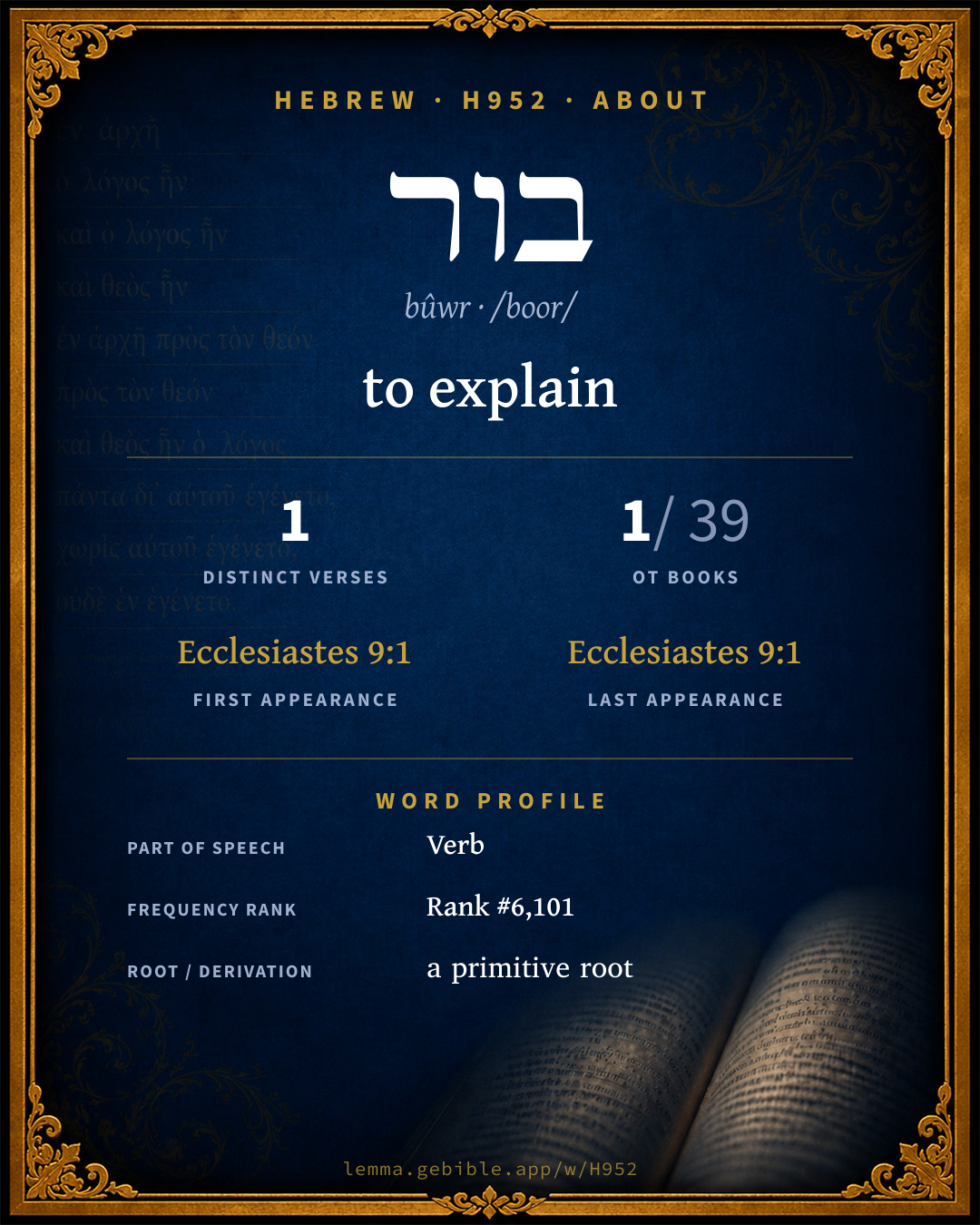
בּוּר
to explain
‘to explain’ is one of 3 main senses fuller range ↓
Full lexicon entry — Brown-Driver-Briggs (BDB)
From Brown-Driver-Briggs (BDB)
Where this word appears
Grammar key — what these labels mean
Stem
- Qal
- The basic, simple active stem — the plain form of the verb (“he wrote”).
Form
- Infinitive Construct
- A bound verbal noun, frequently with prepositions (“to write / in writing”).
Every verse where H952 appears — 1 distinct verse across 1 book. Click any verse to open its interlinear word-by-word view. Verse text shown in the World English Bible for context — . Each verse’s Hebrew form is shown with its reference; the English is not keyword-highlighted, since the data carries no word-level English alignment. Use “Compare translations” on any verse to read it across multiple English versions. This concordance covers the Hebrew Bible; Septuagint (Greek Old Testament) occurrences are not indexed here.
Ecclesiastes 1 verse
About this entry
At a glance — auto-summarized from this page’s data, not written by a person. Every figure links to its source below. This summary describes the numbers; it doesn’t interpret them.
בור — transliterated bûwr — is a Hebrew verb carrying the sense “to explain.” It is rare — just 1 verse in the entire Hebrew Bible. More than three-quarters of its appearances fall in Ecclesiastes. Its lone occurrence is Ecclesiastes 9:1. BDB distinguishes 3 senses for it. Each statement above links to its evidence; the full detail follows below.
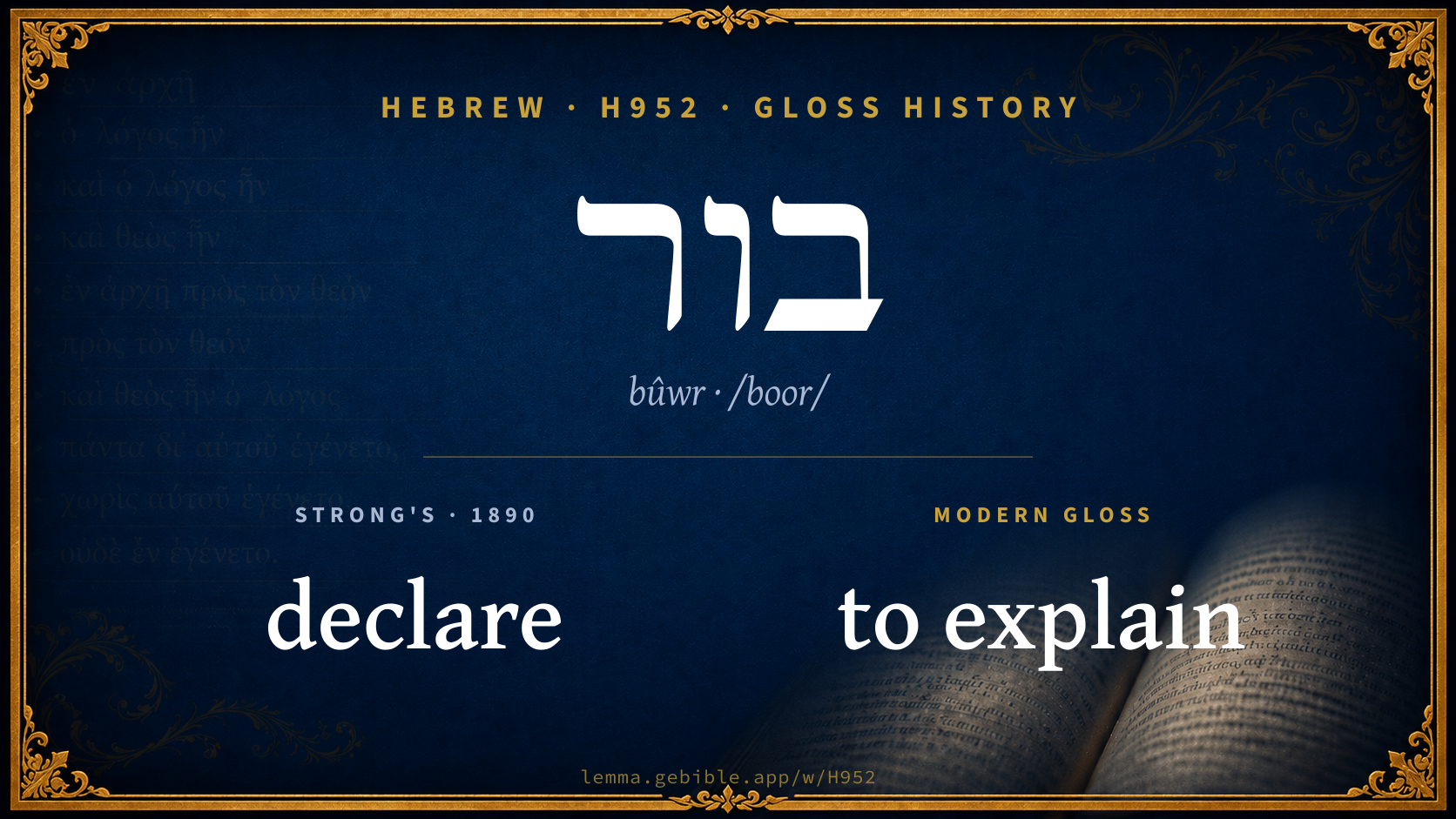
Gloss history
Strong's 1890 vs modern scholarship
About this word
Strong's H952 catalogs a Hebrew word from the Hebrew Old Testament.
These counts are not copied from any lexicon or concordance. They are computed here, from the morphology-tagged Hebrew Old Testament. What Lemma adds →
- 1
- distinct verses
- The word appears in 1 distinct verse.
- 1 / 39
- OT books
- The word appears in 1 of 39 Old Testament books.
- #6,101
- by frequency
- Rank #6,101 (rank 6,101 of 8,640 Hebrew words by occurrence).
View all 1 occurrence in the concordance →
Most concentrated in
- Ecclesiastes 1 verse 100%
By section of the Old Testament
By traditional corpus
Conventional, traditional groupings — biblical authorship is debated, so this is a traditional corpus grouping, not an authorship claim. Each share is this word’s portion of its verses in that division of the Hebrew canon. Each figure is a share of the word’s 1 distinct verse.
- Writings (Ketuvim) 1 verse · 100%
How translations render this word
Counts come from each version’s own published word-to-Strong’s tagging or interlinear alignment — an approximate guide to how each version renders this word, not a word-level alignment the data otherwise carries. Because each total is that version’s own tagged count, the per-version totals vary from one another and need not match the appearance or distinct-verse counts above. These counts may also differ from a printed concordance because Lemma counts each distinctly tagged rendering and does not collapse phrase taggings into a single head-word total. This is a fixed set of word-tagged versions (KJV, ASV, BSB, ULT) and does not change with the reading translation you choose elsewhere. Each version’s license is shown beside its name below (and on Sources).
- King James Version: Declare 1×
- American Standard Version: Explore 1×
- Berean Standard Bible: Concluded 1×
- unfoldingWord Literal Text: Examine 1×, In 1×
King James Version Public Domain
Renders H952 across 1 tagged occurrence — most commonly:
American Standard Version Public Domain
Renders H952 across 1 tagged occurrence — most commonly:
Berean Standard Bible Public Domain
Renders H952 across 1 tagged occurrence — most commonly:
unfoldingWord Literal Text CC BY-SA 4.0
Renders H952 across 2 tagged occurrences — most commonly:
Senses in BDB
The 3 senses BDB distinguishes for this word, in lexicon order (not ranked by frequency or importance). The full entry — with sub-senses — is in the Lexicon Entry tab.
(Qal)
- to make clear, clear up, explain, prove
- (CLBL) to bore into
- (TWOT) to declare (?)
Word origin
בּוּר vb. Qal Ec 9:1; prob. make clear, clear up, explain
— Brown-Driver-Briggs (Oxford 1906, public domain), digitized via Sefaria, supplemented by the OpenScriptures HebrewLexicon (CC BY 4.0). See Sources.
Origin: a primitive root
Jastrow Dictionary
A second Hebrew/Aramaic lexicon for comparison, covering Aramaic and post-biblical (Talmudic, Targumic, Midrashic) usage that the biblical-Hebrew BDB does not. Matched by lemma rather than by Strong’s number, so a lemma may carry more than one Jastrow headword (shown separately below), and the entries cover usage well beyond the Bible.
בּוּר I
- (√בה, v. בהה) to be empty, waste, uncultivated. Y. Dem. VI, 25ᵇ top שלא תָבוּר א"י in order that Palestine should not lie waste. Ib. יובירו ואל וכ׳; (read as) Y. Ab. Zar. I, end, 40ᵇ יָבוּרוּ let them rather lie waste than rent them to a gentile.—Part. בָּר, בָּרָה a. בֹּורָה. B. Mets. 101ᵃ שתהא ברה בידו in order that the field may rather lie waste in his own possession; cmp. Y. l. c. [Rashi fr. ברר to be clear and firm in his possession, by buying it back from the gentile. R. Ḥan., in Tosaf. a. l., בֹּורָה, lying waste in the gentile’s possession; v. Rabb. D. S. a. l. note 90.] B. Bath. 168ᵃ לא צריכא [דאפי׳] בבורה (v. Rabb. D. S. a. l. note) it means to say that even in the case of an unbroken field being rented, the tenant has to pay the scribe’s fees; Rashi: even if the field will have to lie fallow for some time to come yet. [Cmp. part. fem. חוֹלָה fr. חוּל.]
- a. הוֹבִיר (fr. יבר, or אבר) to let lie waste; to neglect. Arakh. IX, 1 (29ᵇ) הֵבִירָהּ (הוֹ׳) if he let it untilled. Ex. R. s. 27, end הוֹבִירָהּ. B. Mets. IX, 3 הו׳ (Y. ed. הב׳). Gen. R. s. 82 מֵבִירָן (מוֹבִירָן; Koh. R. to IV, 6 מְבַיְּירָן Pi.).
- 1. same. Koh. R. l. c., v. supra. Ex. R. s. 32 (play on שית in אשיתך Jer. III, 19) בִּיַּירְתֶּם עצמיכם ye neglected yourselves (mentally).— e.g. Jeremiah 3:19
- *2. (denom. of בּוֹר II or בִּיר) to prepare a pitfall, to entrap. Lev. R. s. 19; v. בִּירָנִית 2).
בּוּר
- ch. as preced. Kal. Targ. O. Gen. XLVII, 19.—Part. בָּיִיר. Taan. 6ᵇ לא בָּיְירֵי וכ׳ the halls (academies) are not empty (oth. expl.: the gardens do not lie waste). Lev. R. s. 1, beg. he sees חקליה בָּיְירָה וכ׳ (Var. ביירא) his field waste (in the Sabbath year) &c.
- as preced. Hif.—B. Mets. IX, 3; Ib. 104ᵇ אי מוֹבַרְנָא לה if I should let it lie waste.
- to become empty (stupid). Targ. Jer. X, 14 (h. text נבער).
בּוּר II
- (cmp. בֹּור I)
- 1. something waste, wild-growing, whence weed, brier. Targ. Is. VII, 23; a. e. (always with הוֹבַאי q. v.; h. text שמיר ושית).
- 2. (adj.) coarse, indigestible. Pl. בּוּרִין. Koh. R. to I, 18 the one ate מלין ב׳ coarse food.
בֹּור
- to choose, v. בָּרַר.
בֹּור I
- (v. בּוּר I) uncultivated, an uncultured person, mannerless, ruffian. Aboth. II, 5; a. fr.—Mikv. IX, 6 של בור, v. בַּנָּאִים.—Pl. בֹּורִים. Num. R. s. 3, beg.
בּוֹר II
- (rarely fem.) (b. h.; v. בּוּר I a.
- 1. pit, cistern, often = בְּאֵר. Erub. II, 4 contrad. to בְּאֵר, v. ib. 18ᵃ ב׳ מכונסין … באר מים חיים.—B. Bath. 64ᵃ ב׳ בחפירה bor means a pit or well gained by mere digging (without masonry), v. דּוּת. B. Kam. V, 5 (50ᵇ), a. fr. ב׳ שיח ומערה a narrow pit (about ten hand-breadths deep), a lengthy ditch, and a spacious cavity. Y. Sot. II, 18ᵃ, v. בְּאֵר. B. Kam. 6ᵃ ב׳ תוכיח the word bor proves. Taan. 8ᵃ, v. חוּלְדָּה.—Trnsf. obstacle, danger (v. Ex. XXI, 33 sq.). B. Kam. 6ᵃ ב׳ המתגלגל a moving danger (e.g. a rolling stone).—ב׳ וסירה, v. סִירָה.—ב׳ הגדול the Large Well, ב׳ הגולה the Pilgrims’ Well, names of cisterns in the Temple premises. Erub. X, 14; Midd. V, 4.—ב׳ ספינה אלכסנדרית the tank of sweet water in Alexandrian merchantmen. Ohol. VIII, 1; Sabb. 35ᵃ; a. e.—[Ib. 77ᵇ ב׳ זינקא, v. בּוּרְזִינְקָא.] e.g. Exodus 21:33
- 2. a receptacle for oil or wine in the press. Maasr. IV, 1 כב׳ קטן like an oil tank on a small scale. Ab. Zar. IV, 8 עד שירד לב׳ until the wine comes into the tank.—Pl. בּוֹרוֹת. B. Bath. 17ᵇ; a. fr.—Erub. 104ᵇ ב׳ הקרות, v. הָקֵר.—[Y. Snh. I, 19ᵃ bot. אני ובורך = ובוראך I and thy Creator.]
A Dictionary of the Targumim, the Talmud Babli and Yerushalmi, and the Midrashic Literature (Marcus Jastrow; London, Luzac, 1903) — Public Domain. Digitized via Sefaria. Digitized via Sefaria. Full attribution on Sources.
Same root — word family
Other BDB entries built from the same root as H952, grouped by Strong’s listed origin. These share a root / origin per the lexicon — not necessarily a shared meaning. Each links to that word’s own entry.
Derived from this word
Compare all same-root words → They share a root, not necessarily a meaning.
Septuagint verse parallels
This word appears in 1 verse that also exists in the Greek Old Testament (Septuagint), out of the 1 Hebrew verse it occurs in. You can read those verses in Greek by switching the Old Testament edition to the Septuagint.
Read these verses in the Septuagint
This is a verse-level parallel only — the same verses exist in both the Hebrew and Greek Old Testaments. No word-level Hebrew↔Greek correspondence is claimed: the data carries no such alignment, so no Greek word is shown as this Hebrew word’s translation. Coverage is not total — the Septuagint omits the deuterocanon and renumbers the Psalms, so some Hebrew verses have no direct Greek parallel.