

Lamentations 3:55

Hebrew (Westminster Leningrad Codex) Lamentations 3:55 appears in the Hebrew Old Testament. The text above is from the Westminster Leningrad Codex. Each word links to its Strong’s number, a concise gloss, and parsing drawn from the Open Scriptures Hebrew Bible morphology. Click any word for its full Brown-Driver-Briggs (BDB) entry.
Download image
Cite this verse

Lamentations 3:55 (World English Bible). Public Domain. Lemma interlinear Bible study tool, https://lemma.gebible.app/v/lamentations/3/55.

Show BibTeX & RIS
BibTeX
RIS
English Translation
I called on your name, Yahweh, out of the lowest dungeon.
World English Bible · Public Domain
Download a study sheet

One document with this verse’s original text, its word-by-word gloss line, the meaning frame, cross-references with their text, attributed commentary, and full source and license credits — printable, and it pastes into notes with its structure intact.

This verse Autodidact and up

Study sheet (.html) Plain text (.txt)

A passage Seminary Student

Up to 50 verses in one chapter. A passage sheet keeps up to 6 commentary sources and 12 cross-references per verse, in the order this page ranks them, and says so on the sheet whenever that leaves anything out. Ask for a single verse and you get the Autodidact verse sheet above.

Everything on this page stays free to read, with no account — the sheet is a download of what is already on screen, not access to it.

Want to remove ads? Support Godless Engineer
Compare translations 3

The same verse in 3 English versions, stacked beneath the original-language interlinear above. Click any original word for its lexicon entry.

Each is an independent rendering of the whole verse — the interlinear is not word-aligned to these translations.

Highlighted words mark where these versions differ — a whole-verse word diff, not a word-by-word alignment.

  • World English Bible Public Domain
    I called on your name, Yahweh, out of the lowest dungeon.
  • King James Version Public Domain
    I called upon thy name, O LORD, out of the low dungeon.
  • unfoldingWord Literal Text CC BY-SA 4.0
    I called on your name, Yahweh, from the pit of the depths.

unfoldingWord Literal Text — © unfoldingWord, licensed CC BY-SA 4.0. Word-aligned USFM3 via Door43 (git.door43.org/unfoldingWord/en_ult).

Versions to compare (up to 4)

3 of 4 selected

Show all 18 translations

Every available English version of this verse, each an independent rendering of the whole verse.

  • World English Bible Public Domain
    I called on your name, Yahweh, out of the lowest dungeon.
  • Berean Standard Bible Public Domain
    I called on Your name, O LORD, out of the depths of the Pit.
  • Majority Standard Bible Public Domain
    I called on Your name, O LORD, out of the depths of the Pit.
  • King James Version Public Domain
    I called upon thy name, O LORD, out of the low dungeon.
  • American Standard Version (1901) Public Domain
    I called upon thy name, O Jehovah, out of the lowest dungeon.
  • Revised Version (1885) Public Domain
    I called upon thy name, O LORD, out of the lowest dungeon.
  • Geneva Bible (1599) Public Domain
    I called vpon thy Name, O Lord, out of the lowe dungeon.
  • Douay-Rheims (1899) Public Domain
    Coph. I have called upon thy name, O Lord, from the lowest pit.
  • Young's Literal Translation Public Domain
    I called Thy name, O Jehovah, from the lower pit.
  • Literal Standard Version CC BY-SA 4.0
    I called Your Name, O YHWH, from the lower pit.
  • Unlocked Literal Bible CC BY-SA 4.0
    I called on your name, Yahweh, from the depths of the pit.
  • unfoldingWord Literal Text CC BY-SA 4.0
    I called on your name, Yahweh, from the pit of the depths.
  • Darby Bible Public Domain
    I called upon thy name, Jehovah, out of the lowest pit.
  • World Messianic Bible Public Domain
    I called on your name, LORD, out of the lowest dungeon.
  • Webster's Bible Public Domain
    I called upon thy name, O LORD, out of the low dungeon.
  • Free Bible Version CC BY-SA 4.0
    I called out for you, Lord, from deep inside the pit.
  • Bible in Basic English Public Domain
    I was making prayer to your name, O Lord, out of the lowest prison.
  • JPS Tanakh (1917) Public Domain
    I called upon Thy name, O LORD, Out of the lowest dungeon.

Literal Standard Version (2020), Covenant Press — licensed CC BY-SA 4.0. Text via the HelloAO Bible API (eBible.org). Unlocked Literal Bible (unfoldingWord) — licensed CC BY-SA 4.0. Text via the HelloAO Bible API (eBible.org). unfoldingWord Literal Text — © unfoldingWord, licensed CC BY-SA 4.0. Word-aligned USFM3 via Door43 (git.door43.org/unfoldingWord/en_ult). Free Bible Version, Dr. Jonathan Gallagher — licensed CC BY-SA 4.0. Text via the HelloAO Bible API (eBible.org).

Word by word

More ways to search: Search by grammar → Find every occurrence → Compare this word →

Practice this passage: Drill this verse → Learn its vocabulary →

About this verse

These counts appear in no published source. They are computed here, from the morphology-tagged text and Lemma’s own curated glosses. What Lemma adds →

5
words
5
distinct lemmas
Prophets
section

Notable vocabulary

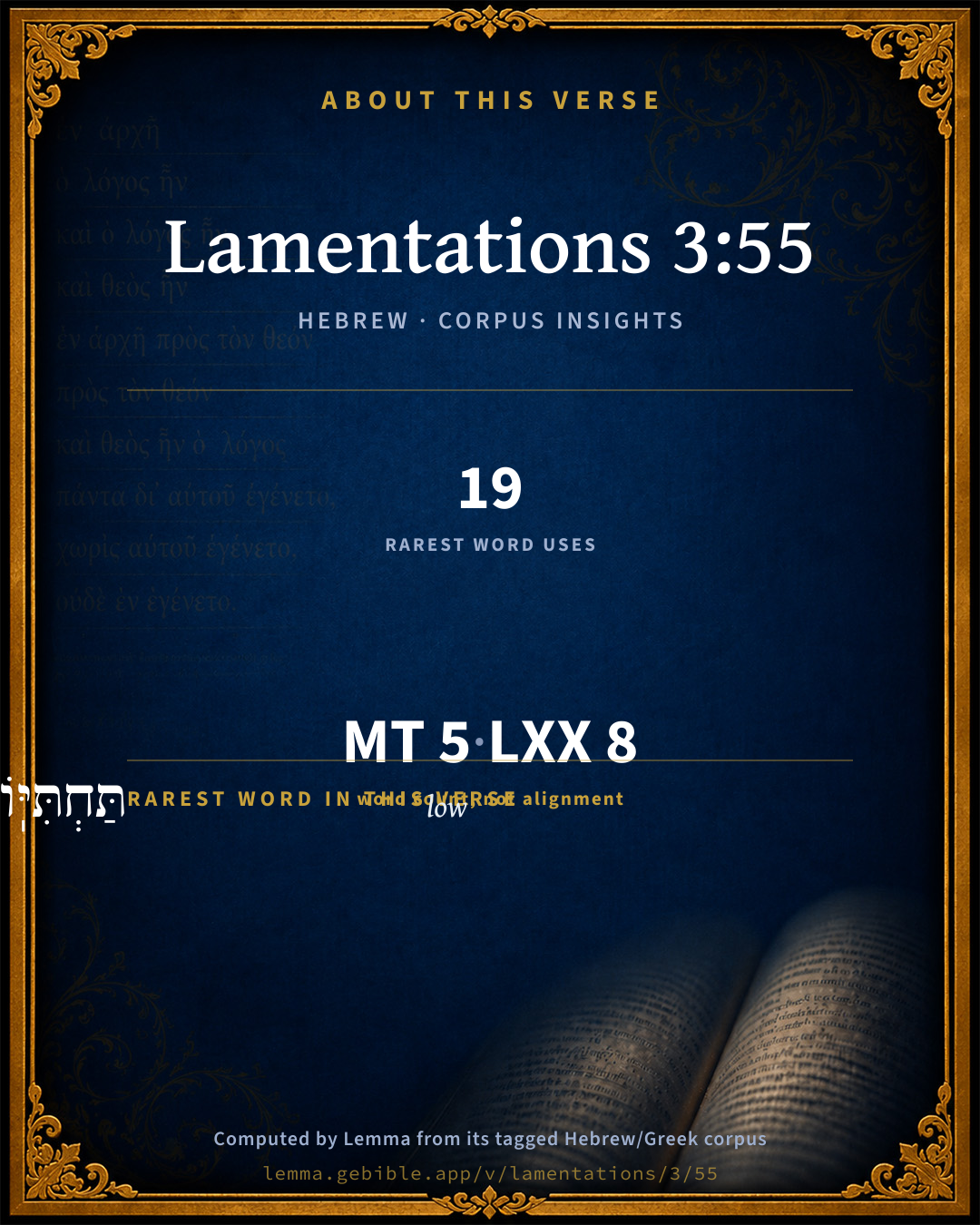
The rarest word here is תַּחְתִּיּֽוֹת low H8482 — appearing just 19 times in the whole Hebrew Bible.

Shared distinctive vocabulary

תַּחְתִּיּֽוֹת low H8482 occurs in 19 verses of the Hebrew Bible. Also found in:

Grammatical profile

  • 1 verb
  • 3 nouns
  • 1 adjective

Verb forms

  • קָרָ֤אתִי Qal · Perfect

Hebrew & Septuagint length

In English translation the verse runs 11 words from the Hebrew and 13 from the Septuagint (LXX English) — closely comparable.

A rough comparison of the two English renderings, which tokenize alike — not a word-level alignment.

Word counts can differ between the Hebrew and the Greek without any difference in meaning — e.g. the Hebrew direct-object marker אֵת has no separate Greek word, and Greek often adds the article ὁ.

In the original languages it is 5 Hebrew tokens and 8 Greek tokens — but the two are counted differently (Hebrew bundles its prefixes and suffixes into one token; the Greek is in lemma form), so that isn’t a like-for-like length.

Cross-references

10

Topical passages linked to Lamentations 3:55 in the Treasury of Scripture Knowledge — connected by theme and wording, ordered by reader-vote popularity; previews shown in the World English Bible.

  • Acts 16:24–28 who, having received such a charge, threw them into the inner prison, and secured their feet in the stocks.
  • 2 Chronicles 33:11–12 Therefore Yahweh brought on them the captains of the host of the king of Assyria, who took Manasseh in chains, and bound him with fetters, and carried him to Babylon.
  • Psalms 18:5–6 The cords of Sheol were round about me; The snares of death came on me.
  • Psalms 40:1–2 I waited patiently for Yahweh. He turned to me, and heard my cry.
  • Psalms 69:13–18 But as for me, my prayer is to you, Yahweh, in an acceptable time. God, in the abundance of your loving kindness, answer me in the truth of your salvation.
  • Psalms 116:3–4 The cords of death surrounded me, The pains of Sheol got a hold of me. I found trouble and sorrow.
  • Psalms 130:1–2 Out of the depths I have cried to you, Yahweh.
  • Psalms 142:3–7 When my spirit was overwhelmed within me, You knew my path. In the way in which I walk, They have hidden a snare for me.
  • Jeremiah 38:6 Then took they Jeremiah, and cast him into the dungeon of Malchijah the king's son, that was in the court of the guard: and they let down Jeremiah with cords. In the dungeon there was no water, but mire; and Jeremiah sank in the mire.
  • Jonah 2:2–4 He said, "I called because of my affliction to Yahweh. He answered me. Out of the belly of Sheol I cried. You heard my voice.

Cross-references courtesy of OpenBible.info (CC BY 4.0).

Hebrew and Greek witnesses Masoretic Hebrew ↔ Greek Septuagint

The same verse in the two great witnesses to the Old Testament, shown verse-for-verse.

These are two independent witnesses, not word-aligned to each other, and the Septuagint is shown in lemma (dictionary) form.

Hebrew Lamentations 3:55 Masoretic · Westminster Leningrad Codex

קָרָ֤אתִי שִׁמְךָ֙ יְהוָ֔ה מִבּ֖וֹר תַּחְתִּיּֽוֹת

I called on your name, Yahweh, out of the lowest dungeon.

World English Bible · Public Domain

Greek LXX Lamentations 3:55 Septuagint · lemma form

ἐπικαλέω ὁ ὄνομα σύ κύριος ἐκ λάκκος κατώτατος

KOPH. I called upon your name, O Lord, out of the lowest dungeon.

LXX2012 (modern English Septuagint) · Public Domain

Hebrew: Westminster Leningrad Codex (CC BY 4.0). Greek: Septuagint (public domain); English from LXX2012 (modern English Septuagint) (Public Domain). How the Septuagint differs from the Hebrew →

Commentary

Notes on Lamentations 3:55 from classic Christian and Jewish commentators (each source and its license shown beneath its notes). The classic Christian expositions comment on the surrounding passage and are grouped to its opening verse, so a note may address several verses; the Jewish commentaries on the Tanakh (Rashi and others) are per-verse, so they appear only where the commentator wrote on this verse.

Lemma curates 59 commentaries, every one of them public domain or Creative Commons licensed, each selected and text-cleaned for this edition rather than reprinted as found. About our sources →

Matthew Henry's Commentary

We may observe throughout this chapter a struggle in the prophet's breast between sense and faith, fear and hope; he complains and then comforts himself, yet drops his comforts and returns again to his complaints, as Psa 42:1-11. But, as there, so here, faith gets the last word and comes off a conqueror; for in these verses he concludes with some comfort. And here are two things with which he comforts himself: -

I. His experience of God's goodness even in his affliction. This may refer to the prophet's personal experience, with which he encourages himself in reference to the public troubles. He that has seasonably succoured particular saints will not fail the church in general. Or it may include the remnant of good people that were among the Jews, who had found that it was not in vain to wait upon God. In three things the prophet and his pious friends had found God good to them: - 1. He had heard their prayers; though they had been ready to fear that the cloud of wrath was such as their prayers could not pass through (Lam 3:44), yet upon second thoughts, or at least upon further trial, they find it otherwise, and that God had not said unto them, Seek you me in vain. When they were in the low dungeon, as free among the dead, they called upon God's name (Lam 3:55); their weeping did not hinder praying. Note, Though we are cast into ever so low a dungeon, we may thence find a way of access to God in the highest heavens. Out of the depths have I cried unto thee (Psa 130:1), as Jonah out of the whale's belly. And could God hear them out of the low dungeon, and would he? Yes, he did: Thou hast heard my voice; and some read the following words as carrying on the same thankful acknowledgment: Thou didst not hide thy ear at my breathing, at my cry; and the original will bear that reading. We read it as a petition for further audience: Hide not thy ear. God's having heard our voice when we cried to him, even out of the low dungeon, is an encouragement for us to hope that he will not at any time hide his ear. Observe how he calls prayer his breathing; for in prayer we breathe towards God, we breathe after him. Though we be but weak in prayer, cannot cry aloud, but only breathe in groanings that cannot be uttered, yet we shall not be neglected if we be sincere. Prayer is the breath of the new man, sucking in the air of mercy in petitions and returning it in praises; it is both the evidence and the maintenance of the spiritual life. Some read it, at my gasping. "When I lay gasping for life, and ready to expire, and thought i was breathing my last, then thou tookest cognizance of my distressed case." 2. He had silenced their fears and quieted their spirits (Lam 3:57): "Thou drewest near in the day that I called upon thee; thou didst graciously assure me of thy presence with me, and give me to see thee nigh unto me, whereas I had thought thee to be at a distance from me." Note, When we draw nigh to God in a way of duty we may by faith see him drawing nigh to us in a way of mercy. But this was not all: Thou saidst, Fear not. This was the language of God's prophets preaching to them not to fear (Isa 41:10, Isa 41:13, Isa 41:14), of his providence preventing those things which they were afraid of, and of his grace quieting their minds, and making them easy, by the witness of his Spirit with their spirits that they were his people still, though in distress, and therefore ought not to fear. 3. He had already begun to appear for them (Lam 3:58): "O Lord! thou hast pleaded the causes of my soul" (that is, as it follows), "thou hast redeemed my life, hast rescued that out of the hands of those who would have taken it away, hast saved that when it was ready to be swallowed up, hast given me that for a prey." And this is an encouragement to them to hope that he would yet further appear for them: "Thou hast delivered my soul from death, and therefore wilt deliver my feet from falling; thou hast pleaded the causes of my life, and therefore wilt plead my other causes."

II. He comforts himself with an appeal to God's justice, and (in order to the sentence of that) to his omniscience.

1. He appeals to God's knowledge of the matter of fact, how very spiteful and malicious his enemies were (Lam 3:59): "O Lord! thou hast seen my wrong, that I have done no wrong at all, but suffer a great deal." He that knows all things knew, (1.) The malice they had against him: "Thou hast seen all their vengeance, how they desire to do me a mischief, as if it were by way of reprisal for some great injury I had done them." Note, We should consider, to our terror and caution, that God knows all the revengeful thoughts we have in our minds against others, and therefore we should not allow of those thoughts nor harbour them, and that he knows all the revengeful thoughts others have causelessly in their minds against us, and therefore we should not be afraid of them, but leave it to him to protect us from them. (2.) The designs and projects they had laid to do him a mischief: Thou hast seen all their imaginations against me (Lam 3:60), and again, "Thou hast heard all their imaginations against me (Lam 3:61), both the desire and the device they have to ruin me; whether it show itself in word or deed, it is known to thee; nay, though the products of it are not to be seen nor heard, yet their device against me all the day is perceived and understood by him to whom all things are naked and open." Note, The most secret contrivances of the church's enemies are perfectly known to the church's God, from whom they can hide nothing. (3.) The contempt and calumny wherewith they loaded him, all that they spoke slightly of him, and all that they spoke reproachfully: "Thou hast heard their reproach (Lam 3:61), all the bad characters they give me, laying to my charge things that I know not, all the methods they use to make me odious and contemptible, even the lips of those that rose up against me (Lam 3:62), the contumelious language they use whenever they speak of me, and that at their sitting down and rising up, when they lie down at night and get up in the morning, when they sit down to their meat and with their company, and when they rise from both, still I am their music; they make themselves and one another merry with my miseries, as the Philistines made sport with Samson." Jerusalem was the tabret they played upon. Perhaps they had some tune or play, some opera or interlude, that was called the destruction of Jerusalem, which, though in the nature of a tragedy, was very entertaining to those who wished ill to the holy city. Note, God will one day call sinners to account for all the hard speeches which they have spoken against him and his people, Jde 1:15.

2. He appeals to God's judgment upon this fact: "Lord, thou hast seen my wrong; there is no need of any evidence to prove it, nor any prosecutor to enforce and aggravate it; thou seest it in its true colours; and now I leave it with thee. Judge thou my cause, Lam 3:59. Let them be dealt with," (1.) "As they deserve (Lam 3:64): Render to them a recompence according to the work of their hands. Let them be dealt with as they have dealt with us; let thy hand be against them as their hand has been against us. They have created us a great deal of vexation; now, Lord, give them sorrow of heart (Lam 3:65), perplexity of heart" (so some read it); "let them be surrounded with threatening mischiefs on all sides, and not be able to see their way out. Give them despondence of heart" (so others read it); "let them be driven to despair, and give themselves up for gone." God can entangle the head that thinks itself clearest, and sink the heart that thinks itself stoutest. (2.) "Let them be dealt with according to the threatenings: Thy curse unto them; that is, let thy curse come upon them, all the evils that are pronounced in thy word against the enemies of thy people, Lam 3:65. They have loaded us with curses; as they loved cursing, so let it come unto them, thy curse which will make them truly miserable. Theirs is causeless, and therefore fruitless, it shall not come; but thine is just, and shall take effect. Those whom thou cursest are cursed indeed. Let the curse be executed, Lam 3:66. Persecute and destroy them in anger, as they persecute and destroy us in their anger. Destroy them from under the heavens of the Lord; let them have no benefit of the light and influence of the heavens. Destroy them in such a manner that all who see it may say, It is a destruction from the Almighty, who sits in the heavens and laughs at them (Psa 2:4), and may own that the heavens do rule," Dan 4:26. What is said of the idols is here said of their worshippers (who in this also shall be like unto them), They shall perish from under these heavens, Jer 10:11. They shall be not only excluded from the happiness of the invisible heavens, but cut off from the comfort even of these visible ones, which are the heavens of the Lord (Psa 115:16) and which those therefore are unworthy to be taken under the protection of who rebel against him.

Matthew Henry's Commentary on the Whole Bible (1708–1710) — public domain (CC PDM 1.0). Text via the HelloAO Bible API.

Trapp's Complete Commentary

John Trapp

Lam 3:55 I called upon thy name, O LORD, out of the low dungeon.

Ver. 55. I called upon thy name, O Lord, out of the low dungeon.] See Psa 130:1 Jon 2:1. {See Trapp on "Psa 130:1"} {See Trapp "Jon 2:1"}

John Trapp, A Commentary or Exposition upon All the Books of the Old and New Testament (1647–1656) — public domain. Text from a community e-Sword module.

Albert Barnes' Notes on the Bible

A prayer for deliverance and for vengeance upon his enemies.

Lam 3:55

Out of the low dungeon - “The lowest pit” of Psa 88:6. Some consider that Ps. 69 was composed by Jeremiah, and is the prayer referred to here (Jer 38:6 note).

Lam 3:56

Thou hast heard - In sending Ebedmelech to deliver me. The next clause signifies “Hide not thine ear to my relief to my cry,” i. e. to my cry for relief.

Lam 3:58

God now appears as the prophet’s next of kin, pleading the lawsuits of his soul, i. e. the controversies which concern his salvation. and rescuing his life, in jeopardy through the malice of his enemies.

Lam 3:59

Wrong - Done to him by the perversion of justice.

Lam 3:60, Lam 3:61

Imaginations - Or, devices.

Lam 3:63

Their sitting down, and their rising up - i. e. all the ordinary actions of their life.

Musick - Or, song, “the subject of it.”

Lam 3:64-66

The versions render the verbs in these verses as futures, “Thou shalt render unto them a recompence,” etc.

Lam 3:65

Give them sorrow of heart - Or, “Thou wilt give them” blindness “of heart.”

Lam 3:66

Persecute ... - Or, pursue them in anger and destroy them, etc.

Albert Barnes' Notes on the Bible (1834–1885) — public domain. Text from a community e-Sword/MySword module.

Keil & Delitzsch

C. F. Keil & F. Delitzsch

Prayer for deliverance, and confident trust in its realization. Lam 3:55. "Out of the lowest pit I call, O Lord, on Thy name;" cf. Psa 88:7, Psa 88:14; Psa 130:1. The perfect קראתי is not a preterite,

(Note: The perfects are so viewed by Ngelsbach, who also thinks that the speaker, in Lam 3:55-58, thanks the Lord for deliverance from the pit, and in Lam 3:55 reminds the Lord of the prayer he has addressed to Him out of the pit. But could he possibly think that the Lord had forgotten this? What, we should like to know, would be the use of this reminder, even if 'תּעלם וגו, Lam 3:56, could be taken as the words of address to the Lord? For we can discover no thanksgiving in Lam 3:55-58. This whole mode of viewing the passage breaks down before Lam 3:59 : "Thou hast seen mine oppression; judge me!" For, if the perfects in Lam 3:55-58 are preterites, then also ראיתה, Lam 3:59, can only be a preterite; and the prophet can only be speaking of injustice that has been done him previously: hence he cannot add thereto the request, "Judge me," inasmuch as the Lord (according to Ngelsbach) has already judged him by delivering him from the pit. Moreover, it is quite arbitrary to understand the perfects in Lam 3:59 and Lam 3:62 as referring to what has been done and is still being done to the speaker by his enemies, if it be agreed that the perfects in Lam 3:55-58 refer only to past events.)

but expresses what has already happened, and still happens. This is evident from the fact that the corresponding perfect, שׁמעתּ, Lam 3:56, is continued by the optative אל־תּעלם. בּור תּחתּיּות is taken from Psa 88:7 : "pit of the lower regions of the earth,"-the תּחתּיּות ארץ, Psa 63:10; Eze 32:18, Eze 32:24, i.e., Sheol, essentially the same with מהשׁכּים, Lam 3:6, which is thereby connected with Psa 88:7, - the dark regions of the depth, whose open mouth is the grave for every one (see Delitzsch on Psalms, l.c.), hence the symbol of mortal danger.

Lam 3:56-66

"Thou hast heard my voice" expresses the full assurance of faith from which the request comes: "Cover not Thine ear from my sighing." רוחה, "breathing out again;" in Eze 8:11, mitigation of oppression, yet not here respiratio, relaxatio (C. B. Michaelis, Rosenmller, etc.), - since the asyndetic לשׁועתי does not accord with such an interpretation, - but a relieving of oneself by means of deeply-drawn sighs, as in Job 32:20; hence "sighing," as Luther has already rendered it, following the Vulgate: ne avertas aurem tuum a singultu meo (Thenius, Gerlach, etc.). - In Lam 3:57 and Lam 3:58, the writer still more fully expresses his confidence that the Lord will accept him. "Thou art near on the day when I call on Thee" is a sentence found in Psa 145:18, and uttered as the experience of all believers. "Thou sayest, Fear not," i.e., Thou assurest me of Thine assistance; cf. Jer 1:8, Jer 1:17, etc. "Thou dost conduct the causes (Ger. Streitsachen) of my soul" (ריבי נפשׁי), i.e., not merely "my lawsuits," but causas quae vitam et salutem meam concernunt (C. B. Michaelis). This is shown by the parallel member, "Thou redeemest my life," sc. from the destruction which threatens it; cf. Lam 3:53., Psa 103:4. With this is connected the request in Lam 3:59, "Thou dost certainly see my oppression" (עוּתה from עוּת, to bend, oppress), the oppression which I suffer; "judge my cause," i.e., help me in my cause, cf. Jer 5:28. The suppliant bases this request, Lam 3:60-62, on the recollection that God, as the Omniscient One, knows the plans and intentions of his opponents. "Thou seest all their plans for revenge." נקמה is not here the outcome of revenge, but the thought of revenge cherished in the heart; it does not, however, mean desire of revenge, or revengeful disposition, but simply the thinking and meditating on revenge, which certainly has the spirit of revenge for its basis, but is not identical with this. Their thoughts are the plans of vengeance. ,ליdat. incomm., "to my hurt;" the reading עלי of some codices is simply a correction after Lam 3:61. This revenge they express in reproaches and invectives. שׂפתי, "lips," for utterances of the lips; and קמי as in Psa 18:40, Psa 18:49 = קמים עלי, Psa 4:3, etc. שׂפתי קמי corresponds to חרפּתם, and חגיונם to מחשׁבתם, Lam 3:61; and the whole of Lam 3:62 still depends on "Thou hearest," without any need for supplying היוּ, as Rosenmller does. Thenius and Ngelsbach would combine Lam 3:62 with 63, and make the former dependent on הבּיטה; but this is unsuitable, nor do they consider that utterances or words are not seen (הבּיט), but heard (שׁמע). With this proposed combination there falls to the ground the further remark of Thenius, that "by lips, devising, sitting, rising up, are meant the conversation and consultation of the enemies one with another." Sitting and rising up have nothing in common with speaking about any subject, but merely form a circumlocution for action generally: cf. Psa 139:2; Deu 6:7; Deu 11:19; Isa 37:28. The form מנגּינה for נגינה occurs nowhere else: Ewald considers it a form that has been lengthened for the purpose of designating a mocking song - "Sing-song." This supposition has at least more to recommend it than the ingenious but worthless idea of Bttcher, that מנגּינה is contracted from מה־נגינה, "what a stringed instrument am I to them;" but it also is improbable. מנגּינה is the subject of the נגינה, as words formed with מ often express merely the subject of the idea contained in a noun or verb; cf. Ewald, 160, b, 3. After this statement of the hostile treatment which the speaker has to suffer, there follows the renewed and further extended request that God may reward the foes according to their deeds. תּשׁיב, "Thou shalt return," is a confident expression of the request that God would do this; hence the optative תּתּן follows in Lam 3:65. In Lam 3:64 is condensed the substance of what is contained in Psa 28:4. מגנּת לב, covering (veil) of the heart, - an expression analogous to the κάλυμμα ἐπὶ τὴν καρδίαν, Co2 3:15, - is not obduration, or hardening, but blinding of the heart, which casts into destruction; but it can scarcely signify "madness" (Delitzsch, Bibl. Psychology, Clark's translation), since the Arabic majannat, insania, furor, has probably received this meaning from jinn, genius, daemon; cf. Gesenius, Thes. s. v., and Rosenmller, ad h. l. "Thy curse to them!" is not to be viewed as dependent on "give," but to be explained in accordance with Ps. 3:9, "Thy blessing [be] upon Thy people!" - thus, "May Thy curse be their portion!" The curse of God is followed by destruction. "Destroy them from under Jahveh's heaven!" i.e., not merely ut non sint amplius sub caelis (C. B. Michaelis), because יהוה is not considered in this latter rendering. The heaven of Jahveh is the whole world, over which Jahveh's authority extends; the meaning therefore is, "Exterminate them wholly from the sphere of Thy dominion in the world," or, Thy kingdom.

Keil & Delitzsch — Biblical Commentary on the Old Testament (1861–1891) — public domain (CC PDM 1.0). Text via the HelloAO Bible API. (Old Testament only.)

The Expositor's Bible

DE PROFUNDIS

Lam_3:55-66

As this third elegy-the richest and the most elaborate of the five that constitute the Book of Lamentations-draws to a close it retains its curious character of variability, not aiming at any climax, but simply winding on till its threefold acrostics are completed by the limits of the Hebrew alphabet, like a river that is monotonous in the very succession of its changes, now flowing through a dark gorge, then rippling in clear sunlight, and again plunging into gloomy caverns. The beauty and brightness of this very variegated poem are found at its centre. Sadder thoughts follow. But these are not so wholly complaining as the opening passages had been. There is one thread of continuity that may be traced right through the series of changes which occupy the latter part of the poem. The poet having once turned to the refuge of prayer never altogether forsakes it. The meditations as much as the petitions that here occur are all directed to God.

A peculiarity of the last portion of the elegy that claims special attention is the interesting reminiscence with which the poet finds encouragement for his present prayers. He is recalling the scenes of that most distressing period of his life, the time when he had been cast into a flooded dungeon. If ever he had come near to death it must have been then: though his life was spared the misery of his condition had been extreme. While in this most wretched situation the persecuted patriot cried to God for help, and as he now recollects for his present encouragement, he received a distinct and unmistakable answer. The scene is most impressive. As it shapes itself to his memory, the victim of tyranny is in the lowest dungeon. This phrase suggests the thought of the awful Hebrew Sheol. So dark was his experience and so near was the sufferer to death, it seems to him as though he had, been indeed plunged down into the very abode of the dead. Yet here he found utterance for prayer. It was the prayer of utter extremity, almost the last wild cry of a despairing soul, yet not quite, for that is no prayer at all, all prayer requiring some real faith, if only as a grain of mustard seed. Moreover, the poet states that he called upon the name of God.

Now in the Bible the name always stands for the attributes which it connotes. To call on Gods name is to make mention of some of His known and revealed characteristics. The man who will do this is more than one "feeling after God"; he has a definite conception of the nature and disposition of the Being to whom he is addressing himself. Thus it happens that old, familiar ideas of God, as He had been known in the days of light and joy, rise up in the heart of the miserable man, and awaken a longing desire to seek the help of One so great and good and merciful. Just in proportion to the fulness of the meaning of the name of God as it is conceived by us, will our prayers win definiteness of aim and strength of wing. The altar to "an unknown god" can excite but the feeblest and vaguest devotion. Inasmuch as our Lord has greatly enriched the contents of the name of God by His full revelation of the Divine Father, to us Christians there has come a more definite direction and a more powerful impulse for prayer. Even though this is a prayer de profundis it is an enlightened prayer. We may believe that, like a star seen from the depths of a well which excludes the glare of day, the significance of the sacred Name shone out to the sufferer with a beauty never before perceived when he looked up to heaven from the darkness of his pit of misery.

It has been suggested that in this passage the elegist is following the sixty-ninth psalm, and that perhaps that psalm is his own composition and the expression of the very prayer to which he is here referring. At all events, the psalm exactly fits the situation; and therefore it may be taken as a perfect illustration of the kind of prayer alluded to. The psalmist is "in deep mire, where there is no standing"; he has "come into deep waters, where the floods overthrow" him; he is persecuted by enemies who hate him "without a cause"; he has been weeping till his eyes have failed. Meanwhile he has been waiting for God, in prayers mingled with confessions. It is his zeal for Gods house that has brought him so near to death. He beseeches God that the flood may not be allowed to overwhelm him, nor "the pit shut her mouth upon him." He concludes with an invocation of curses upon the heads of his enemies. All these as well as some minor points agree very closely with our poets picture of his persecutions and the prayer he here records.

Read in the light of the elegists experience, such a prayer as that of the psalm cannot be taken as a model for daily devotion. It is a pity that our habitual use of the Psalter should encourage this application of it. The result is mischievous in several ways. It tends to make our worship unreal, because the experience of the psalmist, even when read metaphorically, as it was probably intended to be read, is by no means a type of the normal condition of human life. Besides, in so far as we bring ourselves to sympathise with this piteous outcry of a distressed soul, we reduce our worship to a melancholy plaint, when it should be a joyous anthem of praise. At the same time, we unconsciously temper the language we quote with the less painful feelings of our own experience, so that its force is lost upon us.

Yet the psalm is of value as a revelation of a souls agony relieved by prayer; and there are occasions when its very words can be repeated by men and women who are indeed overwhelmed by trouble. If we do not spoil the occasional by attempting to make it habitual it is wonderful to see how rich the Bible is in utterances to suit all cases and all conditions. Such an outpouring of a distressed heart as the elegist hints at and the psalmist illustrates, is itself full of profound significance. The stirring of a soul to its depths is a revelation of its depths. This revelation prevents us from taking petty views of human nature. No one can contemplate the Titanic struggle of Laocoon or the immeasurable grief of Niobe without a sense of the tragic greatness of which human life is capable. We live so much on the surface that we are in danger of forgetting that life is not always a superficial thing. But when a volcano bursts out of the quiet plain of everyday existence, we are startled into the perception that there must be hidden fires which we may not have suspected before. And, further, when the soul in its extremity is seen to be turning for refuge to God, the revelation of its Gethsemane gives a new meaning to the very idea of prayer. Here is prayer indeed, and at the sight of such a profound reality we are shamed into doubting whether we have ever begun to pray at all, so stiff and chill do our utterances to the Unseen now appear to be in comparison with this Jacob-like wrestling.

Immediately after mentioning the fact of his prayer the elegist adds that this was heard by God. His cry rose up from "the lowest dungeon" and reached the heights of heaven. And yet we cannot credit this to the inherent vigour of prayer. If a petition can thus wing its way to heaven, that is because it is of heavenly origin. There is no difficulty in making air to rise above water; the difficulty is to sink it; and if any could be taken to the bottom of the sea, the greater the depth descended the swifter would it shoot up. Since all true prayer is an inspiration it cannot spend itself until it has, so to speak, restored the equilibrium by returning to its natural sphere. But the elegist puts the case another way. In His great condescension God stoops to the very lowest depths to find one of His distressed children. It is not hard to make the prayer of the dungeon reach the ear of God, because God is in the dungeon. He is most near when He is most needed.

The prayer was more than heard; it was answered there was a Divine voice in response to this cry to God, a voice that reached the ear of the desolate prisoner in the silence of his dungeon. It consisted of but two words, but those two words were clear and unmistakable, and quite sufficient to satisfy the listener. The voice said, "Fear not." {Lam_3:57} That was enough.

Shall we doubt the reality of the remarkable experience that the elegist here records? Or can we explain it away by reference to the morbid condition of the mind of a prisoner enduring the punishment of solitary confinement? It is said that this unnatural punishment tends to develop insanity in its miserable victims. But the poet is now reviewing the occurrence, which made so deep an impression on his mind at the time, in the calm of later reflection; and evidently he has no doubt of its reality. It has nothing in it of the wild fancy of a disordered brain. Lunacy raves; this simple message is calm. And it is just such a message as God might be expected to give if He spoke at all-just like Him, we may say. To this remark some doubting critic may reply, "Exactly; and therefore the more likely to have been imagined by the expectant worshipper." But such an inference is not psychologically correct. The reply is not in harmony with the tone of the prayer, but directly opposed to it. Agony and terror cannot generate an assurance of peace and safety. The poison does not secrete its own antidote. Here is an indication of the presence of another voice, because the words breathe another spirit. Besides, this is not an unparalleled experience.

Most frequently, no doubt, the answer to prayer is not vocal, and yet the reality of it may not be any the less certain to the seeking soul. It may be most definite, although it comes in a deed rather than in a word. Then the grateful recipient can exclaim with the psalmist-

"This poor man cried, and the Lord heard him,

And saved him out of all his troubles.". {Psa_34:6}

Here is an answer, but not a spoken one, only an action, in saving from trouble. In other cases, however, the reply approaches nearer the form of a message from heaven. When we remember that God is our Father the wonder is not that at rare intervals these voices have been heard, but rather that they are so infrequent. It is so easy to become the victim of delusions that some caution is requisite to assure ourselves of the existence of Divine utterances. The very idea of the occurrence of such phenomena is discredited by the fact that those persons who profess most eagerly to have heard supernatural voices are commonly the subjects of hysteria; and when the voices become frequent this fact is taken by physicians as a symptom of approaching insanity. Among semi-civilised people madness is supposed to be closely allied to inspiration. The mantis is not far from the mad man. Such a man is not the better off for the march of civilisation. The ancients would have honoured him as a prophet; we shut him up in a lunatic asylum. But these discouraging considerations do not exhaust the question. Delusions are not in themselves disproofs of the existence of the occurrences they emulate. Each case must be taken on its own merits; and when, as in that which is now under our consideration, the character of the incident points to a conviction of its solid reality, it is only a mark of narrowness of thought to refuse to lift it out of the category of idle fancies.

But, quite apart from the question of the sounding of Divine voices in the bodily ear, the more important truth to be considered is that in some way, if only by spiritual impression, God does most really speak to His children, and that He speaks now as surely as He spoke in the days of Israel. We have no new prophets and apostles who can give us fresh revelations in the form of additions to our Bible. But that is not what is meant. The elegist did not receive a statement of doctrine in answer to his prayer, nor, on this occasion, even help for the writing of his inspired poetry. The voice to which he here alludes was of quite a different character.

This was in the olden times; but if then, why not also now? Evidently the elegist regarded it as a rare and wonderful occurrence-a single experience to which he looked back in after years with the interest one feels in a vivid recollection which rises like a mountain, clean cut against the sky, above the mists that so quickly gather on the low plains of the uneventful past. Perhaps it is only in one of the crises of life that such an indubitable message is sent-when the soul is in the lowest dungeon, in extremis, crying out of the darkness, helpless if not yet hopeless, overwhelmed, almost extinguished. But if we listened for it, who can tell but that the voice might not be so rare? We do not believe in it; therefore we do not hear it. Or the noise of the worlds great loom and the busy thoughts of our own hearts drown the music that still floats down from heaven to ears that are tuned to catch its notes; for it does not come in thunder, and we must ourselves be still if we would hear the still small voice, inwardly still, still in soul, stifling the chatter of self, stopping our ears to the din of the world. There are those today who tell us with calm assurance, not at all in the visionarys falsetto notes, that they have known just what is here described by the poet-in the silence of a mountain valley, in the quiet of a sick chamber, even in the noisy crowd at a railway station.

When this is granted it is still well for us to remember that we are not dependent for Divine consolation on voices which to many must ever be as dubious as they are rare. This short message of two words is in effect the essence of teachings that can be gathered as freely from almost every page of the Bible as flowers from a meadow in May. We have the "more sure word of prophecy," and the burden of it is the same as the message of the voice that comforted the poet in his dungeon.

That message is wholly reassuring-"Fear not." So said God to the patriarch: "Fear not, Abram; I am thy shield, and thy exceeding great reward"; {Gen_15:1} and to His people through the prophet of the restoration: "Fear not, thou worm Jacob"; {Isa_41:14} and Jesus to His disciples in the storm: "Be of good cheer: it is I: be not afraid"; {Mar_6:50} and our Lord again in His parting address: "Let not your heart be troubled, neither let it be fearful"; {Joh_14:27} and the glorified Christ to His terrified friend John, when He laid His right hand on him with the words: "Fear not; I am the first and the last; and the Living One; and I was dead, and behold, I am alive forever more, and I have the keys of death and of Hades." {Rev_1:17-18} This is the word that God is continually speaking to His faint-hearted children. When "the burthen of the mystery," and

"the heavy and the weary weight

Of all this unintelligible world"

oppress, when the greater sorrows threaten to crush outright, listening for the voice of God, we may hear the message of love from a Fathers heart as though spoken afresh to each of us; for we have but to acquaint ourselves with Him to be at peace.

The elegist does not recall this scene from his past life merely in order to indulge in the pleasures of memory-generally rather melancholy pleasures, and even mocking if they are in sharp contrast to the present. His object is to find encouragement for renewed hope in the efficacy of prayer. In the complaint that he has put into the mouth of His people He has just been depicting the failure of prayer. But now he feels that if for a time God has wrapped Himself in a mantle of wrath this cannot be forever, for He who was so gracious to the cry of His servant on that evermemorable occasion will surely attend again to the appeal of distress. This is always the greatest encouragement for seeking help from God. It is difficult to find much satisfaction in what is called with an awkward inconsequence of diction the "philosophy of prayer"; the spirit of philosophy is so wholly different from the spirit of prayer. The great justification for prayer is the experience of prayer. It is only the prayerless man who is wholly sceptical on this subject. The man of prayer cannot but believe in prayer; and the more he prays and the oftener he turns to this refuge in all times of need the fuller is his assurance that God hears and answers him.

Considering how God acted as his advocate when he was in danger in the earlier crisis, and then redeemed his life, the poet points to this fact as a plea in his new necessity. {Lam_3:58} God will not desert the cause He has adopted. Men feel a peculiar interest in those whom they have already helped, an interest that is stronger than the sense of gratitude, for we are more attracted to our dependants than to our benefactors. If God shares this feeling, how strongly must He be drawn to us by His many former favours. The language of the elegist gains a great enrichment of meaning when read in the light of the Christian Gospel. In a deep sense, of which he could have had but the least glimmering of apprehension, we can appeal to God as the Redeemer of our life, for we can take the Cross of Christ as our plea. St. Paul makes use of this strongest of all arguments when He urges that if God gave His Son, and if Christ died for us, all other needful blessings, since they cannot involve so great a sacrifice, will surely follow. Accordingly, we can pray in the language of the "Dies Irae"-

"Wearily for me Thou soughtest,

On the Cross my life Thou boughtest.

Lose not all for which Thou wroughtest."

Rising from the image of the advocate to that of the magistrate the distressed man begs God to judge his cause. {Lam_3:59} He would have God look at his enemies-how they wrong him, insult him, make him the theme of their jesting songs. {Lam_3:60-63}

It would have been more to our taste if the poem had ended here, if there had been no remaining letters in the Hebrew alphabet to permit the extension of the acrostics beyond the point we have now reached. We cannot but feel that its tone is lowered at the close. The writer here proceeds to heap imprecations on the heads of his enemies. It is vain for some commentators to plead the weak excuse that the language is "prophetic." This is certainly more than the utterance of a prediction. No unprejudiced reader can deny that it reveals a desire that the oppressors may be blighted and blasted with rum, and even if the words were only a foretelling of a divinely-decreed fate they would imply a keen sense of satisfaction in the prospect, which they describe as something to be gloated over. We cannot expect this Jewish patriot to anticipate our Lords intercession and excuse for His enemies. Even St. Paul so far forgot himself as to treat the High Priest in a very different manner from his Masters behaviour. But we may see here one of the worst effects of tyranny-the dark passion of revenge that it rouses in its victims. The provocation was maddening, and not only of a private nature. Think of the situation-the beloved city sacked and destroyed, the sacred temple a heap of smouldering ruins, village homesteads all over the hills of Judah wrecked and deserted; slaughter, outrage, unspeakable wrongs endured by wives and maidens, little children starved to death. Is it wonderful that the patriots temper was not the sweetest when he thought of the authors of such atrocities? There is no possibility of denying the fact-the fierce fires of Hebrew hatred for the oppressors of the much-suffering race here burst into a flame, and towards the end of this finest of elegies we read the dark imprecation, "Thy curse upon them!" {Lam_3:65}

William Robertson Nicoll, ed., The Expositor's Bible (London: Hodder & Stoughton, 1887–1910) — public domain. 65 of 66 books (1 Corinthians is not separately keyed, as that volume carries no machine-parseable verse references); section-level commentary keyed to the opening verse. Introductory and overview sections not keyed to a specific passage are excluded.

Jamieson, Fausset & Brown

Robert Jamieson, A. R. Fausset & David Brown

I called out of dungeon--Thus the spirit resists the flesh, and faith spurns the temptation [CALVIN], (Psa 130:1; Jon 2:2).

Jamieson, Fausset & Brown — Commentary Critical and Explanatory on the Whole Bible (1871) — public domain (CC PDM 1.0). Text via the HelloAO Bible API.

John Calvin's Commentaries

We certainly see that the Prophet had an inward conflict, which also all the faithful experience, for the spirit fights against the flesh, as Paul teaches us. (Galatians 5:17.) Though, then, he on the one hand apprehended death, he yet ceased not to flee to God; for faith strengthened his mind so that he did not succumb, but on the contrary he firmly rejected the temptation presented to him. Though, then, he was, according to the flesh, persuaded as to his own ruin, he on the other hand, called on the name of God; for the faithful do not measure the power and grace of God by their own thoughts, but give glory to God by recumbing on him even in the greatest extremities.

And this passage ought to be carefully noticed; for when Satan cannot in any other way turn us aside from prayer, he alleges our weakness; “What meanest thou, miserable being? will God hear thee? for what canst thou do? thou tremblest, thou art anxious, nay, thou despairest; and yet thou thinkest that God will be propitious to thee.” Whenever, therefore, Satan tries to shut the door against us so as to prevent us to pray, let this example of the Prophet come to our minds; for he, though he thought himself lost, did not yet cast aside the confidence he entertained as to God’s help and aid. For whence arose his perseverance, except that he in a manner rebuked himself when he found himself so overwhelmed, and as it were dead. These two states of mind are seen in this short prayer of David,

“My God, my God, why hast thou forsaken me?” (Psalm 22:1.)

For when he addressed God, and called him his God, we see his rare and extraordinary faith; and when he complains that he was forsaken, we see how, through the infirmity of the flesh, he thought that it was all over with him as to his salvation. Such a conflict, then, is described here; but faith overcame and gained the victory, for the Prophet ceased not to cry to God, even from the pit of depths — from the pit, that is, from death itself.

And this also ought to be carefully observed; for when God bears us on his wings, or when he carries us in his bosom, it is easy to pray; but when we seem to be cast into the deepest gulfs, if we thence cry to him, it is a real and certain proof of faith and hope. As such passages often occur in the Psalms, they may be compared together; but I touch but slightly on the subject, for it is not my object to heap together all the quotations which are appropriate; it is enough to present the real meaning of the Prophet. It follows, —

John Calvin's Commentaries (1540-1563) — public domain. Text from the Calvin Translation Society English edition (1840s-50s) via the Christian Classics Ethereal Library (ccel.org). Calvin's coverage is partial (roughly two-thirds of the Bible); uncommented books and verses are honest gaps, never fabricated. The 19th-century editor's footnotes and remarks are omitted so the notes are faithfully Calvin's own voice.

Ellicott's Commentary for English Readers

(55) Out of the low dungeon.—Here, again, we have to choose between a literal reference to Jeremiah’s sufferings or a figurative interpretation. The phrase is the same as that of Psa_88:6.

A Bible Commentary for English Readers, edited by Charles John Ellicott (1878–1897) — public domain. Text from a community e-Sword module.

John Gill's Exposition

Thou hast seen all their vengeance,.... The spirit of revenge in them; their wrath and fury, and how they burn with a desire of doing mischief; as well as their revengeful actions, carriage, and behaviour:

and all their imaginations against me; their secret contrivances of mischief, their plots and schemes they devise to do hurt unto me.

John Gill's Exposition of the Whole Bible (1746–1763) — public domain (CC PDM 1.0). Text via the HelloAO Bible API.

Matthew Poole's English Annotations

That is, out of my deepest affliction, as Jonah out of the

belly of hell, Jon 2:2. I cried unto God, and called upon him for mercy.

Matthew Poole's English Annotations on the Holy Bible (1683–1685) — public domain. Text from a community e-Sword/MySword module.

Whedon's Commentary on the Bible

Daniel D. Whedon

55. Low dungeon, etc. — Here is evidently a reminiscence of the 88th psalm, in the sixth verse of which the same original words are rendered lowest pit. The meaning is not sheol, but the deep places.

Daniel D. Whedon (gen. ed.), Commentary on the Old and New Testaments (1874–1909) — public domain. Text from a community e-Sword module.

The Pulpit Commentary

I called. Bunsen renders, "Then I called." But there is no connection indicated in the Hebrew between this and the preceding triad. Out of the low dungeon; literally, out of the pit of the lower parts (of the earth) a phrase borrowed from Psa_88:6. Sheol, or Hades, is signified.

Vers. 55, 56. The cry from the dungeon.

There seems every reason for believing that, in these words, the prophet is recording his own actual experience. Under the reign of Zedekiah, when the doom of Jerusalem was near at hand, the faithful Jeremiah prophesied to the people, and by his warnings and predictions so offended the princes who were in authority in the city that they cast him into the pit of the prison. By Divine goodness he was delivered from this misery by the agency of the eunuch Ebed-Melech. Like a truly godly man, he witnesses to that God who is ever the Hearer of his people"s prayers,

I THE CRY FROM THE DEPTH. It was indeed de profundis that Jeremiah raised his voice and called upon the Lord. From sorrow, suffering, destitution, desertion, misery, helplessness, let men cry unto the Lord. The evil condition that impels them to such a cry is not all evil; there is "the soul of goodness" in it, The dungeon of oppression, of persecution, thus becomes a church indeed.

II THE WITNESS OF THE RESCUED. The prophet testifies that his cry had not been unheeded. Even when immured in a pit so deep that his voice could not reach his fellow men, his entreaty bad reached the ear and roused the pity of the eternal Lord. And he who had heard had answered too, and had sent his messenger to deliver his servant. Where is there a child of God who has not experienced the compassionate interposition of the Most High? The Church should be as one of those temples whose walls are covered with tablets and brasses testifying to mercies received at the hand of the All-gracious.

III THE CONFIDENT PRAYER. All former troubles were as nothing compared to this disaster which now overtakes the city, the nation. Renewed calamity prompts to renewed entreaty, and the memory of compassionate interposition incites to faith and hope. "The Lord hath been mindful of us; he will help us. T.

Jeremiah calling out of the dungeon.

This is no mere figure for a great extremity, as we are made to feel when we read ch. 38, of the prophecies. It was not from amid mere restraint that the prophet cried, but from miry depths, most perilous, painful, and disgusting. Note

I THE PUTTING INTO THE DUNGEON. God does not stretch forth his hand to prevent his servants from being put into such dreadful circumstances He looks on while they are haled to prison and even to death. For a lesson has to be taught with regard to the limitations of human power. Jeremiah"s enemies might say to him, while down in the miry pit, "Where is now thy God?", but this was because they estimated God"s favour to men according to the presence or absence of certain outward things. God"s favour is not shown by preserving us in certain external possessions. Even life may have to be yielded for his sake. God does not interfere miraculously, even with the conduct of wicked men, unless there is some very special reason. What he says is, "You shall really be safe whatever men may do." He who allowed his Son to be put to death, did then open wide, so that no man can shut it, the gate that leads to eternal life.

II THE TAKING OUT OF THE DUNGEON. This was in answer to prayer. And the prayer came from a spirit of trust that no gloom and discomfort of the pit could destroy. If Jeremiah had allowed himself to say that his conjunction with Jehovah had been a mere delusion, then he might have been left in the pit. And even with all his faith he might have been left in the pit. But then there would have been a clear assurance that death was better than life. And, indeed, it is probable that, if God had allowed his servant to go out of the world at the hands of his enemies, he might have been spared a great deal of pain and sorrow. What is to be looked to in these matters is, not the present ease o the individual, but the best way in which his life can be used for the good of men and the glory of God. Prisons are no prisons, pits are no pits, if God chooses to give to his servants liberty and continue to them their natural life. In one way or another he brings his servants out of the horrible pit and out of the miry clay. Y.

The Pulpit Commentary (1880–1919), ed. H.D.M. Spence-Jones & Joseph S. Exell — public domain. Text from a community e-Sword module.

Kretzmann's Popular Commentary

Paul E. Kretzmann

Prayer for Deliverance

v. 55. I called upon Thy name, O Lord, thus overcoming the despair which was trying to paralyze his faith, out of the low dungeon, out of the pit which threatened to become his grave.

v. 56. Thou hast heard my voice, so he cries out in the triumphant confidence of his faith; hide not Thy ear at my breathing, at my cry, as he recovered his breath sufficiently to lay his case before Jehovah once more.

v. 57. Thou drewest near in the day that I called upon Thee. Thou saidst, Fear not, thus assuring the believer of His merciful interest and assistance. Cf Psa 145:18.

v. 58. O Lord, Thou hast pleaded the causes of my soul, being active in all matters pertaining to the believer’s welfare; Thou hast redeemed my life, rescuing him from what seemed to be certain destruction.

v. 59. O Lord, Thou hast seen my wrong, how his rights were violated by the enemies; judge Thou my cause, securing for him the right which he knew was on his side.

v. 60. Thou hast seen all their vengeance and all their imaginations against me, all their vindictive, malicious devices.

v. 61. Thou hast heard their reproach, O Lord, and all their imaginations against me,

v. 62. the lips of those that rose up against me, with scornful mockery, and their device against me all the day, as they meditated evil.

v. 63. Behold their sitting down and their rising up, observing all the conduct and doing of the enemies; I am their music, the object of their derisive songs.

v. 64. Render unto them a recompense, O Lord, according to the work of their hands, as they had so plentifully deserved it.

v. 65. Give them sorrow of heart, literally, "blindness or covering of heart," a stupidity which shut them out from spiritual understanding, Thy curse unto them!

v. 66. Persecute and destroy them in anger from under the heavens of the Lord, so that they would be forever removed from the sphere of Jehovah’s kingdom of the world, thereby losing all their opportunity to do any more harm. Christians may well pray that God would foil all attempts of the enemies to take away His honor and to harm the cause of His kingdom in the world.

Paul E. Kretzmann, Popular Commentary of the Bible (1921–1924) — public domain. Text from a community e-Sword module.

unfoldingWord translationNotes

Door43 World Missions Community

I called on your name

God's name represents his character, and here, "called on your name" represents trusting God's character and calling on him for help. AT: "I called to you for help" (See: Metonymy)

from the depths of the pit

Possible meanings are 1) this refers to the pit that author had been thrown into. AT: "from the bottom of the pit" or 2) the author was afraid that he would die soon, so he spoke as if he were in the place of the dead. AT: "from the pit of the dead"

You heard my voice

Here "voice" represents what he said. AT: "You heard my words" (See: Metonymy)

Do not close your ear

Here "close your ear" represents refusing to listen. AT: "Do not refuse to listen" (See: Metonymy)

You came near

People often come near to a person they help. Here "came near" represents helping the man. AT: "you helped me" (See: Metonymy)

translationWords

call

name

Yahweh

pit

voice

fear

unfoldingWord translationNotes — © Distant Shores Media and the Door43 World Missions Community, licensed CC BY-SA 4.0. Source: git.door43.org/Door43/en_tn.

Lesson kit

Teaching starters — assembled from the data on this page, not authored interpretation. Every prompt links to the verse data it draws on. Edit before teaching.

Lamentations, in the Prophets, opens this verse with 5 words (5 distinct Hebrew lemmas). Its most distinctive word is tachtîy (“low”). A historical commentator’s framing appears above. Read the whole chapter for the surrounding context.

Discussion questions

  1. The word tachtîy carries the sense “low.” How does it shape the verse?
  2. Genesis 6:16 shares the word «low» with this verse. How do the two illuminate each other?
  3. These translations render this verse differently; the difference is in the English rendering, not the original. What questions does that raise?
  4. The verb «קָרָ֤אתִי» is Qal Perfect. How does its form color the action?
  5. Reading how Matthew Henry's Commentary and Trapp's Complete Commentary read this verse, where do the two commentators agree and where do they part?

Things to notice

Reading settings

Reading text

Shown beneath each verse's original-language words.

Old Testament
Old Testament edition

Read the OT as the Masoretic Hebrew (MT) or the Greek Septuagint (LXX).

English shown for the Greek Septuagint (in the Hebrew ↔ Greek comparison).

Comparing translations? Open the Compare panel on any verse page to stack up to four side by side.