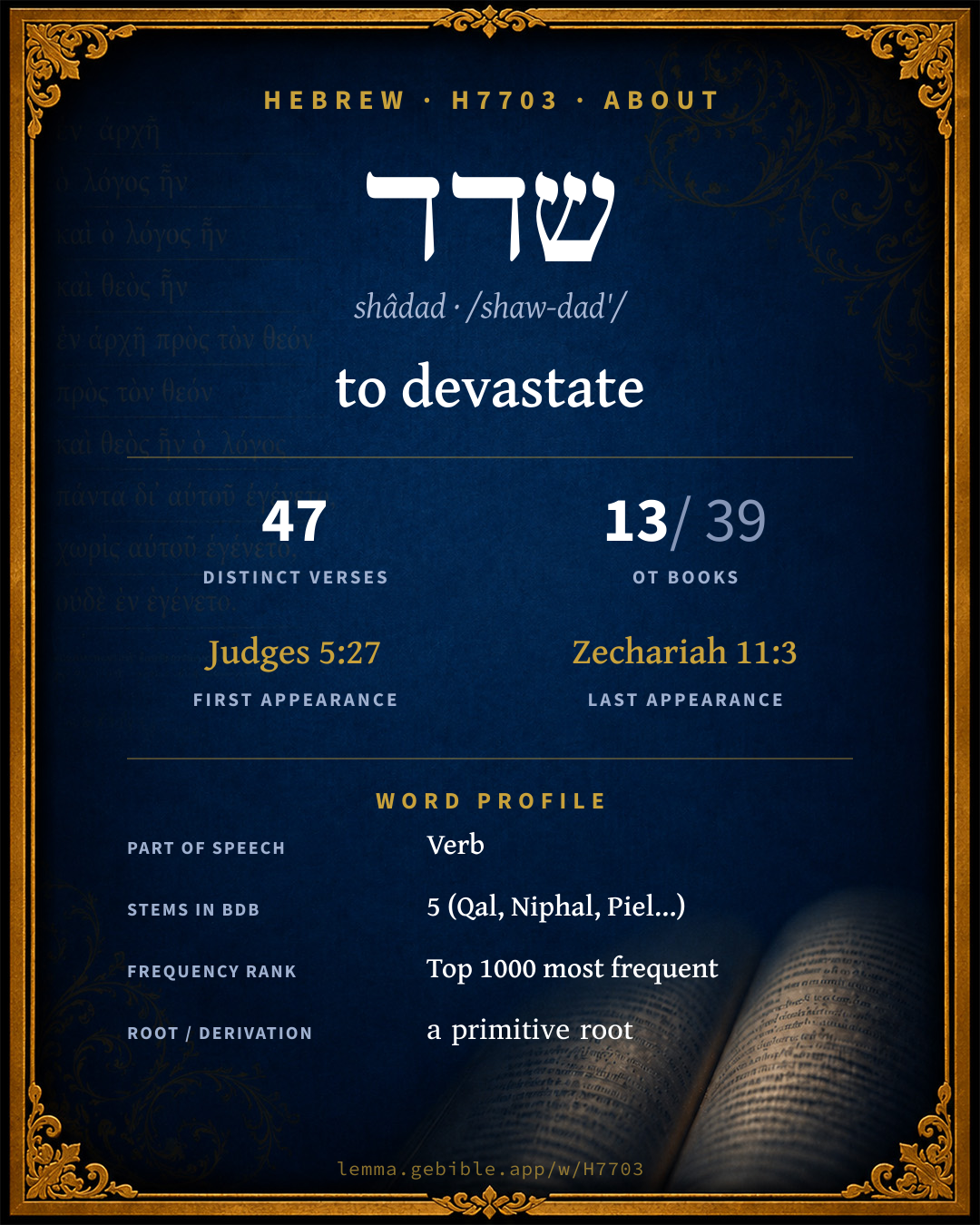
שָׁדַד
to devastate
‘to devastate’ is one of 5 main senses fuller range ↓
Full lexicon entry — Brown-Driver-Briggs (BDB)
From Brown-Driver-Briggs (BDB)
Where this word appears
See every Qal verb in the Hebrew Bible →
Grammar key — what these labels mean
Part of speech
- Verb
- An action or state-of-being word.
Noun type
- Common
- A common noun — a general class of person, place, or thing (“king,” “city,” “water”), not a specific name.
Stem
- Qal
- The basic, simple active stem — the plain form of the verb (“he wrote”).
- Pual
- The passive counterpart of the Piel.
- Niphal
- Usually the simple passive or reflexive of the Qal (“he was written”).
- Qal Passive
- An archaic passive of the Qal, preserved in a few forms.
- Piel
- An intensive or resultative active stem.
Form
- Participle Active
- A verbal adjective expressing ongoing or characteristic action (“writing / one who writes”).
- Perfect
- A completed action or state — Hebrew marks aspect (completeness) more than strict tense (“he wrote”).
- Participle Passive
- A verbal adjective expressing action received (“written”).
- Imperfect
- An incomplete, ongoing, or future action (“he will / would write”).
- Sequential Perfect
- A perfect with prefixed waw continuing a preceding imperfect or command (waw-consecutive perfect).
- Imperative
- A direct command (“write!”).
- Infinitive Construct
- A bound verbal noun, frequently with prepositions (“to write / in writing”).
- Jussive
- A third- or second-person volitional form expressing wish or command (“let him write”).
- Infinitive Absolute
- An unbound verbal noun, often intensifying or standing in for a finite verb.
State
- Absolute
- The independent form of a noun, not bound to a following word.
- Construct
- A noun bound to a following noun in a possessive / “of” relationship (the construct chain).
Person
- 3rd Person
- The one spoken about (“he / she / it / they”).
- 1st Person
- The speaker (“I / we”).
- 2nd Person
- The one addressed (“you”).
Gender
- Masculine
- Grammatically masculine.
- Feminine
- Grammatically feminine.
- Common
- Either gender — not distinguished for this form.
Number
- Singular
- One.
- Plural
- More than one (in Hebrew, generally three or more).
15 verses where H7703 appears in the Qal stem in the Book of Jeremiah. Filtered view — show all forms. Click any verse to open its interlinear word-by-word view. Verse text shown in the World English Bible for context — . Each verse’s Hebrew form is shown with its reference; the English is not keyword-highlighted, since the data carries no word-level English alignment. Use “Compare translations” on any verse to read it across multiple English versions. This concordance covers the Hebrew Bible; Septuagint (Greek Old Testament) occurrences are not indexed here.
Jeremiah
- Jeremiah 4:30 שָׁד֜וּד Qal ptcp.pass ms You, when you are made desolate, what will you do? Though you clothe yourself with scarlet, though you deck you with ornaments of gold, though you enlarge your eyes with paint, in vain do you make yourself beautiful; [your] lovers despise you, they seek your life.
- Jeremiah 5:6 יְשָׁדְדֵ֔/ם Qal impf 3ms + sfx pers 3mp Therefore a lion out of the forest shall kill them, a wolf of the evenings shall destroy them, a leopard shall watch against their cities; everyone who goes out there shall be torn in pieces; because their transgressions are many, [and] their backsliding is increased.
- Jeremiah 6:26 הַ/שֹּׁדֵ֖ד ptcl def.art + Qal ptcp.act ms Daughter of my people, gird you with sackcloth, and wallow yourself in ashes: make you mourning, as for an only son, most bitter lamentation; for the destroyer shall suddenly come on us.
- Jeremiah 12:12 שֹֽׁדְדִ֔ים Qal ptcp.act mp Destroyers are come on all the bare heights in the wilderness; for the sword of Yahweh devours from the one end of the land even to the other end of the land: no flesh has peace.
- Jeremiah 15:8 שֹׁדֵ֣ד Qal ptcp.act ms Their widows are increased to me above the sand of the seas; I have brought on them against the mother of the young men a destroyer at noonday: I have caused anguish and terrors to fall on her suddenly.
- Jeremiah 25:36 שֹׁדֵ֥ד Qal ptcp.act ms A voice of the cry of the shepherds, and the wailing of the principal of the flock! for Yahweh lays waste their pasture.
- Jeremiah 47:4 לִ/שְׁד֣וֹד שֹׁדֵ֤ד prep + Qal inf.cs Qal ptcp.act ms because of the day that comes to destroy all the Philistines, to cut off from Tyre and Sidon every helper who remains: for Yahweh will destroy the Philistines, the remnant of the isle of Caphtor.
- Jeremiah 48:8 שֹׁדֵ֜ד Qal ptcp.act ms The destroyer shall come on every city, and no city shall escape; the valley also shall perish, and the plain shall be destroyed; as Yahweh has spoken.
- Jeremiah 48:18 שֹׁדֵ֤ד Qal ptcp.act ms cs You daughter who dwells in Dibon, come down from your glory, and sit in thirst; for the destroyer of Moab is come up against you, he has destroyed your strongholds.
- Jeremiah 48:32 שֹׁדֵ֥ד Qal ptcp.act ms With more than the weeping of Jazer will I weep for you, vine of Sibmah: your branches passed over the sea, they reached even to the sea of Jazer: on your summer fruits and on your vintage the destroyer is fallen.
- Jeremiah 49:28 וְ/שָׁדְד֖וּ conj + Qal impv 2mp Of Kedar, and of the kingdoms of Hazor, which Nebuchadrezzar king of Babylon struck. Thus says Yahweh: Arise you, go up to Kedar, and destroy the children of the east.
- Jeremiah 51:48 הַ/שּׁוֹדְדִ֖ים ptcl def.art + Qal ptcp.act mp Then the heavens and the earth, and all that is therein, shall sing for joy over Babylon; for the destroyers shall come to her from the north, says Yahweh.
- Jeremiah 51:53 שֹׁדְדִ֛ים Qal ptcp.act mp Though Babylon should mount up to the sky, and though she should fortify the height of her strength, yet from me shall destroyers come to her, says Yahweh.
- Jeremiah 51:55 שֹׁדֵ֤ד Qal ptcp.act ms For Yahweh lays Babylon waste, and destroys out of her the great voice; and their waves roar like many waters; the noise of their voice is uttered:
- Jeremiah 51:56 שׁוֹדֵ֔ד Qal ptcp.act ms for the destroyer is come on her, even on Babylon, and her mighty men are taken, their bows are broken in pieces; for Yahweh is a God of recompenses, he will surely requite.
About this entry
At a glance — auto-summarized from this page’s data, not written by a person. Every figure links to its source below. This summary describes the numbers; it doesn’t interpret them.
שדד (shâdad) is a Hebrew verb most often rendered “to devastate.” It clusters heavily in Jeremiah, which alone accounts for 51% of its uses. It turns up in 47 verses across 13 books, a moderately common footprint. The verb spans 5 stems, from Qal to Niphal. Older and newer Bibles part ways — “is spoiled” in the King James Version, “destroyer” (Berean Standard Bible) in modern versions. See the renderings breakdown. For the data behind this summary, explore the sense tree and the renderings breakdown below.
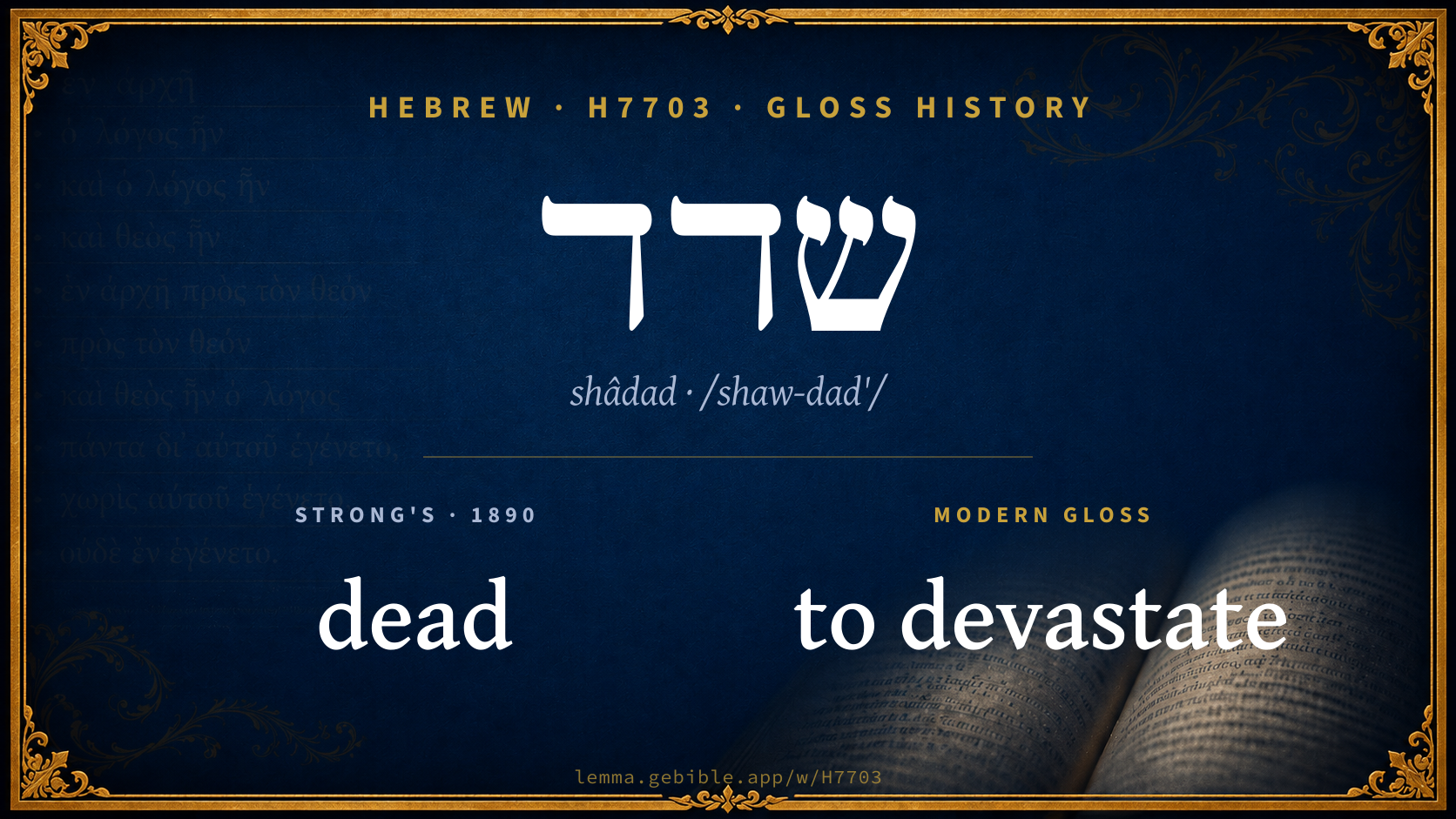
Gloss history
Strong's 1890 vs modern scholarship
About this word
Strong's H7703 catalogs a Hebrew word from the Hebrew Old Testament.
These counts are not copied from any lexicon or concordance. They are computed here, from the morphology-tagged Hebrew Old Testament. What Lemma adds →
- 47
- distinct verses
- The word appears in 47 distinct verses.
- 13 / 39
- OT books
- The word appears in 13 of 39 Old Testament books.
- #658
- by frequency
- Top 1000 most frequent Hebrew words (rank 658 of 8,640 Hebrew words by occurrence).
View all 47 occurrences in the concordance →
By section of the Old Testament
By traditional corpus
Conventional, traditional groupings — biblical authorship is debated, so this is a traditional corpus grouping, not an authorship claim. Each share is this word’s portion of its verses in that division of the Hebrew canon. Each figure is a share of the word’s 47 distinct verses.
- Prophets (Nevi'im) 40 verses · 85%
- Writings (Ketuvim) 7 verses · 15%
How translations render this word
Counts come from each version’s own published word-to-Strong’s tagging or interlinear alignment — an approximate guide to how each version renders this word, not a word-level alignment the data otherwise carries. Because each total is that version’s own tagged count, the per-version totals vary from one another and need not match the appearance or distinct-verse counts above. These counts may also differ from a printed concordance because Lemma counts each distinctly tagged rendering and does not collapse phrase taggings into a single head-word total. This is a fixed set of word-tagged versions (KJV, ASV, BSB, ULT) and does not change with the reading translation you choose elsewhere. Each version’s license is shown beside its name below (and on Sources).
- King James Version: Is spoiled 9×, Spoiler 8×, Is laid waste 5×
- American Standard Version: Is laid waste 12×, Destroyer 9×, Destroy 3×
- Berean Standard Bible: Destroyer 10×, Destroy 3×, Destroyers 3×
- unfoldingWord Literal Text: Destroyer 5×, Has been destroyed 5×, Is devastated 4×
King James Version Public Domain
Renders H7703 across 57 tagged occurrences — most commonly:
Plus 23 renderings that appear only once — usually multi-word phrases or single function words the recovered tagging swept in, not distinct renderings. Not rendered by a distinct English word in 1 further occurrence.
American Standard Version Public Domain
Renders H7703 across 57 tagged occurrences — most commonly:
Plus 28 renderings that appear only once — usually multi-word phrases or single function words the recovered tagging swept in, not distinct renderings.
Berean Standard Bible Public Domain
Renders H7703 across 56 tagged occurrences — most commonly:
Plus 24 renderings that appear only once — usually multi-word phrases or single function words the recovered tagging swept in, not distinct renderings. Not rendered by a distinct English word in 1 further occurrence.
unfoldingWord Literal Text CC BY-SA 4.0
Renders H7703 across 44 tagged occurrences — most commonly:
Plus 20 renderings that appear only once — usually multi-word phrases or single function words the recovered tagging swept in, not distinct renderings.
Senses in the full BDB
Hebrew verbs can shift meaning by stem (binyan): Qal is the basic action, Niphal is often passive or reflexive, Piel often intensifies or makes it factitive, and Hiphil is typically causative. The senses below are grouped under the stem BDB assigns to each. This entry also uses Pual (the passive of Piel) and Hophal (the passive of Hiphil).
What do BDB’s symbols mean?
BDB uses these scholarly abbreviations:
| Symbol | Meaning |
|---|---|
| 𝔊 | the Septuagint (the ancient Greek translation, LXX) |
| 𝔙 | the Vulgate (the Latin translation) |
| 𝔖 | the Syriac version (the Peshitta) |
| 𝔗 | the Targum (the Aramaic translation) |
| ψ | the Psalms |
| √ | root (the underlying root or stem) |
| ‖ | parallel passage (a synonymous or contrasted parallel) |
| † | the dagger: every passage where the word occurs is cited |
The 5 senses and sub-senses the full Brown-Driver-Briggs lexicon distinguishes for this word, in lexicon order (not ranked by frequency), with BDB’s own verbatim wording and sub-sense lettering. Shown in Hebrew script with BDB’s own scholarly abbreviations. The condensed entry is in the Lexicon Entry tab. See also the Forms in the corpus table below.
Qal
- Pf. 3 pl. consec. וְשָֽׁדְדוּ Ez 32:12; sf. שַׁדּוּנִי ψ 17:9; Impf. 3 ms. יָשׁוּד (metapl., cf. Ges§ 67 q Bae) ψ 91:6, sf. יְשָׁדֵּם (Ges§ 67 n) Pr 11:3 Qr (Kt Pf. ושׁדם), יְשָׁדְדֵם Je 5:6; Imv. mpl. שָׁדְדוּ (Ges§ 67 cc) 49:28; Inf. abs. שָׁדוֹד Mi 2:4; cstr. לִשְׁדוֹד Je 47:4 (Ges§ 45 g), cf. also שֹׁד Ho 10:14; Pt. act. שֹׁדֵד Je 6:26 +, etc.; pass. שָׁדוּד Ju 5:27 +, f. שְׁדוּדָה ψ 137:8;—violently destroy, pers., = slay Ju 5:27 (pass.), Je 5:6 (wolf subj.; ‖ הִכָּה); acc. Philistines 47:4 (‖ הִכְרִית), v 4 (subj. י׳); = devastate, acc. בָּבֶל (subj. י׳) Je 51:55, cf. ψ 137:8 (read prob. הַשֹּׁדֵדָה We Du cf. Ew Hi הַשָּׁדוֹדָה v. Köii. 194); אֶת־גְּאוֹן מִצְרַיִם Ez 32:12 (‖ נִשְׁמַד), cf. Ho 10:14, אֶת־מַרְעִיתָם Je 25:36 (subj. י׳), abs. Is 21:2 (‖ בָּגַד), 33:1 (on use of pt. v. Ges§ 120 b), pass. v 1 (‖ בָּנַד), אַתְּי שָׁדוּד Je 4:30 (Gf BaNB 179, but dub.; שְׁדוּדָה); = despoil, acc. pers. Je 49:28; = bring pers. to ruin Mi 2:4 (Inf. abs. + Niph. q.v.), Pr 11:3; weaker, assail ψ 17:9; elsewhere Pt. act. as subst. devastator (despoiler?): of national foes Is 16:1; 21:2; 33:1; Je 6:26 + 8 times Je; שׁוֹדְדֵי לַיְלָה Ob 5 (‖ גַּנָּבִים) del. Now GASm; personal foe Jb 15:21; representing wicked in gen. 12:6 (‖ מַרְגִּיזֵי אֵל). e.g. Ezekiel 32:12
Niphal
- Pf. 1 pl. שָׁדוֹד נִשַׁדֻּנוּ Ges§ 67 u) we are utterly ruined Mi 2:4. e.g. Micah 2:4
Piel
- Impf. 2 ms. אַל־תְּשַׁדֵּד רִבְצוֹ Pr 24:15 assault not his dwelling-place (‖ אַל־תֶּאֱרֹב); Pt. as subst. מְשַׁדֶּד־אָב Pr 19:26 he who assaults, maltreats (his) father (‖ יַבְרִיחַ אֵם). e.g. Proverbs 24:15
Pual
- Pf. 3 ms. שֻׁדַּד Is 15:1 +, 3 fs. שֻׁדְּדָה Je 4:20 +, שָׁדְּדָה Na 3:7 (Ges§ 52 q), etc.;—be devastated, of city Is 15:1(×2); 23:1; Je 48:1; 49:3; Na 3:7, country or nation Je 4:20, cf. v 13 9:18; 48:15, 20; 49:10, dwellings (אֹהֶל) Je 4:20; 10:20, trees Zc 11:2 (del. StaZAW i (1881), 25), cf. v 33, strength of ships Is 23:14, field (by drought) Jo 1:10, crop v 10. †Pōʿel violently destroy: Impf. 3 ms. יְשֹׁדֵד מַצֵּבוֹתָם Ho 10:2 (‖ יַעֲרֹף מִוְבְּחֹתָם). e.g. Isaiah 15:1
Hophal
- Impf. (or Qal pass. Impf.? cf. Ges§ 53 u) be devastated: 3 ms. בָּל־מִבְצָרֶיךָ יוּשָּׁ֑ד Ho 10:14 (of Ephr., יושׁדו); 2 ms. תּוּשַּׁד Is 33:1 (subj. שׁוֹדֵד, v. Qal). e.g. Hosea 10:14
Senses from the full Brown-Driver-Briggs lexicon (Brown, Driver, Briggs; Oxford 1906 — public domain), digitized via Sefaria, supplemented by the OpenScriptures HebrewLexicon (CC BY 4.0). Full attribution on Sources.
Word origin
vb. deal violently with, despoil, devastate, ruin (NH id., Niph.; Arabic سَدَّ stop up, obstruct, arrest, make firm; Ethiopic ሰደደ: expel; Assyrian šadâdu is draw, drag);—
— Brown-Driver-Briggs (Oxford 1906, public domain), digitized via Sefaria, supplemented by the OpenScriptures HebrewLexicon (CC BY 4.0). See Sources.
Origin: a primitive root
Jastrow Dictionary
A second Hebrew/Aramaic lexicon for comparison, covering Aramaic and post-biblical (Talmudic, Targumic, Midrashic) usage that the biblical-Hebrew BDB does not. Matched by lemma rather than by Strong’s number, so a lemma may carry more than one Jastrow headword (shown separately below), and the entries cover usage well beyond the Bible.
שָׁדַד
- (b. h.) to overpower, rob. Pesik. R. s. 26 יבואו השׁוֹדְדִים וִישַׁדְּדוּ אותה let the plunderers come and plunder her; Yalk. Jer. 262 יבואו השונאים וִישׁוֹדְדוּ בה (not בהם).
- same, v. supra.
- to be robbed. Gen. R. s. 75 (ref. to Ps. XII, 6) ואימתי אני לכשאראה עניים נִשְׁדָּדִים וכ׳ (not לכשתראה) when do I rise? When I see the poor robbed and the needy in anguish; Yalk. Ps. 625; Yalk. Zech. 569. e.g. Psalms 12:6
שְׁדַד
- , v. שְׁדֵי
שָׂדַד
- to join, arrange, direct.
- to harrow. Pirké d’R. El. ch. XXVIII; Yalk. Gen. 76 וִישַׂדְּדוּ, v. פָּתַח. Pirké d’R. El. ch. XII לחרש ולְשַׂדֵּד וכ׳ to plough and harrow the ground.
שְׂדַד
- Pa. שַׂדֵּד same. Targ. Job XXXIX, 10 (ed. Wil. יְשַׁ׳).
A Dictionary of the Targumim, the Talmud Babli and Yerushalmi, and the Midrashic Literature (Marcus Jastrow; London, Luzac, 1903) — Public Domain. Digitized via Sefaria. Digitized via Sefaria. Full attribution on Sources.
Forms in the corpus
The 48 distinct written forms H7703 takes in the Hebrew Bible, most frequent first — each parse links to that stem’s occurrences in the concordance. Hebrew forms include their vowel points and cantillation, so a single lemma takes many written forms.
Same root — word family
Other BDB entries built from the same root as H7703, grouped by Strong’s listed origin. These share a root / origin per the lexicon — not necessarily a shared meaning. Each links to that word’s own entry.
Derived from this word
Proper names from this root
People and places named from this root — a name, not an additional meaning of the word.
Compare all same-root words → 2 of the same-root words are proper names (people or places). They share a root, not necessarily a meaning.
Septuagint verse parallels
This word appears in 39 verses that also exist in the Greek Old Testament (Septuagint), out of the 47 Hebrew verses it occurs in. You can read those verses in Greek by switching the Old Testament edition to the Septuagint.
Read these verses in the Septuagint
- Judges 5:27
- Job 12:6
- Psalms 17:9
- Proverbs 11:3
- Isaiah 15:1
- Jeremiah 4:13
- Ezekiel 32:12
- Hosea 10:2
- Joel 1:10
- Obadiah 1:5
- Micah 2:4
- Nahum 3:7
This is a verse-level parallel only — the same verses exist in both the Hebrew and Greek Old Testaments. No word-level Hebrew↔Greek correspondence is claimed: the data carries no such alignment, so no Greek word is shown as this Hebrew word’s translation. Coverage is not total — the Septuagint omits the deuterocanon and renumbers the Psalms, so some Hebrew verses have no direct Greek parallel.