Psalms 137:8

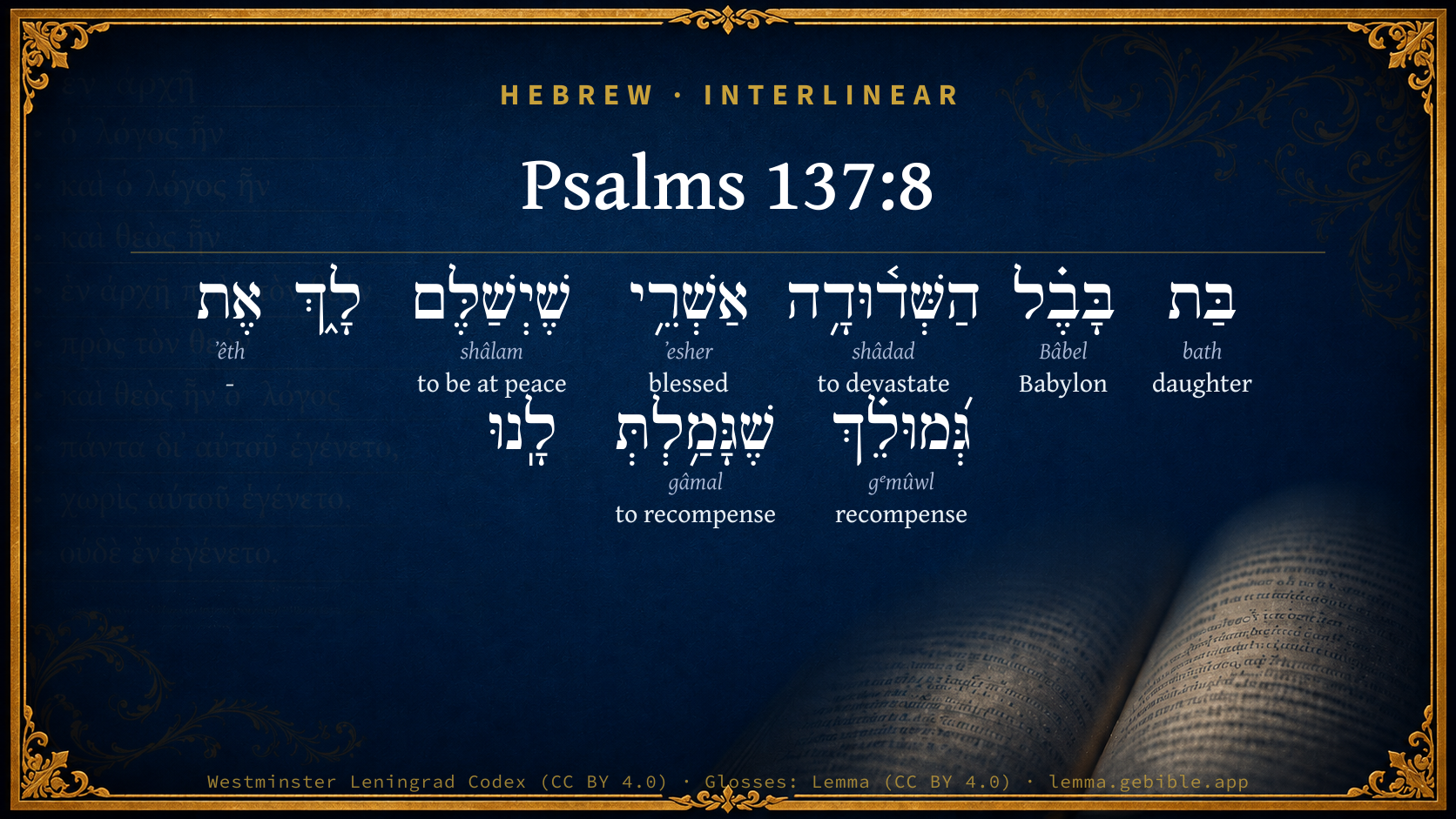
Hebrew (Westminster Leningrad Codex) Psalms 137:8 appears in the Hebrew Old Testament. The text above is from the Westminster Leningrad Codex. Each word links to its Strong’s number, a concise gloss, and parsing drawn from the Open Scriptures Hebrew Bible morphology. Click any word for its full Brown-Driver-Briggs (BDB) entry.
Download image
Cite this verse

Psalms 137:8 (World English Bible). Public Domain. Lemma interlinear Bible study tool, https://lemma.gebible.app/v/psalms/137/8.

Show BibTeX & RIS
BibTeX
RIS
English Translation
Daughter of Babylon, doomed to destruction, He will be happy who rewards you, As you have served us.
World English Bible · Public Domain
Download a study sheet

One document with this verse’s original text, its word-by-word gloss line, the meaning frame, cross-references with their text, attributed commentary, and full source and license credits — printable, and it pastes into notes with its structure intact.

This verse Autodidact and up

Study sheet (.html) Plain text (.txt)

A passage Seminary Student

Up to 50 verses in one chapter. A passage sheet keeps up to 6 commentary sources and 12 cross-references per verse, in the order this page ranks them, and says so on the sheet whenever that leaves anything out. Ask for a single verse and you get the Autodidact verse sheet above.

Everything on this page stays free to read, with no account — the sheet is a download of what is already on screen, not access to it.

Want to remove ads? Support Godless Engineer
Compare translations 3

The same verse in 3 English versions, stacked beneath the original-language interlinear above. Click any original word for its lexicon entry.

Each is an independent rendering of the whole verse — the interlinear is not word-aligned to these translations.

Highlighted words mark where these versions differ — a whole-verse word diff, not a word-by-word alignment.

  • World English Bible Public Domain
    Daughter of Babylon, doomed to destruction, He will be happy who rewards you, As you have served us.
  • King James Version Public Domain
    O daughter of Babylon, who art to be destroyed; happy shall he be, that rewardeth thee as thou hast served us.
  • unfoldingWord Literal Text CC BY-SA 4.0
    Daughter Babylon, the devastated one, the happinesses of the one who makes complete to you your repayment that you paid to us!

unfoldingWord Literal Text — © unfoldingWord, licensed CC BY-SA 4.0. Word-aligned USFM3 via Door43 (git.door43.org/unfoldingWord/en_ult).

Versions to compare (up to 4)

3 of 4 selected

Show all 18 translations

Every available English version of this verse, each an independent rendering of the whole verse.

  • World English Bible Public Domain
    Daughter of Babylon, doomed to destruction, He will be happy who rewards you, As you have served us.
  • Berean Standard Bible Public Domain
    O Daughter of Babylon, doomed to destruction, blessed is he who repays you as you have done to us.
  • Majority Standard Bible Public Domain
    O Daughter of Babylon, doomed to destruction, blessed is he who repays you as you have done to us.
  • King James Version Public Domain
    O daughter of Babylon, who art to be destroyed; happy shall he be, that rewardeth thee as thou hast served us.
  • American Standard Version (1901) Public Domain
    O daughter of Babylon, that art to be destroyed, Happy shall he be, that rewardeth thee As thou hast served us.
  • Revised Version (1885) Public Domain
    O daughter of Babylon, that art to be destroyed; happy shall he be, that rewardeth thee as thou hast served us.
  • Geneva Bible (1599) Public Domain
    O daughter of Babel, worthy to be destroyed, blessed shall he be that rewardeth thee, as thou hast serued vs.
  • Douay-Rheims (1899) Public Domain
    The sun to rule over the day: for his mercy endureth for ever.
  • Young's Literal Translation Public Domain
    O daughter of Babylon, O destroyed one, O the happiness of him who repayeth to thee thy deed, That thou hast done to us.
  • Literal Standard Version CC BY-SA 4.0
    O daughter of Babylon, O destroyed one, || O the blessedness of him who repays to you your deed, || That you have done to us.
  • Unlocked Literal Bible CC BY-SA 4.0
    Daughter of Babylon, soon to be destroyed— may the person be blessed, whoever pays you back for what you have done to us.
  • unfoldingWord Literal Text CC BY-SA 4.0
    Daughter Babylon, the devastated one, the happinesses of the one who makes complete to you your repayment that you paid to us!
  • Darby Bible Public Domain
    Daughter of Babylon, who art to be laid waste, happy he that rendereth unto thee that which thou hast meted out to us.
  • World Messianic Bible Public Domain
    Daughter of Babylon, doomed to destruction, he will be happy who repays you, as you have done to us.
  • Webster's Bible Public Domain
    O daughter of Babylon, who art to be destroyed; happy shall he be, that rewardeth thee as thou hast served us.
  • Free Bible Version CC BY-SA 4.0
    Daughter of Babylon, you will be destroyed! Happy is the one who pays you back, who does to you what you did to us!
  • Bible in Basic English Public Domain
    O daughter of Babylon, whose fate is destruction; happy is the man who does to you what you have done to us.
  • JPS Tanakh (1917) Public Domain
    O daughter of Babylon, that art to be destroyed; happy shall he be, that repayeth thee as thou hast served us.

Literal Standard Version (2020), Covenant Press — licensed CC BY-SA 4.0. Text via the HelloAO Bible API (eBible.org). Unlocked Literal Bible (unfoldingWord) — licensed CC BY-SA 4.0. Text via the HelloAO Bible API (eBible.org). unfoldingWord Literal Text — © unfoldingWord, licensed CC BY-SA 4.0. Word-aligned USFM3 via Door43 (git.door43.org/unfoldingWord/en_ult). Free Bible Version, Dr. Jonathan Gallagher — licensed CC BY-SA 4.0. Text via the HelloAO Bible API (eBible.org).

Word by word

More ways to search: Search by grammar → Find every occurrence → Compare this word →

Practice this passage: Drill this verse → Learn its vocabulary →

גְּ֝מוּלֵ֗ךְ
gᵉmûwl
H1576
“recompense · your”
Noun, Common, Masculine, Singular, Construct + Suffix, Personal, 2nd Person, Feminine, Singular
Part of Speech
Noun
Type
Common
Gender
Masculine
Number
Singular
State
Construct
Full BDB Definition

Origin: from H1580

TWOT: 360a

dealing, recompense, benefit - dealing (of one's hand) - recompense - benefit
  1. בַּת bath H1323 “daughter of” Noun, Common, Feminine, Singular, Construct
  2. בָּבֶ֗ל Bâbel H894 “Babylon” Noun, Proper
  3. הַשְּׁד֫וּדָ֥ה shâdad H7703 “the · devastated” Particle, Definite Article + Verb, Qal, Participle Passive, Feminine, Singular, Absolute
  4. אַשְׁרֵ֥י ʼesher H835 “blessed” Noun, Common, Masculine, Plural, Absolute
  5. שֶׁיְשַׁלֶּם shâlam H7999 “who/which · to be at peace” Particle, Relative + Verb, Piel, Imperfect, 3rd Person, Masculine, Singular
  6. אֶת ʼêth H853 “-” Particle, Direct Object
  7. שֶׁגָּמַ֥לְתְּ gâmal H1580 “who/which · to recompense” Particle, Relative + Verb, Qal, Perfect, 2nd Person, Feminine, Singular

About this verse

These counts appear in no published source. They are computed here, from the morphology-tagged text and Lemma’s own curated glosses. What Lemma adds →

10
words
8
distinct lemmas
Wisdom
section

Notable vocabulary

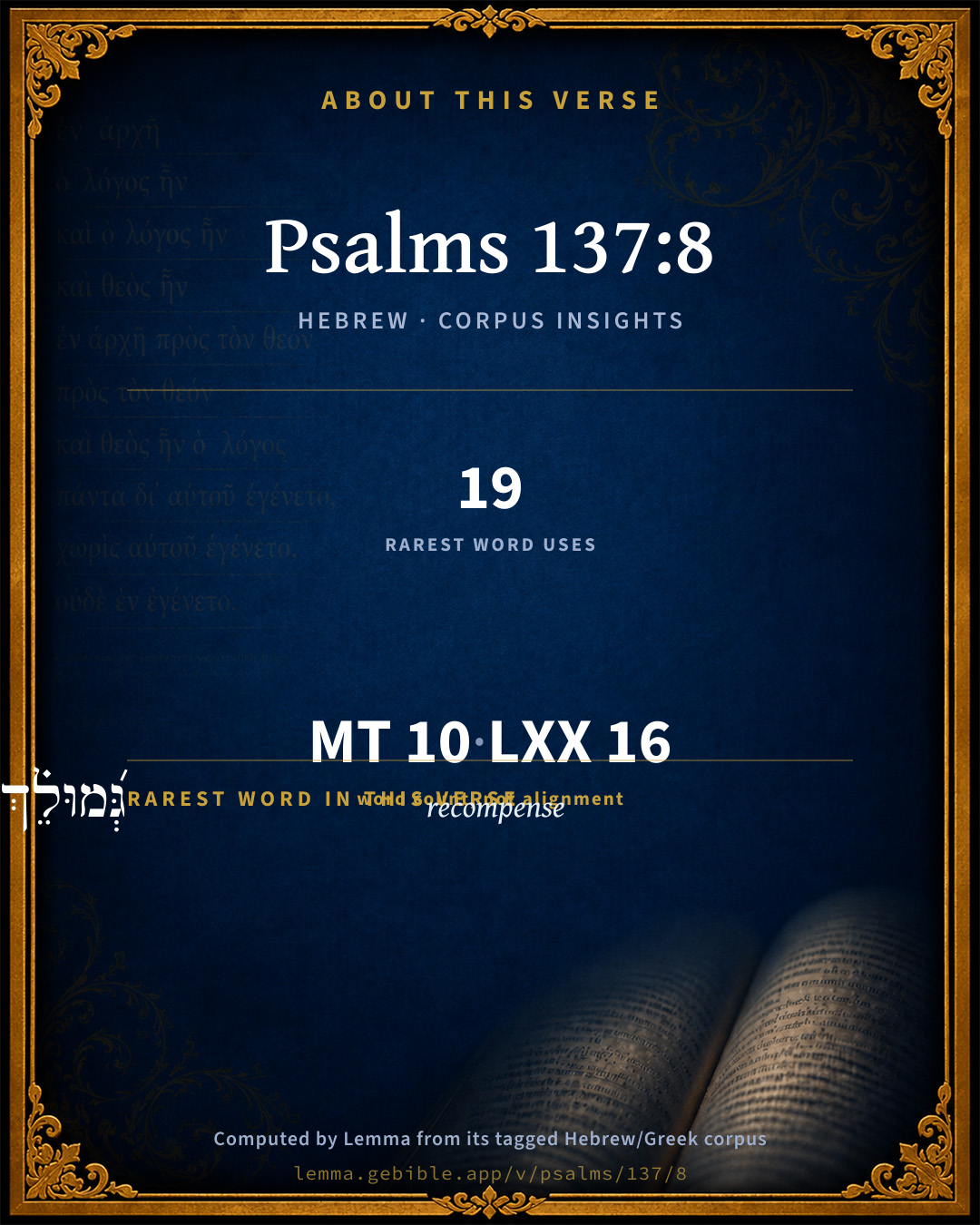
The rarest word here is גְּ֝מוּלֵ֗ךְ recompense H1576 — appearing just 19 times in the whole Hebrew Bible.

Shared distinctive vocabulary

גְּ֝מוּלֵ֗ךְ recompense H1576 occurs in 17 verses of the Hebrew Bible. Also found in:

Grammatical profile

  • 3 verbs
  • 4 nouns
  • 2 prepositions
  • 1 particle

Verb forms

  • הַשְּׁד֫וּדָ֥ה Qal · Participle Passive
  • שֶׁיְשַׁלֶּם Piel · Imperfect
  • שֶׁגָּמַ֥לְתְּ Qal · Perfect

Hebrew & Septuagint length

In English translation the verse runs 18 words from the Hebrew and 17 from the Septuagint (LXX English) — closely comparable.

A rough comparison of the two English renderings, which tokenize alike — not a word-level alignment.

Word counts can differ between the Hebrew and the Greek without any difference in meaning — e.g. the Hebrew direct-object marker אֵת has no separate Greek word, and Greek often adds the article ὁ.

In the original languages it is 10 Hebrew tokens and 16 Greek tokens — but the two are counted differently (Hebrew bundles its prefixes and suffixes into one token; the Greek is in lemma form), so that isn’t a like-for-like length.

Cross-references

13

Topical passages linked to Psalms 137:8 in the Treasury of Scripture Knowledge — connected by theme and wording, ordered by reader-vote popularity; previews shown in the World English Bible.

  • Revelation 18:6 Return to her just as she returned, and repay her double as she did, and according to her works. In the cup which she mixed, mix to her double.
  • Isaiah 14:4–24 that you shall take up this parable against the king of Babylon, and say, How has the oppressor ceased! the golden city ceased!
  • Jeremiah 25:12–14 It shall happen, when seventy years are accomplished, that I will punish the king of Babylon, and that nation, says Yahweh, for their iniquity, and the land of the Chaldeans; and I will make it desolate forever.
  • Isaiah 21:1 The burden of the wilderness of the sea. As whirlwinds in the South sweep through, it comes from the wilderness, from an awesome land.
  • Isaiah 47:1–15 Come down, and sit in the dust, virgin daughter of Babylon; sit on the ground without a throne, daughter of the Chaldeans: for you shall no more be called tender and delicate.
  • Revelation 14:8–11 Another, a second angel, followed, saying, "Babylon the great has fallen, which has made all the nations to drink of the wine of the wrath of her sexual immorality."
  • Psalms 149:6–9 May the high praises of God be in their mouths, And a two-edged sword in their hand;
  • Isaiah 13:1–22 The burden of Babylon, which Isaiah the son of Amoz did see.
  • Isaiah 44:28 Who says of Cyrus, [He is] my shepherd, and shall perform all my pleasure, even saying of Jerusalem, She shall be built; and of the temple, Your foundation shall be laid.
  • Jeremiah 50:1–51:64 The word that Yahweh spoke concerning Babylon, concerning the land of the Chaldeans, by Jeremiah the prophet.
  • Zechariah 2:7 'Come, Zion! Escape, you who dwell with the daughter of Babylon.'
  • Revelation 17:1–18 One of the seven angels who had the seven bowls came and spoke with me, saying, "Come here. I will show you the judgment of the great prostitute who sits on many waters,
  • Revelation 18:20 Rejoice over her, O heaven, you saints, apostles, and prophets; for God has judged your judgment on her."

Cross-references courtesy of OpenBible.info (CC BY 4.0).

Hebrew and Greek witnesses Masoretic Hebrew ↔ Greek Septuagint

The same verse in the two great witnesses to the Old Testament, shown verse-for-verse.

You’re reading Greek Psalm 136 (Hebrew Psalm 137). The Septuagint counts the superscription, so verse numbers can differ from the Hebrew — chapter-level alignment, not verse-by-verse. Numbering follows Rahlfs.

These are two independent witnesses, not word-aligned to each other, and the Septuagint is shown in lemma (dictionary) form.

Hebrew Psalms 137:8 Masoretic · Westminster Leningrad Codex

בַּת בָּבֶ֗ל הַשְּׁד֫וּדָ֥ה אַשְׁרֵ֥י שֶׁיְשַׁלֶּם לָ֑ךְ אֶת גְּ֝מוּלֵ֗ךְ שֶׁגָּמַ֥לְתְּ לָֽנוּ

Daughter of Babylon, doomed to destruction, He will be happy who rewards you, As you have served us.

World English Bible · Public Domain

Greek LXX Greek Psalm 136:8 Septuagint · lemma form

θυγάτηρ βαβυλών ὁ ταλαίπωρος μακάριος ὅς ἀντι ἀποδίδωμι σύ ὁ ἀνταπόδομα σύ ὅς ἀντι ἀποδίδωμι ἐγώ

Wretched daughter of Babylon! blessed shall he be who shall reward you as you have rewarded us.

LXX2012 (modern English Septuagint) · Public Domain

On this verse, Ellicott's Commentary for English Readers discusses the Septuagint’s reading. Read the note in Commentary ↓

Hebrew: Westminster Leningrad Codex (CC BY 4.0). Greek: Septuagint (public domain); English from LXX2012 (modern English Septuagint) (Public Domain). How the Septuagint differs from the Hebrew →

Commentary

Notes on Psalms 137:8 from classic Christian and Jewish commentators (each source and its license shown beneath its notes). The classic Christian expositions comment on the surrounding passage and are grouped to its opening verse, so a note may address several verses; the Jewish commentaries on the Tanakh (Rashi and others) are per-verse, so they appear only where the commentator wrote on this verse.

Lemma curates 59 commentaries, every one of them public domain or Creative Commons licensed, each selected and text-cleaned for this edition rather than reprinted as found. About our sources →

Trapp's Complete Commentary

John Trapp

Psa 137:8 O daughter of Babylon, who art to be destroyed; happy [shall he be], that rewardeth thee as thou hast served us.

Ver. 8. That art to be destroyed] Spoliatrix, saith the Syriac, Isa 33:1.

Happy shall he be] i.e. Well rewarded with wealth and good wishes.

John Trapp, A Commentary or Exposition upon All the Books of the Old and New Testament (1647–1656) — public domain. Text from a community e-Sword module.

The Treasury of David

Charles H. Spurgeon

Ver. 8. O daughter of Babylon, who art to be destroyed. Or the destroyer: let us accept the word either way, or both ways: the destroyer would be destroyed, and the Psalmist in vision saw her as already destroyed. It is usual to speak of a city as a virgin daughter. Babylon was in her prime and beauty, but she was already doomed for her crimes. Happy shall he be that rewardeth thee as thou hast served us. The avenger would be fulfilling an honourable calling in overthrowing a power so brutal, so inhuman. Assyrian and Chaldean armies had been boastfully brutal in their conquests; it was meet that their conduct should be measured back into their own bosoms. No awards of punishment can be more unanswerably just than those which closely follow the lex talionis, even to the letter. Babylon must fall, as she caused Jerusalem to fall; and her sack and slaughter must be such as she appointed for other cities. The patriot poet sitting sorrowfully in his exile, finds a solace in the prospect of the overthrow of the empress city which holds him in bondage, and he accounts Cyrus right happy to be ordained to such a righteous work. The whole earth would bless the conqueror for ridding the nations of a tyrant; future generations would call him blessed for enabling men to breathe again, and for once more making liberty possible upon the earth.

We may rest assured that every unrighteous power is doomed to destruction, and that from the throne of God justice will be measured out to all whose law is force, whose rule is selfishness, and whose policy is oppression. Happy is the man who shall help in the overthrow of the spiritual Babylon, which, despite its riches and power, is "to be destroyed." Happier still shall he be who shall see it sink like a millstone in the flood, never to rise again. What that spiritual Babylon is none need enquire. There is but one city upon earth which can answer to the name.

Ver. 8. O daughter of Babylon, who art to be destroyed. In the beginning of the fifth year of Darius happened the revolt of the Babylonians which cost him the trouble of a tedious siege again to reduce them...he besieged the city with all his forces...As soon as the Babylonians saw themselves be girt by such an army as they could not cope with in the field, they turned their thoughts wholly to the supporting of themselves in the siege; in order whereto they took a resolution, the most desperate and barbarous that ever any nation practised. For to make their provisions last the longer, they agreed to cut off all unnecessary mouths among them, and therefore drawing together all the women and children, they strangled them all, whether wives, sisters, daughters, or young children useless for the wars, excepting only that every man was allowed to save one of his wives, which he best loved, and a maid servant to do the work of the house. Humphrey Prideaux.

Ver. 8. Who art to be destroyed. hdwdvh has been explained in a variety of ways. Seventy: h talaipwrov; Vulg. misera: others, destroyer, powerful, violent, or fierce. Perhaps it best suits the context to regard it as expressing what is already accomplished: it is so certain, in the view of the Psalmist, that the ruin will come, that he uses the past participle, as if the work were now completed. "O daughter of Babylon, the destroyed!" "Bibliotheca Sacra and Theological Review."

Ver. 8. He that sows evil shall reap evil; he that soweth the evil of sin, shall reap the evil of punishment. So Eliphaz told Job that he had seen (Job 4:8), "they that plough iniquity, and sow wickedness, reap the same." And that either in kind or quality, proportion or quantity. In kind, the very same that he did to others shall be done to him; or in proportion, a measure answerable to it. So he shall reap what he hath sown, in quality or in quantity; either in portion the same, or in proportion the like. The prophet cursing Edom and Babel saith thus, "O daughter of Zion, happy shall he be that rewardeth thee as thou hast served us." The original is, "that recompenses to thee thy deed which thou didst to us." ...Thus is wickedness recompensed suo genere, in its own kind. So often the transgressor is against the transgressor, the thief robs the thief, proditoros proditor;as in Rome many unchristened emperors, and many christened popes, by blood and treason got the sovereignty, and by blood and treason lost it. Evil men drink of their own brewing, are scourged with their own rod, drowned in the pit which they digged for others, as Haman was hanged on his own gallows, Perillus tormented in his own engine! Thomas Adams.

Ver. 8-9. The subject of these two verses is the same with that of many chapters in Isaiah and Jeremiah; namely, the vengeance of heaven executed upon Babylon by Cyrus, raised up to be king of the Medes and Persians, united under him for that purpose. The meaning of the words, "Happy shall he be, "is, He shall go on and prosper, for the Lord of hosts shall go with him, and fight his battles against the enemy and oppressor of his people, empowering him to recompense upon the Chaldeans the works of their hands, and to reward them as they served Israel. George Horne.

Ver. 8-9. It needs no record to tell us that, in the siege and carrying away of Jerusalem, great atrocities were committed by the conquerors. We may be sure that

"Many a chiding mother then

And newborn baby died, "

for the wars of the old world were always attended by such barbarous cruelties. The apostrophe of Ps 137:8-9, consequently merely proclaims the certainty of a just retributionof the same retribution that the prophets had foretold (Isa 13:16 47: 1-15 Jer 50:46; compare, "who art to be destroyed", Ps 137:8), and the happiness of those who should be its ministers; who should mete out to her what she had measured to the conquered Jew. It was the decree of Heaven that their "children" should "be dashed to pieces before their eyes." The Psalmist simply recognizes the decree as just and salutary; he pronounces the terrible vengeance to have been deserved. To charge him with vindictiveness, therefore, is to impugn the justice and mercy of the Most High. And there is nothing to sustain the charge, for his words are simply a prediction, like that of the prophet. "As thou hast done, it shall be done unto thee; thy reward shall return upon thine own head": Ob 1:15. Joseph Hammond, in "The Expositor, "1876.

Charles H. Spurgeon's The Treasury of David (1869–1885) — public domain. Psalms only. Text from a community e-Sword/MySword module.

Joseph Benson's Commentary

Psa 137:8-9. O daughter of Babylon — By which he understands the city and empire of Babylon, and the people thereof, who art to be destroyed — Who by God’s righteous and irrevocable sentence, art devoted to certain destruction, and whose destruction is particularly and circumstantially foretold by God’s holy prophets. For the subject of these two verses is the same with that of many chapters in Isaiah and Jeremiah; namely, the vengeance of Heaven executed upon Babylon by Cyrus, raised up to be king of the Medes and Persians for that purpose. Happy shall he be — He shall be blessed and praised in his deed, as having done a glorious work in executing the divine justice upon Babylon, and at the same time, as an instrument in God’s hand, rescuing and delivering the people of God. Happy shall he be that taketh and dasheth thy little ones, &c. — That retaliates upon thee the calamities thou didst bring upon us. It has been objected, that the imprecations, in these verses, against Babylon, do not well comport with God’s directions to his captive people, Jer 29:7, to pray for the peace of Babylon. But here we must distinguish between the ordinary rule of practice and the extraordinary commission given to prophets. The psalmist was a prophet, and wrote by the special direction of the Holy Spirit; while the common people of Israel, and prophets also, in their private capacity, were to follow the ordinary rule of praying for those very enemies whose destruction was coming on, but in God’s own time. In the meanwhile the safety of the Jewish captives depended on the safety of Babylon, and was wrapped up in it; and so it concerned them, both in point of duty and interest, to submit peaceably and quietly to their new masters, and to pray for their prosperity: notwithstanding all which, they might justly hope for a deliverance at the seventy years’ end, and God might instruct his prophets to declare it before hand, together with the manner of it: “see Waterland’s Script. Vind., part 3. page 28. “The meaning of the words, happy shall he be,” says Dr. Horne, “is, He shall go on and prosper, for the Lord of hosts shall go with him, and fight his battles against the enemy and oppressor of his people, empowering him to recompense upon the Chaldeans the works of their hands, and to reward them as they served Israel. The slaughter of the very infants, mentioned in the last verse, is expressly predicted by Isa 13:16; Their children also shall be dashed to pieces before their eyes; their houses shall be spoiled, and their wives ravished. The destruction was to be universal, sparing neither sex nor age. Terrible, but just, are thy judgments, O Lord! The fall of the mystical Babylon is described Revelation 18. in terms and phrases borrowed from this and other prophecies, relating primarily to the ancient city called by that name. Whoever will carefully read over the chapter referred to, with the three subsequent ones, concerning the triumph of Messiah, and the glory of the new Jerusalem, will be able to form proper ideas of the world and the church, and will know where to choose his portion.”

Joseph Benson's Commentary on the Old and New Testaments (1811–1818) — public domain. Text from a community e-Sword module.

J. A. Alexander on Psalms

Joseph Addison Alexander

8. (Psa 137:8) Daughter of Babylon, the desolated! Happy (he) who shall repay to thee thy treatment wherewith thou hast treated us. The daughter of Babylon (or virgin Babylon) is the people or kingdom of Babylonia, personified as a woman. See above, on Psa 9:13. The wasted or desolated is the epithet belonging to her by way of eminence in prophecy and history. There is no need therefore of distinguishing between a partial and total desolation, or between that of the city and the kingdom at large. The last clause may mean nothing more than that such a revolution is at hand that he will be esteemed a fortunate man who treats thee as thou hast treated us. For the true sense of the last verb, see above, on Psa 13:5-6.

Joseph Addison Alexander, The Psalms Translated and Explained (1850) — public domain. Text from a community e-Sword module.

Adam Clarke's Commentary

Verse 8. O daughter of Babylon, who art to be destroyed] Or, O thou daughter of Babylon the destroyer, or, who art to be ruined. In being reduced under the empire of the Persians, Babylon was already greatly humbled and brought low from what it was in the days of Nebuchadnezzar; but it was afterwards so totally ruined that not a vestige of it remains. After its capture by Cyrus, A.M. 3468, it could never be considered a capital city; but it appeared to follow the fortunes of its various conquerors till it was, as a city, finally destroyed.

Rewardeth thee as thou hast served us.] This was Cyrus, who was chosen of God to do this work, and is therefore called happy, as being God's agent in its destruction. Greater desolations were afterwards brought upon it by Darius Hystaspes, who took this city after it had revolted, and slaughtered the inhabitants, men and women, in a barbarous manner. Herod. lib. iii.

Adam Clarke's Commentary on the Bible (1810–1826) — public domain. Text from a community e-Sword/MySword module.

John Calvin's Commentaries

8. O daughter of Babylon Daughter of Babylon denotes the inhabitants of the Babylonish empire. The inhabitants of a city or kingdom are frequently spoken of in Scripture as its daughter. (See Psalm 45:13; Isaiah 47:1; Zechariah 9:9.)

“Il n’entend pas que le service des Perses et Medes ait este agreable a Dieu,” etc. — Fr.

“With what measure ye mete, it shall be measured to you again.” (Matthew 7:2.)

Isaiah (Isaiah 13:16) had issued a special prediction in reference to Babylon, which the Psalmist has doubtless here in his eye — “Behold God has sharpened the iron, and bent the bows; he sends forth the Medes and Persians, which shall not regard silver and gold; they shall thirst for blood only,” etc.

John Calvin's Commentaries (1540-1563) — public domain. Text from the Calvin Translation Society English edition (1840s-50s) via the Christian Classics Ethereal Library (ccel.org). Calvin's coverage is partial (roughly two-thirds of the Bible); uncommented books and verses are honest gaps, never fabricated. The 19th-century editor's footnotes and remarks are omitted so the notes are faithfully Calvin's own voice.

Ellicott's Commentary for English Readers

(8) Daughter of Babylon—i.e., Babylon itself. (See Psa_9:14, Note.)

Who art to be destroyed.—Considerable doubt attaches to the meaning of the Hebrew word here. Our version is that of Theodotion. Aquila and Jerome have “wasted” (comp. Prayer Book version); Symmachus, “robber;” the LXX. and Vulg., “wretched.”

As pointed, the word is a passive participle, and must be rendered as by Aquila, “wasted” or “destroyed,” but with the recollection that a Hebrew would thus speak proleptically of a doom foreseen though not accomplished. Delitzsch quotes an Arab saying: “Pursue the caught one “—i.e., sure to be caught.

The “luxury of revenge” is well expressed in this beatitude, pronounced on him who can carry out to all its bitter end the lex talionis. Commentators have in turn tried to disguise and justify the expression of passion. Happily the Bible allows us to see men as they were without taking their rules of feeling and conduct as ours. “The psalm is beautiful as a poem—the Christian must seek his inspiration elsewhere.”

A Bible Commentary for English Readers, edited by Charles John Ellicott (1878–1897) — public domain. Text from a community e-Sword module.

The Cambridge Bible for Schools and Colleges

gen. ed. J. J. S. Perowne

8. O daughter of Babylon] The city of Babylon personified.

who art to be destroyed] The most obvious translation is that of R.V. marg., that art laid waste. So Aq. and Jerome, vastata. But the following clauses apparently imply that Babylon has not been destroyed, and the participle may be ‘prophetic,’ that art doomed to be laid waste[84]. Delitzsch quotes examples of a similar idiom in Arabic. ‘The stricken one,’=‘one who is doomed to be stricken.’ So Theodotion, ἡ διαρπασθησομένη. Some of the Ancient Versions, however (Symm., Syr., Targ.), render thou waster, a rendering which only requires a slight change of the text, and is adopted by many critics.

[84] Coverdale and the Great Bible of 1539 have, thou shalt come to misery thy self, from Zürich Bible, und du Babel, wirst auch ellend werden. The P.B.V. wasted with misery, from the Great Bible of 1540, may have been suggested by Münster’s devastata and the Vulg. misera.

The Cambridge Bible for Schools and Colleges (gen. ed. J. J. S. Perowne; Cambridge University Press, 1878–1918) — public domain. Text from a community e-Sword module.

John Gill's Exposition

O daughter of Babylon, who art to be destroyed,.... By the determinate counsel and decree of God, and according to divine predictions; see Jer 50:1; so mystical Babylon, antichrist, and the man of sin, who therefore is called the son of perdition, Th2 2:3; because appointed to destruction, and shall certainly go into it, Rev 17:8; or "O thou destroyer", as the Targum, which paraphrases it thus,

"Gabriel, the prince of Zion, said to the Babylonish nation that spoileth or destroyeth;''

which is true of literal Babylon, called the destroying mountain, Jer 51:25; and of mystical Babylon, the destroyer both of the bodies and souls of men, Rev 11:18;

happy shall he be that rewardeth thee as thou hast served us; meaning Darius the Mede, as Kimchi; or rather, or however who must be added, Cyrus the Persian, as R. Obadiah; who were ordered by the Lord to retaliate her, and do as she had done to others, Jer 50:15; and in so doing pronounced happy, being the Lord's shepherd, raised up in righteousness to perform his pleasure, Isa 44:28; and here wished success by the godly Jews. In like manner the Christian princes will reward mystical Babylon, and be the happy instruments of her ruin, Rev 18:6.

John Gill's Exposition of the Whole Bible (1746–1763) — public domain (CC PDM 1.0). Text via the HelloAO Bible API.

Albert Barnes' Notes on the Bible

O daughter of Babylon - That is, Babylon itself; the city of Babylon. On the word “daughter” as thus used, see the notes at Isa 1:8.

Who art to be destroyed - Certainly to be destroyed; of whose destruction there are fixed and absolute prophecies. See the notes at Isa 13:19-22.

Happy shall he be that rewardeth thee as thou hast served us - Margin, that recompenseth unto thee thy deed which thou didst to us. Literally, “Happy shall he be who shall repay to thee the recompence which thou hast recompensed unto us.” The idea is, who shall repay thee for thy treatment of us; or, as we should say in common language, “Who shall pay thee back?” That is, he will be esteemed a fortunate man who is made the instrument of inflicting deserved punishment on a city so guilty and so cruel. He will acquire fame and honor by doing it; his name will be made known abroad and perpetuated among people. In fact, the name of Cyrus, who conquered Babylon, is among the names of the most celebrated of conquerors; and the manner in which he took Babylon and overthrew the government and kingdom, has given him a most eminent place among successful princes and conquerors.

Albert Barnes' Notes on the Bible (1834–1885) — public domain. Text from a community e-Sword/MySword module.

Matthew Poole's English Annotations

Daughter of Babylon; by which he understands the city and empire of Babylon, and the people thereof.

Who art to be destroyed; who art by God’s righteous and irrevocable sentence devoted to certain destruction.

Happy shall he be; as being God’s instrument to vindicate his honour, and execute his just judgments, and fulfil his counsel and word; which Cyrus was to his own great glory and advantage, as appears both from sacred and profane history.

That rewardeth thee as thou hast served us; that shall use thee with equal cruelty.

Matthew Poole's English Annotations on the Holy Bible (1683–1685) — public domain. Text from a community e-Sword/MySword module.

Whedon's Commentary on the Bible

Daniel D. Whedon

8. Daughter of Babylon—A periphrasis for Babylonians, or the metropolitan cities of the empire. Who art to be destroyed. It is not certain whether the word “destroyed,” which is a passive participle, denotes indefinite future or an event impending, and in process of accomplishment. Gesenius: “Soon to be destroyed, or perhaps we may regard the city as captured by Cyrus.” Furst:” Overtaken by violence.” Delitzsch: “Wasted one.” Septuagint and Vulgate: “Wretched.” Jerome:

“Vastata.” The language is prophetic, and seems based upon such passages as Isa_13:19-22; Isaiah 21:9, 10, 47, which see. The scene of Babylon’s catastrophe opened soon after the date of the psalm. Cyrus took Babylon B.C. 539, and removed the capital to Susa, on the eastern bank of the Choaspes, about forty miles southeasterly from Babylon, and left the city a province of the empire. Darius Hystaspes re-subjugated the revolted Babylonians twenty-three years after, removed the gates of the city, broke down its walls to one fourth their height, crucified 3,000 of its nobility, and left the city greatly humbled. In the beginning of the Christian era, Strabo says, “The vast city is a vast desert.”

Rewardeth thee as thou hast served us—This is simply even justice, a vengeance yet to be literally inflicted on mystic Babylon (Antichrist) by eternal justice. See Rev_18:6, where this same sentiment is advanced.

Daniel D. Whedon (gen. ed.), Commentary on the Old and New Testaments (1874–1909) — public domain. Text from a community e-Sword module.

The Pulpit Commentary

O daughter of Babylon; i.e. O nation of the Babylonians. (comp. Isa_47:1, 5 Psa_9:14, etc.) Who art to be destroyed; literally, thou desolated one. The desolation of Babylon began with its capture by Cyrus, but was not completed for many centuries. In the Archaemenian period it was one of the chief cities of the empire. Even under the Parthians it was still a flourishing town. But from the time of Isaiah"s prophecy (Isa_13:1-22) it was a doomed city, and in the eyes of a devout Jew already "desolate." Happy shall he be, that rewardeth thee as thou hast served us; i.e. happy shall he be that completes thy destruction, and the destruction of thy people. He will be the instrument for carrying out God"s vengeance.

The Pulpit Commentary (1880–1919), ed. H.D.M. Spence-Jones & Joseph S. Exell — public domain. Text from a community e-Sword module.

John Wesley's Explanatory Notes

Happy - As being God's instrument to vindicate his honour, and execute his just judgments.

John Wesley, Explanatory Notes Upon the Whole Bible (1754–1765) — public domain. Text via the GEBible commentary corpus.

unfoldingWord translationNotes

Door43 World Missions Community

General Information:

The psalmist addresses the people of Babylon as if they were there listening to him. (See: Apostrophe)

Daughter of Babylon

This represents the city of Babylon and its people. (See: Metonymy)

may the person be blessed

This can be stated in active form. AT: "may God bless the person" (See: Active or Passive)

pays you back for what you have done to us

The writer speaks of someone doing to others what they have done as if were payment. AT: "does to you what you did to us" (See: Metaphor)

dashes your little ones against a rock

"smashes your babies' heads against rocks"

translationWords

Babylon

bless

unfoldingWord translationNotes — © Distant Shores Media and the Door43 World Missions Community, licensed CC BY-SA 4.0. Source: git.door43.org/Door43/en_tn.

Lesson kit

Teaching starters — assembled from the data on this page, not authored interpretation. Every prompt links to the verse data it draws on. Edit before teaching.

Psalms, in the Wisdom, opens this verse with 10 words (8 distinct Hebrew lemmas). Its most distinctive word is gᵉmûwl (“recompense”). A historical commentator’s framing appears above. Read the whole chapter for the surrounding context.

Discussion questions

  1. How does “recompense” (gᵉmûwl) shape what this verse is saying?
  2. How does Judges 9:16, which shares the word «recompense», read alongside this verse?
  3. These translations render this verse differently; the difference is in the English rendering, not the original. What questions does that raise?
  4. «הַשְּׁד֫וּדָ֥ה» is a Qal Participle Passive verb. How does that grammatical form shape the action described?
  5. Compare how Trapp's Complete Commentary and The Treasury of David read this verse. Where do they agree or differ?

Things to notice

Reading settings

Reading text

Shown beneath each verse's original-language words.

Old Testament
Old Testament edition

Read the OT as the Masoretic Hebrew (MT) or the Greek Septuagint (LXX).

English shown for the Greek Septuagint (in the Hebrew ↔ Greek comparison).

Comparing translations? Open the Compare panel on any verse page to stack up to four side by side.