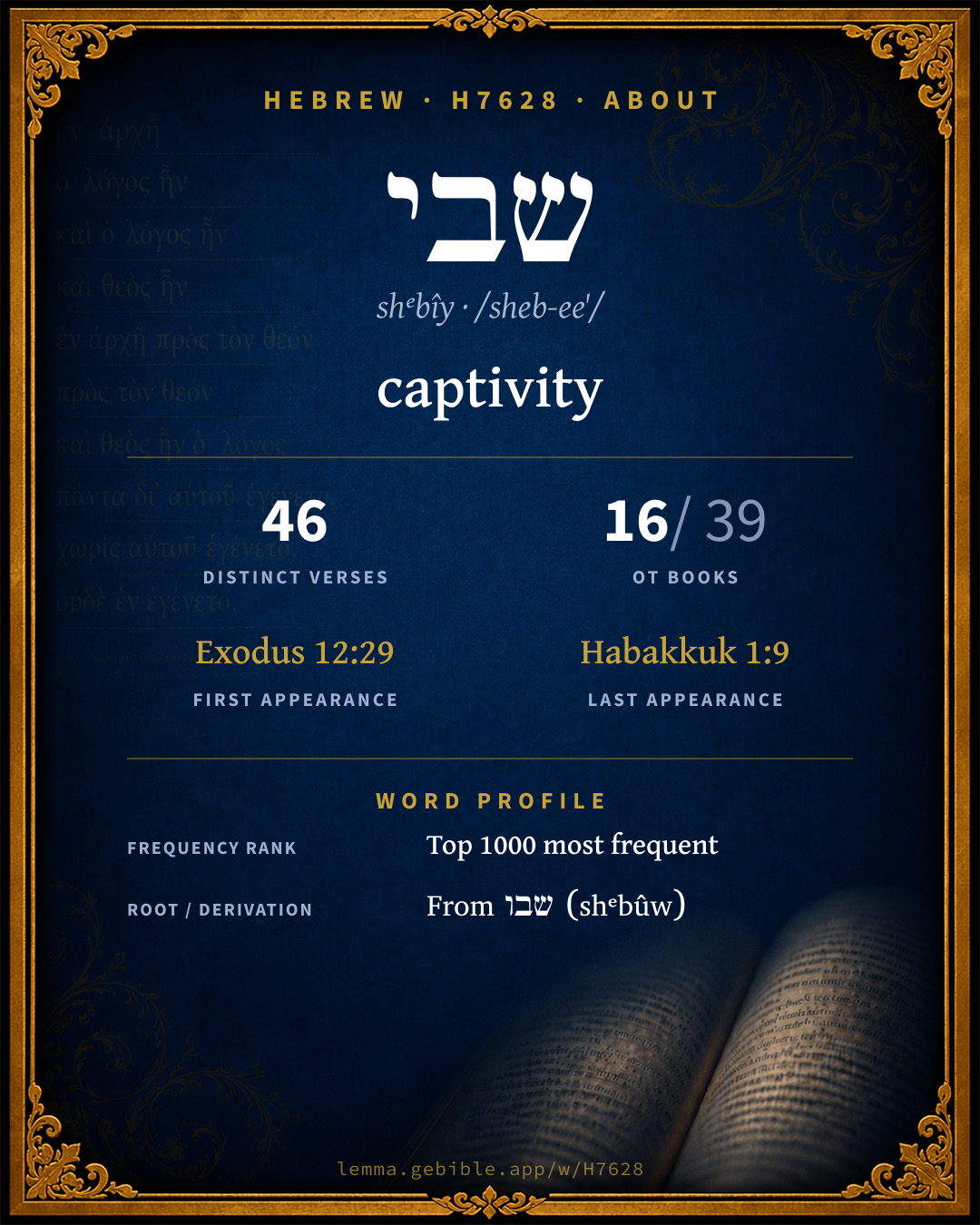
שבי
captivity
‘captivity’ is one of 2 main senses fuller range ↓
Full lexicon entry — Brown-Driver-Briggs (BDB)
From Brown-Driver-Briggs (BDB)
Where this word appears
See every Absolute-state word in the Hebrew Bible →
Grammar key — what these labels mean
Part of speech
- Noun
- A naming word — a person, place, thing, or idea.
- Adjective
- A word that describes or qualifies a noun.
Noun type
- Common
- A common noun — a general class of person, place, or thing (“king,” “city,” “water”), not a specific name.
State
- Absolute
- The independent form of a noun, not bound to a following word.
- Construct
- A noun bound to a following noun in a possessive / “of” relationship (the construct chain).
Gender
- Both
- Attested as both masculine and feminine.
- Feminine
- Grammatically feminine.
Number
- Singular
- One.
- Plural
- More than one (in Hebrew, generally three or more).
Grammatical forms
- Noun, Common, Both, Singular, Absolute 36 times (75%)
- Noun, Common, Both, Singular, Construct 10 times (21%)
- Adjective, Adjective, Feminine, Singular, Absolute 1 time (2%)
- Noun, Common, Both, Plural, Construct 1 time (2%)
Parsed forms decoded from the imported morphology (morphhb / Westminster Leningrad Codex — WLC text public domain, morphhb tagging CC BY 4.0), counted across 48 parsed occurrences — not distinct verses.
Every verse where H7628 appears — 46 distinct verses across 16 books. Click any verse to open its interlinear word-by-word view. Verse text shown in the World English Bible for context — . Each verse’s Hebrew form is shown with its reference; the English is not keyword-highlighted, since the data carries no word-level English alignment. Use “Compare translations” on any verse to read it across multiple English versions. This concordance covers the Hebrew Bible; Septuagint (Greek Old Testament) occurrences are not indexed here.
Exodus 1 verse
Numbers 5 verses
- Numbers 21:1 שֶֽׁבִי n c bs The Canaanite, the king of Arad, who lived in the South, heard tell that Israel came by the way of Atharim; and he fought against Israel, and took some of them captive.
- Numbers 21:29 בַּ/שְּׁבִ֔ית prep det + n c bs Woe to you, Moab! You are undone, people of Chemosh: He has given his sons as fugitives, His daughters into captivity, To Sihon king of the Amorites.
- Numbers 31:12 הַ/שְּׁבִ֧י ptcl def.art + n c bs They brought the captives, and the prey, and the spoil, to Moses, and to Eleazar the priest, and to the congregation of the children of Israel, to the camp at the plains of Moab, which are by the Jordan at Jericho.
- Numbers 31:19 וּ/שְׁבִי/כֶֽם conj + n c bs cs + sfx pers 2mp Encamp you outside of the camp seven days: whoever has killed any person, and whoever has touched any slain, purify yourselves on the third day and on the seventh day, you and your captives.
- Numbers 31:26 הַ/שְּׁבִ֔י ptcl def.art + n c bs Take the sum of the prey that was taken, both of man and of animal, you, and Eleazar the priest, and the heads of the fathers' [houses] of the congregation;
Deuteronomy 2 verses
- Deuteronomy 21:10 שִׁבְיֽ/וֹ n c bs cs + sfx pers 3ms When you go forth to battle against your enemies, and Yahweh your God delivers them into your hands, and you carry them away captive,
- Deuteronomy 28:41 בַּ/שֶּֽׁבִי prep det + n c bs You shall father sons and daughters, but they shall not be yours; for they shall go into captivity.
Judges 1 verse
2 Chronicles 2 verses
Ezra 4 verses
- Ezra 2:1 מִ/שְּׁבִ֣י prep + n c bs cs Now these are the children of the province, who went up out of the captivity of those who had been carried away, whom Nebuchadnezzar the king of Babylon had carried away to Babylon, and who returned to Jerusalem and Judah, everyone to his city;
- Ezra 3:8 מֵ/הַ/שְּׁבִ֣י prep + ptcl def.art + n c bs Now in the second year of their coming to the house of God at Jerusalem, in the second month, began Zerubbabel the son of Shealtiel, and Jeshua the son of Jozadak, and the rest of their brothers the priests and the Levites, and all those who were come out of the captivity to Jerusalem, and appointed the Levites, from twenty years old and upward, to have the oversight of the work of the house of Yahweh.
- Ezra 8:35 מֵֽ/הַ/שְּׁבִ֨י prep + ptcl def.art + n c bs The children of the captivity, who had come out of exile, offered burnt offerings to the God of Israel, twelve bulls for all Israel, ninety-six rams, seventy-seven lambs, and twelve male goats for a sin-offering: all this was a burnt offering to Yahweh.
- Ezra 9:7 בַּ/שְּׁבִ֧י prep det + n c bs Since the days of our fathers we have been exceeding guilty to this day; and for our iniquities have we, our kings, and our priests, been delivered into the hand of the kings of the lands, to the sword, to captivity, and to plunder, and to confusion of face, as it is this day.
Nehemiah 4 verses
- Nehemiah 1:2 הַ/שֶּׁ֖בִי ptcl def.art + n c bs that Hanani, one of my brothers, came, he and certain men out of Judah; and I asked them concerning the Jews who had escaped, who were left of the captivity, and concerning Jerusalem.
- Nehemiah 1:3 הַ/שְּׁבִי֙ ptcl def.art + n c bs They said to me, The remnant who are left of the captivity there in the province are in great affliction and reproach: the wall of Jerusalem also is broken down, and the gates of it are burned with fire.
- Nehemiah 7:6 מִ/שְּׁבִ֣י prep + n c bs cs These are the children of the province, who went up out of the captivity of those who had been carried away, whom Nebuchadnezzar the king of Babylon had carried away, and who returned to Jerusalem and to Judah, everyone to his city;
- Nehemiah 8:17 הַ/שְּׁבִ֥י ptcl def.art + n c bs All the assembly of those who were come again out of the captivity made booths, and lived in the booths; for since the days of Jeshua the son of Nun to that day the children of Israel had not done so. There was very great gladness.
Psalms 2 verses
- Psalms 68:18 שֶּׁ֗בִי n c bs You have ascended on high. You have led away captives. You have received gifts among men, Yes, among the rebellious also, that Yah God might dwell there.
- Psalms 78:61 לַ/שְּׁבִ֣י prep det + n c bs And delivered his strength into captivity, His glory into the adversary's hand.
Isaiah 5 verses
- Isaiah 20:4 שְׁבִ֨י n c bs cs so shall the king of Assyria lead away the captives of Egypt, and the exiles of Ethiopia, young and old, naked and barefoot, and with buttocks uncovered, to the shame of Egypt.
- Isaiah 46:2 בַּ/שְּׁבִ֥י prep det + n c bs They stoop, they bow down together; they could not deliver the burden, but themselves are gone into captivity.
- Isaiah 49:24 שְׁבִ֥י n c bs Shall the prey be taken from the mighty, or the lawful captives be delivered?
- Isaiah 49:25 שְׁבִ֤י n c bs cs But thus says Yahweh, Even the captives of the mighty shall be taken away, and the prey of the terrible shall be delivered; for I will contend with him who contends with you, and I will save your children.
- Isaiah 52:2 שְׁבִיָּ֖ה adj Adjective fs Shake yourself from the dust; arise, sit [on your throne], Jerusalem: loose yourself from the bonds of your neck, captive daughter of Zion.
Jeremiah 8 verses
- Jeremiah 15:2 לַ/שְּׁבִ֖י לַ/שֶּֽׁבִי prep det + n c bs prep det + n c bs It shall happen, when they tell you, Where shall we go forth? then you shall tell them, Thus says Yahweh: Such as are for death, to death; and such as are for the sword, to the sword; and such as are for the famine, to the famine; and such as are for captivity, to captivity.
- Jeremiah 20:6 בַּ/שֶּׁ֑בִי prep det + n c bs You, Pashhur, and all who dwell in your house shall go into captivity; and you shall come to Babylon, and there you shall die, and there shall you be buried, you, and all your friends, to whom you have prophesied falsely.
- Jeremiah 22:22 בַּ/שְּׁבִ֣י prep det + n c bs The wind shall feed all your shepherds, and your lovers shall go into captivity: surely then shall you be ashamed and confounded for all your wickedness.
- Jeremiah 30:10 שִׁבְיָ֑/ם n c bs cs + sfx pers 3mp Therefore don't you be afraid, O Jacob my servant, says Yahweh; neither be dismayed, Israel: for, behold, I will save you from afar, and your seed from the land of their captivity; and Jacob shall return, and shall be quiet and at ease, and none shall make him afraid.
- Jeremiah 30:16 בַּ/שְּׁבִ֣י prep det + n c bs Therefore all those who devour you shall be devoured; and all your adversaries, everyone of them, shall go into captivity; and those who despoil you shall be a spoil, and all who prey on you will I give for a prey.
- Jeremiah 43:11 לַ/שְּׁבִי֙ לַ/שֶּׁ֔בִי prep det + n c bs prep det + n c bs He shall come, and shall strike the land of Egypt; such as are for death [shall be given] to death, and such as are for captivity to captivity, and such as are for the sword to the sword.
- Jeremiah 46:27 שִׁבְיָ֑/ם n c bs cs + sfx pers 3mp But don't be afraid you, Jacob my servant, neither be dismayed, Israel: for, behold, I will save you from afar, and your seed from the land of their captivity; and Jacob shall return, and shall be quiet and at ease, and none shall make him afraid.
- Jeremiah 48:46 בַּ/שֶּׁ֔בִי prep det + n c bs Woe to you, O Moab! the people of Chemosh is undone; for your sons are taken away captive, and your daughters into captivity.
Lamentations 2 verses
- Lamentations 1:5 שְׁבִ֖י n c bs Her adversaries are become the head, her enemies prosper; For Yahweh has afflicted her for the multitude of her transgressions: Her young children are gone into captivity before the adversary.
- Lamentations 1:18 בַ/שֶּֽׁבִי prep det + n c bs Yahweh is righteous; for I have rebelled against his commandment: Please hear all you peoples, and see my sorrow: My virgins and my young men are gone into captivity.
Ezekiel 4 verses
- Ezekiel 12:11 בַ/שְּׁבִ֖י prep det + n c bs Say, I am your sign: like as I have done, so shall it be done to them; they shall go into exile, into captivity.
- Ezekiel 16:53 שְׁבִיתַ֖יִ/ךְ n c bp cs + sfx pers 2fs I will turn again their captivity, the captivity of Sodom and her daughters, and the captivity of Samaria and her daughters, and the captivity of your captives in the midst of them;
- Ezekiel 30:17 בַּ/שְּׁבִ֥י prep det + n c bs The young men of Aven and of Pibeseth shall fall by the sword; and these [cities] shall go into captivity.
- Ezekiel 30:18 בַּ/שְּׁבִ֥י prep det + n c bs At Tehaphnehes also the day shall withdraw itself, when I shall break there the yokes of Egypt, and the pride of her power shall cease in her: as for her, a cloud shall cover her, and her daughters shall go into captivity.
Daniel 2 verses
- Daniel 11:8 בַּ/שְּׁבִ֖י prep det + n c bs Also their gods, with their molten images, [and] with their goodly vessels of silver and of gold, shall he carry captive into Egypt; and he shall refrain some years from the king of the north.
- Daniel 11:33 בִּ/שְׁבִ֥י prep + n c bs Those who are wise among the people shall instruct many; yet they shall fall by the sword and by flame, by captivity and by spoil, [many] days.
Amos 2 verses
- Amos 4:10 שְׁבִ֣י n c bs cs I sent plagues among you like I did Egypt. I have slain your young men with the sword, And have carried away your horses; And I filled your nostrils with the stench of your camp Yet you haven't returned to me," says Yahweh.
- Amos 9:4 בַ/שְּׁבִי֙ prep det + n c bs Though they go into captivity before their enemies, there I will command the sword, and it will kill them. I will set my eyes on them for evil, and not for good.
Nahum 1 verse
Habakkuk 1 verse
About this entry
At a glance — auto-summarized from this page’s data, not written by a person. Every figure links to its source below. This summary describes the numbers; it doesn’t interpret them.
שבי (shᵉbîy) is a Hebrew word most often rendered “captivity.” It first appears in Exodus 12:29. It turns up in 46 verses across 16 books, a moderately common footprint. It is not a single-sense word — see its full sense range. From the same root come שבו and שביה. The sections below give every sense, occurrence, and version rendering.
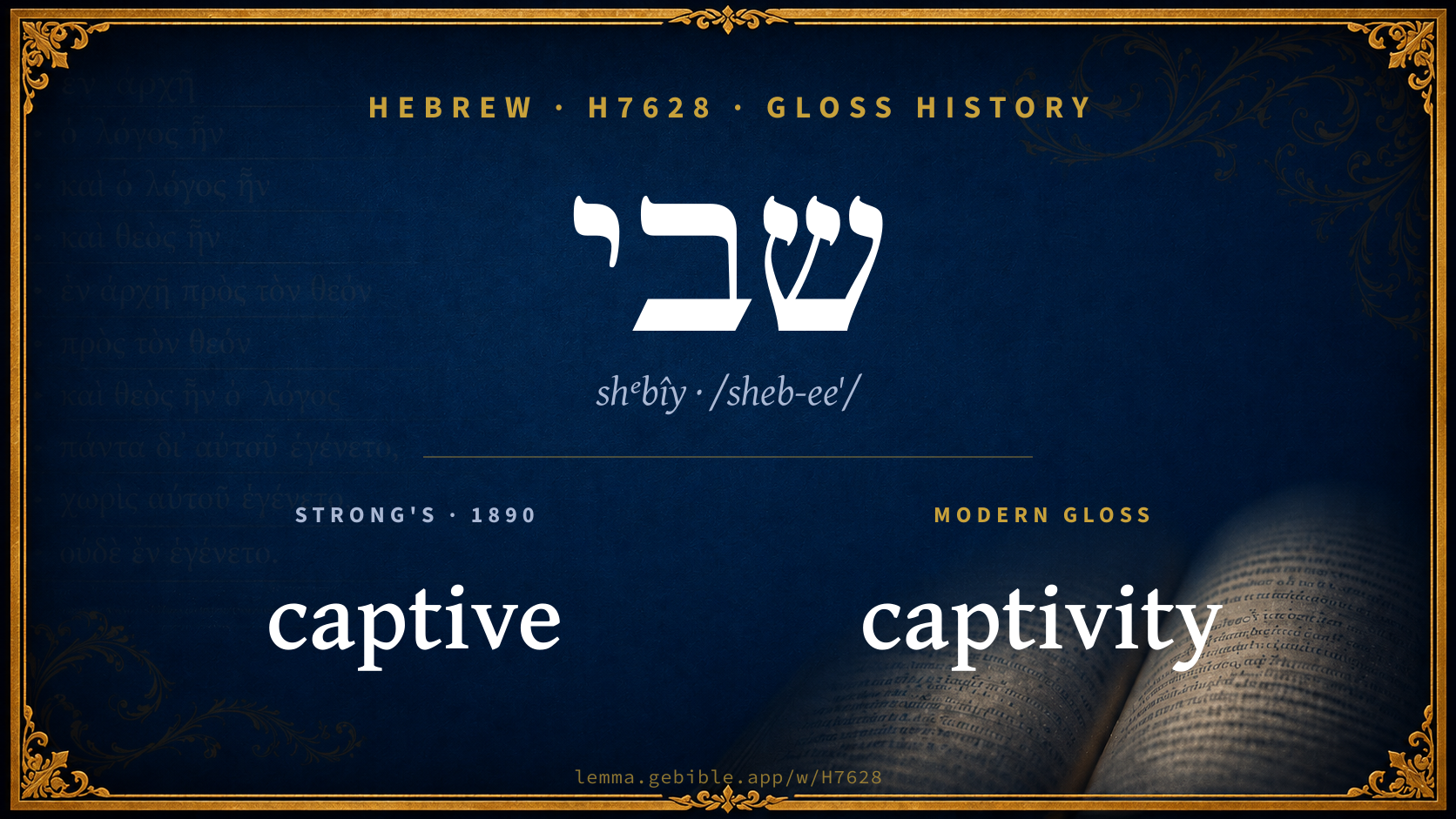
Gloss history
Strong's 1890 vs modern scholarship
About this word
Strong's H7628 catalogs a Hebrew word from the Hebrew Old Testament.
These counts are not copied from any lexicon or concordance. They are computed here, from the morphology-tagged Hebrew Old Testament. What Lemma adds →
- 46
- distinct verses
- The word appears in 46 distinct verses.
- 16 / 39
- OT books
- The word appears in 16 of 39 Old Testament books.
- #767
- by frequency
- Top 1000 most frequent Hebrew words (rank 767 of 8,640 Hebrew words by occurrence).
View all 46 occurrences in the concordance →
By section of the Old Testament
By traditional corpus
Conventional, traditional groupings — biblical authorship is debated, so this is a traditional corpus grouping, not an authorship claim. Each share is this word’s portion of its verses in that division of the Hebrew canon. Each figure is a share of the word’s 46 distinct verses.
- Prophets (Nevi'im) 22 verses · 48%
- Writings (Ketuvim) 16 verses · 35%
- Torah (Pentateuch) 8 verses · 17%
How translations render this word
Counts come from each version’s own published word-to-Strong’s tagging or interlinear alignment — an approximate guide to how each version renders this word, not a word-level alignment the data otherwise carries. Because each total is that version’s own tagged count, the per-version totals vary from one another and need not match the appearance or distinct-verse counts above. These counts may also differ from a printed concordance because Lemma counts each distinctly tagged rendering and does not collapse phrase taggings into a single head-word total. This is a fixed set of word-tagged versions (KJV, ASV, BSB, ULT) and does not change with the reading translation you choose elsewhere. Each version’s license is shown beside its name below (and on Sources).
- King James Version: Captivity 30×, Captives 5×, Captive 4×
- American Standard Version: Captivity 26×, Captives 7×, Captive 3×
- Berean Standard Bible: Captivity 20×, Captives 8×, Exile 5×
- unfoldingWord Literal Text: Captivity 23×, Captives 6×, Captive 4×
King James Version Public Domain
Renders H7628 across 49 tagged occurrences — most commonly:
Plus 10 renderings that appear only once — usually multi-word phrases or single function words the recovered tagging swept in, not distinct renderings.
American Standard Version Public Domain
Renders H7628 across 50 tagged occurrences — most commonly:
Plus 10 renderings that appear only once — usually multi-word phrases or single function words the recovered tagging swept in, not distinct renderings.
Berean Standard Bible Public Domain
Renders H7628 across 49 tagged occurrences — most commonly:
Plus 9 renderings that appear only once — usually multi-word phrases or single function words the recovered tagging swept in, not distinct renderings. Not rendered by a distinct English word in 1 further occurrence.
unfoldingWord Literal Text CC BY-SA 4.0
Renders H7628 across 42 tagged occurrences — most commonly:
Plus 4 renderings that appear only once — usually multi-word phrases or single function words the recovered tagging swept in, not distinct renderings.
Senses in the full BDB
What do BDB’s symbols mean?
BDB uses these scholarly abbreviations:
| Symbol | Meaning |
|---|---|
| 𝔊 | the Septuagint (the ancient Greek translation, LXX) |
| 𝔙 | the Vulgate (the Latin translation) |
| 𝔖 | the Syriac version (the Peshitta) |
| 𝔗 | the Targum (the Aramaic translation) |
| ψ | the Psalms |
| √ | root (the underlying root or stem) |
| ‖ | parallel passage (a synonymous or contrasted parallel) |
| † | the dagger: every passage where the word occurs is cited |
The 3 senses and sub-senses the full Brown-Driver-Briggs lexicon distinguishes for this word, in lexicon order (not ranked by frequency), with BDB’s own verbatim wording and sub-sense lettering. Shown in Hebrew script with BDB’s own scholarly abbreviations. The condensed entry is in the Lexicon Entry tab. See also the Forms in the corpus table below.
- 1. = state of captivity, הָלַךְ בַּשְּׁ׳ Am 9:4; Dt 28:41; Na 3:10; Je 20:6; 22:22; 30:16 Ez 12:11 (+ בַּגּוֹלָה), 30:17, 18; Is 46:2; La 1:18, = הָלַךְ שְׁבִי v 5; בַּשְּׁבִי יָבִא Dn 11:8; נָתַן בַּשְּׁ׳ Ezr 9:7, נָתַן לַשְּׁ׳ ψ 78:61, לֻקַּח בַּשֶּׁ֑בִי Je 48:46; וַאֲשֶׁר לַשְּׁבִי לַשֶּׁ֑בִי Je 15:2; 43:11, וְנָשֵׁינוּ בַּשְּׁ׳ 2 Ch 29:9; בִּשְׁבִי instr. of judgment Dn 11:33; אֶרֶץ שׁ׳ Je 30:10; 46:27;16 2 Ch 6:37, 38; phr. of deliverance (only Ezr Ne): נִשְׁאֲרוּ מִן־הַשְּׁ׳ Ne 1:2, cf. v 3, הַשָּׁבִים מִן־הַשְּׁ׳ 8:17, הָעֹלִים מִשְּׁבִי הַגּוֹלָה Ezr 2:1 = Ne 7:6, הַבָּאִים מֵהַשְּׁ׳ Ezr 3:8; 8:35. e.g. Amos 9:4
- 2. act of capture, עִם שׁ׳ סוּסֵיכֶם Am 4:10 שִׂמְלַת שִׁבְיָהּ Dt 21:13 i.e. garb in which she was captured (> others captivity in both: Am 4:10 = your captive horses; Dt 21:13 her captive’s garb). e.g. Amos 4:10
- 3. = captives (coll.): Ex 12:29 (J), Nu 31:12, 19, 26 (man and beast), Is 20:4 (‖ גָּלוּת), 49:24, 25 Hb 1:9 + Ez 32:9 𝔊 al. (v. שֶׁבֶר ad fin.); appar. fs. Is 52:2 (but v. שָׁבִי); object of שָׁבָה (q.v.) Ju 5:12 (> שֹׁבֶיךָ 𝔖 JDMich We Bu Now), Nu 21:1 (JE), Dt 21:10 ψ 68:19; 2 Ch 28:17. e.g. Exodus 12:29
Senses from the full Brown-Driver-Briggs lexicon (Brown, Driver, Briggs; Oxford 1906 — public domain), digitized via Sefaria, supplemented by the OpenScriptures HebrewLexicon (CC BY 4.0). Full attribution on Sources.
Word origin
n.m. Is 49:24 captivity, captives (coll.);—שׁ׳ abs. Ex 12:29 +, cstr. Ezr 2:1 +; שֶׁ֑בִי Nu 21:1 +; sf. שֶׁבְיְךָ Ju 5:12, שִׁבְיוֹ Dt 21:10, שְׁבִיכֶם Nu 31:19, etc.;—
— Brown-Driver-Briggs (Oxford 1906, public domain), digitized via Sefaria, supplemented by the OpenScriptures HebrewLexicon (CC BY 4.0). See Sources.
Derived from שבו (shᵉbûw) (H7618) — agate.
Jastrow Dictionary
A second Hebrew/Aramaic lexicon for comparison, covering Aramaic and post-biblical (Talmudic, Targumic, Midrashic) usage that the biblical-Hebrew BDB does not. Matched by lemma rather than by Strong’s number, so a lemma may carry more than one Jastrow headword (shown separately below), and the entries cover usage well beyond the Bible.
בֵּי
- 1. (= (= בְּ־ I) in, with, at. Targ. Y. Num. XXII, 28 בי ההיא שעתא at that time. Targ. Cant. I, 9; 13; 14 (ed. Vien. בההיא).
- 2. (= בין) between, among. Sot. 10ᵃ; Meg. 12ᵃ; v. בּוּצִינָא.—Sabb. 109ᵇ בי מיללי (Ms. במ׳) between the embers; a. fr.—בי שמשי (= h. בין השמשות) during sunset. Ber. 43ᵇ קדושא דבי ש׳ the Kiddush said on Friday night. Keth. 103ᵃ כל בי ש׳ every Friday night.
- 3. (= בְּ II) son of; v. בְּרַבִּי. Y. Ber. IV, 7ᶜ bot.; a. fr.
- 4. (= בֵּית) house of, school of; home, place of &c. Targ. Job VII, 9; a. e.—… תנא דבי ר׳ (sub. תני) a student of the school of R. … taught. Ḥull. 42ᵃ; a. fr.—Ab. Zar. 6ᵇ בדבי ר׳ או׳ (Ms. M. ב"ר) in (the Boraitha) of the school of R. O.—Yeb. 21ᵇ דבי אימא רבתי one of the family of the grandmother (whether mother’s or father’s mother). Ib. דבי אבא רבה of the grandfather’s family; דבי דודי one of the uncle’s relation.—דבי רב the Boraitha of Be Rab (Sifra). Ḥull. 66ᵃ (v. Rashi a. l.); a. fr.—בי רבנן college. Ber. 17ᵃ; a. fr. [For other compounds with בי, v. respective determinants.]
פַּגֵּי
- pr. n. pl., v. פָּאגֵי
שַׁב ²
- (preced.)
- 1. = h. שָׁבוּעַ. week. Targ. II Esth. III, 7; a. fr.—Sabb. 156ᵃ האי מאן דבחד בש׳ a person born on the first day of the week; בתרי בש׳ on Monday &c. Bets. 16ᵃ מחד שֵׁבָּיךְ לשבתך from thy first day of the week begin to set aside good things for thy Sabbath; a. fr.
- 2. the seventh day, the Sabbath; day of rest. Targ. Y. Deut. V, 14 שב ונייח a day of rest and repose; Targ. Y. Ex. XX, 10 שבא ונ׳. Targ. Y. Lev. XXIII, 32 שבא ונייחא; Targ. O. ש׳ שבתא (h. text שבת שבתון); a. fr.—Y. Taan. I, 64ᵃ בשׁוּבָּה וכ׳, v. נְיָיח. Y. Sot. I, 16ᵈ bot. כל לילי ש׳ every Sabbath night. Y. Ab. Zar. V, 44ᵈ bot. ערובת ש׳ Sabbath eve; בפוקי ש׳ at the exit of the Sabbath; a. fr.—Y. Taan. IV, 69ᵃ bot. כל ארובת שובאי (corr. acc.).—Pl. שַׁבִּין, שַׁבַּיָּא, שַׁבֵּי. Targ. Is. I, 13 (ed. Wil. שַׁבְּאִין). Targ. I Chr. XXIII, 31; a. fr.—Sabb. 119ᵃ יוסף מוקיר שבי Joseph, the honorer of the Sabbaths; a. e.
שבי
- (b. h.) to capture, carry off.—Part. pass. שָׁבוּי; f. שְׁבוּיָה; pl. שְׁבוּיִים, שְׁבוּיִם, שְׁבוּיִין; שְׁבוּיוֹת. Keth. I, 2 הגיורת והש׳ וכ׳ a proselyte, a captive, and a slave, converted, redeemed, or freed at an age of less than three years and one day. Ib. 4. B. Bath. 8ᵃ bot.; Ḥull. 7ᵃ, a. e. פדיון ש׳, v. פִּדְיוֹן. Shek. II, 5 מותר שבויים לש׳ what is left over from a fund collected for the ransom of captives, must be reserved for the ransom of other captives; מותר שבוי לאותו ש׳ what is left over from a collection for a certain captive, belongs to that captive. Y. ib. II, 47ᵃ top אין פודין ש׳ בש׳ you dare not redeem a captive by surrendering another captive. Keth. 51ᵇ בש׳ הקלו with regard to a woman redeemed from captivity the practice is more lenient (allowing her husband to live with her again). Ib. שְׁבוּיֵי מלכות הרי הן כש׳ women forced by (Roman) officials come under the law of redeemed captives (are permitted to live with their husbands). Gitt. IV, 6, v. פָּדָה; a. fr.
- to be captured. B. Mets. 39ᵃ שבוי שנ׳ מורידין וכ׳ if a person has been captured (banished), we appoint a relative to manage his property. Snh. 104ᵃ שני בני אדם שנִשְׁבּוּ וכ׳ two persons were captured on Mount Carmel. Lam. R. to I, 16 מעשה במרים … שנִשְׁבֵּית וכ׳ it came to pass that Miriam … was carried off (by the Romans), herself and her seven sons. Keth. II, 5 נִשְׁבֵּתִי וטהורה אני I was a captive (among gentiles), but I remained pure; ib. 23ᵃ נִשְׁבֵּיתִי; a. fr.
שְׁבֵי
- Targ. Num. XXI, 1. Targ. I Chr V, 21. Targ. Ps. CVI, 46. Targ. II Chr. VI, 36. Targ. Is. XIV, 2; a. fr.—Part. pass. שָׁבֵי, pl. שָׁבָן, שְׁבָן. Targ. O. Deut. XXXII, 42 שָׁ׳ Ms. I (ed. Berl. שְׁ׳; oth. ed. שִׁבְיָן; Y. שִׁיבִין; v. שִׁבְיָא).—Ber. 56ᵃ דאתו רומאי ושָׁבוּ לך that the Romans came and made thee captive, v. שְׁחַר IV. e.g. 1 Chronicles 5:21
- to be taken captive, be carried off. Targ. Gen. XIV, 14. Targ. I Sam. XXX, 3; a. fr.—B. Mets. 39ᵇ אִשְׁתַּבָּאִי איהי וכ׳ she was captured and one of her daughters. Keth. 23ᵃ אִישְׁתַּבְּיָין בנתיה וכ׳ the daughters of Mar Samuel were captured. Keth. IV, 8 אם תִּשְׁתַּבָּאִי וכ׳, v. פְּרַק; a. e.
שְׁבִי
- preced.) captivity, prison. Hor. III, 7 האשה … מבית הש׳ a woman has the precedence of a man with regard to clothes and to relief from prison.
שְׁבִי ²
- , captivity; (collect. noun) captives. Targ. O. Ex. XII, 29. Targ. Is. XX, 4. Targ. O. Deut. XXI, 10. Ib. 11 (ed. Vien. שִׁבְיָה). Targ. Is. LII, 2 שְׁבִיָא ed. Wil. (ed. Lag. a. oth. שְׁבוּיֵי or שְׁבוֹיֵי); a. fr.—Pl. שִׁבְיָין, שִׁבְיָן. Targ. O. Deut. XXXII, 42, v. שְׁבֵי.—V. שִׁבְיְיתָא.
שָׁבֵי
- (preced.) captor, marauder.—Pl. שָׁבְיָין. Targ. II Chr. VI, 36 שָׁבֵיהוֹן. Targ. Is. XIV, 2 (ed. Wil. שׁוֹבֵיהוֹן).—Y. Ter. VIII, 46ᵃ ש׳ עלון לקרתא וכ׳ marauders invaded a town, and one of them &c.
A Dictionary of the Targumim, the Talmud Babli and Yerushalmi, and the Midrashic Literature (Marcus Jastrow; London, Luzac, 1903) — Public Domain. Digitized via Sefaria. Digitized via Sefaria. Full attribution on Sources.
Forms in the corpus
The 39 distinct written forms H7628 takes in the Hebrew Bible, most frequent first — each parse links to that state’s occurrences in the concordance. Hebrew forms include their vowel points and cantillation, so a single lemma takes many written forms.
Same root — word family
Other BDB entries built from the same root as H7628, grouped by Strong’s listed origin. These share a root / origin per the lexicon — not necessarily a shared meaning. Each links to that word’s own entry.
Derives from
Derived from this word
Compare all same-root words → They share a root, not necessarily a meaning.
Septuagint verse parallels
This word appears in 39 verses that also exist in the Greek Old Testament (Septuagint), out of the 46 Hebrew verses it occurs in. You can read those verses in Greek by switching the Old Testament edition to the Septuagint.
Read these verses in the Septuagint
- Exodus 12:29
- Numbers 21:1
- Deuteronomy 21:10
- Judges 5:12
- 2 Chronicles 28:17
- Ezra 2:1
- Psalms 68:18
- Isaiah 20:4
- Jeremiah 15:2
- Lamentations 1:5
- Ezekiel 12:11
- Daniel 11:8
This is a verse-level parallel only — the same verses exist in both the Hebrew and Greek Old Testaments. No word-level Hebrew↔Greek correspondence is claimed: the data carries no such alignment, so no Greek word is shown as this Hebrew word’s translation. Coverage is not total — the Septuagint omits the deuterocanon and renumbers the Psalms, so some Hebrew verses have no direct Greek parallel.