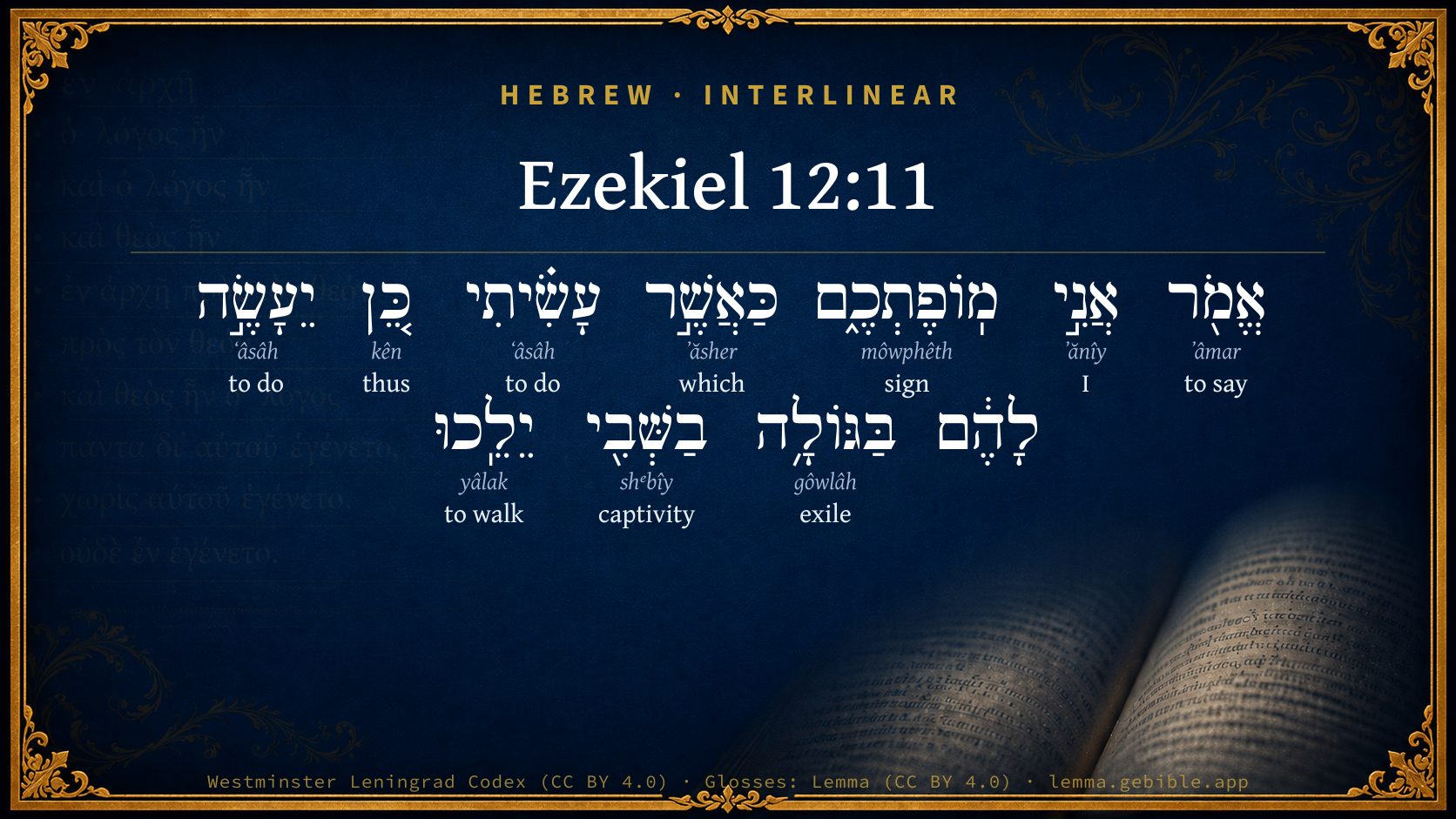
Ezekiel 12:11

Hebrew (Westminster Leningrad Codex) Ezekiel 12:11 appears in the Hebrew Old Testament. The text above is from the Westminster Leningrad Codex. Each word links to its Strong’s number, a concise gloss, and parsing drawn from the Open Scriptures Hebrew Bible morphology. Click any word for its full Brown-Driver-Briggs (BDB) entry.
Download image
Cite this verse

Ezekiel 12:11 (World English Bible). Public Domain. Lemma interlinear Bible study tool, https://lemma.gebible.app/v/ezekiel/12/11.

Show BibTeX & RIS
BibTeX
RIS
English Translation
Say, I am your sign: like as I have done, so shall it be done to them; they shall go into exile, into captivity.
World English Bible · Public Domain
Download a study sheet

One document with this verse’s original text, its word-by-word gloss line, the meaning frame, cross-references with their text, attributed commentary, and full source and license credits — printable, and it pastes into notes with its structure intact.

This verse Autodidact and up

Study sheet (.html) Plain text (.txt)

A passage Seminary Student

Up to 50 verses in one chapter. A passage sheet keeps up to 6 commentary sources and 12 cross-references per verse, in the order this page ranks them, and says so on the sheet whenever that leaves anything out. Ask for a single verse and you get the Autodidact verse sheet above.

Everything on this page stays free to read, with no account — the sheet is a download of what is already on screen, not access to it.

Want to remove ads? Support Godless Engineer
Compare translations 3

The same verse in 3 English versions, stacked beneath the original-language interlinear above. Click any original word for its lexicon entry.

Each is an independent rendering of the whole verse — the interlinear is not word-aligned to these translations.

Highlighted words mark where these versions differ — a whole-verse word diff, not a word-by-word alignment.

  • World English Bible Public Domain
    Say, I am your sign: like as I have done, so shall it be done to them; they shall go into exile, into captivity.
  • King James Version Public Domain
    Say, I am your sign: like as I have done, so shall it be done unto them: they shall remove and go into captivity.
  • unfoldingWord Literal Text CC BY-SA 4.0
    Say, ‘I am a sign to you.’ As I have done, so it will be done to them; they will go into exile and into captivity.

unfoldingWord Literal Text — © unfoldingWord, licensed CC BY-SA 4.0. Word-aligned USFM3 via Door43 (git.door43.org/unfoldingWord/en_ult).

Versions to compare (up to 4)

3 of 4 selected

Show all 18 translations

Every available English version of this verse, each an independent rendering of the whole verse.

  • World English Bible Public Domain
    Say, I am your sign: like as I have done, so shall it be done to them; they shall go into exile, into captivity.
  • Berean Standard Bible Public Domain
    You are to say, ‘I am a sign to you.’ Just as it happened here, so will it be done to them; they will go into exile as captives.
  • Majority Standard Bible Public Domain
    You are to say, ‘I am a sign to you.’ Just as it happened here, so will it be done to them; they will go into exile as captives.
  • King James Version Public Domain
    Say, I am your sign: like as I have done, so shall it be done unto them: they shall remove and go into captivity.
  • American Standard Version (1901) Public Domain
    Say, I am your sign: like as I have done, so shall it be done unto them; they shall go into exile, into captivity.
  • Revised Version (1885) Public Domain
    Say, I am your sign: like as I have done, so shall it be done unto them: they shall go into exile, into captivity.
  • Geneva Bible (1599) Public Domain
    Say, I am your signe: like as I haue done, so shall it be done vnto them: they shall goe into bondage and captiuitie.
  • Douay-Rheims (1899) Public Domain
    Say: I am a sign of things to come to you: as I have done, so shall it be done to them: they shall be removed from their dwellings, and go into captivity.
  • Young's Literal Translation Public Domain
    Say: I `am' your type; as I have done so it is done to them, into a removal, into a captivity, they do go.
  • Literal Standard Version CC BY-SA 4.0
    Say: I [am] your sign; as I have done so it is done to them, into a removal, into a captivity, they go.
  • Unlocked Literal Bible CC BY-SA 4.0
    Say, 'I am a sign to you.' As I have done, so it will be done to them; they will go into exile and into captivity.
  • unfoldingWord Literal Text CC BY-SA 4.0
    Say, ‘I am a sign to you.’ As I have done, so it will be done to them; they will go into exile and into captivity.
  • Darby Bible Public Domain
    Say, I am your sign: as I have done, so shall it be done unto them: they shall go into exile, into captivity.
  • World Messianic Bible Public Domain
    “Say, ‘I am your sign. As I have done, so will it be done to them. They will go into exile, into captivity.
  • Webster's Bible Public Domain
    Say, I am your sign: as I have done, so shall it be done to them: they shall remove and go into captivity.
  • Free Bible Version CC BY-SA 4.0
    You are to say to them, ‘I'm a sign to you.’ Just as it was demonstrated here, so it will happen to them—they will go into exile as prisoners.
  • Bible in Basic English Public Domain
    Say, I am your sign: as I have done, so will it be done to them: they will go away as prisoners.
  • JPS Tanakh (1917) Public Domain
    say: I am your sign: like as I have done, so shall it be done unto them — they shall go into exile, into captivity.

Literal Standard Version (2020), Covenant Press — licensed CC BY-SA 4.0. Text via the HelloAO Bible API (eBible.org). Unlocked Literal Bible (unfoldingWord) — licensed CC BY-SA 4.0. Text via the HelloAO Bible API (eBible.org). unfoldingWord Literal Text — © unfoldingWord, licensed CC BY-SA 4.0. Word-aligned USFM3 via Door43 (git.door43.org/unfoldingWord/en_ult). Free Bible Version, Dr. Jonathan Gallagher — licensed CC BY-SA 4.0. Text via the HelloAO Bible API (eBible.org).

Word by word

More ways to search: Search by grammar → Find every occurrence → Compare this word →

Practice this passage: Drill this verse → Learn its vocabulary →

מֽוֹפֶתְכֶ֑ם
môwphêth
H4159
“sign · your”
Noun, Common, Masculine, Singular, Construct + Suffix, Personal, 2nd Person, Masculine, Plural
Part of Speech
Noun
Type
Common
Gender
Masculine
Number
Singular
State
Construct
Full BDB Definition

Origin: from H3302 in the sense of conspicuousness

TWOT: 152a

wonder, sign, miracle, portent - wonder (as a special display of God's power) - sign, token (of future event)
  1. אֱמֹ֖ר ʼâmar H559 “say” Verb, Qal, Imperative, 2nd Person, Masculine, Singular
  2. אֲנִ֣י ʼănîy H589 “I” Pronoun, Personal, 1st Person, Common, Singular
  3. כַּאֲשֶׁ֣ר ʼăsher H834 “like/as · which” Preposition + Particle, Relative
  4. עָשִׂ֗יתִי ʻâsâh H6213 “to do” Verb, Qal, Perfect, 1st Person, Common, Singular
  5. כֵּ֚ן kên H3651 “thus” Particle, Demonstrative
  6. יֵעָשֶׂ֣ה ʻâsâh H6213 “to do” Verb, Niphal, Imperfect, 3rd Person, Masculine, Singular
  7. בַּגּוֹלָ֥ה gôwlâh H1473 “in/at the · exile” Preposition, Determined + Noun, Common, Feminine, Singular, Absolute
  8. בַשְּׁבִ֖י shᵉbîy H7628 “in/at the · captivity” Preposition, Determined + Noun, Common, Both, Singular, Absolute
  9. יֵלֵֽכוּ yâlak H3212 “to walk” Verb, Qal, Imperfect, 3rd Person, Masculine, Plural

About this verse

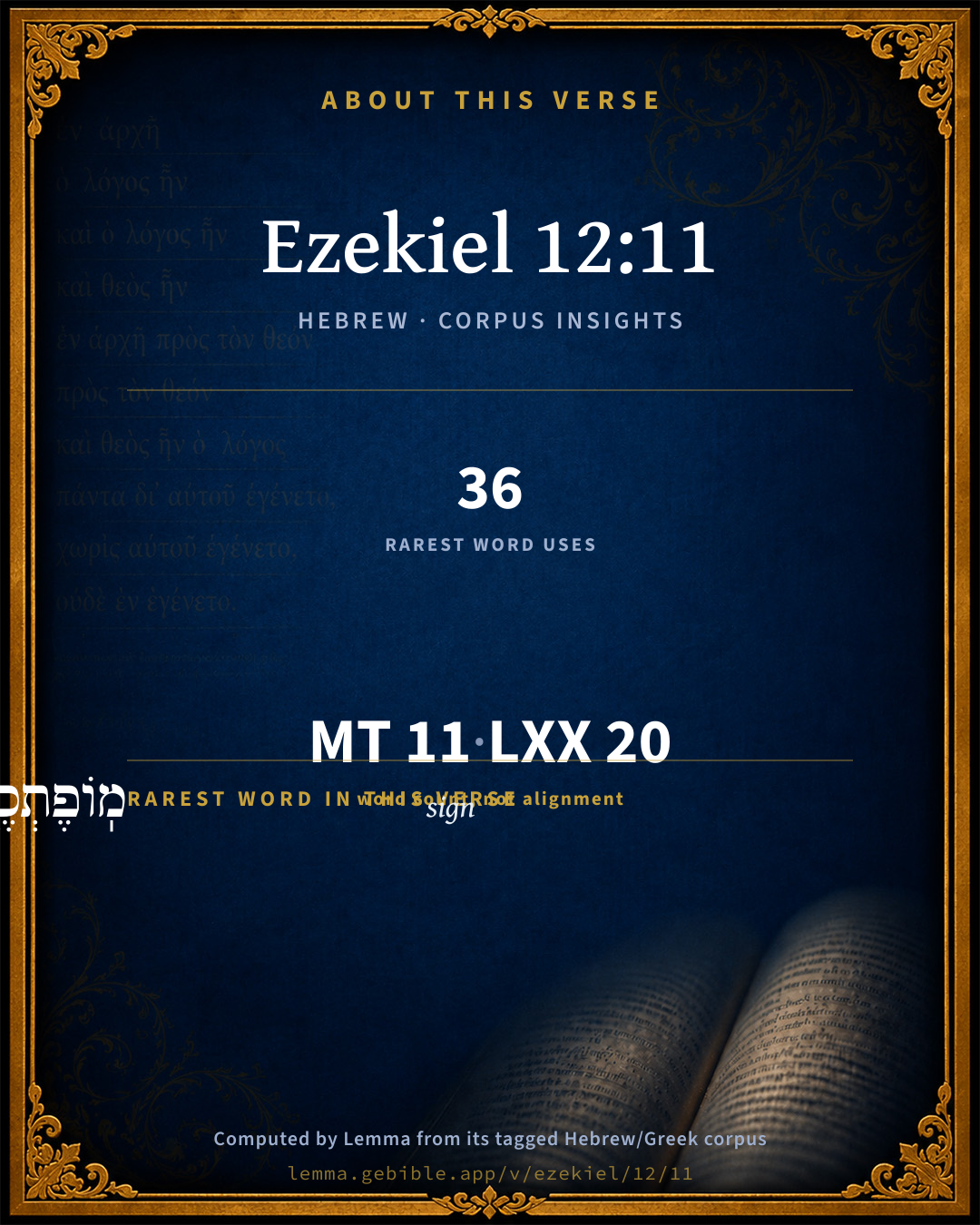
These counts appear in no published source. They are computed here, from the morphology-tagged text and Lemma’s own curated glosses. What Lemma adds →

11
words
9
distinct lemmas
Prophets
section

Shared distinctive vocabulary

מֽוֹפֶתְכֶ֑ם sign H4159 occurs in 35 verses of the Hebrew Bible. Also found in:

Grammatical profile

  • 4 verbs
  • 3 nouns
  • 1 pronoun
  • 1 preposition
  • 2 particles

Verb forms

  • אֱמֹ֖ר Qal · Imperative
  • עָשִׂ֗יתִי Qal · Perfect
  • יֵעָשֶׂ֣ה Niphal · Imperfect
  • יֵלֵֽכוּ Qal · Imperfect

Repetition

A word recurs within this verse — often emphatic in Hebrew:

  • עָשִׂ֗יתִי to do H6213 ×2

Hebrew & Septuagint length

In English translation the verse runs 24 words from the Hebrew and 22 from the Septuagint (LXX English) — closely comparable.

A rough comparison of the two English renderings, which tokenize alike — not a word-level alignment.

Word counts can differ between the Hebrew and the Greek without any difference in meaning — e.g. the Hebrew direct-object marker אֵת has no separate Greek word, and Greek often adds the article ὁ.

In the original languages it is 11 Hebrew tokens and 20 Greek tokens — but the two are counted differently (Hebrew bundles its prefixes and suffixes into one token; the Greek is in lemma form), so that isn’t a like-for-like length.

Cross-references

4

Topical passages linked to Ezekiel 12:11 in the Treasury of Scripture Knowledge — connected by theme and wording, ordered by reader-vote popularity; previews shown in the World English Bible.

  • Jeremiah 15:2 It shall happen, when they tell you, Where shall we go forth? then you shall tell them, Thus says Yahweh: Such as are for death, to death; and such as are for the sword, to the sword; and such as are for the famine, to the famine; and such as are for captivity, to captivity.
  • Jeremiah 52:15 Then Nebuzaradan the captain of the guard carried away captive of the poorest of the people, and the residue of the people who were left in the city, and those who fell away, who fell to the king of Babylon, and the residue of the multitude.
  • Jeremiah 52:28–30 This is the people whom Nebuchadrezzar carried away captive: in the seventh year three thousand twenty-three Jews;
  • Ezekiel 12:6 In their sight shall you bear it on your shoulder, and carry it forth in the dark; you shall cover your face, that you don't see the land: for I have set you for a sign to the house of Israel.

Cross-references courtesy of OpenBible.info (CC BY 4.0).

Hebrew and Greek witnesses Masoretic Hebrew ↔ Greek Septuagint

The same verse in the two great witnesses to the Old Testament, shown verse-for-verse.

These are two independent witnesses, not word-aligned to each other, and the Septuagint is shown in lemma (dictionary) form.

Hebrew Ezekiel 12:11 Masoretic · Westminster Leningrad Codex

אֱמֹ֖ר אֲנִ֣י מֽוֹפֶתְכֶ֑ם כַּאֲשֶׁ֣ר עָשִׂ֗יתִי כֵּ֚ן יֵעָשֶׂ֣ה לָהֶ֔ם בַּגּוֹלָ֥ה בַשְּׁבִ֖י יֵלֵֽכוּ

Say, I am your sign: like as I have done, so shall it be done to them; they shall go into exile, into captivity.

World English Bible · Public Domain

Greek LXX Ezekiel 12:11 Septuagint · lemma form

εἶπον ὅτι ἐγώ τέρας ποιέω ἐν μέσος αὐτός ὅς τρόπος ποιέω οὕτως εἰμί αὐτός ἐν μετοικεσία καί ἐν αἰχμαλωσία πορεύομαι

say, I am performing signs: as I have done, so shall it be to him: they shall go into banishment and captivity.

LXX2012 (modern English Septuagint) · Public Domain

Hebrew: Westminster Leningrad Codex (CC BY 4.0). Greek: Septuagint (public domain); English from LXX2012 (modern English Septuagint) (Public Domain). How the Septuagint differs from the Hebrew →

Targum (Aramaic paraphrase)

1

The Targum is the ancient Jewish Aramaic paraphrase of the Hebrew Scriptures — an interpretive translation, not the Hebrew text itself. Onkelos (literal) and Pseudo-Jonathan (expansive) render the Torah, and Jonathan the Prophets. Coverage is partial: where no permissively-licensed English translation exists for a verse, only the Aramaic is shown. This is verse-level text, not a word-by-word alignment to the Hebrew.

  1. Targum Jonathan Prophets (Joshua–Malachi)
    אֲמַר אֲנָא אָתְכוֹן כְּמָא דַעֲבָדֵית כֵּן יִתְעַבֵיד לְהוֹן בְּגָלוּתָא בְּשִׁבְיָא יְהָכוּן:

    (no public-domain English translation for this verse)

    Targum Jonathan — Aramaic: “Mikraot Gedolot” (public domain). English: “Sefaria Community Translation” (CC0 1.0 (public-domain dedication)); “London "Chaldee Paraphrase," 1871” (public domain). Text via Sefaria.

Commentary

Notes on Ezekiel 12:11 from classic Christian and Jewish commentators (each source and its license shown beneath its notes). The classic Christian expositions comment on the surrounding passage and are grouped to its opening verse, so a note may address several verses; the Jewish commentaries on the Tanakh (Rashi and others) are per-verse, so they appear only where the commentator wrote on this verse.

Lemma curates 59 commentaries, every one of them public domain or Creative Commons licensed, each selected and text-cleaned for this edition rather than reprinted as found. About our sources →

Trapp's Complete Commentary

John Trapp

Eze 12:11 Say, I [am] your sign: like as I have done, so shall it be done unto them: they shall remove [and] go into captivity.

Ver. 11. I am your sign.] And so it pleases you to make me your mocking stock. Sed risus hic est Sardonius. Of such mirth one may safely say, "It is mad; and of such laughter, What doeth it?" {Ecc 2:2}

Like as I have done.] My removal is mira, nova inimica, et ludicra; a marvel, newly hostile, and a show; but upon you it will fall heavily and horridly. That which hath befallen me in type only, shall befall you in truth and reality.

John Trapp, A Commentary or Exposition upon All the Books of the Old and New Testament (1647–1656) — public domain. Text from a community e-Sword module.

Jamieson, Fausset & Brown

Robert Jamieson, A. R. Fausset & David Brown

sign--portent of evil to come (Eze 24:27; Zac 3:8, Margin). Fulfilled (Kg2 25:1-7; Jer 52:1-11).

Jamieson, Fausset & Brown — Commentary Critical and Explanatory on the Whole Bible (1871) — public domain (CC PDM 1.0). Text via the HelloAO Bible API.

Ellicott's Commentary for English Readers

(11) Your sign.—The change of pronoun is intentional. The prophet’s action was to be a sign not only to Zedekiah and the people in Jerusalem, but also to those in captivity, since they rested their hope upon the safety of the holy city.

A Bible Commentary for English Readers, edited by Charles John Ellicott (1878–1897) — public domain. Text from a community e-Sword module.

The Cambridge Bible for Schools and Colleges

gen. ed. J. J. S. Perowne

11. I am your sign] i.e. a sign to you—the exiles, to whom he is speaking; while done “to them” refers to the inhabitants of Jerusalem. Cf. Eze_12:6.

The Cambridge Bible for Schools and Colleges (gen. ed. J. J. S. Perowne; Cambridge University Press, 1878–1918) — public domain. Text from a community e-Sword module.

John Gill's Exposition

My net also will I spread upon him,.... Meaning the Chaldean army, which the Lord raised up, and brought against him, and gave success unto:

and he shall be taken in my snare; as a bird is taken in the snare of the fowler; or a wild beast by the hunter. The Jews have a tradition, which is mentioned both by Jarchi, Kimchi, and Abendana on the place, that there was a cave which reached from Zedekiah's house to the plains of Jericho, by the way of which he fled; and that God prepared a deer, which went upon the top of the cave; and the Chaldeans pursued it; and when it came to the mouth of the cave, Zedekiah was coming out, and they took him:

and I will bring him to Babylon to the land of the Chaldeans; yet shall he not see it; his eyes being put out at Riblah, Jer 39:7. The Prophet Jeremiah says that his eyes should behold the eyes of the king of Babylon, Jer 34:3; and yet here Ezekiel says that he should not see the land of the Chaldeans. Josephus (u) observes, that Zedekiah thought these two prophecies contradicted each other, and therefore gave credit to neither; but they both proved true; he saw the king of Babylon at Riblah; but his eyes being there put out, he saw not Babylon, whither he was carried captive:

though he shall die there; as he did, Jer 52:11.

(u) Joseph. Antiqu. l. 10. c. 7. sect. 2. and c. 8. sect. 2.

John Gill's Exposition of the Whole Bible (1746–1763) — public domain (CC PDM 1.0). Text via the HelloAO Bible API.

Matthew Poole's English Annotations

My person is the emblem of yours, and my actions in these cases are signs of that you shall do; and where you do not actively the like, yet the like shall be done to you, O inhabitants of Jerusalem.

Remove; change their habitations, and carry away their goods, such as the clemency of a conqueror will permit.

Go into captivity; you to whom I tell these things shall see them come from Jerusalem unto Babylon, as dejected, spoiled, and naked captives.

Matthew Poole's English Annotations on the Holy Bible (1683–1685) — public domain. Text from a community e-Sword/MySword module.

Whedon's Commentary on the Bible

Daniel D. Whedon

11. I am your sign — It is no light thing to be set as a sign by the Lord. It is only the brave and consecrated man that God can so use. Few men have been great enough to be honored thus. Jehovah never takes the man clothed in fine linen, but the one clothed in sackcloth, when he would set a man as a sign before the world.

Daniel D. Whedon (gen. ed.), Commentary on the Old and New Testaments (1874–1909) — public domain. Text from a community e-Sword module.

The Pulpit Commentary

Teaching by example.

The Jews had neglected the words of Ezekiel; the prophet is now to attempt to rouse them by a fresh method, by an illustrative action. They would not attend when he told them that the trouble was coining; he is now to perform before their eyes an action illustrative of that trouble. The inhabitants of Jerusalem refused to admit that they will be sent into captivity, and it would seem that their friends in captivity were in sympathy with them in this respect, and could communicate with them. So Ezekiel packs up his goods and removes his house, as a sign of the approaching removal of the Jews into captivity. This is the most effective method of teaching.

I WHY TEACHING BY EXAMPLE IS EFFECTIVE.

1. It is lucid. Deeds are more visible than words. Men of various languages can understand the same facts. The bold outlines of an event are more readily grasped than the floating sounds of speech.

2. It is impressive. We are struck by what we see with our own eyes tar more than by what is reported to us by others. The greatest deeds recorded in history do not produce so much impression on us as the much smaller things with which we have had personal contact; but those historic deeds are far more interesting than abstract philosophical principles.

3. It is suggestive. Deeds are more eloquent than words. They are manysided, and every face; is capable of reflecting some truth. Titus the same illustration may convey various aspects of truth to different persons.

4. It is enduring. The memory of events remains when that of words has faded. Nothing dies so rapidly as the influence of an orator. Facts live forever, while words of preaching vanish almost as soon as they are spoken.

II WHAT TEACHING BY EXAMPLE IS MOST EFFECTIVE.

1. That which is human. We may take illustrations from nature, and read "sermons in stones, books in the running brooks, and good in everything;" but human life is more lull of instruction more lucid, impressive, suggestive, and enduring in its lessons. Hence the inestimable value of honest biography.

2. That which is personal to the teacher. It is good to be able to point to great examples in history. But when the preacher himself does some striking deed, his influence is far greater. Ezekiel was himself to remove in illustration of the Captivity. We can teach best by our lives.

3. That which involves self-sacrifice. Ezekiel"s action was one of trouble and vexation. If our message costs us little, it may be lightly esteemed. Nothing is so impressive as the evidence of pain and cost in the effort to enlighten others. Self-denial is the most eloquent of persuasive influences. He who thus puts himself to trouble proves his sincerity, and impresses his neighbours with his own earnestness, and with the corresponding weightiness of his message.

Note: All this may be most perfectly illustrated from the gospel of Christ. Here we are taught by the facts of the life, death, and resurrection of Christ. Those facts are seen in the personal history of our great Teacher, and pre-eminently in his sacrifice of himself to the truth and for the benefit of the world.

The Pulpit Commentary (1880–1919), ed. H.D.M. Spence-Jones & Joseph S. Exell — public domain. Text from a community e-Sword module.

John Wesley's Explanatory Notes

I am your sign - My person is the emblem of yours, and my actions of that you shall do. And the like shall be done to you, O inhabitants of Jerusalem. We cannot say concerning our dwelling place, that it is our resting place. For how far we may be tossed from it before we die, we cannot foresee.

John Wesley, Explanatory Notes Upon the Whole Bible (1754–1765) — public domain. Text via the GEBible commentary corpus.

unfoldingWord translationNotes

Door43 World Missions Community

I am a sign to you

Here the word "sign" refers to something that communicates a special warning to those who see it. Ezekiel speaks of himself and his actions as being this warning. AT: "I am a warning to you" (See: Metaphor)

so it will be done to them

The word "them" refers to the people living in Jerusalem. This can be stated in active form. AT: "so others will do to them" (See: Active or Passive)

in the dark

"at night"

They will dig through the wall

The word "They" refers to the people living in Jerusalem.

He will cover his face

"The prince will cover his face"

I will spread out my net over him and he will be caught in my snare

Yahweh speaks of enabling the Chaldeans to capture the prince as if he himself were catching the prince in a trap that he had set. (See: Metaphor)

I will bring him to Babylon

Yahweh speaks of enabling the Chaldeans to bring the prince to Babylon as if he himself were bringing the prince there. AT: "I will cause the Chaldeans to bring him to Babylon" (See: Assumed Knowledge and Implicit Information)

translationWords

sign

exile

captive

prince

darkness

Babylon

Chaldea

die

unfoldingWord translationNotes — © Distant Shores Media and the Door43 World Missions Community, licensed CC BY-SA 4.0. Source: git.door43.org/Door43/en_tn.

Lesson kit

Teaching starters — assembled from the data on this page, not authored interpretation. Every prompt links to the verse data it draws on. Edit before teaching.

Ezekiel, in the Prophets, opens this verse with 11 words (9 distinct Hebrew lemmas). Its most distinctive word is môwphêth (“sign”). A historical commentator’s framing appears above. Read the whole chapter for the surrounding context.

Discussion questions

  1. The word môwphêth carries the sense “sign.” How does it shape the verse?
  2. Exodus 4:21 shares the word «sign» with this verse. How do the two illuminate each other?
  3. “to do” occurs 2× in this one verse. What is the effect of the repetition?
  4. The translations on this page render this verse differently — a whole-verse word diff, not a word-by-word alignment. What might account for the different wordings?
  5. The verb «אֱמֹ֖ר» is Qal Imperative. How does its form color the action?
  6. Reading how Trapp's Complete Commentary and Jamieson, Fausset & Brown read this verse, where do the two commentators agree and where do they part?

Things to notice

Reading settings

Reading text

Shown beneath each verse's original-language words.

Old Testament
Old Testament edition

Read the OT as the Masoretic Hebrew (MT) or the Greek Septuagint (LXX).

English shown for the Greek Septuagint (in the Hebrew ↔ Greek comparison).

Comparing translations? Open the Compare panel on any verse page to stack up to four side by side.