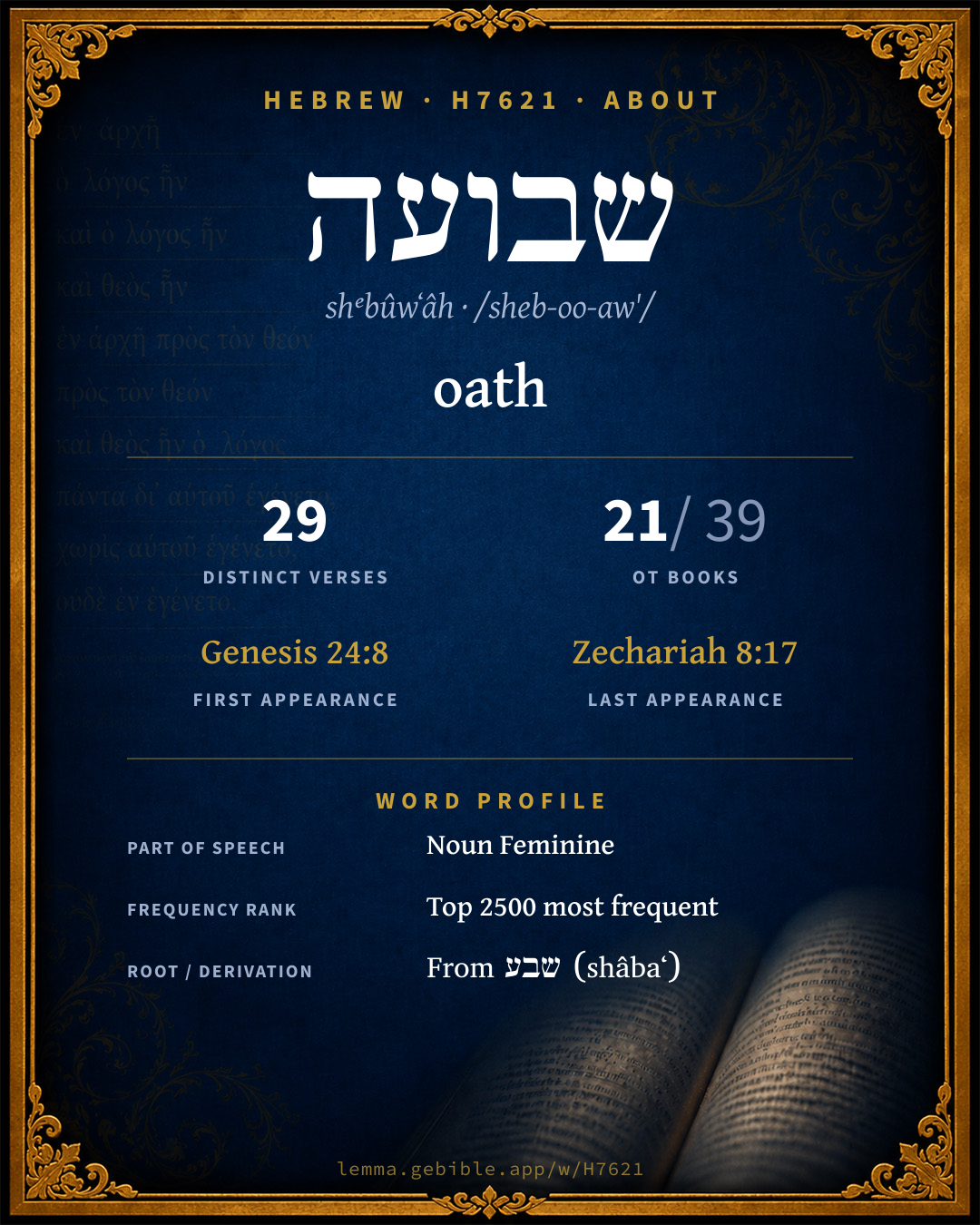
שְׁבוּעָה
oath
‘oath’ is one of 3 main senses fuller range ↓
Full lexicon entry — Brown-Driver-Briggs (BDB)
From Brown-Driver-Briggs (BDB)
Where this word appears
See every Absolute-state word in the Hebrew Bible →
Grammar key — what these labels mean
Part of speech
- Noun
- A naming word — a person, place, thing, or idea.
Noun type
- Common
- A common noun — a general class of person, place, or thing (“king,” “city,” “water”), not a specific name.
State
- Absolute
- The independent form of a noun, not bound to a following word.
- Construct
- A noun bound to a following noun in a possessive / “of” relationship (the construct chain).
Gender
- Feminine
- Grammatically feminine.
Number
- Singular
- One.
- Plural
- More than one (in Hebrew, generally three or more).
12 distinct verses where H7621 appears in the Construct state, across 10 books. Filtered view — show all forms. Click any verse to open its interlinear word-by-word view. Verse text shown in the World English Bible for context — . Each verse’s Hebrew form is shown with its reference; the English is not keyword-highlighted, since the data carries no word-level English alignment. Use “Compare translations” on any verse to read it across multiple English versions. This concordance covers the Hebrew Bible; Septuagint (Greek Old Testament) occurrences are not indexed here.
Genesis 1 verse
Exodus 1 verse
Numbers 2 verses
- Numbers 5:21 בִּ/שְׁבֻעַ֣ת וְ/לִ/שְׁבֻעָ֖ה prep + n c fs cs conj + prep + n c fs then the priest shall cause the woman to swear with the oath of cursing, and the priest shall tell the woman, 'Yahweh make you a curse and an oath among your people, when Yahweh allows your thigh to fall away, and your body to swell;
- Numbers 30:13 שְׁבֻעַ֥ת n c fs cs Every vow, and every binding oath to afflict the soul, her husband may establish it, or her husband may make it void.
Joshua 2 verses
- Joshua 2:17 מִ/שְּׁבֻעָתֵ֥/ךְ prep + n c fs cs + sfx pers 2fs The men said to her, We will be guiltless of this your oath which you have made us to swear.
- Joshua 2:20 מִ/שְּׁבֻעָתֵ֖/ךְ prep + n c fs cs + sfx pers 2fs But if you utter this our business, then we shall be guiltless of your oath which you have made us to swear.
2 Samuel 1 verse
1 Kings 1 verse
1 Chronicles 1 verse
Psalms 1 verse
Ecclesiastes 1 verse
Zechariah 1 verse
About this entry
At a glance — auto-summarized from this page’s data, not written by a person. Every figure links to its source below. This summary describes the numbers; it doesn’t interpret them.
“oath” is the headline sense of the Hebrew noun שבועה (shᵉbûwʻâh). First canonically at Genesis 24:8, it enters the text early. It appears 29 verses across 21 books of the Hebrew Bible, among its moderately common vocabulary. Its meaning spans more than one sense — see its full sense range. Related forms include שבע, שבוע and שבע. The sections below give every sense, occurrence, and version rendering.
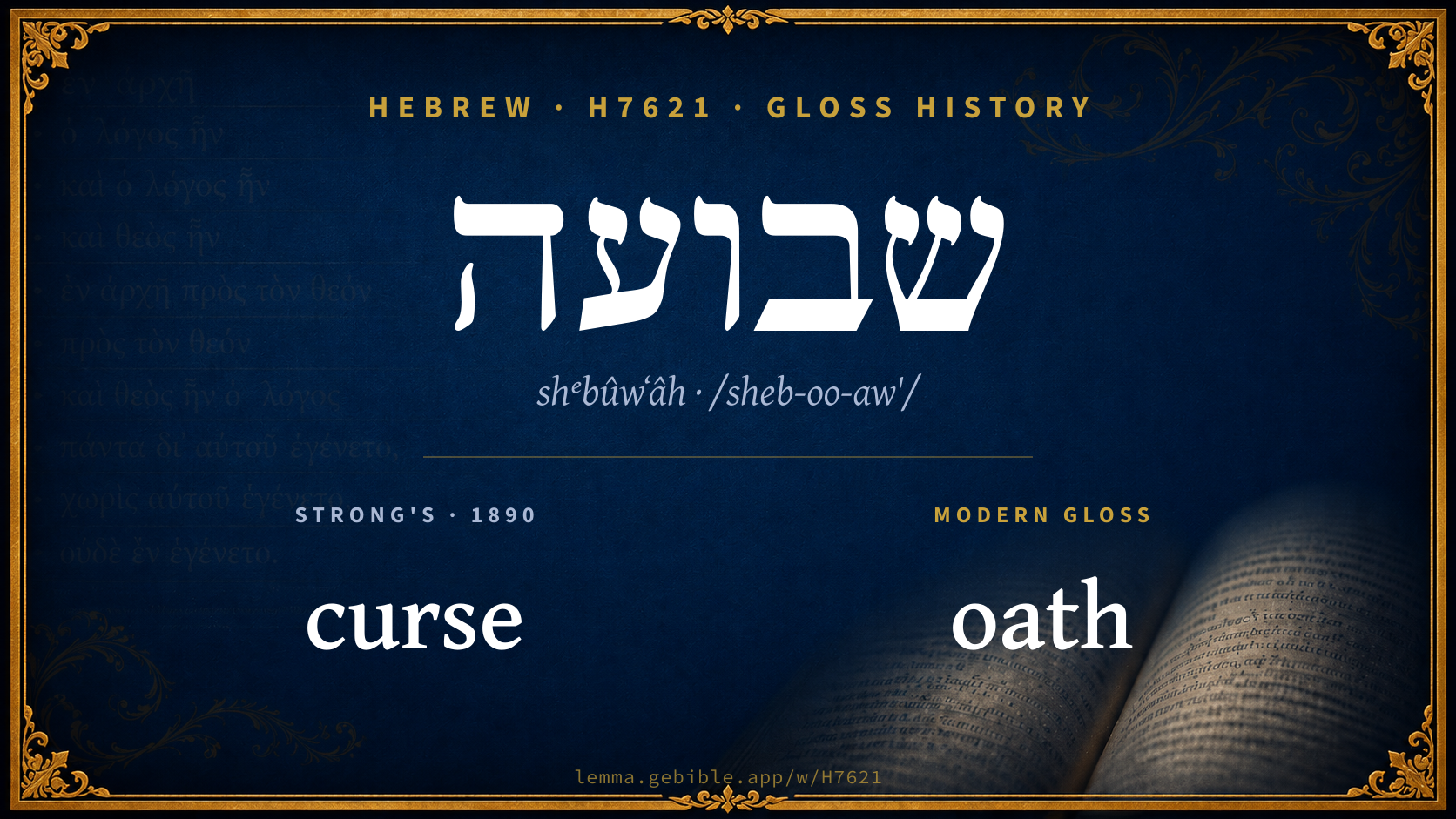
Gloss history
Strong's 1890 vs modern scholarship
About this word
Strong's H7621 catalogs a Hebrew word from the Hebrew Old Testament.
These counts are not copied from any lexicon or concordance. They are computed here, from the morphology-tagged Hebrew Old Testament. What Lemma adds →
- 29
- distinct verses
- The word appears in 29 distinct verses.
- 21 / 39
- OT books
- The word appears in 21 of 39 Old Testament books.
- #1,139
- by frequency
- Top 2500 most frequent Hebrew words (rank 1,139 of 8,640 Hebrew words by occurrence).
View all 29 occurrences in the concordance →
By section of the Old Testament
By traditional corpus
Conventional, traditional groupings — biblical authorship is debated, so this is a traditional corpus grouping, not an authorship claim. Each share is this word’s portion of its verses in that division of the Hebrew canon. Each figure is a share of the word’s 29 distinct verses.
- Prophets (Nevi'im) 12 verses · 41%
- Torah (Pentateuch) 9 verses · 31%
- Writings (Ketuvim) 8 verses · 28%
How translations render this word
Counts come from each version’s own published word-to-Strong’s tagging or interlinear alignment — an approximate guide to how each version renders this word, not a word-level alignment the data otherwise carries. Because each total is that version’s own tagged count, the per-version totals vary from one another and need not match the appearance or distinct-verse counts above. These counts may also differ from a printed concordance because Lemma counts each distinctly tagged rendering and does not collapse phrase taggings into a single head-word total. This is a fixed set of word-tagged versions (KJV, ASV, BSB, ULT) and does not change with the reading translation you choose elsewhere. Each version’s license is shown beside its name below (and on Sources).
BDB lists this Strong’s number as 2 distinct words (homographs). Each count above pools all of them and is not split by sense — see the Senses section below. A low-frequency rendering may belong to a different one of those words, not the primary meaning.
- King James Version†: Oath 24×
- American Standard Version†: Oath 20×, Oaths 2×
- Berean Standard Bible†: Oath 17×, Curse 3×, Oath he swore 2×
- unfoldingWord Literal Text†: Oath 19×, Oath of 4×, From 2×
King James Version Public Domain
Renders H7621 across 29† tagged occurrences — most commonly:
Plus 5 renderings that appear only once — usually multi-word phrases or single function words the recovered tagging swept in, not distinct renderings. Not rendered by a distinct English word in 1 further occurrence.
American Standard Version Public Domain
Renders H7621 across 29† tagged occurrences — most commonly:
Plus 7 renderings that appear only once — usually multi-word phrases or single function words the recovered tagging swept in, not distinct renderings.
Berean Standard Bible Public Domain
Renders H7621 across 29† tagged occurrences — most commonly:
Plus 7 renderings that appear only once — usually multi-word phrases or single function words the recovered tagging swept in, not distinct renderings. Not rendered by a distinct English word in 1 further occurrence.
unfoldingWord Literal Text CC BY-SA 4.0
Renders H7621 across 36† tagged occurrences — most commonly:
Plus 11 renderings that appear only once — usually multi-word phrases or single function words the recovered tagging swept in, not distinct renderings.
13 senses and sub-senses in the full BDB
Hebrew verbs can shift meaning by stem (binyan): Qal is the basic action, Niphal is often passive or reflexive, Piel often intensifies or makes it factitive, and Hiphil is typically causative. The senses below are grouped under the stem BDB assigns to each.
What do BDB’s symbols mean?
BDB uses these scholarly abbreviations:
| Symbol | Meaning |
|---|---|
| 𝔊 | the Septuagint (the ancient Greek translation, LXX) |
| 𝔙 | the Vulgate (the Latin translation) |
| 𝔖 | the Syriac version (the Peshitta) |
| 𝔗 | the Targum (the Aramaic translation) |
| ψ | the Psalms |
| √ | root (the underlying root or stem) |
| ‖ | parallel passage (a synonymous or contrasted parallel) |
| † | the dagger: every passage where the word occurs is cited |
The 13 senses and sub-senses the full Brown-Driver-Briggs lexicon distinguishes for this word, in lexicon order (not ranked by frequency), with BDB’s own verbatim wording and sub-sense lettering. Shown in Hebrew script with BDB’s own scholarly abbreviations. The condensed entry is in the Lexicon Entry tab. See also the Forms in the corpus table below.
שבועה I swear (prob., so to say, seven oneself, or bind oneself by seven things, cf. Thes (as altern.), Gerb 108 ff.
Qal
- (according to Thes Rob Ges) Pt. pass. שְׁבֻעֵי שְׁבֻעוֹת Ez 21:28 those sworn with (= who have sworn) oaths; both from שְׁבוּעָה, according to Krae, oaths of oaths (the most sacred); 𝔊 𝔖 Co om.; both from שָׁבוּעַ, Ew Sm שׁ׳ שָׁ׳ weeks on weeks (plenty of time). e.g. Ezekiel 21:28
Niphal
- Pf. 3 ms. נִשְׁבַּע Gn 24:7 +, etc.; Impf. 3 ms. יִשָּׁבַע Lv 5:24 +, וַיִּשָּׁ֫בַע Gn 24:9 +; 2 ms. תִּשָּׁבִ֑עַ Dt 6:13; 10:20; 1 s. אִשָּׁב֑עַ Gn 21:24, וָאֶשָּׁ֫בַע 1 K 2:8; Ez 16:8, etc.; Imv. ms. הִשָּֽׁבְעָה Gn 21:23 +, etc.; Inf. abs. הִשָּׁבַע Nu 30:3, הִשָּׁבֵעַ Je 7:9; cstr. הִשָּׁבֵעַ Je 12:16(×2) + 1 S 20:17 v. infra; Pt. נִשְׁבָּע Zc 5:3 +, etc.;—swear, take an oath: e.g. Genesis 24:7
- 1. subj. man:
- a. in asseveration, abs. Gn 21:24, 31 (E), Ju 21:1, 18; 2 S 21:2 +; also sq. וַיֹּאמֶר 1 S 20:3; 1 K 1:29, sq. לֵאמֹר 2 S 3:35; Jos 14:9 (D); c. acc. cogn. Nu 30:3 (P; ‖ נָדַר); + לַשֶּׁקֶר Je 5:2; 7:9; Lv 5:24 (P; + עַל rei), Mal 3:5; + על־שׁ׳ Lv 5:22 (P); + לְמִרְמָה ψ 24:4; sq. inf. Lv 5:4 (P), ψ 15:4; 119:106; + ל pers. take an oath to, Jos 6:22 (JE), 9:20 (P; acc. cogn.) Gn 24:9 (+ עַל־הַדָּבָר הַזֶּה) +, so also 1 S 20:17 (read לְהִשָּׁבֵעַ אֶל־ for לְהַשְׁבְּיעַ אֶת־, 𝔊 𝔙 Th We Dr al.); oath of allegiance (לי׳) Is 19:18; 45:23 Zp 1:5; 2 Ch 15:14, cf. (abs.) v 15 (Jos 23:7 v. Hiph.); also sq. וַיֹּאמֶר 2 K 25:24; sq. לֵאמֹר 2 S 21:17; 1 K 1:13; Je 40:9; sq. פֶּן = that not Ju 15:12, sq. אִם = id. 1 K 1:51; + אֶל pers. sq. לֵאמֹר Je 38:16; + בי׳ by י׳, sq. inf. Ju 21:7; + בְּשֵׁם י׳ 1 S 20:42; Is 48:1, cf. Gn 31:53 (E), Dt 6:13; 10:20; Je 12:16 (+ חַי־י׳), Is 65:16; Zc 5:4 (לַשָּׁ֑קְר), Lv 19:12 (id.), ψ 63:12; Dn 12:7; + בי׳ sq. אִם 2 S 19:8; + ל pers. c. בי׳ Jos 9:18, 19 (P; pledge faith), sq. לֵאמֹר 1 S 28:10; 1 K 1:30; 2:8, 23, sq. כִּי of obj. cl. Jos 2:12 (JE), 1 K 1:17; + ל pers. c. בא׳, sq. אִם Gn 21:23 (E), 1 S 30:15; as vb. of quotation + obj. חַי־י׳ Ho 4:15 Je 4:2; 1 S 19:6 (+ אִם), + אִם in orat. recta ψ 132:2 (‖ נָדַר); also + בְּלֹא אֱלֹהִים Je 5:7, בַּבָּ֑עַל 12:16, בְּמַלְכָּם Zp 1:5, cf. Am 8:14 (+ וְאָמַר). e.g. Genesis 21:24
- b. imprecate, curse, בִּ׳ by me ψ 102:9 (cf. שְׁבוּעָה 1 b, קְלָלָה). e.g. Psalms 102:9
- 2. subj. י׳: swear, c. בִּי by myself Gn 22:16 (JE), Je 22:5 (cl. כִּי), 49:13 (id.), Is 45:23 (id.), c. בְּקָדְשׁוֹ Am 4:2 (id.), cf. ψ 89:36 (‖ אִם אֲכַזֵּב), cf. also Am 6:8; 8:7; Je 44:26; 51:14; Is 62:8; swear, sq. inf. Dt 1:35; 4:21; Jos 21:41 (van d. H. Baer; v 43 Gi), sq. מִן inf. = not to Is 54:9(×2), sq. אִם ψ 95:11, sq. לֵאמֹר Dt 1:34; Is 14:24; Nu 32:10 (P); sq. orat. recta ψ 110:4; c. ל pers. take an oath to, Gn 24:7 (J), Ex 13:11 (J), Dt 2:14 + 7 times Dt. (acc. cogn. 7:8; 9:5), Ez 16:8 (‖ בּוֹא בִבְרִית), ψ 89:4 (‖ כָּרַת בְּרִית), v 50 (בֶּאֱמוּנָתֶ֑ךָ), +; ל pers. + inf. (usually to give land) Ex 13:5 (J), Dt 1:8 + 9 times Dt, Jos 1:6; 5:6(×2) (all RD), Je 11:5 (+ acc. cogn.), 32:22; ל pers. + acc. rei (usually land) = promise by oath to Gn 50:24; Ex 33:1; Nu 11:12 (all J), 14:16, 23 (JE), 32:11 (P), Ju 2:1; Mi 7:20; Dt 6:18 + 8 times Dt (obj. covenant 4:31; 8:18); ל pers. om. Dt 31:21. e.g. Genesis 22:16
Hiphil
- Perf. 3 ms. הִשְׁבִּיעַ Ex 13:19 + 1 s. הִשְׁבַּעְתִּי Ct 2:7 +, etc.; Impf. 3 ms. וַיַּשְׁבַּע Gn 50:25 + sf. וַיַּשְׁבִּעֵנִי Gn 24:37, etc.; Inf. abs. הַשְׁבֵּעַ Ex 13:19; 1 S 14:28; cstr. הַשְׁבִּיעַ 1 S 14:27 (20:17 v. Niph.); Pt. sf. מַשְׁבִּיעֶ֑ךָ 1 K 22:16 = 2 Ch 18:15;— e.g. Exodus 13:19
- 1. cause to take an oath, subj. always man: c. acc. pers. Gn 50:6 (J), 1 S 14:27; 1 K 18:10; 2 K 11:4, + acc. cogn. Jos 2:17, 20 (J), + לֵאמֹר Gn 24:37; 50:5 (both J), v 25 (E), Jos 6:26 (J; acc. pers. om.), so (Inf. abs. + Pf.) Ex 13:19 (JE), 1 S 14:28, + וְאָמַר Nu 5:19 and (c. acc. cogn.) v 21 (both P), + inf. cl. Ne 5:12; Ezr 10:5; + בי׳ by י׳ Gn 24:3 (J; cl. אֲשֶׁר), 1 K 2:42 (‖ וָאָעִד בְּךָ, + לֵאמֹר), cf. Jos 23:7 (RD; but read perhaps Niph. תִּשָּֽׁבְעוּ Gr al.; 𝔊 del.), Ne 13:25 (cl. אִם, orat. recta), 2 Ch 36:13. e.g. Genesis 50:6
- 2. adjure, c. acc. pers. 1 K 22:16 = 2 Ch 18:15 (both + cl. אֲשֶׁר); elsewhere only Ct: 5:9, c. cl. מַה־ interrog. v 8, c. cl. אִם that not 2:7; 3:5 (both + ב of oath), = cl. מַה־ 8:4 (v. מָה 2 a (b)).—1 S 20:17 v. Niph. e.g. 1 Kings 22:16
שבועה II (Jos 2
- 1. of man:
- a. attesting innocence Ex 22:10 (E), friendship 2 S 21:7, promise 1 K 2:43 (after שָׁמַר keep; all שְׁבֻעַת י׳ oath to י׳); innocence also Nu 5:21 a; friendship Ne 6:18 (בַּעֲלֵי שׁ׳ לוֹ), promise Lv 5:4; of vow (‖ נדר) Nu 30:3, 11, 14 (שְׁבֻעַת אִסָּר), Jos 9:20 (all P), Ne 10:30 (‖ אָלָה), Ec 9:2, of covenant with י׳ 2 Ch 15:15, שְׁבוּעַת אֱלֹהִים Ec 8:2 (prob. of oath of allegiance to king), שְׁבֻעַת שֶׁקֶר Zc 8:17; of threat Ju 21:5; 1 S 14:26 (𝔊 שְׁבֻעַת י׳); keep, discharge the oath is הֵקִים הַשּׁ׳ Gn 26:3 (J), Je 11:5; נָקָה מִשּׁ׳ be free, exempt from an oath Gn 24:8 (J), cf. Jos 2:17, 20 e.g. Exodus 22:10
- b. = curse, Is 65:15 and (‖ אָלָה) Nu 5:21 (P), Dn 9:11. e.g. Isaiah 65:15
- 2. oath of י׳, in promise, Dt 7:8 (שָׁמַר in rel. cl.), ‖ covenant (בְּרִית), שְׁבוּעָתוֹ לְיִצְחָק ψ 105:9 = 1 Ch 16:16.—שְׁבֻעוֹת מַטּוֹת Hb 3:9 very dub.: AV oaths of the tribes; oaths, rods of the word, Hi-St.; sworn (pt. pass. שָׁבַע) were the rods (= chastisements) of (thy) word, Ges Hi RVm; heptads of spears Ew, cf. Da; text prob. currupt, Now proposes (אַשְׁפָּֽתְךָ) שִׂבַּעְתָּ מַטּוֹת thou hast sated with shafts thy quiver; Marti (after 𝔊Codd.) thy bow was satiated with shafts Ez 21:28 v. √. e.g. Deuteronomy 7:8
Senses from the full Brown-Driver-Briggs lexicon (Brown, Driver, Briggs; Oxford 1906 — public domain), digitized via Sefaria, supplemented by the OpenScriptures HebrewLexicon (CC BY 4.0). Full attribution on Sources.
Word origin
I. vb. swear (prob., so to say, seven oneself, or bind oneself by seven things, cf. Thes (as altern.), Gerb 108 ff.; NH Niph. = BH; 𝔗 שְׁבַע Ithpe. Aph.; v. also Dr Gn 21:28 KöHast.DB number, 565 RSSem. i. 166, 2nd ed., 182 We Reste ArabicHeid. 2, 186);—
I. n.f. (Jos 2:17 read הַזּה AlbrZAW xvi (1896), 116) oath, curse;—abs. שְׁבוּ׳ Jos 9:20 +, שְׁבֻ׳ Gn 26:3 +; cstr. שְׁבֻעַת Ex 22:10 +; sf. שְׁבֻעָתִי Gn 24:8, etc.; pl. שְׁבֻעוֹת abs. Ez 21:28, cstr. Hb 3:9 [Je 5:24 Ez 45:21 v. שָׁבוּעַ];—oath [as acc. cogn. c. הִשָּׁבַע etc. Nu 30:3 + (in rel. cl.) 5 times]:
— Brown-Driver-Briggs (Oxford 1906, public domain), digitized via Sefaria, supplemented by the OpenScriptures HebrewLexicon (CC BY 4.0). See Sources.
Derived from שבע (shâbaʻ) (H7650) — to swear.
Jastrow Dictionary
A second Hebrew/Aramaic lexicon for comparison, covering Aramaic and post-biblical (Talmudic, Targumic, Midrashic) usage that the biblical-Hebrew BDB does not. Matched by lemma rather than by Strong’s number, so a lemma may carry more than one Jastrow headword (shown separately below), and the entries cover usage well beyond the Bible.
שְׁבוּעָה
- oath. Shebu. III, 1 ש׳ שאוכל וכ׳ if he says, I swear that I will eat, or, that I shall not eat &c. Ib. 32ᵇ חזרה ש׳ למחוייב וכ׳ the oath goes back to (is thrown again on) him who is bound to make it. Ib. כל המחוייב ש׳ וכ׳ whoever would, according to law, be bound to make oath, and is disqualified from doing so, must pay; a. fr.—שְׁבוּעַת ביטוי, ש׳ שוא, ש׳ היסת, ש׳ הפקדון &c., v. בִּיטוּי, שָׁוְא, הֶיסֵּת, פִּקָּדוֹן, &c.—שבועת הדיינין the oath imposed by the judges, legal oath. Ib. VI, 1 Y. a. Bab. (Mish. pl.); a. fr.—Pl. שְׁבוּעוֹת. Ib. I, 1 ש׳ שתים שהן ארבע the transgressions in cases of oaths are of two classes, subdivided into four. Ib. 25ᵃ חומר בנדריס מבש׳ וכ׳ there are restrictions in vows which do not apply to oaths &c.; שהש׳ חלות וכ׳ inasmuch as oaths may refer to things unsubstantial as well as to things substantial; Tosef. Ned. I, 5; a. fr.—Sh’buoth, name of a treatise, of the Order of N’ziḳin, of Misnah, Tosefta, Talmud Babli a. Y’rushalmi.
A Dictionary of the Targumim, the Talmud Babli and Yerushalmi, and the Midrashic Literature (Marcus Jastrow; London, Luzac, 1903) — Public Domain. Digitized via Sefaria. Digitized via Sefaria. Full attribution on Sources.
Forms in the corpus
The 29 distinct written forms H7621 takes in the Hebrew Bible, most frequent first — each parse links to that state’s occurrences in the concordance. Hebrew forms include their vowel points and cantillation, so a single lemma takes many written forms.
Same root — word family
Other BDB entries built from the same root as H7621, grouped by Strong’s listed origin. These share a root / origin per the lexicon — not necessarily a shared meaning. Each links to that word’s own entry.
Derives from
Shares the same root
Proper names from this root
People and places named from this root — a name, not an additional meaning of the word.
Compare all same-root words → Showing 4 of 5 — not the complete family. 1 of the same-root words is a proper name (a person or place). They share a root, not necessarily a meaning.
Septuagint verse parallels
This word appears in 27 verses that also exist in the Greek Old Testament (Septuagint), out of the 29 Hebrew verses it occurs in. You can read those verses in Greek by switching the Old Testament edition to the Septuagint.
Read these verses in the Septuagint
- Genesis 24:8
- Exodus 22:11
- Leviticus 5:4
- Numbers 5:21
- Deuteronomy 7:8
- Joshua 2:17
- Judges 21:5
- 1 Samuel 14:26
- 2 Samuel 21:7
- 1 Kings 2:43
- 1 Chronicles 16:16
- 2 Chronicles 15:15
This is a verse-level parallel only — the same verses exist in both the Hebrew and Greek Old Testaments. No word-level Hebrew↔Greek correspondence is claimed: the data carries no such alignment, so no Greek word is shown as this Hebrew word’s translation. Coverage is not total — the Septuagint omits the deuterocanon and renumbers the Psalms, so some Hebrew verses have no direct Greek parallel.