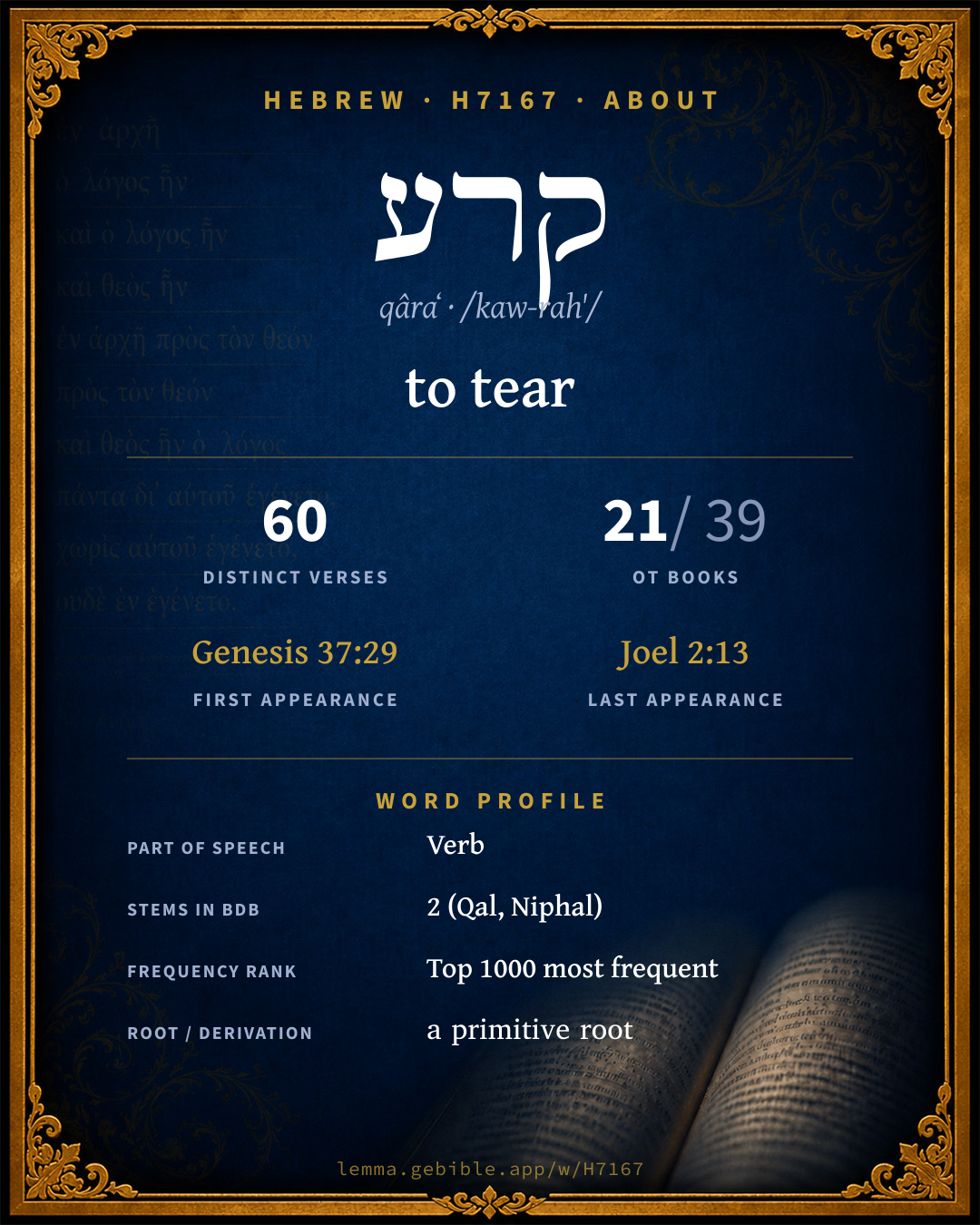
קָרַע
to tear
‘to tear’ is one of 2 main senses fuller range ↓
Full lexicon entry — Brown-Driver-Briggs (BDB)
From Brown-Driver-Briggs (BDB)
Where this word appears
Grammar key — what these labels mean
Part of speech
- Verb
- An action or state-of-being word.
Stem
- Qal
- The basic, simple active stem — the plain form of the verb (“he wrote”). Here: ‘tear away’
- Niphal
- Usually the simple passive or reflexive of the Qal (“he was written”). Here: ‘be rent’
Form
- Sequential Imperfect
- An imperfect with prefixed waw — the standard past-narrative form (waw-consecutive imperfect).
- Perfect
- A completed action or state — Hebrew marks aspect (completeness) more than strict tense (“he wrote”).
- Participle Passive
- A verbal adjective expressing action received (“written”).
- Sequential Perfect
- A perfect with prefixed waw continuing a preceding imperfect or command (waw-consecutive perfect).
- Imperfect
- An incomplete, ongoing, or future action (“he will / would write”).
- Infinitive Construct
- A bound verbal noun, frequently with prepositions (“to write / in writing”).
- Imperative
- A direct command (“write!”).
- Infinitive Absolute
- An unbound verbal noun, often intensifying or standing in for a finite verb.
- Participle Active
- A verbal adjective expressing ongoing or characteristic action (“writing / one who writes”).
State
- Construct
- A noun bound to a following noun in a possessive / “of” relationship (the construct chain).
- Absolute
- The independent form of a noun, not bound to a following word.
Person
- 3rd Person
- The one spoken about (“he / she / it / they”).
- 1st Person
- The speaker (“I / we”).
- 2nd Person
- The one addressed (“you”).
Gender
- Masculine
- Grammatically masculine.
- Common
- Either gender — not distinguished for this form.
- Feminine
- Grammatically feminine.
Number
- Singular
- One.
- Plural
- More than one (in Hebrew, generally three or more).
Every verse where H7167 appears in the Book of 2 Chronicles — 3 distinct verses. Click any verse to open its interlinear word-by-word view. Verse text shown in the World English Bible for context — . Each verse’s Hebrew form is shown with its reference; the English is not keyword-highlighted, since the data carries no word-level English alignment. Use “Compare translations” on any verse to read it across multiple English versions. This concordance covers the Hebrew Bible; Septuagint (Greek Old Testament) occurrences are not indexed here.
2 Chronicles
- 2 Chronicles 23:13 וַ/תִּקְרַ֤ע conj + Qal wimpf 3fs and she looked, and, behold, the king stood by his pillar at the entrance, and the captains and the trumpets by the king; and all the people of the land rejoiced, and blew trumpets; the singers also [played] on instruments of music, and led the singing of praise. Then Athaliah tore her clothes, and said, Treason! treason!
- 2 Chronicles 34:19 וַ/יִּקְרַ֖ע conj + Qal wimpf 3ms It happened, when the king had heard the words of the law, that he tore his clothes.
- 2 Chronicles 34:27 וַ/תִּקְרַ֥ע conj + Qal wimpf 2ms because your heart was tender, and you did humble yourself before God, when you heard his words against this place, and against the inhabitants of it, and have humbled yourself before me, and have torn your clothes, and wept before me; I also have heard you, says Yahweh.
About this entry
At a glance — auto-summarized from this page’s data, not written by a person. Every figure links to its source below. This summary describes the numbers; it doesn’t interpret them.
קרע — transliterated qâraʻ — is a Hebrew verb carrying the sense “to tear.” The King James Version usually renders it “rent,” while modern versions prefer “tore” (Berean Standard Bible) and “he tore” (unfoldingWord Literal Text) — see the renderings breakdown. With 60 verses in 21 books, it is a moderately common word in the Hebrew Bible. Debuting at Genesis 37:29, it then recurs through the corpus. As a verb its force shifts by stem, across 2 stems (Qal, Niphal, and more). Each statement above links to its evidence; the full detail follows below.
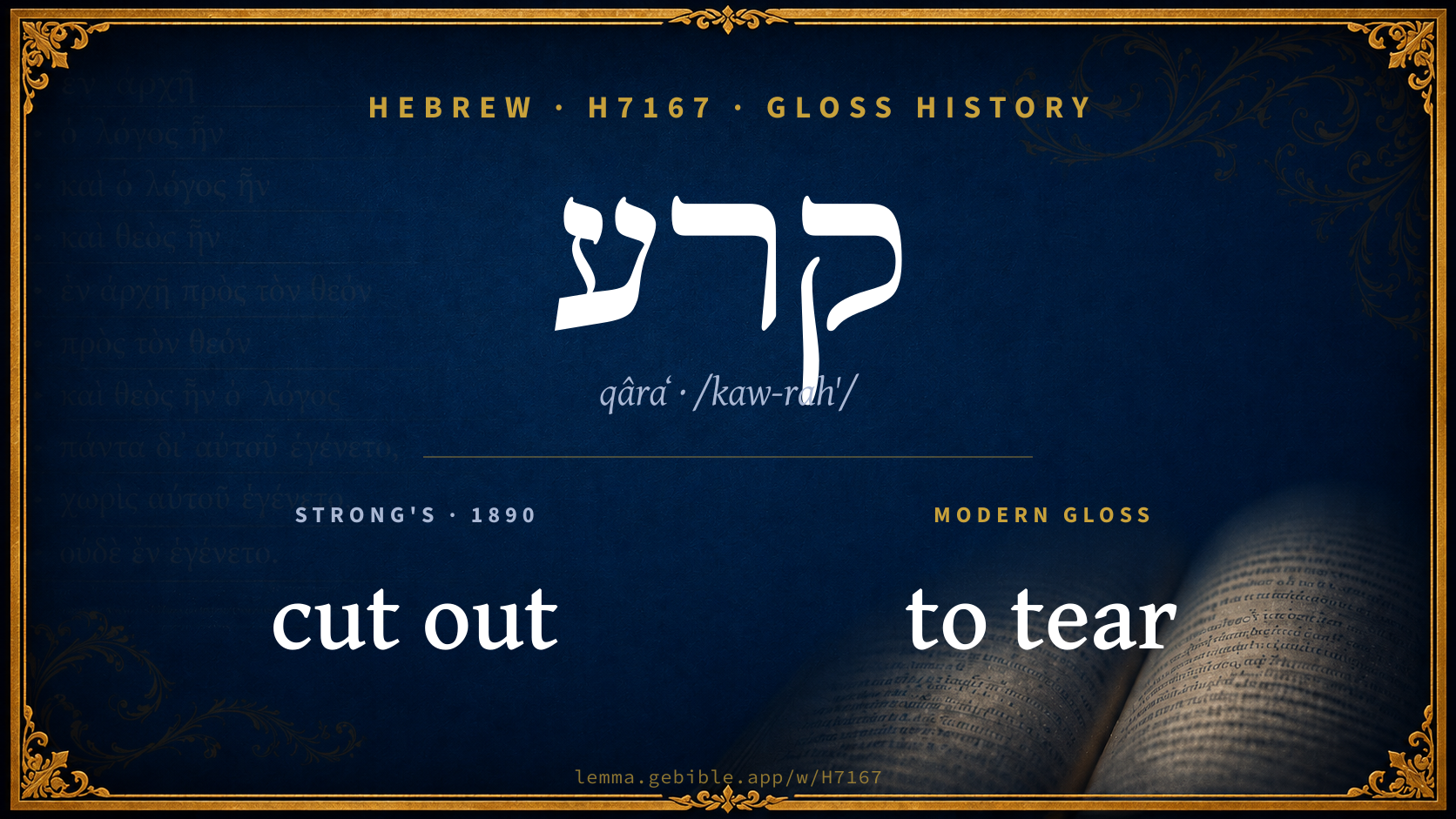
Gloss history
Strong's 1890 vs modern scholarship
About this word
Strong's H7167 catalogs a Hebrew word from the Hebrew Old Testament.
These counts are not copied from any lexicon or concordance. They are computed here, from the morphology-tagged Hebrew Old Testament. What Lemma adds →
- 60
- distinct verses
- The word appears in 60 distinct verses.
- 21 / 39
- OT books
- The word appears in 21 of 39 Old Testament books.
- #611
- by frequency
- Top 1000 most frequent Hebrew words (rank 611 of 8,640 Hebrew words by occurrence).
View all 60 occurrences in the concordance →
By section of the Old Testament
By traditional corpus
Conventional, traditional groupings — biblical authorship is debated, so this is a traditional corpus grouping, not an authorship claim. Each share is this word’s portion of its verses in that division of the Hebrew canon. Each figure is a share of the word’s 60 distinct verses.
- Prophets (Nevi'im) 43 verses · 72%
- Writings (Ketuvim) 10 verses · 17%
- Torah (Pentateuch) 7 verses · 12%
How translations render this word
Counts come from each version’s own published word-to-Strong’s tagging or interlinear alignment — an approximate guide to how each version renders this word, not a word-level alignment the data otherwise carries. Because each total is that version’s own tagged count, the per-version totals vary from one another and need not match the appearance or distinct-verse counts above. These counts may also differ from a printed concordance because Lemma counts each distinctly tagged rendering and does not collapse phrase taggings into a single head-word total. This is a fixed set of word-tagged versions (KJV, ASV, BSB, ULT) and does not change with the reading translation you choose elsewhere. Each version’s license is shown beside its name below (and on Sources).
- King James Version: Rent 20×, He rent 10×, Rend 3×
- American Standard Version: Rent 21×, He rent 7×, It 3×
- Berean Standard Bible: Tore 13×, Torn 8×, He tore 7×
- unfoldingWord Literal Text: He tore 11×, Tore 7×, Tear 5×
King James Version Public Domain
Renders H7167 across 64 tagged occurrences — most commonly:
Plus 27 renderings that appear only once — usually multi-word phrases or single function words the recovered tagging swept in, not distinct renderings.
American Standard Version Public Domain
Renders H7167 across 64 tagged occurrences — most commonly:
Plus 29 renderings that appear only once — usually multi-word phrases or single function words the recovered tagging swept in, not distinct renderings.
Berean Standard Bible Public Domain
Renders H7167 across 63 tagged occurrences — most commonly:
Plus 21 renderings that appear only once — usually multi-word phrases or single function words the recovered tagging swept in, not distinct renderings.
unfoldingWord Literal Text CC BY-SA 4.0
Renders H7167 across 70 tagged occurrences — most commonly:
Plus other, less common renderings. Plus 24 renderings that appear only once — usually multi-word phrases or single function words the recovered tagging swept in, not distinct renderings.
10 senses and sub-senses in the full BDB
Hebrew verbs can shift meaning by stem (binyan): Qal is the basic action, Niphal is often passive or reflexive, Piel often intensifies or makes it factitive, and Hiphil is typically causative. The senses below are grouped under the stem BDB assigns to each.
What do BDB’s symbols mean?
BDB uses these scholarly abbreviations:
| Symbol | Meaning |
|---|---|
| 𝔊 | the Septuagint (the ancient Greek translation, LXX) |
| 𝔙 | the Vulgate (the Latin translation) |
| 𝔖 | the Syriac version (the Peshitta) |
| 𝔗 | the Targum (the Aramaic translation) |
| ψ | the Psalms |
| √ | root (the underlying root or stem) |
| ‖ | parallel passage (a synonymous or contrasted parallel) |
| † | the dagger: every passage where the word occurs is cited |
The 10 senses and sub-senses the full Brown-Driver-Briggs lexicon distinguishes for this word, in lexicon order (not ranked by frequency), with BDB’s own verbatim wording and sub-sense lettering. Shown in Hebrew script with BDB’s own scholarly abbreviations. The condensed entry is in the Lexicon Entry tab. See also the Forms in the corpus table below.
Qal
- Pf. 3 ms. ק׳ 1 S 15:28 +, etc.; Impf. 3 ms. וַיִּקְרַע Gn 37:29 +; 1 s. sf. אֶקְרָעֶנָּה 1 K 11:12, etc.; Imv. mpl. קִרְעוּ 2 S 3:31 Jo 2:13; Inf. abs. קָרֹעַ 1 K 11:11; cstr. לִקְרוֹעַ Ec 3:7, sf. קָרְעִי Ezr 9:5; Pt. act. קֹרֵעַ 1 K 11:31; pass. קָרוּעַ 2 S 15:32, etc.;—tear, rend: e.g. 1 Samuel 15:28
- 1.
- a. usually (39 times) of rending garment in (1) grief: בֶּגֶד Gn 37:29, שִׂמְלָה 37:34; 44:13, כְּתֹנֶת 2 S 13:19, ק׳ ב׳ לִשְׁנַיִם קְרָעִים 2 K 2:12, ק׳ לְבַבְכֶם וְאַל ב׳ Jo 2:13; pt. pass. בְּגָדָיו ק׳ 2 S 1:2; cstr. קְרֻעֵי ב׳ torn of garments (pers. with torn garments) 2 S 13:31 (but read קָֽרְעוּ ב׳ 𝔊 𝔙 Th We al.), 2 K 18:37 = Is 36:22, Je 41:5; מְעִיל †Jb 1:20; 2:12 Ezr 9:3 (+ בֶּגֶד), כְּתֹנֶת 2 S 13:19, קָרוּעַ כֻּתָּנְתּוֹ 2 S 15:32 (Ges§ 121 d); שְׂמָלֹת †Gn 37:34; 44:13; Jos 7:6; pt. pass. †מַדָּיו קְרֻעִים 1 S 4:12; †(2) as symbolic act, ק׳ שַׂלְמָה שְׁנֵים עָשָׁר קְרָעִים 1 K 11:30; †(3) abs. עֵת לִקְרוֹעַ וְעֵת לִתְפּוֹר Ec 3:7. e.g. Genesis 37:29
- b. tear away or out: veils Ez 13:21, fillets from (מֵעַל) arms v 20, mark of leprosy out of (מִן) garment Lv 13:56. e.g. Ezekiel 13:21
- 2. tear away sovereignty (under fig. of garment), subj. י׳, מֵעַל pers. 1 S 15:28 1 K 11:11, also מִיַּד 1 S 28:17 1 K 11:12, 31, מִן 14:8, abs. 11:13; c. acc. יִשׂ׳ + מֵעַל 2 K 17:21. e.g. 1 Samuel 15:28
- 3. tear, rend asunder:
- a. book with (ב) knife Je 36:23. e.g. Jeremiah 36:23
- b. = make wide, large, eyes, with (ב) stibium Je 4:30; windows, וק׳ לוֹ חַלּוֹנָ֑י[ו] 22:14. e.g. Jeremiah 4:30
- c. rend open heavens, and descend, of י׳, Is 63:19. e.g. Isaiah 63:19
- 4. tear, rend, of wild beasts: י׳ as fierce bear Ho 13:8 (obj. סְגוֹר לִבָּם); fig. of human foes ψ 35:15 (acc. pers. om.), so Hup al., but (from context) Ol Bae We al. malign, rail (cf. Arabic supr.); > Gr al. קָרְאוּ. e.g. Hosea 13:8
Niphal
- be rent, of garment (מְעִיל), Impf. 3 ms. וַיִּקָּרַ֑ע 1 S 15:27, יִקָּרֵעַ Ex 28:32; 39:23; be rent, split asunder, of altar 1 K 13:3, 5. e.g. 1 Samuel 15:27
Senses from the full Brown-Driver-Briggs lexicon (Brown, Driver, Briggs; Oxford 1906 — public domain), digitized via Sefaria, supplemented by the OpenScriptures HebrewLexicon (CC BY 4.0). Full attribution on Sources.
Word origin
vb. tear (NH id.; Arabic قَرَعَ strike head, bell, etc., beat drum, box ear, gnash teeth (Frey Dozy); also impugn, censure);—
— Brown-Driver-Briggs (Oxford 1906, public domain), digitized via Sefaria, supplemented by the OpenScriptures HebrewLexicon (CC BY 4.0). See Sources.
Origin: a primitive root
Jastrow Dictionary
A second Hebrew/Aramaic lexicon for comparison, covering Aramaic and post-biblical (Talmudic, Targumic, Midrashic) usage that the biblical-Hebrew BDB does not. Matched by lemma rather than by Strong’s number, so a lemma may carry more than one Jastrow headword (shown separately below), and the entries cover usage well beyond the Bible.
קָרַע
- (b. h.) to tear, split; esp. to rend the garment in mourning. Kel. XVI, 5 עד שיִקְרְעֶנּוּ (Mish. ed. שיַקְרִיעֶנּוּ Hif.) until he tears the bale open. M. Kat. 22ᵇ על כל … אינו קוֹרֵעַ אלא עליון for all dead (except parents) … one must rend only the upper garment. Ib. האשה קוֹרַעַת וכ׳ a woman (mourning for her parents) rends the lower garment and puts it back in its place, and then rends the upper garment. Snh. 60ᵃ אחד השומע … חייב לִקְרוֹעַ both he that hears a blasphemy directly, and he that hears it from one that heard it (and reports as witness before court) must rend his garment; a. v. fr.—Part. pass. קָרוּעַ; pl. קְרוּעִים, קְרוּעִין. M. Kat. 26ᵇ היוצא בבגד ק׳ וכ׳ he that marches before a corpse with a garment rent (for a previous case) robs (deceives) the dead and the living. Ib.ᵃ (ref. to II Kings II, 12) ק׳ ועומדים לשנים remaining always rent in two; ib. 22ᵇ (v. Rabb. D. S. a. l. note 4); Snh. l. c.; a. fr. e.g. 2 Kings 2:12
- 1. same. M. Kat. 26ᵇ ואין מְקָרְעִין בפניו you must not rend your garment in his (the sick man’s) presence. Ib. מקרעין לקטן וכ׳ we rend a minor’s garment in order to make him feel sad; ib. 14ᵇ. R. Hash. 16ᵇ ארבעה … מקרעין גזר וכ׳ four things cause an evil decree passed on man to be torn (cancelled), they are: charity, prayer &c.; a. fr.
- 2. (cmp. גָּרַע) to scrape, to mark the outlines of letters by abrasion. Gitt. 19ᵇ עדים … מקרעין להם וכ׳ for witnesses that know not how to sign their names, grooves are made on blank paper, and they fill the grooves out with ink; ib. 9ᵇ; Y. ib. II, 44ᵇ top ומְקָרֵעַ; [Tosaf. to Gitt. 9ᵇ: you cut the names out on blank paper and put it on the document, and the witnesses fill the cuts out]. Tosef. Sabb. XI (XII), 8, contrad. fr. רשם; a. e.
- to be torn; to be cut open, be operated upon by a section. Yeb. VIII, 6, a. e. טומטום שנ׳, v. טוּמְטוּם. Bekh. 42ᵇ שמא יִקָּרֵעַ וכ׳ he may have an operation performed, and be found a eunuch; Tosef. Yeb. XI, 1; Yeb. 83ᵇ. B. Bath. 168ᵇ נ׳ פסול נִתְקָרֵעַ כשר if a document is found torn, it is invalid; if it appears torn by accident, it is valid as evidence; ib. נ׳ קֶרַע של בית דין נתק׳ וכ׳ miḳrʿa refers to the rent as made in court for cancellation, nithḳareʿa refers to a rent different from the manner customary in court; Y. Gitt. II, 44ᵇ; a. e.
- to become torn, v. supra.
קְרַע
- M. Kat. 20ᵇ אמימר … ק׳ עילויה when Amemar’s grandson died, he rent his garment for him. Keth. 104ᵃ קַרְעִיה וכ׳, v. קִרְעָא; a. e.
- same. Targ. Ps. XXXV, 15 Ms. (ed. בזע).—Part. pass. מְקָרַע. Ber. 58ᵇ, v. וִילוֹן
- to be torn, cut open. Bekh. 42ᵇ אטו כל דמִיקְּרַע וכ׳ is every ṭumṭum that is operated upon found to be a male?; Yeb. 83ᵇ
קֶרַע
- preced.)
- 1. rent; piece. B. Bath. 168ᵇ ק׳ של בית דין, v. קָרַע; Y. Gitt. II, 44ᵇ. Ib. איזהו ק׳ … בין כתב לעדים which is a rent made in court? A cut between the writing and the signatures of the witnesses; (different in B. Bath. l. c.); a. e.—Esp. the rent in the garment as a symbol of mourning. M. Kat. 24ᵃ כל ק׳ שאינו … אינו ק׳ a rent not made at the moment of excitement (v. חִימּוּם) is no rent (has no symbolical meaning); Y. B. Mets. II, end, 8ᵈ, v. בֶּהָלָה. M. Kat. 22ᵇ, v. קְרִיעָה; a. fr.—Pl. קְרָעִים, קְרָעִין. Ib. 26ᵃ ואלו ק׳ שאין וכ׳ and these are the rents which must never be stitched together. Sifra Thazr. Par. 5, ch. XVI (ref. to Lev. XIII, 57) לימד על כל הק׳ וכ׳ this shows that all the torn-off pieces must be burnt. Snh. 60ᵃ נתמלא כל הבגד ק׳ one’s entire garment might soon be full of rents. Tosef. B. Kam. III, 2 לא יאמר … ואת הק׳ וכ׳ the injured person cannot say, take thou … the pieces (the torn garment) and restore to me a cloak; a. fr. e.g. Leviticus 13:57
- 2. the groove made by marking the outlines of letters. Y. Gitt. III, 44ᵇ מרחיב בפניהן את הק׳ (in the case of witnesses that know not how to sign their names) one must make wide grooves for them (so as to leave room for individual characters in filling out the outlines).—Pl. as ab. Bab. Gitt. 19ᵇ, v. קָרַע.
קֶרַע ²
- Keth. 104ᵃ קַרְעֵיה … לקִרְעֵיה וכ׳ he rent his garment (at Rabbi’s death), and turned the rent inside (to hide it); a. e.—Pl. קְרָעִין. Y. Kil. IX, 32ᵇ top וקרעון ואזל קלא דקרעין וכ׳ (not דקרעון) they rent their garments, and the lamentations accompanying the rending were heard as far &c., v. גּוֹבְבָתָא; Y. Keth. XII, 35ᵃ top קלה לק׳ (read: דק׳); Koh. R. to VII, 11, a. IX, 10 קליה דקריעה, read: דקִירְעָה (sing.).
A Dictionary of the Targumim, the Talmud Babli and Yerushalmi, and the Midrashic Literature (Marcus Jastrow; London, Luzac, 1903) — Public Domain. Digitized via Sefaria. Digitized via Sefaria. Full attribution on Sources.
Forms in the corpus
The 47 distinct written forms H7167 takes in the Hebrew Bible, most frequent first — each parse links to that stem’s occurrences in the concordance. Hebrew forms include their vowel points and cantillation, so a single lemma takes many written forms.
Same root — word family
Other BDB entries built from the same root as H7167, grouped by Strong’s listed origin. These share a root / origin per the lexicon — not necessarily a shared meaning. Each links to that word’s own entry.
Derived from this word
Compare all same-root words → They share a root, not necessarily a meaning.
Septuagint verse parallels
This word appears in 59 verses that also exist in the Greek Old Testament (Septuagint), out of the 60 Hebrew verses it occurs in. You can read those verses in Greek by switching the Old Testament edition to the Septuagint.
Read these verses in the Septuagint
- Genesis 37:29
- Exodus 28:32
- Leviticus 13:56
- Numbers 14:6
- Joshua 7:6
- Judges 11:35
- 1 Samuel 4:12
- 2 Samuel 1:2
- 1 Kings 11:11
- 2 Kings 2:12
- 2 Chronicles 23:13
- Ezra 9:3
This is a verse-level parallel only — the same verses exist in both the Hebrew and Greek Old Testaments. No word-level Hebrew↔Greek correspondence is claimed: the data carries no such alignment, so no Greek word is shown as this Hebrew word’s translation. Coverage is not total — the Septuagint omits the deuterocanon and renumbers the Psalms, so some Hebrew verses have no direct Greek parallel.