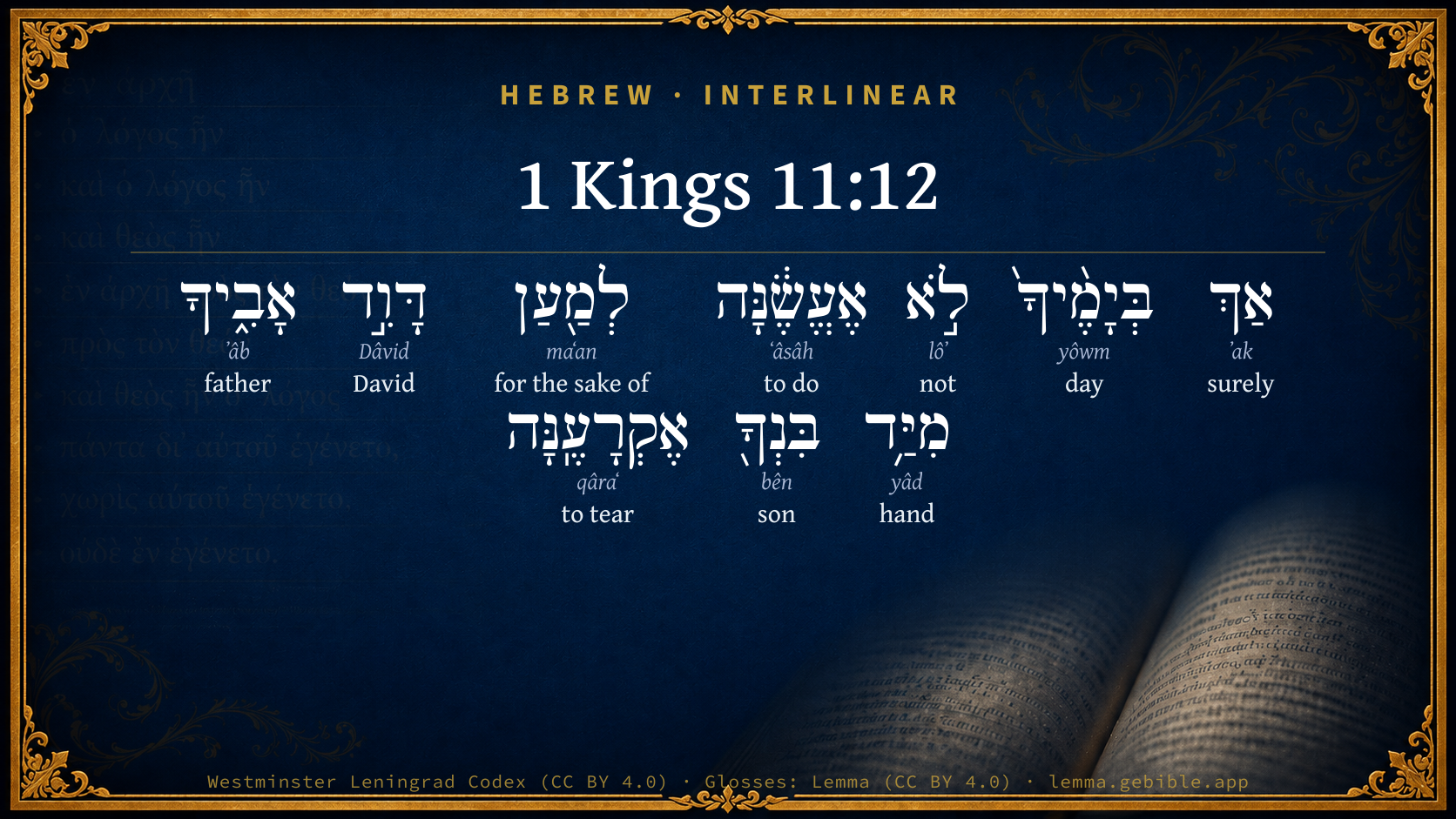
1 Kings 11:12

Hebrew (Westminster Leningrad Codex) 1 Kings 11:12 appears in the Hebrew Old Testament. The text above is from the Westminster Leningrad Codex. Each word links to its Strong’s number, a concise gloss, and parsing drawn from the Open Scriptures Hebrew Bible morphology. Click any word for its full Brown-Driver-Briggs (BDB) entry.
Download image
Cite this verse

1 Kings 11:12 (World English Bible). Public Domain. Lemma interlinear Bible study tool, https://lemma.gebible.app/v/1-kings/11/12.

Show BibTeX & RIS
BibTeX
RIS
English Translation
Notwithstanding in your days I will not do it, for David your father's sake: but I will tear it out of the hand of your son.
World English Bible · Public Domain
Download a study sheet

One document with this verse’s original text, its word-by-word gloss line, the meaning frame, cross-references with their text, attributed commentary, and full source and license credits — printable, and it pastes into notes with its structure intact.

This verse Autodidact and up

Study sheet (.html) Plain text (.txt)

A passage Seminary Student

Up to 50 verses in one chapter. A passage sheet keeps up to 6 commentary sources and 12 cross-references per verse, in the order this page ranks them, and says so on the sheet whenever that leaves anything out. Ask for a single verse and you get the Autodidact verse sheet above.

Everything on this page stays free to read, with no account — the sheet is a download of what is already on screen, not access to it.

Want to remove ads? Support Godless Engineer
Compare translations 3

The same verse in 3 English versions, stacked beneath the original-language interlinear above. Click any original word for its lexicon entry.

Each is an independent rendering of the whole verse — the interlinear is not word-aligned to these translations.

Highlighted words mark where these versions differ — a whole-verse word diff, not a word-by-word alignment.

  • World English Bible Public Domain
    Notwithstanding in your days I will not do it, for David your father's sake: but I will tear it out of the hand of your son.
  • King James Version Public Domain
    Notwithstanding in thy days I will not do it for David thy father's sake: but I will rend it out of the hand of thy son.
  • unfoldingWord Literal Text CC BY-SA 4.0
    However, I will not do it in your days, for the sake of David your father. From the hand of your son I will tear it away.

unfoldingWord Literal Text — © unfoldingWord, licensed CC BY-SA 4.0. Word-aligned USFM3 via Door43 (git.door43.org/unfoldingWord/en_ult).

Versions to compare (up to 4)

3 of 4 selected

Show all 18 translations

Every available English version of this verse, each an independent rendering of the whole verse.

  • World English Bible Public Domain
    Notwithstanding in your days I will not do it, for David your father's sake: but I will tear it out of the hand of your son.
  • Berean Standard Bible Public Domain
    Nevertheless, for the sake of your father David, I will not do it during your lifetime; I will tear it out of the hand of your son.
  • Majority Standard Bible Public Domain
    Nevertheless, for the sake of your father David, I will not do it during your lifetime; I will tear it out of the hand of your son.
  • King James Version Public Domain
    Notwithstanding in thy days I will not do it for David thy father's sake: but I will rend it out of the hand of thy son.
  • American Standard Version (1901) Public Domain
    Notwithstanding in thy days I will not do it, for David thy father's sake: but I will rend it out of the hand of thy son.
  • Revised Version (1885) Public Domain
    Notwithstanding in thy days I will not do it, for David thy father’s sake: but I will rend it out of the hand of thy son.
  • Geneva Bible (1599) Public Domain
    Notwithstanding in thy dayes I will not doe it, because of Dauid thy father, but I will rent it out of the hand of thy sonne:
  • Douay-Rheims (1899) Public Domain
    Nevertheless in thy days I will not do it, for David thy father's sake: but I will rend it out of the hand of thy son.
  • Young's Literal Translation Public Domain
    `Only, in thy days I do it not, for the sake of David thy father; out of the hand of thy son I rend it;
  • Literal Standard Version CC BY-SA 4.0
    Only, I do not do it in your days, for the sake of your father David; I tear it out of the hand of your son;
  • Unlocked Literal Bible CC BY-SA 4.0
    However, for David your father's sake, I will not do it in your lifetime, but I will tear it out of the hand of your son.
  • unfoldingWord Literal Text CC BY-SA 4.0
    However, I will not do it in your days, for the sake of David your father. From the hand of your son I will tear it away.
  • Darby Bible Public Domain
    notwithstanding in thy days I will not do it, for David thy father's sake; I will rend it out of the hand of thy son;
  • World Messianic Bible Public Domain
    Nevertheless, I will not do it in your days, for David your father’s sake; but I will tear it out of your son’s hand.
  • Webster's Bible Public Domain
    Notwithstanding, in thy days, I will not do it, for David thy father's sake: but I will rend it out of the hand of thy son.
  • Free Bible Version CC BY-SA 4.0
    However, for the sake of your father David, I will not do this in your lifetime—I will take it away from your son.
  • Bible in Basic English Public Domain
    I will not do it in your life-time, because of your father David, but I will take it from your son.
  • JPS Tanakh (1917) Public Domain
    Notwithstanding in thy days I will not do it, for David thy father's sake; but I will rend it out of the hand of thy son.

Literal Standard Version (2020), Covenant Press — licensed CC BY-SA 4.0. Text via the HelloAO Bible API (eBible.org). Unlocked Literal Bible (unfoldingWord) — licensed CC BY-SA 4.0. Text via the HelloAO Bible API (eBible.org). unfoldingWord Literal Text — © unfoldingWord, licensed CC BY-SA 4.0. Word-aligned USFM3 via Door43 (git.door43.org/unfoldingWord/en_ult). Free Bible Version, Dr. Jonathan Gallagher — licensed CC BY-SA 4.0. Text via the HelloAO Bible API (eBible.org).

Word by word

More ways to search: Search by grammar → Find every occurrence → Compare this word →

Practice this passage: Drill this verse → Learn its vocabulary →

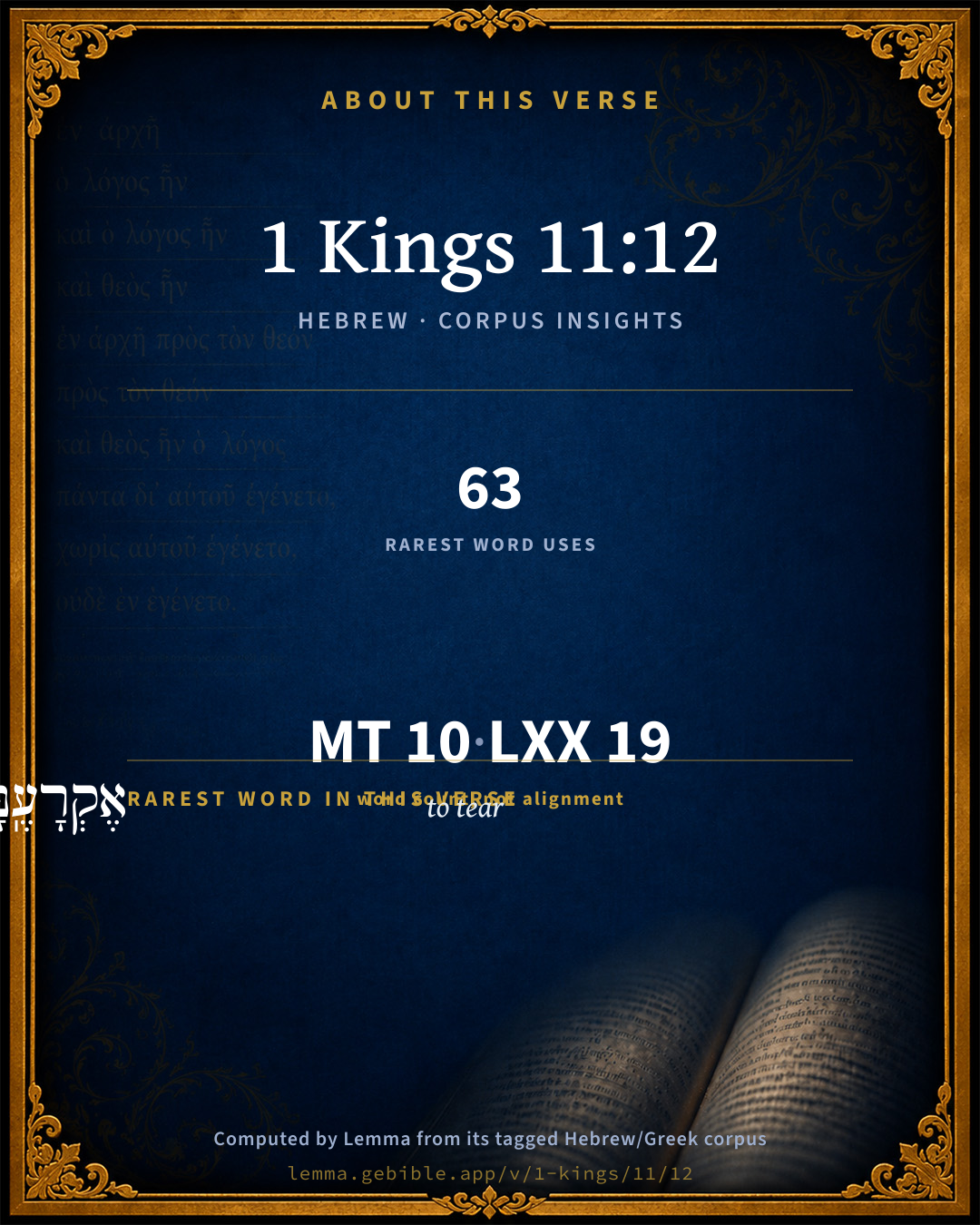
אֶקְרָעֶֽנָּה
qâraʻ
H7167
“to tear · her”
Verb, Qal, Imperfect, 1st Person, Common, Singular + Suffix, Personal, 3rd Person, Feminine, Singular
Part of Speech
Verb
Stem
Qal
Form
Imperfect
Person
1st Person
Gender
Common
Number
Singular
Full BDB Definition

Origin: a primitive root

TWOT: 2074

to tear, tear in pieces - (Qal) - to tear, rend - to tear away or out - to tear, rend asunder - to make wide or large (of eyes) - to rend open (of heavens) - to tear, rend (of wild beasts) - (Niphal) to be rent, be split asunder
  1. אַךְ ʼak H389 “surely” Particle, Accusative
  2. בְּיָמֶ֨יךָ֙ yôwm H3117 “in/at · days · your” Preposition + Noun, Common, Masculine, Plural, Construct + Suffix, Personal, 2nd Person, Masculine, Singular
  3. לֹ֣א lôʼ H3808 “not” Particle, Negative
  4. אֶעֱשֶׂ֔נָּה ʻâsâh H6213 “to do · her” Verb, Qal, Imperfect, 1st Person, Common, Singular + Suffix, Personal, 3rd Person, Feminine, Singular
  5. לְמַ֖עַן maʻan H4616 “for the sake of” Preposition
  6. דָּוִ֣ד Dâvid H1732 “David” Noun, Proper
  7. אָבִ֑יךָ ʼâb H1 “father · your” Noun, Common, Masculine, Singular, Construct + Suffix, Personal, 2nd Person, Masculine, Singular
  8. מִיַּ֥ד yâd H3027 “from · hand of” Preposition + Noun, Common, Both, Singular, Construct
  9. בִּנְךָ֖ bên H1121 “son · your” Noun, Common, Masculine, Singular, Construct + Suffix, Personal, 2nd Person, Masculine, Singular

About this verse

These counts appear in no published source. They are computed here, from the morphology-tagged text and Lemma’s own curated glosses. What Lemma adds →

10
words
10
distinct lemmas
Historical
section

Grammatical profile

  • 2 verbs
  • 5 nouns
  • 1 preposition
  • 2 particles

Verb forms

  • אֶעֱשֶׂ֔נָּה Qal · Imperfect
  • אֶקְרָעֶֽנָּה Qal · Imperfect

Hebrew & Septuagint length

In English translation the verse runs 26 words from the Hebrew and 26 from the Septuagint (LXX English) — the same length.

A rough comparison of the two English renderings, which tokenize alike — not a word-level alignment.

Word counts can differ between the Hebrew and the Greek without any difference in meaning — e.g. the Hebrew direct-object marker אֵת has no separate Greek word, and Greek often adds the article ὁ.

In the original languages it is 10 Hebrew tokens and 19 Greek tokens — but the two are counted differently (Hebrew bundles its prefixes and suffixes into one token; the Greek is in lemma form), so that isn’t a like-for-like length.

Cross-references

8

Topical passages linked to 1 Kings 11:12 in the Treasury of Scripture Knowledge — connected by theme and wording, ordered by reader-vote popularity; previews shown in the World English Bible.

  • Genesis 12:2 I will make of you a great nation. I will bless you, and make your name great. You will be a blessing.
  • Genesis 19:29 It happened, when God destroyed the cities of the plain, that God remembered Abraham, and sent Lot out of the midst of the overthrow, when he overthrew the cities in which Lot lived.
  • Exodus 20:5 you shall not bow yourself down to them, nor serve them, for I, Yahweh your God, am a jealous God, visiting the iniquity of the fathers on the children, on the third and on the fourth generation of those who hate me,
  • 1 Samuel 9:4–5 He passed through the hill-country of Ephraim, and passed through the land of Shalishah, but they didn't find them: then they passed through the land of Shaalim, and there they weren't there: and he passed through the land of the Benjamites, but they didn't find them.
  • 1 Kings 21:29 See you how Ahab humbles himself before me? because he humbles himself before me, I will not bring the evil in his days; but in his son's days will I bring the evil on his house.
  • 2 Kings 20:17 Behold, the days come, that all that is in your house, and that which your fathers have laid up in store to this day, shall be carried to Babylon: nothing shall be left, says Yahweh.
  • 2 Kings 20:19 Then said Hezekiah to Isaiah, Good is the word of Yahweh which you have spoken. He said moreover, Isn't it so, if peace and truth shall be in my days?
  • 2 Kings 22:19–20 because your heart was tender, and you did humble yourself before Yahweh, when you heard what I spoke against this place, and against the inhabitants of it, that they should become a desolation and a curse, and have torn your clothes, and wept before me; I also have heard you, says Yahweh.

Cross-references courtesy of OpenBible.info (CC BY 4.0).

Hebrew and Greek witnesses Masoretic Hebrew ↔ Greek Septuagint

The same verse in the two great witnesses to the Old Testament, shown verse-for-verse.

These are two independent witnesses, not word-aligned to each other, and the Septuagint is shown in lemma (dictionary) form.

Hebrew 1 Kings 11:12 Masoretic · Westminster Leningrad Codex

אַךְ בְּיָמֶ֨יךָ֙ לֹ֣א אֶעֱשֶׂ֔נָּה לְמַ֖עַן דָּוִ֣ד אָבִ֑יךָ מִיַּ֥ד בִּנְךָ֖ אֶקְרָעֶֽנָּה

Notwithstanding in your days I will not do it, for David your father's sake: but I will tear it out of the hand of your son.

World English Bible · Public Domain

Greek LXX 1 Kings 11:12 Septuagint · lemma form

πλήν ἐν ὁ ἡμέρα σύ οὐ ποιέω αὐτός διά δαυίδ ὁ πατήρ σύ ἐκ χείρ υἱός σύ λαμβάνω αὐτός

Only in your days I will not do it for David your father's sake: but I will take it out of the hand of your son.

LXX2012 (modern English Septuagint) · Public Domain

Hebrew: Westminster Leningrad Codex (CC BY 4.0). Greek: Septuagint (public domain); English from LXX2012 (modern English Septuagint) (Public Domain). How the Septuagint differs from the Hebrew →

Targum (Aramaic paraphrase)

1

The Targum is the ancient Jewish Aramaic paraphrase of the Hebrew Scriptures — an interpretive translation, not the Hebrew text itself. Onkelos (literal) and Pseudo-Jonathan (expansive) render the Torah, and Jonathan the Prophets. Coverage is partial: where no permissively-licensed English translation exists for a verse, only the Aramaic is shown. This is verse-level text, not a word-by-word alignment to the Hebrew.

  1. Targum Jonathan Prophets (Joshua–Malachi)
    בְּרַם בְּיוֹמָךְ לָא אֶעְבְדִנָה בְּדִיל דָוִד אֲבוּךְ מִיַד בְּנָךְ אֶעְדִינָה:

    (no public-domain English translation for this verse)

    Targum Jonathan — Aramaic: “Mikraot Gedolot” (public domain). English: “Sefaria Community Translation” (CC0 1.0 (public-domain dedication)); “London "Chaldee Paraphrase," 1871” (public domain). Text via Sefaria.

Commentary

Notes on 1 Kings 11:12 from classic Christian and Jewish commentators (each source and its license shown beneath its notes). The classic Christian expositions comment on the surrounding passage and are grouped to its opening verse, so a note may address several verses; the Jewish commentaries on the Tanakh (Rashi and others) are per-verse, so they appear only where the commentator wrote on this verse.

Lemma curates 59 commentaries, every one of them public domain or Creative Commons licensed, each selected and text-cleaned for this edition rather than reprinted as found. About our sources →

Trapp's Complete Commentary

John Trapp

1Ki 11:12 Notwithstanding in thy days I will not do it for David thy father’s sake: [but] I will rend it out of the hand of thy son.

Ver. 12. Out of the hand of thy son,] i.e., Rehoboam, the only son that Solomon had by so many wives and concubines, quod prodigii instar est, saith one, which may well seem a wonder. See Psa 127:1 Hos 4:10 {See Trapp on title of "Psa 127:1"}

John Trapp, A Commentary or Exposition upon All the Books of the Old and New Testament (1647–1656) — public domain. Text from a community e-Sword module.

The Biblical Illustrator

Joseph S. Exell

1Ki_11:12

Notwithstanding in thy days I will not do it.

Solomons sin

I. The action related to us. To appreciate it, we must consider

(1) the greatness of the offence. Here was authority itself doing that which it ought to have prevented and punished; Davids son departing from Davids God; wisdom guilty of indescribable folly; a man conspicuously favoured (1Ki_11:9), conspicuously disobedient; the appointed builder of Jehovahs temple building rival temples close by. Yet observe, in comparison with it

(2) the lightness of the correction. The offender loses nothing of his power or renown. He has enemies (1Ki_11:14, etc.), but they dare not attack him. There is not a loose stone in his throne till he dies. Only he is warned of the consequences to happen after his death; those consequences themselves, moreover, not being carried out to the full extent even then. Compare the case of pious Hezekiah, who acknowledged the goodness of God, when, for a less offence, he received a heavier stroke (2Ki_20:17-19). Just so it is Gods goodness that is here revealed to us most (Rom_11:22).

II. The motive revealed to us. Why this mercy shown in this instance? Only two reasons are mentioned. One had to do with Jerusalem (1Ki_11:13), the place of Solomons throne. God had chosen it for His dwelling-placer with great objects in view. The other motive (twice mentioned) has to do with Solomons father. For Davids sake the threatened evil was postponed till after his sons death; and even then, for the same Davids sake, it was not to be complete. See, finally, how all this encourages us in the hope of salvation through Christ. See how completely it is part of Gods character to spare one man for anothers sake; especially where they are so connected that they may be considered as one. Also, if He does thus for a sinner and a servant (as here), how much more for His Holy One (Act_2:27), His own Son, the Christ of God! (W. S. Lewis, M. A.)

Children honoured for their fathers sake

Many peerages have been created in this realm which descend from generation to generation, with large estates, the gift of a generous nation, and why? Because this nation has received some signal benefits from one man and has been content to ennoble his heirs for ever for his sake. I do not think there was any error committed when Marlborough or Wellington were lifted to the peerage; having saved their country in war, it was right that they should be honoured in peace; and when for the sake of the parents perpetual estates were entailed upon their descendants, and honours in perpetuity conferred upon their sons, it was only acting according to the laws of gratitude. (C. H. Spurgeon.)

The Biblical Illustrator, edited by Joseph S. Exell (c. 1880s–1900s) — public domain. Text from a community e-Sword module.

Ellicott's Commentary for English Readers

(12, 13) For David my servant’s sake—that is, evidently, in order to fulfil the promise to David. By the postponement of the chastisement, the blessing promised to his son personally would be still preserved; by the retaining of the kingdom, though shorn of its splendour, and limited to Judah, the larger and more important promise, the continuance of the family of David till the coming of the Messiah, would be fulfilled. The “one tribe” is, of course, Judah, with which Benjamin was indissolubly united by the very position of the capital on its frontier. This is curiously indicated in 1Ki_11:31-32, where “ten tribes” are given to Jeroboam, and the remainder out of the twelve is still called “one tribe.”

A Bible Commentary for English Readers, edited by Charles John Ellicott (1878–1897) — public domain. Text from a community e-Sword module.

The Cambridge Bible for Schools and Colleges

gen. ed. J. J. S. Perowne

12. in thy days I will not do it] For a similar postponement of God’s penalty, cf. the history of Ahab (1Ki_21:29).

for David thy father’s sake] An example of God’s mercy shewn towards the descendants of them that love Him, as promised in the second commandment (Exo_20:6), and typifying that fuller mercy which was to be shewn for the sake of the obedience of Christ.

The Cambridge Bible for Schools and Colleges (gen. ed. J. J. S. Perowne; Cambridge University Press, 1878–1918) — public domain. Text from a community e-Sword module.

John Gill's Exposition

Howbeit, I will not rend away all the kingdom,.... The whole kingdom of Israel:

but will give one tribe to thy son; but it seems he had both Benjamin and Judah, and only ten tribes were rent from him; the reason of this mode of expression may be, either because he gave him one of the tribes of Israel, besides that of Judah, which was his own tribe; or only the tribe of Judah is meant, the whole tribe of Benjamin not being his, since Bethel, and some other places in that tribe, were in the possession of Jeroboam; or rather both these are called but one, because their inheritances lay together, and were mixed with one another; and particularly both had a share in the city of Jerusalem, and the kingdom always after the division went by the name of Judah only: and this tribe was given

for David my servant's sake; because of the promise to him, that there should not want one of his seed to sit on his throne, Kg1 9:5.

and for Jerusalem's sake, whom I have chosen; to have the house of his sanctuary and worship in, and therefore thought fit to have one rule there, that, would have a regard to his service in it.

John Gill's Exposition of the Whole Bible (1746–1763) — public domain (CC PDM 1.0). Text via the HelloAO Bible API.

Haydock's Catholic Bible Commentary

Sake. As David placed this son upon the throne, the disgrace would seem to revert on him. (Menochius) --- Here we behold the reward of piety, and how desirable a thing it is to have saints for our parents. (Haydock)

George Leo Haydock (1774–1849), Haydock's Catholic Family Bible and Commentary, 1859 edition — public domain. Excludes Psalms (Douay-Rheims chapter numbering differs from Protestant) and Deuterocanonical books (Catholic canon only).

Matthew Poole's English Annotations

For David thy father’s sake; for the respect I bear to his memory, and for my promise sake made to him, 2Sa 7.

Matthew Poole's English Annotations on the Holy Bible (1683–1685) — public domain. Text from a community e-Sword/MySword module.

The Pulpit Commentary

Notwithstanding in thy days I will not do it The threatening had two gracious and merciful limitations,

(1) The blow should not fall until after his death (cf. ver. 34; 1 Kings, 2Ki_22:20) and

(2) the disruption should be but partial. There should be a "remnant" (Rom_9:27 Rom_11:5, etc.) for David thy father"s sake i.e., because both of David"s piety and God"s promise to him (2Sa_7:13) : but I will rend it out of the hand of thy son.

The Pulpit Commentary (1880–1919), ed. H.D.M. Spence-Jones & Joseph S. Exell — public domain. Text from a community e-Sword module.

John Wesley's Explanatory Notes

Fathers sake - For my promise made to him, 2 Sam. vii, 12-15.

John Wesley, Explanatory Notes Upon the Whole Bible (1754–1765) — public domain. Text via the GEBible commentary corpus.

Lesson kit

Teaching starters — assembled from the data on this page, not authored interpretation. Every prompt links to the verse data it draws on. Edit before teaching.

1 Kings, in the Historical, opens this verse with 10 words (10 distinct Hebrew lemmas). Its most distinctive word is qâraʻ (“to tear”). A historical commentator’s framing appears above. Read the whole chapter for the surrounding context.

Discussion questions

  1. How does “to tear” (qâraʻ) shape what this verse is saying?
  2. Genesis 12:2 shares this passage’s theme. How do the two illuminate each other?
  3. The translations on this page render this verse differently — a whole-verse word diff, not a word-by-word alignment. What might account for the different wordings?
  4. The verb «אֶעֱשֶׂ֔נָּה» is Qal Imperfect. How does its form color the action?
  5. Reading how Trapp's Complete Commentary and The Biblical Illustrator read this verse, where do the two commentators agree and where do they part?

Things to notice

Reading settings

Reading text

Shown beneath each verse's original-language words.

Old Testament
Old Testament edition

Read the OT as the Masoretic Hebrew (MT) or the Greek Septuagint (LXX).

English shown for the Greek Septuagint (in the Hebrew ↔ Greek comparison).

Comparing translations? Open the Compare panel on any verse page to stack up to four side by side.