
Ezekiel 13:20

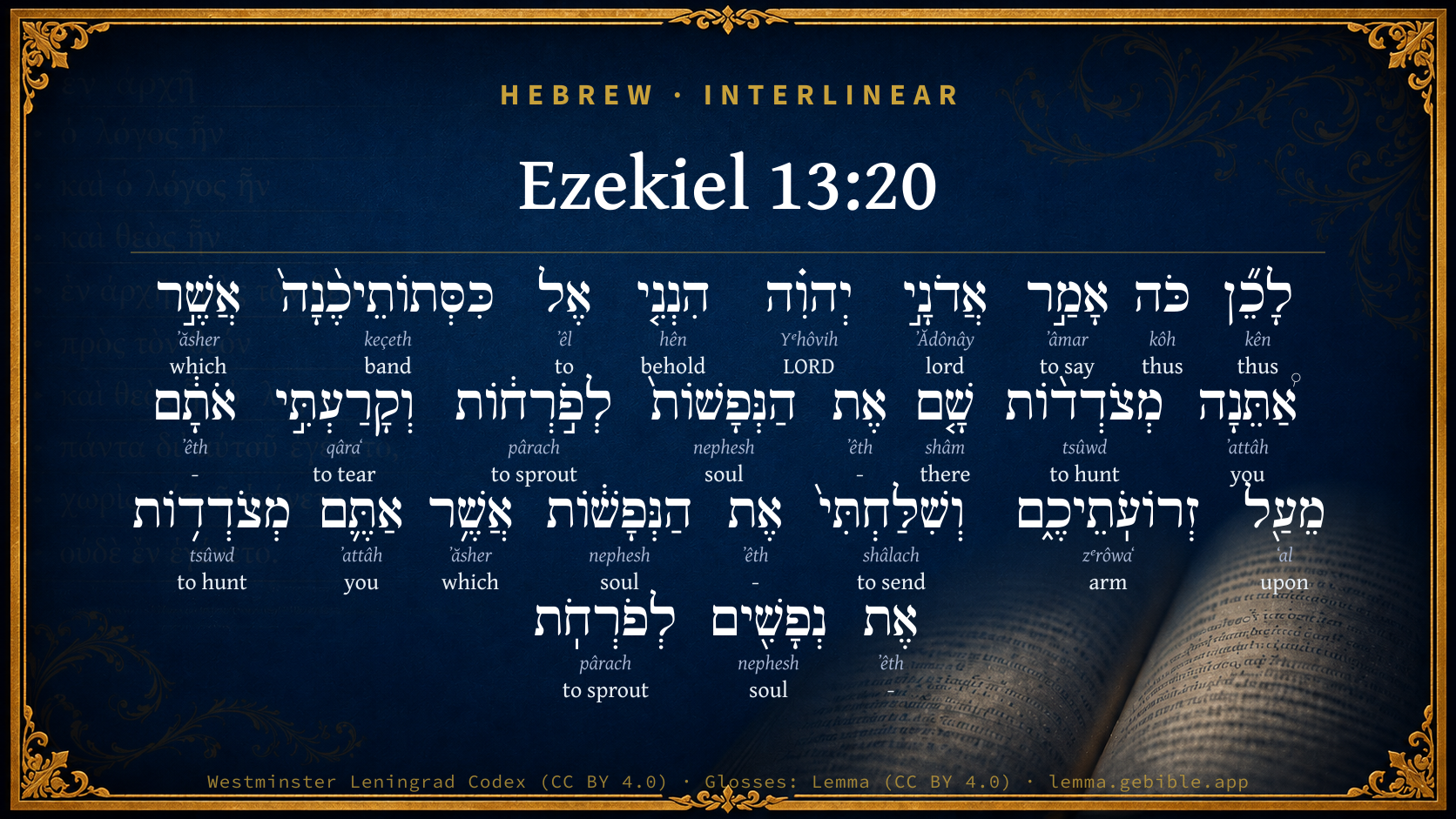
Hebrew (Westminster Leningrad Codex) Ezekiel 13:20 appears in the Hebrew Old Testament. The text above is from the Westminster Leningrad Codex. Each word links to its Strong’s number, a concise gloss, and parsing drawn from the Open Scriptures Hebrew Bible morphology. Click any word for its full Brown-Driver-Briggs (BDB) entry.
Download image
Cite this verse

Ezekiel 13:20 (World English Bible). Public Domain. Lemma interlinear Bible study tool, https://lemma.gebible.app/v/ezekiel/13/20.

Show BibTeX & RIS
BibTeX
RIS
English Translation
Therefore thus says the Lord Yahweh: Behold, I am against your pillows, with which you there hunt the souls to make [them] fly, and I will tear them from your arms; and I will let the souls go, even the souls who you hunt to make [them] fly.
World English Bible · Public Domain
Download a study sheet

One document with this verse’s original text, its word-by-word gloss line, the meaning frame, cross-references with their text, attributed commentary, and full source and license credits — printable, and it pastes into notes with its structure intact.

This verse Autodidact and up

Study sheet (.html) Plain text (.txt)

A passage Seminary Student

Up to 50 verses in one chapter. A passage sheet keeps up to 6 commentary sources and 12 cross-references per verse, in the order this page ranks them, and says so on the sheet whenever that leaves anything out. Ask for a single verse and you get the Autodidact verse sheet above.

Everything on this page stays free to read, with no account — the sheet is a download of what is already on screen, not access to it.

Want to remove ads? Support Godless Engineer
Compare translations 3

The same verse in 3 English versions, stacked beneath the original-language interlinear above. Click any original word for its lexicon entry.

Each is an independent rendering of the whole verse — the interlinear is not word-aligned to these translations.

Highlighted words mark where these versions differ — a whole-verse word diff, not a word-by-word alignment.

  • World English Bible Public Domain
    Therefore thus says the Lord Yahweh: Behold, I am against your pillows, with which you there hunt the souls to make [them] fly, and I will tear them from your arms; and I will let the souls go, even the souls who you hunt to make [them] fly.
  • King James Version Public Domain
    Wherefore thus saith the Lord GOD; Behold, I am against your pillows, wherewith ye there hunt the souls to make them fly, and I will tear them from your arms, and will let the souls go, even the souls that ye hunt to make them fly.
  • unfoldingWord Literal Text CC BY-SA 4.0
    Therefore the Lord Yahweh says this: I am against the magic charms that you have used to ensnare the people’s lives as if they were birds. Indeed, I will tear them from your arms; and the people whom you have trapped like birds—I will let them go free.

unfoldingWord Literal Text — © unfoldingWord, licensed CC BY-SA 4.0. Word-aligned USFM3 via Door43 (git.door43.org/unfoldingWord/en_ult).

Versions to compare (up to 4)

3 of 4 selected

Show all 18 translations

Every available English version of this verse, each an independent rendering of the whole verse.

  • World English Bible Public Domain
    Therefore thus says the Lord Yahweh: Behold, I am against your pillows, with which you there hunt the souls to make [them] fly, and I will tear them from your arms; and I will let the souls go, even the souls who you hunt to make [them] fly.
  • Berean Standard Bible Public Domain
    Therefore this is what the Lord GOD says: See, I am against the magic charms with which you ensnare souls like birds, and I will tear them from your arms. So I will free the souls you have ensnared like birds.
  • Majority Standard Bible Public Domain
    Therefore this is what the Lord GOD says: See, I am against the magic charms with which you ensnare souls like birds, and I will tear them from your arms. So I will free the souls you have ensnared like birds.
  • King James Version Public Domain
    Wherefore thus saith the Lord GOD; Behold, I am against your pillows, wherewith ye there hunt the souls to make them fly, and I will tear them from your arms, and will let the souls go, even the souls that ye hunt to make them fly.
  • American Standard Version (1901) Public Domain
    Wherefore thus saith the Lord Jehovah: Behold, I am against your pillows, wherewith ye there hunt the souls to make `them' fly, and I will tear them from your arms; and I will let the souls go, even the souls that ye hunt to make `them' fly.
  • Revised Version (1885) Public Domain
    Wherefore thus saith the Lord GOD: Behold, I am against your pillows, wherewith ye there hunt the souls to make them fly, and I will tear them from your arms; and I will let the souls go, even the souls that ye hunt to make them fly.
  • Geneva Bible (1599) Public Domain
    Wherefore thus saith the Lord God, Behold, I will haue to do with your pillowes, wherewith yee hunt the soules to make them to flie, and I will teare them from your armes, and will let the soules goe, euen the soules, that ye hunt to make them to flie.
  • Douay-Rheims (1899) Public Domain
    Therefore thus saith the Lord God: Behold I declare against your cushions, wherewith you catch flying souls: and I will tear them off from your arms: and I will let go the souls that you catch, the souls that should fly.
  • Young's Literal Translation Public Domain
    Therefore, thus said the Lord Jehovah: Lo, I `am' against your pillows, With which ye are hunting there the souls of the flourishing, And I have rent them from off your arms, And have sent away the souls that ye are hunting, The souls of the flourishing.
  • Literal Standard Version CC BY-SA 4.0
    Therefore, thus said Lord YHWH: Behold, I [am] against your [magic] bands, || With which you are hunting there the souls of the flourishing, || And I have torn them from off your arms, || And have sent away the souls that you are hunting, || The souls of the flourishing.
  • Unlocked Literal Bible CC BY-SA 4.0
    Therefore the Lord Yahweh says this: I am against the magic charms that you have used to ensnare the people's lives as if they were birds. Indeed, I will tear them from your arms; and the people whom you have trapped like birds—I will let them go free.
  • unfoldingWord Literal Text CC BY-SA 4.0
    Therefore the Lord Yahweh says this: I am against the magic charms that you have used to ensnare the people’s lives as if they were birds. Indeed, I will tear them from your arms; and the people whom you have trapped like birds—I will let them go free.
  • Darby Bible Public Domain
    Wherefore thus saith the Lord Jehovah: Behold, I am against your pillows, that the souls which ye catch by their means may fly away; and I will tear them from your arms, and will let the souls go, the souls that ye catch, that they may fly away.
  • World Messianic Bible Public Domain
    “Therefore the Lord GOD says: ‘Behold, I am against your magic bands, with which you hunt the souls to make them fly, and I will tear them from your arms. I will let the souls fly free, even the souls whom you ensnare like birds.
  • Webster's Bible Public Domain
    Wherefore thus saith the Lord GOD; Behold, I am against your pillows, with which ye there hunt the souls to make them fly, and I will tear them from your arms, and will let the souls go, even the souls that ye hunt to make them fly.
  • Free Bible Version CC BY-SA 4.0
    So this is what the Lord God says: Watch out! I condemn the magic charms you use to trap people like birds, and I will rip them off your arms. I will set free those you have trapped.
  • Bible in Basic English Public Domain
    For this cause the Lord has said: See, I am against your bands with which you go after souls, and I will violently take them off their arms; and I will let loose the souls, even the souls whom you go after freely.
  • JPS Tanakh (1917) Public Domain
    Wherefore thus saith the Lord GOD: Behold, I am against your cushions, wherewith ye hunt the souls as birds, and I will tear them from your arms; and I will let the souls go, even the souls that ye hunt as birds.

Literal Standard Version (2020), Covenant Press — licensed CC BY-SA 4.0. Text via the HelloAO Bible API (eBible.org). Unlocked Literal Bible (unfoldingWord) — licensed CC BY-SA 4.0. Text via the HelloAO Bible API (eBible.org). unfoldingWord Literal Text — © unfoldingWord, licensed CC BY-SA 4.0. Word-aligned USFM3 via Door43 (git.door43.org/unfoldingWord/en_ult). Free Bible Version, Dr. Jonathan Gallagher — licensed CC BY-SA 4.0. Text via the HelloAO Bible API (eBible.org).

Word by word

More ways to search: Search by grammar → Find every occurrence → Compare this word →

Practice this passage: Drill this verse → Learn its vocabulary →

כִּסְּתוֹתֵיכֶ֨נָה֙
keçeth
H3704
“bands · your”
Noun, Common, Feminine, Plural, Construct + Suffix, Personal, 2nd Person, Feminine, Plural
Part of Speech
Noun
Type
Common
Gender
Feminine
Number
Plural
State
Construct
Full BDB Definition

Origin: from H3680

TWOT: 1009a

band, fillet, covered amulets, false phylacteries - used by false prophetesses in Israel to support their demonic fortune-telling schemes
  1. לָכֵ֞ן kên H3651 “to/for · thus” Preposition + Adverb
  2. כֹּה kôh H3541 “thus” Adverb
  3. אָמַ֣ר ʼâmar H559 “to say” Verb, Qal, Perfect, 3rd Person, Masculine, Singular
  4. אֲדֹנָ֣י ʼĂdônây H136 “Lord · my” Noun, Common, Masculine, Plural, Construct + Suffix, Personal, 1st Person, Common, Singular
  5. יְהוִ֗ה Yᵉhôvih H3069 “LORD” Noun, Proper
  6. הִנְנִ֤י hên H2005 “behold · me” Particle, Demonstrative + Suffix, Personal, 1st Person, Common, Singular
  7. אֶל ʼêl H413 “to” Preposition
  8. אֲשֶׁ֣ר ʼăsher H834 “which” Particle, Relative
  9. אַ֠תֵּנָה ʼattâh H859 “you” Pronoun, Personal, 2nd Person, Feminine, Plural
  10. מְצֹדְד֨וֹת tsûwd H6679 “hunting” Verb, Polel, Participle Active, Feminine, Plural, Absolute
  11. שָׁ֤ם shâm H8033 “there” Adverb
  12. אֶת ʼêth H853 “-” Particle, Direct Object
  13. הַנְּפָשׁוֹת֙ nephesh H5315 “the · souls” Particle, Definite Article + Noun, Common, Both, Plural, Absolute
  14. לְפֹ֣רְח֔וֹת pârach H6524 “to/for · sprouting” Preposition + Verb, Qal, Participle Active, Feminine, Plural, Absolute
  15. וְקָרַעְתִּ֣י qâraʻ H7167 “and · to tear” Conjunction + Verb, Qal, Sequential Perfect, 1st Person, Common, Singular
  16. אֹתָ֔ם ʼêth H853 “- · them” Particle, Direct Object + Suffix, Personal, 3rd Person, Masculine, Plural
  17. מֵעַ֖ל ʻal H5921 “from · upon” Preposition + Preposition
  18. זְרוֹעֹֽתֵיכֶ֑ם zᵉrôwaʻ H2220 “arms · your” Noun, Common, Both, Plural, Construct + Suffix, Personal, 2nd Person, Masculine, Plural
  19. וְשִׁלַּחְתִּי֙ shâlach H7971 “and · to send” Conjunction + Verb, Piel, Sequential Perfect, 1st Person, Common, Singular
  20. אֶת ʼêth H853 “-” Particle, Direct Object
  21. הַנְּפָשׁ֔וֹת nephesh H5315 “the · souls” Particle, Definite Article + Noun, Common, Both, Plural, Absolute
  22. אֲשֶׁ֥ר ʼăsher H834 “which” Particle, Relative
  23. אַתֶּ֛ם ʼattâh H859 “you” Pronoun, Personal, 2nd Person, Masculine, Plural
  24. מְצֹדְד֥וֹת tsûwd H6679 “hunting” Verb, Polel, Participle Active, Feminine, Plural, Absolute
  25. אֶת ʼêth H853 “-” Particle, Direct Object
  26. נְפָשִׁ֖ים nephesh H5315 “souls” Noun, Common, Both, Plural, Absolute
  27. לְפֹרְחֹֽת pârach H6524 “to/for · sprouting” Preposition + Verb, Qal, Participle Active, Feminine, Plural, Absolute

About this verse

These counts appear in no published source. They are computed here, from the morphology-tagged text and Lemma’s own curated glosses. What Lemma adds →

28
words
19
distinct lemmas
Prophets
section

Notable vocabulary

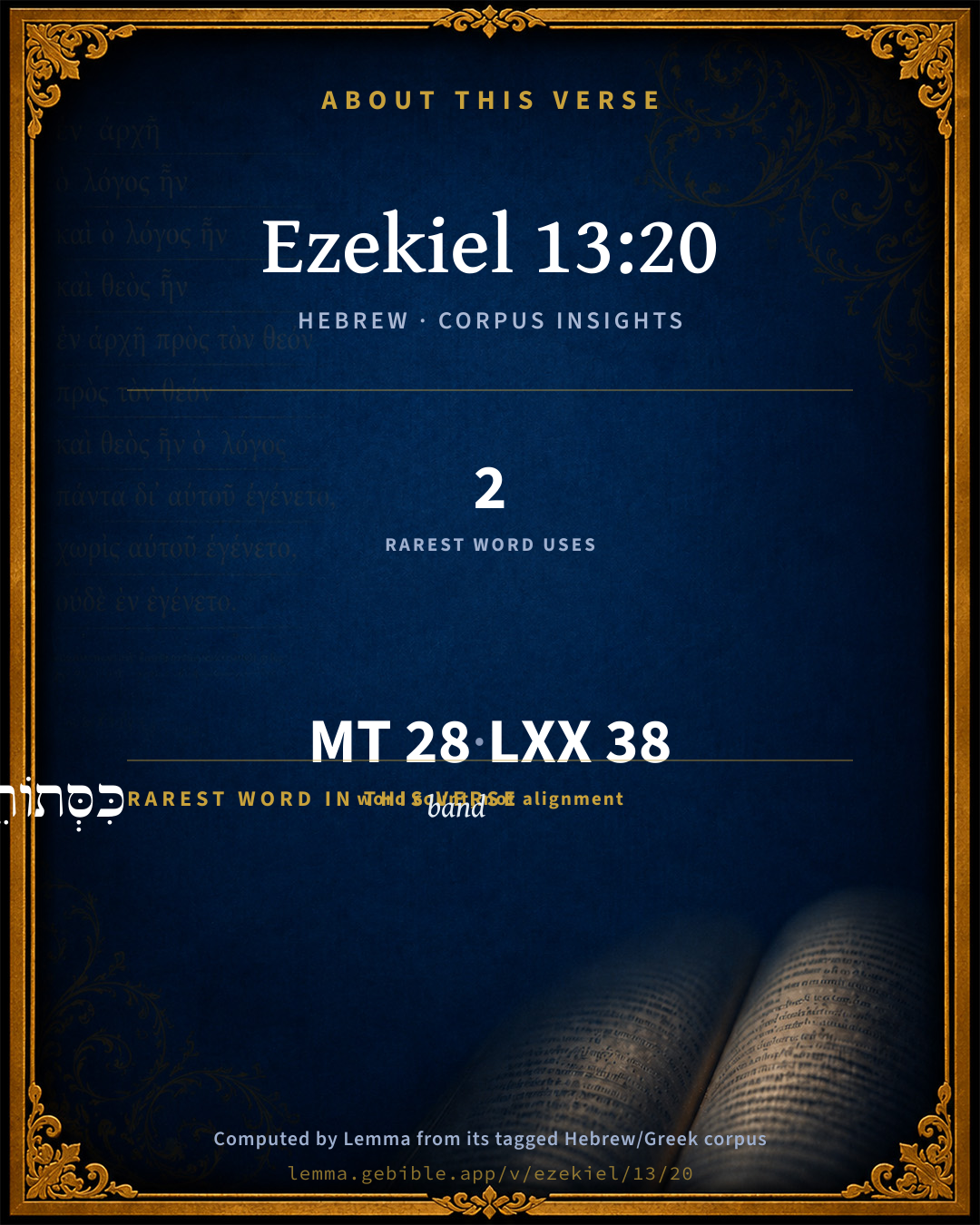
The rarest word here is כִּסְּתוֹתֵיכֶ֨נָה֙ band H3704 — appearing just 2 times in the whole Hebrew Bible.

Shared distinctive vocabulary

כִּסְּתוֹתֵיכֶ֨נָה֙ band H3704 occurs in 2 verses of the Hebrew Bible. Also found in:

Grammatical profile

  • 7 verbs
  • 7 nouns
  • 2 pronouns
  • 2 prepositions
  • 3 adverbs
  • 7 particles

Verb forms

  • אָמַ֣ר Qal · Perfect
  • מְצֹדְד֨וֹת Polel · Participle Active
  • לְפֹ֣רְח֔וֹת Qal · Participle Active
  • וְקָרַעְתִּ֣י Qal · Sequential Perfect
  • וְשִׁלַּחְתִּי֙ Piel · Sequential Perfect
  • מְצֹדְד֥וֹת Polel · Participle Active
  • לְפֹרְחֹֽת Qal · Participle Active

Repetition

Words recur within this verse — often emphatic in Hebrew:

  • הַנְּפָשׁוֹת֙ soul H5315 ×3
  • מְצֹדְד֨וֹת to hunt H6679 ×2
  • לְפֹ֣רְח֔וֹת to sprout H6524 ×2
  • אֲשֶׁ֣ר which H834 ×2
  • אַ֠תֵּנָה you H859 ×2

Hebrew & Septuagint length

In English translation the verse runs 48 words from the Hebrew and 39 from the Septuagint (LXX English) — closely comparable.

A rough comparison of the two English renderings, which tokenize alike — not a word-level alignment.

Word counts can differ between the Hebrew and the Greek without any difference in meaning — e.g. the Hebrew direct-object marker אֵת has no separate Greek word, and Greek often adds the article ὁ.

In the original languages it is 28 Hebrew tokens and 38 Greek tokens — but the two are counted differently (Hebrew bundles its prefixes and suffixes into one token; the Greek is in lemma form), so that isn’t a like-for-like length.

Cross-references

4

Topical passages linked to Ezekiel 13:20 in the Treasury of Scripture Knowledge — connected by theme and wording, ordered by reader-vote popularity; previews shown in the World English Bible.

  • Ezekiel 13:18 and say, Thus says the Lord Yahweh: Woe to the women who sew pillows on all elbows, and make kerchiefs for the head of [persons of] every stature to hunt souls! Will you hunt the souls of my people, and save souls alive for yourselves?
  • 2 Timothy 3:8–9 Even as Jannes and Jambres opposed Moses, so do these also oppose the truth; men corrupted in mind, reprobate concerning the faith.
  • Ezekiel 13:8–9 Therefore thus says the Lord Yahweh: Because you have spoken falsehood, and seen lies, therefore, behold, I am against you, says the Lord Yahweh.
  • Ezekiel 13:15–16 Thus will I accomplish my wrath on the wall, and on those who have daubed it with whitewash; and I will tell you, The wall is no more, neither those who daubed it;

Cross-references courtesy of OpenBible.info (CC BY 4.0).

Hebrew and Greek witnesses Masoretic Hebrew ↔ Greek Septuagint

The same verse in the two great witnesses to the Old Testament, shown verse-for-verse.

These are two independent witnesses, not word-aligned to each other, and the Septuagint is shown in lemma (dictionary) form.

Hebrew Ezekiel 13:20 Masoretic · Westminster Leningrad Codex

לָכֵ֞ן כֹּה אָמַ֣ר אֲדֹנָ֣י יְהוִ֗ה הִנְנִ֤י אֶל כִּסְּתוֹתֵיכֶ֨נָה֙ אֲשֶׁ֣ר אַ֠תֵּנָה מְצֹדְד֨וֹת שָׁ֤ם אֶת הַנְּפָשׁוֹת֙ לְפֹ֣רְח֔וֹת וְקָרַעְתִּ֣י אֹתָ֔ם מֵעַ֖ל זְרוֹעֹֽתֵיכֶ֑ם וְשִׁלַּחְתִּי֙ אֶת הַנְּפָשׁ֔וֹת אֲשֶׁ֥ר אַתֶּ֛ם מְצֹדְד֥וֹת אֶת נְפָשִׁ֖ים לְפֹרְחֹֽת

Therefore thus says the Lord Yahweh: Behold, I am against your pillows, with which you there hunt the souls to make [them] fly, and I will tear them from your arms; and I will let the souls go, even the souls who you hunt to make [them] fly.

World English Bible · Public Domain

Greek LXX Ezekiel 13:20 Septuagint · lemma form

διά οὗτος ὅδε λέγω κύριος κύριος ἰδού ἐγώ ἐπί ὁ προσκεφάλαιον σύ ἐπί ὅς σύ συνστρέφω ἐκεῖ ψυχή καί διαῥήγνυμι αὐτός ἀπό ὁ βραχίων σύ καί ἐκ ἀποστέλλω ὁ ψυχή ὅς σύ ἐκστρέφω ὁ ψυχή αὐτός εἰς διασκορπισμός

Therefore thus says the Lord God, Behold, I am against your pillows, whereby you⌃ there confound souls, and I will tear them away from your arms, and will set at liberty their souls which you⌃ pervert to scatter them.

LXX2012 (modern English Septuagint) · Public Domain

On this verse, Haydock's Catholic Bible Commentary discusses the Septuagint’s reading. Read the note in Commentary ↓

Hebrew: Westminster Leningrad Codex (CC BY 4.0). Greek: Septuagint (public domain); English from LXX2012 (modern English Septuagint) (Public Domain). How the Septuagint differs from the Hebrew →

Targum (Aramaic paraphrase)

1

The Targum is the ancient Jewish Aramaic paraphrase of the Hebrew Scriptures — an interpretive translation, not the Hebrew text itself. Onkelos (literal) and Pseudo-Jonathan (expansive) render the Torah, and Jonathan the Prophets. Coverage is partial: where no permissively-licensed English translation exists for a verse, only the Aramaic is shown. This is verse-level text, not a word-by-word alignment to the Hebrew.

  1. Targum Jonathan Prophets (Joshua–Malachi)
    בְּכֵן כִּדְנַן אֲמַר יְיָ אֱלֹהִים הָא אֲנָא שְׁלַח רוּגְזִי עַל רְקִיעַי חֲשִׁיכִין דְאַתִּין מַטְעֲיָן לְמֵימַר בְּהוֹן אֲנַחְנָא מְחַרְשָׁן יַת נַפְשָׁן לְאַבָּדָא וְאַפְסֵיק יַתְהֵין מֵעָל דַרְעֵיכוֹן וַאֲשֵׁיזֵיב יַת נַפְשָׁתָא דְאַתּוּן מְחַרְשָׁן יַת נַפְשֵׁיהֵן לְאַבָּדוּתָהָא:

    (no public-domain English translation for this verse)

    Targum Jonathan — Aramaic: “Mikraot Gedolot” (public domain). English: “Sefaria Community Translation” (CC0 1.0 (public-domain dedication)); “London "Chaldee Paraphrase," 1871” (public domain). Text via Sefaria.

Commentary

Notes on Ezekiel 13:20 from classic Christian and Jewish commentators (each source and its license shown beneath its notes). The classic Christian expositions comment on the surrounding passage and are grouped to its opening verse, so a note may address several verses; the Jewish commentaries on the Tanakh (Rashi and others) are per-verse, so they appear only where the commentator wrote on this verse.

Lemma curates 59 commentaries, every one of them public domain or Creative Commons licensed, each selected and text-cleaned for this edition rather than reprinted as found. About our sources →

Trapp's Complete Commentary

John Trapp

Eze 13:20 Wherefore thus saith the Lord GOD; Behold, I [am] against your pillows, wherewith ye there hunt the souls to make [them] fly, and I will tear them from your arms, and will let the souls go, [even] the souls that ye hunt to make [them] fly.

Ver. 20. Behold, I am against your pillows.] God’s hatred against sin is such that he hateth anything that is made use of about it. The serpent was cursed because he had been abused by the devil.

To make them fly.] High pitches, αεροβατουντις: as our high attainers, with their new truths and strange speculations, do now pretend to do. Such were the Swenkfeldians - Stinkfeldians, Luther called them, for their ill savour. Swenkfeldius himself bewitched many with those lofty terms, which were much in his mouth, of illumination, revelation, deification, the inward and spiritual man, &c. {a}

{a} Scultet. Annal.

John Trapp, A Commentary or Exposition upon All the Books of the Old and New Testament (1647–1656) — public domain. Text from a community e-Sword module.

Joseph Benson's Commentary

Eze 13:20-23. Behold, I am against your pillows, wherewith ye hunt the souls, &c. — To make them run into those snares and seductions that you have laid for them, Eze 13:18. The metaphor is continued from the manner of hunting and pursuing living creatures, thereby to drive them into the toils prepared for them. I will tear them from your arms — “I will make your cheats and impostures appear so evidently that nobody shall be in danger of being seduced by you any more:” see Eze 13:23. Your kerchiefs also will I tear — I will lay quite open and render useless all your arts; they shall no longer serve your purpose. Because with lies you have made the heart of the righteous sad — As you have deluded and comforted the wicked with vain hopes, so you have disheartened the righteous with groundless fears, or made them sad with the lies and calumnies you have invented against them. Therefore ye shall see no more vanity nor divine divinations, &c. — An entire end shall be put to all your false predictions and divinations; for ye shall all perish, namely, in the siege of Jerusalem, either by the famine, disease, or the weapons of the Chaldeans.

Joseph Benson's Commentary on the Old and New Testaments (1811–1818) — public domain. Text from a community e-Sword module.

Keil & Delitzsch

C. F. Keil & F. Delitzsch

Punishment of the False Prophetesses

Eze 13:20. Therefore thus saith the Lord Jehovah, Behold, I will deal with your coverings with which ye catch, I will let the souls fly; and I will tear them away from your arms, and set the souls free, which ye catch, the souls to fly. Eze 13:21. And I will tear your caps in pieces, and deliver my people out of your hand, and they shall no more become a prey in your hands; and ye shall learn that I am Jehovah. Eze 13:22. Because ye grieve the heart of the righteous with lying, when I have not pained him; and strengthen the hands of the wicked, so that he does not turn from his evil way, to preserve his life. Eze 13:23. Therefore ye shall no more see vanity, and no longer practise soothsaying: and I will deliver my people out of your hand; and ye shall learn that I am Jehovah. - The threat of judgment is closely connected with the reproof of their sins. Eze 13:20 and Eze 13:21 correspond to the reproof in Eze 13:18, and Eze 13:22 and Eze 13:23 to that in Eze 13:19. In the first place, the Lord will tear in pieces the coverings and caps, i.e., the tissue of lies woven by the false prophetesses, and rescue the people from their snares (Eze 13:20 and Eze 13:21); and, secondly, He will entirely put an end to the pernicious conduct of the persons addressed (Eze 13:22 and Eze 13:23). The words from אשׁר אתּנּה to לפרחות (Eze 13:20), when taken as one clause, as they generally are, offer insuperable difficulties, since it is impossible to get any satisfactory meaning from שׁם, and לפרחות will not fit in. Whether we understand by kesâthōth coverings or cushions, the connection of שׁם with אשׁר (where ye catch the souls), which the majority of commentators prefer, is untenable; for coverings and cushions were not the places where the souls were caught, but could only be the means employed for catching them. Instead of שׁם we should expect בּם or בּהם; and Hitzig proposes to amend it in this way. Still less admissible is the proposal to take שׁם as referring to Jerusalem ("wherewith ye catch souls there"); as שׁם would not only contain a perfectly superfluous definition of locality, but would introduce a limitation altogether at variance with the context. It is not affirmed either of the prophets or of the prophetesses that they lived and prophesied in Jerusalem alone. In Eze 13:2 and Eze 13:17 reference is made in the most general terms to the prophets of Israel and the daughters of thy people; and in Eze 13:16 it is simply stated that the false prophets prophesied peace to Jerusalem when there was no peace at all. Consequently we must regard the attempt to find in שׁם an allusion to Jerusalem (cf. Eze 13:16) as a mere loophole, which betrays an utter inability to get any satisfactory sense for the word. Moreover, if we construe the words in this manner, לפרחות is also incomprehensible. Commentators have for the most part admitted that פּרח taht is used here in the Aramaean sense of volare, to fly. In the second half of the verse there is no doubt about its having this meaning. For שׁלּח is used in Deu 22:7 for liberating a bird, or letting it fly; and the combination שׁלּח is supported by the expression שׁלּח לחפשׁי in Exo 21:26, while the comparison of souls to birds is sustained by Psa 11:1 and Psa 124:7. Hence the true meaning of the whole passage לפרחות... שׁלּחתּי את־הנּפשׁות is, I send away (set free) the souls, which ye have caught, as flying ones, i.e., so that they shall be able to fly away at liberty. And in the first half also we must not adopt a different rendering for לפרחות, since את־הנּפשׁות is also connected with it there.

But if the words in question are combined into one clause in the first hemistich, they will give us a sense which is obviously wrong, viz., "wherewith ye catch the souls to let them fly." As the impossibility of adopting this rendering has been clearly seen, the attempt has been made to cloak over the difficulty by means of paraphrases. Ewald, for example, renders לפרחות in both cases "as if they were birds of passage;" but in the first instance he applies it to birds of passage, for which nets are spread for the purpose of catching them; and in the second, to birds of passage which are set at liberty. Thus, strictly speaking, he understands the first לפרחות as signifying the catching of birds; and the second, letting them fly: an explanation which refutes itself, as pârach, to fly, cannot mean "to catch" as well. The rendering adopted by Kimchi, Rosenmller, and others, who translate לפרחות ut advolent ad vos in the first hemistich, and ut avolent in the second, is no better. And the difficulty is not removed by resorting to the dialects, as Hvernick, for the purpose of forcing upon פּרחות the meaning dissoluteness of licentiousness, for which there is no authority in the Hebrew language itself. If, therefore, it is impossible to obtain any satisfactory meaning from the existing text, it cannot be correct; and no other course is open to us than to alter the unsuitable שׁם into שׂם, and divide the words from אשׁר אתּנּה to לפרחות into two clauses, as we have done in our translation above. There is no necessity to supply anything to the relative אשׁר, as צוּד is construed with a double accusative (e.g., Mic 7:2, צוּד חרם, to catch with a net), and the object to מצדדות, viz., the souls, can easily be supplied from the next clause. שׂם, as a participle, can either be connected with הנני, "behold, I make," or taken as introducing an explanatory clause: "making the souls into flying ones," i.e., so that they are able to fly (שׁוּם ל, Gen 12:2, etc.). The two clauses of the first hemistich would then exactly correspond to the two clauses of the second half of the verse. וקרעתּי אתם is explanatory of הנני אל כסת, I will tear off the coverings from their arms. These words do not require the assumption that the prophetesses wore the לסתות on their arms, but may be fully explained from the supposition that the persons in question prepared them with their own hands. 'ושׁלּחתּי וגו corresponds to 'שׂם את־הנּפשׁות וגו; and לפרחות is governed by שׁלּחתּי. The insertion of את־הנּפשׁים is to be accounted for from the copious nature of Ezekiel's style; at the same time, it is not merely a repetition of את־הנּפשׁות, which is separated from לפרחות by the relative clause 'אשׁר אתּם מח, but as the unusual plural form נפשׁים shows, is intended as a practical explanation of the fact, that the souls, while compared to birds, are regarded as living beings, which is the meaning borne by נפשׁ in other passages. The omission of the article after את may be explained, however, from the fact that the souls had been more precisely defined just before; just as, for example, in Sa1 24:6; Sa2 18:18, where the more precise definition follows immediately afterwards (cf. Ewald, 277a, p. 683). - The same thing is said in Eze 13:21, with regard to the caps, as has already been said of the coverings in Eze 13:20. God will tear these in pieces also, to deliver His people from the power of the lying prophetesses. In what way God will do this is explained in Eze 13:22 and Eze 13:23, namely, not only by putting their lying prophecies to shame through His judgment, but by putting an end to soothsaying altogether, and exterminating the false prophetesses by making them an object of ridicule and shame. The reason for this threat is given in Eze 13:22, where a further description is given of the disgraceful conduct of these persons; and here the disgracefulness of their conduct is exhibited in literal terms and without any figure. They do harm to the righteous and good, and strengthen the hands of the wicked. הכאות, Hiphil of כּאה, in Syriac, to use harshly or depress; so here in the Hiphil, connected with לב, to afflict the heart. שׁקר is used adverbially: with lying, or in a lying manner; namely, by predicting misfortune and divine punishments, with which they threatened the godly, who would not acquiesce in their conduct; whereas, on the contrary, they predicted prosperity and peace to the ungodly, who were willing to be ensnared by them, and thus strengthened them in their evil ways. For this God would put them to shame through His judgments, which would make their deceptions manifest, and their soothsaying loathsome.

Keil & Delitzsch — Biblical Commentary on the Old Testament (1861–1891) — public domain (CC PDM 1.0). Text via the HelloAO Bible API. (Old Testament only.)

Tyndale Open Study Notes

Tyndale Open Resources

13:20-23 The false women prophets did not define who qualified for life or death in the way that God did, so their ministry discouraged the righteous by making them feel that their obedience was in vain. It also encouraged the wicked to believe that they could continue in their sins without penalty. The result of this misdirection was to ensnare both the righteous and the wicked, giving both groups false ideas about God.

Tyndale Open Study Notes — © Tyndale Open Resources, licensed CC BY-SA 4.0. Text via the HelloAO Bible API.

Geneva Bible (1599)

Geneva Bible translators

That is, to cause them to perish, and that they should depart from the body.

Geneva Bible (1599) marginal notes — public domain. Text via Bolls.life.

Jamieson, Fausset & Brown

Robert Jamieson, A. R. Fausset & David Brown

I am against your pillows--that is, against your lying ceremonial tricks by which ye cheat the people.

to make them fly--namely, into their snares, as fowlers disturb birds so as to be suddenly caught in the net spread for them. "Fly" is peculiarly appropriate as to those lofty spiritual flights to which they pretended to raise their dupes when they veiled their heads with kerchiefs and made them rest on luxurious arm-cushions (Eze 13:18).

let . . . souls go--"Ye make them fly" in order to destroy them; "I will let them go" in order to save them (Psa 91:3; Pro 6:5; Hos 9:8).

Jamieson, Fausset & Brown — Commentary Critical and Explanatory on the Whole Bible (1871) — public domain (CC PDM 1.0). Text via the HelloAO Bible API.

Adam Clarke's Commentary

Verse 20. The souls that ye hunt to make them fly.] לפרחות lephorechoth, into the flower gardens, says Parkhurst. These false prophetesses decoyed men into these gardens, where probably some impure rites of worship were performed, as in that of אשרה Asherah or Venus. See Parkhurst under פרח.

Adam Clarke's Commentary on the Bible (1810–1826) — public domain. Text from a community e-Sword/MySword module.

John Calvin's Commentaries

Here Ezekiel begins to threaten those women with what would shortly happen, namely, that God would not only render them contemptible, but also ridiculous, before the whole people, that their delusions and impostures might sufficiently appear. This is the Prophet’s intention, as we shall afterwards see; but the Prophet is verbose in this denunciation. God therefore says, that he is an enemy to those cushions, that is, to those false ceremonies which were like cloaks to deceive miserable men: hence he says, that those souls were a prey. He uses the comparison from hunting: ye have hunted, says he, the souls of my people. And this is the meaning of the word used immediately afterwards for flying. This word פרח, pherech, signifies also “to flourish;” but I here willingly subscribe to the opinion of all who interpret it to fly: unless the paraphrast is right in translating it “to perish;” for he thought the Prophet was speaking metaphorically, as if he meant that those souls were ensnared, and so vanished away. But I do not think this quite suitable, since it is more probable that the Prophet is speaking of their lofty speculations. For we know that false prophets boasted in this artifice, when they either raise, or pretend they raise, men’s minds aloft, and curious men desire this only; and hence it happens that the doctrines of the Law and the Gospel are insipid to them, because subtleties alone delight them. And we see at this day how many embrace the follies of Dionysius about the celestial hierarchy, who treat all the prophets, and even Christ himself, as of no value. Hence the Prophet says, that these women hunted the souls of the people, because they had snares prepared in which they entangled all who were subject to their impostures and fallacies. Yet, in my opinion, he also alludes to birds. When, therefore, he has said that all impostures were Satan’s method of hunting souls, he now adds obliquely another simile, that all false prophecies are so many allurements to catch birds. The sense of the passage now appears clear. Behold, therefore, says he, God will arise against your cushions, by which you have hunted birds to make them fly; that is, when you promised wonderful revelations those wretched dupes whom their own curiosity urged on were deceived by such enticements. Afterwards he adds, I will free them from your arms, and I will let go the souls which you have hunted to make them fly, says he. He repeats again what we have already said about deep speculations, by the sweetness of which false prophets are accustomed to entice all fools who cannot be content with true doctrine, nor be wise with sobriety. Meanwhile it is by no means doubtful that God here speaks peculiarly of his elect, who were left among the people. For although they were but few, God was unwilling for them to perish: and for this reason he announces that he would be their avenger, and undeceive them, whether they had been already entrapped, or were just surrounded by these allurements. Since, then, he uses the same word, we gather from this that the phrase cannot be used indiscriminately. For God suffers many to perish, as he says by the Prophet Zechariah, “Let what perishes perish,” (Zechariah 9:9); but meanwhile he rescued a small number as the remnant of his choice, as Paul says. (Romans 11:5.)

John Calvin's Commentaries (1540-1563) — public domain. Text from the Calvin Translation Society English edition (1840s-50s) via the Christian Classics Ethereal Library (ccel.org). Calvin's coverage is partial (roughly two-thirds of the Bible); uncommented books and verses are honest gaps, never fabricated. The 19th-century editor's footnotes and remarks are omitted so the notes are faithfully Calvin's own voice.

John Gill's Exposition

Because with lies ye have made the heart of the righteous sad,.... By polluting the name of the Lord; by hunting and decoying souls into their destructive nets; and by threatening such who would not give heed to their superstitious rites, lying divinations, and false prophecies: so false teachers make the hearts of such sad, who, having seen the insufficiency of their own righteousness, trust in the righteousness of Christ, and are justified by it; by teaching such doctrines as depreciate the love and grace of God the Father; making his love dependent on the creature; his covenant conditional, and salvation to be by works, and not by grace; as detract from the person, offices, and grace of Christ; denying his deity and divine sonship; making light of his blood, and setting up man's righteousness against his: and such as are injurious to the Spirit's work; ascribing regeneration and conversion to man's free will; giving such marks and signs of grace as are not to be found in any, and representing it as what may be entirely lost:

whom I have not made sad; nor would he have them made sad by others; neither by false prophets and their lies, nor by any other means; neither by anything within them, nor anything without them; not by any or all of their spiritual enemies: he would have them comforted; the covenant of grace, and the promises of it, are made for such a purpose; the Scriptures are written for this use; ordinances are designed for this end; ministers are appointed for this work; and this is the office of the divine Spirit; and the Son of God himself was sent on this account:

and strengthened the hands of the wicked, that he should not return from his wicked way; by repentance and reformation; and so far were the wicked from returning from it in this way, that they were emboldened in sin, and hardened in it; and were more frequent and open in the commission of it; and that through the prophecies of these false prophetesses; as wicked men are by the doctrines of false teachers: and particularly

by promising him life; or that he should live long, and enjoy much peace and prosperity in the land of Israel, and not be carried captive into Babylon; and so false teachers harden men in sin, by giving them hopes of eternal life, though they continue in their evil ways; or upon the foot of universal redemption, and upon their repentance, as the fruit of their own free will; and therefore take their swing of sin, as believing that Christ died for all men, and so for them, and therefore shall be saved, live as they will; and that it is in their power to repent when they please, and therefore procrastinate it to the last.

John Gill's Exposition of the Whole Bible (1746–1763) — public domain (CC PDM 1.0). Text via the HelloAO Bible API.

Haydock's Catholic Bible Commentary

Catch. Hebrew also, "hunt the souls to make them into gardens, (Haydock) or flourishing." Septuagint, "you gather souls there." The original seems to be incorrect, ver. 18.

George Leo Haydock (1774–1849), Haydock's Catholic Family Bible and Commentary, 1859 edition — public domain. Excludes Psalms (Douay-Rheims chapter numbering differs from Protestant) and Deuterocanonical books (Catholic canon only).

Matthew Poole's English Annotations

I am against (the same phrase Eze 13:8)

your pillows; the rite, and its signification too.

There hunt the souls; either at Jerusalem, or wherever you give out answers.

To make them fly: in this sense the word is no where else used, and thus used here renders the interpretation obscure. Elsewhere it is, to bud, as Num 17:8; Eze 7:10; to blossom, Isa 27:6; to spring up as a flower or vine, Psa 92:7; Son 6:11; to grow, as Hos 14:8. Thus the sense is obvious; by these lying ceremonies thus applied you promise a flourishing, growing state to all inquirers, and this is, the net with which you hunt souls. It is possible these prophetesses might bring their deceived ones into pleasant gardens, and (if well paid for it) entertain with all the pleasures of flowers and fruits; and might not these prophetesses be the priests of Flora, and seduce young, fair, wanton ones to the idolatry and brutish pleasures of the Floralia?

I will tear them, with some violence and suddenness, that may express an indignation; as, 2Ki 5:7, when the king of Israel rent his clothes at the hearing the letter of Benhadad king of Syria, so in wrath will God suddenly tear your enchanting and divining habits.

From your arms; either from the arms of such as put them on when they consulted with these seducers; or may be the seducers might ordinarily wear them, to be known what they were.

Will let the souls go: you held the souls of those that heard you as captives, or as bewitched with your enchantments and pleasures; but I will set them free, some I will enlighten to discover your frauds, others I will undeceive by sending them into captivity.

Matthew Poole's English Annotations on the Holy Bible (1683–1685) — public domain. Text from a community e-Sword/MySword module.

Whedon's Commentary on the Bible

Daniel D. Whedon

20. To make them fly — Rather, as birds (Gesenius, Smend). The figure of the net is still being carried out.

That ye hunt to make them fly — This passage is very corrupt, but by a slight change the text may read, “that ye hunt go free” (Cornill, Driver).

Daniel D. Whedon (gen. ed.), Commentary on the Old and New Testaments (1874–1909) — public domain. Text from a community e-Sword module.

The Pulpit Commentary

To make them fly, etc.; rather, with the Revised Version and Ewald, as if they were birds, carrying out the thought that the amulets on the arms of the prophetesses, and the veil cast over the heads of the votaries, were like the snare of the fowler. So the threat that follows, that the amulets should be torn off and the veil rent, is practically equivalent to the promise that the victims should be "delivered out of the snare of the fowler". (Psa_91:3 Psa_124:7) They should no longer he in the power of those who traded on their credulity. They too shall know that he who speaks is indeed Jehovah.

The Pulpit Commentary (1880–1919), ed. H.D.M. Spence-Jones & Joseph S. Exell — public domain. Text from a community e-Sword module.

John Wesley's Explanatory Notes

There - At Jerusalem. Grow - You promise a flourishing, growing, state to all inquirers; and this is the net with which you hunt souls. Tear them - With violence, and suddenness.

John Wesley, Explanatory Notes Upon the Whole Bible (1754–1765) — public domain. Text via the GEBible commentary corpus.

unfoldingWord translationNotes

Door43 World Missions Community

the magic charms that you have used to ensnare the people's lives as if they were birds

Yahweh speaks of these women using their magic charms to deceive people as if the people were birds that the women trapped with those charms. (See: Metaphor)

charms

objects believed to have magical powers

to ensnare

"to trap" "to catch in a snare"

tear them from your arms

"tear the charms from your arms"

rescue my people from your hand

Here the word "hand" represents power or control. AT: "rescue my people from your power" (See: Metonymy)

they will no longer be trapped in your hands

Here the word "hand" represents power or control. Yahweh speaks of the people being in the control of these women as if the women had trapped them with their hands. This can be stated in active form. AT: "you will no longer trap them like prey in your hands" or "you will no longer control them with your power" (See: Metonymy and Metaphor and Active or Passive)

translationWords

Lord Yahweh

magic

life

free

veil

hand

know

unfoldingWord translationNotes — © Distant Shores Media and the Door43 World Missions Community, licensed CC BY-SA 4.0. Source: git.door43.org/Door43/en_tn.

Rashi

Rabbi Shlomo Yitzchaki (Rashi)

to fly away To fly to Gehinnom because of you.

and I shall free the people whose souls As the Targum renders: and I shall save the people upon whose souls you cast a spell to destroy them.

whose souls The people [whose souls you ensure] to fly away.

Rashi on the Tanakh — English translations: “The Judaica Press complete Tanach with Rashi, translated by A. J. Rosenberg” (CC BY 4.0); “Pentateuch with Rashi's commentary by M. Rosenbaum and A.M. Silbermann, 1929-1934” (public domain); “The Metsudah Tanach series, Lakewood, N.J” (CC BY 4.0); and “The Book of Joshua, Metsudah Publications, 1997” (CC BY 4.0). Text via Sefaria.

Lesson kit

Teaching starters — assembled from the data on this page, not authored interpretation. Every prompt links to the verse data it draws on. Edit before teaching.

Ezekiel, in the Prophets, opens this verse with 28 words (19 distinct Hebrew lemmas). Its most distinctive word is keçeth (“band”). A historical commentator’s framing appears above. Read the whole chapter for the surrounding context.

Discussion questions

  1. How does “band” (keçeth) shape what this verse is saying?
  2. How does Ezekiel 13:18, which shares the word «band», read alongside this verse?
  3. What does the repetition of “soul” (3× in this one verse) do in this verse?
  4. These translations render this verse differently. What is at stake in choosing one wording over another?
  5. «אָמַ֣ר» is a Qal Perfect verb. How does that grammatical form shape the action described?
  6. Compare how Trapp's Complete Commentary and Joseph Benson's Commentary read this verse. Where do they agree or differ?

Things to notice

Reading settings

Reading text

Shown beneath each verse's original-language words.

Old Testament
Old Testament edition

Read the OT as the Masoretic Hebrew (MT) or the Greek Septuagint (LXX).

English shown for the Greek Septuagint (in the Hebrew ↔ Greek comparison).

Comparing translations? Open the Compare panel on any verse page to stack up to four side by side.