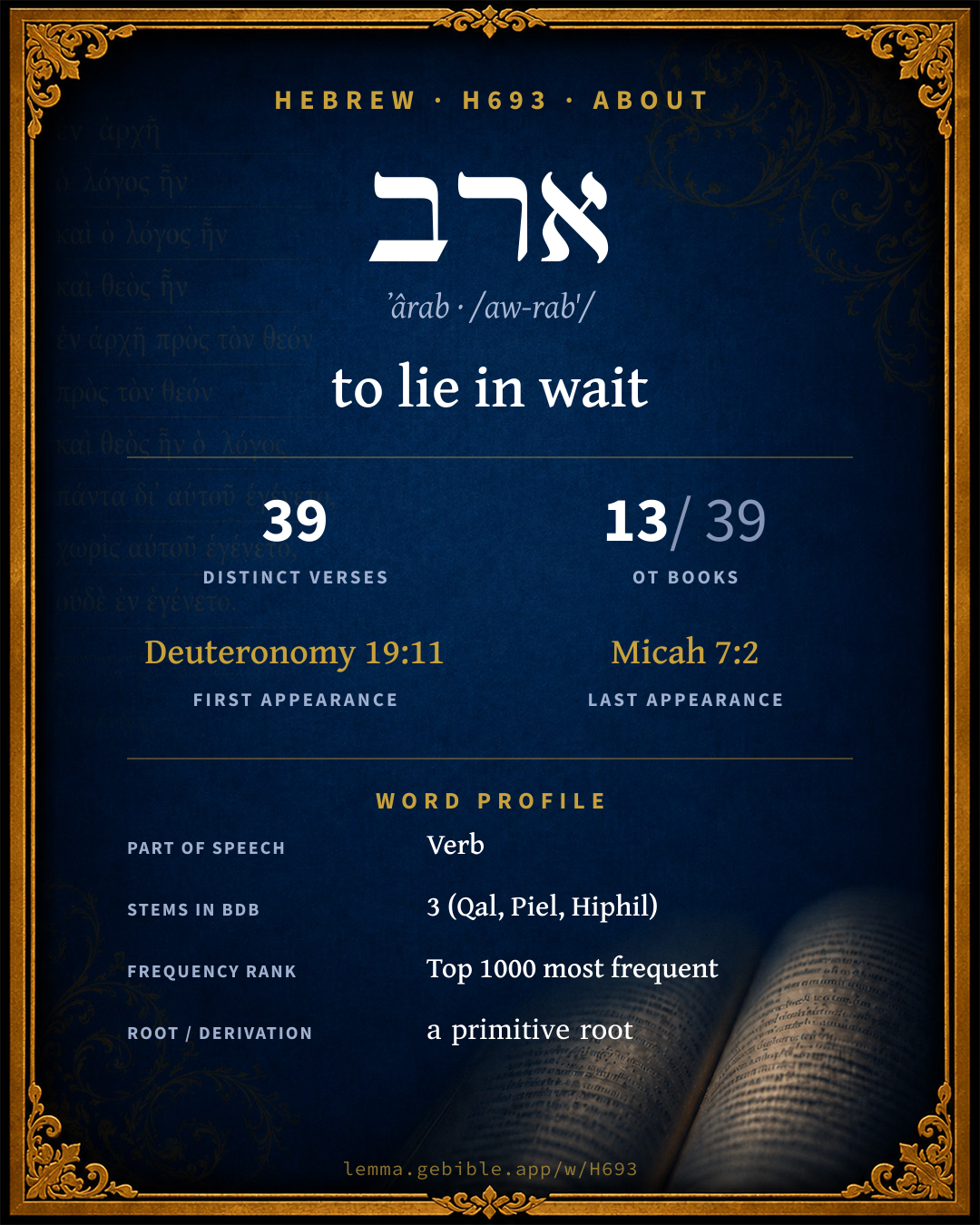
אָרַב
to lie in wait
also: ambush, lurk fuller range ↓
Full lexicon entry — Brown-Driver-Briggs (BDB)
From Brown-Driver-Briggs (BDB)
Where this word appears
See every Qal verb in the Hebrew Bible →
Grammar key — what these labels mean
Part of speech
- Verb
- An action or state-of-being word.
Noun type
- Common
- A common noun — a general class of person, place, or thing (“king,” “city,” “water”), not a specific name.
Stem
- Qal
- The basic, simple active stem — the plain form of the verb (“he wrote”).
- Piel
- An intensive or resultative active stem. Here: ‘pl.’
Form
- Participle Active
- A verbal adjective expressing ongoing or characteristic action (“writing / one who writes”).
- Sequential Imperfect
- An imperfect with prefixed waw — the standard past-narrative form (waw-consecutive imperfect).
- Imperfect
- An incomplete, ongoing, or future action (“he will / would write”).
- Perfect
- A completed action or state — Hebrew marks aspect (completeness) more than strict tense (“he wrote”).
- Sequential Perfect
- A perfect with prefixed waw continuing a preceding imperfect or command (waw-consecutive perfect).
- Imperative
- A direct command (“write!”).
- Infinitive Construct
- A bound verbal noun, frequently with prepositions (“to write / in writing”).
- Cohortative
- A first-person volitional form expressing wish or resolve (“let me / let us write”).
- Jussive
- A third- or second-person volitional form expressing wish or command (“let him write”).
State
- Absolute
- The independent form of a noun, not bound to a following word.
- Construct
- A noun bound to a following noun in a possessive / “of” relationship (the construct chain).
Person
- 3rd Person
- The one spoken about (“he / she / it / they”).
- 2nd Person
- The one addressed (“you”).
- 1st Person
- The speaker (“I / we”).
Gender
- Masculine
- Grammatically masculine.
- Feminine
- Grammatically feminine.
- Common
- Either gender — not distinguished for this form.
Number
- Singular
- One.
- Plural
- More than one (in Hebrew, generally three or more).
Grammatical forms 18 distinct
- Verb, Qal, Participle Active, Masculine, Singular, Absolute 16 times (39%)
- Verb, Qal, Participle Active, Masculine, Plural, Absolute 3 times (7%)
- Verb, Qal, Sequential Imperfect, 3rd Person, Masculine, Plural 2 times (5%)
- Verb, Piel, Participle Active, Masculine, Plural, Absolute 2 times (5%)
- Verb, Qal, Imperfect, 3rd Person, Feminine, Singular 2 times (5%)
- Verb, Qal, Imperfect, 3rd Person, Masculine, Plural 2 times (5%)
- Verb, Qal, Imperfect, 3rd Person, Masculine, Singular 2 times (5%)
- Verb, Qal, Perfect, 3rd Person, Common, Plural 2 times (5%)
+10 more forms (10 occurrences)
Parsed forms decoded from the imported morphology (morphhb / Westminster Leningrad Codex — WLC text public domain, morphhb tagging CC BY 4.0), counted across 41 parsed occurrences — not distinct verses.
Every verse where H693 appears — 39 distinct verses across 13 books. Click any verse to open its interlinear word-by-word view. Verse text shown in the World English Bible for context — . Each verse’s Hebrew form is shown with its reference; the English is not keyword-highlighted, since the data carries no word-level English alignment. Use “Compare translations” on any verse to read it across multiple English versions. This concordance covers the Hebrew Bible; Septuagint (Greek Old Testament) occurrences are not indexed here.
Deuteronomy 1 verse
Joshua 7 verses
- Joshua 8:2 אֹרֵ֛ב Qal ptcp.act ms You shall do to Ai and her king as you did to Jericho and her king: only the spoil of it, and the cattle of it, shall you take for a prey to yourselves: set you an ambush for the city behind it.
- Joshua 8:4 אֹרְבִ֤ים Qal ptcp.act mp He commanded them, saying, Behold, you shall lie in ambush against the city, behind the city; don't go very far from the city, but be all ready:
- Joshua 8:7 מֵ/הָ֣/אוֹרֵ֔ב prep + ptcl def.art + Qal ptcp.act ms and you shall rise up from the ambush, and take possession of the city: for Yahweh your God will deliver it into your hand.
- Joshua 8:12 אֹרֵ֗ב Qal ptcp.act ms He took about five thousand men, and set them in ambush between Bethel and Ai, on the west side of the city.
- Joshua 8:14 אֹרֵ֥ב Qal ptcp.act ms It happened, when the king of Ai saw it, that they hurried and rose up early, and the men of the city went out against Israel to battle, he and all his people, at the time appointed, before the Arabah; but he didn't know that there was an ambush against him behind the city.
- Joshua 8:19 וְ/הָ/אוֹרֵ֡ב conj + ptcl def.art + Qal ptcp.act ms The ambush arose quickly out of their place, and they ran as soon as he had stretched out his hand, and entered into the city, and took it; and they hurried and set the city on fire.
- Joshua 8:21 הָֽ/אֹרֵב֙ ptcl def.art + Qal ptcp.act ms When Joshua and all Israel saw that the ambush had taken the city, and that the smoke of the city ascended, then they turned again, and killed the men of Ai.
Judges 13 verses
- Judges 9:25 מְאָרְבִ֗ים Piel ptcp.act mp The men of Shechem set liers-in-wait for him on the tops of the mountains, and they robbed all who came along that way by them: and it was told Abimelech.
- Judges 9:32 וֶ/אֱרֹ֖ב conj + Qal impv 2ms Now therefore, up by night, you and the people who are with you, and lie in wait in the field:
- Judges 9:34 וַ/יֶּאֶרְב֣וּ conj + Qal wimpf 3mp Abimelech rose up, and all the people who were with him, by night, and they laid wait against Shechem in four companies.
- Judges 9:43 וַ/יֶּאֱרֹ֖ב conj + Qal wimpf 3ms He took the people, and divided them into three companies, and laid wait in the field; and he looked, and, behold, the people came forth out of the city; He rose up against them, and struck them.
- Judges 16:2 וַ/יֶּאֶרְבוּ conj + Qal wimpf 3mp [It was told] the Gazites, saying, Samson is come here. They compassed him in, and laid wait for him all night in the gate of the city, and were quiet all the night, saying, [Let be] until morning light, then we will kill him.
- Judges 16:9 וְ/הָ/אֹרֵ֗ב conj + ptcl def.art + Qal ptcp.act ms Now she had liers-in-wait abiding in the inner chamber. She said to him, The Philistines are on you, Samson. He broke the cords, as a string of tow is broken when it touches the fire. So his strength was not known.
- Judges 16:12 וְ/הָ/אֹרֵ֖ב conj + ptcl def.art + Qal ptcp.act ms So Delilah took new ropes, and bound him therewith, and said to him, The Philistines are on you, Samson. The liers-in-wait were abiding in the inner chamber. He broke them off his arms like a thread.
- Judges 20:29 אֹֽרְבִ֔ים Qal ptcp.act mp Israel set liers-in-wait against Gibeah round about.
- Judges 20:33 וְ/אֹרֵ֧ב conj + Qal ptcp.act ms cs All the men of Israel rose up out of their place, and set themselves in array at Baal Tamar: and the liers-in-wait of Israel broke forth out of their place, even out of Maareh Geba.
- Judges 20:36 הָ֣/אֹרֵ֔ב ptcl def.art + Qal ptcp.act ms So the children of Benjamin saw that they were struck; for the men of Israel gave place to Benjamin, because they trusted to the liers-in-wait whom they had set against Gibeah.
- Judges 20:37 וְ/הָ/אֹרֵ֣ב הָ/אֹרֵ֔ב conj + ptcl def.art + Qal ptcp.act ms ptcl def.art + Qal ptcp.act ms The liers-in-wait hurried, and rushed on Gibeah; and the liers-in-wait drew themselves along, and struck all the city with the edge of the sword.
- Judges 20:38 הָ/אֹרֵ֑ב ptcl def.art + Qal ptcp.act ms Now the appointed sign between the men of Israel and the liers-in-wait was that they should make a great cloud of smoke rise up out of the city.
- Judges 21:20 וַ/אֲרַבְתֶּ֥ם conj + Qal pf 2mp They commanded the children of Benjamin, saying, Go and lie in wait in the vineyards,
1 Samuel 2 verses
- 1 Samuel 22:8 לְ/אֹרֵ֖ב prep + Qal ptcp.act ms that all of you have conspired against me, and there is none who discloses to me when my son makes a league with the son of Jesse, and there is none of you who is sorry for me, or discloses to me that my son has stirred up my servant against me, to lie in wait, as at this day?
- 1 Samuel 22:13 לְ/אֹרֵ֖ב prep + Qal ptcp.act ms Saul said to him, Why have you conspired against me, you and the son of Jesse, in that you have given him bread, and a sword, and have inquired of God for him, that he should rise against me, to lie in wait, as at this day?
2 Chronicles 1 verse
Ezra 1 verse
Job 1 verse
Psalms 2 verses
- Psalms 10:9 יֶאֱרֹ֬ב יֶ֭אֱרֹב Qal impf 3ms Qal impf 3ms He lurks in secret as a lion in his ambush. He lies in wait to catch the helpless. He catches the helpless, when he draws him in his net.
- Psalms 59:3 אָֽרְב֡וּ Qal pf 3cp For, behold, they lie in wait for my soul. The mighty gather themselves together against me, Not for my disobedience, nor for my sin, Yahweh.
Proverbs 6 verses
- Proverbs 1:11 נֶאֶרְבָ֥ה Qal coh 1cp If they say, "Come with us, Let's lay in wait for blood; Let's lurk secretly for the innocent without cause;
- Proverbs 1:18 יֶאֱרֹ֑בוּ Qal impf 3mp But these lay wait for their own blood. They lurk secretly for their own lives.
- Proverbs 7:12 תֶאֱרֹֽב Qal impf 3fs Now she is in the streets, now in the squares, And lurking at every corner.
- Proverbs 12:6 אֱרָב Qal inf.cs The words of the wicked are about lying in wait for blood, But the speech of the upright rescues them.
- Proverbs 23:28 תֶּֽאֱרֹ֑ב Qal impf 3fs Yes, she lies in wait like a robber, And increases the unfaithful among men.
- Proverbs 24:15 תֶּאֱרֹ֣ב Qal juss 2ms Don't lay in wait, wicked man, against the habitation of the righteous. Don't destroy his resting-place:
Jeremiah 1 verse
Lamentations 2 verses
Hosea 1 verse
Micah 1 verse
About this entry
At a glance — auto-summarized from this page’s data, not written by a person. Every figure links to its source below. This summary describes the numbers; it doesn’t interpret them.
ארב (ʼârab) is a Hebrew verb most often rendered “to lie in wait.” Debuting at Deuteronomy 19:11, it then recurs through the corpus. With 39 verses in 13 books, it is a moderately common word in the Hebrew Bible. It concentrates in Judges, which alone accounts for 33% of its uses. Different stems carry different senses — BDB groups them under 3 stems, among them Qal and Piel. The sections below give every sense, occurrence, and version rendering.
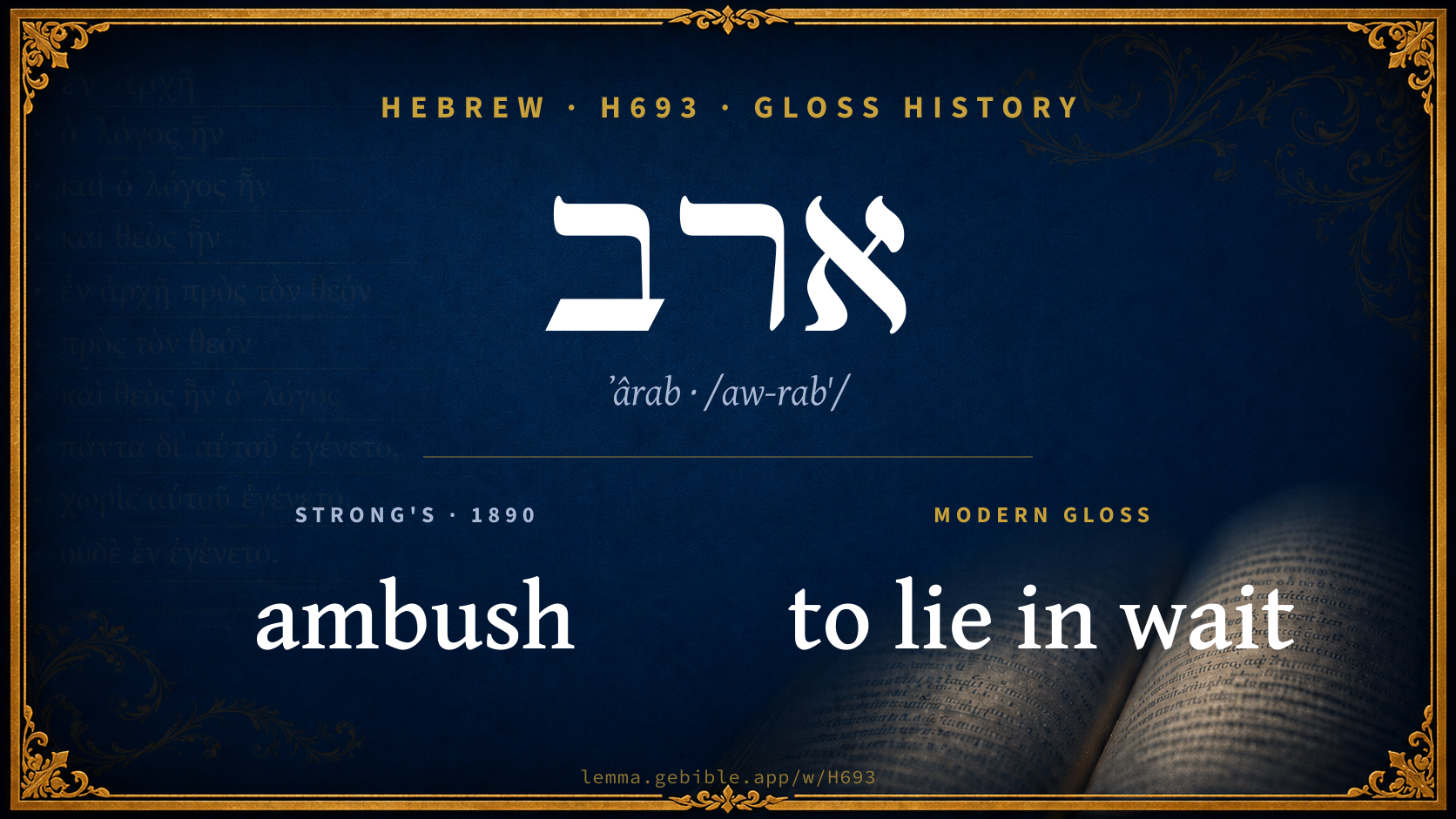
Gloss history
Strong's 1890 vs modern scholarship
About this word
Strong's H693 catalogs a Hebrew word from the Hebrew Old Testament.
These counts are not copied from any lexicon or concordance. They are computed here, from the morphology-tagged Hebrew Old Testament. What Lemma adds →
- 39
- distinct verses
- The word appears in 39 distinct verses.
- 13 / 39
- OT books
- The word appears in 13 of 39 Old Testament books.
- #891
- by frequency
- Top 1000 most frequent Hebrew words (rank 891 of 8,640 Hebrew words by occurrence).
View all 39 occurrences in the concordance →
By section of the Old Testament
By traditional corpus
Conventional, traditional groupings — biblical authorship is debated, so this is a traditional corpus grouping, not an authorship claim. Each share is this word’s portion of its verses in that division of the Hebrew canon. Each figure is a share of the word’s 39 distinct verses.
- Prophets (Nevi'im) 25 verses · 64%
- Writings (Ketuvim) 13 verses · 33%
- Torah (Pentateuch) 1 verse · 3%
How translations render this word
Counts come from each version’s own published word-to-Strong’s tagging or interlinear alignment — an approximate guide to how each version renders this word, not a word-level alignment the data otherwise carries. Because each total is that version’s own tagged count, the per-version totals vary from one another and need not match the appearance or distinct-verse counts above. These counts may also differ from a printed concordance because Lemma counts each distinctly tagged rendering and does not collapse phrase taggings into a single head-word total. This is a fixed set of word-tagged versions (KJV, ASV, BSB, ULT) and does not change with the reading translation you choose elsewhere. Each version’s license is shown beside its name below (and on Sources).
BDB lists this Strong’s number as 5 distinct words (homographs). Each count above pools all of them and is not split by sense — see the Senses section below. A low-frequency rendering may belong to a different one of those words, not the primary meaning.
- King James Version†: Liers in wait 7×, Ambush 3×, Against me to lie in wait 2×
- American Standard Version†: Liers-in 8×, Ambush 4×, Lie in wait 2×
- Berean Standard Bible†: Ambush 9×, Lie in wait 7×, Lay in wait 4×
- unfoldingWord Literal Text†: Ambush 13×, Ambushers 3×, Lie in ambush 3×
King James Version Public Domain
Renders H693 across 41† tagged occurrences — most commonly:
Plus 21 renderings that appear only once — usually multi-word phrases or single function words the recovered tagging swept in, not distinct renderings. Not rendered by a distinct English word in 1 further occurrence.
American Standard Version Public Domain
Renders H693 across 41† tagged occurrences — most commonly:
Plus 27 renderings that appear only once — usually multi-word phrases or single function words the recovered tagging swept in, not distinct renderings.
Berean Standard Bible Public Domain
Renders H693 across 41† tagged occurrences — most commonly:
Plus 13 renderings that appear only once — usually multi-word phrases or single function words the recovered tagging swept in, not distinct renderings.
unfoldingWord Literal Text CC BY-SA 4.0
Renders H693 across 42† tagged occurrences — most commonly:
Plus 18 renderings that appear only once — usually multi-word phrases or single function words the recovered tagging swept in, not distinct renderings.
15 senses and sub-senses in the full BDB
Hebrew verbs can shift meaning by stem (binyan): Qal is the basic action, Niphal is often passive or reflexive, Piel often intensifies or makes it factitive, and Hiphil is typically causative. The senses below are grouped under the stem BDB assigns to each.
What do BDB’s symbols mean?
BDB uses these scholarly abbreviations:
| Symbol | Meaning |
|---|---|
| 𝔊 | the Septuagint (the ancient Greek translation, LXX) |
| 𝔙 | the Vulgate (the Latin translation) |
| 𝔖 | the Syriac version (the Peshitta) |
| 𝔗 | the Targum (the Aramaic translation) |
| ψ | the Psalms |
| √ | root (the underlying root or stem) |
| ‖ | parallel passage (a synonymous or contrasted parallel) |
| † | the dagger: every passage where the word occurs is cited |
The 15 senses and sub-senses the full Brown-Driver-Briggs lexicon distinguishes for this word, in lexicon order (not ranked by frequency), with BDB’s own verbatim wording and sub-sense lettering. Shown in Hebrew script with BDB’s own scholarly abbreviations. The condensed entry is in the Lexicon Entry tab. See also the Forms in the corpus table below.
ארב I lie in wait (Arabic أَرُبَ i. was crafty, iii. went obliquely Dozy (knot) Frey)
Qal
- Pf. וְאָרַב consec. Dt 19:11 וַאֲרַבְתֶּם Ju 21:20; אָרָֽבְתִּי׃ Jb 31:9; אָֽרְבוּ ψ 59:4 La 4:19; Impf. יֶאֱרֹב ψ 10:9(×2); יֶאֱרֹ֑בוּ Pr 1:18; Mi 7:2; וַיֶּֽאֶרְבוּ Ju 9:34; 16:2; נֶֽאֶרְבָה Pr 1:11; Imv. אֱרֹב Ju 9:32; Inf. אֱרָב־ Pr 12:6; Pt. אֹרֵב Jos 8:2 + 11 times; אוֹרֵב Jos 8:12 + 4 times; אֹרְבִים Jos 8:4 + 2 times;—lie in wait (with hostile purpose), abs. Ju 9:32, 43 + 21:20; Jb 31:9; ψ 10:9; Pr 7:12; 23:28; 1 S 22:8, 13; La 3:10 (of bear, cf. ψ 10:9); c. inf. of purpose ψ 10:9; c. acc. א׳ דָּם Pr 12:6; c. עַל, and pers. against whom Ju 9:34; usually c. ל Dt 19:11; Mi 7:2; Ju 16:2; ψ 59:4; Pr 1:11, 18; 24:15; La 4:19 cf. Jos 8:2, 4, 14; Pt. as subst. = liers-in-wait (pl.) Ju 20:29; usually sg. coll. ambush Jos 8:2, 12, 14, 19, 21; Ju 16:9, 12; 20:33, 36, 37(×2), 38 Ezr 8:31; pl. of this sing. = ambuscades Je 51:12; sg. = place of lying-in-wait, ambush (loc. sense) Jos 8:7. e.g. Deuteronomy 19:11
Piel
- Pt. pl. מְאָֽרְבִים liers-in-wait. Qal Pt. Ju 9:25 (c. ל), 2 Ch 20:22 (c. עַל).? e.g. Judges 9:25
Hiphil
- Impf. וַיָּרֶב בנחל (for וַיַּאֲרֶב) 1 S 15:5 (cf. Dr Köi 390; Ges-Kau§68. 2 queries) but text dub.; cf. Ol§ 257 b, & Klo, who proposes ויעבר בנחל. e.g. 1 Samuel 15:5
ארב II much, many, great
- a. (1) much: of substances, gold 1 K 10:2 ψ 19:11, silver (money) 2 K 12:11 = 2 Ch 24:11, bronze 1 Ch 18:8, wine Est 1:7; of other quantities, e.g. spoil 2 S 3:22, property 2 Ch 32:29, seed Dt 28:38, etc.; רַב שֶׁיִּהְיוּ Ec 6:3b be it much that his days amount to; (2) especially of collectives, numerous, עַם־רַב Jos 11:4 2 S 13:34, עֲבֻדָּה רַבָּה Gn 26:14 Jb 1:3, מִקְנֶה רַב Dt 3:19 +, etc. e.g. 1 Kings 10:2
- b. pl. many: pers. Ex 5:5; Ju 8:30; 9:40; 1 K 4:20; 11:1 +, things Gn 30:43 Am 5:12 Dt 31:17 +; n. om. רַבּוֹת Dn 11:41 (sc. lands; read רִבּוֹת myriads Kmp Bev Behrm Marti Prince); יָמִים רַבִּים many days (a long time) Gn 21:34; 37:24 + 28 times, שָׁנִים רַבּוֹת Ne 9:30; Ec 6:3a, אִם עוֹד רַבּוֹת בַּשָּׁנִים Lv 25:51; רַבּוֹת עִתִּים Ne 9:28 many times (v. supr.) = פְּעָמִים רַבּוֹת ψ 106:43 Ec 7:22; מַכָּה רַבָּה Dt 25:3 many blows; מַיִם רַבִּים many waters Nu 20:11; 24:7 + 27 times, cf. Is 8:7; etc. e.g. Exodus 5:5
- c. רַב as subst. coll. pers. Ex 19:21, also (opp. מְעַט) 1 S 14:6; Nu 13:18; 26:54, 56; 33:54; 35:8; so רַבַּת (Ges§ 130a) 2 Ch 30:17, 18, and (rei; = much) Ez 24:12; רַב cstr. before abstr. (= רֹב) Is 21:7; 63:7 ψ 145:7; especially pl. רֵבִּים of pers. Ex 23:2(×2) + 37 times + בַּת־רַבִּים Ct 7:5 (v. p. 123). e.g. Exodus 19:21
- d. cstr. = abounding in, רַב־בְּרָכוֹת Pr 28:20, רַב־חֶסֶד (v. 1. חֶסֶד 3), רַב־כֹּחַ ψ 147:5, רַב־מְאֵרוֹת Pr 28:27, רַב הַמְּהוּמָה Ez 22:5, רַב־נוֹצָה 17:7, רַב־הָעֲלִילִיָּה Je 32:19, רַב־פְּעָלִים 2 S 23:20 = 1 Ch 11:22, רַב־פָּ֑שַׁע Pr 29:22, רַב־תְּבוּנָה 14:29; רַבַּת אוֹצָרֹת Je 51:13, רַבַּת בָּנִים 1 S 2:5, רַבָּ֫תִי עָם La 1:1 (Ges§ 90 1). e.g. Proverbs 28:20
- e. + מִן comp. = more numerous than Ex 1:9; Nu 22:15; Jos 10:11; Ju 16:30; 2 K 6:16; Is 54:1; 1 Ch 24:4; 2 Ch 32:7; Dn 11:13; sq. inf., too many to Gn 36:7; Ju 7:2 (cf. v 4); vid. also foll. e.g. Exodus 1:9
- f. רַב = abundant, enough Gn 24:25; 33:9; as exclam. enough! Gn 45:28; 2 S 24:16 = 1 Ch 21:15; 1 K 19:4, so (+ מִן inf.) Ex 9:28 (מִן 6 d); רַב־לָךְ (with implication of excess) Dt 3:26 (let it) suffice thee! so רַב־לָכֶם Ez 45:9, also Nu 16:3, 7 = ye assume too much! + inf. it is enough for you to Dt 1:6; 2:3 (i.e. you have done it enough), so + מִן inf. 1 K 12:28, מִן subst. Ez 44:6. e.g. Genesis 24:25
- g. as adv. much, exceedingly (only ψψ), רַב ψ 123:3, רָ֜ב ψ 18:15 (Hup De Che al.; HPS 2 S 22:15 conj. רָמָה; om. ‖ 2 S 22:15); רַבָּה ψ 62:3; 78:15; 89:8 (𝔊 Bae רַב הוּא); רַבַּת (Aramaism, cf. Syriac ܪܶܒܰܬ, ܪܰܒܰܬ, Nö§ 155 A WSG 135) ψ 65:10; 120:6 (= long enough), 123:4; 129:1, 2. e.g. Psalms 123:3
- 2. great:
- a. of person ψ 48:3, space 1 S 26:13, the deep Am 7:4 Gn 7:11 Is 51:10 ψ 36:7 (fig.), city La 1:1 (רַבָּ֫תִי בַגּוֹיִם Ges§ 90 1),—v. also צִידוֹן, חֲמָת;—plague Nu 11:33, empire Est 1:20, goodness ψ 31:20, wickedness Gn 6:5, etc. e.g. Psalms 48:3
- b. specif. strong (opp. אֵין כֹּחַ) 2 Ch 14:10; רַב לְהוֹשִׁיעַ Is 63:1; so רַבִּים as subst. Is 53:12 (‖ עֲצוּמִים). e.g. 2 Chronicles 14:10
- c. major natu Gn 25:23 (opp. צָעִיר); רַבִּים as subst. grandævi, Jb 32:9. e.g. Genesis 25:23
- d. + מִן comp. greater than Dt 7:1, 17; 9:14; 20:1; too great for Jos 19:9; 1 K 19:7.—Pr 26:10 is hopelessly corrupt, v. Toy. e.g. Deuteronomy 7:1
ארב III chief (Assyrian-Bab. influence, cf. rab DlHWB 609b
ארב IV archer
Senses from the full Brown-Driver-Briggs lexicon (Brown, Driver, Briggs; Oxford 1906 — public domain), digitized via Sefaria, supplemented by the OpenScriptures HebrewLexicon (CC BY 4.0). Full attribution on Sources.
Word origin
I. vb. lie in wait (Arabic أَرُبَ i. was crafty, iii. went obliquely Dozy (knot) Frey)—
III. adj. much, many, great;—ms. abs. ר׳ Gn 24:25 +, רָ֑ב Gn 33:9 +, also רָב֥ 2 Ch 20:2, רָב֖ 28:8, רָב֨ Ezr 10:13, etc.; cstr. רַב Ex 34:6 +; fs. רַבָּה Nu 11:33 +; cstr. רַבַּת Ez 22:5 +, רַבָּ֫תִי (Ges§ 90 k l) La 1:1(×2); mpl. abs. רַבִּים Ex 23:2(×2) +, cstr. v. ii. רב; fpl. abs. רַבּוֹת Gn 30:43 +;—[often both as pred. and as attrib.; as attrib. preceding n. (infl. of usage for numerals? KöSynt. § 334 k Ges§ 132b): רַב Is 63:7 ψ 145:7 (but read prob. רֹב, רָב־; in Is 21:7 ר׳ is pred.), רַבִּים Je 16:16 ψ 32:10; 89:51 (on context BöNÄ Bae, also Hup), Pr 7:26 1 Ch 28:5, רַבּוֹת Ne 9:28 Pr 31:29];—
IV. n.m. chief (Assyrian-Bab. influence, cf. rab DlHWB 609b; Biblical Aramaic רַב);—cstr. ר׳ Je 39:9 +; pl. cstr. רַבֵּי 39:13; 41:1 (but v. infr.);—especially רַב־ טַבָּחִים chief of guardsmen (v. טַבָּח), only as title of Bab. officer Je 39:9, 10 + 15 times Je, 7 times ‖ 2 K 25 (cf. שַׂר הַטּ׳ in Gn [JE]); also †רַב הַחֹבֵל Jon 1:6 chief of the sailors, i.e. captain; †in gen. כָּל־רַב בֵּיתוֹ Est 1:8, †רַב־סָרִיסָיו Dn 1:3 (v. סָרִיס), and so רַבֵּי מֶלֶךְ בָּבֶל Je 39:13, רַבֵּי הַמֶּלֶךְ 41:1 (late gloss; om. 𝔊 and ‖ 2 K 25:25, so Hi Gf Gie). †The foll. titles of Assyrian-Bab. officers are prob. loan-words in Heb.: רַב־מָ֑ג Je 39:3, 13 usually chief soothsayer (v. מָ֑ג), but = rab-mugi [? chief of princes] Pinches Hast. DB. Rab-mag; רַב־סָרִיס (cf. Old Aramaic [Nineveh] רב סרס Lzb366), 2 K 18:17 (Assyrian; not in ‖ Is 36:2), Je 39:3, 13 (Bab.), usually chief eunuch, but = rabû-ša-rêši, chief of the heads (the principal men) Wkl Unters. z. altor. Gesch., 1889, Excurs. v, p. 138 (actually found as rubû-ša-ri-ešu PinchesAcad. June 25, 1892, 618), PinchesHast. DB. Rab-saris; רַב־שָׁקֵה (van d. H. רַבְשָׁקֵה) chief of the officers (?) (so prob. Assyrian rab- ŠAḲ; šaḳû = high one; COT 2 K 18:17 KBii. 23 DlHWB 685a TieleBab.-Assyrian Gesch. 497. 513 PinchesHast. DB. iv. 191), 2 K 18:17, 19, 26, 27, 28, 37; 19:4, 8 = Is 36:2, 4, 11, 12, 13, 22; 37:4, 8.
V. n.m. archer;—s. רַב Pr 26:10, pl. רַבִּים Je 50:29 (‖ דֹּרְכֵי קֶשֶׁת), sf. רַבָּיו Jb 16:13 (in fig.; Bö al. רֹבָיו; Vrss. Ew al. his missiles).
— Brown-Driver-Briggs (Oxford 1906, public domain), digitized via Sefaria, supplemented by the OpenScriptures HebrewLexicon (CC BY 4.0). See Sources.
Origin: a primitive root
Jastrow Dictionary
A second Hebrew/Aramaic lexicon for comparison, covering Aramaic and post-biblical (Talmudic, Targumic, Midrashic) usage that the biblical-Hebrew BDB does not. Matched by lemma rather than by Strong’s number, so a lemma may carry more than one Jastrow headword (shown separately below), and the entries cover usage well beyond the Bible.
אָרַב
- 1. to press into holes, to make holes; to weave; join.
- 2. to look through a hole, to espy, lurk, lie in wait. B. Kam. 44ᵇ, a. e. (ref. to Deut. XIX, 11) וא׳ לו וכ׳ it says ‘And he lurks for him’ &c., that means the intention to kill that man.—Denom. ארובה, אורבא, ארבל׳, ארבא, ארבתא. e.g. Deuteronomy 19:11
*אֲרַב
- , part. אָרְבָּא lurking. B. Mets. 101ᵇ; B. Kam. 85ᵃ; B. Bath. 168ᵃ thou appearest to me כאריא א׳ like a lurking lion, i.e. I have no confidence in thee.
A Dictionary of the Targumim, the Talmud Babli and Yerushalmi, and the Midrashic Literature (Marcus Jastrow; London, Luzac, 1903) — Public Domain. Digitized via Sefaria. Digitized via Sefaria. Full attribution on Sources.
Forms in the corpus
The 39 distinct written forms H693 takes in the Hebrew Bible, most frequent first — each parse links to that stem’s occurrences in the concordance. Hebrew forms include their vowel points and cantillation, so a single lemma takes many written forms.
Same root — word family
Other BDB entries built from the same root as H693, grouped by Strong’s listed origin. These share a root / origin per the lexicon — not necessarily a shared meaning. Each links to that word’s own entry.
Derived from this word
Proper names from this root
People and places named from this root — a name, not an additional meaning of the word.
Compare all same-root words → Showing 4 of 5 — not the complete family. 1 of the same-root words is a proper name (a person or place). They share a root, not necessarily a meaning.
Septuagint verse parallels
This word appears in 38 verses that also exist in the Greek Old Testament (Septuagint), out of the 39 Hebrew verses it occurs in. You can read those verses in Greek by switching the Old Testament edition to the Septuagint.
Read these verses in the Septuagint
- Deuteronomy 19:11
- Joshua 8:2
- Judges 9:25
- 1 Samuel 22:8
- 2 Chronicles 20:22
- Ezra 8:31
- Job 31:9
- Psalms 59:3
- Proverbs 1:11
- Jeremiah 51:12
- Lamentations 3:10
- Hosea 7:6
This is a verse-level parallel only — the same verses exist in both the Hebrew and Greek Old Testaments. No word-level Hebrew↔Greek correspondence is claimed: the data carries no such alignment, so no Greek word is shown as this Hebrew word’s translation. Coverage is not total — the Septuagint omits the deuterocanon and renumbers the Psalms, so some Hebrew verses have no direct Greek parallel.