
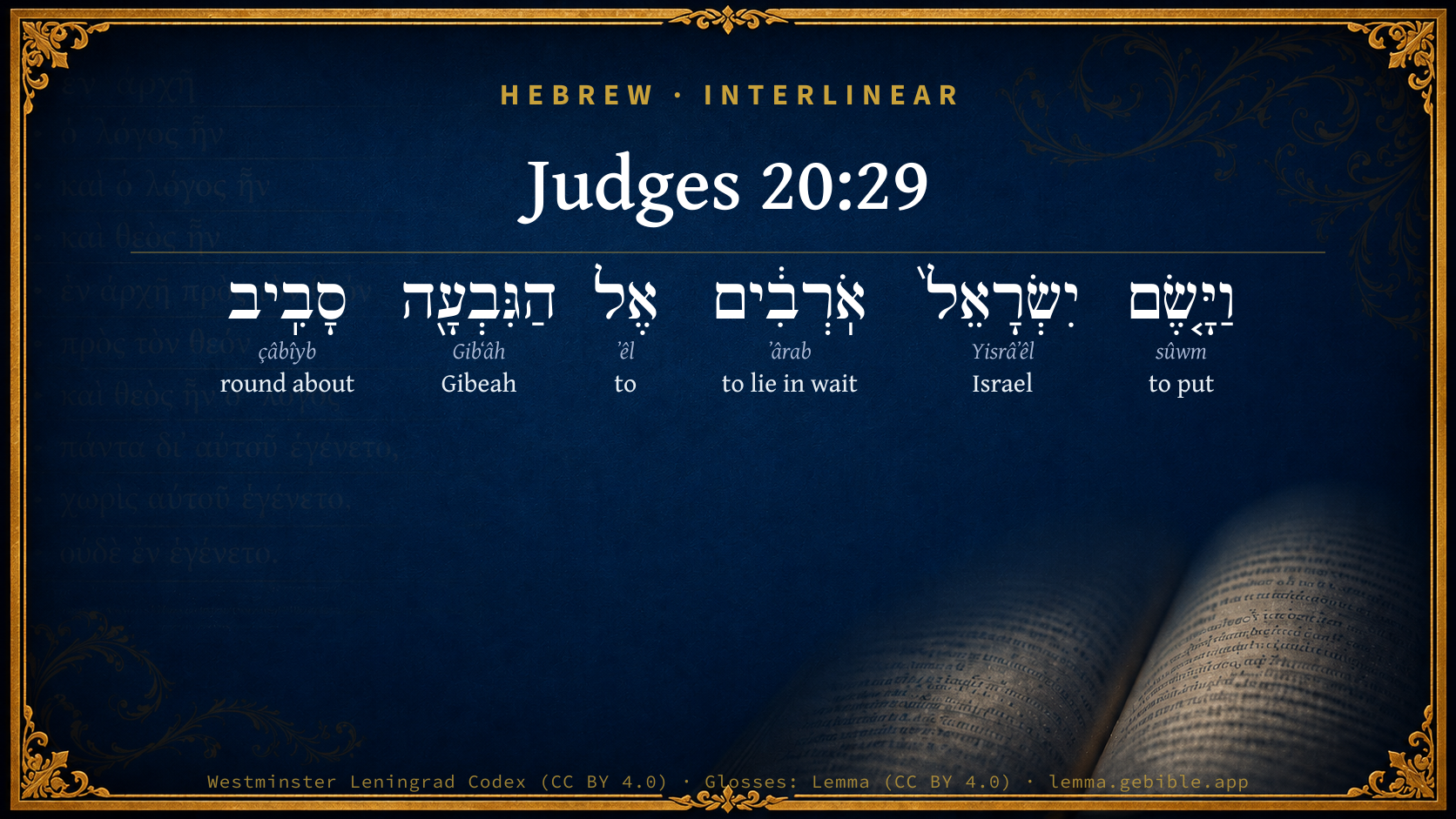
Judges 20:29

Hebrew (Westminster Leningrad Codex) Judges 20:29 appears in the Hebrew Old Testament. The text above is from the Westminster Leningrad Codex. Each word links to its Strong’s number, a concise gloss, and parsing drawn from the Open Scriptures Hebrew Bible morphology. Click any word for its full Brown-Driver-Briggs (BDB) entry.
Download image
Cite this verse

Judges 20:29 (World English Bible). Public Domain. Lemma interlinear Bible study tool, https://lemma.gebible.app/v/judges/20/29.

Show BibTeX & RIS
BibTeX
RIS
English Translation
Israel set liers-in-wait against Gibeah round about.
World English Bible · Public Domain
Download a study sheet

One document with this verse’s original text, its word-by-word gloss line, the meaning frame, cross-references with their text, attributed commentary, and full source and license credits — printable, and it pastes into notes with its structure intact.

This verse Autodidact and up

Study sheet (.html) Plain text (.txt)

A passage Seminary Student

Up to 50 verses in one chapter. A passage sheet keeps up to 6 commentary sources and 12 cross-references per verse, in the order this page ranks them, and says so on the sheet whenever that leaves anything out. Ask for a single verse and you get the Autodidact verse sheet above.

Everything on this page stays free to read, with no account — the sheet is a download of what is already on screen, not access to it.

Want to remove ads? Support Godless Engineer
Compare translations 3

The same verse in 3 English versions, stacked beneath the original-language interlinear above. Click any original word for its lexicon entry.

Each is an independent rendering of the whole verse — the interlinear is not word-aligned to these translations.

Highlighted words mark where these versions differ — a whole-verse word diff, not a word-by-word alignment.

  • World English Bible Public Domain
    Israel set liers-in-wait against Gibeah round about.
  • King James Version Public Domain
    And Israel set liers in wait round about Gibeah.
  • unfoldingWord Literal Text CC BY-SA 4.0
    So Israel set ambushers against Gibeah all around.

unfoldingWord Literal Text — © unfoldingWord, licensed CC BY-SA 4.0. Word-aligned USFM3 via Door43 (git.door43.org/unfoldingWord/en_ult).

Versions to compare (up to 4)

3 of 4 selected

Show all 18 translations

Every available English version of this verse, each an independent rendering of the whole verse.

  • World English Bible Public Domain
    Israel set liers-in-wait against Gibeah round about.
  • Berean Standard Bible Public Domain
    So Israel set up an ambush around Gibeah.
  • Majority Standard Bible Public Domain
    So Israel set up an ambush around Gibeah.
  • King James Version Public Domain
    And Israel set liers in wait round about Gibeah.
  • American Standard Version (1901) Public Domain
    And Israel set liers-in-wait against Gibeah round about.
  • Revised Version (1885) Public Domain
    And Israel set liers in wait against Gibeah round about.
  • Geneva Bible (1599) Public Domain
    And Israel set men to lie in waite round about Gibeah.
  • Douay-Rheims (1899) Public Domain
    And the children of Israel set ambushes round about the city of Gabaa:
  • Young's Literal Translation Public Domain
    And Israel setteth liers in wait against Gibeah, round about,
  • Literal Standard Version CC BY-SA 4.0
    And Israel sets ones lying in wait against Gibeah, all around,
  • Unlocked Literal Bible CC BY-SA 4.0
    So Israel set men in secret places around Gibeah.
  • unfoldingWord Literal Text CC BY-SA 4.0
    So Israel set ambushers against Gibeah all around.
  • Darby Bible Public Domain
    So Israel set men in ambush round about Gib'e-ah.
  • World Messianic Bible Public Domain
    Israel set ambushes all around Gibeah.
  • Webster's Bible Public Domain
    And Israel set liers in wait around Gibeah.
  • Free Bible Version CC BY-SA 4.0
    Then the Israelites set up an ambush around Gibeah.
  • Bible in Basic English Public Domain
    So Israel put men secretly all round Gibeah to make a surprise attack on it.
  • JPS Tanakh (1917) Public Domain
    And Israel set liers-in-wait against Gibeah round about.

Literal Standard Version (2020), Covenant Press — licensed CC BY-SA 4.0. Text via the HelloAO Bible API (eBible.org). Unlocked Literal Bible (unfoldingWord) — licensed CC BY-SA 4.0. Text via the HelloAO Bible API (eBible.org). unfoldingWord Literal Text — © unfoldingWord, licensed CC BY-SA 4.0. Word-aligned USFM3 via Door43 (git.door43.org/unfoldingWord/en_ult). Free Bible Version, Dr. Jonathan Gallagher — licensed CC BY-SA 4.0. Text via the HelloAO Bible API (eBible.org).

Word by word

More ways to search: Search by grammar → Find every occurrence → Compare this word →

Practice this passage: Drill this verse → Learn its vocabulary →

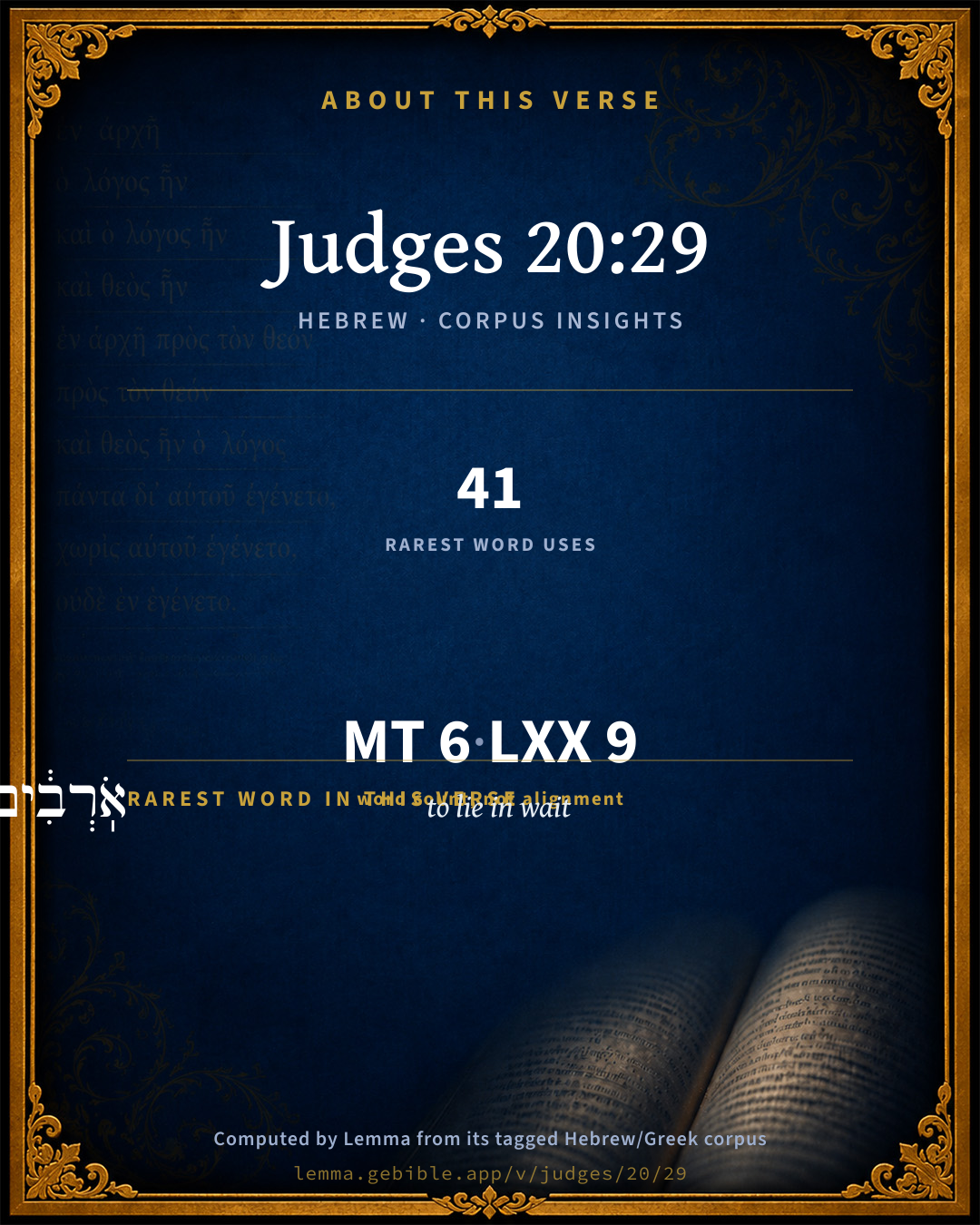
About this verse

These counts appear in no published source. They are computed here, from the morphology-tagged text and Lemma’s own curated glosses. What Lemma adds →

6
words
6
distinct lemmas
Historical
section

Shared distinctive vocabulary

אֹֽרְבִ֔ים to lie in wait H693 occurs in 39 verses of the Hebrew Bible. Also found in:

Grammatical profile

  • 2 verbs
  • 3 nouns
  • 1 preposition

Verb forms

  • וַיָּ֤שֶׂם Qal · Sequential Imperfect
  • אֹֽרְבִ֔ים Qal · Participle Active

Hebrew & Septuagint length

In English translation the verse runs 7 words from the Hebrew and 13 from the Septuagint (LXX English) — the Septuagint runs noticeably longer here. See the side-by-side →

A rough comparison of the two English renderings, which tokenize alike — not a word-level alignment.

Word counts can differ between the Hebrew and the Greek without any difference in meaning — e.g. the Hebrew direct-object marker אֵת has no separate Greek word, and Greek often adds the article ὁ.

In the original languages it is 6 Hebrew tokens and 9 Greek tokens — but the two are counted differently (Hebrew bundles its prefixes and suffixes into one token; the Greek is in lemma form), so that isn’t a like-for-like length.

Cross-references

3

Topical passages linked to Judges 20:29 in the Treasury of Scripture Knowledge — connected by theme and wording, ordered by reader-vote popularity; previews shown in the World English Bible.

  • Joshua 8:4 He commanded them, saying, Behold, you shall lie in ambush against the city, behind the city; don't go very far from the city, but be all ready:
  • 2 Samuel 5:23 When David inquired of Yahweh, he said, You shall not go up: make a circuit behind them, and come on them over against the mulberry trees.
  • Judges 20:34 There came over against Gibeah ten thousand chosen men out of all Israel, and the battle was sore; but they didn't know that evil was close on them.

Cross-references courtesy of OpenBible.info (CC BY 4.0).

Hebrew and Greek witnesses Masoretic Hebrew ↔ Greek Septuagint

The same verse in the two great witnesses to the Old Testament, shown verse-for-verse.

Here the Septuagint runs noticeably longer than the Hebrew — LXX2012 (modern English Septuagint) 13 words vs World English Bible 7. A rough length comparison of the two English translations, not a word-level alignment — read both below.

These are two independent witnesses, not word-aligned to each other, and the Septuagint is shown in lemma (dictionary) form.

Hebrew Judges 20:29 Masoretic · Westminster Leningrad Codex

וַיָּ֤שֶׂם יִשְׂרָאֵל֙ אֹֽרְבִ֔ים אֶל הַגִּבְעָ֖ה סָבִֽיב

Israel set liers-in-wait against Gibeah round about.

World English Bible · Public Domain

Greek LXX Judges 20:29 Septuagint · lemma form

καί τίθημι ὁ υἱός ἰσραήλ ἔνεδρον ὁ γαβαα κύκλος

And the children of Israel set an ambush against Gabaa round about it.

LXX2012 (modern English Septuagint) · Public Domain

On this verse, Keil & Delitzsch discusses the Septuagint’s reading. Read the note in Commentary ↓

Hebrew: Westminster Leningrad Codex (CC BY 4.0). Greek: Septuagint (public domain); English from LXX2012 (modern English Septuagint) (Public Domain). How the Septuagint differs from the Hebrew →

Targum (Aramaic paraphrase)

1

The Targum is the ancient Jewish Aramaic paraphrase of the Hebrew Scriptures — an interpretive translation, not the Hebrew text itself. Onkelos (literal) and Pseudo-Jonathan (expansive) render the Torah, and Jonathan the Prophets. Coverage is partial: where no permissively-licensed English translation exists for a verse, only the Aramaic is shown. This is verse-level text, not a word-by-word alignment to the Hebrew.

  1. Targum Jonathan Prophets (Joshua–Malachi)
    וְשַׁוִי יִשְׂרָאֵל כְּמָנִין עַל גִבְעֲתָא סְחוֹר סְחוֹר:

    (no public-domain English translation for this verse)

    Targum Jonathan — Aramaic: “Mikraot Gedolot” (public domain). English: “Sefaria Community Translation” (CC0 1.0 (public-domain dedication)); “London "Chaldee Paraphrase," 1871” (public domain). Text via Sefaria.

Commentary

Notes on Judges 20:29 from classic Christian and Jewish commentators (each source and its license shown beneath its notes). The classic Christian expositions comment on the surrounding passage and are grouped to its opening verse, so a note may address several verses; the Jewish commentaries on the Tanakh (Rashi and others) are per-verse, so they appear only where the commentator wrote on this verse.

Lemma curates 59 commentaries, every one of them public domain or Creative Commons licensed, each selected and text-cleaned for this edition rather than reprinted as found. About our sources →

Jamieson, Fausset & Brown

Robert Jamieson, A. R. Fausset & David Brown

THEY DESTROY ALL THE BENJAMITES, EXCEPT SIX HUNDRED. (Jdg. 20:29-48)

And Israel set liers-in-wait round about Gibeah--A plan was formed of taking that city by stratagem, similar to that employed in the capture of Ai [Jos 8:9].

Jamieson, Fausset & Brown — Commentary Critical and Explanatory on the Whole Bible (1871) — public domain (CC PDM 1.0). Text via the HelloAO Bible API.

Trapp's Complete Commentary

John Trapp

Jdg 20:29 And Israel set liers in wait round about Gibeah.

Ver. 29. And Israel set liers in wait.] See the like strategem used at Ai. {Jos 8:4-5}

John Trapp, A Commentary or Exposition upon All the Books of the Old and New Testament (1647–1656) — public domain. Text from a community e-Sword module.

Joseph Benson's Commentary

Jdg 20:29-30. Israel set liers in wait — Though they were assured of the success, by a particular promise, yet they did not neglect the use of means; as well knowing that the certainty of God’s promises doth not excuse, but rather require, man’s diligent use of all fit means for the accomplishment of them. The children of Israel — That is, a considerable part of them, who were ordered to make the first attack, and then to counterfeit flight, to draw the Benjamites forth from their strong hold. See Jdg 20:32.

Joseph Benson's Commentary on the Old and New Testaments (1811–1818) — public domain. Text from a community e-Sword module.

Keil & Delitzsch

C. F. Keil & F. Delitzsch

The Victory on the Third Day's Engagement. - Jdg 20:29. The account of this commences with the most important point, so far as their success was concerned: Israel set liers in wait (troops in ambush) round about Gibeah.

Jdg 20:30

They then advanced as on the former occasions.

Jdg 20:31-32

The Benjaminites came out again to meet the people (of Israel), and were drawn away from the town (the perfect הנתּקוּ without ו is subordinate to the preceding verb, and defines more precisely the advance itself, whilst the mode in which they were drawn away from the town is not described more fully till Jdg 20:32, Jdg 20:33), and began to smite the beaten of the people (who pretended to fly) as formerly upon the roads (where two roads part), of which one led up to Bethel and the other to Gibeah, into the field (Gibeah is the town at which the battle took place, that is to say, somewhere in the neighbourhood, so that a road might easily run from the field of battle towards the town into the field), "about (sc., putting to death) thirty men of Israel." This statement introduces the more precise definition of the חללים.

Jdg 20:32

Then the Benjaminites supposed that Israel was beaten by them as before; but the Israelites said: We will flee, and draw it (the tribe of Benjamin) away from the town to the roads (the high-roads mentioned in Jdg 20:31). On the Dagesh dirimens in נתקּוּהוּ, see Ewald, 92, c.

Jdg 20:33

Carrying out this plan, "all the men of Israel rose up from their places," i.e., left the place they had occupied, drew back, "and set themselves in battle array" in Baal-thamar, i.e., palm-place, which still existed, according to the Onom., in the time of Eusebius, as a small place in the neighbourhood of Gibeah, bearing the name of Bethamar. While this was going on, the ambush of Israel broke forth from its position "from the plains of Geba." The ἁπ. λεγ. מערה, from ערה to strip, denotes a naked region destitute of wood. גּבע is the masculine form for גּבעה, and ממּערה־גבע a more precise definition of ממּקומו. This rendering, which is the one given in the Targum, certainly appears the simplest explanation of a word that has been rendered in very different ways, and which the lxx left untranslated as a proper name, Μαρααγαβέ. The objection raised to this, viz., that a naked level country was not a place for an ambush, has no force, as there is no necessity to understand the words as signifying that the treeless country formed the actual hiding-place of the ambush; but the simple meaning is, that when the men broke from their hiding-place, they came from the treeless land towards the town. The rendering given by Rashi, Trem., and others, "on account of the tripping of Gibeah," is much less suitable, since, apart from the difficulty of taking מן in different senses so close together, we should at least expect to find העיר (the city) instead of גּבע.

Jdg 20:34

Through the advance of the ambush there came 10,000 picked men of all Israel "from opposite to Gibeah" (who now attacked in the rear the Benjaminites who were pursuing the flying army of Israel); "and the contest became severe, since they (the Benjaminites) did not know that the calamity was coming upon them."

Jdg 20:35

And Jehovah smote Benjamin before Israel (according to His promise in Jdg 20:28), so that the Israelites destroyed of Benjamin on that day twenty and five thousand and an hundred men (i.e., twenty-five thousand and upwards).

This was the result of the battle, which the historian gives at once, before entering more minutely into the actual account of the battle itself. He does this in Jdg 20:36-46 in a series of explanations, of which one is attached to the other, for the most part in the form of circumstantial clauses, so that it is not till Jdg 20:46 that he again comes to the result already announced in Jdg 20:35.

(Note: The opinions expressed by De Wette, etc. that Jdg 20:35 is spurious, and by Bertheau, that Jdg 20:36-46 contain a different account of the battle, simply prove that they have overlooked this peculiarity in the Hebrew mode of writing history, viz., that the generally result of any occurrence is given as early as possible, and then the details follow afterwards; whilst these critics have not succeeded in adducing even apparent differences in support of their opinions.)

Jdg 20:36-38

The Benjaminites, for instance, saw (this is the proper rendering of ויּראוּ with vav consec., which merely indicates the order of thought, not that of time) that they were beaten, and the man of Israel vacated the field before Benjamin (מקום נתן, to give place by falling back and flying), because they relied upon the ambush which they had placed against Gibeah. The Benjaminites did not perceive this till the ambush fell upon their rear. But the ambush itself, as is added in Jdg 20:37 by way of further explanation, hastened and fell (fell as quickly as possible) into Gibeah, and went thither and smote the whole town with the edge of the sword. To this there is added the further explanation in Jdg 20:38 : "And the arrangement of the Israelites with the ambush was this: multiply, to cause smoke-rising to ascend (i.e., cause a great cloud of smoke to ascend) out of the city." The only objection that can be raised to this view of הרב, as the imperative Hiphil of רבה, is the suffix ם-attached to להעלותם, since this is unsuitable to a direct address. This suffix can only be explained by supposing that there is an admixture of two constructions, the direct appeal, and the indirect explanation, that they were to cause to ascend. If this be not admitted, however, we can only follow Studer, and erase the suffix as an error of the pen occasioned by the following word משׂאת; for the other course suggested by Bertheau, namely that הרב should be struck out as a gloss, is precluded by the circumstance that there is no possible way of explaining the interpolation of so apparently unsuitable a word into the text. It certainly stood in the text used by the lxx, though they have most foolishly confounded הרב with חרב, and rendered it μάχαιρα.

Jdg 20:39-41

"And the men of Israel turned in the battle:" that is to say, as is afterwards more fully explained in Jdg 20:39, Jdg 20:40, in the form of a long new circumstantial clause, whilst Benjamin had begun to smite, etc. (repeated from Jdg 20:31, Jdg 20:32), and the cloud (המּשׂאת = העשׁן משׂאת, Jdg 20:38) had begun to ascend out of the city as a pillar of smoke, and Benjamin turned back, and behold the whole city ascended towards heaven (in smoke), Israel turned (fighting) and Benjamin was terrified, for it saw that misfortune had come upon it (see Jdg 20:34). In Jdg 20:41, the thread of the narrative, which was interrupted by the long circumstantial clause, is again resumed by the repetition of "and the men of Israel turned."

Jdg 20:42-43

The Benjaminites "now turned (flying) before the Israelites to the way of the desert," i.e., no doubt the desert which rises from Jericho to the mountains of Bethel (Jos 16:1). They fled therefore towards the north-east; but the battle had overtaken (reached or seized) them, and those out of the towns (had perished). The difficult expression מהערים ואשׁר, of which very different, and for the most part arbitrary, explanations have been given, can only be in apposition to the suffix attached to the verb: "Benjamin, and in fact those who had come to the help of Gibeah out of the towns of Benjamin" (see Jdg 20:14, Jdg 20:15), i.e., all the Benjaminites. The following words, וגו משׁחיתים, are a circumstantial clause explanatory of the previous clause, הדב המּלחמה: "since they (the men of Israel) destroyed him (Benjamin) in the midst of it." The singular suffix בּתוכו does not refer to Benjamin, as this would yield no sense at all, but to the preceding words, "the way of the desert" (see Jdg 20:45). - In Jdg 20:43 the account is continued by three perfects attached to one another without a copula: "they enclosed (hedged round) Benjamin, pursued him; at the place of rest they trod him down to before Gibeah eastwards." מנוּחה is not used adverbially in the sense of "quietly," which would not give any fitting meaning, but is an accus. loci, and signifies place of rest, as in Num 10:33. The notice "to before Gibeah" refers to all three verbs.

Jdg 20:44

In this battle there fell of Benjamin 18,000 men, all brave men. The את before כּל־אלּה is not a preposition, "with" (as the lxx, Cod. Al., and Bertheau render it), but a sign of the accusative. It serves to show that the thought which follows is governed by the principal clause, "so far as all these were concerned, they were brave men."

Jdg 20:45

The remainder fled to the desert, to the rock (of the place) Rimmon, which is described in the Onom. (s. v. Remmon) as a vicus fifteen Roman miles to the north of Jerusalem. It has been preserved in the village of Rummn, which stands upon and around the summit of a conical limestone mountain, and is visible in all directions (Rob. Pal. ii. p. 113). "And they (the Israelites) smote as a gleaning upon the roads 5000 men." עולל, to have a gleaning of the battle, i.e., to smite or slay, as it were, as a gleaning of the principal battle (vid., Jer 6:9). Mesilloth are the high-roads mentioned in Jdg 20:31. "And pursued them to Gideom, and smote of them 2000 more." The situation of Gideom, which is only met with here, is not precisely known; but it must have been somewhere between Gibeah and Rimmon, as the rock Rimmon, according to Jdg 20:47, afforded a safe place of refuge to the fugitives.

Jdg 20:46-47

On the total number of the slain, see the remarks on Jdg 20:15. - In Jdg 20:47 the statement already made in Jdg 20:45 with regard to the flight is resumed; and it is still further related, that 500 men reached the rock Rimmon, and dwelt there four months, i.e., till the occurrence described in Jdg 21:13.

Jdg 20:48

The Israelites turned (from any further pursuit of the fugitive warriors of Benjamin) to the children of Benjamin, i.e., to such of the people of the tribe of Benjamin as were unarmed and defenceless, and smote them with the edge of the sword, "from the town (or towns) onwards, men to cattle (i.e., men, women, children, and cattle), to every one who was found;" i.e., they cut down men and cattle without quarter, from the towns onwards even to those who were found elsewhere. כּל־הנּמצא עד (to all that was found) corresponds to מעיר (from the city), and עד־בּהמה מתם (men to beast) serves as a more precise definition of the עיר (city): everything that was in the city, man and beast. מתם is pointed wrongfully for מתם, men, the reading in several MSS and most of the early editions (see Deu 2:34; Deu 3:6). They also set fire to all the towns that were met with, i.e., all without exception. Thus they did the same to the Benjaminites as to the Canaanites who were put under the ban, carrying out the ban with the strictest severity.

Keil & Delitzsch — Biblical Commentary on the Old Testament (1861–1891) — public domain (CC PDM 1.0). Text via the HelloAO Bible API. (Old Testament only.)

Lange's Commentary on the Holy Scriptures

The men of Israel recommence hostilities. By feigned flight they draw the Benjamites away from Gibeah, which thereupon falls into their hands and is destroyed, together with nearly the whole tribe.

Jdg_20:29-48.

29And Israel set liers in wait round about Gibeah. 30And the children [sons] of Israel went up against the children [sons] of Benjamin on the third day, and put themselves in array against Gibeah, as at other times. 31And the children [sons] of Benjamin went out against the people, and were [thus] drawn away from the city; and they began to smite of the people, and kill,6 as at other times, in the highways, of which one goeth up to the house of God [Beth-el], and the other to Gibeah in the field, about thirty men of Israel. 32And the children [sons] of Benjamin said, They are smitten down [omit: down] before us, as at the first. But the children [sons] of Israel said, Let us flee, and draw them from the city unto the highways. 33And all the men of Israel rose up out of their place, and put themselves in array at Baal-tamar: and the liers in wait of Israel came forth [also] out of their places34[place], even out of the meadows [naked fields]7 of Gibeah. And there [they] came against8 Gibeah ten thousand chosen men out of all Israel, and the battle 35[there] was sore: but they [i. e. the Benjamites] knew not that evil was near them. And the Lord [Jehovah] smote Benjamin before Israel: and the children [sons] of Israel destroyed of the Benjamites that day twenty and five thousand and an hundred men: all these drew the sword.

36So [Now] the children [sons] of Benjamin saw that they [the sons of Israel] were smitten:9 for the men of Israel gave place to the Benjamites, because they trusted unto the liers in wait which they had set beside [against] Gibeah. 37And the liers in wait hasted, and rushed upon Gibeah; and the liers in wait drew themselves along,10 and smote all the city with the edge of the sword. 38Now there was [omit: there was] an [the] appointed sign between the men of Israel and the liers in wait [was], that they should make a great flame [cloud—lit. elevation, rising] with [of] 39smoke rise up11 out of the city. But when [omit: when] the men of Israel retired in the battle, [and] Benjamin began to smite and kill of the men of Israel about thirty persons: for they said, Surely they are smitten down [omit: down] 40before us, as in the first battle. And when the flame [cloud—cf. Jdg_20:38] began to arise up out of the city with [omit: with] a pillar of smoke, the Benjamites looked behind them, and behold, the flame [whole] of the city ascended up [in flames, or smoke] 41to heaven. And when [omit: when] the men of Israel turned again, [and] the men of Benjamin were amazed [confounded]: for they saw that evil was come upon them. 42Therefore they turned their backs before the men of Israel unto the way of the wilderness; but the battle overtook [or, pursued after] them; and them 43which came out of the cities they destroyed in the midst of them.12 Thus [omit: Thus] they [They] inclosed the Benjamites round about, and chased them, and trode them down with ease [at their place of rest,] over against [as far as before] Gibeah toward the sun-rising [on the east.]13 44And there fell of Benjamin eighteen thousand men; all these were men of valour. 45And they turned and fled toward the wilderness unto the rock of Rimmon: and they gleaned of them in the highways five thousand men; and pursued hard after them unto Gidom, and slew two thousand men [more] of them. 46So that all which fell that day of Benjamin were twenty and five thousand men that drew the sword; all these were men of valour. 47But six hundred men turned and fled to the wilderness unto the rock Rimmon, and abode in the rock Rimmon four months. 48And the men of Israel turned again upon [returned unto] the children [sons] of Benjamin, and smote them with the edge of the sword, as well the men of every city,14 as the beast [cattle], and all that came to hand [was found]: also they set on fire all the cities that they came to that were found].

TEXTUAL AND GRAMMATICAL

[1 Jdg_20:31.—וַיָּחֵלוּ לְהַכּוֹת מֵהָלָם חֲלָלִים: “and they began to smite of the people, slain;” i. e, they smote so that the smitten became slain. חֲלָלִים is the accusative of closer definition. Dr. Cassel takes it as nomi-native: “They began to smite, (so that,) as at the former times, slain of the people were [i.e., lay] on the highways, of which one,” etc. Similarly in ver 39.—Tr.]

[2 Jdg_20:33.—מַעֲרֶה. Dr. Cassel: Blösse, “nakedness”; cf. his remarks below. The Peshito read מְעָרָה, a cave; the LXX. in Cod. Alex., and the Vulgate, מַעֲרָכ, “from the west.” Fürst (in his Lexicon) defines מַעֲרֶה as “forest,” and derives it from a conjectural root עָרָה III., to sprout thickly, to which he also assigns the participle in Psa_37:35. Keil seeks to remove the difficulty of connecting the ambuscade with an open, treeless plain, by remarking that “the words of the text do not require us to suppose that the forestless region was the place of hiding, but may be so understood as to affirm that the ambuscade, having broken up from its hiding-place, advanced against the city from the forestless region.” But he has failed to notice that the participle מֵגִיתַ speaks precisely of the “breaking forth,” and leaves the idea of “advancing on the city” entirely unexpressed.—Tr.]

[3 Jdg_20:34.—וַיָּבֹאוּ מִנֶּגֶר לַגִּבְעָה: “from before Gibeah.” Dr. Cassel, like the E. V., has “against.” Bertheau says: “The ambuscade, consisting of ten thousand chosen men, came ‘from straight before’ Gibeah; whither they came, is not stated, but from the connection it appears that they attacked the Benjamites, who were fighting at some distance from the city, in the rear.” Keil adopts the same explanation. But it is manifest from Jdg_20:37-38, and especially Jdg_20:40-41, that Bertheau and Keil are wrong, and the E. V. and our author right.”—Tr.]

[4 Jdg_20:36.—וַיִּרִאוּ בְנֵי־בִנְיָמִן כִּי נִגָּפוּ. With this verse, a new and more detailed account of the conflict begins. So Bertheau, Keil, and Bunsen, as well as our author. To indicate this to the eye, we have introduced a new paragraph division into the text. Bertheau and Bunsen agree with our author that the subject of נִגָּפוּ is “the sons of Israel.” According to Keil, “the sons of Benjamin saw that they were smitten, and that the men of Israel only gave way before them because they depended on the ambuscade which they had laid against Gibeah. They became aware of this when the ambuscade fell on their rear.” But this is inconsistent with Jdg_20:37, and certainly with Jdg_20:40. Jdg_20:36 is a restatement of Jdg_20:32, introductory to the detailed account that now follows.—Tr.]

[5 Jdg_20:37.—וַיִּמְשֹׁדְ. Dr. Cassel translates: “and the ambuscade overpowered and smote the whole city;” and adds in a foot-note: “In the sense of Job_24:22 : מָשַׁדְ אַבִּירִים בְּכֹחוּ”. But there the word probably means “to hold fast, to preserve,” cf. Delitzsch in locum. It seems better to take it here in the sense “to march, advance,” cf. Jdg_4:6.—Tr.]

[6 Jdg_20:38.—הֶרֶב לְהַעֲלוֹתָם. The first of these words being taken as the apocopated hiphil imperative, a mixture of the direct with the indirect address arises from the suffix of the third person in the second word. Dr. Cassel avoids this by declaring הֶרֶכ to be an apocopated infinitive (see below); but it is better to admit the existence of a grammatical inaccuracy.—Tr.]

[7 Jdg_20:42.—וַאֲשֶׁר מֵהֶעָרִים מַשְׁחִיתִים אוֹתוֹ בְּתוֹכוֹ. Dr. Cassel translates: “and they of the cities (through which Benjamin came) destroyed them in the midst of them.” Compare the exegetical remarks. Keil: “The words וַאשֶׁר מהֶעִרים can only be an appositional explanation of the suffix in הִרְכִּיקַתְהוּ, in the sense: Benjamin, namely, they who out of the cities of Benjamin had came to the aid of Gibeah (cf. Jdg_20:14 f), i.e., all Benjamites The following מַשְׁחִיתּים ויו is a circumstantial clause illustrative of the preceding דֶרֶךְ הַמִּדְבָּר: ‘in that they (the men of Israel) destroyed him (Benjamin) in the midst of it.’ The singular suffix in בִתוֹכוֹ, refers not to Benjamin—for that yields no tolerable sense—but to the preceding דֶרֶךְ הַמִּדְבָּר: ‘in the midst of the way to the desert.’ ”

[8 Jdg_20:43.—This verse continues the description begun in Jdg_20:42, by means of an animated constructio asyndeta. כִּתְּרוּ אֶת־בִּנְיָמן, they surrounded Benjamin (by throwing out bodies of men on his flanks); הּרְדִיפֻהוּ, pursued after him; מְנוּחָה הִדְרִיכֻהוּ, fell upon and trode him down at his resting-place (that is, when, exhausted, he halted to take breath—מנוּחָה, accusative of place); and this pursuit and slaughter continued until the pursuers, who started from some distance north of Gibeah (Jdg_20:31), had come south “as far as before Gibeah on its eastern side.” There the remnant of the pursued found means to turn northward again, Jdg_20:45; and were again pursued as far as Gidom (a place evidently somewhere between east of Gibeah and Rimmon). Compare our author’s remarks below, which, however, indicate a slightly different conception on some points.—Tr.]

[9 Jdg_20:48.—מֵעִיר מְתֹם. Dr. Cassel renders: “everything of the city, to the cattle and whatever else was found;” and adds the following note: “Many MSS., and the more recent expositors, point מְתִם, men, and yet it cannot be said that with בְּהֵמָה, this forms an altogether suitable antithesis, inasmuch as it still fails to express the idea that everything was put under the ban of destruction. The pointing מְתֹם finds support in Jos_8:24; Jos_10:20, where similar instructions עַר־תֻּמָּם are spoken of.”—Tr.]

EXEGETICAL AND DOCTRINAL

Jdg_20:29 ff. From the determined purpose of the ten tribes to prosecute the war, Benjamin should have taken occasion to yield. Since Israel continued firm, notwithstanding severe losses, it might have concluded that it was impossible to resist permanently. It might also have observed that another spirit animated this second war, and that Israel had become thoroughly in earnest to complete the work it had taken in hand. Another interval of time had manifestly passed by. After the dissolution of the first army, Israel had to levy a new one (illustrative examples of this may be found in the North American Union war). Accordingly, the first engagements are spoken of together, as the “former” or the “first” war (Jdg_20:32; Jdg_20:39). The tribes of Israel now first conclude to use strategic arts. This circumstance incidentally affords data which enable us to obtain a somewhat clearer idea of the theatre of the war. Gibeah lay high; the attack of the Israelites came from the direction of Bethel, i.e., from the Northwest. Two highways are mentioned, along which the sons of Benjamin advanced to meet the assailants—one leading to Bethel, the other to “Gibeah-in-the-Field” (a Lower, or Field-Gibeah in contrast with the Higher, or Mountain-Gibeah). The Israelites allure the Benjamites, rendered unwary by former successes, farther and farther away from the heights and the city. It is expressly said that Benjamin went out “to meet them” (לִקְרַאת, Jdg_20:31). They offer scarcely any resistance, but retreat, constantly followed by Benjamin, who already sees the triumphs of the first two battle days reenacted (Jdg_20:32). Not until they have reached Baal Tamar,15 doubtless at a suitable distance from Gibeah, do they halt, and wait for the prearranged signal from other divisions who lay in ambush, and who were to attack the city as soon as the Benjamites should leave it. The place from which the city is thus suddenly attacked, is called מערה־גכע (Jdg_20:33). The Masora has pointed מַעֲרֵה, evidently deriving the word from עָרָה, to be naked, and intending to express by it, as Raschi also explains, the “nakedness” of Gibeah, i.e., its accessible part. The Targum renders it by מֵישַׁר; the same term by which it constantly renders עֲרָכָה, so that possibly it may have read מֵעֲרָבָה.16 It might then be understood of the point where the hill slopes down to the plain, and thus becomes more accessible. The simplest way would be to point so as to read מְעָרָה, a cave, as the Septuagint also seems to do: Μααραγέβα (instead of Μαρααγεβέ). North of the present Jeba, with which our Gibeah is held to be identical, runs the Wady es-Suweinît. It comes from Beitîn and el-Bîreh, to the Northwest, and, after passing Jeba, runs between high precipices, in one of which is a large cavern called Jâihah (Rob. i. 441).

Jdg_20:34-35. And they came against Gibeah, ten thousand men. We now first learn the numerical strength of the ambuscade, the placing of which was stated in Jdg_20:29. It is scarcely necessary to point out that we have here another fact going to show the improbability of a besieging army of 400,000, who could have surrounded the whole of Gibeah on all sides. Verses 34 and 35, while telling about the ambuscade, take occasion briefly to indicate the result of the whole war, according to what, as Keil justly observes, is a characteristic practice of Hebrew historiography. This is followed, Jdg_20:36 ff., by the more detailed account derived from ancient notes. Nor is there any discrepancy between Jdg_20:35, which states that there fell 25,100 men of Benjamin, and Jdg_20:46, which gives the number at 25,000. The latter is only the sum total of the three round numbers of Jdg_20:44-45, namely, 18,000 + 5,000 + 2,000; and the great fidelity of the report shows itself in the fact that since the hundred over 25,000 is not divided between the round sums, it is also not included in the sum total, although according to Jdg_20:35 its inclusion was only a matter of course. The artifice employed by the Israelites against the Benjamites, was in a different way also used against Shechem by Abimelech. Similar stratagems, practiced by Scipio, Hannibal, and others, are collected by Frontinus (Stratagematicon, lib. iii. cap. 10). Scipio besieged a city in Sardinia, feigned to take to flight before the besieged, and when they thoughtlessly followed him, per eos, quos in proximo occultaverat, oppidum invasit.

Jdg_20:36. For the sons of Benjamin had thought that they were smitten. The “they” of this sentence refers to the Israelites, as appears from the succeeding words. The verse is a recapitulation of verse 32, and is therefore to be rendered by the pluperfect: “they had seen or thought.” They actually had seen, that the sons of Israel allowed themselves to be smitten.

Jdg_20:38. And the appointed sign between the men of Israel and the liers in wait was, that they should cause a great cloud of smoke to rise up out of the city. The form הֶרֶב (הֶרב לְהַעֲלוֹתָם) is explained by the phrase כַבְּסֵנִי הַרִבֵּה, Psa_51:4, where the keri has הֶרֶכ. For not the imperative only, but precisely the infinitive, which forms it (both הַרְכֵּה), is also apocopated into הֶרֶכ, and takes in consequence the adverbial signification, “strongly,” “very,” “fully.” The word is quite essential to the full understanding of the sentence. The men of the ambuscade are to cause a great pillar of smoke, like that of a burning city, to ascend, such as could not fail to be visible at a distance, and could not be mistaken. Bertheau must have overlooked this, when he proposed to remove the word out of the text.17

Jdg_20:42 ff.. And the inhabitants of the cities destroyed them in the midst of them. The men of Benjamin fled; and in flight passed through the cities that lay in their course. Thereupon the inhabitants of these cities also arise, and slay the fugitives in their midst. The same thing occurs in all wars, when disorganized, fugitive troops must pass through the enemy’s land.18 Other explanations, such as have been given from time immemorial, do not appear to harmonize with the connection and the language. The clause cannot refer to those who burned the city; for how could they be called “אֲשֶׁר מֵהֶעָרִים”? Equally incomprehensible is the reason for using this expression, and the בְּתוִכוֹ connected with it, if Bertheau’s explanation, which Keil has mostly followed, be adopted; for the pursuit and inclosure are first delineated in Jdg_20:43. The explanation of Le Clerc appears to me to come nearest the sense: Cum confugerunt Benjaminitœad urbes aliorum Israelitarum, ab iis occidebantur. Only, this must not be understood of a systematic application for refuge on the part of the Benjamites; but of the natural phenomenon that against a pursued and smitten foe everything rises up. The narrator evidently points in this way to the embittered feelings against Benjamin which everywhere prevailed. In proportion to Benjamin’s former overbearing haughtiness, is his present experience of misery. Not only is the hostile army continually at his heels, but he meets with enemies everywhere. Only the wilderness, which he endeavors to reach by fleeing in an eastern and northeastern direction toward the Jordan, promises safety. But before he arrives there, divisions of his men are cut off and surrounded (כִּתְּרוּ, Jdg_20:43). The pursuit is unceasing (this is the sense of הִרְוִיפֻהוּ מְנוּחָה, “they chase his rest,” hence probably the hiphil), he scarcely thinks to be able to take breath for a moment, before they are behind him again: in this way he is driven until he finds himself within the limits of the wilderness east of Gibeah. Finally, still pursued as far as an unknown place called Gidom, a remnant of his shattered hosts finds an asylum in the rock Rimmon, northeast of Gibeah and below Ophra, for the modern Rummôn, lying high, on a rocky Tell, on the north side of the great Wady el-’Asas, is held to be the rock Rimmon of our narrative (Rob. iii. 290; ii. 440).

Six hundred men of the whole tribe saved themselves on that rock. All the rest fell slain by the hands of brethren. They owed their safety to the eagerness of their pursuers to turn back, and destroy everything belonging to Benjamin, cities, houses, and herds. The cities are put under the ban and burned, like Jericho and other cities of the enemy. The Israelites are even more severe in their treatment of Benjamin, than the Pythia was toward the hostile Crissa, which was to be “warred on by day and by night and be made desolate, and whose inhabitants were to become slaves.” But grief and regret did not fail to come.

Footnotes:

[6][Jdg_20:31.—וַיָּחֵלוּ לְהַכּוֹת מֵהָלָם חֲלָלִים: “and they began to smite of the people, slain;” i. e, they smote so that the smitten became slain. חֲלָלִים is the accusative of closer definition. Dr. Cassel takes it as nomi-native: “They began to smite, (so that,) as at the former times, slain of the people were [i.e., lay] on the highways, of which one,” etc. Similarly in ver 39.—Tr.]

[7][Jdg_20:33.—מַעֲרֶה. Dr. Cassel: Blösse, “nakedness”; cf. his remarks below. The Peshito read מְעָרָה, a cave; the LXX. in Cod. Alex., and the Vulgate, מַעֲרָכ, “from the west.” Fürst (in his Lexicon) defines מַעֲרֶה as “forest,” and derives it from a conjectural root עָרָה III., to sprout thickly, to which he also assigns the participle in Psa_37:35. Keil seeks to remove the difficulty of connecting the ambuscade with an open, treeless plain, by remarking that “the words of the text do not require us to suppose that the forestless region was the place of hiding, but may be so understood as to affirm that the ambuscade, having broken up from its hiding-place, advanced against the city from the forestless region.” But he has failed to notice that the participle מֵגִיתַ speaks precisely of the “breaking forth,” and leaves the idea of “advancing on the city” entirely unexpressed.—Tr.]

[8][Jdg_20:34.—וַיָּבֹאוּ מִנֶּגֶר לַגִּבְעָה: “from before Gibeah.” Dr. Cassel, like the E. V., has “against.” Bertheau says: “The ambuscade, consisting of ten thousand chosen men, came ‘from straight before’ Gibeah; whither they came, is not stated, but from the connection it appears that they attacked the Benjamites, who were fighting at some distance from the city, in the rear.” Keil adopts the same explanation. But it is manifest from Jdg_20:37-38, and especially Jdg_20:40-41, that Bertheau and Keil are wrong, and the E. V. and our author right.”—Tr.]

[9][Jdg_20:36.—וַיִּרִאוּ בְנֵי־בִנְיָמִן כִּי נִגָּפוּ. With this verse, a new and more detailed account of the conflict begins. So Bertheau, Keil, and Bunsen, as well as our author. To indicate this to the eye, we have introduced a new paragraph division into the text. Bertheau and Bunsen agree with our author that the subject of נִגָּפוּ is “the sons of Israel.” According to Keil, “the sons of Benjamin saw that they were smitten, and that the men of Israel only gave way before them because they depended on the ambuscade which they had laid against Gibeah. They became aware of this when the ambuscade fell on their rear.” But this is inconsistent with Jdg_20:37, and certainly with Jdg_20:40. Jdg_20:36 is a restatement of Jdg_20:32, introductory to the detailed account that now follows.—Tr.]

[10][Jdg_20:37.—וַיִּמְשֹׁדְ. Dr. Cassel translates: “and the ambuscade overpowered and smote the whole city;” and adds in a foot-note: “In the sense of Job_24:22 : מָשַׁדְ אַבִּירִים בְּכֹחוּ”. But there the word probably means “to hold fast, to preserve,” cf. Delitzsch in locum. It seems better to take it here in the sense “to march, advance,” cf. Jdg_4:6.—Tr.]

[11][Jdg_20:38.—הֶרֶב לְהַעֲלוֹתָם. The first of these words being taken as the apocopated hiphil imperative, a mixture of the direct with the indirect address arises from the suffix of the third person in the second word. Dr. Cassel avoids this by declaring הֶרֶכ to be an apocopated infinitive (see below); but it is better to admit the existence of a grammatical inaccuracy.—Tr.]

[12][Jdg_20:42.—וַאֲשֶׁר מֵהֶעָרִים מַשְׁחִיתִים אוֹתוֹ בְּתוֹכוֹ. Dr. Cassel translates: “and they of the cities (through which Benjamin came) destroyed them in the midst of them.” Compare the exegetical remarks. Keil: “The words וַאשֶׁר מהֶעִרים can only be an appositional explanation of the suffix in הִרְכִּיקַתְהוּ, in the sense: Benjamin, namely, they who out of the cities of Benjamin had came to the aid of Gibeah (cf. Jdg_20:14 f), i.e., all Benjamites The following מַשְׁחִיתּים ויו is a circumstantial clause illustrative of the preceding דֶרֶךְ הַמִּדְבָּר: ‘in that they (the men of Israel) destroyed him (Benjamin) in the midst of it.’ The singular suffix in בִתוֹכוֹ, refers not to Benjamin—for that yields no tolerable sense—but to the preceding דֶרֶךְ הַמִּדְבָּר: ‘in the midst of the way to the desert.’ ”

[13][Jdg_20:43.—This verse continues the description begun in Jdg_20:42, by means of an animated constructio asyndeta. כִּתְּרוּ אֶת־בִּנְיָמן, they surrounded Benjamin (by throwing out bodies of men on his flanks); הּרְדִיפֻהוּ, pursued after him; מְנוּחָה הִדְרִיכֻהוּ, fell upon and trode him down at his resting-place (that is, when, exhausted, he halted to take breath—מנוּחָה, accusative of place); and this pursuit and slaughter continued until the pursuers, who started from some distance north of Gibeah (Jdg_20:31), had come south “as far as before Gibeah on its eastern side.” There the remnant of the pursued found means to turn northward again, Jdg_20:45; and were again pursued as far as Gidom (a place evidently somewhere between east of Gibeah and Rimmon). Compare our author’s remarks below, which, however, indicate a slightly different conception on some points.—Tr.]

[14][Jdg_20:48.—מֵעִיר מְתֹם. Dr. Cassel renders: “everything of the city, to the cattle and whatever else was found;” and adds the following note: “Many MSS., and the more recent expositors, point מְתִם, men, and yet it cannot be said that with בְּהֵמָה, this forms an altogether suitable antithesis, inasmuch as it still fails to express the idea that everything was put under the ban of destruction. The pointing מְתֹם finds support in Jos_8:24; Jos_10:20, where similar instructions עַר־תֻּמָּם are spoken of.”—Tr.]

[15]Movers (phönizier, i. 661) proposes to explain this name of a place by means of the Phœnician Tamyrus, Zeus Demarus. Raschi, on the other hand, connected it with the district of Jericho.

[16]This is supported by the Syriac-Hexaplar version of Paul of Tella, which has מן מערכא, which gives us a gendering of ἀπὸ δυσμῶν (Rördam, p. 179).

[17]On the very ancient false reading חֶרֶכ, found in some Hebrew MSS. and in the LXX., cf. Keil. Paul of Tella has given a similar rendering in his Syriac version (Rördam, p. 180).

[18][But on this occasion the fugitives do not pass through the enemy’s land. From first to last, whether fighting or fleeing, Benjamin moves on his own soil within his own boundaries; and this fact makes our author’s explanation of the last clause of Jdg_20:42 impossible. Cf. note 7 under “Textual and Grammatical.”—Tr.]

Lange's Commentary on the Holy Scriptures (Critical, Doctrinal, and Homiletical), ed. John Peter Lange, English translation edited by Philip Schaff (1864–1880) — public domain. Text from a community e-Sword module.

Adam Clarke's Commentary

Verse 29. Israel set liers in wait] Though God had promised them success, they knew they could expect it only in the use of the proper means. They used all prudent precaution, and employed all their military skill.

Adam Clarke's Commentary on the Bible (1810–1826) — public domain. Text from a community e-Sword/MySword module.

Ellicott's Commentary for English Readers

(29) Set liers in wait.—This exceedingly simple and primitive stratagem had also been successful against Ai (Jos_8:4) and against Shechem (Jdg_9:43). Here, as in Jdg_20:22-23, the narrative follows a loose-order, the general fact being sometimes stated by anticipation, and the details subsequently filled in.

A Bible Commentary for English Readers, edited by Charles John Ellicott (1878–1897) — public domain. Text from a community e-Sword module.

The Cambridge Bible for Schools and Colleges

gen. ed. J. J. S. Perowne

29. From the narrative A, which describes, not the two battles and Jehovah’s direct interference (Jdg_20:23; Jdg_20:28; Jdg_20:35), but the stratagem by which the Israelites captured the city; cf. Jos_8:4-8 JE. This v. continues Jdg_20:19.

liers in wait] Plural, while Jdg_20:33; Jdg_20:36-38 use the sing. collect., the ambush. The plural may refer to the various parties posted round about the city.

The Cambridge Bible for Schools and Colleges (gen. ed. J. J. S. Perowne; Cambridge University Press, 1878–1918) — public domain. Text from a community e-Sword module.

John Gill's Exposition

And the children of Israel went up against the children of Benjamin on the third day,.... Not the day following the second battle, since it would take more time to go to Shiloh, and fast and offer sacrifices there, but on the third day from the second battle:

and put themselves in array against Gibeah, as at other times; as they had done on the first and second days of battle.

John Gill's Exposition of the Whole Bible (1746–1763) — public domain (CC PDM 1.0). Text via the HelloAO Bible API.

Albert Barnes' Notes on the Bible

The stratagem described is exactly that by which Joshua took Ai (marginal reference).

Albert Barnes' Notes on the Bible (1834–1885) — public domain. Text from a community e-Sword/MySword module.

Matthew Poole's English Annotations

Though they were assured of the success by a particular and absolute promise, yet they do not neglect the use of means; as well knowing that the certainty of God’s purposes or promises doth not excuse, but rather require man’s diligent use of all fit means for the accomplishment of them.

Round about Gibeah, i.e. on several sides of it, as may be gathered from the following verses.

Matthew Poole's English Annotations on the Holy Bible (1683–1685) — public domain. Text from a community e-Sword/MySword module.

Whedon's Commentary on the Bible

Daniel D. Whedon

29. Liers in wait — Armed warriors in ambush. They probably went out under cover of the night, and concealed themselves in the meadows around Gibeah. Jdg_20:33.

Daniel D. Whedon (gen. ed.), Commentary on the Old and New Testaments (1874–1909) — public domain. Text from a community e-Sword module.

The Pulpit Commentary

Set liers in wait. Made wiser by misfortune, they now act cautiously.

The Pulpit Commentary (1880–1919), ed. H.D.M. Spence-Jones & Joseph S. Exell — public domain. Text from a community e-Sword module.

John Wesley's Explanatory Notes

Liers in wait - Though they were assured of the success, by a particular promise, yet they do not neglect the use of means; as well knowing that the certainty of God's promises doth not excuse, but rather require man's diligent use of all fit means for the accomplishment of them.

John Wesley, Explanatory Notes Upon the Whole Bible (1754–1765) — public domain. Text via the GEBible commentary corpus.

Kretzmann's Popular Commentary

Paul E. Kretzmann

The Benjamites Defeated and Almost Exterminated

v. 29. And Israel set liers-in-wait round about Gibeah; they no longer relied upon superior force, but made use of strategic arts in placing various details of soldiers in ambush.

v. 30. And the children of Israel went up against the children of Benjamin on the third day, moving forward to attack the city, and put themselves in array against Gibeah as at other times.

v. 31. And the children of Benjamin, in total ignorance of the ambush in their rear, went out against the people, and were drawn away, torn away, severed, from the city; and they began to smite of the people and kill, to wound, disable, and slay, as at other times, in the highways, at the intersection of two roads, of which one goeth up to the house of God, to Bethel, and the other to Gibeah in the field, to the fields near the city, about thirty men of Israel.

v. 32. And the children of Benjamin said, They are smitten down before us, as at the first. But the children of Israel, relying upon their ambuscade, said, Let us flee, and draw them from the city unto the highways, as just related.

v. 33. And all the men of Israel rose up out of their place, they relinquished their advanced position, and put themselves in array, forming a new line of battle, at Baal-tamar (place of palms); and the liers-in-wait of Israel came forth out of their places, even out of the meadows of Gibeah, a slope near the city denuded of forest growth, but probably covered with bushes which offered sufficient shelter to the men in ambush.

v. 34. And there came against Gibeah ten thousand chosen men out of all Israel, that being the sum total of the men who had been placed in ambush, and the battle was sore; but they, the Benjamites, knew not that evil was near them, that misfortune had overtaken them.

v. 35. And the Lord smote Benjamin before Israel, this fact being brought out here with great emphasis; and the children of Israel destroyed of the Benjamites that day twenty and five thousand and an hundred men; all these drew the sword.

v. 36. So the children of Benjamin saw that they were smitten, they had thought, when they rushed forward to attack the invading army that the Israelites were once more overcome; for the men of Israel gave place to the Benjamites, because they trusted unto the liers-in-wait, which they had set beside Gibeah.

v. 37. And the liers-in-wait hasted and rushed upon Gibeah, all these details being added here in a description of the battle; and the liers-in-wait drew themselves along, they moved forward steadily, and smote all the city with the edge of the sword.

v. 38. Now there was an appointed sign, one which both the attacking party and the ambush had agreed upon, between the men of Israel and the liers-in-wait, that they should make a great flame with smoke, a mighty pillar which could not be overlooked, rise up out of the city.

v. 39. And when the men of Israel retired in the battle, Benjamin began to smite and kill of the men of Israel about thirty persons, as related above,

v. 31. for they said, Surely they are smitten down before us as in the first battle.

v. 40. But when the flame began to arise up out of the city with a pillar of smoke, the whole city, apparently, going up in smoke, the Benjamites looked behind them, and, behold, the flame of the city ascended up to heaven, literally, "there went up the whole of the city heavenward. "

v. 41. And when the men of Israel turned again, making a sudden firm stand after their apparent flight, the men of Benjamin were amazed, filled with terror; for they saw that evil was come upon them.

v. 42. Therefore they turned their backs before the men of Israel unto the way of the wilderness, trying to escape toward the northeast; but the battle overtook them; and them which came out of the cities they destroyed in the midst of them, literally, "and they out of the cities destroyed them in their midst," that is, wherever the fugitives came, the inhabitants of the cities fell upon them and slew them, for the feeling again et Benjamin was bitter everywhere.

v. 43. Thus they inclosed the Benjamites round about, completely surrounding them, and chased them, and trode them down with ease, or, from Menuchah, over against Gibeah toward the sun-rising.

v. 44. And there fell of Benjamin, in this part of the battle, eighteen thousand men; all these were men of valor.

v. 45. And they turned, trying to escape in another direction, and fled toward the wilderness unto the rock of Rimmon, about fifteen miles north of Jerusalem; and they, the Israelites, gleaned of them, killed in this running skirmish after the main battle, in the highways five thousand men; and pursued hard after them unto Gidom, in the direction toward Rimmon, and slew two thousand men of them.

v. 46. So that all which fell that day of Benjamin were twenty and five thousand men that drew the sword; all these were men of valor. This is a round number, the exact number included one hundred men more,

v. 35. In addition, there were evidently a thousand men who had fallen in the first battles, making the total of the slain Benjamites twenty-six thousand and one hundred.

v. 47. But six hundred men turned and tied to the wilderness unto the rock Rimmon, they effected their escape and fortified themselves in the fastnesses of this rocky wilderness, and abode in the rock Rimmon four months.

v. 48. And the men of Israel, in a fury which knew no mercy, turned again upon the children of Benjamin, on the defenseless part of the population, old people, women, and children, and smote them with the edge of the sword, as well the men of every city as the beast, and all that came to hand, whatever living thing they happened to strike; also they set on fire all the cities that they came to. It was a campaign of extermination much more savage than any undertaken against any of the heathen nations. But it was the punishment of God upon the tribe which had taken the part of the criminals of Gibeah; for the holiness of God cannot bear the abominations of the heathen in the midst of His people. All those who know His command and truth, and still persist in doing according to the manner of the heathen, should be excluded from the company of the believers, eventually to be punished by the wrath of Him who is a jealous God.

Paul E. Kretzmann, Popular Commentary of the Bible (1921–1924) — public domain. Text from a community e-Sword module.

unfoldingWord translationNotes

Door43 World Missions Community

Israel set men

Here "Israel" refers to the people of Israel. AT: "the Israelites" (See: Metonymy)

secret places

"in ambush"

translationWords

Israel

Gibeah

Benjamin

unfoldingWord translationNotes — © Distant Shores Media and the Door43 World Missions Community, licensed CC BY-SA 4.0. Source: git.door43.org/Door43/en_tn.

Lesson kit

Teaching starters — assembled from the data on this page, not authored interpretation. Every prompt links to the verse data it draws on. Edit before teaching.

Judges, in the Historical, opens this verse with 6 words (6 distinct Hebrew lemmas). Its most distinctive word is ʼârab (“to lie in wait”). The Greek Septuagint runs longer here. A historical commentator’s framing appears above. Read the whole chapter for the surrounding context.

Discussion questions

  1. What does “to lie in wait” (ʼârab) contribute to the verse as a whole?
  2. How does Deuteronomy 19:11, which shares the word «to lie in wait», read alongside this verse?
  3. The Septuagint runs longer here than the Hebrew. What might account for the difference?
  4. These translations render this verse differently. What is at stake in choosing one wording over another?
  5. «וַיָּ֤שֶׂם» is a Qal Sequential Imperfect verb. How does that grammatical form shape the action described?
  6. Compare how Jamieson, Fausset & Brown and Trapp's Complete Commentary read this verse. Where do they agree or differ?

Things to notice

Reading settings

Reading text

Shown beneath each verse's original-language words.

Old Testament
Old Testament edition

Read the OT as the Masoretic Hebrew (MT) or the Greek Septuagint (LXX).

English shown for the Greek Septuagint (in the Hebrew ↔ Greek comparison).

Comparing translations? Open the Compare panel on any verse page to stack up to four side by side.